
Our readers keep the lights on and my morning glass full of iced black tea. As an Amazon Associate, I earn from qualifying purchases.
Specs are compiled from manufacturer listings and verified buyer reviews and can change over time — please confirm the key details on the product page before buying.
If your shop air turns hazy an hour into a sanding session, you do not need a bigger dust collector — you need a hanging air filter that pulls the fine particles your bag misses. The picks below are all built for wood shops, garages, and basement workshops, and each one is matched to the size of space it can actually keep clear.
I’m Min — the founder and writer behind Gadgets Feed. This guide is built by comparing the manufacturers’ published specifications and the patterns across verified customer reviews, so you get each pick’s real strengths and trade-offs instead of marketing spin.
Airflow, filter rating, and noise are the three numbers that decide whether a unit disappears into your background or drives you out of the shop. The right air filtration system for wood shop is the one sized to your square footage and mounted where the dust actually hangs.
Our Picks at a Glance


How To Choose The Best Air Filtration System For Wood Shop
A shop air filter is not a dust collector. A collector grabs chips at the tool; an air filtration system scrubs the fine airborne dust that floats through your whole shop and settles on every surface. Buying the wrong size is the single most common mistake — a unit too small for your space runs constantly and never quite clears the haze.
Match CFM To Your Shop’s Square Footage
CFM stands for cubic feet per minute — the volume of air the unit moves in one minute. More CFM clears a bigger room faster, but it also costs more and often runs louder. Shops up around 500 square feet do well with a mid-range unit, while a large two-car garage or open workshop wants something in the thousand-CFM range. Every unit here lists the square footage it covers, so use that number as your starting filter.
Understand Your Filter Rating Before You Buy
Filter ratings tell you the smallest particle the unit traps. A micron is one-millionth of a meter — for reference, fine wood dust and drywall dust sit in the range your eyes cannot see but your lungs can. A 1-micron inner filter catches the fine stuff, a 5-micron pre-filter catches the bigger particles first and protects the inner filter, and a 0.1-micron electrostatic filter reaches down to the finest particles of all. MERV is a separate scale that rates overall filtration; a higher MERV number traps more.
Check The Decibel Rating For A Working Shop
Decibels (dB) measure how loud the unit runs. Normal conversation sits around 60 dB, so a filter rated near that level fades into the background while you work. Units up in the high 60s are closer to a shop vac and can wear on you over a long session. If you run the filter for hours at a stretch, the low-speed noise rating is the number worth checking.
Quick Comparison
| Model | Best For | Airflow (CFM) | Filtration | Noise (dB) | Amazon |
|---|---|---|---|---|---|
| DEWALT DWXAF101★ Best Overall | Set-and-forget auto filtration | 3-speed + AUTO | H11 HEPA, 2-stage | 64 | Amazon |
| ALORAIR Purecare 780SCompact Pick | Small benches and tight spaces | 850/1050 | MERV-13, 2-stage | 58 | Amazon |
| PURISYSTEMS PuriCare 500IGTop Performer | Mid-size shops, up to 500 sq ft | 350/450/500 | 2-filter + ionizer | 61 | Amazon |
| POWERTEC AF4001E | Budget-conscious smaller shops | 300/350/400 | 5-micron + 1-micron | — | Amazon |
| Abestorm DecDust 1350IG | Large shops, up to 1700 sq ft | 1050-1350 | MERV-11, 360° intake | 65 | Amazon |
| WEN 3417 | Big shops wanting industrial airflow | 556/702/1044 | 5-micron + 1-micron | 63-68 | Amazon |
| Powermatic PM1250 | Finishing rooms and quiet shops | 754 | 0.1-micron electrostatic | 50.8 high / 41.3 low | Amazon |
| JET AFS-1000C | Large shops with auto sensor control | 6-speed auto | 5-micron outer + 1-micron inner | 67 | Amazon |
In-Depth Reviews
1. DEWALT Air Filtration System Dust Collector for Woodworking DWXAF101
Our pick — 4.5★ from 150+ verified ratings; the strongest balance of quality and price.
The set-and-forget scrubber that keeps running long after you have locked up and gone inside.
Here is the system for the woodworker who forgets to turn the filter off. This unit runs a two-part filtration setup: a static cotton pre-filter catches the coarse stuff first, then an H11 HEPA filter — HEPA means a dense pleated media rated to trap very fine particles — pulls over 95% of 0.3 μm particles from the air. In a real shop, that is the difference between a visible haze an hour after sanding and air that simply looks clear.
The 4 working modes are where this earns its keep. HI, MID, and LO give you manual control, while AUTO uses an onboard sensor to read the air and shift speeds on its own. That is the mode worth having: it idles low when the shop is quiet and ramps up the moment you start cutting. The timer settings of 1H, 2H, 4H, and 8H mean you can walk out mid-project and let it clean the air behind you. Everything ships with hooks and chains for a ceiling hang, and at 20.9 pounds it is light enough to hoist solo.
What wins people over is the filtration itself, and the dust clearing that follows right behind it. Owners running it in dusty garages report the air noticeably cleaner and less dust tracked into the house. At 64 dB it stays quiet enough to work beside. The catch worth knowing: the remote is infrared and wants a clear line of sight, so a few owners keep it pointed at the unit or press a couple of times. Mount it high and the remote gets fussy; the auto sensor does most of the work anyway.
Where it pulls ahead
- H11 HEPA filter captures over 95% of 0.3 μm particles for genuinely clear shop air.
- AUTO mode reads the air and shifts fan speed without you touching a thing.
- Timer presets of 1H, 2H, 4H, and 8H let it clean up after you have left.
- At 20.9 pounds, it is light for a ceiling-mounted unit and easy to hang with the included hooks and chains.
Worth knowing
- The infrared remote needs a clear line of sight to the unit.
- At 11.6 pounds lighter than the ALORAIR, it trades nothing on power — it is simply built leaner for overhead mounting.
- For a full two-car garage, you will want more airflow than this produces.
Grab this one: A small-to-mid garage or basement shop where you want filtration that decides for itself when to run.
Think twice: Very large open shops, where the airflow here comes up short next to the bigger CFM units below.
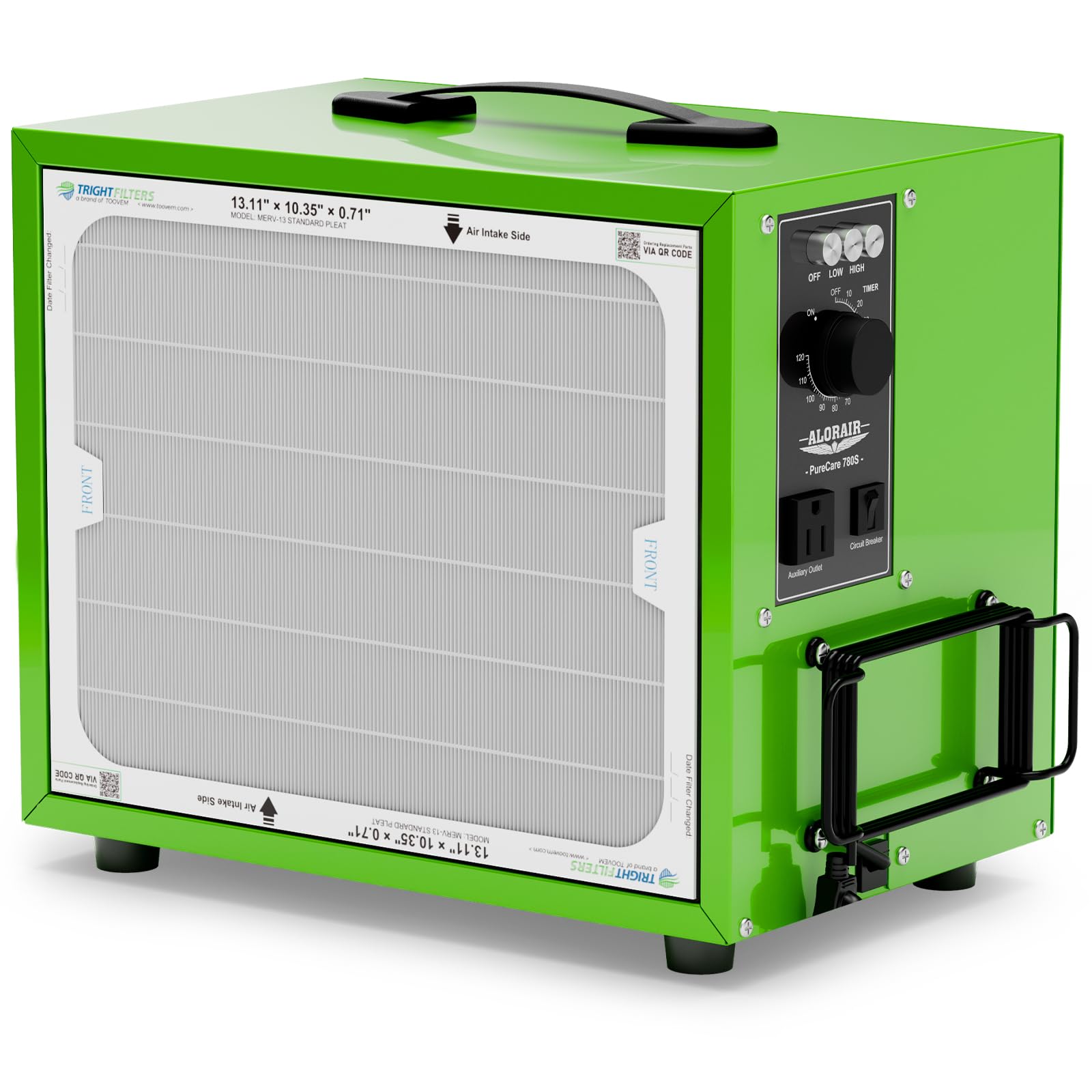
2. ALORAIR 580/780 CFM 2-Stage Air Filtration System for Woodworking
Lots of suction in a package you can carry from the bench to the floor and back.
This is the one for a shop where you never quite know where you will be making dust. A built-in vortex fan pushes 850/1050 CFM through two airflow stages — that is cubic feet per minute, or how much air the unit moves each minute — enough to circulate a space up to 800 sq. ft. The filtration side runs a MERV-13 filter that stops 90% of 3-10 μm particles without strangling the airflow. For sanding, turning, and scroll saw work, that combination clears the air while you keep cutting.
Portability is the whole idea. At 17.4 pounds with a top handle, you carry it to the workbench, set it down, and it stays put on four rubber feet that kill vibration. On top of that, the makers spec it at under 58 dBA running quietly, and there is a timer knob to set a 1-2 hour auto shutoff. An extra socket on the control panel lets you run another tool off the same spot. Compared to the DEWALT above, this one runs 11.6 pounds lighter — you notice that the first time you move it mid-project.
What buyers call out most is the raw air throughput; One owner put it plainly: the filters captured heavy dust in one day.. The recurring gripe is a low-frequency hum that carries through the room, and a handful find it loud enough to want a lower speed setting. It is a workbench tool that happens to be quiet enough for a small shop — not a whisper-quiet ceiling unit.
Who it fits: Renting a shop, working from a bench, or moving between sanding stations — the handle and 17.4-pound weight make this the grab-and-go option.
The honest caveat: That two-sided exhaust and low hum can get old in a small enclosed space, so give it some breathing room.
Best match: Woodworkers who want strong airflow in a unit they can actually relocate.
Look elsewhere: Anyone chasing a silent ceiling mount for a large shop — the hum and smaller coverage will not get you there.
3. PURISYSTEMS Air Filtration System PuriCare 500IG
A three-stage filter with an ionizer that covers a mid-size shop up to 500 square feet.
If your shop is somewhere between a one-car garage and a full two-car space, this is sized right. It moves air at 350, 450, or 500 CFM across three speeds, and the top end is built for a 500 sq. ft. floor area. The filtration runs three stages — an outer filter grabs the larger particles, an inner filter traps the smaller ones, and a built-in ionizer adds a stream of ions to help the air settle. Both filters are replaceable and reusable, so you clean rather than rebuy.
Two features stand out for a working shop. The RF remote works from any angle up to 26 feet, even with something blocking your view — better than the line-of-sight infrared on the DEWALT above. And the timer runs from 1H to 6H, so you can leave the shop and let it finish the job. It sits at 61 dB and can go on a benchtop or hang from the ceiling, with rubber feet that keep it from marring your work surface.
Effectiveness is what the shop owners rave about, with dust removal right behind. One owner running two units reported the shop air transformed within a day, and another found it clears sanding and spray-paint dust in a small woodshop. The recurring gripe is the remote — one quit after about six months, and replacement filters tend to run high. Set it up with a switched outlet and you sidestep the remote issue entirely.
Suits: Mid-size home shops that want an ionizer, a 500 sq. ft. rating, and an RF remote that works through obstacles.
Pass on it: If you would rather not rely on a remote at all — a switched outlet solves it, but this unit is remote-first by design.
4. POWERTEC AF4001E 3-Speed RF Remote Controlled Air Filtration System
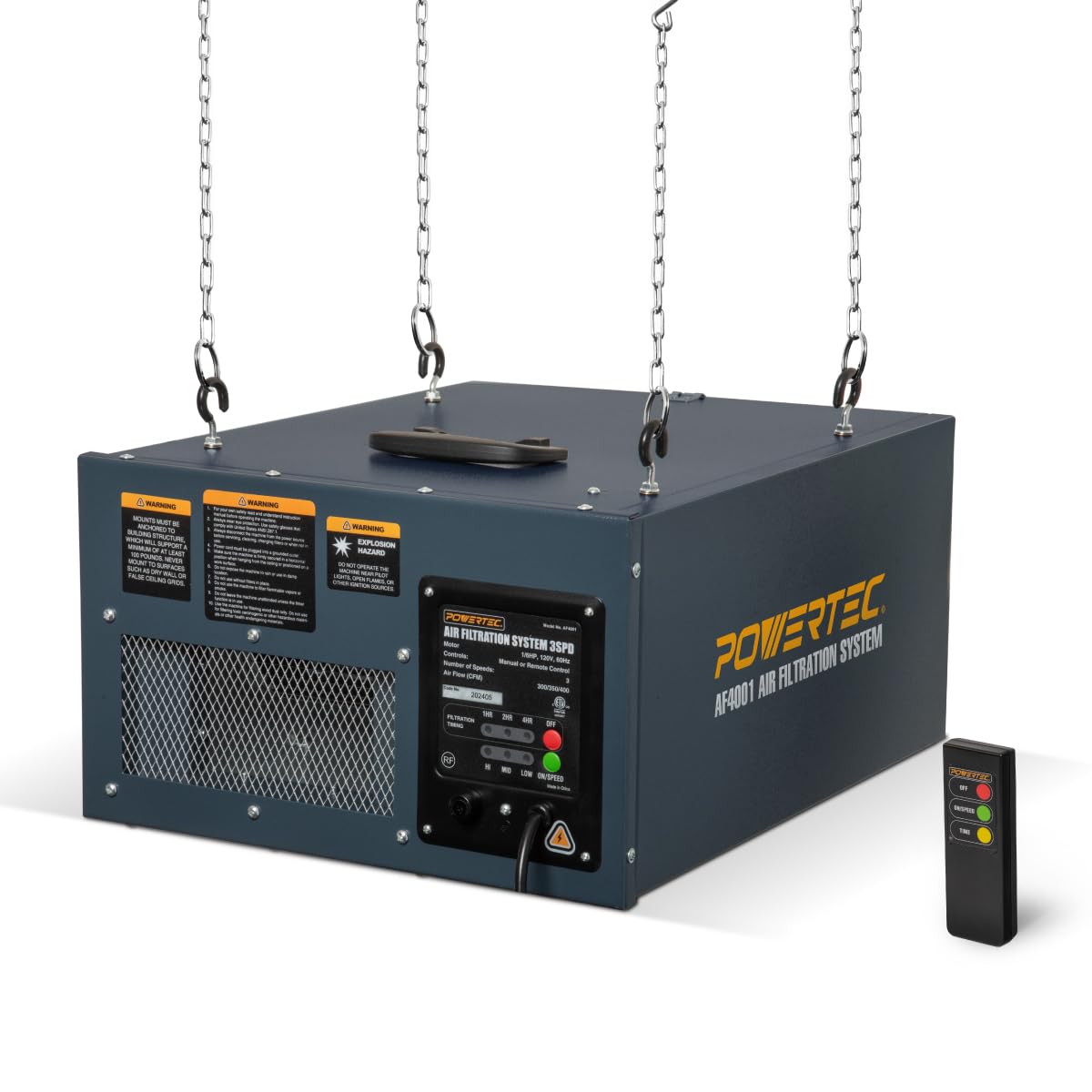
The entry-level ceiling hanger that still moves real air and keeps the shop clear.
Not every shop needs a thousand CFM. This unit runs three speeds at 300, 350, or 400 cubic feet per minute and covers the smaller single-car garage or basement shop with room to spare. Filtration is a two-stage setup: a 5-micron outer filter pulls the bigger dust particles, and a 1-micron inner filter catches the rest of the airborne fines. The RF remote controls power, speed, and a timer with 1hr, 2hr, and 4hr options — no line-of-sight hassle.
Owners describe this one clearing a shop fast. Buyers report air quality swinging near-perfect within minutes of a high-speed run, and the high setting stays quiet enough to work beside. One buyer runs it in a 20’x30′ wood shop and likes it enough to plan a second for the CNC and laser side. Tool-less filter changes make maintenance easy, and the ceiling hooks are included. The two most-praised aspects here are airflow and value, and both come up over and over in the owner feedback.
The honest trade-off is finish quality. A few units arrive with small dents or slightly loose electrical screws, and the remote is the weak link on a minority of units. Some owners also note it can power on by itself on certain outlets, which a switched outlet fixes. Owners mention no drop in performance after 7 months of use.
Why owners keep it
- 3 speeds up to 400 CFM clear a small shop in minutes.
- 5-micron outer plus 1-micron inner filter catches both coarse and fine dust.
- RF remote handles power, speed, and 1hr/2hr/4hr timer from anywhere.
- Tool-less filter changes and ceiling hooks included.
What to weigh
- A few units turn on by themselves on certain outlets — a switched outlet cures it.
- Build finish is utilitarian; some arrive with small dents.
- 400 CFM tops out well short of the bigger airflow units below.
Reach for this if: You want dependable ceiling filtration for a one-car garage or basement shop and value matters more than premium finish.
Keep looking if: Your shop is a full two-car space — the 400 CFM ceiling will not move enough air.
5. Abestorm 360 Degree Intake Air Filtration System DecDust 1350IG

A 360-degree intake monster that pulls fine sawdust from every direction in a big shop.
For a large open shop, this is the volume king of the bunch. It pulls air through a 360-degree intake and moves 1050-1350 cubic feet per minute across two speeds, covering rooms up to 1700 sq. ft. — a bigger footprint than anything else on this list. Filtration runs on a MERV-11 filter with four replacements included, and a built-in ionizer handles particles, dust, sawdust, and odors at the same time. Electrical demand is 115V, 60 Hz, 1.5 A, and it weighs 27 pounds.
Setup flexibility is where it pulls ahead. You can hang it from chains, mount it on a bench on the four anti-slip rubber pads, or screw it straight to the ceiling. Touch panel and remote give you control either way, with the remote reaching up to 27 feet. In a 400 sq ft shop under heavy use, customers note fine sawdust visibly pulled toward the 360-degree intake and the timer handling shutoff up to six hours out.
The performance is what buyers mention most — capturing wood dust even on light use and keeping a workspace clean. The recurring complaint is noise: at 60 to 69 dBA it can rival a shop vac, and a few owners have re-shopped for a quieter unit as a result. There is also a strong downward draft if you mount it overhead, which some owners deflect with a simple homemade diffuser. Mount it high and give yourself a diffuser plan.
Why it earns a spot: Only unit here rated for 1700 sq. ft., with 360-degree intake and four filters in the box.
Plan around this: The noise at 60-69 dBA is real — this is a working unit, not a background hum.
Go with it here: A big open shop or garage where airflow and coverage outrank quiet running.
Temper expectations: If a low noise floor is non-negotiable, the noisy spec and strong downdraft will push you toward the Powermatic further down.
6. WEN 3417 3-Speed Remote-Controlled Industrial-Strength Air Filtration System

The industrial-strength workhorse that moves more air than almost anything else in the category.
When you need raw airflow, this is the pick. It runs three speeds at 556, 702, or 1044 cubic feet per minute, covering rooms up to 1000 sq. ft. with an electrical draw of 110-120V, 60 Hz, 3A. Filtration is a 1-micron inner filter and a 5-micron pre-filter, both easily replaceable. At 55 pounds, it is the heaviest unit here — that mass is what keeps vibration out of the ceiling.
The RF remote works from up to 26 feet away from any angle, even with obstacles in the way, and the programmable timer shuts the unit off after a set number of minutes. An owner running this in a 22×28 shop keeps it on low and reports airflow quieter than his other tools. Another keeps the timer running 1-2 hours after work and finds it effective.
Functionality and build quality are the two things owners mention most — a big one is running this after a workshop day and finding noticeably less airborne fine dust where a dust collector alone was not enough. The honest catches: it occasionally ghost-starts, which an added RF switch fixes, and at 55 pounds it takes two people to hang. A few units also show a loud rattle at the lowest speed, so low-speed noise is the quality wildcard.
Why pros reach for it
- 1044 CFM at top speed handles a 1000 sq. ft. shop.
- 1-micron inner plus 5-micron pre-filter catches fine dust.
- Programmable timer auto-shuts off after a set number of minutes.
- RF remote works up to 26 feet from any angle.
Plan ahead for
- 55 pounds means two people for a ceiling hang.
- Ghost starts can happen — an added RF switch solves it.
- Low-speed rattle shows up on a few units.
Pick it when: Your shop is a full two-car or larger space and you want to feel the air move.
skip it if: A quiet runner matters more than raw CFM, or you want a unit you can hang solo.
7. Powermatic Electrostatic Air Filtration System, 0.1-Micron Filter, 754 CFM (PM1250)

The near-silent filter that keeps fine dust out without drowning out a conversation.
If you want a filter you barely notice, this is the one. It runs at 50.8 dB on High and 41.3 dB on Low — lower than normal conversation, and the quietest unit on this list by a wide margin. Airflow is 754 CFM, which cycles the air in a 680 sq. ft. space about five times per hour, similar to an oversized two-car garage. The electrostatic filter works like a magnet, pulling the finest particles down to 0.3 microns — the tightest rating here.
It is built for a finishing room as much as a cutting room. Owners run it for long periods managing paint, stain, and poly fumes alongside dust, and it stays quiet and efficient the whole time. It is also certified to California Air Resource Board (CARB) standards and Energy Star rated. A filter cleaning alert reminds you every 1,000 hours, and the filter is designed for up to 3,000 hours of life. Portability is a plus — a carrying handle and mounting options for ceiling, wall, or tabletop open up placements the other units do not.
Quiet operation and overall quality are the two things that come up most; One owner ran it while remodeling an apartment and found drywall dust and wood dust landing on finished surfaces dropped noticeably.. The honest caveat is that this is the most expensive unit here, and some owners feel the cost is steep for what it does. It is a premium tool, not a bargain pick.
The standout: 50.8 dB on High and a 0.1-micron electrostatic filter — the tightest filtration and lowest noise in the whole list.
What to know: The ceiling mount runs the unit upside-down, which a few owners note takes some getting used to.
Fit for: Finishing rooms, shared spaces, and any shop where quiet running and the finest-particle filtration both matter.
Not ideal if: You need maximum airflow for a huge open shop — 754 CFM is strong but not the biggest number here.
8. JET Air Filtration System AFS-1000C

The premium smart sensor unit that adjusts its own speed the moment dust levels climb.
This one leads with intelligence. An automatic air quality sensor reads the room and adjusts the six speeds on its own — the fan spins up the moment your table saw throws dust and eases back once the air is clear. Filtration is two-stage: an outer filter catches 99% of 5-micron particles, and an inner filter catches 85% of 1-micron particles. At 1000 CFM the airflow sits up with the biggest units here, and the whole thing runs on a quiet, efficient BLDC motor — a brushless motor that runs cooler and lasts longer than a standard one.
Premium touches round it out. A bright LED display panel is angled for easy reading when the unit is ceiling-mounted, so you are not craning to check it. A filter status indicator tells you when a replacement is due, and the RF remote handles all six speeds plus a 16-hour timer. It weighs 33 pounds — lighter than the WEN’s 55 pounds, which makes a solo ceiling hang more realistic. The injection-molded plastic body is built to dampen vibration and noise, landing at 67 dB on the highest speed.
Quality and functionality are the two aspects owners highlight most. One owner ran the auto sensor in a dusty barn and reported the fan powering up on its own whenever animals stirred up sawdust and hay. Air turnover of once every 5-6 minutes clears a 400 sq ft shop effectively. The honest trade-off: this is the most expensive unit on the list, and it does not remember your last speed setting when it restarts, so you set it again each time. A few units have shown an error code that required support, which is the risk you take at the top tier.
What you pay for
- Auto air quality sensor adjusts six speeds without input from you.
- Outer filter catches 99% of 5-micron particles; inner catches 85% of 1-micron particles.
- 16-hour timer and RF remote control all six speeds.
- Angled LED panel reads easily from the floor when ceiling-mounted.
Trade-offs to know
- Does not remember the last speed setting on restart.
- Premium price tags it as the top-tier pick here.
- A few units surface an error code requiring support — the wildcard at this level.
Reach for this when: You want the smartest auto-sensing unit here and a 16-hour timer for long overnight runs in a large shop.
Think about an alternative if: You want the same airflow for less money and do not need the air quality sensor.
Understanding the Specs
CFM (Cubic Feet Per Minute)
CFM tells you how much air the unit moves in one minute — the bigger the number, the faster it scrubs a large space. A shop up to 500 square feet is well served in the 350-500 CFM range, while 1000+ CFM units are built for full two-car garages and open workshops. More CFM usually means more noise, so match the airflow to your actual square footage rather than buying the biggest number you can find.
Micron and MERV Ratings
A micron is one-millionth of a meter — fine wood dust sits in the range your eyes cannot see. A 1-micron inner filter catches the finest airborne dust, a 5-micron pre-filter handles the bigger particles first, and a 0.1-micron electrostatic filter traps the very finest of all. MERV is a separate overall filtration scale where a higher number traps more; a MERV-13 filter, for example, stops 90% of 3-10 μm particles without cutting airflow.
FAQ
How do I know what CFM my wood shop needs?
Do I need a HEPA filter or is a MERV filter enough?
Can I hang an air filtration system from my garage ceiling?
How loud will one of these run in my shop?
How often do I need to clean or replace the filters?
Is an air filtration system the same as a dust collector?
What’s the difference between an RF remote and an IR remote?
Can I run other tools off the same circuit as my air filter?
Do these air filtration systems ship to California?
Will a small unit work in a large shop if I run it longer?
Final Thoughts: The Verdict
If clean shop air is the goal, the air filtration system for wood shop winner is the DEWALT DWXAF101 — it pairs H11 HEPA filtration with an AUTO sensor that runs itself and a timer that finishes the job after you leave. If you want strong airflow you can carry between benches, the ALORAIR Purecare 780S is the portable pick. And for a large open shop that wants 1700 sq ft of coverage, the Abestorm DecDust 1350IG moves the most air. The quietest, tightest filter in the group is the Powermatic PM1250, worth the reach if noise is your deal-breaker.
How We Picked
We do not accept paid placement. Every pick is matched to a real buyer and a real use-case; we do not hands-on test units.
Sources & Methodology
Specifications: manufacturer listings and product documentation. Review insights: verified customer reviews, as of September 2026. Pricing: not shown on this page (it changes often); check the current price via the retailer link.
As an Amazon Associate, Gadgets Feed earns from qualifying purchases. This does not affect which products we feature.