
Our readers keep the lights on and my morning glass full of iced black tea. As an Amazon Associate, I earn from qualifying purchases.
Specs are compiled from manufacturer listings and verified buyer reviews and can change over time — please confirm the key details on the product page before buying.
If you’re tired of watering lead-acid cells and still only getting two or three miles before the cart starts crawling, a single 48V lithium pack is the fix most owners wish they’d made sooner. The big win is simple: one sealed battery replaces four to eight heavy lead-acid units, drops hundreds of pounds off the cart, and ends the acid top-ups for good. This guide covers ten real 48V packs that fit Club Car, EZ-GO, Yamaha and other 48-volt systems, and it explains what actually matters — capacity in amp-hours (a measure of how much energy the battery holds), continuous discharge in amps (the steady current it can deliver), and whether the kit really includes the charger and monitor you need.
I’m Min — the founder and writer behind Gadgets Feed. This guide is built by comparing the manufacturers’ published specifications and the patterns across verified customer reviews, so you get each pick’s real strengths and trade-offs instead of marketing spin.
Most conversion headaches trace back to one number — continuous discharge amps — so we lead with that and translate the rest into plain outcomes. Here are the 48 volt golf cart batteries worth your money.
Our Picks at a Glance
How To Choose The Best 48 Volt Golf Cart Batteries
The single biggest mistake first-time buyers make is shopping by price and ignoring amps. Your cart’s controller pulls a surge of current the moment you hit a hill, and if the battery’s continuous discharge rating is too low, the BMS cuts power mid-climb. So the two numbers that decide whether a pack works for your cart are capacity and continuous discharge — everything else is convenience.
Start With Continuous Discharge, Not Capacity
Continuous discharge is the steady current a pack feeds your motor without tripping its protection. A 200A continuous rating handles most stock controllers and trolling motors; a 250A continuous rating gives extra headroom for upgraded controllers and heavier carts. Ignore this and you’ll feel cutouts on the steepest part of your course.
Match Amp-Hours To Your Daily Range
Amp-hours (Ah) is the size of the fuel tank. A 100Ah pack and a 105Ah pack both run a full 18 holes on a typical 3kW cart, but the larger pack leaves more in reserve for a second loop or a longer drive home. If you routinely run errands beyond the course, lean toward the higher capacity.
Check What The Kit Actually Includes
A charger matched to LiFePO4 is not optional — a lead-acid charger will not charge these packs correctly. Most kits here include a 58.4V charger, and several bundle a touchscreen monitor and Bluetooth app. Tray fit and terminal clearance also matter: a few carts need light trimming of the plastic ribs before a drop-in.
Quick Comparison
| Model | Best For | Capacity | Continuous Discharge | Weight | Amazon |
|---|---|---|---|---|---|
| Cloudenergy 48V 105Ah Kit★ Best Overall | Best overall balance | 105Ah | 250A | 82.7 lb | Amazon |
| ELEFAST 48V 100Ah KitBest Value | Budget-conscious converters | 100Ah | 200A | 92 lb | Amazon |
| CHINS 48V 100AhLong-Range Pick | Long daily runtime | 100Ah | 200A | 87 lb | Amazon |
| VPauexii 48V 72Ah | Tight battery compartments | 72Ah | 200A | 94.8 lb | Amazon |
| OGRPHY 48V 100Ah Kit | In-cart onboard charging | 100Ah | 200A | 88.1 lb | Amazon |
| LOSSIGY 48V 100Ah Kit | Yamaha and RV owners | 100Ah | 200A | 82.9 lb | Amazon |
| TEMGO 48V 100Ah | Lightest PACK | 100Ah | 200A | 61.7 lb | Amazon |
| Cloudenergy 48V 105Ah 250A BMS | Biggest power headroom | 105Ah | 250A | 92.5 lb | Amazon |
| DC HOUSE 48V 100Ah Metal Case | Fire-resistant metal build | 100Ah | 200A | 95.9 lb | Amazon |
| VATRER POWER 48V 105Ah | Safety-first buyers | 105Ah | 200A | 102.5 lb | Amazon |
In‑Depth Reviews
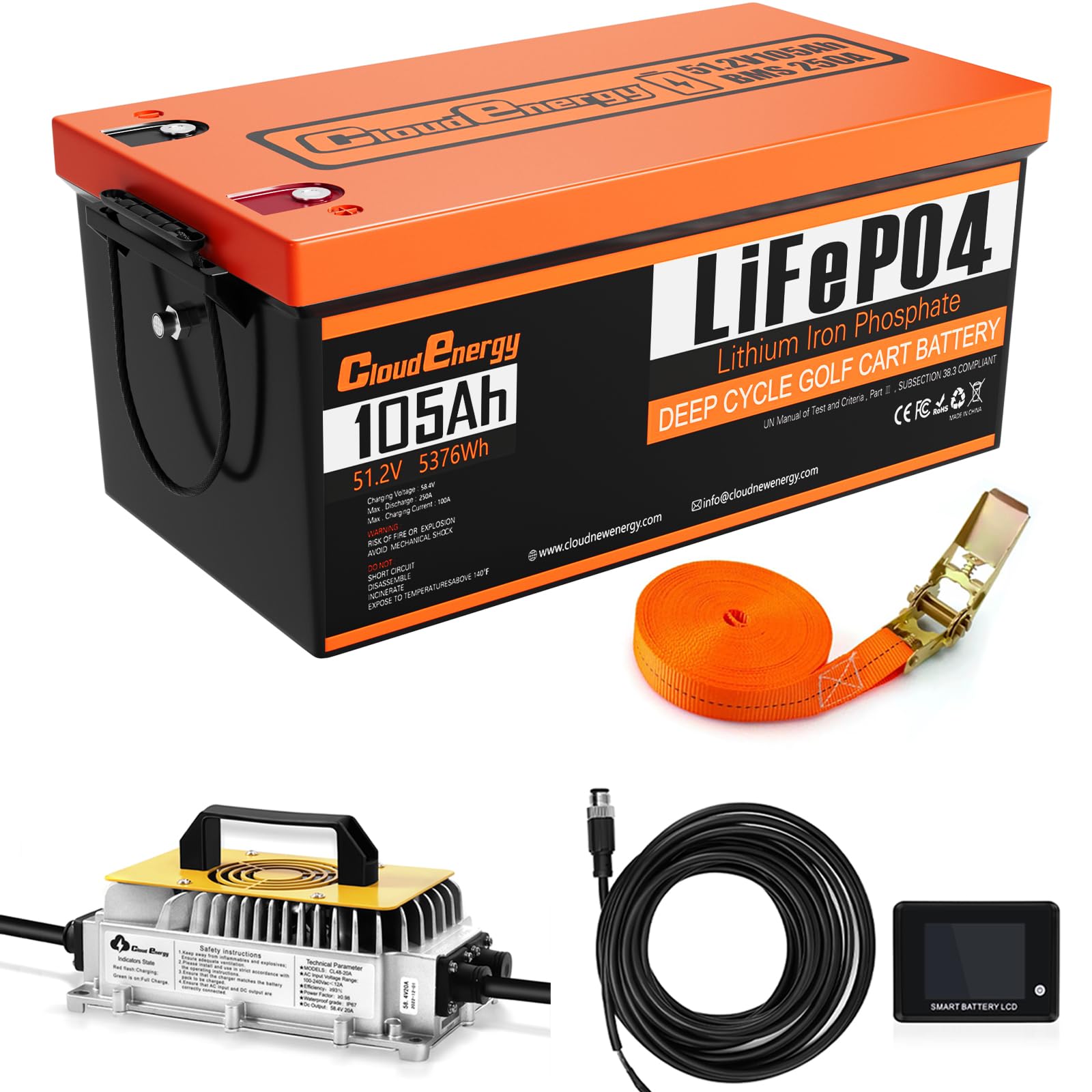
1. Cloudenergy 48V 105Ah LiFePO4 Lithium Golf Cart Battery With Charger Kit
Our pick — over 4.5★ from 350+ verified ratings; the strongest balance of quality and price.
The kit that wins on raw amp-hours and discharge headroom at the same time.
You get the most energy in this roundup: 105 amp-hours (a measure of how much energy the battery holds). That capacity sits inside a case rated IP67 (a dust-tight and water-resistant rating), so it keeps out dust and survives being splashed or rained on — handy on muddy cart paths and in wet storage. The 250A continuous discharge (the steady current it feeds your controller) is the highest of the ten picks too, which matters every time you point the cart at a steep fairway.
Set it against the ELEFAST 100Ah kit below and the gap is real: 105 amp-hours against 100, and 250A continuous against 200A — the Cloudenergy leads on both. It is also the lighter pack, at 82.7 pounds versus the ELEFAST’s 92 pounds. Buyers report a roughly two-hour swap in a Yamaha G29, with quicker acceleration, higher top speed, and stronger hill power on the stock controller. Regen braking still works, and owners mention 40 to 45 miles per charge. One long-term owner did note the BMS charge percentage drifting and the charger getting finicky after roughly a year, but support shipped a free replacement charger and a firmware fix.
The kit is genuinely complete: a 58.4V 20A fast charger, a 2.8-inch LCD touch screen, a mounting strap, and a 16-cell pack. What wins owners over most is the overall quality of the battery itself, and a close second is how long it holds a charge. You get two years of daily-driving confidence built on that reputation — and if the cart ever acts up, the company answers within 24 hours.
Where It Pulls Ahead
- 105Ah capacity and 250A continuous discharge — the highest of any pick here
- 82.7 lb, lighter than the 92 lb ELEFAST kit
- Complete kit: charger, LCD touch screen, and strap included
What To Know First
- Fits universal 48V trays, but some carts need the 8V dividers ground down for a clean fit
- BMS charge percentage can read off over time and the charger occasionally needs a firmware refresh
Buy it if: you want maximum range and headroom in one sealed pack for Club Car, EZ-GO, Yamaha, Polaris, or Cushman.
Look elsewhere if: your cart’s tray can’t be modified, since the 10.59″D x 20.55″W x 8.66″H case needs clearance.
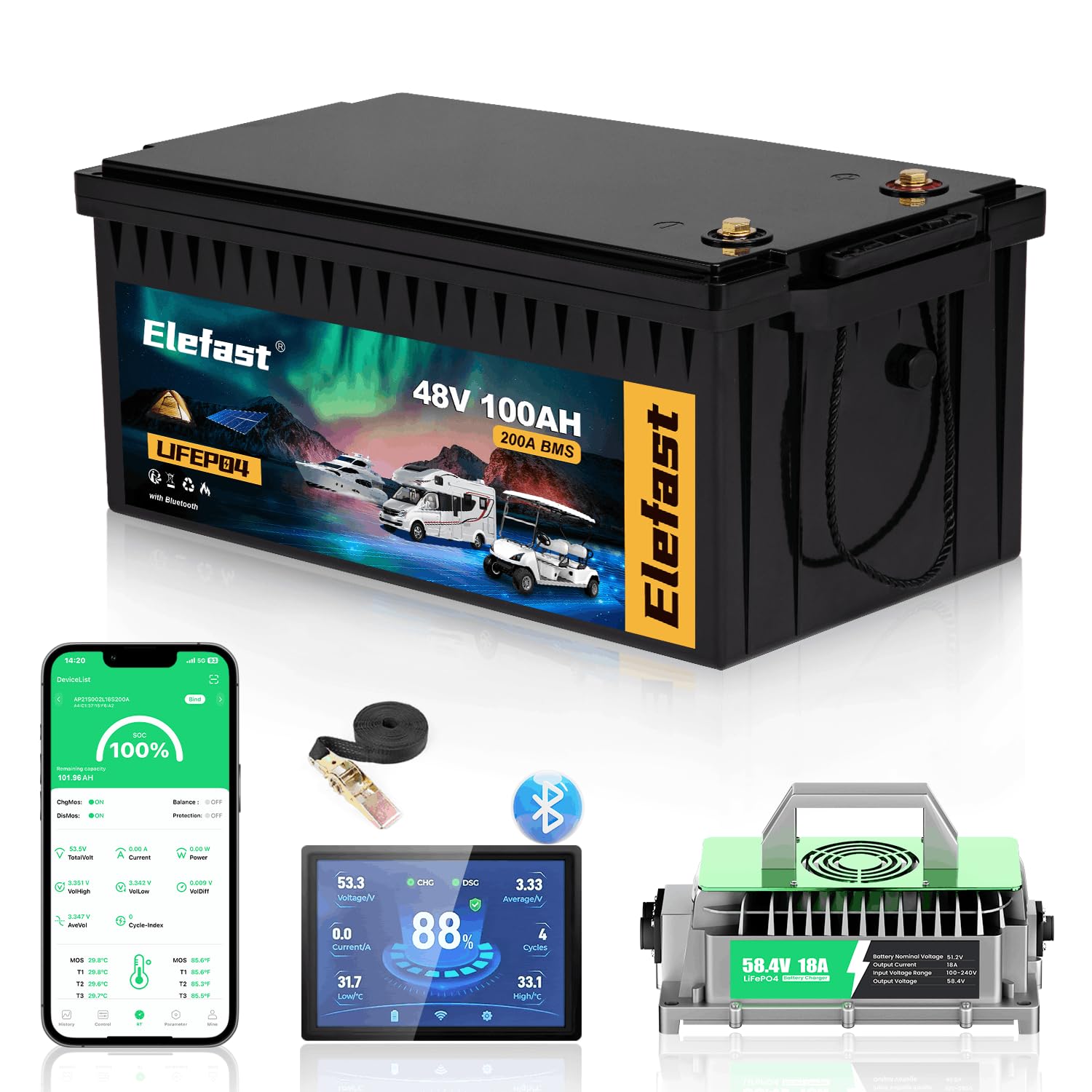
2. ELEFAST 48V 100AH Lithium Battery Golf Cart Kit with 200A BMS & Bluetooth
A 100Ah kit built for budget converters who still want a full 5.12kWh of energy.
This one trades a little capacity for a friendlier entry price. It packs 100 amp-hours and 5.12kWh of energy, and its 2C discharge rating means it can pour out a big surge for steep climbs and rough ground. The cells here are EVE A+ grade power cells — the same tier of component found in pricier packs — and the whole thing is drop-and-shock resistant inside a flexible plastic case.
Owners say the swap is the easy part: several replaced four 12V lead-acid batteries in a 2006 Club Car in under two hours. The charger runs cooler than the original equipment, and the click-in connector plus on-screen battery level are the small touches that make daily use pleasant. Compared with the Cloudenergy above, though, this kit is the heavier build at 92 pounds and offers less continuous current at 200A, so a heavily upgraded cart will want the extra headroom.
One honest thread runs through the owner feedback: charge indication can be optimistic. A cart that showed 46% indicated did shut down and take more than 12 hours to refill to full, and another owner saw a similar early cutoff. It is a real-world quirk worth planning around — charge earlier and keep the seat off while charging so the unit gets airflow — rather than a reason to skip the kit. The Bluetooth app is also minimal, so if you want detailed cell data you’ll rely on a third-party app.
The price-to-capability read: 100Ah and 5.12kWh with premium EVE cells at a value-tier price, plus a 58.4V 18A charger and 2.8-inch LCD screen in the box.
The catch: the BMS percentage readout can be off, and the app is bare-bones — budget for a little extra monitoring discipline.
Reach for this if: you’re converting an older Club Car or E-Z-GO and want solid lithium chemistry without paying for extras you won’t use.
Think twice if: you run a high-draw upgraded controller that needs more than 200A continuous.
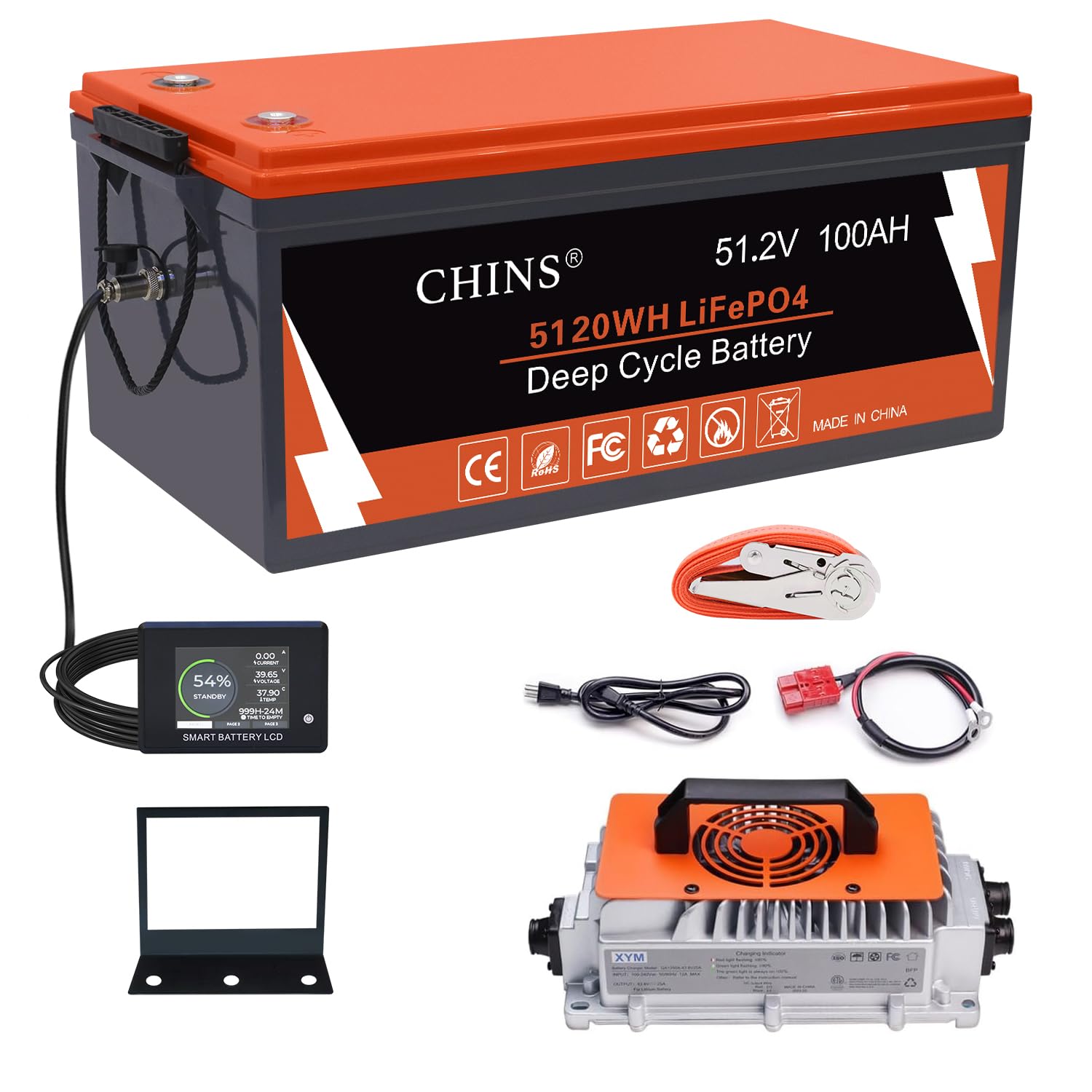
3. CHINS 48V Lithium Battery Golf Cart 100AH, Includes 18A Charger, Monitor
Built for the owner who wants a cart that runs all day on a big property.
Where this pack shines is endurance. The 5.12kWh of capacity is rated to push a 3kW golf motor for a solid stretch under test, and buyers running larger parcels say it carries them through a full day of chores without a midday charge. The 200A BMS handles high-draw moments, with a peak rated far above the steady figure for the initial surge when you take off.
Two things stand out in owner experience. First, the drop-in nature: several swapped six lead-acid batteries for this one unit, freeing up under-seat storage and cutting the cart’s weight substantially. Second, the app gives live diagnostics, which is exactly what you want when you’re watching a long run down to its last bar. The monitor and Bluetooth both earn steady praise.
The fair caveat is the meter. Owners note the battery gauge can read inaccurately, and the pack is set up to cut power rather than limp — so you don’t get a soft warning before it stops. Treat the displayed percentage as a rough guide and keep a buffer. If you forget to charge and let it sit low, plan to top it up promptly, because deep discharge is where lithium packs get stressed. Support is responsive when something does go wrong, with replacement chargers sent to revive a drained pack.
Runtime that earns its keep: 5.12kWh for a 3kW motor and a 58.4V 18A charger that refills from empty to full in about seven hours, plus a 0V wake-up function for low-voltage recovery.
This is your pick if: you cover real distance across acreage and need a single-purchase lithium that lasts a full work day.
Heads up if: you rely on an accurate state-of-charge readout — the meter can drift and the pack favors cutting off over easing down.
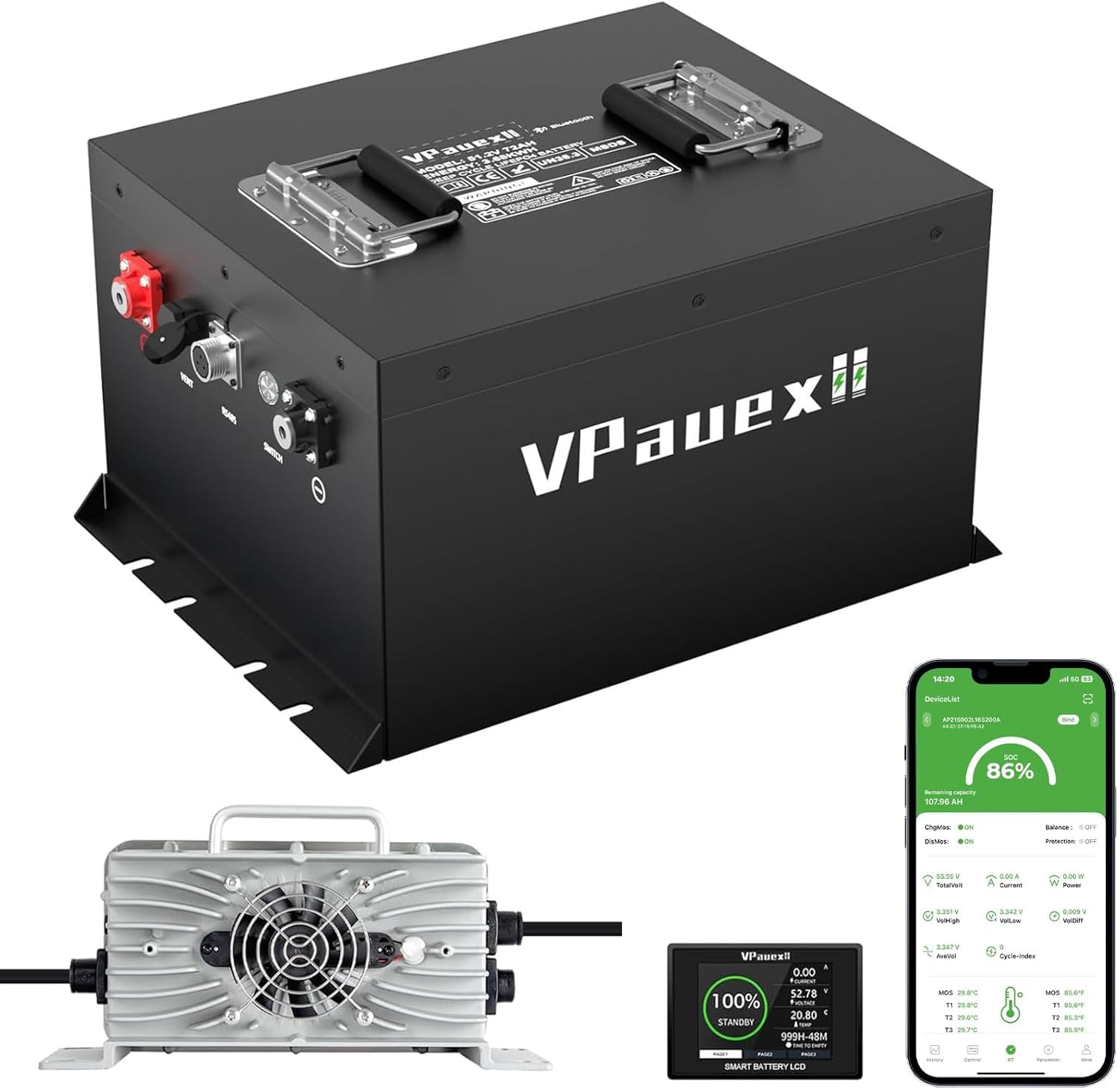
4. VPauexii 48V 72Ah Golf Cart Battery with 18A Charger, 200A BMS, Metal Casing
The miniaturized pack for carts where the battery bay is the real bottleneck.
Most 48V packs here are roughly 20 inches wide; this one is not. At 16.73 x 12.59 x 8.46 inches, it is the most compact case in the roundup, which is the whole point — it slides into carts with tight compartments and frees up room for gear. What you give up is capacity: this is a 72Ah pack, not a 100Ah or 105Ah, so think of it as enough for a full 18 holes rather than a marathon ranch circuit.
In a 2012 Club Car Precedent, customers note a drop-in fit with pre-attached mounting plates and 78% charge left after a full round. It packs a 200A continuous discharge with a 58.4V 18A charger that the maker rates for a full refill in about four hours, which is quick for a pack this size. Two monitoring paths come standard: an LCD touchscreen and a Bluetooth app that tracks state of charge, temperature, and health.
The trade is straightforward. You get a smaller tank and a shorter rated range than the 100Ah and 105Ah packs in this guide, so if your day regularly stretches past one course loop, the bigger-capacity options up top serve you better. One owner also flagged that there’s no remote on/off button, so plan to use the pack’s own switch.
Why Compact Wins Here
- The smallest footprint of any pick, at 16.73 x 12.59 x 8.46 inches
- Metal casing protects the cells from bumps and vibration
- Pre-attached mounting plates and a 200A continuous discharge rating
Plan Around This
- 72Ah is the smallest capacity here — not built for multi-loop days
- No remote on/off button; you’ll use the pack’s switch directly
The verdict: a smart fit-first choice when your cart’s compartment has no room for a full-width pack and one round per charge is all you need.
skip it if: you need 100Ah-plus capacity for long days — the bigger packs in this guide carry more energy.
5. OGRPHY 48V Lithium Golf Cart Battery Conversion Kit with Touch Monitor and Charger
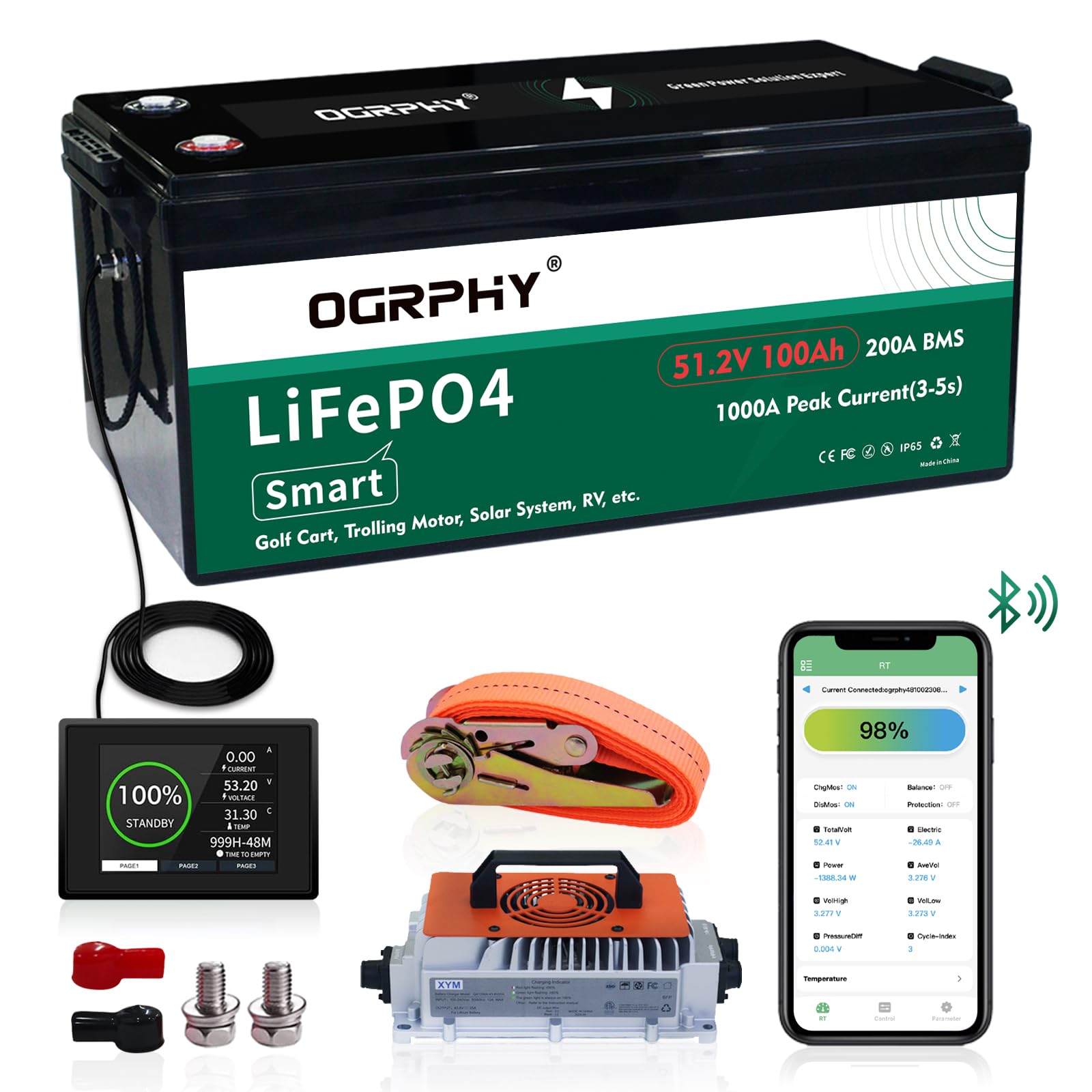
A 100Ah kit that lets you charge through your cart’s existing port instead of hauling out a cord.
The standout here is the onboard 58.4V 18A charger. Rather than leaving a separate unit on the garage floor, you mount it in the cart and charge through the original charging port — the same routine you already had with lead-acid. That single design choice is why this kit feels less like a project and more like a same-but-better swap.
Underneath, it’s a 100 amp-hour, 5.12kWh LiFePO4 pack with a 200A BMS rated to hold up under high surge. It’s certified to the UL 1973 standard, so the pack has been through third-party testing for stationary and light-EV battery safety. And the safety guidance is spelled out clearly: always switch the battery off before touching cables, never use a lead-acid charger, and inspect aging wiring before installation. Owners appreciate having two ways to watch the pack — a Bluetooth app plus a dedicated touchscreen on a stand.
The honest friction point is wiring. This isn’t a true plug-and-play for every cart — some owners had to modify the battery tray and move a control board to get a clean fit, and the monitor’s short cables can frustrate. That’s the trade for the onboard charger setup. Get past the install and the payoff is real: reviewers point out noticeably more torque and higher top speed than their old lead-acid bank.
What makes it different: the onboard charger mounts in the cart and charges through your existing port — both a 100Ah/5.12kWh pack and a 200A BMS with a 0V wake-up function for reviving low-voltage batteries.
Choose this if: you want to keep your cart’s original charging routine and value an onboard charger plus a hardwired display over a loose plugin unit.
Reconsider if: you want zero-modification drop-in — expect to trim or relocate some parts to fit the tray.
6. LOSSIGY 48V Lithium Battery Golf Cart Conversion Kit with Charger & Monitor
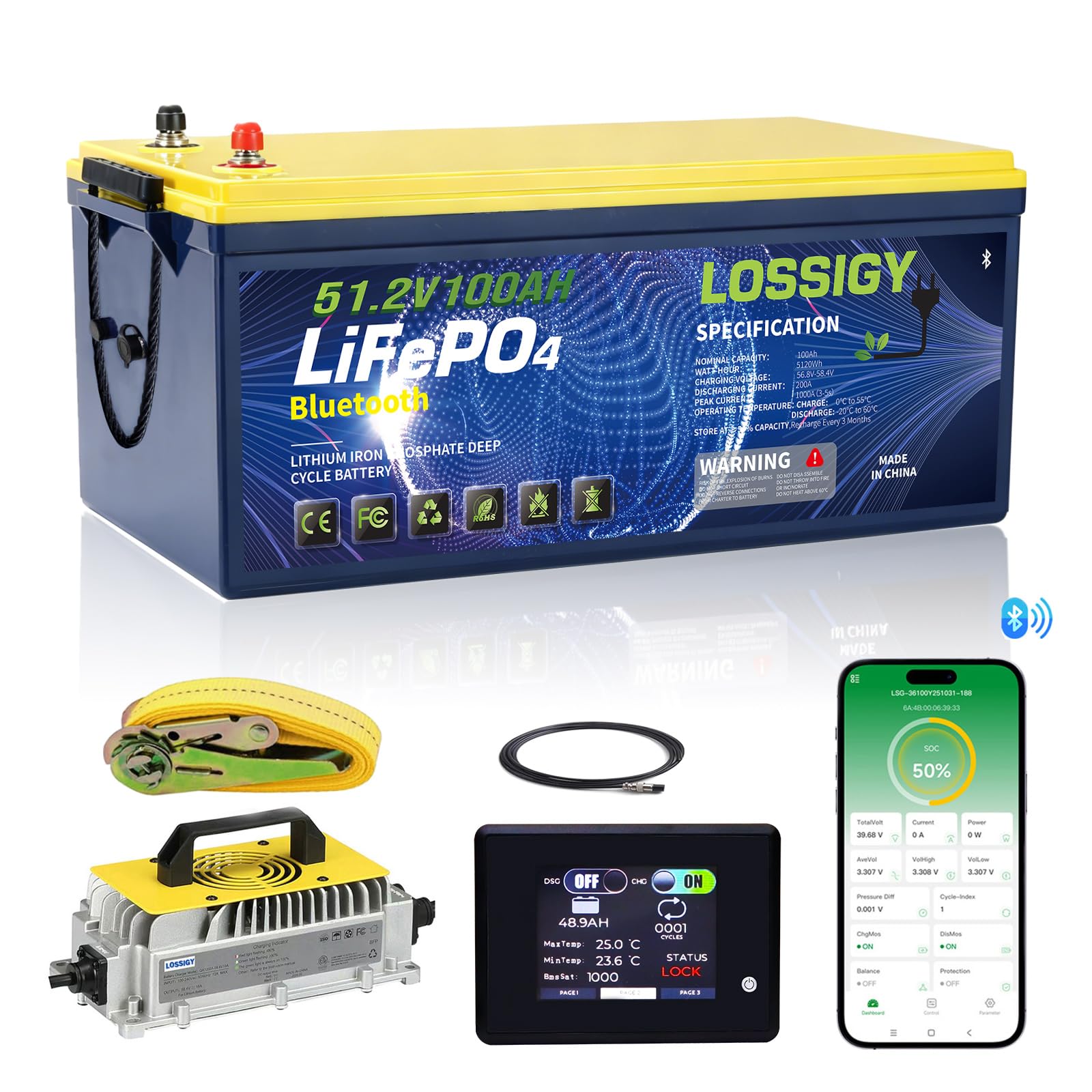
Yamaha owners keep coming back to this 100Ah kit for its surge and reliability.
Peak current is the headline. The 200A smart BMS can spike to a very high momentary figure for a few seconds — exactly the burst a controller demands when you hit the throttle from a stop or point the cart up a rise. That surge capacity, plus a steady 200A continuous rating, is why this kit feels responsive rather than sluggish. It’s a 100Ah, 5.12kWh pack with a minimum 4000-cycle rating and a 5-year warranty.
Yamaha owners are the most vocal fans, and reliability runs through the feedback: carts that keep working trip after trip. Many report swapping out six 8V lead-acid batteries and feeling a clear lift in acceleration and responsiveness. The weight drop is dramatic too, with several owners measuring savings in the hundreds of pounds, which frees up power for speed rather than hauling. Charging is quick with the included 18A unit.
Read the install notes before you buy, though. The plastic rim and pre-angled elements mean this isn’t always a true drop-in; owners of certain Club Car models have had to fabricate a mount and raise the seat slightly, and this kit intentionally ships without a strap in favor of cables. The monitor has earned mixed marks for cable placement and clarity, so many simply rely on the Bluetooth app, which owners find excellent. Budget a few hours and a bit of patience — the reward is a deeply satisfying upgrade once it’s dialed in.
What Owners Love
- Very high peak current for confident takeoffs and hill climbs
- 4000-cycle minimum and a 5-year warranty
- Big weight savings — hundreds of pounds off the cart
What To Plan For
- Not a universal drop-in — some carts need a fabricated mount
- Monitor cable setup and mounting clarity are the recurring gripe
For you if: you own a Yamaha or want the strongest surge response in the 100Ah class and are comfortable with a hands-on install.
Not ideal if: you expect a tool-free drop-in on an oddly shaped tray — measure first.
7. TEMGO 48V (51.2V) 100Ah LiFePO4 Lithium Golf Cart Battery

The lightest full-size pack here — 61.7 pounds that transforms how a cart handles.
If you want the biggest weight swing, this is the pack. At 61.7 pounds, it is the lightest 100Ah-class battery in this roundup — lighter than most 48V packs on the list by a wide margin. In a cart that once carried six lead-acid batteries, that translates into a livelier, quicker ride, and owners consistently report a real speed gain on flat ground. It’s a 100Ah, 51.2V LiFePO4 pack with a 200A smart BMS that peaks at 10.24kW of output.
The kit comes fully loaded: a 58.4V 18A charger, a 2.8-inch LCD touch display, and a durable retention strap, so there’s nothing extra to buy. Installation runs quick for most — several owners finished in well under two hours in a Club Car DS. The ABS case is impact-resistant and shaves weight, so the cart carries less bulk even as the pack’s apparent output climbs.
The fit is the thing to watch. The case is taller than some older carts’ trays allow, and owners of certain older models have had to raise the seat slightly or trim a couple of plastic protrusions to seat it. It’s a small, quick fix with a saw, but worth knowing before you order. If your tray is snug, measure first. Beyond that, the response is overwhelmingly positive — smoother running, faster takeoff, and a pack that quietly delivers.
The feel-it-in-your-hands difference: 61.7 pounds installed means less mass to drag around, which is why shoppers say quicker acceleration and easier handling.
Grab this if: you want the lightest full-capacity pack and a complete charger-and-monitor kit in one purchase.
Measure first if: you have an older cart with a short tray — the case may need the seat raised a touch.
8. Cloudenergy 48V (51.2V) 105AH Lithium Golf Cart Battery 250A BMS
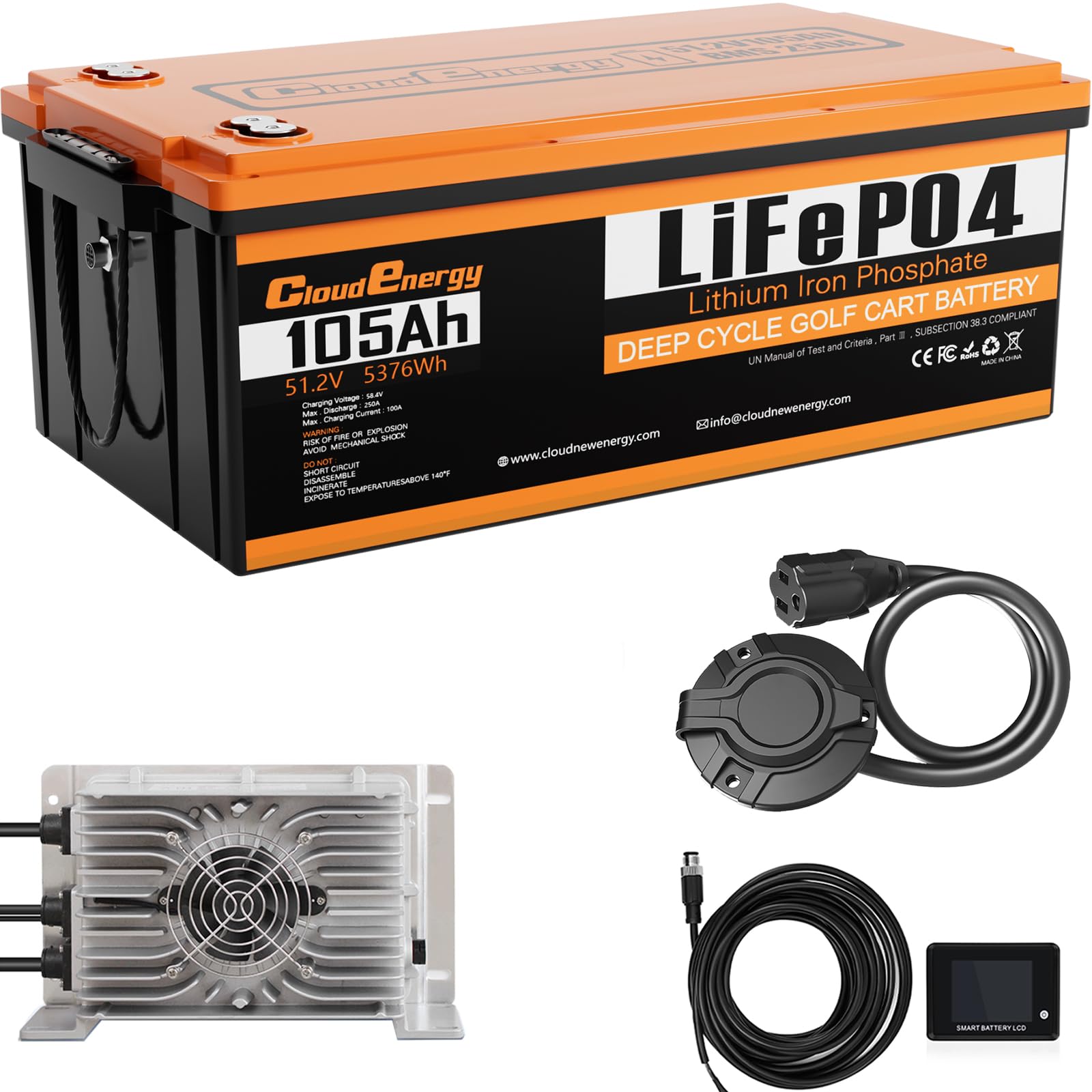
A 105Ah pack with a 250A BMS that laughs at steep grades and heavy loads.
This is the pack to pick when you want maximum current on tap without going up a tier in capacity. It carries 105 amp-hours like the Cloudenergy kit up top, but with the same 250A continuous discharge rating and a peak burst designed to handle the toughest climbs and heaviest carts in the group. The 10.24kW power output is the kind of figure that shows up when a cart noses up a steep grade with two riders and gear aboard.
The 4-in-1 kit is generous: a 58.4V 20A fast charger, a 2.8-inch LCD touchscreen with its own holder, a charger extension cable, and a 78.74-inch mounting strap. The ABS case is rated IP67, so it shrugs off dust and splashes. Buyers report quicker acceleration and much longer range in Yamaha and Icon carts, with several going weeks between top-ups on daily use.
The honest caveat is the display. More than one owner has found the screen fiddly or unresponsive, with some preferring to simply use the app instead. A pack this capable deserves honest monitoring, so if you rely on a screen, know that Bluetooth is the more dependable path. Otherwise, this is a strong, high-output pack with the same proven chemistry and customer support as its sibling.
Where the extra power shows: the 250A continuous rating and 10.24kW output mean less strain when the controller asks for everything at once — the moment you feel a lesser pack bog down.
Pick it when: your cart is heavy, your terrain is hilly, or you’ve upgraded the controller and need the extra continuous current.
Know this going in: the LCD can be temperamental, so lean on the Bluetooth app for accurate reads.
9. DC HOUSE Metal Case 48V 100Ah Lithium Golf Cart Battery Kit with 18A Charger
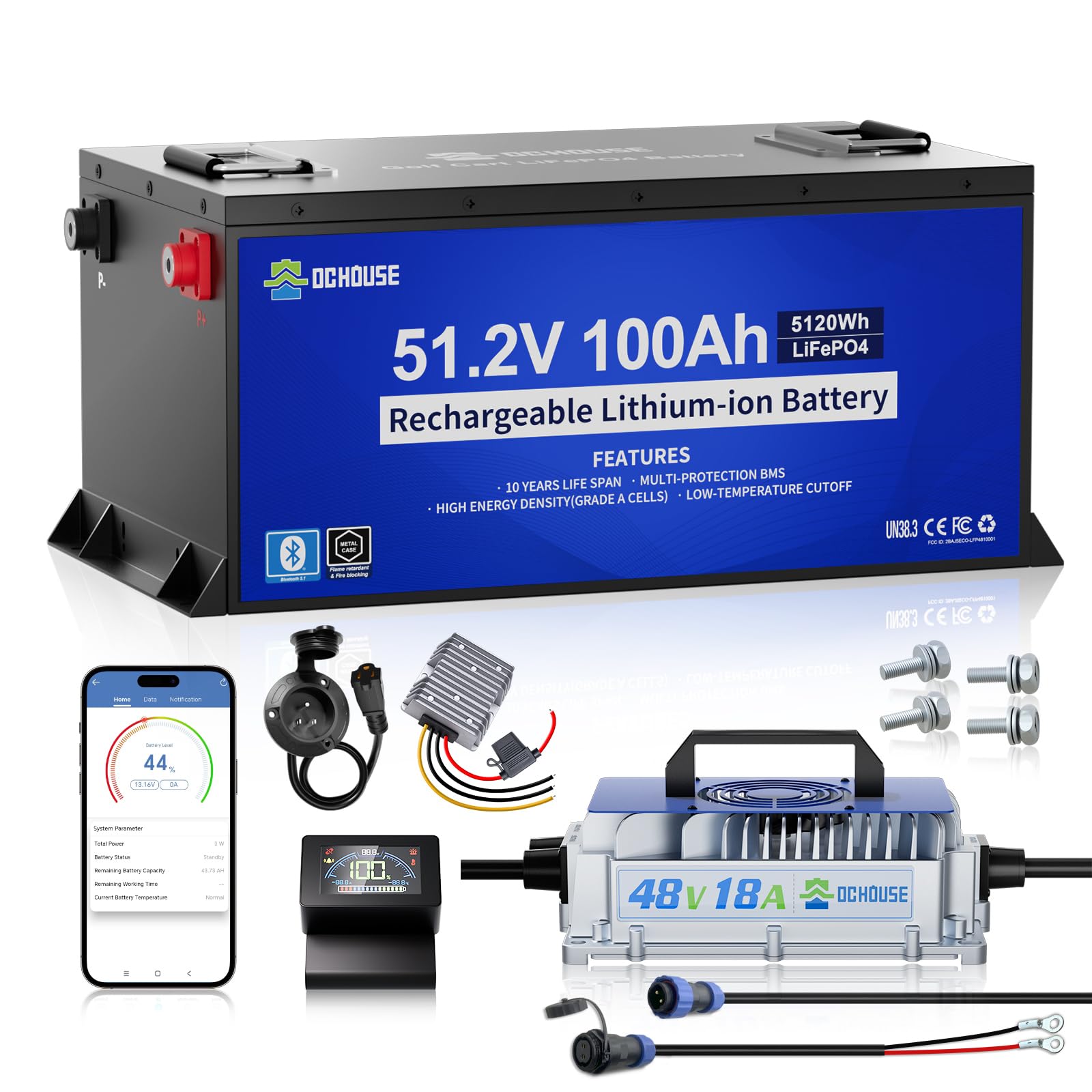
A fire-resistant sheet-metal case built for carts that live outside and take abuse.
Most packs here use a plastic or ABS shell. This one steps up to a fireproof, anti-collision sheet-metal case with a vent and a one-key safety switch — a build designed to resist impact and reduce swelling risk while extending the pack’s working life. It’s a 100Ah LiFePO4 pack with a 200A BMS, a 2C discharge rating for steep climbs, and a peak surge for the initial pull. It also carries six key BMS protections, including low-temperature cutoff for safer charging and discharging in cold weather.
The kit is thorough — the battery, a 48V 18A charger that refills in roughly five and a half hours, a DC-DC step-down converter, and an AC port plug. Owners mention over a week between charges, speeds in the thirties on flat roads, and a big weight cut versus lead-acid. It’s compatible with the major 48V carts, and support is local, with a 3-year warranty backing it.
The friction points are real but manageable. Because the metal case is bulkier, some carts need a bit of trimming to fit, and this kit ships in multiple packages that arrive separately — so don’t panic if the charger lags behind the battery. A few owners also had to keep their original gauge or add a tie-down, since the metal build doesn’t always include mounting straps.
Built To Last Outdoors
- Fireproof sheet-metal case with vent and one-key safety switch
- Six BMS protections including low-temperature cutoff
- Ships with charger, DC-DC converter, and AC port plug
Factor These In
- Ships as separate packages that arrive at different times
- Bulky case may need tray trimming for a clean fit
Right for: an exposed cart that needs a rugged, fire-resistant enclosure and cold-weather protection as much as capacity.
Less ideal if: you want a single-box arrival and a guaranteed drop-in fit.
10. VATRER POWER 48V 105Ah Lithium Golf Cart Battery, UL2271 Listed

The 105Ah pack that chased third-party safety certification as its calling card.
This one leads with a credential: it’s certified to the UL2271 standard for LEV lithium batteries, meaning it passed third-party testing for vibration, impact, thermal runaway, overcharge, and short circuit. For anyone wary of lithium under the seat, that certification — plus an IP67-rated cold-rolled metal case — is the reassurance they’re paying for. It’s a 105Ah, 5.37kWh LiFePO4 pack with a 200A BMS and a 58.4V 18A charger that the maker rates for a full refill in about five and a half hours.
The performance matches the build. Customers note strong off-the-line surge, steady hill power, and 30 to 40 miles per charge. The touchscreen monitor sits right on the dash for live viewing. And the numbers back the feel — this pack carries 105 amp-hours against the ELEFAST’s 100, and its 5.37kWh energy figure edges past the CHINS pack’s 5.12kWh, so it leads both on capacity and stored energy.
Two things to respect. First, this is the heaviest pack in the group, so the weight savings over lead-acid — real, but less dramatic than a lighter sibling — require a bit more care when lifting it into place. The company replaced one such unit, and its five-year limited warranty and US phone support round out a reassuring package.
The Case For It
- UL2271 certified and IP67-rated metal case for serious confidence
- 105Ah and 5.37kWh — the highest stored energy in this roundup
- Touchscreen monitor, charger, and 5-year limited warranty included
The Honest Trade-Off
- The heaviest pick here, so it’s less easy to lift in
- Must be switched off in tow mode during long idle periods to avoid drain
Best for: a safety-focused buyer who wants third-party certification and maximum stored energy and will dock the cart properly between rides.
Not the pick if: absolute lightest weight is your priority over certification and capacity.
Understanding the Specs
Amp-Hours And Energy Capacity
Amp-hours (Ah) tells you how much charge the pack holds — think of it as tank size. A 100Ah pack and a 105Ah pack both suit a typical 3kW cart, but the higher figure leaves more in reserve. Energy, measured in kilowatt-hours (kWh), combines that with voltage; a 100Ah pack at 51.2V stores about 5.12kWh, while the largest packs here reach 5.37kWh.
Continuous Discharge And Peak Current
Continuous discharge is the steady current a pack can feed your controller all day. A 200A continuous rating handles most stock systems; 250A adds headroom for upgraded controllers. Peak current is a brief spike — measured in seconds — for the initial surge of a climb. A BMS that covers both keeps you from losing power mid-hill.
BMS And Low-Temperature Cutoff
The battery management system (BMS) is the pack’s brain, guarding against overcharge, over-discharge, overcurrent, short circuit, and extremes of temperature. Low-temperature cutoff blocks charging when it is too cold. That matters if you store your cart in an unheated garage, because it protects the cells when conditions would otherwise harm them.
Chemistry, Case, And Cycle Life
LiFePO4 is the lithium iron phosphate chemistry used across these packs — it trades a little energy density for stability and a long life. Cycle life counts full charge-and-drain cycles; a pack rated for 4000 to 6000 cycles is built to outlast a lead-acid bank many times over. The case matters too: a metal shell resists impact and heat better than plastic, while an IP67 rating adds dust and splash protection.
FAQ
Will a 48V lithium pack fit in the battery bay of my existing cart?
Do I need a special charger for a 48V LiFePO4 battery?
Why does my 48V lithium battery shut off before it reads empty?
Is 100Ah enough for a full round of golf?
What does continuous discharge amperage actually mean for driving?
How long will a 48V lithium golf cart battery actually last?
Can I use a 48V lithium battery for a trolling motor or solar setup?
What is low-temperature cutoff and why does it matter in winter?
Why do some 48V battery kits arrive in several boxes?
Is a metal case better than a plastic one for a golf cart battery?
Final Thoughts: The Verdict
For most buyers, the strongest all-around pick is the Cloudenergy 48V 105Ah LiFePO4 Kit because it pairs the roundup’s highest 105Ah capacity with a 250A continuous discharge rating and a complete charger-and-monitor kit. If keeping your cart’s original charging routine is the goal, the OGRPHY Kit with its onboard charger is the one to reach for. And when third-party safety certification is non-negotiable, the VATRER POWER 48V 105Ah with its UL2271 listing and 5.37kWh of stored energy earns the spot. If you want the biggest weight swing for the least hassle, the 61.7-pound TEMGO 100Ah is the lightest full-capacity pack on the list, and its long-standing reputation for holding a charge makes it an easy recommendation. Whichever your cart’s tray and controller allow, any of these ten will end the acid top-ups and give you more range, more response, and far less maintenance than the lead-acid bank you’re replacing.
How We Picked
We do not accept paid placement. Every pick is matched to a real buyer and a real use-case; we do not hands-on test units.
Sources & Methodology
Specifications: manufacturer listings and product documentation. Review insights: verified customer reviews, as of September 2026. Pricing: not shown on this page (it changes often); check the current price via the retailer link.
As an Amazon Associate, Gadgets Feed earns from qualifying purchases. This does not affect which products we feature.