
Our readers keep the lights on and my morning glass full of iced black tea. As an Amazon Associate, I earn from qualifying purchases.
Specs are compiled from manufacturer listings and verified buyer reviews and can change over time — please confirm the key details on the product page before buying.
You are standing at the drill press with a hole to open up in steel, and the bit you grabbed is skipping across the surface and burning its edge. The real question is simple: which oversized bit will actually bite, stay straight, and survive the job? This guide sorts the nine picks worth your bench space, explains the shank and point geometry in plain words, and tells you exactly who each one is for.
I’m Min — the founder and writer behind Gadgets Feed. This guide is built by comparing the manufacturers’ published specifications and the patterns across verified customer reviews, so you get each pick’s real strengths and trade-offs instead of marketing spin.
Every oversized bit here shares the same core spec — a 7/8-inch cutting diameter on a reduced shank that squeezes into a standard chuck — but they split sharply on point angle, coating, and how hard a material they will tolerate before you have to sharpen them. Below, each pick gets the same honest treatment: the exact numbers, the real-world gripes, and the one you should reach for. If you want the short version first, this is the most reliable 7/8 inch drill bit lineup for a normal shop.
Our Picks at a Glance

How To Choose The Best 7/8 Inch Drill Bit
A 7/8-inch bit is a hole-opener, not a starter bit. You use it when an existing hole needs to go bigger, when a bolt or stud needs clearance, or when a thick plate needs a bore a regular twist bit simply cannot reach. That job is hard on the tool, so the details below decide whether your bit cuts cleanly through the whole task or dies on the first few holes.
Match the point angle to your material
The point angle (the measured spread of the cutting tip) controls how the bit enters the metal. A 118-degree point is the traditional, sharper-tipped grind — it cuts freely but tends to wander on hard surfaces unless you center-punch first. A 135-degree split point (a tip with a small secondary grind that acts like its own pilot) resists walking and starts closer to where you aim, which is why the cobalt bits here favor it for stainless and hardened steel.
The MAXTOOL carries a 118-degree point, while the uxcell runs 135 degrees — a meaningful split for anyone drilling hard alloys. If your work is mostly mild steel, the difference is minor; if it is stainless or heat-treated stock, the 135-degree geometry earns its keep.
Shank type decides what tool can hold it
The shank is the smooth end that goes into the chuck. Three common shapes show up at this diameter: a plain round shank, a 3-flat shank (round with three machined flats that give the jaws something to bite), and a hex shank (a six-sided end built for quick-change chucks and impact drivers). A 3-flat or hex shank resists spinning in the chuck far better than a plain round one, especially under the torque a bit this size demands.
Half-inch reduced shanks are the standard here because they fit the 1/2-inch chucks most home drill presses carry. Just check your chuck’s maximum capacity before you buy — a chunkier bit than your chuck can hold will not seat at all.
Coatings and cobalt content
Cobalt is the alloying element that lets a bit survive heat. The 5% cobalt blends in this lineup hold their hardness at higher temperatures, which matters because a 7/8-inch cut generates a lot of friction. Coatings layer on top of that: black oxide holds lubricant and resists corrosion, while titanium aluminum nitride adds a hard, heat-resistant surface. Neither coating fixes a bad technique — both reward steady feed pressure and a little cutting fluid.
Quick Comparison
| Model | Best For | Cutting Angle | Material | Shank Type | Amazon |
|---|---|---|---|---|---|
| MAXTOOL SD02B00R056★ Best Overall | All-round shop work on metal, wood, and plastic | 118 degrees | HSS M2 | Straight | Amazon |
| uxcell 7/8″ Reduced ShankBudget Champion | Hard metals and stainless on a budget | 135 degrees | M35 5% Cobalt | Reduced Shank | Amazon |
| Drill America D/A3F7/8Best Grip | General-purpose drilling with a grip-safe chuck fit | 118 degrees | High Speed Steel | 3-Flat | Amazon |
| Meccion KXY-MHZ0708 | Cast iron and mixed hard-metal jobs | 135 degrees | M35 5% Cobalt | Round | Amazon |
| Yellow Paw YP-7-8-Cobalt | Heavy, repeated drilling in steel and aluminum | 135 degrees | M35 5% Cobalt, TiAlN Coated | Round | Amazon |
| Accusize 0412-0078 | Stainless and heat-treated steel with a firm chuck grip | 135 degrees | M35 5% Cobalt | 3-Flat | Amazon |
| PATIKIL 7/8″ M35 Cobalt | High-speed cutting on stainless and alloy steel | 135 degrees | M35 5% Cobalt, TiAlN Coated | 3-Flat | Amazon |
| NordWolf NW-23042 | Tight spots and impact-driver setups | 135 degrees | M35 5% Cobalt | Hex | Amazon |
| VALYRIANTOOL 3PCS Set | Spare bits and value buying on stainless jobs | 135 degrees | HSS M35 (HSSCO) | Straight | Amazon |
In-Depth Reviews
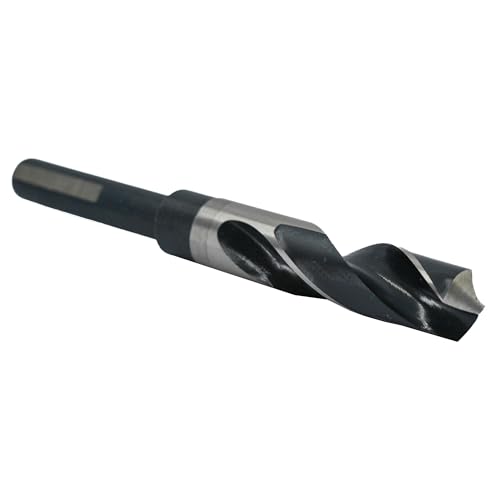
1. MAXTOOL 7/8″ Silver and Deming Drill Bit, HSS M2
Our pick — over 4.5★ from 550+ verified ratings; the strongest balance of quality and price.
The general-purpose workhorse a jobbing machinist reaches for when one bit has to do everything.
This is a high-speed steel M2 bit with a black oxide finish, a 118-degree point, and a 7/8-inch cutting diameter on a 1/2-inch reduced shank. M2 steel is the balanced, all-round grade — hard enough for mild steel, tough enough to make a fast start in wood and aluminum without chipping. The black oxide coating holds lubricant at the cutting edge, which is exactly what keeps heat under control when you are boring a big hole at the drill press.
What wins people over with this bit is the cut itself — owners describe it slicing through materials that cheaper bits fight against, and one owner drilled 116 holes into line posts on a single bit without opening the spare: “I had to drill 116 holes in 58 sections of line posts for a customer… One bit took care of everything.” It also answers the “will it fit my tools?” worry, since the 1/2-inch reduced shank seats in a standard 1/2-inch chuck, and the 6-inch overall length gives you enough reach for a thick bracket or a block you cannot lift to the press.
The honest catch is the 118-degree point. That grind cuts freely but tends to skate on hard or work-hardened steel unless you center-punch first, so a stainless job is where you would rather have the 135-degree bits further down. It also is not a substitute for a cobalt bit when the material is genuinely tough — this is a mild-steel-and-above all-rounder, not a stainless specialist.
What earns the top slot
- M2 high-speed steel with a black oxide finish — cuts fast and resists friction without flaking cheaply.
- 118-degree point with a milled flute that clears chips and starts accurately in softer metals.
- 1/2-inch reduced straight shank drops straight into a standard chuck — no adapter needed.
- 6-inch overall length reaches deeper into a fixture or thick plate.
Where it gives ground
- The 118-degree point wanders easier on hardened stock; center-punch or pilot-drill first.
- Not a cobalt bit, so stainless and heat-treated steel are harder work than with the 135-degree picks.
Reach for it if: you want one dependable bit for mixed metal, wood, and plastic jobs and value an accurate start over maximum heat tolerance.
Think twice if: stainless and hardened steel are your everyday work — the 135-degree cobalt bits handle those better.
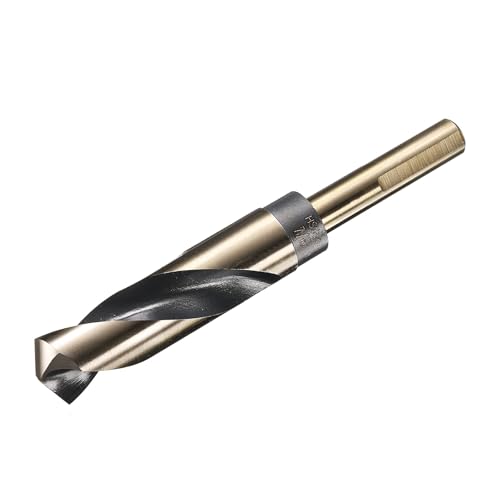
2. uxcell 7/8″ Reduced Shank 3-Flat M35 5% Cobalt Drill Bit
Three cobalt bits at a budget-friendly price — the play if you expect to burn through a bit or two.
Start with the geometry, because it is the whole story here: a 135-degree split-point tip mounted on a 1/2-inch reduced 3-flat shank, cutting a 7/8-inch hole with a 3-inch flute length. The 135-degree grind is the harder-material geometry — it self-centers instead of skating, which is why this bit is aimed at stainless, alloy cast iron, and copper rather than soft stock. And the price buys you a 3-piece package, so you have a fresh edge in the drawer instead of a trip to the store.
The material spec is what makes that price interesting: M35 high-speed steel with 5% cobalt and a black-and-gold finish for corrosion and wear resistance. Cobalt is the element that survives heat, and 5% is the content that turns a bit from a mild-steel cutter into one that will face stainless. Buyers report it cutting 3/8″ 316 stainless cleanly, staying sharp for a few dozen holes rather than hundreds — a fair read for a bit at this end of the range.
Here is the honest trade-off. This is a jobbing-grade tool, not a production bit. Expect it to hold an edge through a batch of holes and then want a touch-up on the grinder, and expect to work harder on a deep, continuous stainless cut than you would with a premium cutter. For occasional oversized work, that math is hard to argue with.
Why the 135-degree point sells it: the split-point tip is meant to bite where you aim instead of walking, and that matters most on stainless. That, plus the 7/8-inch cutting diameter on a shank your 1/2-inch chuck already accepts, is the value proposition in two lines.
Best for: budget-conscious shops that want a cobalt, self-centering bit and don’t mind keeping a spare on hand.
Look elsewhere if: you need a bit to survive heavy, continuous stainless production work — that is premium territory.
3. Drill America 7/8″ Reduced Shank High Speed Steel Drill Bit, D/A3F Series
A general-purpose HSS bit with a 3-flat shank that refuses to slip when the torque builds.
The spec to notice first is the shank. This is a 3/4-inch-class high-speed steel bit — 7/8-inch cutting diameter on a 1/2-inch reduced 3-flat shank, ground to a 118-degree point with a black oxide and bright finish. Three machined flats give the chuck jaws something to bite, which is the difference between a bit that turns and a bit that spins in the jaws under load. The black oxide surface also holds coolant pockets near the cutting edge, so lubricant stays where the heat is.
Owners reach for this for real jobs — drilling rotors for pressed-in wheel studs is the one that comes up, and one owner drilled ten rotor holes with the tenth cut matching the first. In other words, it turns at the correct low rpm with a little cutting oil and simply keeps working. A reviewer bolting this onto an ATV build praised the ATV-friendly chunk of it, cutting clean holes through aluminum. There is also real pride among buyers that a chunk of Drill America’s line is USA-made, which they compare directly to the cheaper imported versions.
Now the limits. The 118-degree point is the traditional grind — great on mild steel and aluminum, but it walks on hardened stock unless you center-punch first. And like every 7/8-inch bit here, it is fussy about speed: run it too fast and you will watch it dull in front of you. Match it to mild and medium steels and it rewards you.
Why machinists like it
- 3-flat shank bites the chuck jaws — less spinning under the torque a big bit creates.
- Black oxide surface holds coolant at the edge and resists corrosion.
- 118-degree point cuts cleanly in low and medium tensile materials like mild steel and aluminum.
- Available in a USA-made line buyers actively seek out for general-purpose work.
What to plan around
- 118-degree approach needs a center punch on hard stock — it will walk otherwise.
- Runs best slow with oil; fast rpms dull it quickly.
Pick this when: your drilling is mostly low and medium tensile steel or aluminum and you want a shank that will not slip mid-cut.
Keep shopping when: your jobs are all stainless or heat-treated alloy — a cobalt 135-degree bit is the better tool.
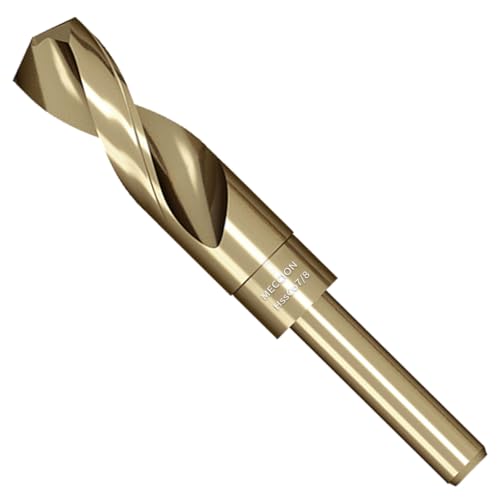
4. Meccion 7/8 Inch M35 Cobalt Reduced Shank Twist Drill Bit
A cobalt bit tuned for cast iron and mixed hard metals — start it slow and it does the job.
This is a 5% cobalt high-speed steel bit with a 135-degree pilot-point tip and a round shank, cutting a 7/8-inch hole on a 1/2-inch reduced diameter. The box claims five times the life of standard bits, but that figure is the maker’s own. What is real is the geometry: the pilot point reduces walking, the round shank gives good concentricity, and the tapered web and large spiral flute push chips out instead of packing them into the cut.
The application stories here lean toward genuinely awkward materials. Owners mention machining the threads off cast iron pipe caps on a bench-top mill — exactly the sort of task that chews up an ordinary bit — and drilling out forged, hardened suspension components and finding the bit still sharp afterward. For a stubborn job in cast iron or a hard-metal casting, this bit is built for the fight. Buyers also report drilling 303 stainless parts up to 1.560″ deep.
The trade-off to know before you buy has nothing to do with the size: it is in the technique the size demands. The maker’s own guidance is to pre-drill a small pilot hole for best results, because a bit this wide generates serious heat. Skip that step, run it fast, and you will cook the edge like any oversized bit — this one included. Treat it as a consumable that can be resharpened and it holds its place.
The machinist’s read: a 135-degree cobalt bit is the right tool for cast iron and hard-metal stock, and the pilot point configuration makes it start accurately where smaller bits would skate. That 5x-life figure is the manufacturer’s claim, not a tested guarantee.
Best suited to: cast iron, hard-metal castings, and the occasional stainless job where you want a cobalt edge that starts where you aim.
Skip the swap for it if: you only ever drill mild steel or wood — a cheaper standard HSS bit does that without cobalt.
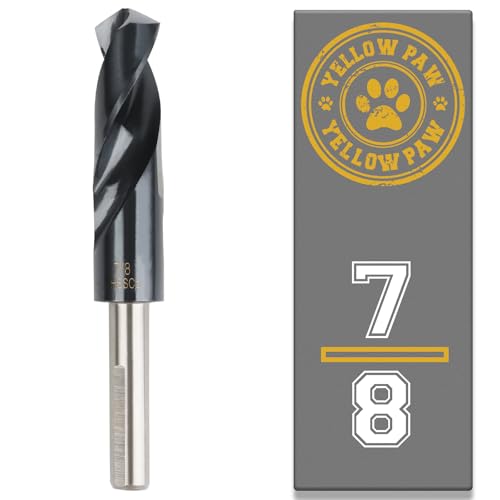
5. Yellow Paw 7/8 Inch Drill Bit for Metal, Industrial Grade M35 Cobalt
The through-and-through cutter for shop work — 5% cobalt, a 135-degree split point, and a TiAlN coat built for heat.
The headline spec is the combo: a 7/8-inch cutting diameter and 6-inch total length with a 3-inch working flute, in 5% cobalt M35 steel finished with titanium aluminum nitride. That last bit — TiAlN, a hard ceramic-style coating — is what gives the bit its heat resistance, so it keeps cutting when a plain bit would be asking to cool. The 135-degree split point resists walking into stiff material, and the whole bit arrives in a plastic storage case.
Where the Yellow Paw earns its place is in metal that fights back. Customers note it boring through a recycled railroad rail and bed-frame angle that standard HSS bits would not touch, cutting braked calipers to take wheel studs, and working hardened 8-ga. steel plate without cutting fluid. That is the picture of a bit that tolerates temperature and keeps working. The company is US-based, and the listing backs it with a customer-satisfaction guarantee and a stated replacement offer — little comfort on a hot job, but a decent signal for a tool that will eventually wear.
To be straight with you: 7/8-inch is a lot of steel to spin, and the bit has to be run slow with pressure. Owners are unanimous that cutting fluid and a steady feed turn a difficult job into a clean hole, so factor in a bottle of oil. And on the hardest stainless, the split-point geometry still has limits — no bit of this size will match a fresh bit on day one after a hard run without a touch-up on the grinder.
Why it leads on value
- 5% cobalt M35 steel with a TiAlN coating for heat resistance in tough metals.
- 135-degree split point starts accurately in stiff material with less walking.
- 3-inch working flute and 6-inch total length give real reach and good chip clearance.
- Plastic case included for storage and a clean edge on the next job.
Real-world budget notes
- Demands slow rpm, steady pressure, and cutting oil — running it fast burns the edge.
- Not a scraper for the toughest stainless without a touch-up after a hard run.
Right choice for: anyone who wants one 7/8-inch bit for repeated work in hard metal and is prepared to run it slow with coolant.
Not the one for: a one-off soft-metal job, where a cheaper HSS bit does the same thing for less.
6. Accusize ANSI M35 S&D Drill Bit, 7/8 in, 0412-0078

A 135-degree cobalt bit with a 3-flat shank — the machinist’s pick for stainless and heat-treated work.
Here is the setup on this one: an ANSI M35 (high-speed steel plus 5% cobalt) silver-and-deming bit, 7/8-inch cutting diameter, 1/2-inch shank with three equal flats, 6-inch overall length, and a 3-inch flute. The 135-degree split point is what gives it the bite. Unlike a standard 118-degree point — the one found on cheaper bits — this cobalt grind self-centers, so on stainless or hardened stock it does not need a spot drill first and it cuts with much less wobble.
Owners put it through low-rpm press work in 1/4-inch plate steel with cutting oil, and the recurring note is a clean, straight hole at the right diameter without significant dulling. For a shop that drills stainless on a steady basis, the 3-flat shank finishes the case: three flats mean three places for the chuck jaws to grab, so the bit stays put under the twist of a big cutter. Build the pilot hole first and this bit holds its size through the run.
The fine print: this is a cobalt bit with a split point, which is exactly the trade-off — it demands a slow speed and a real cutting fluid, and it is priced at the top of the cobalt tier because of that. If you just want to open a hole in soft steel, a cheaper bit does it. If stainless is the job, this is the geometry to buy.
Why the split point is the selling point: a 135-degree cobalt tip does not need a spot drill to stay on center, so it starts cleanly on stainless and holds a straight, right-sized hole through the run.
Set your sights on it if: stainless steel and heat-treated parts are routine in your shop and you want a bit that starts on center without a pilot.
Leave it on the shelf if: your work is mild steel only — a lower-tier HSS bit gets that done for less.
7. PATIKIL 7/8″ Drill Bit, 1/2″ Shank M35 Cobalt 5% HSS
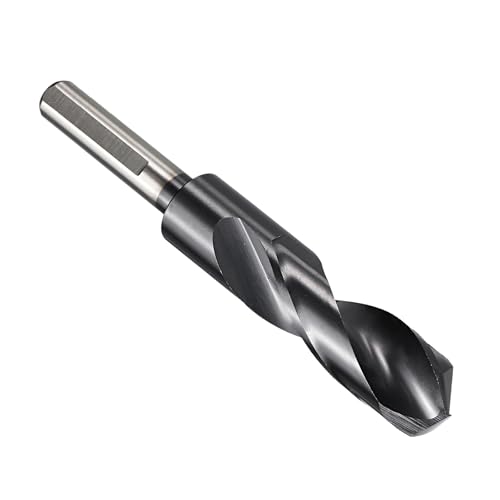
A cobalt bit with a coating and a 3-flat shank for jobs that run hot and fast.
Start with the two specs that define this one: M35 high-speed steel with 5% cobalt and a titanium aluminum nitride coating, cutting a 7/8-inch hole on a 1/2-inch reduced 3-flat shank with a 135-degree split point. Titanium aluminum nitride is a hard, heat-resistant coating, and it works with the cobalt content to keep the edge from chipping when a cut runs hot. For a drill bit, that combination is about surviving high-speed stainless and alloy work — not just frowning at the material.
The application note is worth reading before you use it. The maker’s guidance is to keep the bit perpendicular, drop the rpm on stainless, and keep steady but moderate feed pressure — with a strong recommendation to use cutting fluid or, failing that, to lift the bit often to clear chips and cool it. That is good practice on any 7/8-inch bit, and it is repeated here because this one is aimed at materials where heat kills an edge fast. When you follow it, the paying job is boring a large hole without the edge chipping out.
Be honest about what it is, though. This is a solid, machined cobalt bit for dry, light-metal, and general shop work — not a specialist that survives a hundred continuous stainless holes. Like every bit at this diameter, it is a consumable: expect to resharpen it after a hard run, and let the cobalt content and coating do their job in the meantime.
The reason to consider it: 5% cobalt is the content that earns its keep on heat, and a 135-degree split point keeps the hole where you want it. Combine that with the TiAlN coating and a 3-flat shank and you have a bit aimed squarely at dirty, high-speed alloy work.
Go for it if: you cut stainless and alloy steel and want a coated cobalt bit with a shank that stays put in the chuck.
Pass if: you want a throwaway bit for soft wood and plastic — the cobalt and coating are wasted on that.
8. NordWolf M35 Cobalt 7/8″ Stubby Drill Bit with 7/16″ Hex Shank
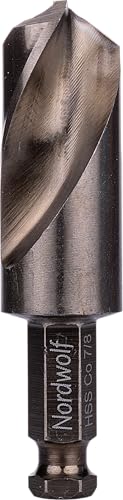
The stubby oddball that reaches holes no full-length bit can touch — and locks into an impact driver.
Every other pick here is a long bit. This one is the opposite: a 7/8-inch cutting diameter on a 2.36-inch overall body with a 1-inch cutting flute and a 7/16-inch hex shank. M35 cobalt steel and a 135-degree split point do the cutting. The short body is the whole point of the design — it lets the bit sit inside a tight frame, a recessed bracket, or a spot where a 6-inch bit simply will not fit. The hex shank is the second half of the idea: it slips into standard chucks, quick-change chucks, and impact drivers, so you can drill with the tool already in your hand.
Reviewers point out using it with a magnetic drill after adapting the arbor, and boring clean, burr-free holes in PVC and steel and round vent pipe without the bit skating on the surface. Using it to cut out a seized part — an oxygen sensor rusted solid — comes up as well. The short overall length has a real payoff here: less bit hanging out of the chuck means more stiffness, less flex, and less chance of a wandering entry, which is exactly what you want in a hole you cannot see.
Two honest limits. This is short, so it will not deepen a hole that a longer bit opened — buy it for the tight spot, not the deep bore. And a bit this rigid in a hex shank can be unforgiving if you over-torque it in a tight hole; a steady hand serves you better than a heavy foot.
The case for the stubby
- 2.36-inch overall length reaches hard-to-access, tight spaces a full-length bit cannot.
- 7/16-inch hex shank fits standard and quick-change chucks plus impact drivers.
- M35 cobalt with a 135-degree split point handles stainless and aluminum.
- 1-inch cutting flute with no walking on round stock like vent piping.
Where it stops short
- Short body will not reach the bottom of a deep hole — pair it with a long bit for that.
- Rigid in the chuck, so go easy on over-torquing in a tight spot.
Worth grabbing if: your hole is in a tight, recessed spot and you want to drive it straight from an impact driver.
Not your bit if: you mostly drill deep, straight-through holes — a full 6-inch bit covers that far better.
9. VALYRIANTOOL 3PCS 7/8 Inch Cobalt Drill Bit Set, M35 HSSCO
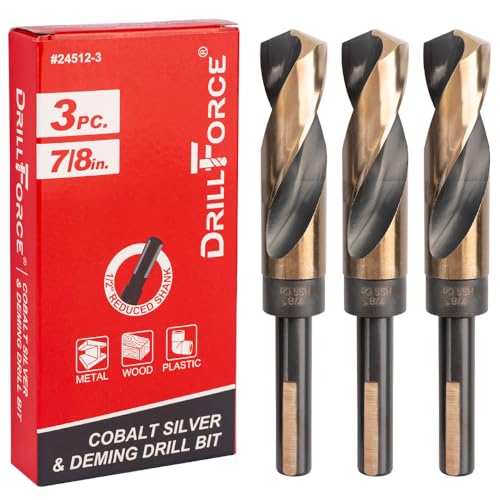
Three cobalt bits and a gold finish — the spare-heavy pick for stainless jobs done in batches.
Three bits in one box is the first thing you notice, and here it is matched by a real spec sheet: M35 HSSCO high-speed steel, a 135-degree split point, and a round reduced shank on a 6-inch bit with a 1/2-inch body. The black-and-gold finish is the coating side of the deal — the same black oxide family that holds lubricant at the cutting edge, extended across three bits instead of one. The point angle is the one meant to center accurately and cut fast without wandering.
The set is aimed at shop jobs where a bit might not survive the batch: stainless, cast iron, zinc alloy, and copper. It is the right thing to have when a job calls for several holes in material that eats an edge, because a fresh bit is snapped in and the dull one goes to the grinder. And that is exactly the situation that turns a single expensive bit into an expensive mistake. This set turns it into a stocked drawer.
Say it plainly: getting three is the value, and buying three means paying once for a set rather than three times for singles. If your drilling is occasional and gentle, one bit would be enough — this is for the person who already knows a 7/8-inch bit wears out under real work.
The value case: a 3-piece set turns bit wear from an interruption into a spanner-in-the-drawer fix. The 135-degree split point and 5% cobalt M35 steel mean the bits are built to face stainless, not just mild steel.
Buy this one when: you do repeated stainless and hard-metal drilling and want spares on the bench from day one.
Overkill if: one 7/8-inch hole is a once-a-year need — a single bit covers that.
Understanding the Specs
Cutting Angle (118 vs 135 Degrees)
The cutting angle is the angle at the very tip of the bit — the point where the two cutting edges meet. A 118-degree point is the traditional grind: it shears metal efficiently, but its longer, sharper nose tends to wander when it hits a hard surface. A 135-degree point is a blunter, more stable tip that resists walking and often carries a split point (a small secondary grind that starts the cut like its own pilot). The practical effect: 135-degree bits are the ones to pick for stainless, hardened steel, and awkward angled work, while 118-degree bits suit mild steel, aluminum, wood, and plastic just fine.
Shank Geometry and Chuck Fit
The shank is the smooth end that seats in the chuck. At 7/8-inch cutting diameter, a full-size shank would fit almost no home drill, so these bits use a reduced shank: a 1/2-inch mounting section sized to a standard half-inch chuck. On top of that the shape matters — a plain round shank relies on jaw pressure alone, a 3-flat shank has three machined flats the jaws can grab, and a hex shank is built for quick-change chucks and impact drivers. A firmer grip means less spin, better hole accuracy, and less chance the bit marrs the workpiece as it slips.
FAQ
Will a 7/8 inch drill bit fit my drill?
What is a reduced shank drill bit and why does it matter?
Do I need a pilot hole before drilling with a 7/8 inch bit?
Can a 7/8 inch bit drill through stainless steel?
Why does my 7/8 inch bit walk on the surface?
How long will a 7/8 inch cobalt bit last?
What is the difference between HSS M2 and M35 cobalt bits?
Which shank type is best — round, 3-flat, or hex?
Can I use a 7/8 inch bit on wood and plastic?
Is it worth buying a 3-piece 7/8 inch bit set over a single bit?
What speed and technique should I use with a 7/8 inch bit?
Final Thoughts: The Verdict
For most shops, the 7/8 inch drill bit winner is the MAXTOOL Silver and Deming bit because its M2 steel and 118-degree point cut metal, wood, and plastic cleanly and seat into any standard half-inch chuck — the crowd favorite here, rated 4.6 stars by 550+ owners. If your work runs to stainless, cast iron, or hardened alloy, grab the Yellow Paw M35 Cobalt bit, whose 5% cobalt and TiAlN coating are built for heat, or the uxcell 3-piece cobalt pack if you want spares on the bench without stretching the budget. And for a hole in a tight, recessed spot where no full-length bit fits, the NordWolf stubby bit is the one to reach for. Whichever you choose, run it slow with fluid, and it will cut far better than a fast, dry pass ever will.
How We Picked
We do not accept paid placement. Every pick is matched to a real buyer and a real use-case; we do not hands-on test units.
Sources & Methodology
Specifications: manufacturer listings and product documentation. Review insights: verified customer reviews, as of September 2026. Pricing: not shown on this page (it changes often); check the current price via the retailer link.
As an Amazon Associate, Gadgets Feed earns from qualifying purchases. This does not affect which products we feature.