
Our readers keep the lights on and my morning glass full of iced black tea. As an Amazon Associate, I earn from qualifying purchases.
Specs are compiled from manufacturer listings and verified buyer reviews and can change over time — please confirm the key details on the product page before buying.
When the power goes out, you want your router, phone, laptop, fan, and even a small fridge or a CPAP machine to keep running without spending a fortune. A good budget power station does that. The hard part is picking one that holds its charge, recharges fast enough to be ready again, and does not quietly fall apart after a few months. That is what this guide sorts out for you.
I’m Min — the founder and writer behind Gadgets Feed. This guide is built by comparing the manufacturers’ published specifications and the patterns across verified customer reviews, so you get each pick’s real strengths and trade-offs instead of marketing spin.
Here is what separates a keeper from a regret: battery chemistry, honest capacity, and recharge speed you can live with. Below you will find the models that hold up in real outages, camping trips, and road life, so you can pick the right budget power station without guessing.
Our Picks at a Glance
How To Choose The Best Budget Power Station
Buying a power station for the first time is confusing because every listing shouts about watts. Watts tell you what the unit can push out at once. Watt-hours (Wh) tell you how long it can keep doing that. A station rated at 500W with 512Wh will run a 100W device for roughly five hours; a 300W station with 220Wh gives you far less. Always check the Wh number first, because that is your real run time.
Battery Chemistry Decides How Long It Lasts
Most older budget stations use standard lithium-ion cells. LiFePO4 (lithium iron phosphate, a chemistry that handles far more recharge cycles) is the upgrade worth hunting for. A LiFePO4 pack rated for thousands of cycles keeps working for years, where a standard lithium-ion pack fades after a few hundred charges. If you plan to leave the unit plugged in as a home backup for a decade, this one choice matters more than any other spec on the page.
Recharge Speed Is Your Real Emergency Test
A station that takes eight hours to refill is useless if the outage is already happening. Look for fast AC charging, ideally under two hours for a full top-up, and check whether the unit supports AC and DC charging at the same time. Solar input matters for camping, but a 40W panel on a cloudy day will top up slowly — it is a trickle, not a refill. Car charging (through the 12V outlet) is your middle ground on the road.
Ports And Sine Wave Protect Your Gear
Pure sine wave AC output matters because sensitive electronics — laptops, CPAP machines, routers — can misbehave on the choppy power a cheap inverter produces. For laptop owners, a USB-C PD port rated at 60W or 100W lets you skip the wall brick entirely. A car port and DC outputs cover 12V accessories like fridges and camp lights.
Quick Comparison
| Model | Best For | Capacity (Wh) | Output (W) | Weight | Amazon |
|---|---|---|---|---|---|
| ALLWEI 500W 512Wh★ Best Overall | Home backup & CPAP | 512Wh | 500W | 13 lb | Amazon |
| LIBRIDS 640WhTop Performer | Fast UPS & heavy loads | 640Wh | 600W | — | Amazon |
| VTOMAN Jump 600XFastest Recharge | Fast recharge & RV travel | 268.8Wh | 600W | 9.92 lb | Amazon |
| EBL 500W 519.48Wh | Camping & home office | 519.48Wh | 500W | 18 lb | Amazon |
| GRECELL EB500 (519Wh) | Craft shows & car fridge | 519Wh | 500W | 18 lb | Amazon |
| GRECELL 500W 519.48Wh | Camping & basecamp | 519.48Wh | 500W | 14.1 lb | Amazon |
| Apowking HP200L 220Wh | Hiking & tent camping | 220Wh | 300W | 5 lb | Amazon |
| Bailibatt 300W 257Wh | Light travel & emergencies | 257Wh | 300W | 5.4 lb | Amazon |
In‑Depth Reviews
1. ALLWEI Portable Power Station 500W, 512Wh LiFePO4
Our pick — over 4★ from 2,000+ verified ratings; the strongest balance of quality and price.
The LiFePO4 workhorse that keeps a fridge and a CPAP running when the grid quits
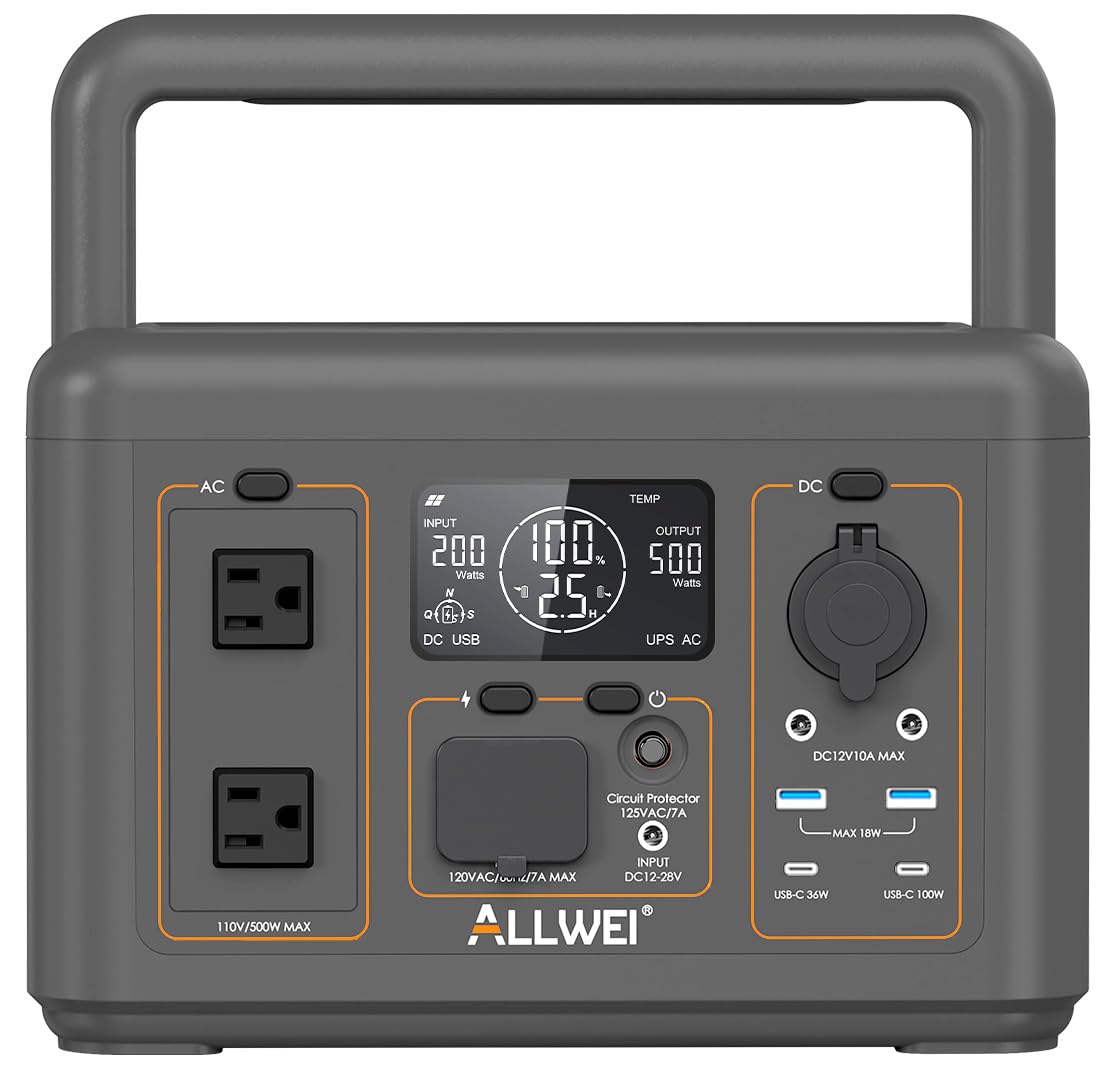
Start with the two numbers that decide everything. The 512Wh LiFePO4 battery (a lithium iron phosphate pack built for far more recharge cycles than ordinary lithium) is the largest capacity here, and the 500W output handles most household essentials. Hold it next to the 300W Bailibatt and the gap is plain: 512Wh versus 257Wh, and 13 pounds versus that unit’s 5.4 pounds. You are trading carry weight for staying power.
What wins people over is the build. Owners running it for emergency duty report a CPAP lasting through the night. As buyers report, it runs a BMC Luna 2 for 20 hours over three nights and a Respironics Dream Station 2 for 12 hours across two nights. A full charge takes 2.5 hours on the wall in Q Mode, or 6.5 hours on a 100W solar panel. Two USB-C ports (one pushing 100W) mean your laptop skips the wall brick.
The catch is the reliability picture, which runs mixed rather than glowing. The unit is the heaviest on this list and the charge meter has been known to behave oddly, so treat it as a stationary home backup rather than a frequent flier. If you want something you can sling in a backpack, this is not it.
Where It Pulls Ahead
- 512Wh LiFePO4 capacity, the largest battery pack in this roundup
- Rated for 3,000 charge cycles to 70% capacity — roughly a decade of home-backup use
- UPS mode plus 1000W surge covers sensitive gear and motor starts
- Full wall charge in 2.5 hours; dual USB-C with a 100W port
What To Weigh First
- The heaviest model here, so it stays put rather than travels
- Charge display can misbehave; reliability feedback runs mixed
- No 24V output — 24V input only
Made for: keeping your fridge, router, and CPAP alive at home through long outages
Pass it over if: you want carry-light camping power — its 13 pounds and stationary build suit a shelf, not a daypack
2. LIBRIDS Portable Power Station 640Wh, 1200W Surge
The fastest-charging box here — 1.5 hours to full, 10ms to switch over
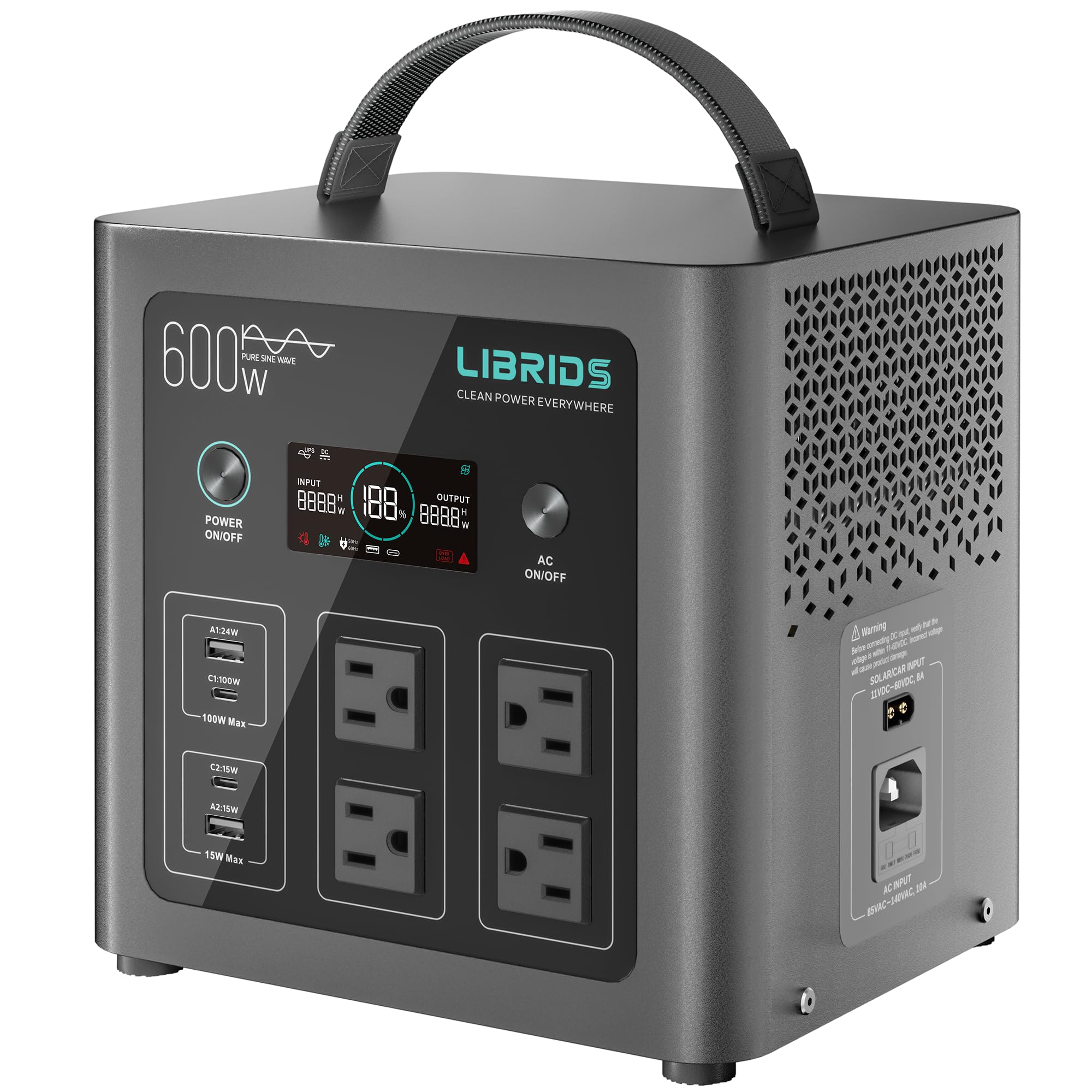
If you hate waiting for a recharge, the LIBRIDS ends the argument. It goes from empty to fully charged in 1.5 hours on AC, so you can top it up during a lunch break. Its 10ms UPS (an automatic switch that jumps to battery in a few thousandths of a second) keeps a router or computer alive through a brownout. Nothing else in this lineup refills that fast — the EBL, for instance, takes 6-7 hours on the wall.
Capacity is 640Wh, the largest pack on this page, with 600W continuous and 1200W surge. That surge is what lets a compressor-driven appliance — a fridge, a freezer — start up without tripping. Owners ran a deep freezer through a blown transformer at roughly 5% battery drop per hour, and a 45L fridge for 6-7 hours. Four AC outlets plus USB ports cover up to eight devices at once, and the metal enclosure helps it shed heat indoors.
Weigh this honestly: it is a heavier, indoor-leaning unit. The bottom label carries a UL safety warning that it is meant for dry, well-ventilated indoor use and should not meet rain or moisture. So it is brilliant as a home or campsite-under-clear-skies backup, not a rain-soaked trail companion.
Why it earns a top slot: it pairs the biggest pack here with the fastest recharge and a 4,000-plus cycle LiFePO4 battery backed by a 5-year warranty.
One thing you should know: the “Indoor Use Only” warning is real, so keep it out of rain, humidity, and wet conditions.
Reach for this if: you want an always-ready home backup that refills over a lunch break
Look elsewhere if: you need a station that lives outdoors in the weather
3. VTOMAN Jump 600X Portable Power Station 600W
Barely ten pounds, 80% charged in fifty minutes — built for the road, not the shelf
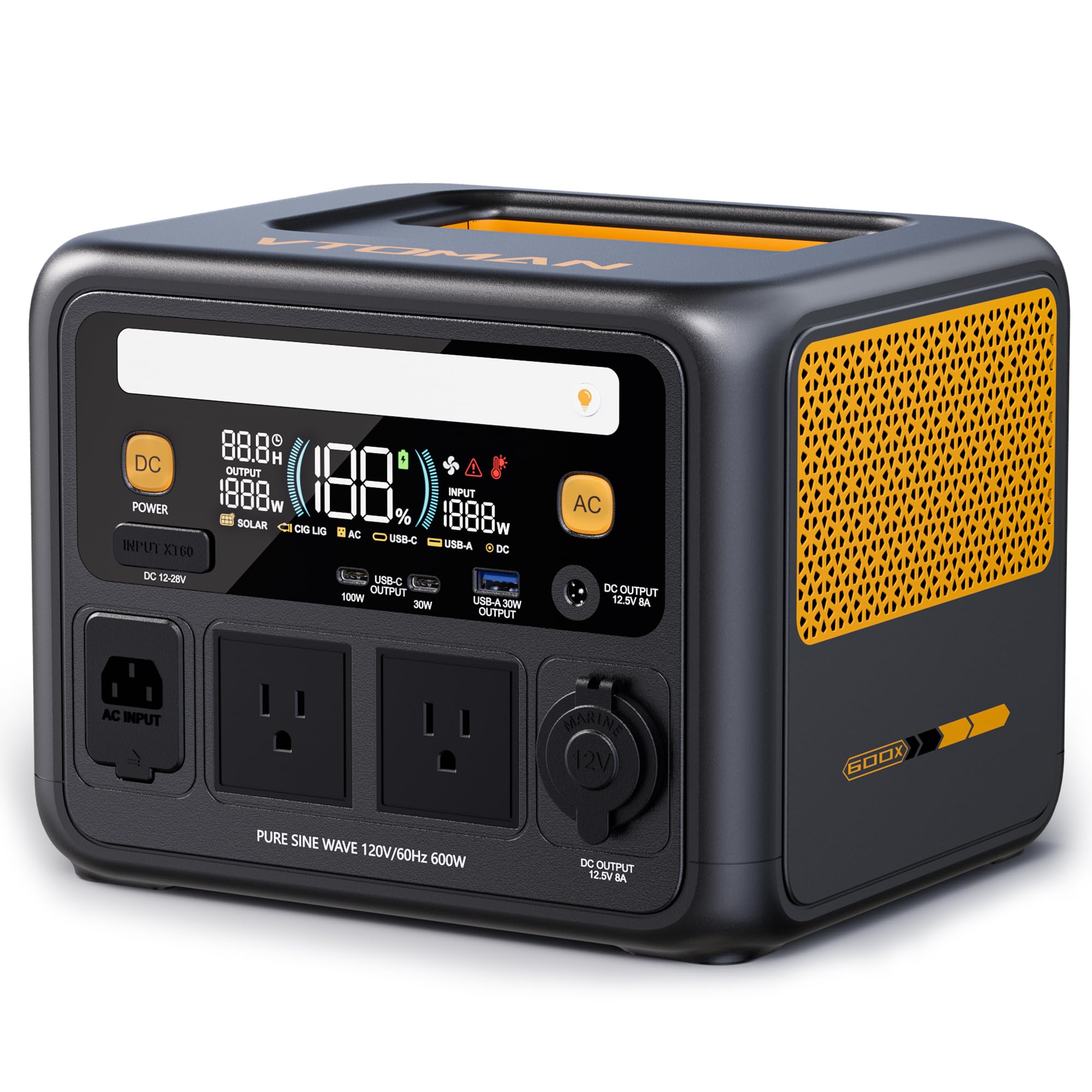
You can carry this VTOMAN one-handed and still get fast charging. At 9.92 pounds and 9.4 × 8.1 × 7.2 inches, it is light enough to grab with one hand, and the flat top slides into a packing gap — the maker states it is about 27% smaller and 32% lighter than the previous model. Plug it in and CHARGE CORE hits 80% in 50 minutes, full in 75, or about 2 hours on the 170W AC input.
Its LiFePO4 pack is rated for 3,000 cycles to 80% capacity, and the 600W pure sine wave output with a 1200W surge starts a fridge compressor or a power tool. The 100W USB-C PD port — 67% more power than the previous 60W version — fills a laptop fast. Owners run a mini fridge for 5-plus hours on half charge and keep a PC and two monitors going for 8-plus hours during outages.
Here is the honest trade: the 268.8Wh pack is the smallest capacity among the mid-tier picks, so heavy loads drain it quicker than the 500Wh-class rivals. Capacity for the price is the recurring note — great for camping and short outages, tighter if you plan to run a fridge around the clock.
What Buyers Rave About
- 9.92 lb and a compact flat-top frame make one-hand carry easy
- 80% in 50 minutes, full in 75 via AC plus DC simultaneous charging
- 3000-cycle LiFePO4 pack with 12 built-in protections
Read Before You Decide
- 268.8Wh is small — heavy loads empty it faster than the 500Wh rivals
- The 12V DC port won’t drive a 150W car heater; use the AC outlet instead
The right call for: road-trippers and remote workers who value a fast refill and light carry
Think twice if: your plan is to run a fridge continuously — the smaller pack will not stretch that far
4. EBL Portable Power Station 500W (Peak 1000W), 519.48Wh
Ten ports, a wireless charging pad, and enough muscle to run a small air conditioner
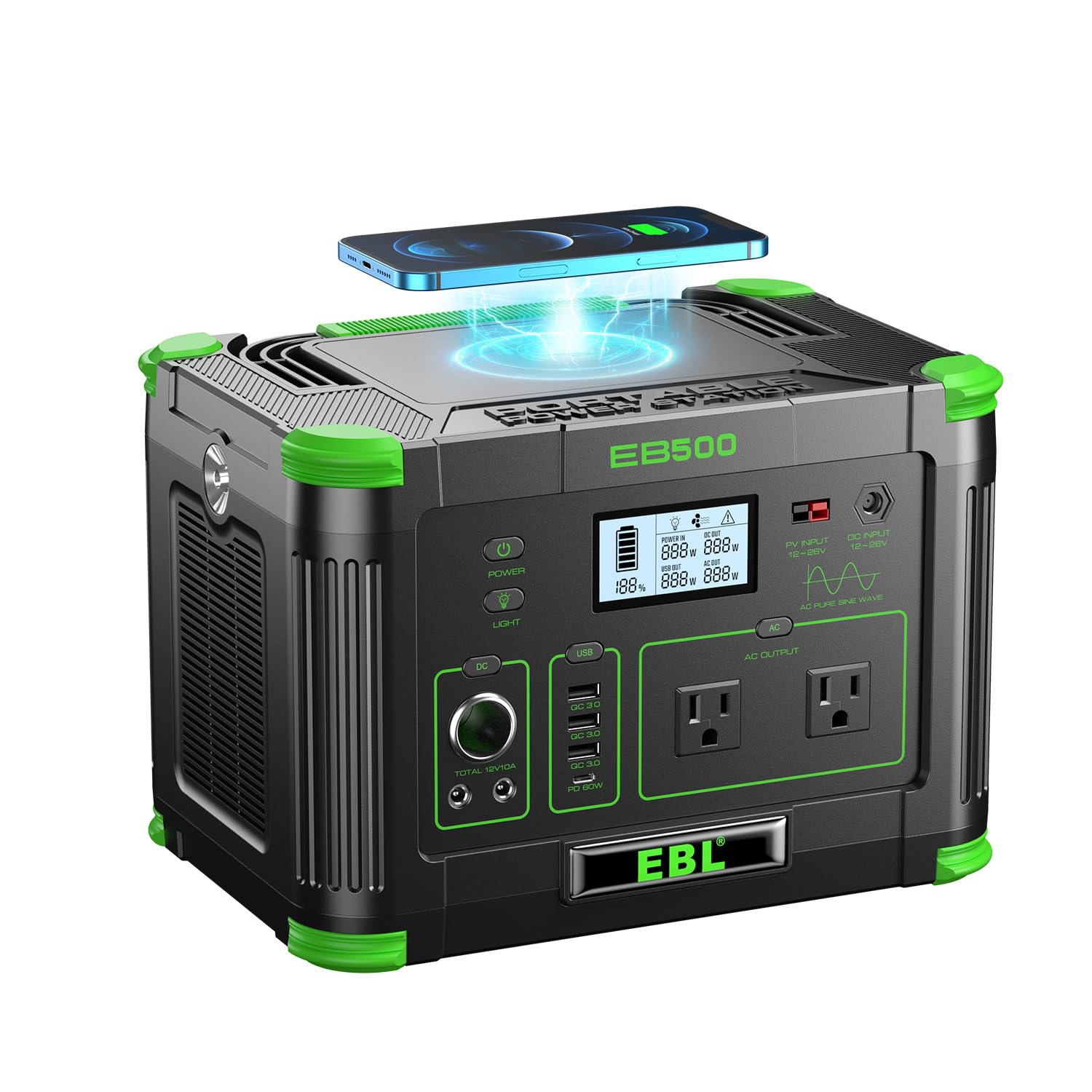
You get more ports here than on any other pick: a 519.48Wh (140,400mAh) pack feeding two AC outlets, three USB-A, one USB-C PD, two DC ports, a car port, and a wireless charging pad. The 500W output with a 1000W peak drives everything from routers to a 6000 BTU air conditioner — owners who ran a 615W air conditioner got 4 hours straight in peak heat, and a large fan on high ran 4 hours leaving 25% in reserve.
For home-office duty it is a steady hand: keeping a Wi-Fi router and computer running through a full-day outage with charge to spare is exactly the scenario this was built for. Recharge runs 6-7 hours on the wall, 7-8 in the car, or 6-9 on a 100W-plus solar panel. The wireless pad is a neat extra for phones, though a thick case can block it.
The one honest note is a rare-unit reliability snag — an occasional unit arrives with an unresponsive AC outlet, and the units run heavy at 18 pounds. As with any station, test your AC output the day it lands, well before the trip that matters.
Standout spec: that wireless charging pad plus nine physical ports turns one box into a charging station for the whole family.
Sizing tip: at 18 pounds it is a car-and-home unit, so plan a permanent spot rather than a backpack slot.
Best matched to: households that want to charge a pile of devices at once from a single brick
Less ideal when: you want something pocket-light to carry on a hike
5. GRECELL Portable Power Station 500W, 519Wh
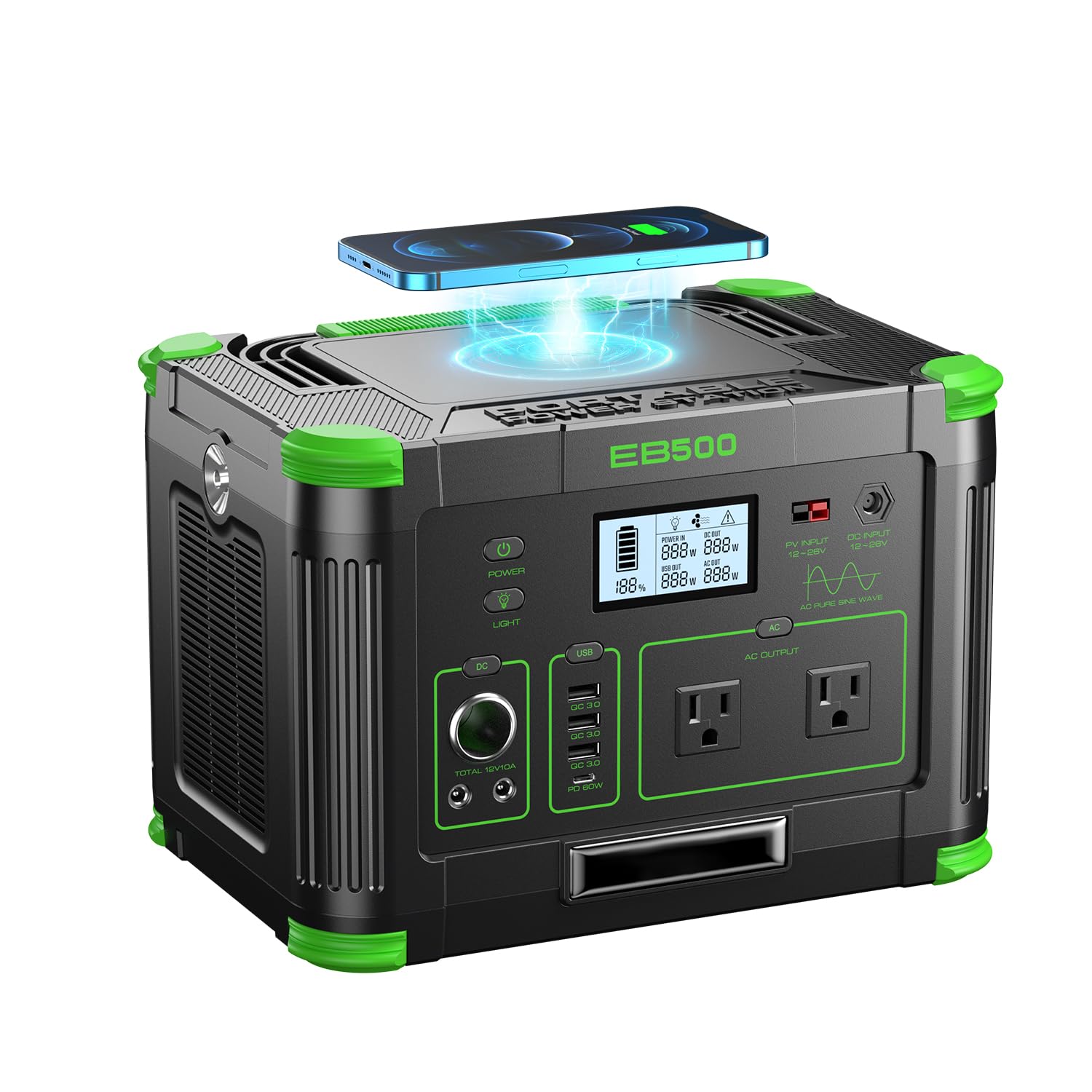
A ten-device power hub that sips battery through an overnight car-fridge run
The headline number is 519Wh (140,400mAh) feeding a 500W pure sine wave output across a full deck of ports — two AC, three USB-A QC, one 60W USB-C PD, two DC, a car port, and a wireless charger. That is ten devices at once, and the 60W USB-C fills a laptop more than twice as fast as a standard USB-C charger.
What earns it a value slot is real-world endurance. It ran a car fridge overnight for 11 hours still showing 100%, and at craft shows it powered two lamps for 9 hours with 40% remaining. Recharge is flexible: 6-7 hours on the wall, 7-8 on the car, or 6-9 on a 100W solar panel. A built-in BMS (battery management system, which watches temperature and current to cut power before damage) guards against overcharge and shorts.
Do plan around the weight — at 18 pounds this is a stay-put unit, not a lug-around. And as with any station, order early enough to test it before you rely on it.
Why It Wins On Value
- 519Wh pack at a value-tier price point
- Ten outputs including 60W USB-C PD and a 10W wireless pad
- Handles an overnight fridge run with battery to spare
Size It Right
- 18 pounds makes it a home or basecamp fixture, not a travel carry
- Solar top-up is slow in anything but full sun
Ideal for: families and vendors powering several devices from one station without chasing a premium price
Skip it when: you need power you can carry on your back
6. GRECELL Portable Power Station 500W, 519.48Wh
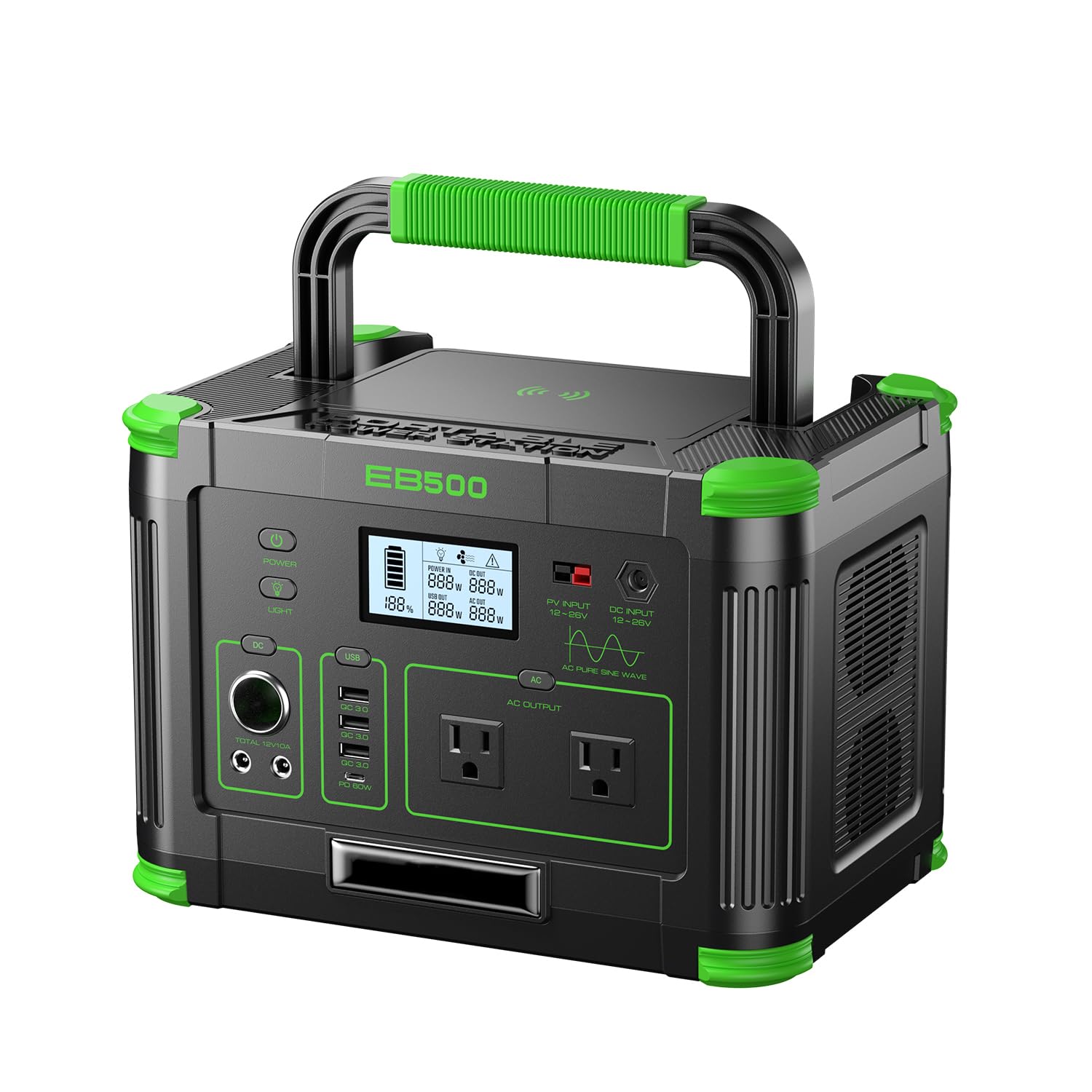
A dark-green basecamp box with a built-in flashlight and a solid carry handle
Where the LIBRIDS leans indoors, this GRECELL is dressed for the campsite. The 519.48Wh pack pushes 500W through two pure sine wave AC outlets, and the deck runs ten ports total — three USB-A QC, a 60W USB-C PD, two DC, a car port, and a 10W wireless charger. The built-in LED flashlight with light-strobe-SOS modes is the tell that this one was designed for trips and outages alike.
At 14.1 pounds with a solid handle it is lighter than the other 500W-class units here, which makes it the more forgiving one to haul to a tent or an RV. A smart BMS watches temperature, voltage, and current to keep the lithium pack safe. Recharge gives you three routes — 6-7 hours wall, 7-8 car, or 6-9 on solar with a 100W panel. Owners mention it running camping gear, projectors, and road-trip essentials reliably.
The honest limit is solar: recharging from a panel is a slow trickle and, in anything less than strong sun, barely moves the needle — one buyer watched it climb from 59% to 61% in an hour. Treat solar as a top-up between wall charges, not your main source.
what separates it: a 14.1-pound carry weight and an SOS flashlight make it a camping-first station, unlike the heavier home-only units above.
The caveat to plan for: solar recharge is genuinely slow, so bring a wall outlet into the trip where you can.
Go for this if: camping and road trips sit at the top of your list and you want a lighter 500W-class pack
Not the one if: you expect a solar panel to refill it quickly off-grid
7. Apowking Portable Solar Generator 300W with 40W Panel

Five pounds, a bundled 40W solar panel, and a floodlight that runs for days
This is the only station here that ships with its own solar panel — a 40W monocrystalline unit using 24% high-efficiency cells built to grab what light it can in dawn, dusk, or overcast conditions. The station itself packs a 220Wh (60,000mAh) Li-ion battery into a 5-pound body measuring 8.5 × 6.7 × 4.1 inches, small enough for a daypack. Output runs 300W rated with a 600W peak across seven ports.
The extra that surprises people is the light. Rather than a token flashlight, it has a wide-area LED backlight that covers up to 100 square feet in a 5000K, roughly 300-lumen beam for 30-plus hours on one charge — pitched-tent reading or cooking at dusk sorted. Owners note it holds a good charge for its compact size, runs a small TV and sump pump during outages, and holds charge about 8 hours in mixed use.
The trade is charging speed, and it is the recurring gripe. Wall charging is slow (4-plus hours for a full top-up) and the bundled 40W panel tops up gradually — owners consistently wish it were a 60W panel. If you will mostly plugin at home and take the panel as a backup, this is a light, capable rig; if you expect fast solar refills, temper expectations.
Where it fits: hikers and tent campers who want the lightest self-contained solar kit, panel included, at a wallet-friendly price.
The speed caveat: charging — wall or solar — is the slowest here, so size it for overnight refills rather than quick top-ups.
Suits you if: portability and a bundled panel matter more to you than fast charging
Reconsider if: quick recharge is your priority — this one takes its time
8. Bailibatt Portable Power Station 300W, 257Wh
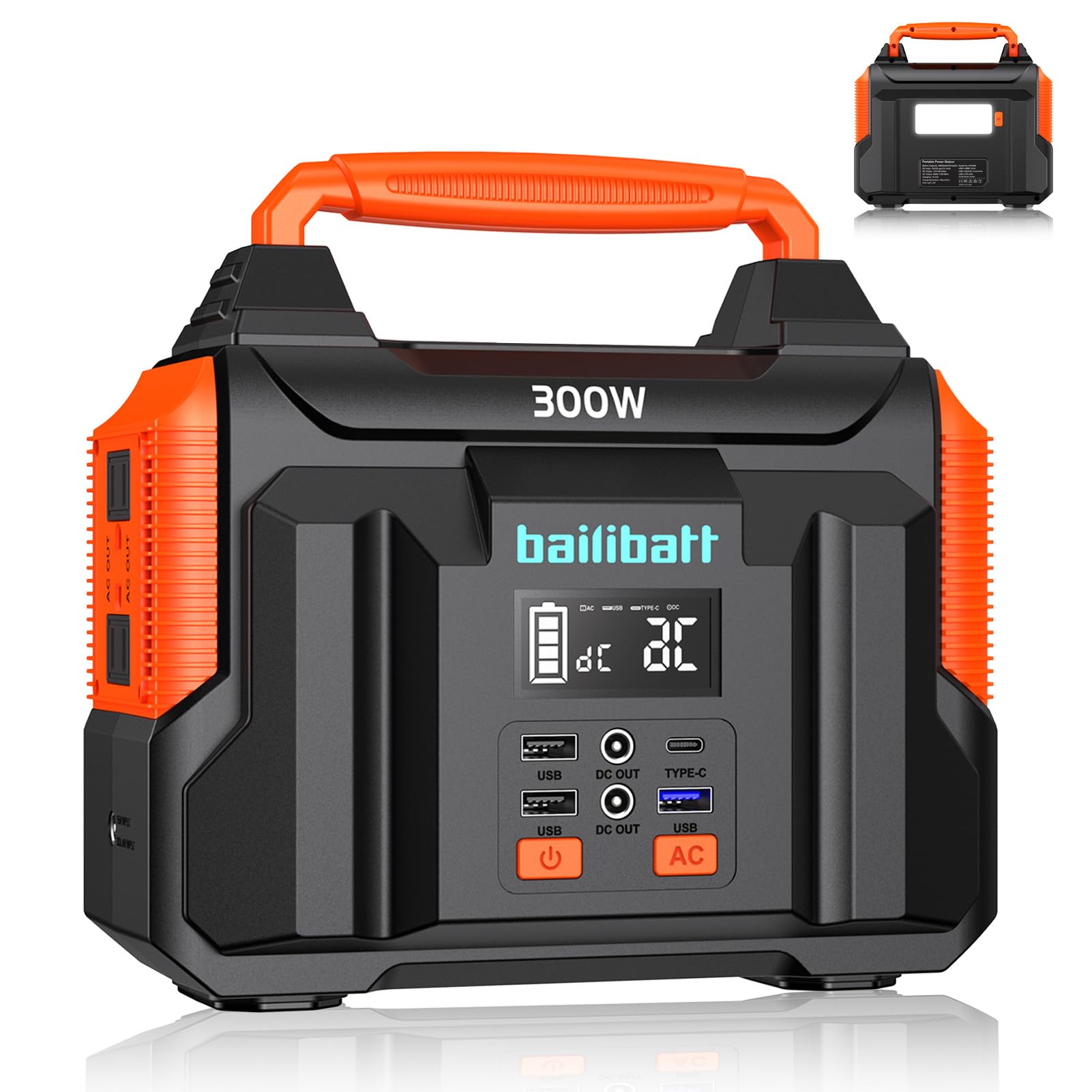
The featherweight backpack pick that still runs a CPAP for two days
For pure grab-and-go convenience, this is hard to argue with: 4.6 pounds and a built-in 69,600mAh battery inside a body that fits in a daypack. Set against the ALLWEI above, the size gap is stark — 5.4 pounds versus 13 pounds, and a 257Wh pack versus 512Wh. You are choosing light carry over long runtime.
Eight outputs keep it useful: two 120V pure sine wave AC outlets, dual 12V/10A DC ports, a 24W USB-C PD, a QC3.0 port, and two USB-A. The 257Wh Grade-A pack is rated for 1,500-plus charge cycles, with a BMS guarding voltage, current, and temperature. As customers note, it runs a Philips CPAP for two days off a 12V adapter. It also recharged phones and flashlights through a prolonged outage and made coffee while never registering fully charged.
The honest catch: the 300W ceiling and 257Wh pack mean bigger appliances are out of reach, and a few owners find the battery drains faster than expected. It is a devices-and-CPAP station, not a fridge-and-freezer one.
What Makes It Tick
- 4.6 lb and compact — genuinely backpackable
- Runs a CPAP for two days on a 12V adapter
- Eight ports spanning AC, DC, USB-C PD, and QC3.0
Set Your Expectations
- 300W / 257Wh limits it to devices, not large appliances
- Some owners find the battery drains quicker than claimed
Perfect when: your priority is a light emergency pack for phones, laptops, and a CPAP
Not your unit if: you need to run a fridge or run high-draw gear
Understanding the Specs
Watt-Hours vs Watts
Watts (W) tell you the maximum you can plug in at once — a 500W station runs anything rated under 500W. Watt-hours (Wh) tell you how long that power lasts. A 512Wh pack running a 100W load lasts roughly five hours; a 220Wh pack lasts far less on the same load. Always read both numbers together, and check the surge rating (often double the continuous wattage) because motors on fridges and power tools pull a big spike at startup.
Battery Chemistry and Cycle Life
LiFePO4 (lithium iron phosphate, a chemistry that tolerates far more recharge cycles) lasts longer than standard lithium-ion, and a rating like 3,000 or 4,000 cycles to 80% capacity is the number to look for. Cycle count is the number of full charge-and-drain runs before the pack holds noticeably less. Higher cycles means the station keeps working for years of outages rather than fading after a season.
FAQ
How many watt-hours do I need to run a fridge or freezer?
Why does my station shut off when I plug in my fridge?
What is the difference between LiFePO4 and standard lithium-ion?
How long does it take to recharge these stations?
Can I run a CPAP machine on a budget power station?
Is a pure sine wave output really necessary?
Will a 40W solar panel actually recharge my station?
Where should I store a power station between uses?
Can a power station act as a UPS for my computer or router?
Do these units work indoors without fumes?
Final Thoughts: The Verdict
For most people, the budget power station that gets the balance right is the ALLWEI 500W 512Wh LiFePO4 — the largest battery here, rated for thousands of cycles, with a fast 2.5-hour wall charge that keeps a fridge and a CPAP running through real outages. If recharge speed tops your list, the LIBRIDS 640Wh refills in 1.5 hours and switches over in 10ms. And if your trips are light and you need a pack you can actually carry, the Bailibatt 300W travels at 4.6 pounds and still runs a CPAP for two days.
How We Picked
We do not accept paid placement. Every pick is matched to a real buyer and a real use-case; we do not hands-on test units.
Sources & Methodology
Specifications: manufacturer listings and product documentation. Review insights: verified customer reviews, as of September 2026. Pricing: not shown on this page (it changes often); check the current price via the retailer link.
As an Amazon Associate, Gadgets Feed earns from qualifying purchases. This does not affect which products we feature.