
Our readers keep the lights on and my morning glass full of iced black tea. As an Amazon Associate, I earn from qualifying purchases.
Specs are compiled from manufacturer listings and verified buyer reviews and can change over time — please confirm the key details on the product page before buying.
You want water you can actually carry, store, and pour without leaks or a plastic aftertaste. That means choosing a bag built for your exact job: hauling water to basecamp, stocking an emergency kit, or topping up an RV tank. The nine picks below cover every one of those jobs, with the real strengths and trade-offs spelled out so you can pick in a few minutes instead of a few hours.
I’m Min — the founder and writer behind Gadgets Feed. This guide is built by comparing the manufacturers’ published specifications and the patterns across verified customer reviews, so you get each pick’s real strengths and trade-offs instead of marketing spin.
Water storage breaks into two families: drinkable bags you carry and large tanks you park, and each one has a different set of numbers to check. This breakdown of the best water bag covers both types so you match capacity and material to your trip.
Our Picks at a Glance

How To Choose The Best Water Bag
The right bag is the one that matches how you move water, not the one with the biggest number on the label. A 10-liter backpacking bladder and a 63-gallon tank both hold water, but they solve completely different problems. Start by deciding whether you carry the water or park it, then work through the four specs below.
Decide capacity by how you lift it
Small bags in the 2 to 10-liter range fit in a pack and lift with one hand. Large bladders in the 60-gallon class stay in a truck bed or on a cart because they get heavy fast. The honest rule: match the size to your lifting ability, not to your storage ambition.
Check the material denier and layer count
Denier is a measure of how thick and tough the woven fabric inside the bag is. A 1,000-denier (1000D) exterior resists punctures from rocks and branches, while a lower denier is lighter but more fragile. Bags with double-layer construction and welded seams hold up longer under pressure.
Look at the lid and outlet design
Gravity filter bags need a wide opening for fast filling and a hose or valve for dispensing. Carry bags often use a multi-spout lid so you can pour slowly or fast. The outlet is where most leaks start, so a reinforced valve on the bottom edge drains cleaner than one on the side.
Confirm filter compatibility before buying
Many gravity bags connect directly to common filter straws, but not all fit without an adapter. If you already own a filter, check the bag’s stated compatibility list. A bag that fits your filter turns one clean water source into a full camp supply.
Quick Comparison
| Model | Best For | Capacity | Weight | Material | Amazon |
|---|---|---|---|---|---|
| MSR Dromedary Bag Water Reservoir★ Best Overall | Expeditions and offroad emergency water | 10 liters | 9.6 ounces | Polyurethane (PU) | Amazon |
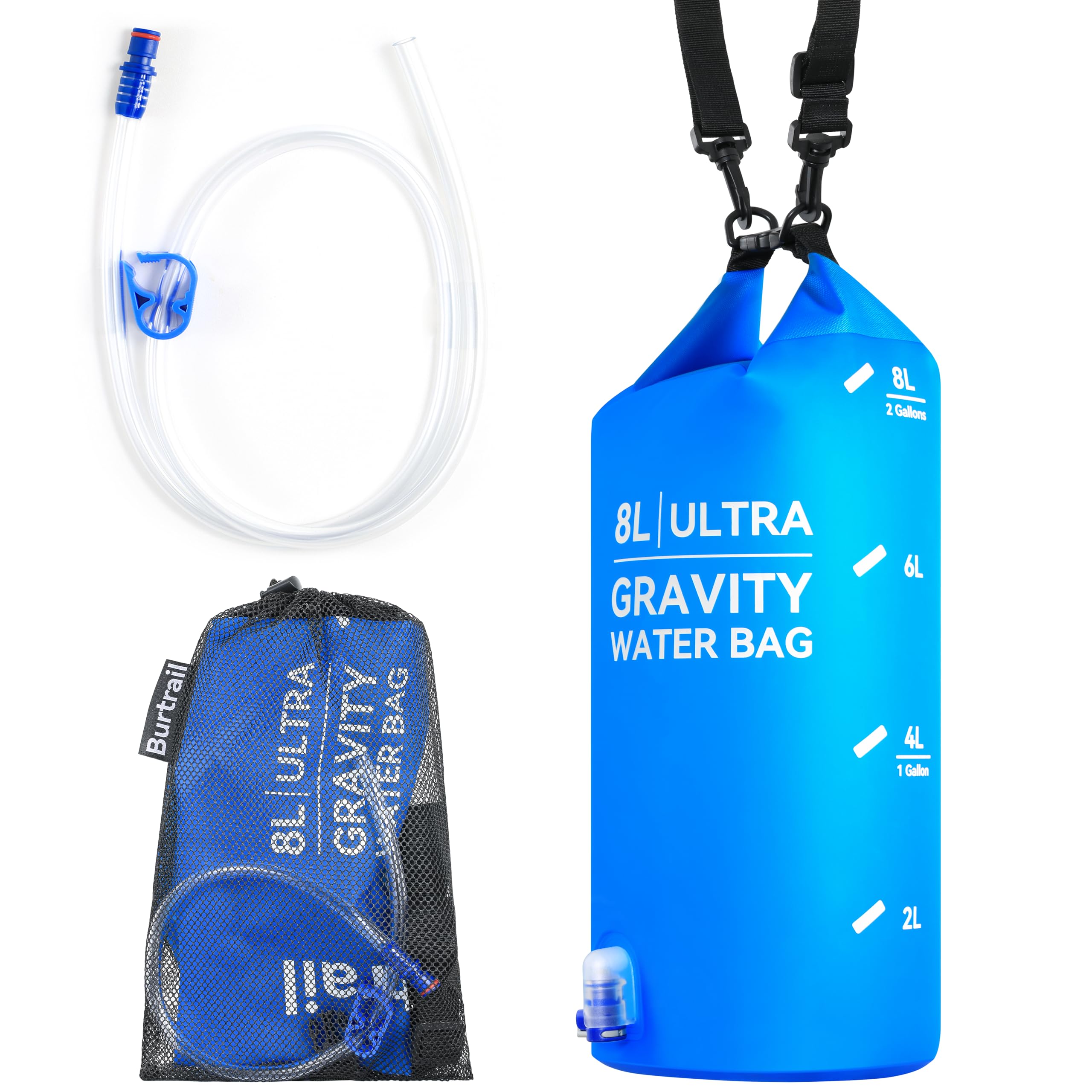
| Ultra Gravity Water BagMost Versatile | Backpacking with a filter straw | 2 gallons | 0.36 kg | Food-grade TPU | Amazon |
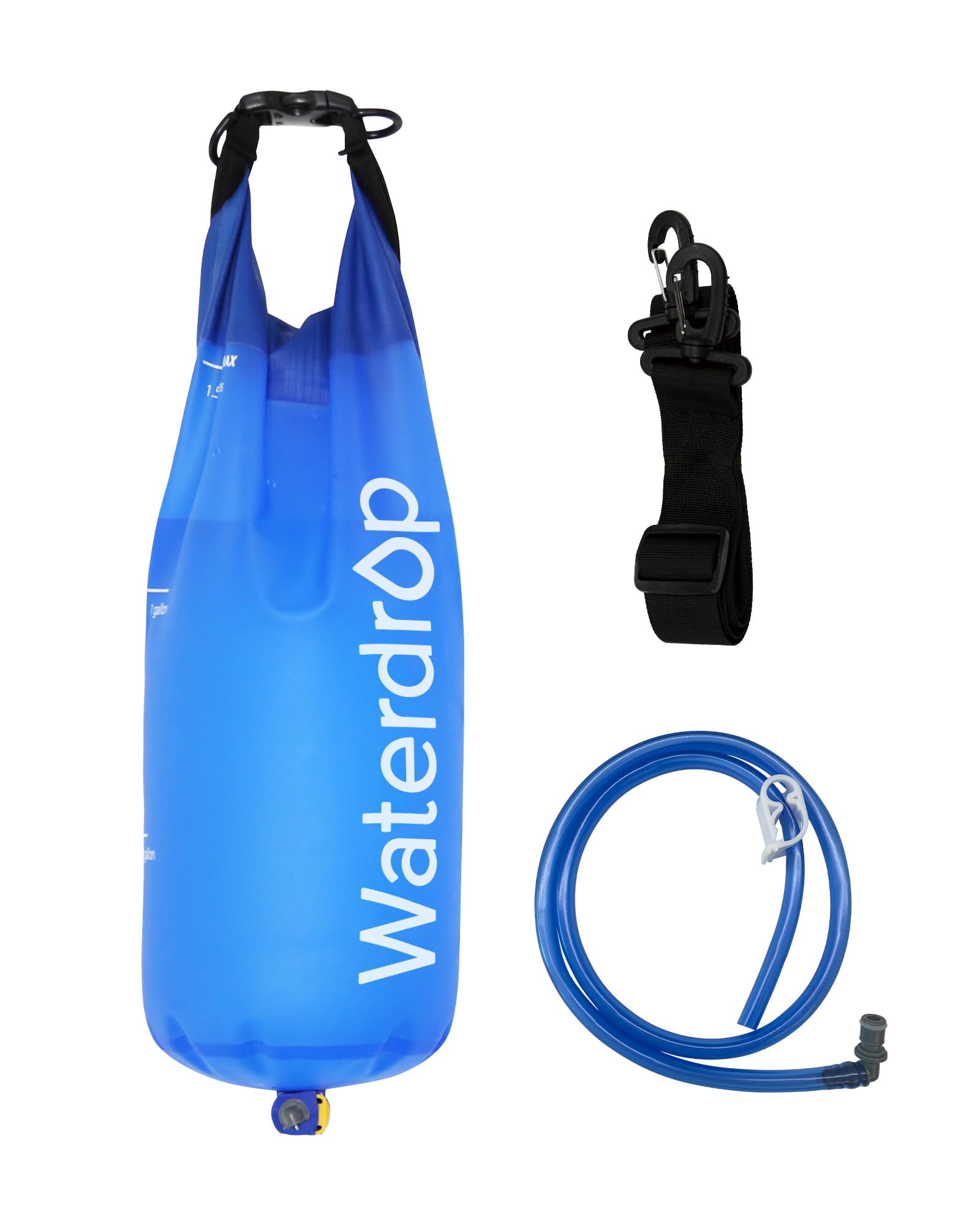
| Waterdrop Gravity Water BagBest for Filters | Camp water for one or two people | 1.5 gallons | 0.29 pounds | Thermoplastic Polyurethane (TPU) | Amazon |
| Sea to Summit Watercell X | Basecamp shower and pack trips | 6 liters | 6.9 ounces | Nylon with TPU film | Amazon |
| HydraPak Seeker | Campsite tap and gravity feed | 10 liters | 9.2 ounces | — | Amazon |
| VEVOR Water Storage Bladder | Garden, RV, and ATV watering | 330 liters | 7.8 pounds | Polyvinyl Chloride (PVC) | Amazon |
| GHOSOONE Water Bladder Tank | RV and truck-bed bulk water | 63.4 gallons | 5.5 pounds | Polyvinyl Chloride (PVC) | Amazon |
| 2 Pack Collapsible Water Container | Emergency kits and hand wash stations | 5.3 gallons | 6.4 ounces | BPA-free material | Amazon |
| WaterBrick 6-Pack Storage Containers | Long-term stackable emergency stock | 3.5 gallons each | 18 pounds | Food-grade HDPE plastic | Amazon |
In‑Depth Reviews
1. MSR Dromedary Bag Water Reservoir
Our pick — over 4.5★ from 500+ verified ratings; the strongest balance of quality and price.
The bladder that pulls double duty as pillow, shower, and desert water reserve.
For hauling water you can trust on jagged rock and in a bouncing side-by-side, this is the one. The exterior is 1,000-denier (a thick, tough woven fabric), so it shrugs off punctures that would shred a thinner bag. The inside is laminated with an improved BPA-free food-grade lining, which is why the water tastes clean rather than rubbery. At 9.6 ounces and 10 liters, it packs down small when empty and still holds enough for two people on a long day.
Owners treat this bag roughly and it keeps its shape — it gets used as a pillow, a solar shower, and a desert emergency reserve. The lid offers three spouts: a flip spout for a slow pour, a small screw cap for a medium flow, and a large screw cap for fast filling. One practical trade-off is color: the black shell hides dirt well but warms water faster when it sits in the sun. If you want it to feed a hydration hose, it converts with an MSR hose kit, though that kit is a bulky add-on to pack.
Capacity here is exact and honest — 10 liters, listed at 12 inches wide by 23 inches tall. That size lasts two people most of a day, and it fills a 32-ounce Nalgene in under a minute. It is the priciest small-bag option, and the lid is the one thing people either love or find fussy. What wins people over is the build quality — the 1,000-denier shell and welded seams hold up where cheaper bags give out.
What holds up trip after trip
- Tough 1,000-denier exterior handles freezing and rough ground.
- BPA-free food-grade lining leaves no plastic or rubber taste.
- Three-spout lid covers slow pours and fast fills.
- Packs small when empty despite the 10-liter capacity.
Where it asks for care
- The flip nozzle on the smaller sibling can crack, though it seals without leaking.
- Converting to a hydration hose needs a separate MSR kit that is large and heavy.
- Black shell absorbs heat, so water warms faster in direct sun.
Reach for this if: you need one tough bag for offroad water, backpacking, or a backcountry shower that will not fail.
Look elsewhere if: you want a lightweight gravity filter setup for a group and would rather not add the hose kit.
2. Ultra Gravity Water Bag
A two-gallon gravity bag that turns almost any filter straw into a camp water station.
If you already carry a filter straw, this is the upgrade that saves your arms. It holds 2 gallons and pairs with SP128 Mini, SP129 Squeeze, and Micro Squeeze filters, plus other common straw brands — you fill it, hang it, and let gravity do the filtering. The body is food-grade TPU (a flexible, rubbery plastic), BPA-free, and built for leak prevention. At 0.36 kg it stays light in a pack, and the adjustable strap plus cuttable hose let you set it up wherever you stop.
Group hikers are the ones who benefit most. It comfortably filters water for a group of five, and the double-soldered edge seal handles the squeeze of a full bag. The wide mouth fills fast, and the hose auto-locks when inserted so it will not pop loose mid-fill. One honest catch: dispensing runs through the hose, so there is no squeeze nozzle for washing hands without a bit of planning. Backpackers also learn to roll it rather than fold it — sharp creases wear the material over time.
The offset from the MSR above is weight and format: this one hangs as a gravity system, while the MSR works as a carry-and-pour bag. On capacity, it holds 2 gallons to the MSR’s 10 liters, and it is lighter to carry in a pack. Owners lean on its value and function — it simply does the filter-to-bottle job without fuss.
The gravity argument: hanging two gallons and letting physics filter it beats pumping by hand all evening. The value is the pitch here — a low-priced gravity bag that filters for a group of five without pumping.
Small upkeep note: dry it thoroughly after each trip before long storage. skip it if you only ever filter for one person on the move, where a squeeze pouch is lighter.
Suits: the group backpacker or basecamp cook who wants a hands-free filter station with their own straw.
One limitation: no squeeze nozzle for handwashing, and the hose makes the last cup slower to dispense than a wide-mouth pour.
3. Waterdrop Gravity Water Bag
A featherweight one-and-a-half-gallon gravity bag that weighs barely a third of a pound empty.
Here is the number that matters: 0.29 pounds. That is light enough to shrug off on a long approach, and it is the key edge over the heavier MSR bag. The 1.5-gallon capacity suits one or two people for a day hike or a short camp. It is built from TPU (a flexible, safe plastic) with a BPA-free claim, and it pairs with the Waterdrop Filterstraw plus Sawyer MINI Series filters so you can build a gravity system from gear you may already own.
What owners say in practice is that it is durable and easy to use — it survives rough trips to camp and holds enough for a small group. The wide opening fills fast, and one full bag filters in the time it takes to set up the rest of camp. The recurring gripe is the top: overfill it and water escapes from the lid rather than the valve, so fill to the line and check the seal. The included hose has a pinch clip that some find stiff and a plain plastic clip that grips less firmly than a real carabiner.
Compared with the two-gallon Ultra Gravity bag above, this one trades half a gallon of capacity for a lighter carry and easy Sawyer compatibility. New owners also note a strong plastic taste at first — a vinegar rinse a couple of times settles it before you rely on it in the field.
What earns its place in the pack
- 0.29 pounds empty — barely noticeable on the trail.
- Connects to Waterdrop Filterstraw and Sawyer MINI Series filters.
- Wide opening fills fast and drains fully from the bottom valve.
- Durable TPU body holds up on multi-mile trips to camp.
Where it needs a steady hand
- Overfilling leaks from the top seal rather than the valve.
- The hose pinch clip is stiff and the plastic clip grips loosely.
- A plastic taste needs a vinegar flush before first use.
Best matched to: the ounce-counting backpacker filtering for one or two who already owns a Sawyer or Waterdrop straw.
Think twice if: you want to fill and forget — the top seal rewards careful filling, not a rushed top-off.
4. Sea to Summit Watercell X
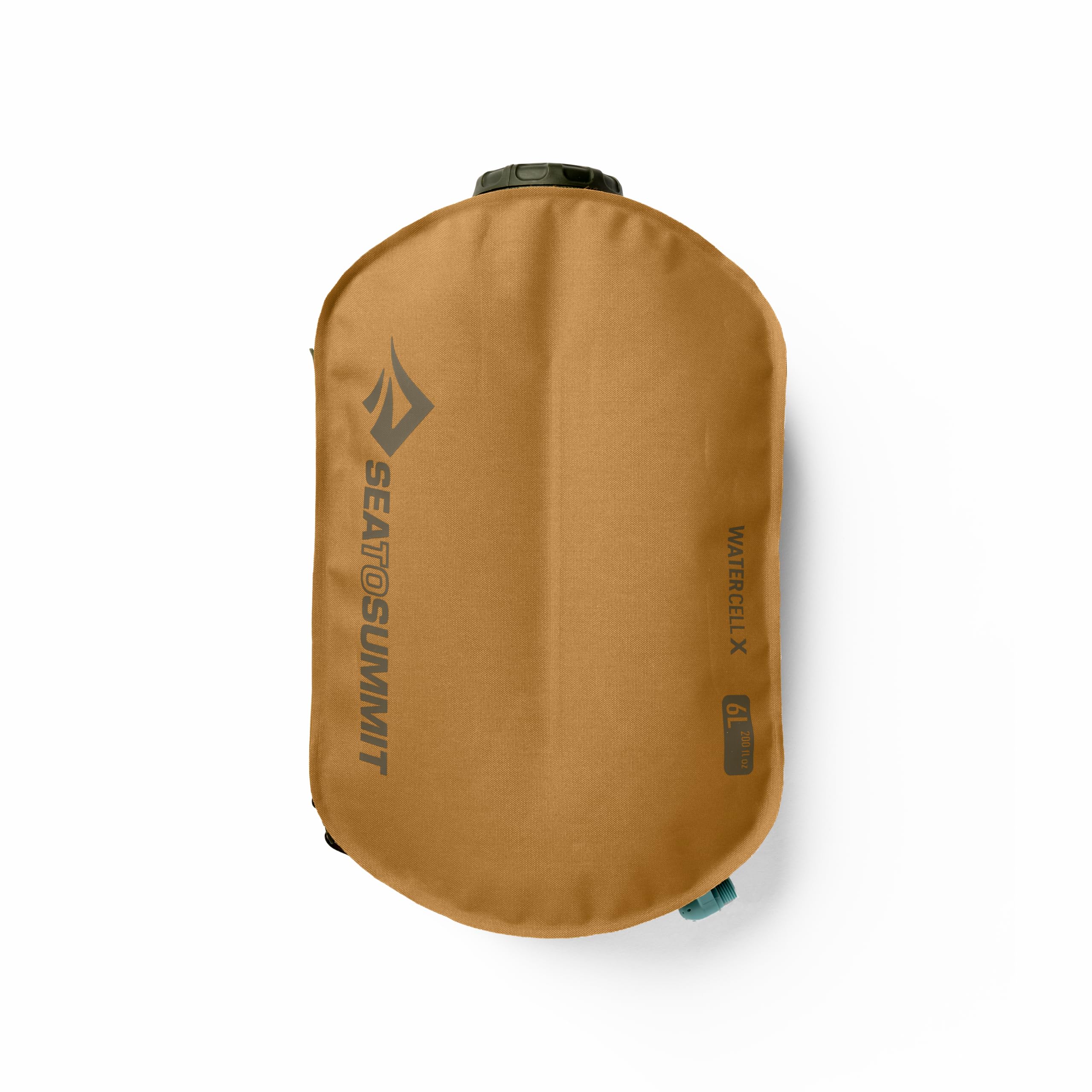
A packable six-liter dipper that turns into a backcountry shower when you need one.
This is the bag for basecamp comfort, not survival extremes. It holds 6 liters in a 3D molded shape with an internal baffle, a panel inside that keeps the bag from ballooning so filling and draining stay easy. The body uses certified recycled 400D nylon with RF-welded seams and a food-grade TPU film, and the 63-millimeter multi-function cap gives you variable flow control plus a shower fitting that stows on the carry strap. At 6.9 ounces it packs to the size of a rolled shirt.
Owners push it hard and it holds — it survives high-speed drops onto gravel and rocks, and it floats if it goes overboard, which matters for rafting and paddle trips. The welded lash points and adjustable TPU strap let you hang it or lash it to a pack. One quirk worth knowing: it uses recycled 400D nylon rather than a heavy denier shell, so it sheds a little weight at the cost of the armor-thick feel the MSR offers. It is also BPA, PVC, and non-PFAS, and bluesign APPROVED.
Compared with the 1.5-gallon Waterdrop above, this one adds a shower fitting — a hot rinse after a dusty day is the difference. It is also filter-compatible through the wide-mouth opening, so it can double as a gravity reservoir with a screw-on filter. The shade of water can pick up a bitter note for some owners until it is rinsed, so give it a clean-out before your first trip.
The dipper advantage: variable flow control from a low-profile cap means no more glug-glug splashing when filling bottles or basins on a countertop or camping table.
Fit note: the 6-liter size runs larger than most solo trips need. Pair it with a smaller bottle for one-person overnights, and reserve the full six liters for group camp or showers.
The right buy for: car campers, rafters, and basecamp hikers who want a shower fitting and a packable dipper in one.
pass on it if: you want the thickest, most puncture-proof shell available — this prioritizes packability over armor.
5. HydraPak Seeker Collapsible Camping Water Storage
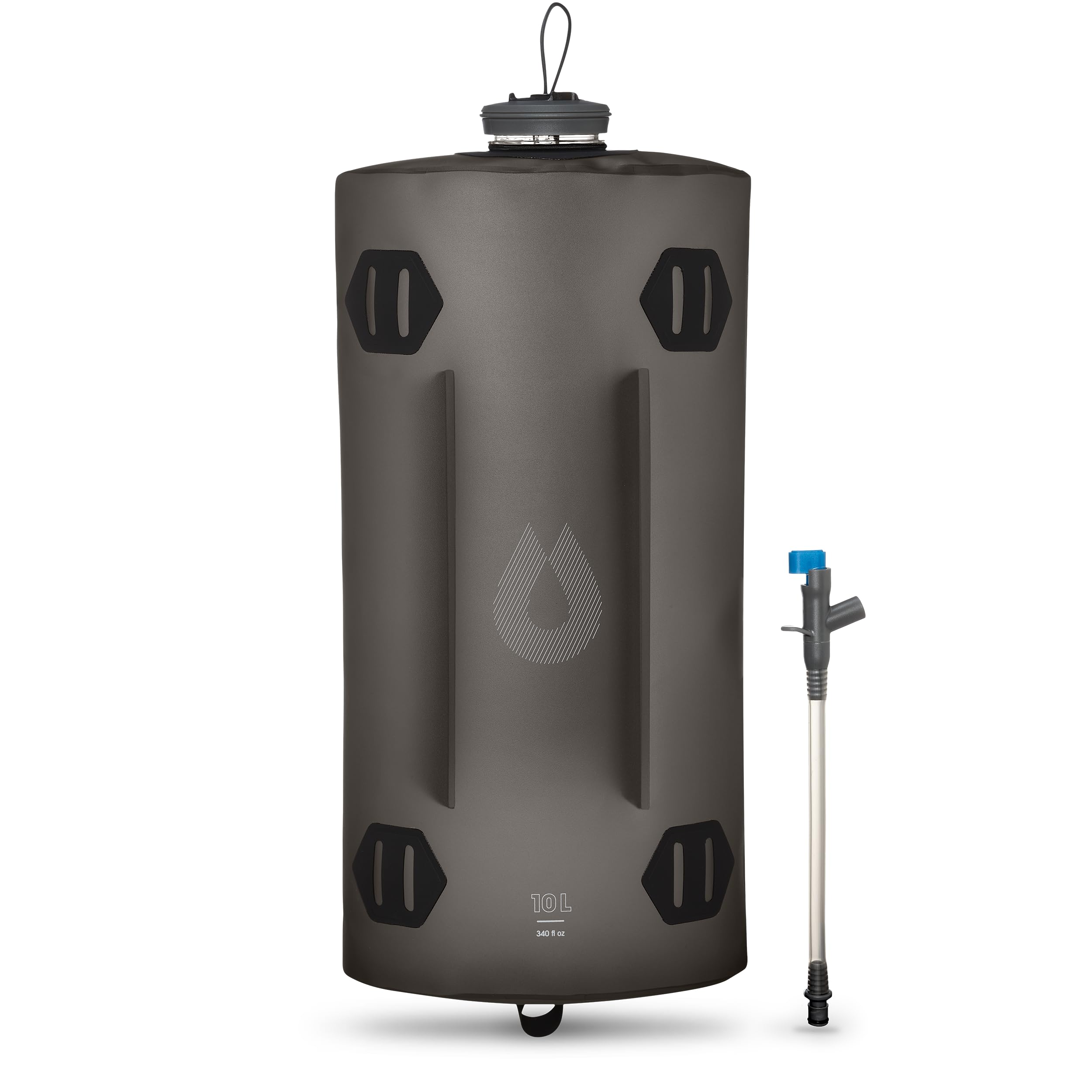
The campsite tap that stands on a table and dispenses clean water with one press.
The standout here is the cap, not the capacity. It connects to a Plug-N-Play Camp Tap that locks open when you press and release it, so you can fill a bottle or wash dishes hands-free. It also fits backcountry water filters through the same PNP connection. The 10-liter bag holds enough for a full camp day, and at 9.2 ounces it packs into its included storage bag when empty. Load-bearing lash points let you hang it for a gravity feed or strap it to a pack.
Owners describe the spigot as working better than expected — it stands upright or hangs, packs small, and leaves no plastic taste. It handles desert and primitive camping well and works for handwashing, dishes, and drinking water from one source. The 10-liter size runs larger than most solo trips need, so a smaller bottle covers overnights. The cap also fits the older 3-liter Seeker, so if you already own that bag you gain the tap without buying a new one.
Against the Sea to Summit above, this one trades the shower fitting for a true press-and-lock tap — better for dispensing at camp, less oriented to showering. One durability note from long-term owners: a seam can start leaking after a year, though the company replaced it under warranty without argument, which is worth knowing before you buy.
The tap payoff: a press-and-release faucet means one hand holds the bottle while the other presses — no propping the bag up and no splash on the tent floor.
Who should size down: 10 liters is heavy when full, so solo campers are better served by a smaller bag and refills. Group or family camp is where this earns its keep.
Pick this for: group camping and desert trips where a tabletop tap outranks a shower fitting.
Consider the trade-off: long-term owners note a seam can weep after a year of hard use, though the warranty replacement is real.
6. VEVOR Water Storage Bladder
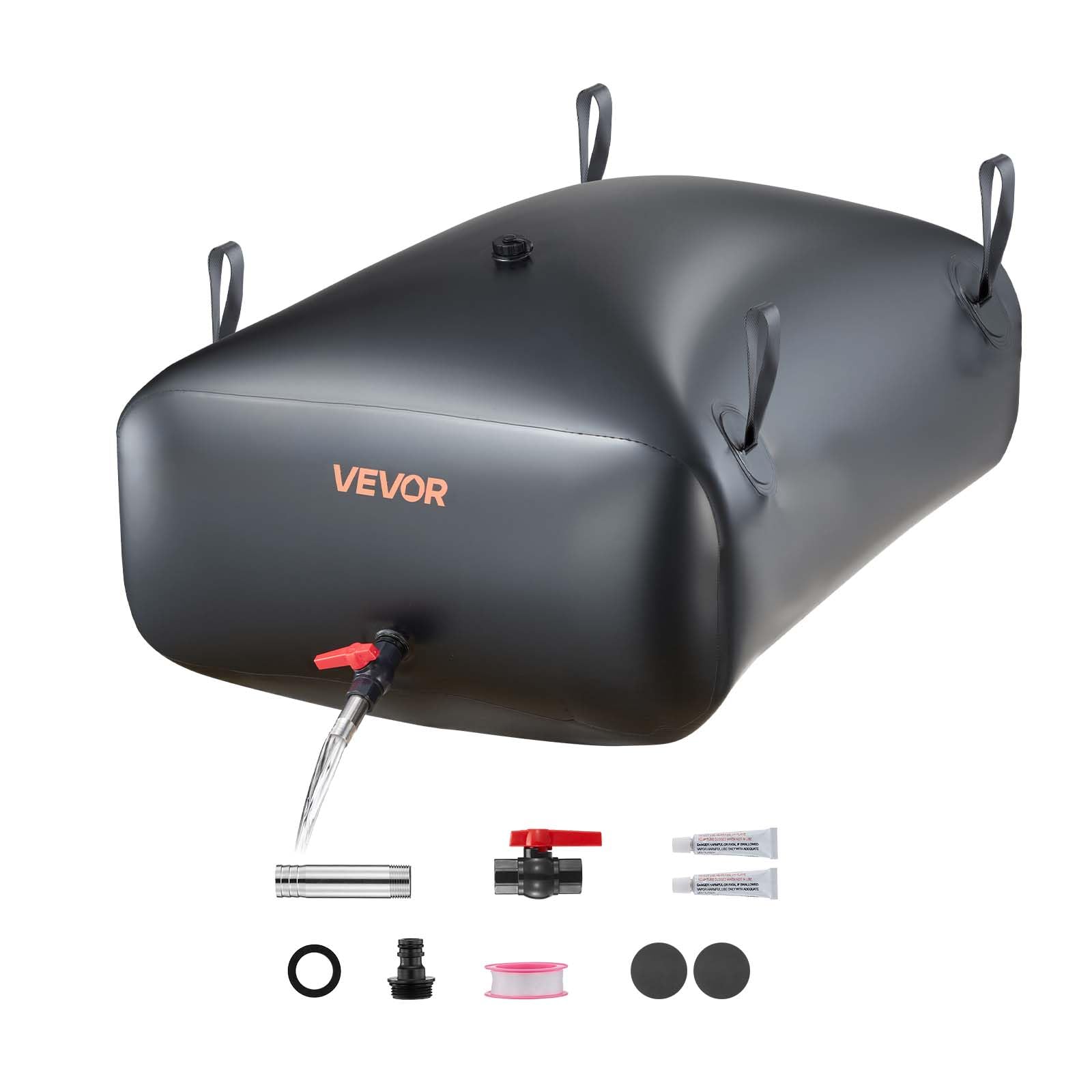
A truck-bed water tank that folds flat and moves when you do.
When the job is moving serious water to a garden, an RV, or a job site, this bag parks in a pickup bed and does the lifting for you. It holds 87.2 gallons (330 liters), set up at 47.6 by 32.1 by 14.6 inches, and weighs 7.8 pounds empty. The shell is thick double-layer 1000D fabric with a PVC coating and a tear- and wear-resistant mesh inner layer — the same denier class that keeps this bag alive through seasons of outdoor use. It handles temperatures from 5°F to 167°F, so it tolerates cold nights and hot sun without cracking.
The fittings are ready to use: a DN25 32-millimeter inlet for a garden hose, and a DN20 25-millimeter outlet threaded for a faucet. Heat-sealed double-layer seams and pre-installed sealing rings at the outlet guard against drips, and an extra replacement ring plus sealing tape come in the box. Four reinforced carry loops let you secure it in a pickup bed or on an SUV roof. It folds flat for storage, which is the whole point versus a rigid tank.
Against the 63-gallon GHOSOONE below, this one holds noticeably more — 330 liters versus 63.4 gallons — but it is also heavier and costs more, so choose by volume need. The recurring gripe is the outlet: some buyers report a slight drip until the connection is reseated. It is not potable-rated, so use it for irrigation, washing, and non-drinking supply. What owners praise most is the thick, sturdy material and how easily it carries water to where there is no tap.
The field reports: put it on the front of an ATV to water horses and gardens, strap it to a tractor bucket to water trees, or catch rain for the tomato patch — thick material and no leak worries on the good units.
Setup reality: when full it is cumbersome to move, so plan where it sits before you fill it. A drip at the outlet can appear; reseat the sealing ring and keep the spare handy.
The right fit for: gardeners, ranchers, and RV owners who need bulk non-potable water that stores flat between uses.
Not your bag if: you need drinking water — this is built for irrigation and washing, not drinking supply.
7. GHOSOONE Water Bladder Tank
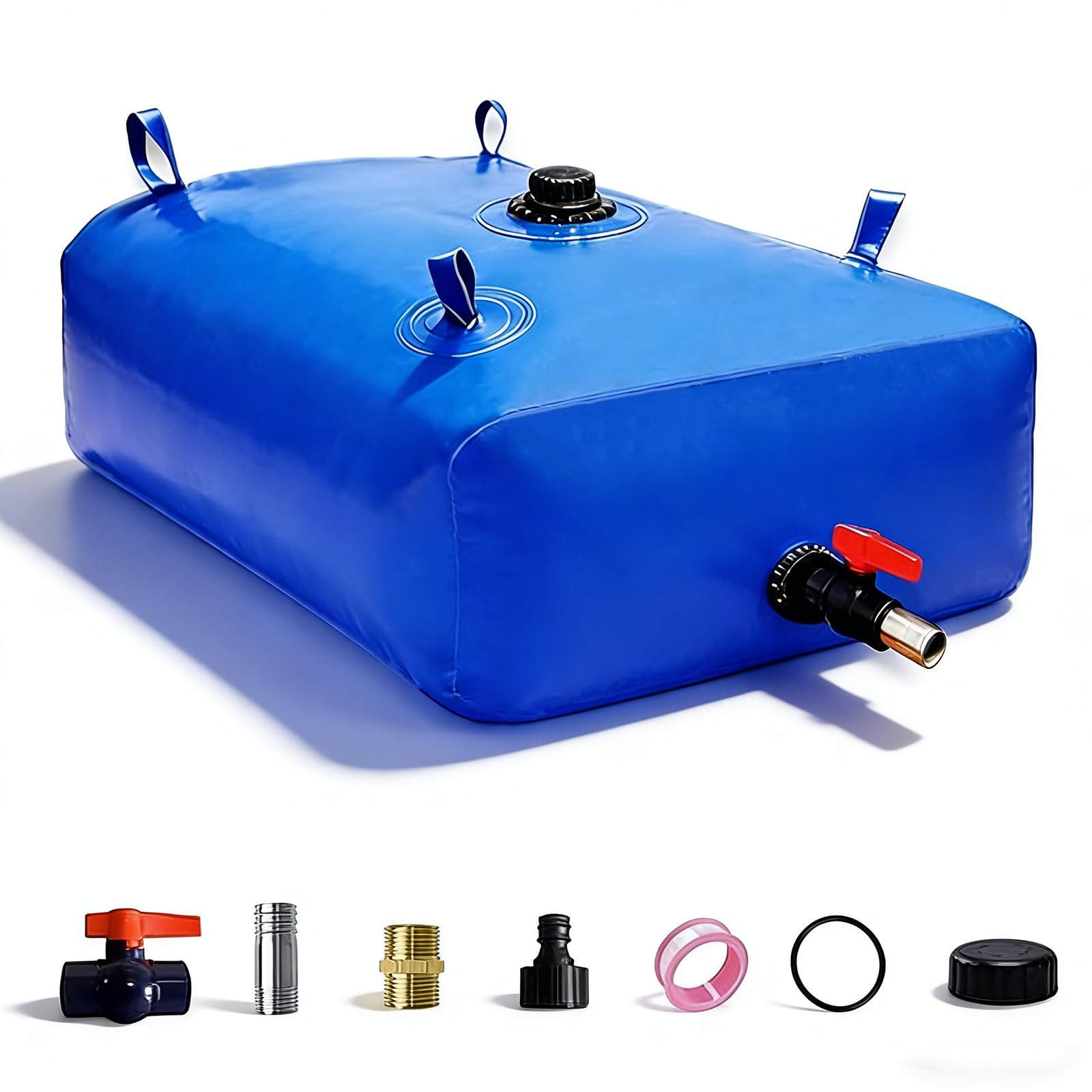
The 63-gallon bladder that fits a cart, fills a camper tank, and folds into a shoebox.
At 63.4 gallons for the price, this is the pick for RV dry camping and off-grid water runs. It holds 63.4 gallons, opens to 39.3 by 23.6 by 15.7 inches, and weighs 5.5 pounds empty — light enough to carry to the fill point and set in place by yourself. The shell is premium 2000D PVC-coated polyester mesh at 0.9 millimeters thick with double-sided coating, built for puncture, tear, abrasion, UV, and antistatic resistance. High-frequency welded, reinforced rib seams are designed to seal under pressure, and it runs from -30°F to +175°F.
The fittings are the practical win: a 1-inch inlet (32-millimeter outer, 25-millimeter inner) that fits standard garden hoses, a 3/4-inch shut-off outlet valve, and a rigid 32-millimeter connector in the box — no adapters needed. Four rust-proof reinforced handles make it carryable, and it folds to 16.9 by 9.1 by 6.8 inches for storage. It is rated for non-potable use, and the maker states up to 10 years of service with proper care, which means storing it flat away from sharp objects and harsh chemicals.
Against the 87.2-gallon VEVOR above, this one carries less volume but is lighter and easier to place solo — worth the trade if you do not need the extra gallons. Two honest notes: the fill hole is small enough that some owners add a hose modification, and the outlet can need a male-to-male adapter for a standard spigot. The most-discussed concern is leakage at the outlet, so fill it once at home and check the seams before you depend on it in the field.
Why campers reach for it
- 63.4 gallons in a 5.5-pound bag that folds to a compact size.
- 2000D PVC-coated mesh resists punctures, tears, UV, and abrasion.
- Ready fittings — 1-inch inlet and 3/4-inch shut-off valve, no adapters.
- Handles from -30°F to +175°F for year-round outdoor use.
Set-up and care notes
- The small fill hole may need a hose modification for fast filling.
- A male-to-male adapter may be needed for a standard spigot.
- Leakage is the most-discussed concern, so test on arrival.
Good match for: RV dry campers and tent campers who want to fill a tank with water they trust from home.
Check first if: your spigot uses a standard male fitting — you may need one extra adapter to dispense.
8. 2 Pack Collapsible Water Container with Spigot

Two collapsible cubes that make a hand wash station out of a single filling.
For emergency kits and camp handwashing, this two-pack covers more ground than a single bag. Each container holds 5.3 gallons, and two combined give you 10.6 gallons — noticeably more storage than the two-gallon gravity bags above. Empty, each one weighs only 6.4 ounces, which matters when you compare it to the MSR bag at 9.6 ounces; this is the lighter carry of the two. The shape is a foldable cube with a glossy finish and a clear body, measuring 11 inches wide by 13 inches tall, made from a BPA-free, non-toxic material.
Owners lean on their quality and function — the spigot seals well, resists leaks, and turns a cube into a hand wash station in an outage. In apartments with older adults, they cut down on lifting heavy jugs, and one owner reduced a whole cupboard of containers to two. The 5.3-gallon size also handles a real pour: they held water for a wedding beverage station and surprised people with how much they held. The recurring gripe is folding — once full and used, they will not lie perfectly flat again, so budget some storage space.
Against the MSR above, this two-pack wins on price and number of containers but loses on armor — it is a light BPA-free cube, not a 1,000-denier expedition bag. Treat it as the value pick for the garage, the car trunk, and the emergency shelf, not the rocky backcountry. It fits the same jobs as a small jug without the weight.
The everyday win: a spigot on a cube makes a hand wash and dish station wherever there is no tap — camp, tailgate, or a kitchen with the water off.
Storage reality: they will not fold flat again once used, so plan a cupboard or bin to hold them. it’s not for you if you need expedition-grade puncture resistance.
The value pick for: emergency kits, family camping, and anyone who wants two spigot containers for the price of one specialty bag.
Know before you buy: they lose their flat fold after first use, so you trade packability for the bigger capacity.
9. WaterBrick 6-Pack Storage Containers
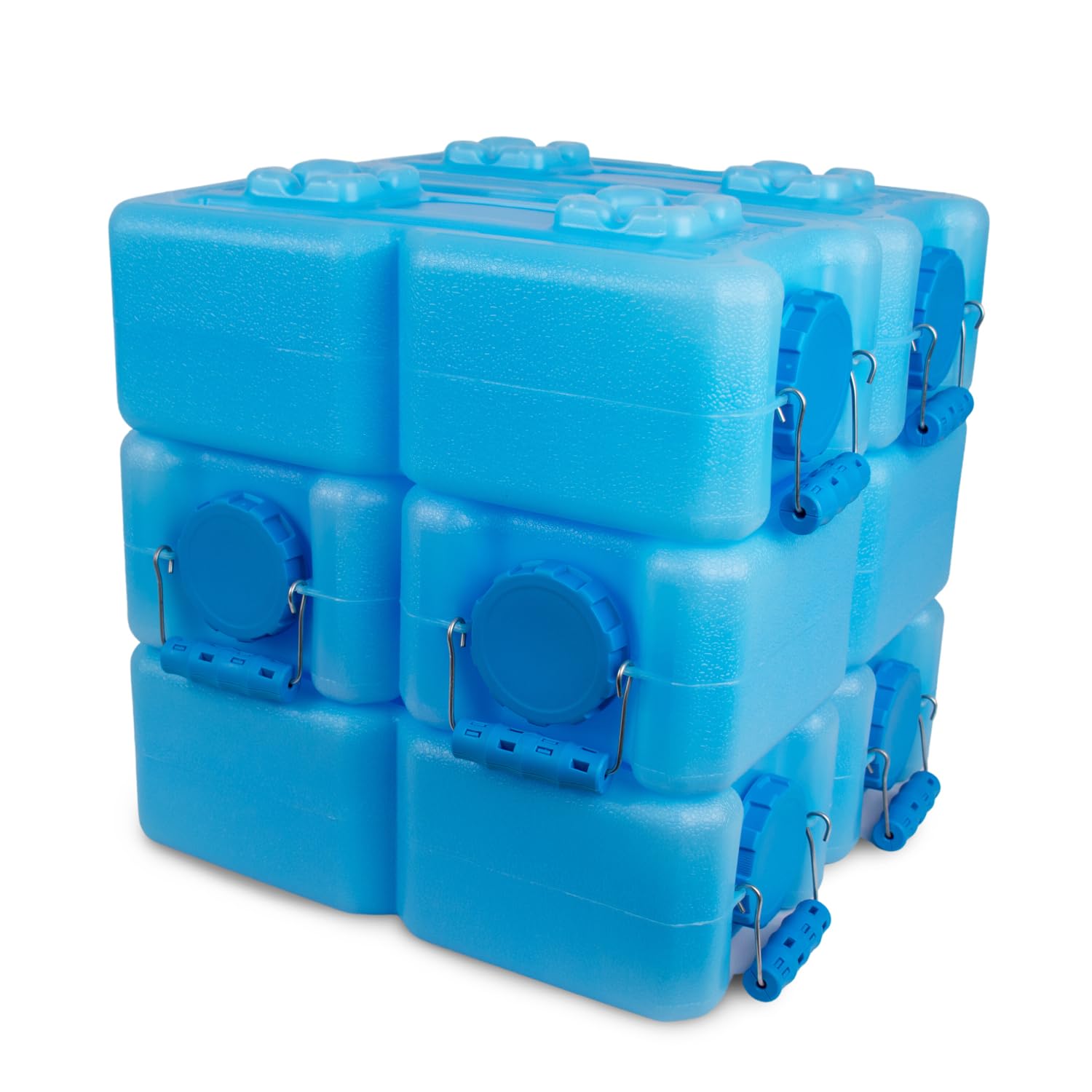
Six rugged bricks that stack into a twenty-one-gallon wall you can build anywhere.
This is the long-term storage pick, not a travel bag. You get six 3.5-gallon containers for 21 gallons total, each one built like a brick — 18 inches long, 9 inches wide, 6 inches tall, with a molded handle for one-handed carrying. They are made in the U.S. from food-grade HDPE plastic that is BPA-free, and at 18 pounds per brick they stay a manageable lift even when full, which separates them from heavier five-gallon jerry cans. The wide opening lets an adult reach in by hand to clean or to pack rice, beans, and dry goods.
The stackability is the real design win. The bricks cross-stack two per row up to 4 feet high, or eight rows, so a closet or an RV bay becomes organized water storage instead of a pile. Owners stack and lock them under a counter and report that they stay put during RV travel. They fit preppers, boaters, and campers, and they work with a Berkey system for filtered-water storage. Fill, move, and store all stay simple — the point of the whole design.
Two things to know before you commit. The cap takes a careful turn — cross-thread it and it will not seal, so thread it straight. And the last bit of water will not pour out cleanly, so fully emptying a brick for winter storage takes patience. The most-discussed topic is cap leakage when stacked, so fill each brick and check its cap seal on arrival. Value splits owners — some call the six-pack well worth it, others want it priced lower.
What the stack does for you
- Cross-stacks two per row up to 4 feet high for tight spaces.
- Food-grade, BPA-free HDPE made in the U.S. with a wide hand-clean opening.
- 18-pound bricks with handles are easy to lift and move individually.
- Stores dry goods too — rice, beans, sugar, and pet food.
What to watch at home
- Caps cross-thread easily, so turn them straight to seal.
- Getting the final cup of water out takes patience.
- Cap leakage when stacked is the most-discussed issue, so check seals on arrival.
Built for: preppers, boaters, and RV owners who want a permanent, stackable water wall in a closet or bay.
Not the pick if: you want a bag you carry on a hike — this is stationary storage, not travel gear.
Understanding the Specs
Denier and layer count
Denier is a measure of the thickness and durability of the woven fabric inside a bag. A 1,000-denier exterior (a very tough woven shell) resists punctures from rock and brush, while a lower denier stays lighter but wears faster. Double-layer PVC with a mesh inner layer adds tear and abrasion resistance on top of the base denier, which is what keeps larger tank-style bladders alive through seasons of outdoor duty.
Capacity versus portability
Capacity in gallons or liters tells you how much water you carry, but weight and size decide whether you can actually move it. A 5.3-gallon container weighs over 40 pounds full, while a 2-gallon gravity bag stays liftable in one hand. Match the number to your lifting ability: small bags for carry, large bladders for parked use in a truck bed or on a cart.
Filter compatibility
Gravity bags often connect directly to common filter straws, which lets one clean source supply a whole camp. Compatibility is listed by model — for example, SP128 Mini, SP129 Squeeze, Micro Squeeze, Sawyer MINI, and Waterdrop Filterstraw. Check the bag’s stated list before you buy, because a mismatch means buying an adapter or a second filter.
Seams, valves, and temperature range
Welded or heat-sealed seams hold pressure better than stitched ones, and a bottom-mounted valve drains cleaner than a side port. Temperature range matters if the bag lives outdoors: some tanks run from -30°F to +175°F, and others from 5°F to 167°F, so check the rating if you store water through winter.
FAQ
What is the difference between a gravity water bag and a carry water bag?
Will this gravity bag fit my Sawyer or Waterdrop filter?
How do I stop a plastic taste in a new water bag?
Can I use these large bladders for drinking water?
How long can I store water in a collapsible bag?
Why does my water bag leak at the lid or outlet?
What does denier mean and does it really matter?
Are collapsible water containers worth it for emergency prep?
How full can I fill a gravity bag without it leaking?
Which is better, a collapsible bag or a rigid water container?
Final Thoughts: The Verdict
For most buyers, the best water bag is theMSR Dromedary Bag because its 1,000-denier shell and food-grade lining handle real abuse without leaking or leaving a plastic taste. If you want a filter-ready gravity station instead, the Ultra Gravity Water Bag gives you 2 gallons and a hands-free setup for a group. For campsite comfort, the Sea to Summit Watercell X adds a shower fitting that the others do not have. And if your water lives at home rather than on the trail, the WaterBrick 6-Pack stacks 21 gallons into a closet wall. Whichever you pick, buy before the season starts, not the week you leave — reviewers wait until the night before a trip, then discover a dried-out seal they should have tested at home. Pick the job, match the number, and fill it with confidence.
How We Picked
We do not accept paid placement. Every pick is matched to a real buyer and a real use-case; we do not hands-on test units.
Sources & Methodology
Specifications: manufacturer listings and product documentation. Review insights: verified customer reviews, as of September 2026. Pricing: not shown on this page (it changes often); check the current price via the retailer link.
As an Amazon Associate, Gadgets Feed earns from qualifying purchases. This does not affect which products we feature.