
Our readers keep the lights on and my morning glass full of iced black tea. As an Amazon Associate, I earn from qualifying purchases.
Specs are compiled from manufacturer listings and verified buyer reviews and can change over time — please confirm the key details on the product page before buying.
If your tap water tastes flat, smells of chlorine, or leaves a film on your kettle, an alkaline water filter system fixes the problem at the source — and the best one for most homes is a tankless under-sink reverse osmosis unit with a mineral stage that puts calcium back in and pushes pH up. Below you’ll find eleven systems sorted by what actually matters: how many gallons they produce per day, whether they need electricity, how much under-sink space they eat, and what owners say after living with them for months.
I’m Min — the founder and writer behind Gadgets Feed. This guide is built by comparing the manufacturers’ published specifications and the patterns across verified customer reviews, so you get each pick’s real strengths and trade-offs instead of marketing spin.
Some units mount under the sink and plumb straight into your cold line, others sit on the counter and need nothing but a power outlet. The one you want depends on your space, your water pressure, and whether you rent or own. That’s exactly what this breakdown of the best alkaline water filter system options sorts out for you.
Our Picks at a Glance
How To Choose The Best Alkaline Water Filter System
The single biggest mistake buyers make here is counting filtration stages on the box instead of reading two numbers: how many gallons per day the system makes, and how much water it wastes to make them. Those two figures decide whether you wait twenty seconds or two minutes for a glass, and whether your water bill notices.
Start with your daily water volume, not the stage count
A household that drinks, cooks, and fills ice trays with filtered water burns through several gallons a day. Look for a system rated in gallons per day — abbreviated GPD — because that figure tells you how fast the unit recovers between pours. A 500 GPD tankless model refills your glass in about ten seconds. A 75 GPD model with a storage tank fills the tank slowly overnight but pours fine from the tap, which suits lighter users who don’t mind the wait.
Decide tankless versus tank before you measure your cabinet
A tank model stores finished water in a pressure vessel under the sink. It pours instantly but occupies serious cabinet real estate and, over years, can collect a stale taste in that standing water. A tankless unit makes water on demand the moment you open the faucet — no stored water, far less space. Check the dimensions listed for any system against your actual cabinet before buying, because a tall tankless unit can fight a garbage disposal for room.
Understand what the alkaline stage actually does
Reverse osmosis strips nearly everything out of water, including the calcium and magnesium that give it body. An alkaline or remineralization stage adds those minerals back after filtration, which softens the flat, empty taste plain RO water is known for and lifts the pH reading above neutral. That’s the whole point of buying an alkaline system rather than a standard RO unit — the mineral cartridge is the difference.
Check your water pressure and whether you have power under the sink
Most reverse osmosis systems want a steady feed pressure to work efficiently, and some tankless models plug into an outlet under the cabinet. If you’re on well water or low pressure, a unit with a built-in booster pump keeps output strong. If you rent or have no outlet under the sink, a countertop model sidesteps the whole issue — no plumbing, no drilling, just fill and plug in.
Quick Comparison
| Model | Best For | Capacity (GPD) | Install Type | Pure:Drain | Amazon |
|---|---|---|---|---|---|
| iSpring RO5004F-AK★ Best Overall | Whole-home daily drinking | 500 | Under Sink | 2:1 | Amazon |
| Waterdrop TK-AD-FSNo-Power Pick | Camping & no-power use | Gravity (2.25 gal) | Countertop | — | Amazon |
| APEC ROES-PH75XBest Value | Value under-sink RO | 75 | Under Sink | — | Amazon |
| NU Aqua 7-Stage | Fast tank-based flow | 100 | Under Sink | — | Amazon |
| Waterdrop G5P500A | Space-saving tankless | 500 | Under Sink | 2:1 | Amazon |
| Waterdrop WD-T4-A | Dual-flow mineral choice | 450 | Under Sink | 2:1 | Amazon |
| Frizzlife M800 | Cordless high flow | 900 | Under Sink | 4:1 | Amazon |
| SimPure T2-600A | Built-in pressure tank | 600 | Under Sink | 2:1 | Amazon |
| APEC RO-PH90 | Proven long-haul RO | 90 | Under Sink | — | Amazon |
| SimPure Y9A | Renters, no plumbing | 300 | Countertop | — | Amazon |
| Aqua Ionizer Deluxe 5.0 | pH range control | Filter: 4000 L | Countertop | — | Amazon |
In‑Depth Reviews
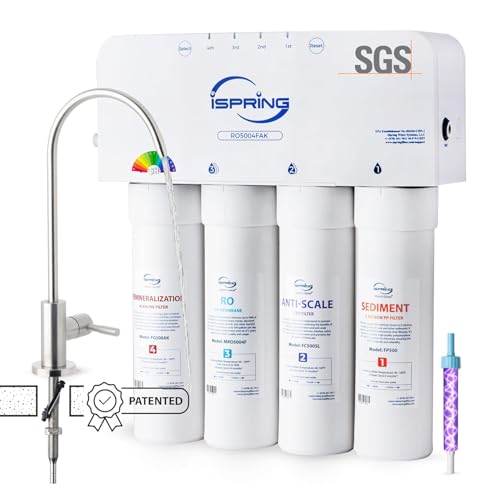
1. iSpring RO5004F-AK UV Alkaline Reverse Osmosis Water Filter
Our pick — over 4.5★ from 950+ verified ratings; the strongest balance of quality and price.
Five hundred gallons a day with a UV lamp and minerals back in the glass — the one to beat.
For a family that fills water bottles every morning, this is the pick that never makes you wait. It’s rated at 500 gallons per day — that’s the amount of finished water it can produce in 24 hours — and iSpring says it fills a cup in roughly 10 seconds, which you notice the moment you stop fighting a slow tap. It does that without a storage tank, so there’s no stale water sitting around and no bulky pressure vessel stealing your cabinet.
That tankless build is why it beats the tank-based APEC RO-PH90 for daily volume. The iSpring is rated at 500 gallons versus the APEC’s 90, and it trades no minerals to get there — a dedicated AK stage adds calcium and other minerals back after the reverse osmosis membrane strips everything out, which is what lifts the pH above neutral and kills the flat, empty taste. It also runs a built-in UV light rated up to 8,000 hours of use, an extra disinfection step that the Gravity Waterdrop model below simply doesn’t have because it has no power at all.
What you’ll really feel is the under-sink space and the installation. The top-mounted fastener design lets you tighten everything from above the counter, so you’re not contorted on your back reaching a nut behind the disposal, and the tankless body frees up the cabinet floor. Buyers report the install runs to a handful of steps with no plumbing background needed, and the color-coded lines keep it straight. One owner on well water measured TDS falling from 420 to 23.
Where It Pulls Ahead
- 500 GPD tankless output fills a cup in about 10 seconds
- Built-in UV lamp rated up to 8,000 hours
- 2:1 pure-to-drain ratio wastes far less water than typical RO
- AK mineral stage restores calcium and lifts pH
- Top-mount fastener means no under-sink contortion
Weigh Before You Buy
- Needs an electrical connection for the pump and UV
- Occasional reports of minor leaks traced to a drain saddle or included valve
- A pressure tank model is cheaper if you rarely need high volume
Reach for this if: you want the highest daily output here with minerals and UV in one tankless box, and you have power under the sink.
Think twice if: your cabinet has no outlet or you’d rather spend less and accept slower tank-based recovery.
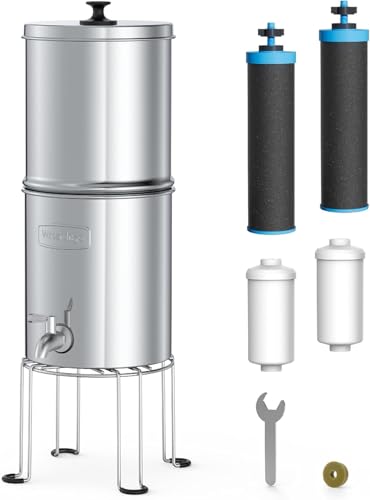
2. Waterdrop TK-AD-FS Alkaline Gravity Water Filter System
Zero plumbing, zero power, and it goes camping with you in the back of the car.
No outlet, no drill, no plumber — this is the one for a rental kitchen, an RV, a cabin, or the tailgate of a truck. It holds 2.25 gallons in a food-grade 304 stainless steel body and pulls water through by gravity alone, so it works during a power outage and packs away for trips. For context, that 2.25-gallon tank versus the iSpring’s 500-gallon-per-day rating is the whole trade-off in one number: this is a batch system, not an on-demand stream.
The two white fluoride cartridges are the headline here. Most gravity filters of this type reduce chlorine, taste, and odor; Waterdrop adds a dedicated fluoride filter on top of the coconut-shell carbon blocks, which is the spec sheet line that separates it from a plain countertop pitcher. The carbon filters are rated to treat up to 6,000 gallons and the fluoride filters 1,000 gallons, and owners mention an easy 30-minute assembly including flushing all four filters. Owners also like that the included spigot is metal rather than plastic and that total chlorine strips read clean after setup.
The honest catch is travel logistics. One owner points out you have to fully disassemble it to move it, and it won’t fit assembled in a pantry, so it’s more of a leave-it-on-the-counter tool than a grab-and-go. The recurring gripe in the reviews is the occasional leak and questions about the spigot rusting over time, so treat the seals with care and dry the unit between uses. For a family of four drinking indoors, or anyone who wants alkaline water without an electrical outlet, it earns its spot.
Real-world read: Set it up once, flush it, and it becomes a quiet fixture on the counter that needs no electricity to do its job.
Lands best with: renters, campers, and RV owners who can’t drill or run power under a sink.
Less ideal if: you want endless on-demand flow from a tap, since gravity batch filtering is inherently slower.
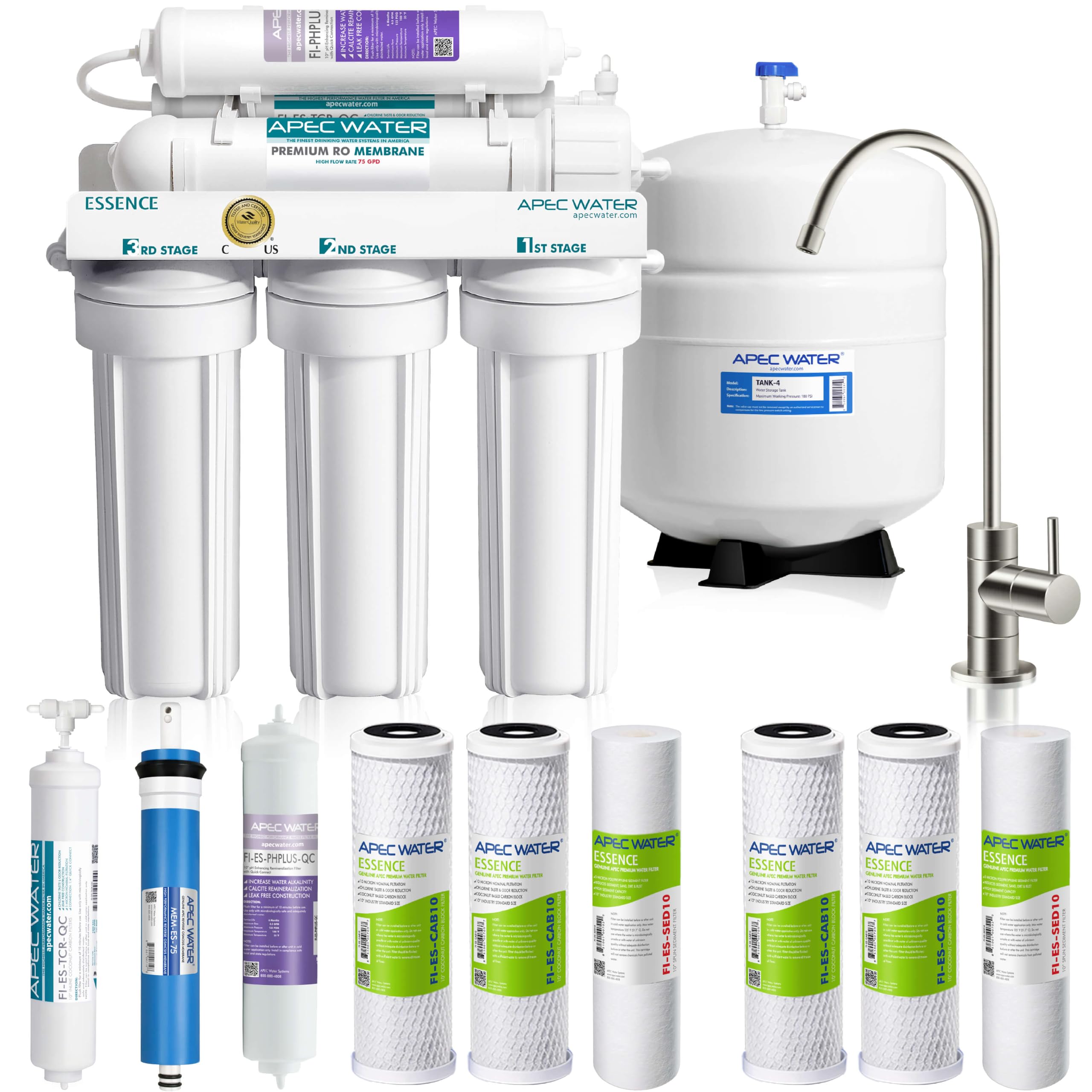
3. APEC Water ROES-PH75X 6-Stage Under Sink Alkaline RO System
The budget-friendly entry into real six-stage under-sink alkaline filtration with a spare filter set in the box.
If you want true multi-stage under-sink filtration but the tankless premium models feel like overkill, this is the value play. It runs six stages and is rated at 75 gallons per day, which means it recovers slowly into its storage tank but pours fine at the tap for a couple of glasses at a time. The mineral stage uses premium-grade calcium to raise pH and replace the body that reverse osmosis removes, and APEC touts it as a WQA-certified system that removes up to 99% of impurities including chlorine, fluoride, arsenic, and lead.
The bundle is the quiet win. APEC includes an extra set of pre-filters for stages 1 through 3, and the ad says pre-filters should be swapped once every six months. That spare set means you’re not buying replacements the week you install it. Owners who came from an older reverse osmosis setup describe the swap as straightforward with standard quarter-inch tubing, and the pre-filters protect the RO membrane, which stretches the money you spend over the life of the system.
Here’s the part to weigh. This system works on feed pressure between 40 and 85 psi, so if your home runs low pressure you’ll want a booster pump and should check that before ordering. There’s a durability gripe in the mix too — a cracked fitting after a couple of years on one long-term unit — so handle the connections gently and don’t over-tighten. For the price, it delivers genuine six-stage filtration and a mineral stage without the tankless complexity.
Why It Wins On Price
- Six-stage filtration with an alkaline mineral stage
- Includes an extra set of pre-filters for stages 1-3
- WQA-certified system rated to remove up to 99% of impurities
- DIY-friendly install with standard 1/4-inch tubing
Terms To Accept
- 75 GPD is slow — best with its storage tank for light pour demands
- Wants steady feed pressure between 40 and 85 psi
- Fittings have cracked on some long-term units; install gently
The sensible default: for a first under-sink alkaline system, this delivers the full six-stage process and a spare filter set for the least outlay.
Move on if: you need high-volume output or run low water pressure without adding a booster pump.
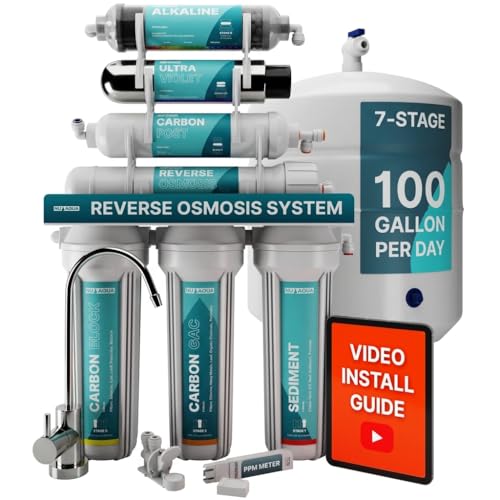
4. NU Aqua 7-Stage UV Alkaline Under Sink Reverse Osmosis Water Filter System
A tank-based workhorse that doubles typical output and throws in a free water tester.
Picture a bathroom-scale drop from harsh city water to something you’d actually reach for. Customers note TDS dropping from 194 to 17 and from 650 to 25, turning sharp tap water into something that tastes like bottled. It’s rated at 100 gallons per day with its storage tank, which doubles the output of a standard under-sink reverse osmosis system, so you get faster recovery between pours than the 75 GPD and 90 GPD models here.
The seven-stage chain runs a UV lamp plus a HydraCoil membrane and finishes with a remineralization step that adds minerals back, which is what nudges the pH above neutral. A bonus PPM meter ships in the box so you can test your own water before and after — the ad says PPM meter included. The countertop faucet is 100% lead-free stainless steel, and the filter housings are double o-ring sealed, a small detail that matters if you hate slow drips under the cabinet.
What buyers keep mentioning is longevity. Long-term owners describe third and fourth systems across family homes with no leaks over years of service, and they stress checking water pressure before buying — low-pressure homes should pick the booster-pump version. The one recurring complaint is the sixth mineral stage leaving a sulfur-like smell for some users, who simply removed that cartridge and kept drinking the reverse osmosis side. Filter changes are straightforward, and the 120-day trial and three-year warranty back it up.
What earns it a slot: seven stages, a UV lamp, a stainless faucet, and a meter for testing your own water — a lot of system for a tank-based unit.
One owner wrinkle: a few users found the final mineral stage left an off smell and pulled that cartridge out, still loving the water. It’s a personal-taste call, not a defect.
Suits: anyone who trusts a storage tank for steady pour pressure and wants a decade-plus service reputation behind it.
Looks past if: you need max daily GPD or you’re sensitive to the taste of added minerals in the finishing stage.
5. Waterdrop G5P500A Reverse Osmosis System, 8-Stage Alkaline
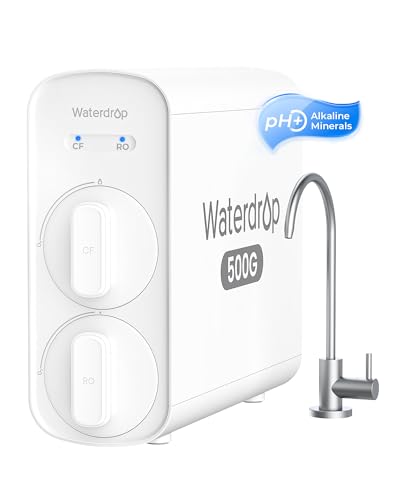
A slim tankless under-sink unit that frees up cabinet space without giving up flow.
Where the iSpring leads on raw output, this one leads on getting out of your way. Waterdrop’s tankless design is built to reclaim up to 70% of your under-sink space by dropping the storage tank entirely, which is a real difference if a bucket and a disposal already own your cabinet. It’s still rated at 500 gallons per day and fills a 6-ounce cup in about 8 seconds — that’s the flow number to hold against the 100 GPD NU Aqua above, which is meaningfully slower to recover.
The filtration is eight stages with a 0.0001 μm (micrometer, one-millionth of a meter) RO membrane that strips particles larger than that, then an alkaline stage that adds calcium, magnesium, sodium, and potassium back in. The 2:1 pure-to-drain ratio means two cups of clean water for every cup that goes down the drain. The spec sheet is clean too: NSF/ANSI 58 and 372 certified, BPA-free housing, rated to run at temperatures down to 41 °F, and the unit runs off a 1.31 liters-per-minute rated flow.
What you’ll notice day to day is the noise and the footprint. Owners describe a quiet unit that tucks small under the sink, easy filter changes you can do yourself, and taste that beats both bottled and countertop filtered water. The one honest gap: the tankless design here means the unit produces on demand rather than storing a tankful, so a heavy simultaneous draw — filling a big pot while someone else runs the tap — can outpace it. For most two-to-four person households it keeps up with ease.
What Stands Out
- 500 GPD tankless flow, fills a 6-ounce cup in about 8 seconds
- Tankless body frees up to 70% of under-sink space
- 8-stage filtration with alkaline mineralization (Ca²⁺, Mg²⁺, Na⁺, K⁺)
- NSF/ANSI 58 & 372 certified, BPA-free housing
- 2:1 pure-to-drain ratio
Where It Demands A Little
- Some users note a pressure drop after certain replacement filters
- Needs an electrical connection and a drilled faucet hole
- On-demand only, no stored reserve for simultaneous heavy draws
Ideal for: tight kitchens where cabinet space is the deciding factor and you still want 500 GPD flow.
Another route: a tank model like the NU Aqua if you want a stored reserve for filling multiple containers at once.
6. Waterdrop WD-T4-A Alkaline pH+ Reverse Osmosis Water Filter, 10-Stage

Two streams from one faucet — plain RO when you want neutral, mineral-rich alkaline when you don’t.
The dual-flow faucet is the reason this one earns its place. You flip between a standard reverse-osmosis stream and a separate mineral-enhanced alkaline stream depending on what you’re doing — alkaline for drinking, plain RO for your iron or the aquarium, where added minerals would be the wrong call. It’s a niche of one here; most systems make one kind of water only. Rated at 450 gallons per day with a 2:1 pure-to-drain ratio, the ad says it cuts wastewater by up to 800% against traditional reverse osmosis.
The ten-stage stack runs a reverse osmosis membrane plus a dedicated mineral-enriched line that adds alkaline minerals back for the finishing taste. It’s NSF/ANSI 372 certified and the housing is BPA-free, and the smart filter-life reminder uses indicator lights and a buzzer so you don’t miss a change — the ad lists CF filter at 6 months, RO membrane at 24 months, and CB and mineralizer filters at 12 months each, which spreads replacement cost predictably across the year.
Where it needs a caveat: the tankless, on-demand design produced mixed flow feedback, with some owners finding it slower than they expected when filling large pots. One user also found the re-mineralized line carried a slightly off taste and stuck to the plain RO side, while another praised the alkaline stream. That’s the honest picture — you’re buying flexibility between two water types, and how the mineral taste lands is personal. The compact body still saves up to 70% of under-sink space.
The reason to choose it: a genuine three-way valve makes this the only system here that pours both neutral RO and mineralized alkaline from the same faucet.
Set expectations on: flow is on-demand and rated at 450 GPD, so it’s not the fastest for filling multiple large containers back to back.
Matches: households where one person wants alkaline and another wants plain filtered water, all from one install.
Consider alternatives if: you want max fill speed or you know you’ll only ever drink the mineral stream.
7. Frizzlife M800 Non-Electric Tankless Reverse Osmosis Water Filter
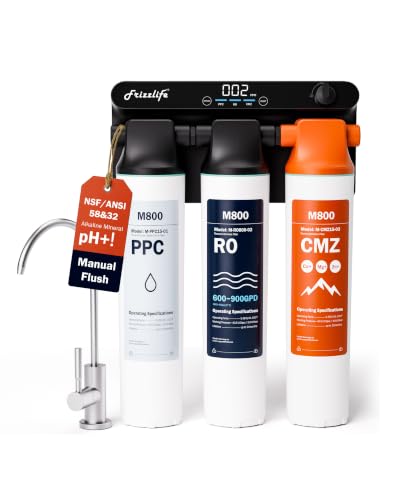
More daily output than anything else on this list — and it does it with no power cord at all.
This is the one for the kitchen that has no outlet to spare under the sink. Frizzlife’s tankless design runs entirely on your existing water pressure, so there’s no electricity, no pump whine, and no storage tank — it just sits there silently and makes mineral-rich water on demand. The capacity figure is the headline: it’s rated at 900 gallons per day, which is the most on this list and meaningfully higher than the 500 GPD G5P500A above.
The efficiency number is just as striking. Its dynamic 4:1 pure-to-drain ratio means four cups of clean water for every cup sent down the drain, the best ratio among these picks — the closest competitors, the iSpring and Waterdrop models, run 2:1. The ad also points to a 12-month carbon block, a 12-month remineralization filter, and a 24-month RO filter, so replacement intervals stretch further between cartridge changes. Eight filtration stages reduce heavy metals, chlorine, PFOA, and PFOS, then add calcium, magnesium, and zinc back in.
The honest catch is the one you can guess: without a pump, there’s no power to push water through fast on demand the way an electric system can, so it relies on your supply pressure — one owner added an icemaker pressure tank to keep fridge line pressure up. You also need to check cabinet clearance, since the M800 is a tall unit. What owners praise most is the taste and the simple functionality: quiet, no tank to swap, all parts included, and a display that shows real-time TDS and filter life.
Standout spec: the 4:1 pure-to-drain ratio is the highest here, wasting the least water of any system on the list.
Catch to know: with no electric pump, flow rides on your feed pressure, so it isn’t the fastest under-the-tap pourer despite the huge daily rating.
For you if: you’ve got no outlet under the sink, want the highest GPD here, and value minimal water waste.
Look elsewhere if: you need instant pumped flow — that’s a job for an electric unit.
8. SimPure T2-600A UV Alkaline Reverse Osmosis Water Filter, 600 GPD
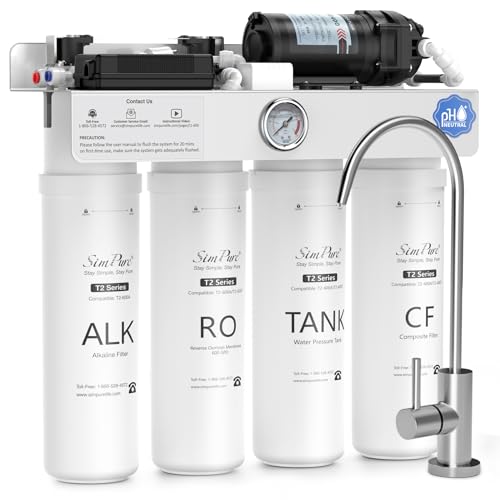
A tankless body that hides a pressure tank inside — steady flow without the separate vessel.
Here’s a clever middle path. Most tankless systems give up the stored-pressure advantage when they drop the external tank — this one keeps it by tucking a built-in pressure tank inside the compact housing. That solves the classic tankless complaint of a slow tail-off when you’re filling a pot, and it’s rated at 0.42 GPM (gallons per minute, a live flow measure that’s easier to picture than a daily total). The capacity is 600 gallons per day with a 2:1 filtered-to-drain ratio.
For water quality the ad is specific: tested to NSF/ANSI 58 standards, It claims removal of 99.99% of contaminants including lead, arsenic, PFAS, PFOA, fluoride, nitrates, microplastics, chlorine, and TDS. It runs UV as an extra step against whatever’s left, then an alkaline stage adds calcium, magnesium, and potassium and balances pH. The all-in-one design also makes direct connections to refrigerators and ice makers straightforward — no external tank to route around.
What owners say lines up with the design intent. It installs simply, all parts included, and the built-in tank is reported to boost the first pour — one gallons-a-minute fill lands under three minutes. Customer service gets frequent praise for answering on weekends. The main knock is a manual that could be clearer on mounting and indicator lights, and a pump that runs a touch louder than a storage-tank system. Nothing that stops a strong recommendation.
Why The Design Works
- 600 GPD with a built-in pressure tank for steady flow (0.42 GPM)
- NSF/ANSI 58 tested; claims 99.99% contaminant removal including PFAS and lead
- UV plus alkaline remineralization with calcium, magnesium, and potassium
- Tool-free twist filter changes and 2:1 filtered-to-drain ratio
Small Print To Note
- Manual is thin on mounting and indicator-light guidance
- The pump runs a bit noisier than a tank-based system
- Needs power under the sink
Go for it when: you want tankless space savings without giving up the steady pressure a stored tank provides.
Reconsider if: you have no power under the cabinet or you insist on a near-silent install.
9. APEC Water RO-PH90 6-Stage Under Sink RO System, Alkaline, 90 GPD
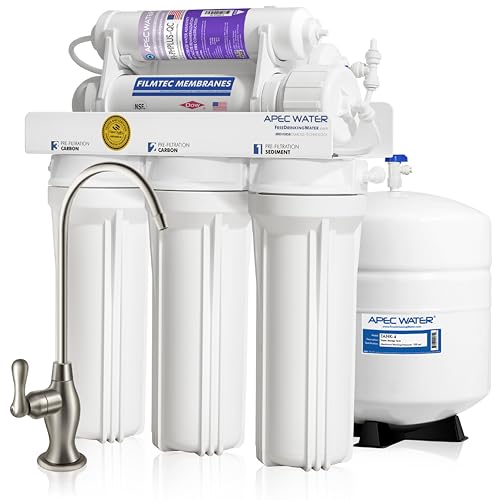
The veteran under-sink alkalinizer people buy again a decade later.
Some products earn trust the slow way, and this is one — owners describe installing their second and third units over ten-plus years and coming back because the first one simply kept working. It’s rated at 90 gallons per day with a storage tank, so it pours fine at the tap for normal use without the upfront cost of a tankless pump. The six stages strip up to 99% of impurities including chlorine, fluoride, arsenic, and lead, then a pH-enhancement stage adds high-purity calcium carbonate to raise the pH above neutral.
For anyone replacing a worn-out reverse osmosis unit, the install is a genuine relief. Owners routinely note the filter assembly is heavy enough that it doesn’t need to be screwed to the cabinet wall — no unnecessary holes in your cabinetry — and the swap from an old system reuses existing lines. One owner measured output pH rising from about 5.5 to about 9.5, in bottled-alkaline territory. The faucet is 100% metal and lead-free, paired with premium JG Quick Connect fittings designed for a secure, leak-resistant seal.
The one number to respect is your feed pressure. This system works best with at least 50 psi, and ideal around 75 — below that you’ll want a booster pump, so test it before ordering. A couple of long-term users have had a minor o-ring leak and a fitting crack after years, so don’t over-tighten the housings. Get the pressure right and you’re set for a decade.
Why people re-buy it: genuine repurchase loyalty across ten-year spans is the strongest durability signal a filter system can carry.
Verify first: a minimum feed pressure is required, so check your psi and add a booster if you’re short.
Best for: a homeowner who wants a proven, easy-to-maintain six-stage alkaline RO system and plans to keep it for years.
Wrong fit if: your well or municipal pressure runs low and you’d rather not add a pump.
10. SimPure Y9A UV Countertop Reverse Osmosis Water Filter, Alkaline

A whole reverse osmosis setup that sits on your counter and asks your landlord for nothing.
Renters, RV owners, dorm dwellers — this is the one built for you. It needs no plumbing and no drilling; you fill a tank, plug it into a standard outlet, and the six-stage filtration with a 0.0001 μm RO membrane does the rest. It’s rated at 300 gallons per day and the ad says it produces about 4.4 ounces in 10 seconds and fills an 8-ounce glass in 18 seconds, which is dramatically faster than the 50-75 GPD most countertop reverse osmosis units manage. The transparent side tank lets you see your water level without pulling the unit out.
That side-tank placement is a genuinely good call versus the rear-tank countertop units that make you drag the machine forward every refill. The post-mineralization filter adds calcium, magnesium, and potassium back in, lifting the water to 50-80 ppm after filtration — a measured figure in the spec sheet — which is where the alkaline character and the fuller taste come from. The six stages reduce TDS by up to 99.88% and target PFAS, PFOA, PFOS, lead, chlorine, nitrates, and fluoride. The body is BPA-free food-grade plastic and the unit needs only 18 inches of vertical clearance, so it clears standard cabinets.
The reality check is the wastewater handling. Because there’s no drain line, the unit collects wastewater you empty yourself, and standing water in a countertop reserve is something a fastidious owner will notice. One long-term user needed extra flush cycles to clear floating particles early on. Filter replacement intervals are also a factor some renters flag as an ongoing cost. None of that changes what this is: the easiest path to alkaline reverse osmosis water when you can’t touch the plumbing.
What you gain: real reverse osmosis plus alkaline minerals at 300 GPD, sitting on a counter with zero installation.
What you manage: you empty the wastewater tank and handle filter swaps on a schedule — the trade for having no drain line.
Built for: renters, travelers, and small-space kitchens who want genuine RO and alkaline water without a plumber.
Not your pick if: you’d rather set it once and have wastewater drain itself — that needs an under-sink install.
11. Aqua Ionizer Deluxe 5.0 Water Ionizer with 7 Water Settings
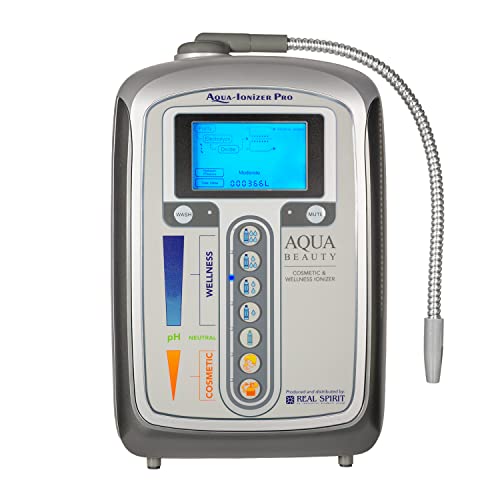
Seven selectable water types from one countertop box, including acidic presets for cleaning.
This is a different animal from the reverse osmosis systems above — it’s a water ionizer, not a filter-and-store unit, and it works by running your tap water through an activated carbon filter and then across electrified plates to split it into alkaline or acidic streams on demand. You choose from seven settings: four continuously variable alkaline, one non-ionized purified, and two ionized acidic presets across a pH range from 4.5 to 10.0. The carbon filter is rated to clean and treat 4,000 liters before replacement.
The alkaline side is where the appeal lives. It’s designed to produce water with a negative ORP (oxidation-reduction potential, a measure of antioxidant capacity) down to -600 mV. It also self-cleans by reversing polarity after each use. Reviewers point out the pH climbs right where they want it — One long-term user measured output pH around 9.5 with ORP in the 600-730 range, and another added a pre-filter that dropped source PPM from roughly 215 to 20-50.. The water tastes great, the unit is compact, and the setup is simple enough that the ad’s “no plumbing” claim holds up.
Two things worth knowing before you buy. First, this unit is not compatible with well water, so it’s built for a treated municipal supply. Second, durability is the mixed spot in owner experiences — most units run for years, but a few have failed early, and one buyer found the machine needed a pre-filter that wasn’t mentioned upfront to avoid a smell developing. Treat pre-filtration and regular self-cleaning as part of ownership. Support has a strong track record of replacing faulty units, which softens the risk considerably.
What Makes It Different
- 7 selectable water settings across a 4.5 to 10.0 pH range
- Designed for ORP down to -600 mV antioxidant capacity
- Self-cleaning via polarity reversal after each use
- Activated carbon filter rated to treat 4,000 liters
Know Before You Commit
- Not compatible with well water — needs treated municipal supply
- Some units have failed early; a pre-filter may be needed for best results
- It’s an ionizer, not a reverse osmosis contaminant filter
Right for you if: you want to dial in a specific alkaline pH and antioxidant ORP reading on treated city water from the countertop.
Pass if: you’re on well water or you want a system that removes contaminants the way reverse osmosis does.
Understanding the Specs
GPD (Gallons Per Day)
This is the total volume of finished water a system can produce in a full day, and it’s the clearest signal of how it keeps up with your household. A higher GPD number means faster recovery between pours and less waiting when several people want water at once. Tankless systems publish big GPD figures because they make water on demand; tank-based units publish lower ones because they refill a storage vessel slowly instead. Match the number to how much your household actually drinks and cooks with, not to the biggest figure on the page.
Pure-to-Drain Ratio
Reverse osmosis pushes some water down the drain to carry away the contaminants it rejects, and this ratio tells you how much clean water you get for each unit of waste. A 2:1 ratio means two cups of filtered water for every cup of wastewater; a 4:1 ratio wastes far less. Traditional reverse osmosis systems often run closer to 1:1, so a listed 2:1 or 4:1 is a real efficiency gain over the old standard. Check it if you care about water bills or conservation.
The Mineral (Alkaline) Stage
Reverse osmosis removes nearly everything from water, including the calcium and magnesium that give it body and taste. The alkaline or remineralization cartridge sits after the membrane and adds minerals back, which lifts the pH above neutral and removes the flat, empty quality of plain reverse osmosis water. This is the stage that makes a system “alkaline” rather than just filtered. Replace it on the schedule the maker lists, because a spent mineral cartridge stops doing its job.
TDS And TDS Meters
TDS stands for total dissolved solids — the sum of minerals, salts, and metals in your water, measured in ppm (parts per million). A reverse osmosis system’s job is to drop that number hard, and owners here report tap readings falling from the hundreds down into the low double digits after filtration. Bear in mind that an alkaline system adds minerals back in after the membrane, so a slightly higher final TDS reading is expected and normal, not a sign the filter isn’t working.
FAQ
Will an alkaline water filter system raise my pH the way bottled alkaline water does?
Do alkaline water filter systems need electricity and a power outlet under the sink?
How much under-sink space does a tankless alkaline RO system actually free up?
What is TDS and why does my reading go back up after the alkaline stage?
How often do I replace the filters in an alkaline water filter system?
Can I install an under-sink alkaline RO system without a plumber?
Does an alkaline water filter system work with well water?
What is the difference between a water ionizer and a reverse osmosis alkaline filter system?
Are countertop alkaline RO systems as effective as under-sink models?
Do alkaline water filter systems really cut out bottled water costs?
Final Thoughts: The Verdict
For most homes, the alkaline water filter system winner is the iSpring RO5004F-AK because it pairs the highest daily output here with a built-in UV lamp and a mineral stage that puts calcium back and lifts pH — a combination no other single unit on this list matches. If you want two water types from one faucet, grab the Waterdrop WD-T4-A. And for anyone who rents or can’t drill, the SimPure Y9A is the one to reach for. The Frizzlife M800 is the quiet pick if your cabinet has no outlet — nine hundred gallons a day with no power cord. Whichever you choose, checking your water pressure and cabinet clearance before you order will save you a return trip.
How We Picked
We do not accept paid placement. Every pick is matched to a real buyer and a real use-case; we do not hands-on test units.
Sources & Methodology
Specifications: manufacturer listings and product documentation. Review insights: verified customer reviews, as of September 2026. Pricing: not shown on this page (it changes often); check the current price via the retailer link.
As an Amazon Associate, Gadgets Feed earns from qualifying purchases. This does not affect which products we feature.