
Our readers keep the lights on and my morning glass full of iced black tea. As an Amazon Associate, I earn from qualifying purchases.
Specs are compiled from manufacturer listings and verified buyer reviews and can change over time — please confirm the key details on the product page before buying.
When the grid drops, your furnace, fridge, and lights can keep running — if your generator reaches them through a permanently wired panel instead of a tangle of cords. A 30 Amp transfer switch is the box that lets you flip your essential circuits from utility power to generator power safely, without back-feeding the line (sending power backward into the grid) and endangering the crew working on it. This guide sorts through the real options in the 30 amp class and tells you which ones homeowners actually keep.
I’m Min — the founder and writer behind Gadgets Feed. This guide is built by comparing the manufacturers’ published specifications and the patterns across verified customer reviews, so you get each pick’s real strengths and trade-offs instead of marketing spin.
Below you will find the circuits, amperage, inlet types, and indoor or outdoor ratings that decide which unit fits your home, along with what buyers report after a season of storms. The best 30 Amp Transfer Switch is the one that matches your generator, your panel, and where you plan to plug in.
Our Picks at a Glance


How To Choose The Best 30 Amp Transfer Switch
Getting this purchase right depends on three questions you can answer before you ever open a box: how many circuits you need to keep alive, how your generator physically connects to the house, and whether the panel lives indoors or out. Sort those three and the shortlist practically names itself.
Match the circuit count to what you refuse to live without
A “circuit” is one breaker’s worth of your home — the kitchen outlets, the furnace, the bedroom lights. A 30 amp switch with 6 circuits covers a tight triage list: fridge, freezer, furnace blower, a couple of lighting runs, and a router. A 10-circuit unit lets you bring more rooms back online, and several of the panels here run 10 single-pole circuits or 5 double-pole (240V) circuits instead. Decide your “must-run” list on paper first, because adding circuits after the fact means a bigger panel and another install.
Know which inlet your generator cord needs
An inlet is the receptacle on the box where your generator’s cable plugs in — it is the single most common mismatch buyers hit. The L14-30 style is a twist-lock connector rated for 30 amps at 240 volts, and it is the standard pairing for a portable generator in this class. Some kits ship with the inlet built in, while others expect you to wire your own outdoor receptacle and supply your own conduit and cable. Check both ends: the box’s inlet type and your generator’s outlet type.
Indoor, outdoor, and the IP54 rating
IP54 is a weather-sealing standard — the “5” means dust-protected and the “4” means it shrugs off splashing water from any direction. If your panel sits in a garage, basement, or utility closet, an indoor unit is fine and often cheaper. If it has to live on an exterior wall, pay for the sealed outdoor version, because an indoor-rated enclosure exposed to rain is a real safety problem.
Quick Comparison
| Model | Best For | Circuits | Type | Inlet / Rating | Amazon |
|---|---|---|---|---|---|
| Reliance Controls 30 amps 240 volt 2 space 6 circuits Surface Mount Generator Power Transfer Kit★ Best Overall | Whole-kit simplicity for a portable generator | 6 | Manual | Screw terminal | Amazon |
| Cheng USA T30 T-30 30Amp Transfer SwitchRV & Solar Pick | RV and solar auto-switching | 2-way | Automatic | Plug in | Amazon |
| 306C Pro/Tran 30-Amp 6-Circuit 2 Manual Transfer SwitchSmart Value | Critical-load backup on a budget | 6 | Manual | Screw terminal | Amazon |
| 306A Pro/Tran2 30-Amp 6-Circuit 2 Manual Transfer Switch with Optional Power Inlet | Sealed 6-circuit install indoors or out | 6 | Manual | Twist-lock / IP54 | Amazon |
| Reliance Controls 31410B Pro/Tran 10-Circuit 30-Amp Indoor Generator Transfer Switch | Ten circuits in a tight indoor space | 10 (5 double-pole) | Manual | 18-inch flexible whip | Amazon |
| R306A Pro/Tran Outdoor 30-Amp 6-Circuit 2 Manual Transfer Switch with L14-30 Power Inlet | Exterior wall mounting | 6 | Manual | L14-30 / IP54 | Amazon |
| Reliance Controls Indoor Backup Power Transfer Switch 30310A | Balancing up to 10 loads with wattmeters | 10 | Manual | Wattmeters built in | Amazon |
| Generac 6853 HomeLink Upgradeable 30 Amp Transfer Switch Kit | Future path to automatic standby | 8 (expandable to 10) | Manual | NEMA 14-30R, 10 ft cord | Amazon |
| 310C Pro/Tran2 30-Amp 10-Circuit 2 Manual Transfer Switch | Maximum circuit coverage with sealed outdoor rating | 10 | Manual | Flexible conduit / IP54 | Amazon |
In‑Depth Reviews
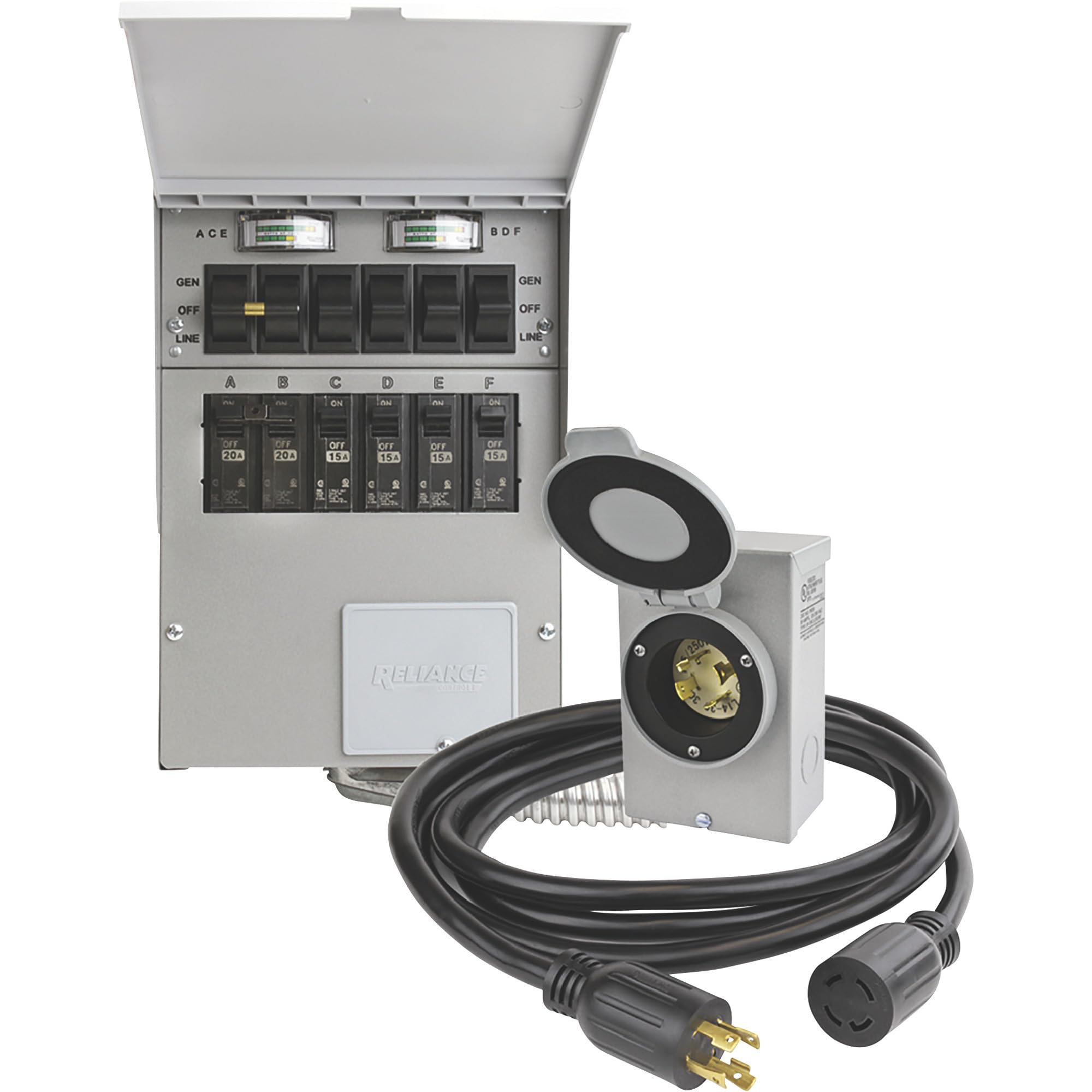
1. Reliance Controls 30 amps 240 volt 2 space 6 circuits Surface Mount Generator Power Transfer Kit
Our pick — over 4.5★ from 250+ verified ratings; the strongest balance of quality and price.
The crowd favorite at 4.6 stars across 287 ratings — the kit that arrives ready to wire.
The headline number here is the 7,500 watts — that is the ceiling on continuous generator output this panel is built to carry. If your portable generator tops out at or below that figure, this box is rated for the whole job. It handles up to 6 single-pole circuits, or one double-pole plus 4 single-pole, so you can keep a 240V load and four everyday rooms running at the same time. And unlike the 306C below, which ships as a bare panel, this one arrives completely pre-wired.
That pre-wiring is exactly why it wins people over. Everything you need to hook a generator into six of your home’s circuits is in the box — an adapter for old-style 240V plugs, colour-coded wiring, and instructions first-timers describe as clear enough to follow without guessing. The install surface-mounts against your existing load center (the main breaker box), and a typical wiring pass runs about 20 minutes once the mounting is done. Owners mention feeding a 6,500W generator into it and powering a 3,300 sq ft home’s circuits within 10 minutes of a 90-minute outage.
What you pay for is convenience, not exotic hardware. The catch is the mounting and the wire: you drill through brick or wall for a flush install, and you supply the 10-gauge wire and the outdoor outlet yourself, since the kit stops at the panel. More than one buyer flagged that the unit’s own leads can be crossed on arrival, so a continuity tester before you land them in the breakers is a cheap insurance policy. Push-button actuators and a touch-style control method make the switching itself dead simple.
Where It Earns Its Keep
- Handles up to 7,500W continuous generator output — matches most portable units.
- Comes fully pre-wired with colour-coded leads and an adapter for older 240V plugs.
- 6 single-pole circuits, or 1 double-pole plus 4 single-pole, covers a real triage list.
- Roughly 20-minute wiring pass after mounting, per owner accounts.
What To Plan Around
- You supply the 10-gauge wire, the outdoor receptacle, and a flush-mount kit.
- Brick or wall drilling is the hardest part of the job.
- Leads have been reported crossed on occasion — verify before terminating.
Reach for this if: you want the least thinking between box and breaker panel, and your generator sits at or under 7,500 running watts.
Think twice if: you need more than six circuits, or you want a factory L14-30 inlet — you will wire your own outlet here.
2. Cheng USA T30 T-30 30Amp Transfer Switch
An automatic switch that flips sources on its own — no hand on the lever, no interruption of your day.
If the rest of this list is about manual panels you walk over and toggle, this one works differently. It is an electronic switch, rated 30 A (30 amps, the current it can carry), that senses the incoming source and swaps to it automatically — meaning if you run an inverter (a device that turns battery power into household AC) or a solar bank, it moves the load to grid power when your battery runs low and back again when the bank recovers. That is a fundamentally different product than a wall-mounted breaker panel, and it is the reason RV owners and solar owners shortlist it.
The build reads rugged in reviewers’ hands. It is a compact 2-way switch with plug-in connectors and copper contacts, and customers note running it daily at around 350W with no hiccups over a year of service. The automatic handoff is what people lean on — shore power to onboard generator, or inverter to grid, with the switch preventing both sources from connecting at once so nothing gets back-fed. As owners put it after a year in an RV: “Switches over nicely as intended and hasn’t skipped a beat.”
Here is the honest catch, and it is a big one: this is not an uninterruptible power supply (a battery that keeps devices running with zero gap). There is a brief delay during the switch, so sensitive electronics will reset and lights will flicker for a moment. The other thing to know is the wiring — while the installation is widely called straightforward, some owners find the leads shorter than they would like in cramped compartments, and the install itself demands real RV electrical experience rather than a first-timer’s afternoon. A rotary actuator (a motor that turns the switch), sensor-based control, and a touch-pad controller round out the spec.
The automatic advantage: you never touch a lever — the switch detects the low battery or the lost shore power (the power pedestal at a campsite) and moves the load itself, which is exactly what boondocking RV owners and off-grid solar setups want from a 30 A transfer switch.
Not a battery backup: the switching delay is a real limitation, so anything with a sensitive clock or a computer inside might blink off when the handoff happens.
Best for: RV and solar owners who want a hands-off 30 A handoff between sources and can handle a crowded compartment install.
Look elsewhere if: you need clean uninterrupted power or you are not comfortable working inside an RV electrical bay.
3. 306C Pro/Tran 30-Amp 6-Circuit 2 Manual Transfer Switch
Six circuits, screw terminals, and the highest-rated mix of function and build on the whole list.
This is the panel for someone who has already picked six critical loads and wants a straightforward manual box to keep them live. It is a 6-way, 30 A unit with screw-terminal connectors, and it carries six 120V circuits — enough for the TV, the lights, a microwave, a Starlink dish, and a propane heater blower on one triage list. The actuators are hinge-lever style, and the contacts use copper, brass, and phosphor bronze.
What stands out in owner experience is how reliable the switching itself feels once it is in. Functionality and build quality are the two things people rave about most here, and the unit is designed to keep working whether or not your main utility power is on. Reviewers point out feeding a 9,500W generator through it and running the whole thing off simple breaker wiring without hiring an electrician, adding their own NEMA L5-30P plugs to match their setup. Pair it with the right cable and it behaves as a set-and-leave box.
Factor in two realities before you buy. The first is that this panel has no 240V circuits, so a 240V well pump or electric dryer is off the table — you are running 120V loads only. The second is the install itself, which rewards comfort with a breaker panel; if you have that, the hardest part tends to be drilling conduit holes and deciding which six circuits get the wires. The contact material and 6-way layout make it a solid value pick for the price tier.
What Wins People Over
- Bragged about for functionality and build quality above anything else.
- Works whether the main breakers are on or off — no dependence on utility state.
- Screw-terminal wiring that a confident DIYer can handle without an electrician.
- Six 120V circuits cover a realistic list: fridge, lights, microwave, router, heater blower.
Worth Knowing First
- No 240V circuits — 240V appliances will not run off it.
- You supply your own plugs and cable to match your generator.
- Conduit drilling is the reported sticking point during install.
Who it suits: the homeowner with basic panel knowledge who wants six reliable 120V circuits and a box that just keeps switching.
Who should skip it: anyone who needs to run a 240V appliance, or who would rather hand off the electrical work entirely.
4. 306A Pro/Tran2 30-Amp 6-Circuit 2 Manual Transfer Switch with Optional Power Inlet
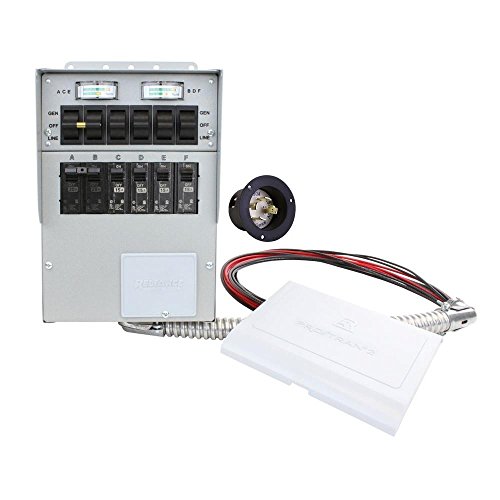
A 6-circuit 30 A panel with an IP54 seal and a twist-lock connector rated for the outdoors.
The spec to focus on here is the IP54 rating — that is the weather-sealing standard that means the enclosure is dust-protected and immune to splashing water from any angle. Pair that with a twist-lock connector, which screws your generator’s plug into place instead of leaving it loose, and you have a panel designed to sit on an exterior wall or in a garage without flinching. It is a 6-way, 30 A unit that handles a 30A generator directly.
Owners put this one through real backup work. On the same 6-circuit layout that has proven so reliable, people report powering lighting, WiFi, outlets, fridge, freezer, security cameras, the bathroom, and a gas furnace during outages, and several say they have installed it up to four times. What readers keep coming back to is the switch replacing extension cords — as one owner put it, “Safer than suicide cords; meets code.” The pre-wired box connects to the generator and main panel without drama, and a typical job runs about an hour to land 6 circuits.
The wrinkle to know is the documentation. The installation instructions land mixed — some find them clear enough to follow solo, others call them awful and lean on the fact that the box arrives pre-wired and fairly self-explanatory. The physical footprint is modest, and the twist-lock inlet is the head-turner versus the screw-terminal kits elsewhere in this list. Expect to source your own outdoor receptacle, since the kit stops short of that.
The sealed-connection angle: the IP54 enclosure and twist-lock connector together are what make this one an outdoor-capable 6-circuit box, and that combination is the reason buyers reach for it over a plain indoor panel.
The instruction caveat: not every owner found the manual helpful — the pre-wiring is what carries most installs, so skim the directions and keep a basic electrical comfort level.
Best for: anyone mounting a 6-circuit panel where splashing rain or garage dust is a real concern, and who wants a locked-in generator plug.
Look elsewhere if: you want a step-by-step manual to walk you through it, or you need more than six circuits.
5. Reliance Controls 31410B Pro/Tran 10-Circuit 30-Amp Indoor Generator Transfer Switch

Ten circuits in a steel cabinet built for generators up to 7,500 running watts.
Ten single-pole circuits — or five double-pole — is the draw here, and it is a meaningful jump over the 6-circuit panels above. A single-pole circuit (one breaker slot for a 120V line) covers ordinary lights and outlets; a double-pole circuit (two slots for a 240V line) covers big loads like a well pump. This unit is made for generators up to 7,500 maximum running watts, and it comes with an 18-inch flexible conduit whip (a pre-made cable sleeve) that attaches to your load center, so you are not running a long rigid stretch to reach the box. The cabinet is powder-coated steel with six combination knockouts (punch-out holes for wiring), and it weighs in at 12.12 pounds.
Look at where it lands in daily use: shoppers say running a furnace fan, kitchen and living-room lights, two fridges, and more off the ten circuits, and they describe switching through two outages without fault. It is built for both residential and commercial installs, and the reported install experience is easy enough that the hardest part ends up being load balance. Because there are no load meters on this panel, the advice from experienced owners is to split your heavy 120V loads across the two sides of the box rather than stacking them.
The honest note is the small hardware. Multiple buyers flag that the breakers feel like lightweight plastic — one reported a breaker breaking during installation and sent the unit back. In fairness, that is a small fraction of the many who install it cleanly, but it is worth handling the breakers carefully and keeping the included ones seated correctly. Note also that you supply your own generator cord — a separate 10-gauge 25 ft cable is commonly needed with this panel.
The Case For It
- Ten single-pole circuits or five double-pole — the most flexible circuit count in this indoor class.
- 18-inch flexible conduit whip makes attaching to the load center faster.
- Rated for generators up to 7,500 maximum running watts.
- Powder-coated steel cabinet with six combination knockouts.
Where It Falls Short
- No built-in load meters — you balance circuits by hand.
- Included breakers are described as lightweight plastic; handle them gently.
- Requires a separate 25 ft 10-gauge generator cord and a 240V-source setup.
Best for: an indoor install where ten circuits of headroom is the priority and the panel can live near the load center.
Pass on it if: you want onboard meters to watch your draw, or you would rather not source a separate generator cord.
6. R306A Pro/Tran Outdoor 30-Amp 6-Circuit 2 Manual Transfer Switch with L14-30 Power Inlet

A 4.8-rated outdoor panel with the L14-30 inlet built right in — plug in and flip.
The defining feature is the L14-30 inlet already on the box. That is the twist-lock connector rated for 30 amps at 240 volts that matches the standard portable generator cord, and having it built in means you are not cutting a separate hole for a receptacle. Add the IP54 seal and this 6-way, 30 A panel is made to live on an exterior wall. The steel cabinet is thick, and there are dual amp meters to watch how hard your breakers are working. It is rated for a 30A / 4,000W generator in one owner’s account.
Owners describe the cabinet as genuinely durable — a locking panel, quality breakers, and switches that stand up to repeated throws. The dual amp meters (gauges that show how much current each leg is pulling) turn out to be the sleeper feature: one owner caught an unexpected high draw from an automatic clothes iron he had not factored in, which is exactly the kind of load surprise these gauges exist to flag. The box runs a fridge, lights, TV, and a computer without trouble, and it supports both 120V and 240V output depending on how you wire it.
The install is the honest hurdle. Not complicated in concept, but feeding 14 wires through a 3/4-inch conduit with two 90-degree bends is very tight — one owner’s job stretched to three hours fighting it. The included 3/4-inch fittings drew complaints, and the DIY fix is to order 1-inch fittings instead. Weigh that against the highest rating in this roundup and it is a fair trade for buyers who want a factory inlet and can be patient with the conduit.
The inlet advantage: a factory L14-30 receptacle plus IP54 sealing is the combination most buyers want for outdoor mounting, and it saves the separate-receptacle step other kits require.
The conduit reality: pulling 14 wires through tight 3/4-inch bends is the one part of this job people report fighting, so budget a slower afternoon.
Best for: an exterior install where you want the generator inlet built in and are willing to plan the conduit runs carefully.
Better to skip if: you want a quick, forgiving install or more than six circuits of coverage.
7. Reliance Controls Indoor Backup Power Transfer Switch, 30 Amp, 10 Circuit Transfer Panel 30310A
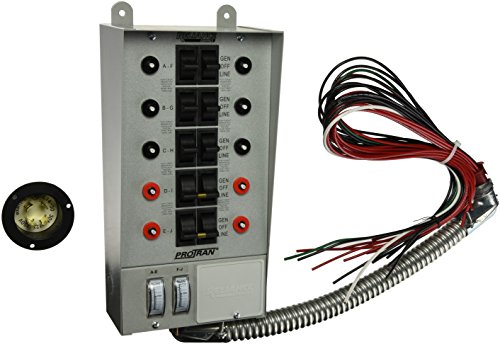
Ten individually controlled circuits with wattmeters that show exactly what you are pulling.
The reason to step up to this panel is control, not just capacity. It manages 10 individually controlled household circuits, letting you power refrigerators, freezers, sump pumps, heating equipment, garage doors, and lighting during an outage — and it is rated for generators up to 7,500 running watts. The built-in wattmeters are the real differentiator: they monitor your load in real time and let you balance it across the panel so you don’t trip a circuit mid-outage. It carries a 30 amp rating across those 10 circuits.
The design is built around safety first. It physically isolates your home’s wiring from the utility grid while you run on backup, which is the feature that protects both your equipment and the crews working the lines. Owners who install it describe the process as straightforward, with clear instructions and someone even noting the tech support line was genuinely helpful. The panel is also code-compliant when installed to local electrical codes, and it fits in a compact footprint that works in tight utility closets.
The recurring caveat is real and worth naming. Some units arrive with damage, and there are reports of wires not being length-matched or labeled per circuit, forcing the installer to trace pairs by hand. Those are a minority against a long record, but they argue for opening the box the day it lands and confirming every breaker and lead before scheduling the install. The wattmeters and 10-circuit layout remain the reason this model holds its spot on the list.
What Makes It Different
- Built-in wattmeters show real-time load so you can balance circuits and avoid tripping.
- Isolates your home wiring from the grid during backup — a real safety feature.
- 10 individually controlled circuits cover fridges, freezers, sump pumps, furnace, garage.
- Straightforward install with clear instructions per the majority of owners.
Worth Being Careful About
- A minority of units arrive damaged — open the box and inspect on arrival.
- Some wires arrive unlabeled per circuit, requiring manual pair tracing.
- One owner reports the instruction illustrations are small.
Reach for this if: you want to actively manage a 10-circuit load and see exactly what your generator is feeding, with built-in wattmeters doing the watching.
Better to skip if: you want a factory-labeled wire loom, or you need an automatic switch rather than a manual panel.
8. Generac 6853 HomeLink Upgradeable 30 Amp Transfer Switch Kit

Eight circuits you can expand to ten later, with a clear path to automatic standby down the road.
The hook here is the word upgradeable. This kit ships with 8 circuits but is built to expand to 10, and it accepts standard, tandem, GFCI, and arc fault breakers — your breaker type is not locked to one brand’s proprietary set. It is rated 30 amps and pairs with generators starting at 5kW with a 30-Amp L14-30 receptacle. It comes with a 10-foot cord and a resin power inlet box, and it fits applications from small houses to greenhouses and tiny homes.
Day-to-day, owners like the single-switch simplicity and the indicator lights that tell you whether you are on utility or generator power. One owner paired it with a Ford F150 Powerboost’s 7.2kW bed power (7,200 watts from the truck’s built-in outlet) and reported it as a clean emergency backup for Florida outages, and the unit powers a fridge, gas furnace blower, sump pump, and upstairs lights without extension cords. Generac recommends a certified and licensed electrician for the install, and the connection to the breaker panel is direct, so no outdoor receptacle is needed in this kit.
Two things to balance against the 4.7 rating. First, it is built around Generac’s ecosystem — it is designed for Generac generators, and that design intent is not obvious from every listing, so check compatibility with whatever you run. Second, the kit does not include the wires or a 50A breaker, since those vary by breaker brand and home layout, and the instruction illustrations run small. Neither is a defect, but both mean you should plan the wiring before the electrician arrives.
The expandable angle: accepting standard, tandem, GFCI, and arc fault breakers — and growing from 8 to 10 circuits — makes this the most future-proof panel in the roundup.
The ecosystem caveat: designed for Generac machines, and the missing wires and 50A breaker mean you source the rest of the install yourself.
Best for: a Generac owner who wants room to grow the circuit count and a step-up path toward automatic standby later.
Less ideal if: you run a different brand’s generator, or you want every wire and breaker supplied in the box.
9. 310C Pro/Tran2 30-Amp 10-Circuit 2 Manual Transfer Switch

Ten circuits, an IP54 seal, and the highest rating on the list at 4.8.
This is the panel for someone who wants maximum coverage without giving up outdoor capability. It is a 10-way, 30 A switch rated for generators running 120/240V up to 7,500 running watts, and it carries the same IP54 weather seal as the smaller outdoor Reliance boxes — dust-protected and splash-resistant. Ten circuits means ten separate loads under individual control, and the circuit protection lets you switch individual circuits from line power to generator one at a time rather than moving everything at once.
Two panel meters make the difference in daily use: they show real-time generator load and let you test the generator while you are still on grid power, so you know your backup is ready before you ever need it. Owners describe the components and workmanship as quality, with a well-written manual, and the install is often called fail-safe simple — red lead to the breaker, the removed wire to black. It handles a 7.5KW generator (7,500 watts) without complaint, and it is heavy and solid rather than flimsy. Expect about a two-hour install with help.
The gripe that keeps coming up is the wire labeling. Some units arrive with letters like I, J, and H printed over wire information, making pairs hard to distinguish, and there are reports of wires running about a foot short for a second box. It is a labeling quibble, not a function problem, and the fix is to label your own pairs as you go.
Why It Leads
- 10 circuits with individual line-to-generator switching for maximum control.
- Two panel meters show real-time load and let you test the generator while on grid.
- IP54 sealed for outdoor or garage mounting.
- Rated for 120/240V generators up to 7,500 running watts.
The Fine Print
- Wire labels can be hard to read, so plan to tag pairs yourself.
- Wires can run about a foot short on a second box configuration.
- Heavy enough that a two-person install is the smart move.
Best for: a buyer wiring ten circuits who wants sealed outdoor capability and meters to monitor load one circuit at a time.
skip it if: you want factory-clear wire labeling or you are only backing up a handful of loads.
Understanding the Specs
Circuit count and the 30 amp rating
A 30 amp transfer switch is rated to carry 30 amps of current through its bus, which pairs with a portable generator in that output class. Circuit count is separate — a 6-circuit box keeps six separate loads live, while a 10-circuit box keeps ten. Match the count to your must-run list before you buy, because adding circuits later means a bigger panel. Note that some panels run 120V circuits only while others accept 240V; the product data here tells you which is which.
Inlet type, connectors, and weather sealing
The inlet is where your generator cable plugs in, and the connector type has to match your generator cord. L14-30 is the twist-lock connector rated for 30 amps at 240 volts; screw-terminal and flexible-conduit setups expect you to wire your own outdoor receptacle. For outdoor mounting, look for an IP54 rating — dust-protected and splash-resistant from any direction — since an indoor enclosure left in the rain is a safety problem, not a shortcut.
FAQ
Will a 30 amp transfer switch run my whole house?
What is the difference between a manual and an automatic transfer switch?
Can I install a 30 amp transfer switch myself?
What generator works with a 30 amp transfer switch?
How many circuits do I really need on a transfer switch?
Do I need an outdoor or indoor rated transfer switch?
Is a transfer switch safer than a suicide cord?
Can a 30 amp transfer switch run a 240V appliance like a well pump?
How long does installation take on a 30 amp transfer switch?
Do I need load meters on a transfer switch?
Final Thoughts: The Verdict
For most owners, the 30 amp transfer switch winner is the Reliance Controls Surface Mount Generator Power Transfer Kit because it arrives fully pre-wired for generators up to 7,500 running watts, handles six circuits, and pairs with a 4.6-star record that owners keep coming back to. If you want the highest-rated coverage with an IP54 seal (a rating for protection against dust and splashing water), grab the 310C Pro/Tran2 and its ten circuits and dual meters. And for RV or solar owners who want a hands-off handoff instead of a lever, the Cheng USA T30 is the automatic one to reach for. Whichever you pick, the smart move is to open the box the day it lands, confirm every breaker and lead, then schedule the install — that five-minute check is what saves you a mid-outage surprise.
How We Picked
We do not accept paid placement. Every pick is matched to a real buyer and a real use-case; we do not hands-on test units.
Sources & Methodology
Specifications: manufacturer listings and product documentation. Review insights: verified customer reviews, as of September 2026. Pricing: not shown on this page (it changes often); check the current price via the retailer link.
As an Amazon Associate, Gadgets Feed earns from qualifying purchases. This does not affect which products we feature.