
Charging a sealed AGM 12-volt battery isn’t like topping off a standard flooded cell. The wrong voltage curve or a missing temperature sensor can cook the electrolyte dry from the inside, turning a premium absorbed glass mat battery into a paperweight within months. You need a smart charger that recognizes the chemistry, applies a precise absorption phase, and switches to a safe float voltage automatically.
I’m Min — the co-founder and writer behind Gadgets Feed. I’ve spent dozens of hours analyzing charge profiles, pulse repair frequencies, and safety certifications across the current pool of AGM-specific chargers to separate the true maintainers from the general-purpose units that merely claim compatibility.
Whether you are topping off a weekend RV battery, reviving a deeply discharged golf cart pack, or keeping a winter-stored boat battery at peak health, this guide breaks down the seven best options to find the right battery charger for agm 12 volt battery.
How To Choose The Best Battery Charger For AGM 12 Volt Battery
Selecting an AGM-specific charger starts with three non-negotiable technical parameters: charging profile, current rating, and safety mechanisms. A charger that lacks an AGM-dedicated mode or relies on a single fixed voltage will degrade the battery’s glass mat separators over repeated cycles.
AGM Absorption Voltage & Float Voltage
An AGM battery must be charged to an absorption voltage between 14.4V and 14.7V, then held at a float voltage around 13.2V to 13.5V. Any charger that cannot precisely limit the float stage risks drying the battery by driving excess current through the absorbed electrolyte. Look for a unit that explicitly lists AGM in its compatibility matrix and publishes the voltage targets for each stage.
Amperage Rating: Matching Charger to Battery Capacity
For a typical 12V AGM battery in a car or lawn tractor (30Ah to 100Ah), a charger rated between 5A and 15A is ideal. A 20A unit can reduce charging time on large deep-cycle AGM packs (over 100Ah) but may push too much heat into a smaller battery. Trade-off: higher amperage shortens charge time but demands careful temperature management. If your primary use is maintenance, a 5A unit is safer and extends cycle life.
Multi-Stage Charging & Pulse Repair
Premium AGM chargers follow a multi-stage process: bulk, absorption, float, and often a pulse desulfation mode. Desulfation sends high-frequency voltage spikes through the battery to break down lead sulfate crystals that form on the plates. Not all desulfators are equal — some apply a timed cycle, while others continuously monitor internal resistance. For a battery that has sat discharged for weeks, a charger with a forced or repair mode (able to wake batteries below 2V) is a practical edge.
Quick Comparison
On smaller screens, swipe sideways to see the full table.
| Model | Category | Best For | Key Spec | Amazon |
|---|---|---|---|---|
| NOCO GENIUS5 | Smart Maintainer | Long-term float maintenance & dead battery recovery | 5A; charges from 1V; Force Mode | Amazon |
| CTEK MXS 5.0 | 8-Step Specialist | European cars, reconditioning, all-weather charging | 4.3A; 8-step adaptive charging | Amazon |
| Battery Tender 15 Amp | Multi-Amp Selector | Multi-vehicle garages, switchable 15/8/2A | 15A; LCD display; ISM adaptive charging | Amazon |
| Schumacher SC1280 | Rapid Charge | Fast 15A recovery for standard AGM batteries | 15A; automatic voltage detection | Amazon |
| VEVOR 20A Smart Charger | Budget Wide-Voltage | 6V/12V/24V AGM & LiFePO4 charging | 20A; 3.6-inch LCD; Supply Mode | Amazon |
| YHCHKJ 20A | High-Amperage Value | High-speed AGM charging for large 12V/24V packs | 20A; 3-level 12V/24V; 5-year warranty | Amazon |
| Huiaipaic 20A | Budget Pulse Repair | Desulfation on a tight budget, dual voltage | 20A; Pulse Repair; 300W output | Amazon |
In‑Depth Reviews
1. NOCO GENIUS5

The NOCO GENIUS5 is the benchmark for AGM float maintenance. Its 5-amp output is enough for most car, motorcycle, and marine AGM batteries from 20Ah to 120Ah, and the integrated thermal sensor adjusts the charge voltage by ambient temperature — critical for AGM batteries stored in garages where temperature swings exceed 20°C. Unlike many budget chargers that apply a blanket 14.4V regardless of conditions, the GENIUS5 dynamically drops the absorption voltage in hot environments to prevent electrolyte boiling.
What sets this charger apart is its ability to wake batteries from as low as 1 volt using Force Mode. A deeply discharged AGM battery often reads below 5V and triggers a refusal on standard chargers. The GENIUS5 bypasses this by manually forcing a charge current until the battery voltage stabilizes above the minimum threshold. Precision pulse charging also reverses sulfation continuously, which extends the life of an AGM battery that sits for months between uses.
The build quality is compact at only 1.6 pounds, and the included eyelet terminals allow permanent under-hood installation for vehicles that need regular top-ups. The only real concession is the 5-amp ceiling — if you are regularly charging a 200Ah deep-cycle AGM bank from flat, a 20-amp unit will cut the time by over 60%. But for the vast majority of AGM owners, the combination of safety, precision, and battery revival capability makes this the clear best overall choice.
Why it’s great
- Forces charge on batteries below 1V, perfect for neglected AGM packs
- Thermal sensor adjusts voltage automatically — no manual temperature compensation
- Compact design with removable clamps and permanent eyelet leads
Good to know
- Limited to 5A maximum, slower for large deep-cycle banks
- Instruction documentation lacks detailed desulfation stage descriptions
2. CTEK MXS 5.0

The CTEK MXS 5.0 is built around an eight-step charging algorithm that covers desulfation, bulk, absorption, analysis, reconditioning, float, and pulse maintenance. For AGM batteries, step 4 (absorption) holds a steady 14.4V until the current drops below 0.5A — a tight threshold that ensures the glass mat is fully saturated without overcharging. The “recondition” step applies a controlled voltage spike to break down lead sulfate while the battery is already partially charged, which is safer than the brute-force desulfation some budget units attempt on empty batteries.
Splash-proofing to IP65 and spark-proof clamps make this charger safe for damp environments like boat bilges or engine bays exposed to rain. The cold-weather performance is noteworthy: the MXS 5.0 automatically compensates for low temperatures by raising the charge voltage by 0.3V per 10°C below 25°C, preventing undercharging in a 0°C storage shed. Many owners run these units for years straight on seasonal vehicles without any battery degradation.
The downside is the 4.3-amp limit — a 100Ah AGM battery at 50% depth of discharge will take roughly 12 hours to return to full. The accompanying manual is also thin on technical details; the full charging curve is only documented online. For the AGM owner who values multi-stage precision over raw speed, and who keeps the charger connected for weeks at a time, the CTEK MXS 5.0 delivers unmatched long-term battery health.
Why it’s great
- 8-stage charging with dedicated AGM absorption and float profiles
- IP65 splash-proof housing — safe for outdoor and marine use
- Temperature compensation prevents undercharging in winter storage
Good to know
- Rated at only 4.3A; slow for large deep-cycle AGM packs
- Instruction manual is sparse — key settings only explained online
3. Battery Tender 15 Amp

The Battery Tender 15 Amp is the most configurable mainstream charger for AGM batteries, offering switchable outputs of 15, 8, and 2 amps. This range covers everything from a rapid recovery of a dead truck AGM at 15A to a gentle 2A float for a deep-cycle marine battery that sits through the winter. Selectable chemistry also includes standard AGM, gel, flooded, and LiFePO4, which is rare at this price point — most chargers in the sub- range only support two chemistries.
The interactive LCD display shows charging rate, battery type, and percentage of charge completion, all of which are legible even in moderate daylight. ISM (Interactive Supply Mode) adaptive charging resumes full output if the battery voltage drops under load, which is useful for AGM batteries powering security systems or engine block heaters that draw parasitic current. The spark-proof connection and reverse polarity detection add safety margins when working in tight engine compartments.
One subtle limitation: if the charger loses AC power and then regains it, the unit defaults back to its 15A high-rate setting rather than remembering the previously selected amperage. For a sensitive AGM battery that requires a consistent low-amp float, this could inadvertently push too much current until the user manually resets the mode. We recommend checking the display after any power interruption. Overall, the flexibility of three amperage levels in one unit makes this the best pick for households with multiple AGM batteries of different sizes.
Why it’s great
- Three amp levels (15/8/2A) cover fast charging and gentle maintenance
- Interactive LCD display with battery percentage and error messages
- 5-year warranty with lifetime customer service support
Good to know
- Defaults to 15A after AC power loss — must manually re-select low amp mode
- No LED status indicator on the housing; need to check the LCD
4. Schumacher SC1280

The Schumacher SC1280 is a fully automatic 15-amp charger that detects battery voltage and chemistry automatically before applying the correct charging curve. For AGM batteries, it selects a 14.4V absorption phase then drops to a 13.2V float — both squarely within the safe window for absorbed glass mat chemistry. The 15-amp bulk rate can recover a 60Ah AGM from 50% charge in under two hours, which makes it a strong option for a daily-use vehicle that needs a quick top-up between drives.
The digital display provides battery voltage and state-of-charge percentage in real time, which eliminates the guesswork common with old-style analog meters. Reverse hook-up protection is built into the alligator clips, so accidental polarity reversal won’t damage the charger. The unit also includes a desulfation mode that operates as part of the automatic cycle — though Schumacher does not publish the pulse frequency, customer reports confirm it has revived sulfated batteries that would no longer hold a full charge.
Where this charger stumbles is its lack of a manual mode. The automatic algorithm defaults to AGM at 15A every time power is cycled, which can be too aggressive for a small 14Ah motorcycle AGM. The fan is also audible at full speed, though it only runs during the bulk phase. If you want a set-and-forget rapid charger for a single standard AGM battery (60Ah to 120Ah), the SC1280 delivers proven Schumacher reliability without the complexity of multi-amp switches.
Why it’s great
- 15A rapid charging recovers standard AGM batteries in under 2 hours
- Automatic voltage and chemistry detection removes user error
- Built-in desulfation mode helps restore mildly sulfated AGM plates
Good to know
- No user-selectable amperage — always defaults to 15A AGM after power reset
- Fan creates audible noise during the bulk charge phase
5. VEVOR 20A Smart Charger

The VEVOR 20A Smart Charger is a capable multi-voltage unit that works with 6V, 12V, and 24V AGM batteries, as well as lithium and lead-acid chemistries. The 20-amp maximum current is genuinely useful for large deep-cycle AGM batteries — a 200Ah pack at 50% DoD can be recharged in roughly 5 hours. The charger features four selectable modes: charging, maintain, desulfation, and a “Supply Mode” that forces charge on batteries as low as 1V, similar in concept to the NOCO Force Mode but at a much lower price point.
The 3.6-inch LCD screen is one of the largest in this class, displaying working mode, voltage, current, and power percentage in a clear white-on-blue layout. Independent buttons for mode selection and current adjustment eliminate the confusing multi-function button system found on cheaper chargers. Build quality is solid at 1.8 pounds with a robust plastic housing, and the included battery clamps are thick copper with good spring tension.
The trade-off comes in the finer technical details: VEVOR does not specify the exact absorption voltage for AGM mode (customer tests suggest it hovers around 14.4V), and the desulfation mode cannot be manually activated — it only runs automatically during the analysis phase. Some users also report that the charger runs warm during extended 20A operation, so adequate ventilation is required. For the price, this is the most versatile option for someone who needs to charge AGM batteries across multiple voltages and battery sizes without spending premium money.
Why it’s great
- 20A output charges large deep-cycle AGM packs significantly faster than 5A units
- Supply Mode recovers batteries as low as 1V without manual intervention
- Large 3.6-inch LCD screen provides real-time charging data at a glance
Good to know
- AGM absorption voltage is not publicly published — measured around 14.4V by users
- Heatsink runs warm during sustained 20A operation; requires free airflow
6. YHCHKJ 20A
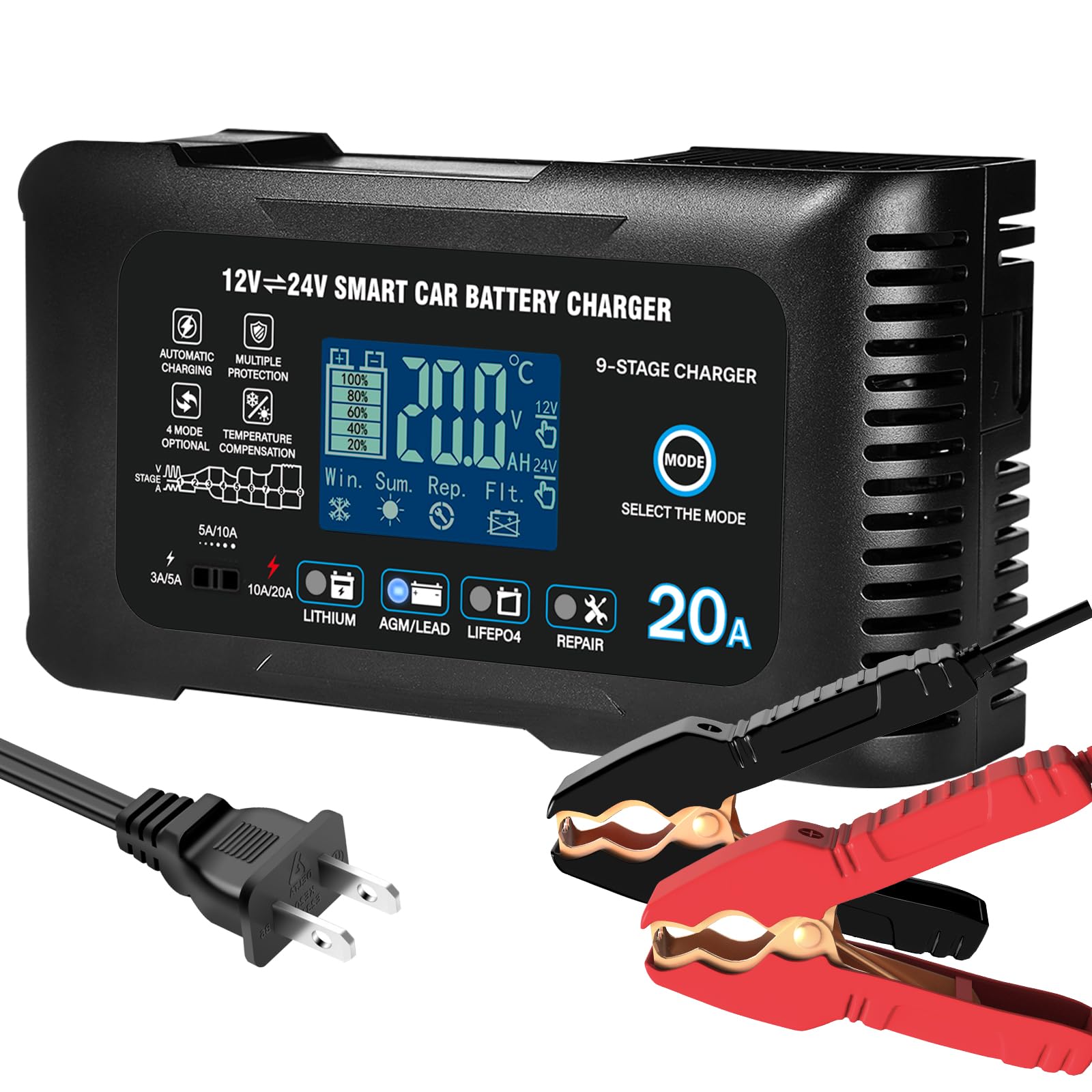
The YHCHKJ 20A charger aims squarely at the mid-range sweet spot with a UL-certified 20-amp design that supports both 12V and 24V AGM batteries plus LiFePO4 chemistry. The one-button start simplifies operation — plug in, select the battery type and current (12V at 5A/10A/20A or 24V at 3A/5A/10A), and let the three-level smart charging system handle the rest. For AGM batteries, the unit applies temperature compensation, adjusting the voltage based on ambient readings to prevent overcharging in summer and undercharging in winter.
The large LCD screen displays voltage, current, internal temperature, and charging percentage, plus summer/winter mode indicators. Pulse repair mode uses high-frequency spikes to desulfate lead-acid and AGM packs, and the 5-year after-sales warranty is among the longest in this price tier. Build quality is decent — the housing feels sturdy, and the alligator clips grip battery terminals securely.
Where the YHCHKJ falls short of the premium units is in its AGM detection logic. When set to AGM, the charger applies a blanket 14.6V absorption regardless of battery age and condition, without the fine multi-stage nuance that CTEK or NOCO offer. Also, the minimum starting voltage is 2V — batteries below this threshold will not be recognized, so Force Mode is absent. If you need a fast, UL-listed charger for routine AGM top-ups and occasional lithium charging, the YHCHKJ delivers good value for the wattage.
Why it’s great
- True 20A current with 3-level amperage selection for 12V AGM batteries
- UL certified with temperature compensation for seasonal charging
- 5-year warranty — longer than most competitors at this price point
Good to know
- Minimum starting voltage of 2V — cannot wake fully dead AGM batteries
- AGM absorption voltage is fixed at 14.6V without multi-stage refinement
7. Huiaipaic 20A
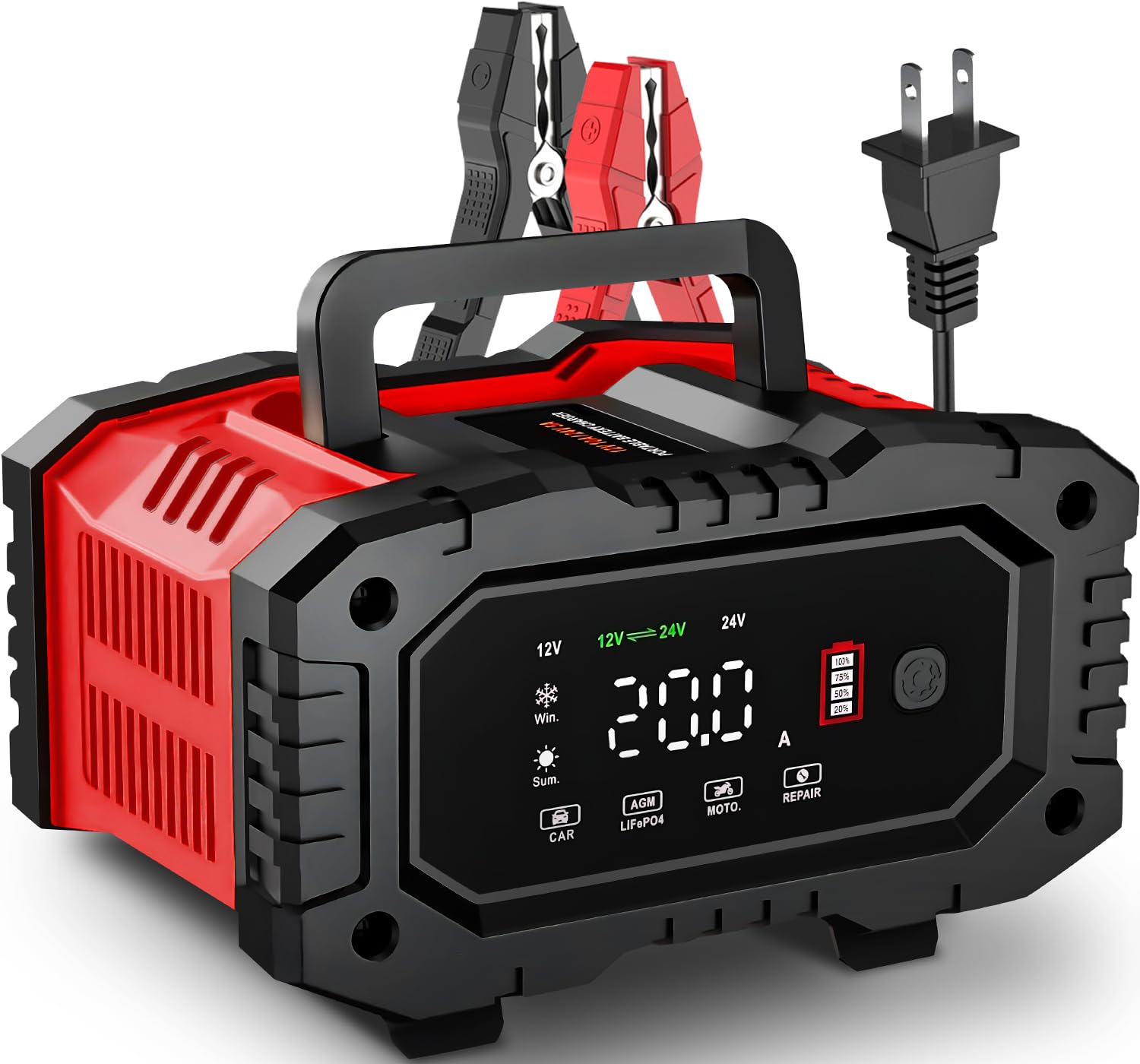
The Huiaipaic 20A charger packs a surprising number of features for its price tier: 20-amp output, pulse repair desulfation, a large LCD, and a foldable handle with onboard cable wrap. It is compatible with 12V and 24V lead-acid AGM, GEL, SLA, and even LiFePO4 batteries. The pulse repair mode uses both high-frequency and low-frequency spikes to break down lead sulfate, and the repair mode can be manually selected for batteries that have been idle for extended periods — a feature often missing on sub- chargers.
The LCD screen clearly shows voltage, current, percentage, and summer/winter mode status, though several customer reviews note the display is difficult to read in direct outdoor daylight. The device includes a summer/winter mode that adjusts the target voltage by roughly 0.8V between hot and cold environments — a simplified but effective form of temperature compensation. The unit is remarkably light at 2.2 pounds (1,020 grams), making it easy to carry between vehicles.
The compromises are typical for the budget segment: build quality feels lighter than premium chargers, the AGM charging profile is not published, and the manual is generic. The pulse repair mode cannot activate a completely dead battery or repair seriously damaged plates — it works best on mildly sulfated batteries. For someone who already owns an AGM battery and needs an occasional desulfation cycle combined with 20-amp charging speed at the lowest possible entry cost, the Huiaipaic is a functional, capable option.
Why it’s great
- 20-amp output at a very accessible cost for budget-focused buyers
- Manual pulse repair mode for reviving mildly sulfated AGM batteries
- Foldable handle with integrated cable wrap for tidy storage
Good to know
- LCD display washes out in direct sunlight; hard to read outdoors
- Cannot activate a completely dead (0V) battery despite repair mode
FAQ
Can I use a regular lead-acid charger on my AGM 12V battery?
Why does my AGM battery get hot when I charge it at 20 amps?
How often should I run a desulfation cycle on my AGM battery?
What does “Force Mode” do for a completely dead AGM battery?
Can I leave an AGM battery charger connected indefinitely?
Final Thoughts: The Verdict
For most users, the battery charger for agm 12 volt battery winner is the NOCO GENIUS5 because its dynamic temperature compensation and 1V Force Mode provide unmatched safety and revival capability for daily-use and stored AGM batteries. If you need an 8-stage adaptive algorithm that includes a dedicated reconditioning step for deep-cycle AGM packs, grab the CTEK MXS 5.0. And for multi-vehicle households that need switchable amp levels from 2A to 15A, nothing beats the Battery Tender 15 Amp.