
The vibration in your hands tells you everything — you are either laying down a mirror-finish or burning through clearcoat. A random orbital or rotary auto buffer polisher is the difference between a showroom shine and a costly repaint. Choosing the wrong one means swirls, holograms, or heat damage that no wax can fix.
I’m Min — the co-founder and writer behind Gadgets Feed. I’ve spent countless hours analyzing power ratings, pad ecosystems, and customer feedback patterns across the entire range of auto buffer polishers to separate the tools that deliver professional results from those that just spin their pads.
Whether you are a beginner looking for a safe first machine or a seasoned detailer needing production-speed correction, this guide breaks down the top contenders for the best auto buffer polisher based on real-world specs and owner experiences.
How To Choose The Best Auto Buffer Polisher
An auto buffer polisher is an investment in your vehicle’s paint. The wrong choice can create holograms, burn through edges, or overheat halfway through a job. Here is what actually matters when separating a capable tool from a frustrating one.
Dual Action vs. Rotary: Which Polisher Action Is Right?
Dual action (DA) polishers combine a spinning motion with a random orbital path. This design drastically reduces the risk of burning paint and creating holograms, making it the go-to choice for beginners and professionals working on modern clearcoat paints. Rotary buffers spin in one fixed direction and cut aggressively, but require significant experience to avoid paint damage. For nearly all car detailing tasks — from swirl removal to final waxing — a dual action polisher offers the safest and most forgiving experience.
Motor Power and Speed Range
Motor wattage directly dictates how much pressure the polisher can sustain without bogging down. Look for motors above 700 watts for consistent correction on harder paints. A variable speed range is essential — low speeds (1,500-2,500 RPM or OPM) are ideal for spreading wax and polish, while higher speeds (3,500-4,500+) are needed for cutting compounds and defect removal. The ability to dial in exactly the right speed prevents heat buildup and splatter.
Pad Size and Backing Plate Versatility
The pad size determines how much area you cover per pass and how easily you can navigate curves. A standard 5-inch or 6-inch backing plate is the sweet spot for cars — large enough for hoods and doors, yet nimble enough for bumpers. Some polishers offer convertible backing plates, letting you swap between 5-inch and 6-inch pads. For tight spaces like emblems, mirror housings, and motorcycle frames, a mini polisher with a 1-inch to 3-inch pad is a necessary companion.
Quick Comparison
On smaller screens, swipe sideways to see the full table.
| Model | Category | Best For | Key Spec | Amazon |
|---|---|---|---|---|
| Griot’s Garage G9 | Premium | Flawless paint correction with ergonomic comfort | 1,000W motor, 9mm orbit, 2,000-6,400 OPM | Amazon |
| Meguiar’s MT300 | Premium | Consistent torque under pressure for pros | Digital Torque Management, 4.5A motor | Amazon |
| BATOCA 6″ DA | Mid-Range | Complete kit with dense pad selection | 700W motor, 6-speed, includes carbon brushes | Amazon |
| THINKWORK 20V Cordless | Mid-Range | Outdoor and boat detailing without cords | 20V battery, 10-inch pad, dual handle | Amazon |
| AVID POWER 1200W Rotary | Value | Heavy-cut paint correction on a budget | 1,200W motor, 6-speed, 6″ & 7″ backing plates | Amazon |
| LDHTHOPI 980W DA | Value | Beginner-friendly DA with a generous accessory kit | 980W motor, 9mm orbit, 2,800-5,800 RPM | Amazon |
| SPTA Cordless Mini | Specialty | Tight spots, emblems, and motorcycle detailing | 12V battery, 3 backplate sizes, 2,000-4,500 OPM | Amazon |
In‑Depth Reviews
1. Griot’s Garage G9 Random Orbital Polisher

The G9 is a benchmark in the mid-premium segment, packing a 1,000-watt motor with a 9mm orbit throw that delivers smooth, predictable correction without excessive vibration. Its variable speed range of 2,000 to 6,400 OPM covers everything from gentle wax application to aggressive defect removal, and the fan-cooled counterbalance ensures the machine runs cool even during extended sessions. The double-shot rubber grip and contoured shroud make it noticeably easier to hold for an entire vehicle, reducing fatigue during long polishing days.
Converting to a 5-inch pad system requires only an optional backing plate, giving you tighter control on smaller panels without needing a second tool. The 10-foot quick-connect power cord provides decent reach, though some users find the trigger lock design could be more intuitive. When matched with Griot’s own microfiber pads, this polisher produces a high-gloss finish with minimal hologram risk, making it a strong choice for both enthusiasts and professionals who value consistent speed control.
Owner feedback consistently highlights the G9’s low vibration levels and powerful, bog-resistant operation. The primary drawbacks are the lack of a removable side handle for added leverage and the fact that you’ll want to replace the included foam pads with higher-quality options for compound work. For most detailers, this is the one machine that balances power, comfort, and finish quality without crossing into unrealistic budget territories.
Why it’s great
- 1,000W motor provides consistent power under heavy pressure
- Ergonomic grip design reduces fatigue over long use
- Low vibration and smooth operation for swirl-free finishes
Good to know
- Trigger lock design is functional but not the most refined
- No side handle included in the base kit
- Stock foam pads may require upgrading for heavy compound cutting
2. Meguiar’s MT300 Variable Speed DA Polisher

Meguiar’s MT300 stands apart with its Digital Torque Management, a system that electronically adjusts torque to maintain the loaded speed level you select. This means when you push down to remove a deep scratch, the motor doesn’t bog down — it keeps spinning at the same consistent rate, delivering predictable cut and preventing the uneven finishing that plagues lesser DA polishers. The soft start technology gradually ramps up the pad motion, reducing the initial sling of polish and giving you better control from the moment you pull the trigger.
The multi-position D-handle improves leverage and comfort, allowing you to adjust your grip based on the angle of the panel you’re correcting. The billet counterweight ensures near-zero wobble, which directly translates to fewer holograms and a flatter finish. The MT300 accepts universal 5-inch and 6-inch backing plates, though it ships without pads or a backing plate, requiring a separate purchase to get started. This is a deliberate choice for professionals who already have a preferred pad system.
User reports consistently praise the MT300’s consistent performance on hard clearcoats and its lightweight feel — it weighs only 5.4 pounds, making it one of the lighter full-size DA options. The trade-off is a 4.5-amp motor that, while efficient, can feel less powerful than the 1,000-watt class of competitors. The inclusion of spare brushes and a robust build quality adds long-term value, and the overall package is aimed squarely at detailers who prioritize finishing quality over raw cutting speed.
Why it’s great
- Digital Torque Management maintains speed under load for consistent cutting
- Soft start prevents polish sling and improves control
- Lightweight design at 5.4 lbs reduces fatigue
Good to know
- Does not include a backing plate or pads
- Motor feels less powerful than some direct-drive competitors
- Some users report higher vibration levels at maximum speed
3. BATOCA 6″ Dual Action Random Orbital Polisher

The BATOCA 6-inch DA polisher delivers a compelling package for its price tier, combining a 700-watt pure copper motor with a 6-speed control dial ranging from 1,000 to 3,800 OPM. The eccentric shaft design — a hallmark of effective dual action — ensures the polishing motion is both random and orbital, meaning the pad spins in a random pattern that prevents burn-through even if you linger in one spot too long. This makes the BATOCA an extremely safe machine for novices who want to tackle swirl removal without risking paint damage.
The kit includes a dense assortment of accessories: 6-inch flat foam pads, wool polishing bonnets, sanding papers, a washing microfiber towel, a tool bag, and even a pair of disposable gloves and spare carbon brushes for the motor. The D-handle and straight handle offer flexibility for different grip styles, and the chameleon-green body makes it easy to spot on a crowded workbench. The included pads, however, are quite stiff straight out of the box and benefit from a break-in session on a test panel before touching your vehicle’s paint.
Long-term owner experiences highlight the machine’s ability to run for extended sessions — one user detailed three cars over eight hours without any loss of performance. The carbon brushes are easily replaceable, extending the tool’s lifespan beyond cheaper throwaway alternatives. The main limitation is the motor’s 700-watt rating, which can struggle to maintain speed against heavy cutting force on very hard clearcoats. For everyday maintenance, waxing, and light-to-medium defect removal, this kit provides excellent starting value.
Why it’s great
- Comprehensive kit includes pads, wool bonnets, and tool bag
- Eccentric shaft design makes it beginner-safe against paint damage
- Replaceable carbon brushes extend motor lifespan
Good to know
- Stock foam pads are stiff and require break-in
- 700W motor can bog down on aggressive compound work
- Some users report pad backing adhesive issues with heavy use
4. THINKWORK 20V Cordless Buffer Polisher

For detailers who work outdoors, on boats, or in locations where dragging an extension cord across the garage floor is a genuine hazard, the THINKWORK 20V cordless polisher cuts the tether completely. Its 20-volt rechargeable lithium battery delivers up to 30 minutes of continuous operation per charge, and the kit includes two 2Ah batteries plus a fast charger, effectively giving you an hour of runtime. The 10-inch pad size covers large surfaces — hoods, roofs, and boat hulls — faster than standard 5 or 6-inch polishers, making it a productivity tool for spread work rather than precision correction.
The pure copper bipolar motor produces a dual-action random orbit that minimizes swirl creation, and the six adjustable speed settings range from 1,500 to 3,600 RPM, allowing you to dial down for wax application or crank up for defect removal. The double-handle design — a fixed main handle and a detachable side handle — provides excellent control, and the machine weighs a manageable 7.28 pounds. The included accessory kit is generous: wool bonnets, coral velvet polishing pads, waxing bonnets, and grid waxing sponges cover most basic polishing and waxing scenarios.
Owner experiences are largely positive regarding the lightweight feel and ease of use, though the included pads tend to wear quickly and some users recommend purchasing higher-quality replacement pads from the start. The cordless convenience is a genuine time-saver for boats and RVs, but the 30-minute-per-battery runtime means you will need to plan your workflow around charging cycles. If your primary need is polishing a car in good condition or maintaining a large gelcoat surface without cord limitations, this is a practical cordless alternative.
Why it’s great
- Cordless design eliminates tripping hazards and extends reach
- 10-inch pad covers large areas quickly for waxing and light polishing
- Two included batteries allow near-continuous work with rotation
Good to know
- Included pads wear faster than standalone aftermarket options
- 30-minute runtime per battery requires charging strategy
- Not suitable for heavy paint correction due to motor limitations
5. AVID POWER 1200W Car Buffer Polisher
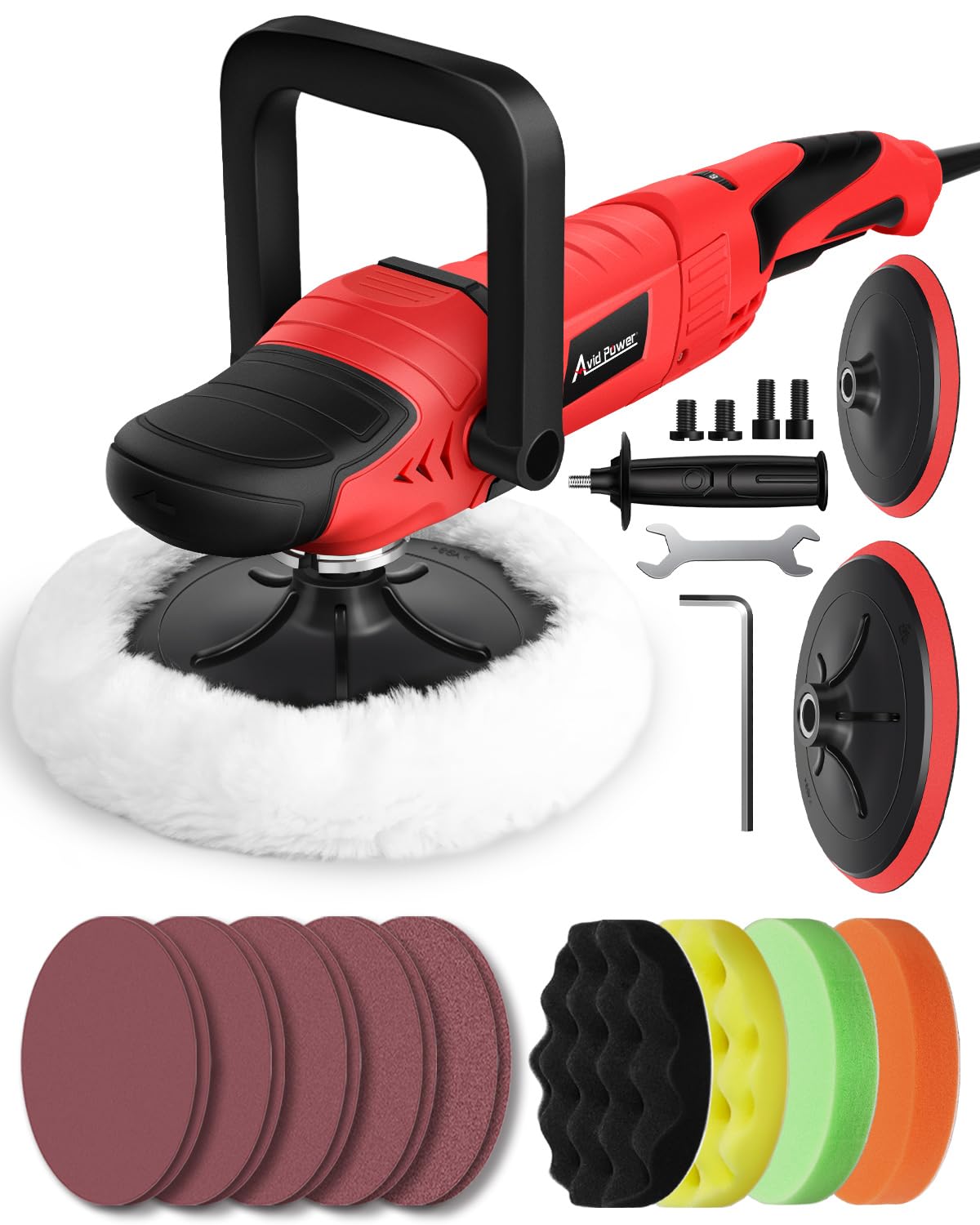
The AVID POWER 1200W polisher is a rotary machine, meaning it spins the pad in one fixed direction. This gives it a raw cutting advantage over dual-action polishers for removing heavy oxidation, deep scratches, and wet-sanding marks — a 1,200-watt motor delivering 1,000-3,500 RPM of direct drive torque can shave down clearcoat quickly. The precision-aligned motor shaft reduces vibration compared to cheaper rotary buffers, and the advanced cooling design with heat-resistant copper wiring and optimized airflow keeps the tool running through two-plus hours of continuous use without thermal shutdown.
The kit is exceptionally comprehensive: two backing plates (6-inch and 7-inch), 10 sanding papers, four 6-inch polishing pads, a 7-inch wool buffing bonnet, and three handle attachments (D-handle, side handle, and front cover grip) for maximum ergonomic flexibility. The variable speed dial is easy to adjust on the fly, and the rubberized body provides a confident grip even when your hands are slick with wax residue. Users report restoring oxidized boat gelcoat and heavily neglected car paint to a glossy finish that previously required a shop quoting over for the same work.
Rotary polishers demand respect — they generate heat quickly and can burn through paint edges if you stay stationary too long or use too aggressive a pad. The AVID POWER is a capable tool for those who already understand rotary technique or are willing to practice on scrap panels. The plastic housing feels less premium than higher-end competitors, but the motor performance and included accessory count make it a strong entry-level rotary for those who need serious cutting power without a serious budget.
Why it’s great
- 1,200W rotary motor provides aggressive cut for deep defect removal
- Includes both 6″ and 7″ backing plates for pad flexibility
- Advanced cooling design prevents overheating during long sessions
Good to know
- Rotary action requires experience to avoid paint burn
- Plastic housing feels less durable than metal counterparts
- Not suitable for beginners without practice on test panels
6. LDHTHOPI 980W Dual Action Polisher

The LDHTHOPI dual action polisher offers a compelling price-to-performance ratio with a 980-watt motor and variable speed control spanning 2,800 to 5,800 RPM. The random orbital action — a 9mm orbit path that moves in a constantly shifting pattern — provides the safety net that beginners need. Unlike a rotary buffer, this DA polisher will not burn through clearcoat even if you pause on an edge, making it a low-stress introduction to paint correction. The motor uses pure copper wire windings for efficient heat dissipation and consistent power delivery.
This polisher ships with eight detachable foam pads in different cut levels — yellow for heavy compounding, orange for medium cutting, blue for fine polishing, and white for final wax application. The inclusion of a carrying bag, detachable D-handle, and a side handle means you can start detailing out of the box without hunting for additional accessories. The trigger lock feature keeps the machine running at your set speed without maintaining finger pressure, though some users note the lock button requires both hands to engage securely.
Feedback from owners is consistently positive about the smooth speed adjustment and the gentle acceleration curve. The tool does generate noticeable heat during extended operation, and some users have reported that the backing on the foam pads can separate after cleaning, requiring adhesive reinforcement. For light-to-moderate polishing, waxing, and scratch removal on daily-driver paint, the LDHTHOPI performs well above its price point and is forgiving enough for first-time users to achieve pro-adjacent results.
Why it’s great
- Forgiving dual-action design is ideal for novice detailers
- 980W motor provides ample power for light and medium correction
- Comes with 8 pads covering compound through wax application
Good to know
- Unit generates noticeable heat during extended sessions
- Pad backing can delaminate during cleaning over time
- Trigger lock is secure but not one-handed operable
7. SPTA Cordless Mini Polisher
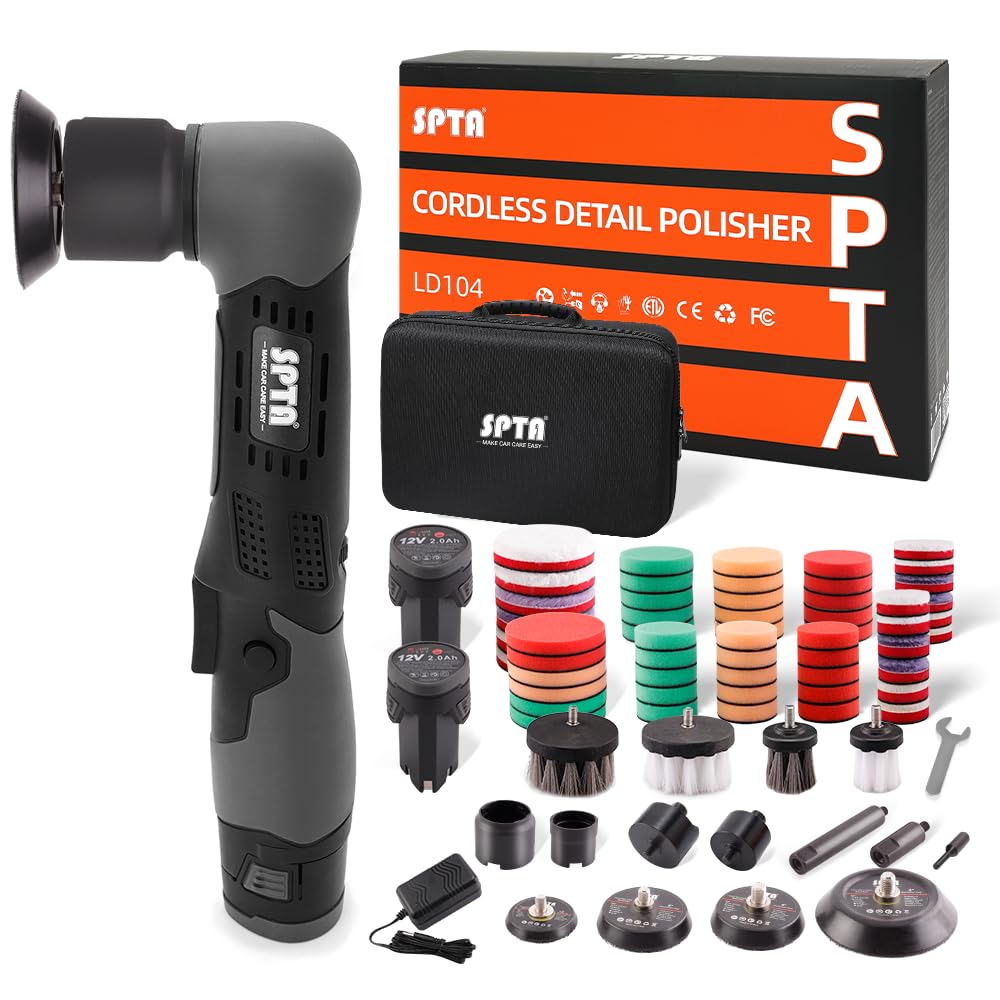
Full-size polishers are invaluable for hoods and doors, but they are useless on tight areas like emblems, motorcycle frames, door jambs, and mirror housings. The SPTA Cordless Mini Polisher is purpose-built for these precision zones, offering a compact body that fits in your palm with a weight of just under 2 kilograms. It supports three backing plate sizes — 25mm, 50mm, and 80mm — letting you choose the exact pad footprint for the panel you are working on. The dual-action free-spinning rotation operates between 2,000 and 4,500 oscillations per minute, providing hologram-free polishing even at close quarters.
The kit includes two 2,000 mAh batteries, which deliver approximately 45-55 minutes of run time each when new. This gives enough capacity to detail an entire motorcycle or address all the tight spots on a full-size car. The package is da bomb with accessories: two extension shafts, protective covers, brushes, four support plates, and a staggering 54 polishing pads across 25mm, 50mm, and 76mm sizes. The carrying case, while functional, requires disassembling the tool to fit inside, which is a minor inconvenience for a machine that otherwise punches above its weight class.
Users in automotive painting and motorcycle detailing communities praise the SPTA Mini for its quiet, low-vibration operation and its ability to denib fresh paint with 2,000 and 3,000-grit sanding before buffing to a gloss. The battery life decreases after around ten charge cycles, but the dual-battery system helps compensate. This is a specialist tool — it cannot replace a full-size DA for whole-panel correction — but it fills the detailer’s gap between a full-size pad and manual hand polishing with unmatched precision.
Why it’s great
- Three interchangeable backing plates cover 25mm to 80mm
- Quiet, low-vibration operation ideal for delicate work
- Includes two batteries and 54 pads for out-of-box readiness
Good to know
- Battery life diminishes noticeably after approximately 10 charge cycles
- Case requires disassembly of the tool for storage
- Not a replacement for full-size DA on large paint corrections
FAQ
What is the difference between a rotary and a dual action polisher?
Can a beginner use a DA polisher safely on their car?
How many watts do I need for a car polisher?
What pad sizes work best for car detailing?
Should I buy a corded or cordless buffer polisher?
Final Thoughts: The Verdict
For most users, the best auto buffer polisher winner is the Griot’s Garage G9 because it combines a 1,000-watt motor, smooth 9mm orbit, and ergonomic design into a package that performs reliably across all detailing stages without the high price of boutique machines. If you want digital torque management that keeps speed consistent under heavy pressure, grab the Meguiar’s MT300. And for cordless freedom on large outdoor surfaces like boats and RVs, nothing beats the THINKWORK 20V Cordless Polisher.