
Our readers keep the lights on and my morning glass full of iced black tea. As an Amazon Associate, I earn from qualifying purchases.
Specs are compiled from manufacturer listings and verified buyer reviews and can change over time — please confirm the key details on the product page before buying.
Getting real hi-fi sound used to mean a stack of separates, a pile of speaker cable, and a weekend of fiddling. That is no longer true. Today’s better budget systems are powered, tuned, and ready to fill a room the moment you unbox them — and the smartest buys pair genuine detail with a plug-and-play setup instead of an amplifier-matching headache. Read on for exactly which ones earn the shelf space.
I’m Min — the founder and writer behind Gadgets Feed. This guide is built by comparing the manufacturers’ published specifications and the patterns across verified customer reviews, so you get each pick’s real strengths and trade-offs instead of marketing spin.
Every pick below is judged on the specs that actually change how music sounds in your room — driver size and count, amplifier wattage, wired input range, and the frequency response that decides whether bass feels full or thin. If you want the short version, the best budget audiophile system is the one that matches your room size and your source gear first, then your taste.
Our Picks at a Glance

How To Choose The Best Budget Audiophile System
Buying your first serious-sounding system is really a set of three decisions: how much space you have, what you are plugging in, and if you want to add an amplifier later or never think about one again. Get those three right and almost any of the picks below will sound excellent in your room.
Active Versus Passive — the one choice that shapes everything
An active system (also called powered) has the amplifier built into the speaker cabinet, so you plug a source straight in and you are done. The Edifier S1000MKII, Fluance Ai41, and Edifier MR5 all work this way, and the big upside is that the amp is matched to the drivers at the factory instead of guessed at by you. The trade-off is that you cannot swap the amp out later without replacing the whole speaker.
Match the driver size to the room, not to the marketing
Bigger drivers move more air, which is what you feel as bass. The S1000MKII runs a 5.5-inch aluminum alloy midrange bass driver, the Fluance Ai41 a 5-inch woven glass fiber driver, and the Klipsch The Three Plus a 5.25-inch high excursion woofer — all tuned for near-field listening and mid-sized rooms. In a small bedroom, a single compact two-way like the Klipsch fills the space; in a lounge, the larger cabinet of the Philips with its 5.25-inch woofers and bass-reflex ports is the better fit.
Follow your sources to the right inputs
If you still spin vinyl, a dedicated phono input saves you a standalone preamp — the Sony STRDH190 and the ANGELS HORN turntable both provide one. If you stream from a phone or tablet, Bluetooth with a high-quality codec such as aptX HD keeps the signal clean. And if your desktop PC or console is the main source, look at USB, optical, or TRS inputs so you are not stacking adapters.
Watch the frequency range, and read it honestly
A lower bottom number in the frequency response means deeper bass on paper. The Edifier MR5 reaches down to 46Hz, the S1000MKII to 45Hz, and the Philips to 50Hz, so all three will give you real low-end for music and movies. Specs alone never guarantee a great room, though — placement near a back wall boosts bass, and a heavy desk absorbs some of it, so it is worth moving a speaker a few feet before you decide it sounds thin.
Quick Comparison
| Model | Best For | Driver Size | Amplifier / Power | Wired Inputs | Amazon |
|---|---|---|---|---|---|
| Edifier S1000MKII★ Best Overall | Desktop and TV listening | 5.5 in. + 1 in. tweeter | Class D, 60W x 2 | Optical, coaxial, AUX | Amazon |
| Klipsch The Three PlusCompact Pick | Small rooms and vinyl | 5.25 in. woofer + dual 2.25 in. | Biamplified 2.1 stereo | Phono/RCA, optical, USB | Amazon |
| ANGELS HORN Turntable SystemBest Value Kit | Complete vinyl starter setup | Included bookshelf speakers | Built-in phono preamp | RCA line out, Bluetooth 4.2 | Amazon |
| Philips TAM8905/37 | All-in-one lounge system | 5.25 in. woofers + dome tweeters | 100W | Aux, USB, Wi-Fi, Bluetooth | Amazon |
| Fluance Ai41 | TV and turntable upgrades | 5 in. woven glass fiber + tweeter | Integrated 90W | RCA, optical, subwoofer out | Amazon |
| Edifier MR5 | Studio-accurate desktop work | 5 in. woofer + 3.75 in. + 1 in. | 110W RMS, 101dB peak SPL | XLR, TRS, RCA, AUX | Amazon |
| Sony STRDH190 Bundle | Vinyl plus digital flex | SSCS5 3-way, 3-driver | 2-channel receiver | Phono, 4 analog inputs | Amazon |
| Bose Wave Music System IV | Countertop all-in-one | Waveguide speaker technology | Integrated stereo | 3.5mm audio input | Amazon |
| Denon D-M41 | Compact CD and radio lovers | 4 3/4 in. woofer/mid + 1 in. tweeter | 2x30W | Two digital inputs, Bluetooth | Amazon |
In‑Depth Reviews
1. Edifier S1000MKII Audiophile Active Bookshelf 2.0 Speakers
Our pick — over 4.5★ from 550+ verified ratings; the strongest balance of quality and price.
A 5.5-inch aluminum woofer and a built-in 60-watt-per-side amp in one shelf-ready cabinet.
This is the system that wins people over on sound, not on bells and whistles. Each speaker holds a 5.5-inch aluminum alloy midrange bass driver paired with a 1-inch advanced titanium dome tweeter, and the response runs from 45 Hz up to 40 kHz — which in plain terms means you get deep, tuneful bass and clean treble sparkle without an added subwoofer in most rooms. The built-in Class D amplifier delivers 60 watts per speaker, so there is no receiver to buy, no amp to match, and no speaker cable to run to a separate box. You plug your source straight into the back and press play.
What most owners talk about is how smooth it sounds next to how imposing it looks. The cabinet finish reads like a small monitor, but the tuning leans warm and full rather than bright or shouty, and that is the combination home theater and desktop listeners both land on. The two Edifier systems here split by purpose: this one targets casual and living-room listening, while the MR5 above it in the lineup chases studio accuracy — and this is also the larger-driver pick against the Klipsch, at 5.5 inches versus 5.25 inches. Bluetooth runs 5.0 with Qualcomm aptX HD decoding, and the connection reaches 32.8 feet, so you can leave your phone on the couch and still stream. On top of that, there is on-speaker volume, bass, and treble adjustment plus a wireless remote, and the rear panel accepts optical, coaxial, and AUX — so a TV, a CD player, a Blu-ray deck, and a laptop can all stay connected at once. Setup is genuinely plug-and-play.
If you want the strongest do-it-all pair for a desk or a TV stand without buying separate electronics, this is the one to start with, and the crowd agrees — it holds a 4.6-star rating across 580+ ratings. The honest catch is the finish and the furniture footprint: it is a satin-brown cabinet rather than a black one, so it may not disappear beside dark electronics. And it is heavier than a simple desktop speaker, so you will want to find its final spot before you move it twice.
Where it stands out
- 60 watts per speaker from the built-in Class D amp means no external receiver or amplifier to buy or match.
- 5.5-inch aluminum alloy bass driver plus a 1-inch titanium dome tweeter, with response from 45 Hz to 40 kHz.
- Optical, coaxial, and AUX inputs keep a TV, CD player, and laptop connected at the same time.
- Bluetooth 5.0 with Qualcomm aptX HD decoding and 32.8 feet of range for cleaner wireless streaming.
Worth knowing
- The finish is a brown wood-grain cabinet rather than plain black, which is a look some buyers do not want next to their other gear.
- The remote must be pointed fairly directly at the unit, and switching inputs is remote-dependent.
Best for: anyone who wants a single powered pair on a desk or TV stand and never wants to think about an amplifier again.
Look elsewhere if: you need Bluetooth in every room or a companion app — this unit keeps everything on the cabinet and the remote.
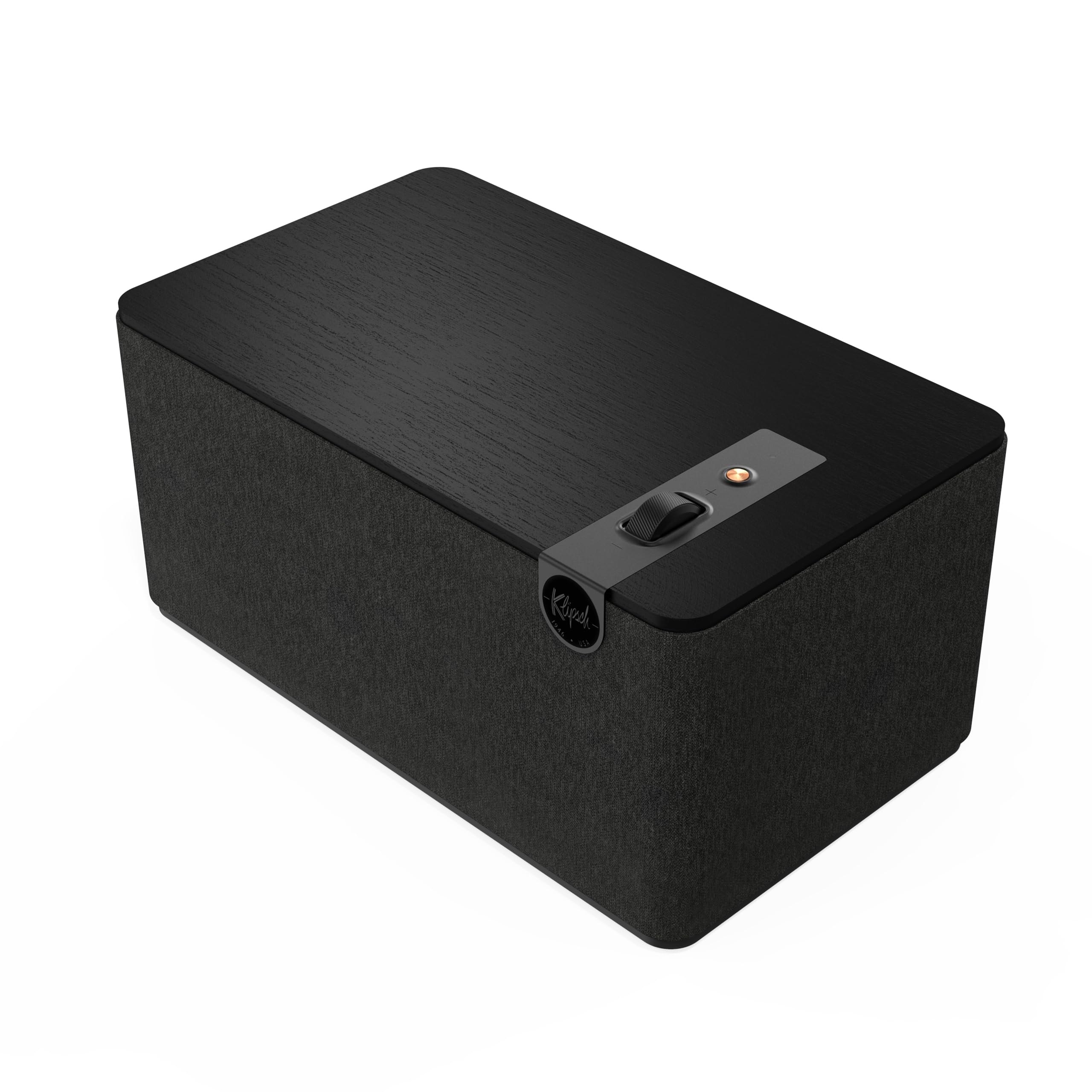
2. Klipsch The Three Plus Premium Bluetooth Speaker System
A single tabletop box that takes a turntable straight in and still has room to shake a small room.
For a one-box system, this is the most flexible option here. It runs a biamplified 2.1 stereo setup — dual 2.25-inch full-range drivers plus a 5.25-inch high excursion woofer — tuned for a bold, full sound with real bass, and the broad tonal balance is what lifts it above the other compact speaker. Owners who compare it against higher-priced rivals describe it as landing close to what you would expect from a system that costs many times more. That is how you end up with a full, warm, un-fussy sound from a box that fits on a bookshelf or a media console.
Two practical features separate it from the rest of the field. First, it is ready for a turntable from the start thanks to the phono/RCA inputs, so vinyl can be your main source without buying a separate preamp. And if you stream wirelessly, the Bluetooth 5.3 connection reaches 40 feet — here it outruns the Edifier S1000’s 32.8 feet, so your source is not locked to the same room. It also takes optical and USB-C inputs, and USB-C can even reverse-charge a device while it plays. There is an app for setting EQ, saving presets, and getting firmware updates. In the rare-when-you-need-it department: Broadcast Mode lets you wirelessly connect ten-plus of these speakers together if you ever build that dream house-wide setup.
The natural limitation is that it is a single-box stereo system rather than a pair of spaced speakers, so you will not get the pinpoint left-right imaging you can create by pulling apart two bookshelf cabinets. It is also the pick for people who want one clean box on a console, not for someone chasing a wide two-speaker stage. For a small to mid-size room where records, streams, and movies all need to sound good from one neat unit, this is the one.
Where it shines: the phono/RCA inputs mean a turntable plugs in without a separate preamp, and Bluetooth 5.3 carries a steady signal up to 40 feet.
Something to weigh: it is one box doing stereo, so soundstage width is limited by the cabinet — this is the setup for a compact console, not a hi-fi room.
The best fit if: your turntable and your streaming phone deserve one tidy, furniture-friendly box that does both well.
Pass on it if: you want a true separated left-and-right stage or multi-room app control.
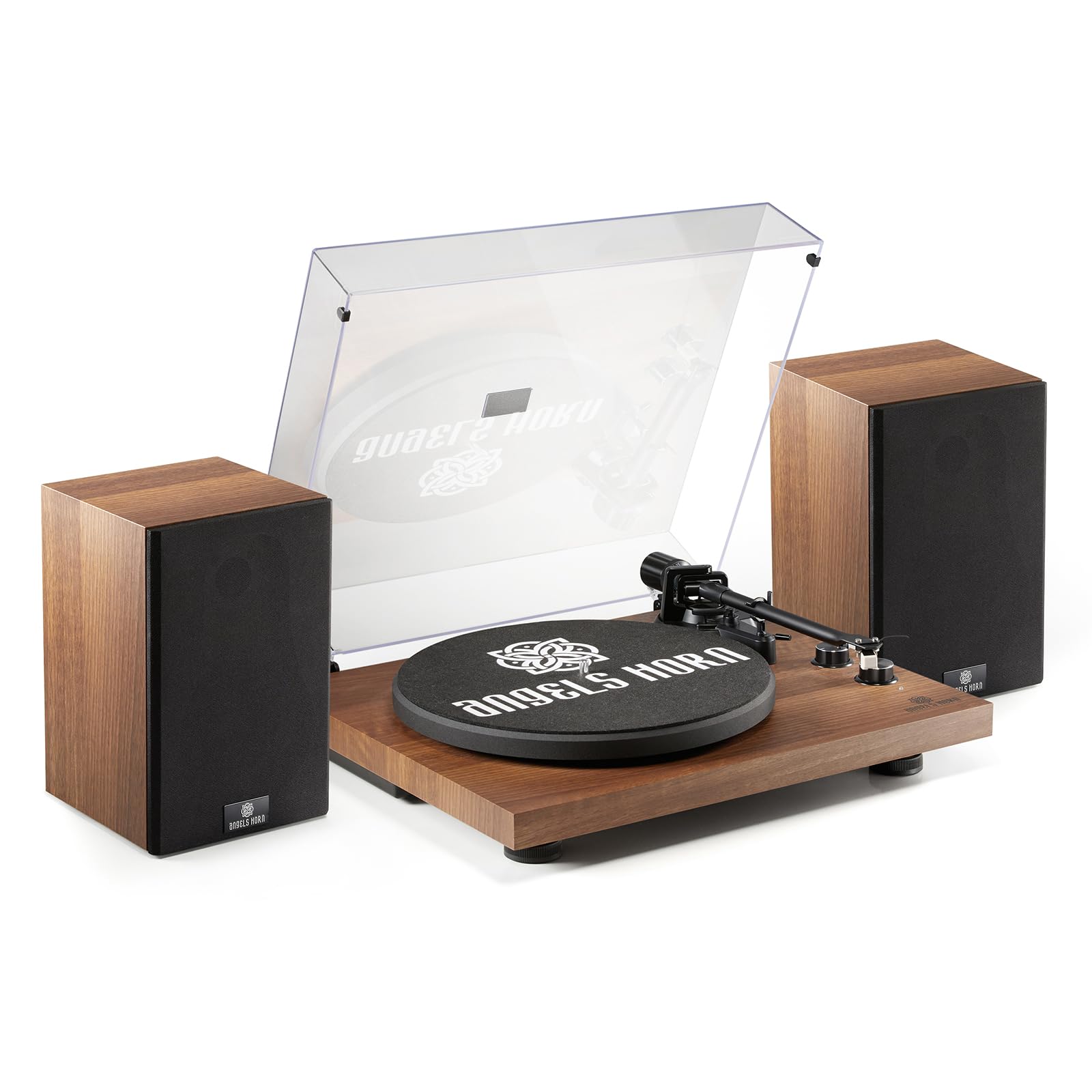
3. ANGELS HORN Vinyl Record Player Hi Fi System with Stereo Bookshelf Speakers
A complete turntable-and-speakers box that turns a stack of old records into a listening session in one afternoon.
This package gets you from a stack of records to music in one purchase: the turntable, two stereo bookshelf speakers, and everything needed to spin. The engineering effort behind it went into the sound rather than the trinkets, and the result is a warm, distortion-free presentation that owners describe as genuinely surfacing what is pressed on the record. Two speeds cover the standard 33 1/3 and 45 RPM formats, and the belt drive is quoted as quieter than the direct-drive alternatives. The built-in phono preamp means you do not need a separate preamp box, and an adjustable counterweight plus a stable iron platter work together to keep the needle tracking cleanly and cut skipping. The high-end phono cartridge is a magnetic AT-3600L, which is the kind of part you would normally have to buy separately.
Bluetooth is here as an input, not an afterthought — it runs version 4.2 and lets you stream from your phone straight through the system’s speakers. Compared with the Klipsch’s version 5.3, that is an older wireless standard, so you get simpler compatibility rather than the longest range. The natural wood base and the included speakers share a single design language, so the whole set reads as intentional furniture rather than a mismatched parts pile. Buyers who deliberately choose it for the look describe it as décor that doubles as audio gear, which is not something you can say about most budget systems.
Where this kit has limits is in the stock speakers. They are perfectly usable from the start, but the system gives you room to upgrade them later, and the better comparison is to consider it a turntable with speakers included rather than a speaker-first purchase. Because the phono preamp and adjustable counterweight are part of the unit, you can also run the table through a home stereo or add better bookshelf speakers down the line without replacing everything. It is a smart first step for anybody who wants to know whether vinyl is for them before committing larger money.
What earns it a spot
- Complete one-box solution — turntable plus two bookshelf speakers, ready to spin with a built-in phono preamp.
- Adjustable counterweight and a stable iron platter reduce skipping and distortion at the needle.
- Two speeds (33 1/3 and 45 RPM) and a magnetic AT-3600L cartridge that would normally cost extra.
- Bluetooth 4.2 lets your phone feed the same speakers when you are not playing records.
Where it gets real
- The included speakers are adequate rather than impressive — many owners upgrade them, so treat the package as a turntable with speakers thrown in.
- The counterbalance and turntable setup can take a modest amount of fiddling to get right the first time.
Reach for this: if you want to plug in your first real turntable, keep your current speakers on standby, and grow the system later.
Look past it if: you already own serious speakers and just want the turntable on its own.
4. Philips Bluetooth & WiFi Stereo System for Home with CD Player

The only system here that plays a CD, a Spotify stream, and a radio station without a single app swap.
If your collection is a mix of discs, streams, and radio, this is the pick that handles all of it in one unit. Wi-Fi and Spotify Connect let you stream your playlists and podcasts directly, Bluetooth takes whatever your phone has loaded, the CD drawer handles your old discs, and there is a USB port for files plus FM and Internet Radio for news and stations. The amp puts out 100W through dome tweeters and 5.25-inch woofers with bass-reflex ports, which is more than enough to fill a lounge or an open-plan kitchen. The frequency range runs 50 Hz to 20,000 Hz, so it will not dig as deep as the Edifier S1000MKII’s 45 Hz floor — bass reach is slightly tighter here.
Where this beats the plain speaker-in-a-box alternatives is variety. There is aux-in for anything with a headphone jack, a color display showing the artist and track, preset sound styles tuned for hip-hop through to choral music, and a remote control with the core functions at the top. The included FM antenna helps lock in a clean station, and the 30-foot Bluetooth wireless range lets you keep the source on the far sofa. Owners who have run it for months still call it out for outrunning their expectations on a twenty-five-year-old CD-R, which says a lot about how forgiving the drive is.
Fair warning: connecting the speakers to the receiver trips some people up, and the clock feature draws the most mixed notes of any feature on the unit. It is the sort of thing worth being patient with during setup, because once it is wired correctly the system is far less fussy day-to-day. For a buyer who wants one console doing everything rather than a stack of separate boxes, that setup effort is a reasonable price to pay.
One thing it does that the rest can’t: a CD drawer, FM and Internet Radio, Spotify Connect, Bluetooth, USB, aux, and a headphone jack — all in one box.
The honest caveat: connecting the speakers to the receiver can confuse new owners during first setup, so plan to give the manual your full attention on day one.
Choose this one if: you want the widest source list possible — vinyl-free, disc-friendly, stream-capable, radio-ready — in a single branded system.
Not your pick if: you want a truly deep, dedicated bass foundation and a traditional phono input.
5. Fluance Ai41 Powered 2-Way 2.0 Stereo Bookshelf Speakers

A powered pair with a built-in 90W amp and a subwoofer output, so you can never outgrow the low end.
What makes this pairing worth the shelf space is flexibility. A 90W integrated amplifier runs both speakers, so like the Edifier S1000MKII there is no receiver to add. From there it opens up: an optical input for your TV or console, RCA for a turntable or source, Bluetooth 5.0 for wireless streaming, and — the part that separates it — a subwoofer output, so you can add deeper bass later without replacing the system. The 5-inch woven glass fiber drivers are light and rigid, which is how they keep midrange detail clean and bass undistorted at sensible levels, and high-performance neodymium tweeters give the sound a wide stereo image that still holds up if you are sitting off to the side. The internally braced MDF cabinets and rear bass port keep the resonance down, which means the cabinets are not coloring the sound they are producing.
Where the design occasionally splits opinion is loudness. At normal listening levels and in normal rooms, the volume is genuinely full, but a few owners do find they need to push it harder than expected with bass boosted. That is a fair trade-off for the price you are paying for a full-size pair of speakers with this much built-in. The practical fix is straightforward: sit within a normal listening distance and adjust the source volume, and it holds up fine.
The other thing to love is the finish and build. The white walnut cabinet looks like furniture, not a budget speaker, and the layout is compact enough for a tight shelf — one owner even notes the cabinets are compact at ten inches high, which is about the size that fits a standard media shelf without overhang. There is a proper remote with bass and treble trim, which is handy because different recordings vary so much in bass content. For buyers who want a pair of real speakers, not a single box, and who want room to grow, this is the strongest fit in the field.
Why the price makes sense
- Integrated 90W amp drives both speakers, so no receiver is needed.
- RCA, optical, and Bluetooth 5.0 inputs cover TV, turntable, and phone streaming without adapters.
- A subwoofer output means you can add deeper bass later — rare on an all-in-one powered pair.
- 5-inch woven glass fiber drivers with neodymium tweeters and braced MDF cabinets keep the midrange clean.
Two things to accept
- Maximum volume may not be loud enough for very large or open rooms with bass boosted, so match it to your listening distance.
- The built-in DSP and amplifier limit bass extension versus a larger dedicated subwoofer.
Pick it for: a smaller room, a TV stand, or a desk where you want two proper speakers and the option to add a subwoofer later.
Not the one if: you have a large open room where a full-size tower system, not a bookshelf pair, is the better fit.
6. Edifier MR5 2.0 Studio Monitor Bookshelf Speakers

A three-way active monitor tuned for hearing every layer in a mix, not just the beat.
If your listening leans analytical — gaming, producing, or picking apart a recording — this is the one aimed at you. It is a 3-way active crossover design, where each driver handles its own frequency band rather than forcing two drivers to cover everything, and that is what lets the sound stay detailed instead of smearing together. It pairs a 5-inch long-throw woofer, a 3.75-inch mid driver, and a 1-inch silk dome tweeter, and it holds the widest response range of the group, from 46 Hz up to 40 kHz. The 110W RMS Class D amplifier also delivers 101 dB peak SPL, which is why it can fill a mid-size room without sounding strained. The Hi-Res badge reflects support for 24-bit/96kHz audio over both wired and wireless connections, so high-resolution files land intact.
The connectivity is the deepest on this list. It takes XLR (the balanced three-pin studio standard), TRS, RCA, and AUX alongside Bluetooth 6.0 with multi-point connection, plus a front-panel 3.5mm headphone jack. That is why so many buyers run it from a desktop PC, a console, or studio gear without needing a hub — the back panel has the ports. It also adds a layer of tuning you do not get on most bookshelf speakers: physical rear knobs for high and low frequency adjustment plus an app for room compensation, with low cut-off, desktop control, and acoustic space presets. If your speakers sit near a wall or on a desk, that tuning is what stops bass from piling up and going muddy.
One honest limitation is that it offers no dedicated subwoofer output. Buyers who want to layer in a subwoofer find workarounds, but the standard path is not present. The trade-off in exchange is that the three-way design already reaches down to 46 Hz, so for most rooms and most content you will not miss a sub. For anyone who wants monitors that reward close listening as much as casual listening, this is the sharpest tool in the box.
The spec that matters here: a genuine 3-way crossover with a separate 3.75-inch mid driver, which means vocals and instruments keep their own space instead of fighting the bass driver.
Where it asks you to adapt: there is no dedicated subwoofer output, so low-end layering is a workaround rather than a plug-in.
Built for you if: you sit at a desk, mix or game for hours, and want the widest detail across the frequency range.
Look elsewhere if: the cosmetic look of a home speaker matters more to you than the tuning flexibility behind it.
7. Sony STRDH190 2-Channel Stereo Receiver with SSCS5 Bookshelf Speakers

A traditional receiver-and-speaker bundle that treats your turntable as a first-class citizen.
Some buyers do not want an all-in-one box; they want a proper receiver with a pair of speakers hanging off it. That is exactly what this bundle delivers. The STRDH190 brings together two streams in one chassis — a dedicated phono input for a turntable and Bluetooth connectivity for your phone — and lets you switch between analog and digital without pulling cables. That means if you still play vinyl and also stream from your phone, both sources are covered without a separate preamp or dongle. The STRDH190 also carries four analog inputs plus one output, so a CD player and a tape deck can hang off the same receiver and stay in place. The A+B function lets you run two sets of speakers — one for the room, one outdoors or in a second room — which is a feature the powered all-in-ones simply do not offer.
The bundle rounds out with the practical extras: the SSCS5 3-way, 3-driver bookshelf speaker system, Monoprice 14AWG speaker wire, and five pairs of gold-plated banana plugs, so you are not hunting down cable and connectors on the way home. Set-up takes minutes for most buyers, and the sound on the SSCS5 is what earns the praise — owners running it for a home gym describe being genuinely impressed with how loud it fills the space. Where the setup leaves room is bass extension; the SSCS5 reaches it comfortably but not deep, so if you want subterranean bass you are best pairing the receiver with a subwoofer on the second A/B output.
The receiver also handles the daily conveniences: the remote controls power and Bluetooth pairing, and phone pairing is quick. Multi-phone streaming is supported, and a small display lets you see which device is connected. If you are stepping up from a Bluetooth speaker and want a proper amplifier-and-speakers relationship instead of a single box, this is the closest thing to an old-school hi-fi starter kit without the higher price tag.
Why it earns its place: two turntables can be connected, four analog inputs are open, and the A+B output can drive a second pair of speakers — none of the powered all-in-ones here do that.
What you give up: the SSCS5 speakers do not reach very deep on their own, so real bass needs a subwoofer inline with the receiver.
Best for: vinyl-first buyers who want a real receiver, a second-speaker zone, and a stack they can grow.
skip it if: you want a single remote-controlled box and nothing else on the shelf.
8. Bose Wave Music System IV

A single countertop unit that turns a stack of CDs and the morning radio into a small, tidy listening station.
This is a curated listing — the unit is Certified Refurbished, which means it has been inspected and reconditioned to look and work like new, and ships with a minimum 90-day warranty. It is a good reminder to confirm the condition notes for any refurbished purchase before you buy. The Wave Music System IV itself is entirely self-contained. It has a CD/MP3 CD player and a tuner that pulls in AM and FM stations, and the panel displays song information. A dual alarm and a snooze touch-top make it a natural fit for the bedroom, and the slim remote with twelve presets keeps every station and function one tap away.
The sound quality is the real reason people keep buying this model, because it lives at the same address for years and is regarded as a piece of furniture-quality design. It produces lifelike, room-filling sound thanks to the waveguide speaker technology inside — a folded internal channel that lets a single cabinet produce fuller sound than its size suggests. The result is that it fills a room from one small box, which is why it works so well in a kitchen, a bedside table, or a small office. There is also a standard 3.5mm audio input for connecting any device with a headphone jack, and the 8-foot AC power cable gives you some placement flexibility.
Two things to note. First, wireless streaming requires an optional Bluetooth adapter — it is not built in. Second, because this model leans hard on the CD player and AM/FM tuner for its sources, it is the pick for someone who genuinely wants discs and radio rather than a streamer-first setup. If those match the way you actually listen, the sound quality and the clean design make it a system you will keep on the counter for a very long time.
What keeps people loyal
- Waveguide speaker technology pushes room-filling sound from a single compact cabinet.
- CD/MP3 CD player, AM/FM tuner, dual alarms, and a 12-preset remote cover a full daily routine.
- Certified Refurbished, inspected and repackaged to work like new, with a minimum 90-day warranty.
What to plan for
- Bluetooth is not built in — wireless streaming needs an optional adapter.
- No phono or optical inputs, so a turntable or a modern console needs another route in.
Ideal for: a kitchen counter or bedside table where CDs, radio, and an alarm matter more than wireless streaming.
Not the one if: you need built-in Bluetooth from the start or a turntable connection without adding hardware.
9. Denon D-M41 Home Theater Mini Amplifier and Bookshelf Speaker Pair

A mini receiver and speaker pair that fits in a TV cabinet and still brings dedicated CD, radio, and headphone duties.
For small to mid-size rooms, this is the system that behaves like a proper hi-fi stack in miniature. The D-M41 pairs a stereo CD/FM receiver with a pair of SC-M41 bookshelf speakers running a 4 3/4-inch woofer/mid and a 1-inch high-definition silk dome tweeter at 2x30W. It is built around a triple noise reduction design that preserves signal purity by eliminating interference from three separate noise sources, and that is why it stays clean and lush even when you push the volume up. The result is a smooth, natural sound that makes the case for Denon’s long-running home hi-fi reputation. In its frequency range it covers 20 Hz to 20 kHz, which is the standard full band for music.
The dedicated headphone amplifier is the standout feature here — a jack on the stereo receiver that lets you listen personally without disturbing anyone else in the house, which is a rarer commodity than it should be. Two digital inputs let you stream via Bluetooth and also hook up a TV, a set-top box, or another source, so it can live as both your music system and your screen companion. The FM/AM antenna are included, and the compact chassis even fits inside the slot of a standard TV cabinet, which is where owners tend to place it. Because the CD player and FM tuner are both built in, this is a genuine standalone system for anyone who still plays discs and radio.
The trade-off is that this is a compact mini system, and its limits show up at the extremes: 2x30W does not deliver the raw volume of a full-size stereo, and it does not include a USB input. A wired connection from a phone requires an adapter. So it is the pick for listeners who prize compactness, thoughtful controls, and reliable disc playback, not for someone chasing maximum loudness or a purely streaming setup. When those match your priorities, the D-M41 rewards you with years of unfussy listening.
What you are really paying for: a dedicated headphone amp, a proper CD transport, and a compact chassis that fits in a media cabinet — none of the other systems here combine all three.
The honest limit: 2x30W output and no USB input, so this is the compact choice, not the loudest or most codec-flexible one.
The right call if: you want a compact CD-and-radio mini system that fits into a media cabinet and sounds more refined than its size suggests.
Pick something else if: you need USB playback or a system built around streaming rather than discs.
Understanding the Specs
What amplifier wattage actually buys you
Wattage is headroom — the ability to play loud and clean without distortion, especially on bass-heavy passages. A 60W-per-side system like the Edifier S1000MKII can fill a decent room, while the Edifier MR5 delivers 110W RMS with 101 dB peak SPL for louder near-field listening. More watts is not automatically better sound — a well-tuned 90W pair like the Fluance Ai41 often sounds more controlled than a louder system that has to work hard to hit the same level.
How to read frequency response
The two numbers in a spec like 45 Hz to 40 kHz define how low the bass reaches and how high the treble extends. A lower first number means more low-end weight — the MR5 at 46 Hz and the S1000MKII at 45 Hz both reach lower than the Philips at 50 Hz. The top number matters less for most music, but a system that reaches to 40 kHz is often smoother in the audible midrange because it is not rolling off early. Frequency numbers describe potential, not reality — room placement and the quality of your source file both change how much of that range you actually hear.
FAQ
Do I need a separate amplifier with powered bookshelf speakers?
What is a phono input and do I need one?
Will a budget audiophile system fill a small room?
Does a bigger driver always mean better bass?
Is Bluetooth good enough for serious listening?
Can I connect a turntable and a TV to the same system?
How much does room size change what sounds good?
Do I need a subwoofer with bookshelf speakers?
Is a system with a built-in CD player worth it today?
What inputs should I look for on a budget system?
How does a refurbished system compare to a new one?
Final Thoughts: The Verdict
For most buyers, the best budget audiophile system here is the Edifier S1000MKII — it pairs a 5.5-inch aluminum alloy driver and a 1-inch titanium dome tweeter with a built-in 60W-per-side Class D amp, so you get deep, full sound with no receiver to buy. Start there if you want the most complete standalone pair. If vinyl is your centerpiece, the Klipsch The Three Plus takes a turntable straight in through its phono/RCA inputs and still streams over Bluetooth 5.3 from up to 40 feet. And if you want a traditional receiver you can grow with — phono input, four analog inputs, and a second speaker zone — the Sony STRDH190 bundle is the one to reach for. Match the system to your room and your sources first; the right pair will reward you every time you press play.
How We Picked
We do not accept paid placement. Every pick is matched to a real buyer and a real use-case; we do not hands-on test units.
Sources & Methodology
Specifications: manufacturer listings and product documentation. Review insights: verified customer reviews, as of September 2026. Pricing: not shown on this page (it changes often); check the current price via the retailer link.
As an Amazon Associate, Gadgets Feed earns from qualifying purchases. This does not affect which products we feature.