
Our readers keep the lights on and my morning glass full of iced black tea. As an Amazon Associate, I earn from qualifying purchases.
Specs are compiled from manufacturer listings and verified buyer reviews and can change over time — please confirm the key details on the product page before buying.
If you are studying anatomy, teaching it, or just trying to explain to a nervous patient where something hurts, the model you buy decides how quickly things click. The right pick puts real landmarks in your hands — numbered, labeled, and sturdy enough to survive a semester in your bag — while the wrong one smears its printed numbers or tips over mid-lesson.
I’m Min — the founder and writer behind Gadgets Feed. This guide is built by comparing the manufacturers’ published specifications and the patterns across verified customer reviews, so you get each pick’s real strengths and trade-offs instead of marketing spin.
Below you will find plain-English breakdowns of the seven models worth your attention, from a laser-etched skull to a rolling full-size skeleton, plus a comparison table and a specs guide. Every pick here earns its place as one of the best anatomy model human study tools you can buy today.
Our Picks at a Glance


How To Choose The Best Anatomy Model Human
Anatomy models are not a single product — they are a small family of study tools, and the one you want depends on which system you are memorizing and where you plan to use it. A skull that lives on a nursing student’s desk has very different demands from a full skeleton that rolls between classrooms. Start by naming the body part you need to learn, then match the model’s scale, labeled-part count, and stand to the way you actually study.
Labels: etched versus printed
Numbers and names on a model only help if they survive handling. Laser-etched markings are cut into the surface, so they stay put through repeated touch, while printed or sticker labels sit on top and can peel or rub away over time. If you plan to quiz yourself daily — covering the label and naming the structure — this single difference decides whether your model still works next semester.
Scale and portability
Real-size models show true proportions and save you from misjudging how one structure sits relative to another. Half-scale and hand-sized models trade some of that accuracy for something you can actually carry: a 33.4-inch frame fits a classroom desk, and a foam brain that fits in a palm can ride in a backpack or a coat pocket.
How the parts attach
Removable pieces are what turn a display object into a study tool — you pull the calvarium or the front heart wall off, look inside, and put it back. Magnets give the cleanest reseating because there’s no clip to line up and nothing to snap off; pegs and metal joints do the same job in larger skeleton builds. Check the listing for the words “magnetic,” “peg,” or “articulated” before you commit.
Quick Comparison
| Model | Best For | Body Part | Size / Scale | Weight | Amazon |
|---|---|---|---|---|---|
| Upgraded Life Size Human Head Skull Model with Laser-Etched Fonts★ Best Overall | Daily self-quizzing on skull bones | Skull (3-part) | Life size | 710 g | Amazon |
| Cross Section Foam Brain ModelBest for Teaching | Explaining brain regions to a class or client | Brain (2 labeled halves) | Hand-sized, nearly life size | 10.2 ounces | Amazon |
| Human Skull Model, Life Size 3-Part with Removable Skull Cap | Students who plan to drop-test their model | Skull (3-part) | Life size | 880 g | Amazon |
| Axis Scientific Life-Size Human Heart Model | Nurses and med students on a cardio block | Heart (2-part) | Life size | 0.25 kg | Amazon |
| breesky Human Skeleton Model for Anatomy, 33.4” | Classroom visual aids and group study | Full skeleton | 33.4 in (1:2 scale) | — | Amazon |
| EVOTECH SCIENTIFIC Human Body Model, 15 Pcs | Showing how organs sit together | Full torso (15 pieces) | 11 in | — | Amazon |
| breesky Life Size Medical Human Skeleton Model with Nervous System | Anywhere you need a real landmark reference | Full skeleton (206 bones) | 70.8 in | 22 pounds | Amazon |
In‑Depth Reviews
1. Upgraded Life Size Human Head Skull Anatomical Model with Laser-Etched Fonts
Our pick — over 4.5★ from 600+ verified ratings; the strongest balance of quality and price.
The skull that finally stops the labels wearing off your fingers
Most numbered skulls fade where your thumb rests. This one carves the font into the surface with a laser, so the numbers stay crisp no matter how many times you point at the foramen during study sessions — that’s the fix that separates it from older hand-painted versions.
At 710 grams, it sits lightly on a desk or shelf. It splits into three familiar parts — calvaria, base of skull, and mandible — which means you can lift the skull cap to check sutures from above, then work the jaw separately when you are drilling the mandible’s structures. A single instruction sheet ships in the box, and the PVC body is non-toxic and odorless, so it doesn’t smell like a plastic factory on day one.
What buyers keep bringing up
- Laser-etched numbers that will not smudge or wipe off — the whole reason to pay a little more.
- Study-friendly build: numbered landmarks line up with what you see on a wall chart.
- Durable PVC body with a matte finish that photographs well for note-taking.
- Lighter than the 880 g Medarchitect skull — easier to hold in one hand while you point with the other.
Where it stops short
- A handful of foramen locations don’t match every textbook plate, so cross-check against your course material.
- The jaw on some units pops off easier than you’d expect when you handle it firmly.
- A few shipments have arrived with small pieces missing, so open the box on delivery day.
The honest read: If you are memorizing bone names or teaching patients, the laser-etched numbers make this the safest daily-use skull you can buy.
Think twice if: You need textbook-perfect foramen placement — bring your syllabus and verify before relying on it as your only reference.
2. Cross Section Foam Brain Model with Free Stand, Answer Sheet & Digital Worksheet
Two labeled halves that magnet together — half lesson, half quiz
Hand this to a student and watch them pull it apart on their own. One half shows labeled lobes and internal structures, the other is set up in quiz format, so you can flip a side over and test yourself without a second sheet of paper. The two pieces hold together with magnets and pop apart with almost no effort.
The foam body feels like a firm sponge, which is why it lands in classroom demos and counseling offices rather than on a specimen shelf. At 10.2 ounces it fits a hand and slides into a bag, and the included stand lets it sit upright on a counter while you talk through memory, emotion, or language regions. Teachers and clinicians use it the same way — pass it around, let people open it, and answer the questions that follow.
Where it shines: For a real-world classroom or a patient conversation, the sticky-point here is engagement — kids and adults both reach for it, and the magnet halves make the “open it up” moment feel natural.
What holds you back: Brain-model durability is the honest weak spot on foam pieces in general, and this one is no exception — the interior labels are printed glossy paper and reward clean, dry hands. Treat it like a teaching aid, not a fidget toy, and it lasts.
Reach for this if: You teach, counsel, or do patient education and want something people will actually pick up and handle.
Look elsewhere if: You need a rugged model that survives back-of-the-bag transit every day.
3. Human Skull Model, Life Size 3-Part Anatomical Model with Removable Skull Cap and Articulated Mandible

The model that took a drop to the floor and kept teaching
If you are the kind of student who knocks things off the desk, this is the skull to own. A buyer reports it “was accidentally dropped and survived the fall minus a few cracked teeth” — the kind of durability story that makes a difference when a model is going to live in a backpack and a lab bag for months.
Weighing in at 880 grams, it sits more solidly on a shelf than the 710 g laser-etched pick, and that extra heft is what helps it feel like bone in the hand. The calvaria lifts off with a combination of magnets and small pegs, which holds it firmly when you close it back up — a design that reads clearly when you’re pointing out sutures or tracing the base of the skull. Every foramen and fossa is modeled, and a free colorful skull chart ships in the box for cross-referencing while you work.
The other reason to keep this on your list is what owners actually use it for. Nursing students report it carried them through bone and foramen memorization, and a dental professional who took head and neck anatomy years earlier called the teeth, soft TMJ fossa, and articulation the standout details. That combination — classroom-ready labeling plus real tooth and joint geometry — makes it a strong pick for anyone whose study path runs through the skull.
One thing to plan around: Size runs smaller than some buyers hope for from a model listed as life size — if exact real-world scale is your priority, measure against a reference before ordering.
Suits: Nursing and dental students who want a heavy, well-articulated skull plus a chart to work from.
Not the right one if: Absolute 1:1 scale is a hard requirement for your coursework.
4. Axis Scientific Life-Size Human Heart Model

Thirty-four numbered structures you can actually pull apart
Cardiac anatomy lives in the interior — ventricles, atria, valves, coronary arteries and veins — and that is exactly what this model exposes. The front wall detaches on hidden magnets so you can look straight into the chambers without fighting clips or hunting for a loose piece. Thirty-four numbered structures map to a full-color study manual that uses real photographs of the model itself, so every label corresponds to what you are holding, not a simplified illustration.
At 0.25 kg and standing about six inches tall on its desktop base, it is small enough to ride in a backpack and stable enough to leave on a shelf. Nurses and med students both keep it close for the same reason — one owner in a cardiothoracic role uses it to refresh valve anatomy before shifts, and first-year med students have used it to line up coronary angiography angles and talk through congenital defects with classmates.
Real-world reputation: Buyers describe it as accurate and beautifully hand-painted, with detachable parts that open and reseat easily — the quality of the coloring and the model’s usefulness for teaching are the two things that come up again and again.
The honest footnote: It runs noticeably smaller than the classroom versions many students see in lab, and a few owners note the structure names differ from the Martini anatomy textbook, so pair it with your course’s naming conventions.
Best fit: A&P students, nursing staff, and anyone who needs valve and chamber anatomy at a glance.
Consider another pick if: You want a full-size classroom heart or you need a numbered legend printed directly on the stand.
5. breesky Scientific Human Skeleton Model for Anatomy, 33.4”
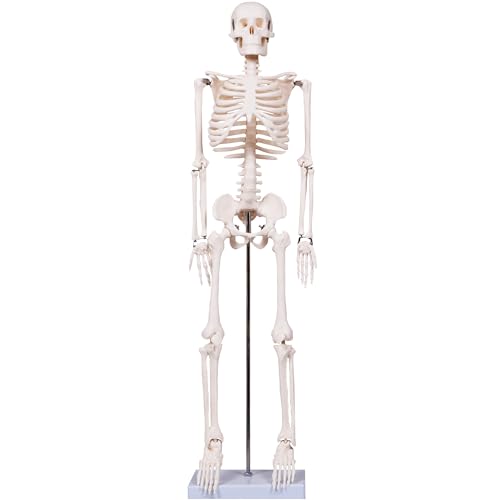
A half-scale skeleton small enough for a desk, detailed enough to quiz from
Big skeletons take up floor space. This one stops at 33.4 inches — a 1:2 comparison to a real human — so it stands on a shelf or desk without crowding the room. Every major joint is articulated: mandible, shoulder, elbow, wrist, hip, knee, and ankle all move, and the arms and legs come off when you want to study a region up close.
The build is cast from a real human specimen, which is why the sutures, foramina, and grooves are visible on all the individual bones. Assembly takes 3-5 minutes — the model arrives largely put-together, so you mostly slide the legs onto their joints and set it on the stand. Because it ships with a joint and bone poster, you have a reference chart without buying one separately.
What buyers report lines up with what the specs promise: it works as a classroom visual aid, it helps with memorizing bone names, and one student credits it with scoring a 95/100 on a lab test. The most common snag is the stand — a few users found the plastic base flimsy and replaced it with a DIY wood plaque, and a handful note the model is top-heavy when you push the joints through their full range.
Where it earns its place: For the price of a mid-range model, you get a full articulated skeleton, a poster, and a form factor that works in a small room.
Know before you buy: The stand is the weak point — plan on reinforcing it or replacing it with something heavier if you plan to move the model often.
Pick this if: You want a full skeleton on a desk or shelf and you’re comfortable upgrading the base yourself.
Skip if: You need a skeleton that stays standing on its own without modifications.
6. EVOTECH SCIENTIFIC Human Body Model for Anatomy, 15 Pcs Removable 11 inch Torso

Eleven inches of torso that pulls apart into fifteen teachable pieces
If your study problem is relative position — how the heart sits next to the lungs, where the liver tucks under the diaphragm — this is the model that solves it. It breaks down into fifteen detachable parts: trunk, brain, heart, esophagus and aorta, four lung pieces, skull cap, stomach, diaphragm, liver, pancreas and spleen, and intestines. Each piece reappears in its anatomical spot when you close it back up.
It stands on a nice-looking oak-wood base and is hand-painted in PVC, so it earns a spot on a shelf between study sessions — a full 11-inch piece that fits in a bag when you need to take it to class. A colorful educational brochure ships with it to walk you through the organs and their relative positions. The mannequin-target user is anyone studying anatomy, nursing, or physiology — students, first-grade classrooms, and pre-med learners all turn up using it the same way.
Owners describe the piece count and the pull-apart experience as the fun part — a science-loving kid treating it as a hands-on lesson, a mom using it as a classroom center, and a med student calling it perfect for visual learners. The recurring friction point is reassembly: the pamphlet isn’t detailed enough for someone returning pieces for the first time, and the lungs particularly need a firm hand to seat correctly.
Where it wins
- Fifteen labeled pieces make internal anatomy tangible for any age group.
- Portable 11-inch size fits in a bag and travels between classes.
- Solid oak-wood base turns it into a display piece, not just a study aid.
- Hand-painted PVC body wipes clean if the classroom gets messy.
Where it asks patience
- Reassembly is genuinely tricky at first — expect a learning curve.
- Lungs need firm seating to stay in place through repeated opening.
- Brochure is thin on reassembly guidance for first-time users.
Perfect for: Teachers, curious kids, and medical students who want organs in context and don’t mind learning the reassembly order.
Look elsewhere if: You want a study model you can tear apart and reset in under a minute.
7. breesky Human Skeleton Model for Anatomy — Life Size 70.8 in with Rolling Stand and 3 Posters

The 70.8-inch roll-anywhere reference for professionals and boards-heavy study
When the classroom model doesn’t match what is on your exam, this is the one that does. The 206 articulated bones are cast from a real human specimen, so every landmark is where your course poster says it should be — one radiology tech student reported it is the same skeleton used in anatomy and positioning courses, which is about as strong a matching signal as you get from a buyer.
At 70.8 inches it stands to full life height, which preserves the detail that shrinks out of smaller models. The head and joints all detach and move, and the whole thing breaks down into parts when you need to study a region up close. Its rolling bracket has five wheels, so you can move it between classrooms, offices, or a clinic room without hauling it — useful in any room where full-size anatomy needs to travel with you.
Satisfied buyers describe it as anatomically correct, matching the bony landmarks on school skeletons and holding anatomical position on its stand. A kinesiology student summed it up: rolls from the start, easy to set up, joints move smoothly. Three posters covering articulations, ligaments, and muscles ship with it. The recurring catch is the wheeled base — the stand is more top-heavy than a wall-mounted or weighted base, and a few owners have had the model tip forward when bumped, so park it somewhere it won’t get knocked.
The reason to spend up: For accuracy and real landmarks, nothing in this list matches a full-sized specimen-cast skeleton — this is the one professionals reference.
Plan for the stand: The five-wheel bracket moves easily but tips more than a fixed base, so weigh it down or keep it away from foot traffic.
Best for: Chiropractors, PTs, radiology students, and anyone who needs a real landmark reference they can roll into the room.
Reconsider if: You don’t have the floor space or a spot where a top-heavy full-size skeleton can live safely.
Understanding the Specs
Anatomical scale and height
Scale is the first spec to check, because it decides how much detail survives and how easily you can carry the model. A “life size” label tells you the model matches real human proportions — good for true-to-life placement training. “1:2” or “1/2 life size” means the model is half the size of a real person, which is why the breesky 33.4-inch skeleton is described as roughly half-scale. Hand-sized models give up height but gain portability, which is why a foam brain at 10.2 ounces or an 11-inch torso ends up in bags and classrooms.
Label application and labeling method
How a model’s numbers get onto the surface decides whether it stays useful. Laser-etched means the font is cut into the PVC itself, so the markings survive daily handling and thumb pressure. Printed or sticker labels sit on top and can peel, smear, or fade — which is exactly what separates older hand-painted skull models from the laser-etched upgrade. When you shop, look for the words “laser-etched,” “engraved,” or “printed labels that withstand repeated handling” — and check that the model includes a chart, booklet, or answer sheet so the numbers mean something when you sit down to study.
FAQ
Is a life size skull model actually the same size as a real human skull?
Will laser-etched numbers on a skull model really stay on after months of handling?
What is the difference between a magnetic model and one that uses pegs?
Can a foam brain model actually hold up in a classroom?
Is a 33.4-inch skeleton too small to study from?
Do I need a rolling base on a full-size skeleton, or does a fixed stand work better?
Are the numbers and names on these models consistent with anatomy textbooks?
What size canvas bag or backpack fits a hand-sized anatomy model?
Do models ship with a study reference in the box?
Should I pick a single-system model or a multi-piece torso model?
Final Thoughts: The Verdict
For most first-time buyers, the anatomy model human winner is the Medarchitect Upgraded Skull with Laser-Etched Fonts, because its etched numbers survive daily quizzing while printed skulls don’t. If your study runs through the heart instead, the Axis Scientific Life-Size Human Heart Model gives you 34 numbered structures and a manual built from real photographs of the model. For classrooms and hands-on group teaching, the breesky 33.4-inch skeleton fits a desk and takes a poster with it. And when a full-size, roll-anywhere reference is what you need, the breesky 70.8-inch skeleton with the rolling stand is the one chiropractors, PTs, and radiology students keep in the room. Whichever you choose, buy the model that matches the exam in front of you.
How We Picked
We do not accept paid placement. Every pick is matched to a real buyer and a real use-case; we do not hands-on test units.
Sources & Methodology
Specifications: manufacturer listings and product documentation. Review insights: verified customer reviews, as of September 2026. Pricing: not shown on this page (it changes often); check the current price via the retailer link.
As an Amazon Associate, Gadgets Feed earns from qualifying purchases. This does not affect which products we feature.