
Our readers keep the lights on and my morning glass full of iced black tea. As an Amazon Associate, I earn from qualifying purchases.
Specs are compiled from manufacturer listings and verified buyer reviews and can change over time — please confirm the key details on the product page before buying.
Buying an amplifier is really about one thing: matching power to your speakers without paying for features you will never touch. Get that match right and a 50W amp will fill a living room without strain. Get it wrong and the amp clips into distortion long before the speakers reach full volume. This guide sorts through the picks that actually deliver — the Denon PMA-600NE is the one most people should start with, because its 70W per channel at 4 ohms, built-in DAC, and phono input cover a full stereo system in one box.
I’m Min — the founder and writer behind Gadgets Feed. This guide is built by comparing the manufacturers’ published specifications and the patterns across verified customer reviews, so you get each pick’s real strengths and trade-offs instead of marketing spin.
Whether you are rebuilding a vintage system or powering a garage, the goal is the same: enough continuous watts at your speakers’ impedance. This breakdown of the best audio power amplifier picks covers budget receivers, DJ rack amps, and serious hi-fi.
Our Picks at a Glance


How To Choose The Best Audio Power Amplifier
The single most important thing to get right is matching your amp’s continuous wattage to your speakers’ impedance and power rating. Inputs, DAC, remote, and looks matter only after the amp can drive your speakers without clipping.
Continuous Watts Versus Peak Watts
Peak wattage is a short-burst number that tells you almost nothing about sustained output. Continuous power (the watts an amp can sustain, often quoted at 8 ohms and 4 ohms) is what actually determines whether your speakers reach full volume without strain. When a spec sheet quotes only one figure, look for the impedance it was measured at.
Matching Impedance In Ohms
Ohms measure how hard a speaker is for an amp to push. A 4-ohm speaker demands roughly double the current of an 8-ohm one, so check that your amp is rated to handle the load. Home-theater users with low-impedance floorstanders often need more amplifier than the spec sheet suggests.
Inputs, DACs, And Phono Stages
A built-in DAC lets you feed a TV or streamer straight into the amp over optical or USB without an external converter. A phono stage lets you plug a turntable directly. Both save money and desk space — but only buy the one you will actually use, since extra digital circuitry can add a little noise.
Quick Comparison
| Model | Best For | Power Rating | Channels | Built-In DAC | Amazon |
|---|---|---|---|---|---|
| Denon PMA-600NE★ Best Overall | Hi-Fi music systems | 70W at 4 ohms | 2 | Yes (optical/coaxial) | Amazon |
| Pyle PDA77BUBest For Karaoke | Karaoke & whole-home | 800W peak | 4 | No | Amazon |
| Rockville RPA9Best for Entry DJ | Entry DJ rigs | 800W RMS | 2 | No | Amazon |
| AIYIMA A80 | Desktop & small rooms | 300W x2 (TPA3255) | 2 | Yes (ESS9038Q2M) | Amazon |
| Rockville RPA12 | DJ & live events | 1400W RMS | 2 | No | Amazon |
| Crown XLi800 | Halls & auditoriums | 300W at 4 ohms | 2 | No | Amazon |
| Crown XLS1002 | Subwoofer & pro PA | 350W at 4 ohms | 2 | No (DSP crossover) | Amazon |
| WiiM Amp Ultra | Streaming hi-fi | 100W | 2 | Yes (ESS SABRE) | Amazon |
| Denon PMA-1700NE | Serious hi-fi | 140W x 2 | 2 | Yes (384 kHz/32-bit) | Amazon |
In‑Depth Reviews
1. Denon PMA-600NE Bluetooth Stereo Amplifier
Our pick — over 4.5★ from 550+ verified ratings; the strongest balance of quality and price.
The integrated amp that powers real speakers without asking you to buy a separate DAC.
If you own passive bookshelf or floorstanding speakers and you want one box that handles music, TV, and a turntable, this is where to start. The PMA-600NE outputs 70W per channel at 4 ohms — enough current to drive a wide range of speakers without strain. A built-in DAC (a chip that converts digital audio from a TV or streamer into sound) handles both optical and coaxial connections. There is also a phono input for a turntable, so a vinyl rig plugs straight in with no extra box.
What makes the 600NE stand out is its analog mode. You can switch off the digital circuits entirely, giving the amplifier an undivided signal path for pure analog playback. Owners say the volume at a quarter turn is already too loud to talk over, and the powered subwoofer output fills in the low end that smaller speakers miss. The amp uses what Denon calls an Advanced High Current circuit to balance power and detail, and it stays cool during long sessions. For value, this is the strongest overall pick in this list.
There are two honest trade-offs. The volume control is the recurring complaint — owners describe it as laggy or coarse, and some dislike the feel. The input selector font is small and dim, which is a minor annoyance in a dark room. Neither stops the amp from doing its job, and the Bluetooth pairs instantly with a phone or tablet for casual listening.
What earns the pick
- 70W per channel at 4 ohms drives a wide range of speakers
- Built-in DAC plus phono input covers TV, streaming, and vinyl
- Analog mode turns off digital circuits for pure analog playback
- Powered sub out fills in the bass smaller speakers miss
Where it asks for patience
- Volume control draws mixed feedback for being laggy and coarse
- Input labels are small and dim, hard to read in low light
Best fit: anyone building a first real stereo around passive speakers, with a turntable or a TV in the mix.
Look elsewhere if: you want app-based streaming built in and never plan to plug in a turntable.
2. Pyle Home Stereo Receiver with Bluetooth
Four channels, two mic jacks, and enough inputs to make any room a party room.
This is the receiver to buy when your priority is features over fidelity. It piles on the connections: dual 1/4-inch microphone jacks with independent volume for karaoke, plus USB, SD card, FM radio, RCA, AUX, and a 3.5mm input. Bluetooth 5.0 (a wireless audio standard that stays connected over a longer range) reaches up to 30+ feet away. The 800W figure is peak power, not continuous — owners who stress-test it say the real number is nearer 500W, still plenty for a garage or a workshop.
What makes it useful is the channel count. It runs four channels, which owners put to work across ceiling speakers in a whole home or a set of garage speakers. Setup is simple and the front-panel controls and LED display make adjustments easy without digging through menus. The mic inputs with reverb and delay controls are a genuinely rare feature at this level — most amps at this size do not offer karaoke at all.
The honest catch is Bluetooth memory. The receiver remembers its last pairing and does not forget easily, which causes real trouble in an apartment building if it latches onto a neighbor’s device. A few owners also report a faint static buzz at idle with no input, and one unit arrived with a static issue that warranted a return. For a garage, workshop, or standalone venue, neither issue is likely to bother you.
Where the value sits: the 4-channel layout and the dual mic inputs with reverb are the differentiators here. No other amp in this list offers karaoke controls, so if that is your goal, the shortlist is short.
Reach for this if: you want a cheap receiver that runs multiple speaker zones and can host a karaoke night.
Pass on it if: you share walls with neighbors who own Bluetooth devices and you want a clean digital signal path.
3. Rockville RPA9 2-Channel Professional/DJ Rack Mount Power Amplifier
A rack-mount workhorse that brings pro-style inputs to a small-event budget.
If you are a DJ just getting started, the RPA9 gives you enough power to fill a venue: 3000W peak and 800W RMS (RMS is the continuous power it can deliver, not just short bursts) through two channels. Its rugged metal chassis survives being hauled in and out of gigs. The connectivity is what separates it at this level — XLR, 1/4-inch, and RCA inputs plus speakON and banana outputs (two common pro speaker connector types) mean it wires into just about any mixer or speaker. A built-in crossover (a circuit that splits low and high frequencies) handles subwoofer routing, and dual fans with a heat sink keep the internals cool during long sets. The front panel gives you volume controls and LED indicators that stay readable in a dark booth.
The 2U rackmount form factor is the real draw for touring and mobile setups: it bolts into a standard rack case and stays put. One owner ran a pair of these for two to three years with no failures, and another drove a set of outdoor speakers loud enough to be heard across a yard. In stereo or bridged modes, it handles a range of speaker loads and costs a fraction of what comparable pro gear commands.
Two things to weigh up. The rated power is the headline spec but is disputed — several owners say the RMS rating is optimistic, and that it runs out of headroom on larger speakers. With 8-ohm speakers under 400W mixer output, you may find yourself pushing gain higher than you would like. Two fans also mean audible fan noise at low listening levels, so it is not a silent-room amp. For small events and budget setups, both limitations are manageable; for serious touring, the next size up in the range is worth the stretch.
Why it earns its rack space
- XLR, 1/4-inch, and RCA inputs plus speakON and banana outputs
- Bridgeable for larger single-speaker runs
- Dual fans and heat sink keep it cool on long gigs
- Rack-mount 2U chassis built for travel
What buyers flag
- Rated power is disputed by owners as optimistic
- Heavier speakers exceed its comfortable headroom
- Fans are audible at low volume for quiet-room listening
The right pick for: new DJs and small-event rigs that need pro connectors and rack-mount build without a premium outlay.
Step up if: you plan to drive larger 12 or 15-inch speakers near their limits — go for the RPA12 instead.
4. AIYIMA A80 Bluetooth Stereo DAC Amplifier TPA3255
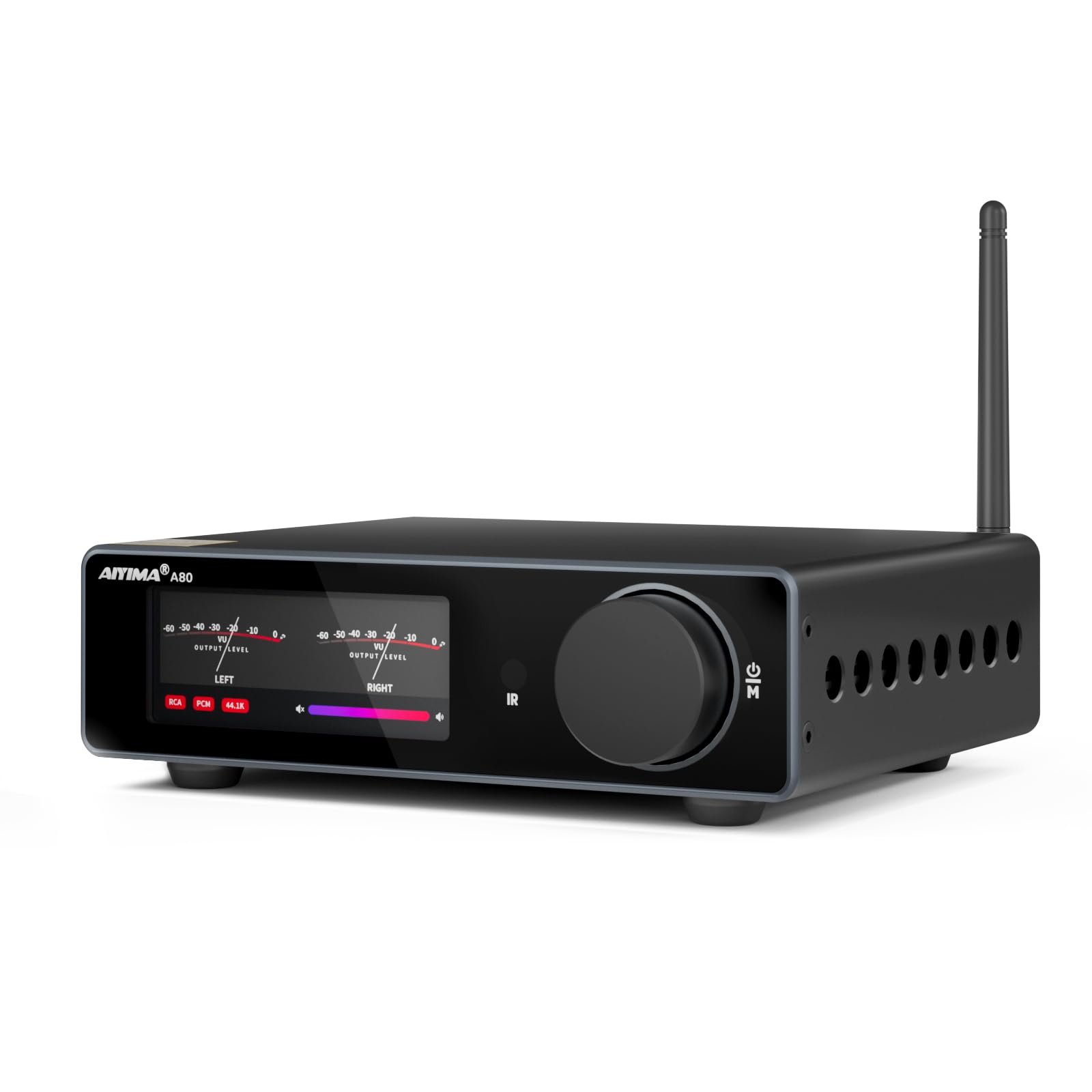
A small box that puts a full DAC and Class D amp on your desktop without the clutter.
The A80 is a hi-res desktop amp (hi-res means it plays audio files with more detail than a standard CD) built around two chips: a TPA3255 Class D amplifier, and an ESS9038Q2M DAC (a digital-to-analog converter, the chip that turns digital files into sound). Class D is a highly efficient amplifier design that runs cooler and lighter than the traditional Class AB designs, and here the numbers back that up — the amp delivers up to 300W per channel, with total harmonic distortion (THD, a measure of how much the amp distorts the signal) as low as 0.006%, so loud passages stay clean instead of turning harsh. It supports DSD256 and PCM playback (two high-resolution audio formats) for high-resolution audio files. The professional TRS balanced inputs (a three-contact connector that cancels electrical noise) isolate the amp from electrical interference — a feature most desktop amps at this size leave out — which means less background hiss at high volume.
The input selection covers almost every modern source: Bluetooth, USB, optical, and coaxial, plus a 3.5mm subwoofer output for a powered sub. There is a digital VU meter (a real-time level display that shows input status and volume) with multiple display modes, and a remote for tone and input control. Owners run these with bookshelf speakers, tower speakers, and vintage systems and consistently describe clean, detailed sound with an imperceptible noise floor. One owner replaced a seven-channel home-theater receiver set to stereo and found the A80 clearer and more powerful.
There are three things worth knowing. The 3.5mm subwoofer output needs an adapter if your subwoofer uses an RCA cable, and the output level is lower than some rivals — you may need to push the sub gain up. The amp runs warm after about 30 minutes at average volume, so leave it a little breathing room. And it powers on manually rather than sensing an incoming signal, going into standby after five minutes of low volume. None of these are dealbreakers on a desk, where you are sitting near it anyway.
The real-world read: balanced TRS inputs and a genuine ESS9038Q2M DAC chip put this in a different technical class from most desktop amps its size.
A smart buy for: computer audio, small offices, and anyone who wants hi-res playback without a tower of separates.
Think twice if: your subwoofer uses an RCA cable and you prefer an amp that turns itself on with an incoming signal.
5. Rockville RPA12 2-Channel Professional/DJ Rack Mount Power Amplifier

Five thousand watts of peak punch, built for clubs, gyms, and block parties.
Where the RPA9 runs into limits, the RPA12 has room to spare. It delivers 5000W peak and 1400W RMS through two bridgeable channels, with a built-in crossover switch with 80 Hz and 160 Hz settings for routing to PA speakers or subwoofers. Total harmonic distortion is rated below 0.03%, which means the sound stays clean and accurate even at high output. A built-in limiter (a protective circuit that stops sudden peaks from damaging your speakers) is the kind of feature you only appreciate the day it saves you a driver.
The steel chassis, efficient cooling fans, and three operating modes — stereo, parallel, and bridged (bridged combines both channels into one stronger output) — make it flexible enough to handle different speaker setups as your rig grows. Buyers report using them to drive 18-inch subwoofers, large PA speakers, and karaoke systems with the same amp. One owner who runs a 13,000W rack for DJ and block-party work said the amp drives several blocks of audience with more power than needed, and another used it to power a pair of 12-inch speakers that a name-brand amp handled no better. The three-year warranty backs the build.
There is a real limitation for home use: bridged mode on demanding subwoofers will clip (distort and cut the signal) if you push the gain past around ten o’clock, so a subsonic filter (a circuit that removes inaudible low frequencies) is worth adding if your source sends them. Fan noise is another trade-off — the fans are efficient but audible, which is fine for a loud venue and less ideal in a quiet living room.
Why it punches above its class
- 1400W RMS across two bridgeable channels
- Crossover switch with 80 Hz and 160 Hz settings
- Built-in limiter protects speakers from peaks
- Three operating modes: stereo, parallel, and bridged
Where it asks for care
- Bridged subwoofer setups clip past moderate gain
- Fan noise is real, better suited to event venues than living rooms
The one to choose for: club, gym, karaoke, and live-event rigs that need big RMS power without a pro-audio price tag.
skip it if: it is going in a quiet room where fan noise would be a constant distraction.
6. Crown XLi800 Two-Channel Power Amplifier

The institutional workhorse built to run quietly in halls and auditoriums for years.
When audio gear has to survive constant use in public spaces, the XLi800 is the kind of amp buyers keep coming back to. It delivers 300W continuous per channel at 4 ohms and 600W when bridged, driven by a toroidal transformer — a large, low-noise transformer that keeps the electrical signal clean. It uses a Class AB amplifier design, which runs warmer than the newer Class D options but is known for a smooth, musical sound. The brushed stainless-steel case weighs in at 25.1 pounds, and buyers who already own these in halls describe them as built to last.
What really stands out in owner feedback is the fan noise — or rather the lack of it. Buyers repeatedly praise the low-frequency fan as barely noticeable, which is unusual for a pro-audio amp and makes the XLi800 one of the few pro amps that works well in a home theater. One buyer replaced an older Crown amp with this one and heard more body and depth, plus tighter channel gain that produced a centered stereo image. RCA inputs, binding posts, and a selectable input sensitivity switch of 1.4V or 0.775V give you flexibility on the wiring side.
The one well-documented design quirk is that the unbalanced inputs are not grounded to the chassis. In most setups that does not matter, but if you feed it from a computer or a source with a ground loop, you may hear a hum. The fix is either a single grounded source, a matchbox, or careful cable management. Buyers who solve it describe the amp as flawless. The bright blue power light is also worth a mention — a small strip of tape will do the job if you are using it near a TV.
What buyers keep coming back for: the near-silent fan is the standout trait here, since it lets a pro-grade amp sit quietly in a home theater or auditorium without an audible distraction.
The right buy for: installers and home-theater owners who need serious reliability and near-silent operation.
Be prepared for: a possible hum from unbalanced sources — a single grounded source or a matchbox solves it.
7. Crown XLS1002 2-Channel Class D DriveCore Professional Power Amplifier with DSP

Class D efficiency and DSP power that handles subwoofer loads other amps cannot.
The XLS1002 is rated at 550W at 2 ohms, 350W at 4 ohms, and 215W at 8 ohms per channel — plus 1100W at 4 ohms and 700W at 8 ohms when bridged. What makes those numbers useful is that the amp can actually stay stable at 2 ohms, a load that would push most home-audio amplifiers into protection mode. One buyer ran a 2-ohm bridged setup by accident for nine months with zero issues, no clipping and no thermal shutdowns. The Class D design and Crown’s DriveCore technology keep the whole unit under eleven pounds — light enough to rack and carry without strain.
Crown packs real signal processing into the amp: a PureBand Crossover System with selectable band-pass filters for each channel, and Peakx Limiters that protect speakers from sudden peaks while maintaining output. There is also a sleep mode that kicks in after inactivity, saving power without a button press. Inputs cover balanced XLR, quarter-inch TRS, and RCA, while outputs use quarter-inch speaker connectors. Buyers drive everything from 4-octave PA systems to a 12-inch dual-voice-coil subwoofer, and one owner said it powered an entire wall of eight 18-inch subs with power to spare.
Two caveats. It is a pro-level amp, so its inputs work at professional line level (+14dBu, a stronger signal than home gear uses) while home gear outputs at consumer level (-10dB) — you will likely need a matchbox device (a small adapter that matches the two signal levels) if you connect it to a home theater receiver. Also, the unit needs a proper 4 to 5 amp socket, so a cheap extension block may not cut it. Neither issue affects the amp’s reliability; it just means you should plan for the signal chain.
Where it pulls ahead
- Stable and clean even bridged at 2 ohms
- Built-in PureBand crossover with selectable band-pass filters
- Peakx Limiters protect your speakers under load
- Under eleven pounds, easy to rack and move
What to plan for
- Pro line-level inputs likely need a matchbox in a home theater
- Warranty disputes reported after the standard window closes
Best matched to: home theater subwoofer duty and PA systems that need real 2-ohm stability and DSP built in.
One caution: check the warranty terms carefully — a few owners mention being told coverage was shorter than expected. Treat that as a plan-for-it note, not a dealbreaker.
8. WiiM Amp Ultra Stereo Streaming Amplifier

One box that streams, amplifies, and auto-tunes itself to whatever room you put it in.
The WiiM Amp Ultra folds a streaming player, a DAC, and an amplifier into a single case. It puts out 100W through two channels with distortion rated at -106 dB THD+N (a measure of how clean the signal stays). The ESS SABRE DAC and dual TI TPA3255 amp chips, paired with PFFB technology, keep the sound consistent regardless of what speakers you connect. It streams Spotify, TIDAL, Qobuz, Amazon Music, and Roon in up to 24-bit/192kHz quality, and Wi-Fi 6 with Bluetooth 5.3 keeps the connection stable even in a busy home network.
The standout feature is RoomFit room correction. It auto-calibrates the sound based on your actual room and speakers, which matters in small rooms where bass gets muddled. There is a 3.5-inch touchscreen on the front for album art and settings, and a physical remote included. Buyers drive everything from KEF bookshelf speakers to Emotiva tower speakers and describe the sound as punchy, detailed, and unusually clean for a device this size. The app gives full EQ and subwoofer level control, and an HDMI ARC input makes it easy to pair with a TV for a clean two-channel theater setup.
Two compatibility notes matter. First, the Amp Ultra does not support Apple AirPlay — you have to use the WiiM Home app, Bluetooth, or HDMI ARC to get audio into it. Second, the Bluetooth codecs are limited to SBC and AAC, so if you want the best possible wireless sound, use Wi-Fi streaming rather than Bluetooth. For most living rooms with good Wi-Fi, that is not an issue.
The defining trait: the ESS SABRE DAC and RoomFit auto-calibration are what separate this from a standard streaming amp — the sound adapts to your room, not the other way around.
Made for: anyone who wants hi-res streaming, TV audio, and a real amplifier in one compact box.
Not right if: you rely on AirPlay — this device cannot act as an AirPlay receiver, so route audio through Wi-Fi or HDMI ARC instead.
9. Denon PMA-1700NE Integrated Amplifier

End-game power and control for the buyer who intends to keep the same amp for a decade.
The PMA-1700NE is the top of this list, and its spec sheet explains why. It delivers 140W per channel with Denon’s Advanced AL32 Processing Plus upsampling — which takes a digital signal and converts it to 384 kHz/32-bit resolution before playback — so high-res files and CDs both sound smooth and detailed. The single push-pull circuit design balances raw power with musical detail, and the amp handles an unusually wide range of speaker difficulties, including low-sensitivity and 4-ohm designs that most integrated amps struggle with.
The phono stage is a serious feature for vinyl owners: it supports both MM and MC cartridges, which means you can plug in everything from a standard moving-magnet turntable to a low-output moving-coil cartridge without an external preamp. The analog mode switches off the digital circuits so analog sources keep a cleaner path. There are three digital inputs, a USB-DAC for direct computer connection, and preamp outputs for linking to external amps. The unit weighs 17 kg and its chassis is fitted with premium components.
The build quality is the real point of buying this amp. Owners describe the sound as transparent, with a wide soundstage and precise imaging that makes even difficult-to-drive speakers sound better. It does not have Wi-Fi or Bluetooth, so a streamer is still needed for modern input. It also lacks a subwoofer output, which matters if you run a powered sub. The amp runs warm and needs ventilation room. These are not flaws for its intended user — they are simply where the money is spent on sound rather than features.
The case for the upgrade
- 140W per channel handles demanding speakers
- MM/MC phono support for any turntable cartridge
- 384 kHz/32-bit upsampling on digital sources
- Analog mode isolates digital circuits
What it does not do
- No Wi-Fi or Bluetooth built in
- No subwoofer output
- Runs warm and needs space around it
Worth stretching for: a long-term stereo system where the amp will outlive several pairs of speakers.
Skip if: you need streaming, Bluetooth, or a subwoofer output — those live in the WiiM Amp Ultra instead.
Understanding the Specs
Watts And Ohms
Watts measure how much power an amp can deliver; ohms measure how much the speaker resists that flow. A 4-ohm speaker is a harder load than an 8-ohm speaker, so an amp rated at 70W into 4 ohms will generally output less into 8 ohms. When comparing amps, always compare the wattage at the same impedance — an amp rated at 300W at 4 ohms is not the same as one rated at 300W at 8 ohms.
Class AB Versus Class D
Class AB amplifiers use traditional transistor designs and typically weigh more, run warmer, and produce a warm, smooth sound. Class D amplifiers switch on and off rapidly for high efficiency — they run cooler, weigh far less, and in modern designs (like Crown’s DriveCore or the TPA3255 chip) sound clean and detailed. Neither is inherently better; pick Class AB if you want a classic feel and can afford the weight, and Class D if you need portability and efficiency.
FAQ
What is the difference between peak watts and RMS watts on an amplifier?
Do I need a preamp to use a power amplifier?
Can I connect my phone directly to a pro power amplifier?
How do I match amplifier power to my speakers?
What does a built-in DAC do on an amplifier?
Is a Class D amplifier as good as a Class AB amplifier?
Can I use a home audio amplifier for DJ or PA speakers?
Why does my amplifier run hot during use?
Can I bridge the channels on a two-channel amplifier for more power?
Do I need a phono stage to connect a turntable to an amplifier?
Final Thoughts: The Verdict
For most people, the audio power amplifier that hits the right balance is the Denon PMA-600NE. It has the strongest combination of clean power, real inputs, and value in this lineup — a built-in DAC, a phono stage (a built-in input for a turntable), Bluetooth, and 70W per channel at 4 ohms cover the needs of a typical home system without forcing you into separate boxes. If streaming is your priority and you want the amp to tune itself to your room, the WiiM Amp Ultra is the better fit. For a garage, karaoke setup, or budget multi-room install, the Pyle PDA77BU handles more channels and connections than anything else here. And if you are after a long-term hi-fi anchor that will outlive multiple speaker upgrades, the Denon PMA-1700NE is the one to build around. Whichever you pick, match the wattage and impedance (the speaker’s electrical resistance, measured in ohms) to your speakers first — that single step decides whether the amp sounds easy or strained.
How We Picked
We do not accept paid placement. Every pick is matched to a real buyer and a real use-case; we do not hands-on test units.
Sources & Methodology
Specifications: manufacturer listings and product documentation. Review insights: verified customer reviews, as of September 2026. Pricing: not shown on this page (it changes often); check the current price via the retailer link.
As an Amazon Associate, Gadgets Feed earns from qualifying purchases. This does not affect which products we feature.