
Our readers keep the lights on and my morning glass full of iced black tea. As an Amazon Associate, I earn from qualifying purchases.
Specs are compiled from manufacturer listings and verified buyer reviews and can change over time — please confirm the key details on the product page before buying.
You already know the scene: you’re standing over an open backpack, digging elbow-deep past a rain shell to find one sock, while everything else you packed has turned into a loose pile of shifting stuff. A good set of stuff sacks fixes that in one move. It groups your gear into labeled, organized bundles so you pack faster, find things without unpacking the whole bag, and keep your base weight low while you do it.
I’m Min — the founder and writer behind Gadgets Feed. This guide is built by comparing the manufacturers’ published specifications and the patterns across verified customer reviews, so you get each pick’s real strengths and trade-offs instead of marketing spin.
The catch most buyers miss is that a stuff sack and a dry bag are not the same tool — one organizes, the other seals out water, and a few products here do both. This shortlist covers both jobs so you can pick the right one without guessing. The smartest move is matching the fabric, closure, and size to how you actually pack; if you want the best backpacking stuff sacks without the research, this list is built for exactly that.
Our Picks at a Glance

How To Choose The Best Backpacking Stuff Sacks
Stuff sacks look identical on a product page, which is exactly why so many buyers end up with the wrong one. Here is what actually decides whether a sack earns a permanent spot in your pack.
Drawstring or roll-top?
A drawstring sack closes with a cord you cinch shut — fast to open, but it only keeps out splashes and dust, not a full dunking. A roll-top dry sack closes by folding the top over on itself and clipping a buckle, which creates a genuine watertight seal you can trust in rain or near water. If you paddle, cross streams, or hike in a wet climate, pay for the roll-top.
Fabric weight and denier
Denier (written as “D”) measures how thick the individual threads are, and lower numbers mean lighter fabric. A 20D nylon sack is lighter and packs smaller than a 70D one, but it is also easier to puncture on a sharp rock or a snagged branch. Ultralight hikers pick the lower denier to shave weight; everyone else is usually happier with the tougher fabric.
Match the liter size to the job
Pick your sack by liters, not by “small, medium, large.” A 3L sack holds a folded rain jacket or a day of socks and tees, so your day pack stays tidy. A 9L to 15L sack swallows a sleeping bag or several days of clothes. A 20L sack handles bulky gear like a tent. Buying a multi-size set often costs less than buying single sacks one at a time.
Quick Comparison
| Model | Best For | Capacity Options | Closure Type | Fabric / Weight | Amazon |
|---|---|---|---|---|---|
| Frelaxy Stuff Sack Set 5-Pack★ Best Overall | Organizing everything at once | 3L to 20L (5-pack) | Drawstring | Tear-resistant polyester; 20g–50g | Amazon |
| Coghlan’s Stuff Sacks & Ditty Bag SetsBest for Bulky Gear | Bulky camp gear & tent storage | 10L / 15L / 20L | Drawstring | 200D Oxford ripstop; 52g | Amazon |
| OMVMO Compression SackBest Compression | Squeezing bulky gear down small | 12L to 53L | Buckle | 320T/400T nylon; 0.2–0.3 lbs | Amazon |
| REDCAMP 5PCS Ditty Bags Set | Seeing contents without opening | 5-piece set | Drawstring | Nylon mesh + Oxford; 0.11 kg | Amazon |
| Frelaxy Waterproof Dry Bag 2 Pack | Wet weather & water sports | 5L & 15L | Roll-top | 210T diamond ripstop; 1.5–2.1 oz | Amazon |
| Sea to Summit Lightweight Stuff Sack | Ultralight everyday packing | 3L | Drawstring | 70D PU-coated nylon; 0.06 kg | Amazon |
| Sea to Summit Ultra-Sil Dry Bag | Fast-and-light waterproof storage | 5L | Roll-top | 30D Ultra-Sil Cordura; 0.07 lbs | Amazon |
| SIDE BY SIDE Small Dry Bag | Protecting electronics & laundry | 10L | Roll-top | Military-grade filament nylon; 47g | Amazon |
| Osprey Ultralight Dry Sack | Clipping onto a pack or paddleboard | 3L | Roll-top | Waterproof-coated nylon; 0.06 lb | Amazon |
In‑Depth Reviews
1. Frelaxy Stuff Sack Set 5-Pack (3L&5L&9L&15L&20L), Ultralight Ditty Bags
Our pick — over 4.5★ from 900+ verified ratings; the strongest balance of quality and price.
Five sizes in one bag means every loose item in your pack finds a home.
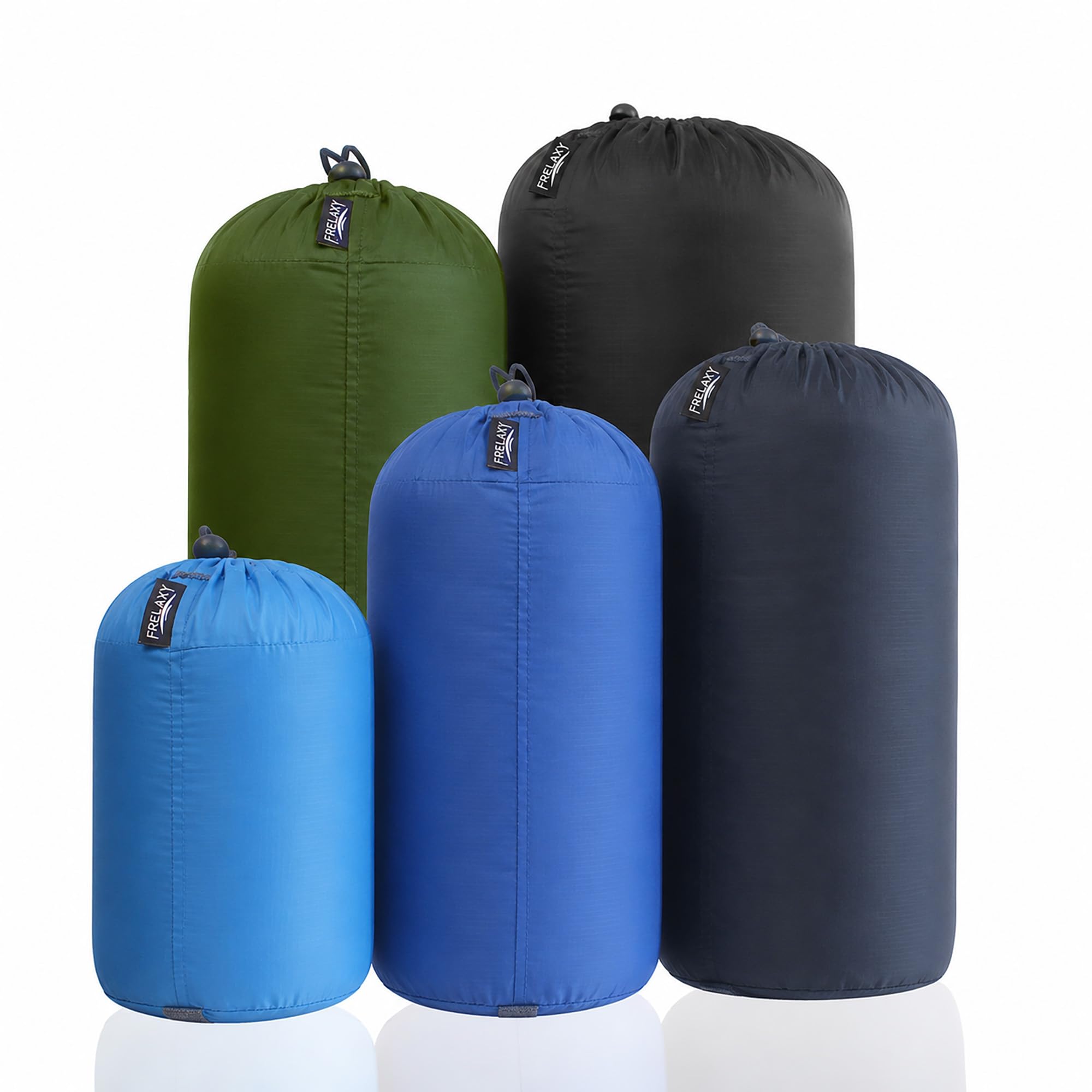
The headline number here is five — a 3L, 5L, 9L, 15L, and 20L sack in one set, so you get a dedicated bag for almost any load instead of buying singles. The whole set stays light because the bags weigh between 20g and 50g depending on size. Even the biggest 20L sack adds about as much weight as a couple of energy bars. For scale, the smallest sack in this set weighs 20g while the Coghlan’s single sack weighs 52g — a 2.6x difference in favor of the ultralight set.
What wins people over is the build quality, and the size range is a close second — buyers love that each sack is color-coded to its size. Sky Blue is the 3L, Blue is the 5L, Navy is the 9L, Army Green is the 15L, and Black is the 20L. That color-to-size link means you can grab the exact sack you need by feel without unclipping anything. The polyester fabric has a water-resistant coating, and a dust flap inside the opening keeps grit away from your clean clothes.
Buyers report the water resistance holds up well — as the review pages sum it up: “effective water resistance, no leaks even with wet swimsuit.” The drawstring closure has a cord lock (a sliding toggle that keeps the cord tight) and doubles as a carry handle. A pull handle on the bottom lets you drag the sack out of a tightly packed bag. Frelaxy backs the set with a 12-month warranty.
What Earns Its Place in the Pack
- Five sizes (3L to 20L) cover everything from socks to a tent
- Lightest set here — 20g to 50g per sack
- Color-coded to size for grab-and-go organizing
- Water-resistant coating plus an interior dust flap
What to Know Before You Buy
- Not built for a full sleeping bag — Frelaxy says use it for snacks, clothes, hats, and small gear
- Water-resistant, not a submersible dry bag
Reach for this if: you want one purchase that organizes your entire pack across every load size.
Look elsewhere if: you need true submersible waterproofing for kayaking or river crossings.
2. Coghlan’s Stuff Sacks & Ditty Bag Sets – Lightweight Ripstop Storage Bags
One tough sack that swallows a whole tent and keeps going.
If your problem is one big bulky item rather than a dozen small ones, this is the sack built for it. A 20L version is the star here — owners mention it holds a tent plus extra gear when a factory tent bag tears out. It comes in 10L, 15L, or 20L sizes, and the 20L measures 9″L x 9″W x 21″H. At 52g it is heavier than the ultralight competition, but the trade-off is a 200D Oxford ripstop fabric that resists abrasion on rough ground.
What buyers value most is the durability of the material, and the haul handle on the bottom gets steady praise for making a heavy sack easy to grab and carry. The fabric carries a PFC-free Rudolf DWR coating — a water-repellent finish applied without the harmful chemicals some older coatings used — so light rain and damp ground won’t soak through. A cord-lock drawstring keeps contents secure and opens fast when you need something.
The honest caveat is the closure hardware. The recurring gripe is that the drawstring is thinner than premium options and the cord lock is small and fiddly to grip with cold fingers. It’s a minor annoyance on an otherwise tough bag, and it’s the kind of detail that matters if you’re opening this sack dozens of times a day in the cold. The size range gets mixed reactions too: it swallows bulky loads well but isn’t the bag for tiny, delicate items.
The standout spec: 200D Oxford ripstop is the toughest fabric on this list, which is exactly why it handles a tent, a woobie, or a cordless vacuum without complaint. The 10L, 15L, and 20L options give you a size for weekend camp gear or extra clothes.
The honest read: it’s a workhorse organizer, not a precision piece. If you want your drawstring to feel premium every time you open it, budget for that upgrade.
Best for: campers and RVers packing one big, heavy item that needs a reinforced home.
Skip if: you want a soft, smooth-gliding drawstring — the cord lock here is stiff and small.
3. OMVMO Compression Sack, 12L/19L/32L/46L/53L Water-Resistant Sleeping Bag Stuff Sack
Four straps crank a sleeping bag down to a fraction of its packed size.
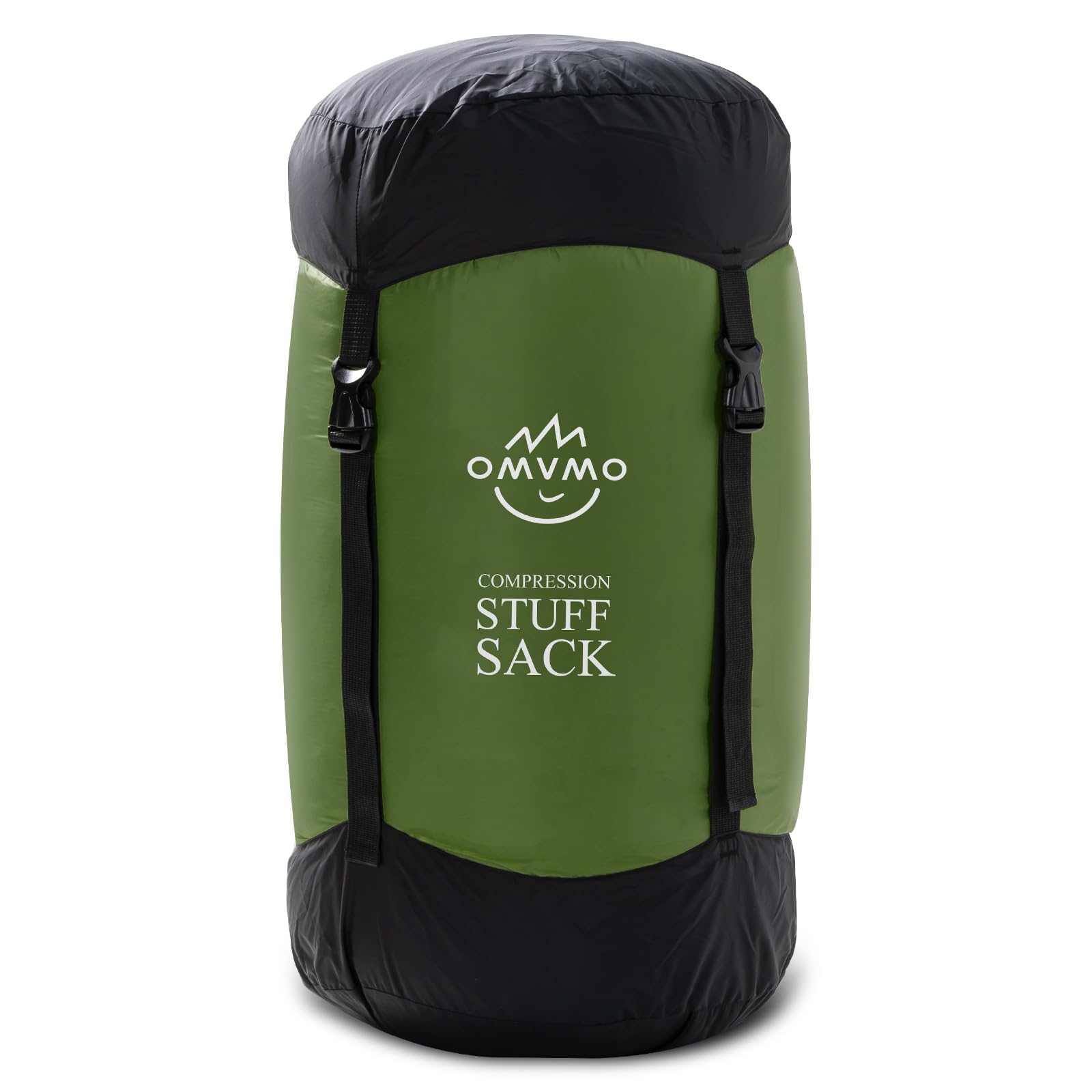
This is the sack you want when “smaller” matters more than “tougher.” It runs 12L, 19L, 32L, 46L, and 53L, so you can match one to a day hike or a week-long trip. The body is built from 400T 20D nylon (a thin, tightly woven fabric) while the top and bottom panels use 320T 40D nylon — the same class of material found in premium down sleeping bags. The real difference from everything else here is the closure: four adjustable straps, two quick-release buckles and two compression straps let you cinch the load down uniformly rather than just stuffing it in.
The weights stay honest for a compression sack too: 0.2 lbs for the 12L, 0.22 lbs for the 19L, 0.25 lbs for the 32L, 0.29 lbs for the 46L, and 0.3 lbs for the 53L. Both nylon types are water-resistant and highly tear-resistant, and the compression sack compresses a bulky top quilt or a large down comforter down to a small, dense bundle. Customers note a 15L bag compressed several days of clothes and still fit inside a 33L backpack with room left for shoes — with a caveat that it did the job on a 17-day trip.
Here’s the thing to plan around: the compressed shape ends up as a short, wide cylinder, which can be awkward to slide into a tightly packed suitcase. The compression is the point, so embrace the shape. Fit also splits opinion — a quarter of this sack’s size, function, and durability feedback lands mixed, with some buyers finding a given size too small for a bulky 0-degree sleeping bag and others finding it roomy. Measure your bag before choosing.
Straps Do the Heavy Lifting
- Four straps (two buckle, two compression) for even cinching
- 320T/400T nylon keeps it light — 0.2 lbs at 12L
- Padded bottom handle with a soft cotton grip layer
- Seams hidden in the ribbon and eight strap joints double-stitched
Worth a Second Look
- Compressed shape is a short, wide cylinder — check it fits your bag
- Some buyers find the smaller sizes too tight for a bulky 0-degree bag
- Thin nylon material needs gentle handling around sharp gear
The winning move: pick this when the goal is shrinking a sleeping bag or down layer, not just containing it.
Wrong tool if: you need a flat, stable shape that slides neatly into a suitcase corner.
4. REDCAMP 5PCS Small Ditty Bags Set for Backpacking
Mesh panels let you spot the right bag without opening a single one.
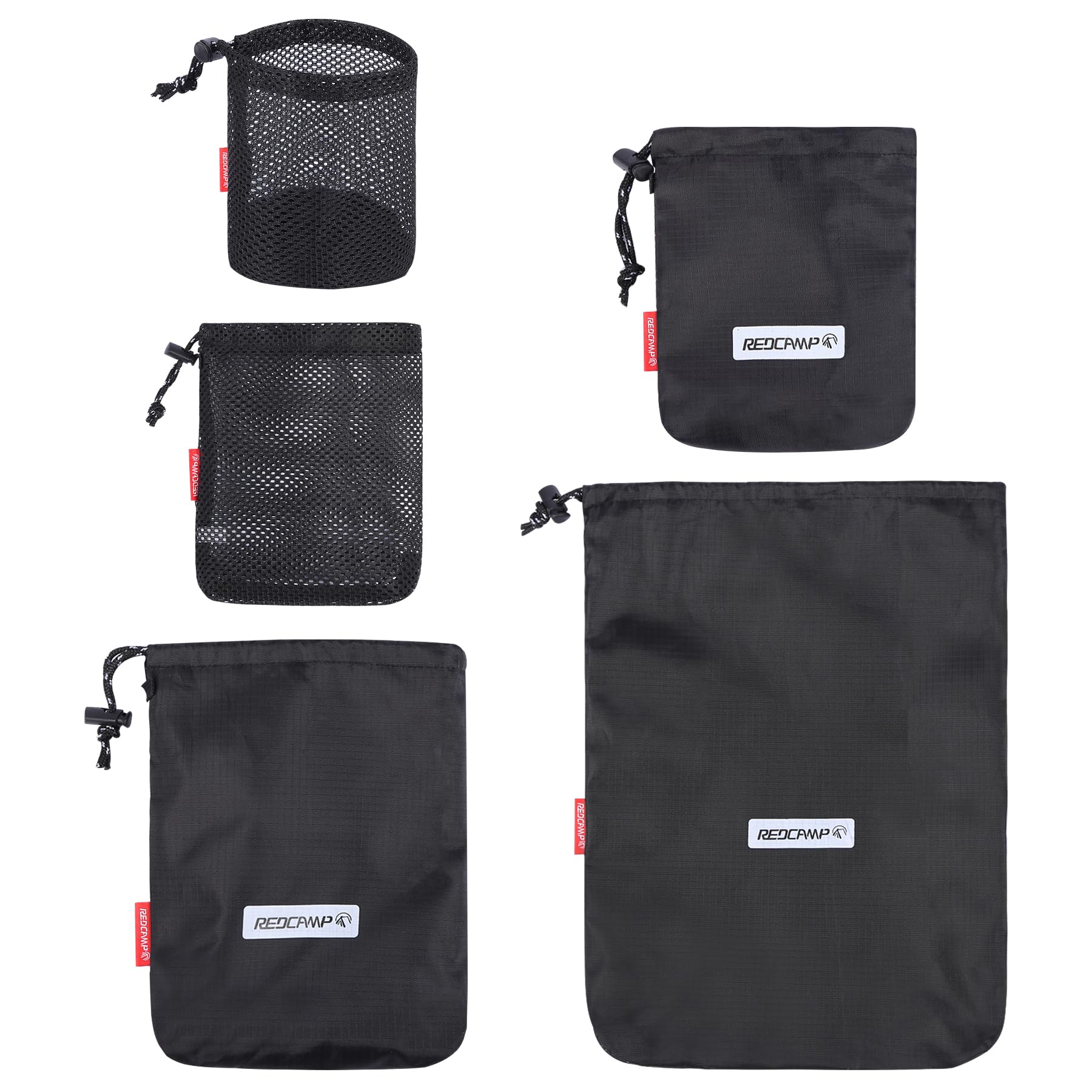
Five bags, and two of them are pure mesh while the other three mix a mesh panel with a solid fabric side. That dual-sided design is what makes this set different — you see what’s inside at a glance instead of unzipping each bag hunting for a charger or a pair of socks. The set handles up to 10 pounds of load capacity, and the fabric is thickened nylon mesh and premium Oxford cloth. The manufacturer rates the drawstring closures for over 1,000 open-and-close cycles.
These are on the small side, so think of them as organizers for the loose bits: keys, jewelry, toiletries, socks, electronics, cookware, even stacking cups. Reviewers point out the mesh bags hold up over a year of heavy use with no seam rips, and the separate compartments keep small items from scattering in a backpack. For anyone packing a trip, that separation is the real payoff — you stop digging through a jumbled pile.
Sizing is the honest catch. The individual bag dimensions don’t follow a neat progression, so a couple of them feel oddly proportioned depending on what you’re stuffing in. That’s a minor quibble on an otherwise tidy organizer set, and it’s worth a quick look at the listed dimensions before you buy if you have a specific item in mind. The drawstring closure on each bag keeps contents contained.
Where it fits: campers who pack cookware and want each pot and cup in its own bag, and travelers separating socks from electronics. The mesh visibility is the reason to pick this set over a solid-fabric alternative.
The trade-off: these are small ditty bags, not bulk haulers. If you need to stuff a sleeping bag, size up to a larger sack from this list.
Suits you if: you pack lots of small, fiddly items and want to find them by sight, not by feel.
Not this one if: your packing problem is one big bulky item — the mesh bags won’t stretch to cover it.
5. Frelaxy Waterproof Dry Bag 2 Pack, Lightweight Ripstop Dry Sack Set

Two sizes, taped seams, and a roll-top that keeps water on the outside.
Everything about this set is aimed at water. The fabric is 210T diamond ripstop polyester with a PU10000mm coating — that number measures how much water pressure the fabric resists before it soaks through. The seams are double-stitched and fully taped, and the roll-top closure folds and clips into a watertight seal. The buckle and D-ring are rated for 10,000 cycles, so clipping the sack to a pack strap holds up to daily use.
The 5L and 15L sizes split the job cleanly: the small one for a phone, keys, and a wallet, the large one for clothes and shoes. At 1.5 oz for the 5L and 2.1 oz for the 15L, neither one drags your pack weight down. Shoppers say this dry bag works well as a compression sack for backpacking and stays dry for rafting, rain, and kayaking. Several also use the 15L for soaking laundry during travel — it takes up almost no room in a suitcase and keeps clean and dirty clothes apart.
What buyers appreciate most is the all-around quality and the water resistance specifically, and the roll-top closure gets regular mention for being simple to operate with cold hands. The one thing buyers occasionally wish for is more capacity in the big bag — the 15L gets tight when it’s packed with shoes and layers. Not a dealbreaker, just a sign to size up if you travel with bulky footwear.
Why It Handles Wet Weather
- PU10000mm coating plus fully taped, double-stitched seams
- Roll-top closure with a TPU (a flexible, rubber-like material) strip the maker rates 10x stronger than plastic
- Two sizes (5L, 15L) cover smalls and clothes
- Ultralight at 1.5 oz and 2.1 oz
Where It Falls Short
- The 15L tops out fast with shoes and bulky layers
- D-ring and buckle are sturdy but add a little weight versus drawstring sacks
Buy this for: backpacking in wet weather, kayaking, rafting, and travel where “keep it dry” is the whole point.
Think twice if: you need a big dry bag — the 15L is the ceiling and it fills quickly.
6. Sea to Summit Lightweight Stuff Sack, Durable Outdoor and Travel Storage

A 3L sack that slips into a suitcase and stays there for years.
This is the 3L size of Sea to Summit’s Lightweight Stuff Sack, measuring 5.5 x 9.2 inches and weighing just 0.06 pounds, so it adds almost nothing to your pack. It’s built from a 70D PU-coated nylon (a thicker nylon with a waterproof polyurethane coating) with a 2,000mm waterhead rating — that rating measures how tall a column of water the fabric holds back before moisture passes through, and 2,000mm is genuine rain protection for a stuff sack. The drawcord uses Hypalon pull tabs (a tough, rubbery material that grips well) and the interior is coated white to make contents easy to spot.
What owners consistently value is the quality of the construction. The seams are double-stitched and reinforced at stress points, and the round base has a webbing pull handle that makes it easy to yank the sack out of a crammed pack. Buyers report packing a folded men’s medium rain jacket in the 3L size with room to spare. One owner reports using these sacks daily for over three years and washing them with regular laundry on high heat with no melting. That kind of longevity traces to the bluesign-approved fabric and PFC-free DWR finish.
The one bit of fine print: 3L is a snug size, and it won’t hold a bulky winter layer or most sleeping bags. Buyers occasionally note that a 4L would fit a large down parka better. It’s worth measuring what you plan to pack — a 3L sack covers socks, tees, and a small layer, and that’s about it. Value-for-money feedback is mixed on the higher price tag against cheaper sacks, but the materials justify it for buyers who keep gear for years.
The defining feature: a 2,000mm waterhead rating on a drawstring sack is rare, and it’s why this one shrugs off rain where cheaper drawstring bags soak through.
Honest sizing note: 3L fills up fast. If you’re stuffing a down parka, go a size up because the large fits tight at this capacity.
Choose this if: you want a single high-quality 3L sack for organizing clothes and small gear in a pack or suitcase.
Keep looking if: you need to pack bulk — this capacity is aimed at socks, tees, and layers.
7. Sea to Summit Ultra-Sil Dry Bag, Ultralight Waterproof Dry Storage

A 5L waterproof sack that weighs less than most car keys.
At 0.07 pounds, this is the lightest watertight option on the list, and it does the job without cutting a single corner on waterproofing. The 5L size is made from 30D Ultra-Sil Cordura ripstop nylon with a slippery finish — that slick surface is what lets it slide in and out of a jammed backpack without a fight. It has a 2,000mm waterhead rating, reinforced tape-sealed seams, and a Hypalon roll-top closure. The oval base resists rolling and the patent-pending buckle can be swapped out in seconds if it ever breaks.
The Ultra-Sil goes down as the thin-material champion here. It’s translucent, so you can see what’s inside, and it packs into an almost flat, whisper-thin bundle when empty. Compared to the larger Sea to Summit Lightweight Sack, this one is a roll-top dry bag versus a drawstring, so choose based on if you need a true watertight seal or just splash protection. Owners mention using them for hotel-room laundry, wet swimsuits, and checked-bag toiletries, and one owner has kept a single bag working for years without it ever tearing or leaking.
Two honest notes stand out from buyer feedback. First, the waterproof fabric traps air, so if you’re trying to squeeze a bulky down item, it resists compression — it’s a dry bag first, a compression sack second. Second, the fabric is thin, and thin fabric is unforgiving of sharp gear like tools or trekking poles pressing against it. Treat it as a well-made waterproof layer, not a puncture-proof container.
Why Thru-Hikers Like It
- 0.07 lbs at 5L — the lightest waterproof sack on the list
- 2,000mm waterhead with taped, double-stitched seams
- Translucent fabric and slippery finish for fast packing
- Field-replaceable buckle for a full repair without tools
Real Constraints
- Thin material — sharp gear can pierce it over time
- Traps air, so it resists compressing bulky down loads
- Color coding on some bags is inconsistent at night, especially Orange looking Red
Made for: fast-and-light backpackers and travelers who count every ounce and want gear that stays dry.
Less ideal if: your trip includes compression of bulky items — the air-trapping fabric fights you there.
8. SIDE BY SIDE Small Lightweight 10L Dry Bag, Stuff Sack for Backpacking

A 10L sack that guards a laptop as easily as it guards a wet swimsuit.
The number that sells this bag is 10 liters at just 1.65 oz. That’s a big enough volume to swallow a laptop or a day of clothes while barely registering on your pack weight. The material is a lightweight military-grade filament nylon with reinforced, sealed seams and a sturdy roll-top buckle. Roll the top down three times, clip the buckle, and it seals against rain, spills, and a damp tent floor.
Customers note using this dry bag in ways the product page never mentions. One owner used it for travel laundry in Japan, soaking clothes up to four hours with no leaks. Another used it as extra waterproofing for a MacBook Pro 16″ in wet conditions — the sack fits in a laptop compartment and adds no bulk. The lightweight, packable design and the quality of the material are what buyers praise most, and its portability makes it easy to roll up and stow when empty.
Two quirks are worth knowing. A few reviewers point out loose threads on a stitched seam right out of the bag, though the stitching has held up in real use. And this is a 10L bag — some buyers wish a slightly smaller size existed for shorter trips. Neither issue stops it from doing the job. Measure your intended contents against 10 liters before you commit.
Where it earns its keep: the 1.65 oz weight plus a genuine roll-top seal makes this the best pick for protecting electronics, passports, or a laptop in wet conditions, and it doubles as a laundry bag on trips.
The wrinkle: a rare loose thread shows up on some units at unboxing, and 10L is the only size, so small jobs feel oversized.
Pick it if: you want one lightweight sack to protect expensive gear and handle laundry on the road.
Another size may suit you better if: you pack minimal gear and want a small, tight sack — this is the only capacity offered.
9. Osprey Ultralight Waterproof Dry Sack

A 3L sack built to clip onto a pack strap and stay put through rain.
Osprey’s dry sack is a 3-liter, waterproof-coated nylon bag with a roll-top closure and water-resistant coated seams. It carries an IPX5 rating, which means it withstands water spray and jets but is not meant for full submersion. The rectangular shape packs efficiently into a backpack, and a D-ring lets you clip it to a pack or hang it to dry. It’s ultralight at 0.06 lb, so it disappears into a load.
Buyers use these for both trail and daily life. Several clip their 3L sack to a paddleboard to keep a phone and keys dry, and the compact size is the reason they pick it over bulkier bags. Another buyer fits a Sony Alpha mirrorless camera with room to spare inside the 3L size. Beyond the trail, customers use the Osprey sack to organize luggage and everyday gear, and its light weight and simple function are what earn the consistent praise.
The main tension here is the IPX5 rating. It handles spray and rain without trouble, but it is not submersible — a bag dragged under water or sat in a puddle can take on moisture. Buyers also take issue with the sizing on some listings, expecting a 35L bag and finding the actual sack is much smaller. Treat 3L as the real capacity and the IPX5 rating as “weatherproof, not dive-proof,” and the bag delivers exactly what it promises.
Why It Stays on the Pack
- IPX5 waterproof rating handles rain and spray
- D-ring clips to a pack strap or dries on a line
- Rectangular shape packs efficiently with gear
- 0.06 lb — barely any weight added
What to Keep in Mind
- IPX5 means spray-proof, not submersible — don’t dunk it
- 3L fills fast; a large phone and keys is close to the practical limit
- Some listings inflate the labeled capacity
Best for: paddleboarders, day-hikers, and travelers who want a compact sack to clip on and keep the essentials dry.
Not the one if: you need true submersible protection — the IPX5 rating only covers spray.
Understanding the Specs
Denier (D) and Fabric Weight
Denier measures the thickness of the threads in the fabric, and lower numbers mean lighter, thinner material. A 20D nylon sack is prized by ultralight hikers but is more vulnerable to punctures than a 200D Oxford ripstop. Choose based on whether you’re shaving grams or hauling rough gear that can abrade the fabric.
Waterhead Rating and IPX Codes
A waterhead rating, like 2,000mm or PU10000mm, measures how much water pressure the fabric holds back before moisture passes through. IPX5 is a spray-resistance rating, meaning the bag handles rain and splashes but is not designed to be submerged. For kayaking or stream crossings, look for a roll-top closure with taped seams and a high waterhead number.
Closure Type
A drawstring with a cord lock opens fast and keeps dirt out but won’t survive a dunking. A roll-top closure folds over on itself and clips shut, creating a watertight seal. If water protection matters, roll-top wins; if you’re organizing dry gear and want quick access, a drawstring is enough.
Liter Capacity
Liters indicate volume, not dimensions. A 3L sack holds a folded jacket or a day of small clothes, a 9L to 15L sack takes a sleeping bag or several days of gear, and a 20L sack handles tents and bulky items. Match the liter size to the single biggest thing you plan to pack inside it.
FAQ
What is the difference between a stuff sack and a dry bag?
Will a 20L stuff sack hold a tent?
Are these stuff sacks actually waterproof?
What size sack do I need for a sleeping bag?
Can I use a stuff sack for laundry while traveling?
What denier fabric should I look for?
Is a compression sack better than a regular stuff sack?
How long do these stuff sacks last?
Can I clip a dry bag to the outside of my pack?
Do these stuff sacks add much weight to my pack?
How We Picked
We do not accept paid placement. Every pick is matched to a real buyer and a real use-case; we do not hands-on test units.
Sources & Methodology
Specifications: manufacturer listings and product documentation. Review insights: verified customer reviews, as of September 2026. Pricing: not shown on this page (it changes often); check the current price via the retailer link.
As an Amazon Associate, Gadgets Feed earns from qualifying purchases. This does not affect which products we feature.