
Our readers keep the lights on and my morning glass full of iced black tea. As an Amazon Associate, I earn from qualifying purchases.
Specs are compiled from manufacturer listings and verified buyer reviews and can change over time — please confirm the key details on the product page before buying.
A backpack vacuum is only as good as the battery strapped to your spine, and that is exactly where most cordless models let you down. You want to walk into a job or a room without hunting for an outlet, run long enough to finish the floor, and not feel like you are carrying a sack of bricks. This guide covers the cordless backpack vacuums worth strapping on, what runtime and filtration actually mean for your day, and which pick fits a pro crew versus a big house.
I’m Min — the founder and writer behind Gadgets Feed. This guide is built by comparing the manufacturers’ published specifications and the patterns across verified customer reviews, so you get each pick’s real strengths and trade-offs instead of marketing spin.
Runtime, battery platform, and filtration drive every real decision here, so each pick below pairs its specs with what owners actually experience on the job. That is the practical way to judge the best battery operated backpack vacuum for your floors and your budget.
Quick Picks
- Milwaukee Electric M18 Fuel 3-in-1 Backpack — Best Overall
- Makita XCV09Z 18V X2 LXT Lithium-Ion — Best Value
- Sanitaire Transport Commercial Cordless — Longest Runtime
- Makita XCV10PTX 18V X2 LXT Lithium-Ion — Best for Dust Control
- Makita XCV09PT 18V X2 LXT Lithium-Ion — Best for Stairs
- ProTeam GoFit 3 Cordless 4Ah — Compact Pick
How To Choose The Best Battery Operated Backpack Vacuum
Buying a cordless backpack vacuum is a multi-year equipment purchase, so the numbers on the box matter more than the brand name stitched on the harness. The two figures that decide most purchases are runtime on a charge and the filtration rating, because those shape how long you can clean and what ends up back in the air you are breathing.
Runtime is the number you feel by lunchtime
A vacuum that lists a long runtime on its low setting will not give you that same time on high, where the motor pulls the most power. A pack rated up to 116 minutes on normal may drop to 33 minutes at max, so match the runtime number to how you actually clean. Continuous heavy use drains a battery fast; a 5Ah pack might give you only around 20 minutes flat out, which is why spare batteries matter as much as the vacuum.
Filtration decides what you breathe
A HEPA filter (High-Efficiency Particulate Air, a dense filter that traps tiny particles) rated to capture 99.97% of particles 0.3 microns and larger keeps fine dust out of the air you and anyone nearby are breathing. On commercial jobs, a sealed HEPA system matters even more because it keeps what you pick up from drifting back out. Disposable bags feed that system, and small bags fill fast on big jobs.
Battery platform and voltage
Voltage and platform decide whether you can swap packs mid-job. An 18V X2 system runs two 18V packs together for 36V of power, while a dual 24V setup lets you drain one pack then the other. If you already own batteries for a specific brand, buying a bare tool that runs on them can save you from starting a collection from scratch. Check whether the model ships with batteries or as a bare tool, because that changes the real cost and the first day you can actually use it.
Harness weight and balance
The weight printed on the spec sheet is not the weight you feel. How that mass sits on your back and shoulders decides whether you can wear it for an hour without aching. Most of the weight lives in the batteries, so a pack that spreads the load and lets you adjust it without tools tends to win on long jobs.
Quick Comparison
| Model | Best For | Runtime | Battery System | Weight | Amazon |
|---|---|---|---|---|---|
| Milwaukee Electric M18 Fuel 3-in-1 Backpack Vacuum | Job sites and cars | — | M18 18V platform | 15.3 lb | Amazon |
| Makita XCV09Z Backpack Dry Vacuum | Bare tool on an existing LXT kit | 116 min normal | 18V X2 (36V), tool only | 12.4 lb | Amazon |
| Sanitaire Transport Cordless Backpack Vacuum | Whole-house cleaning in one charge | 70 min | Dual 24V batteries | 15 lb | Amazon |
| Makita XCV10PTX Backpack Dust Extractor Kit | Dust-sensitive jobs with tools | 62 min normal | 18V X2 (36V), 5.0Ah kit | — | Amazon |
| Makita XCV09PT Backpack Dry Vacuum Kit | Stairs and plug-free spots | 116 min normal | 18V X2 (36V), 5.0Ah kit | — | Amazon |
| ProTeam GoFit 3 Cordless Backpack Vacuum | Smaller-framed commercial cleaners | 51 min low | 4Ah single battery | 12.8 lb | Amazon |
In‑Depth Reviews
1. Milwaukee Electric M18 Fuel 3-in-1 Backpack Vacuum
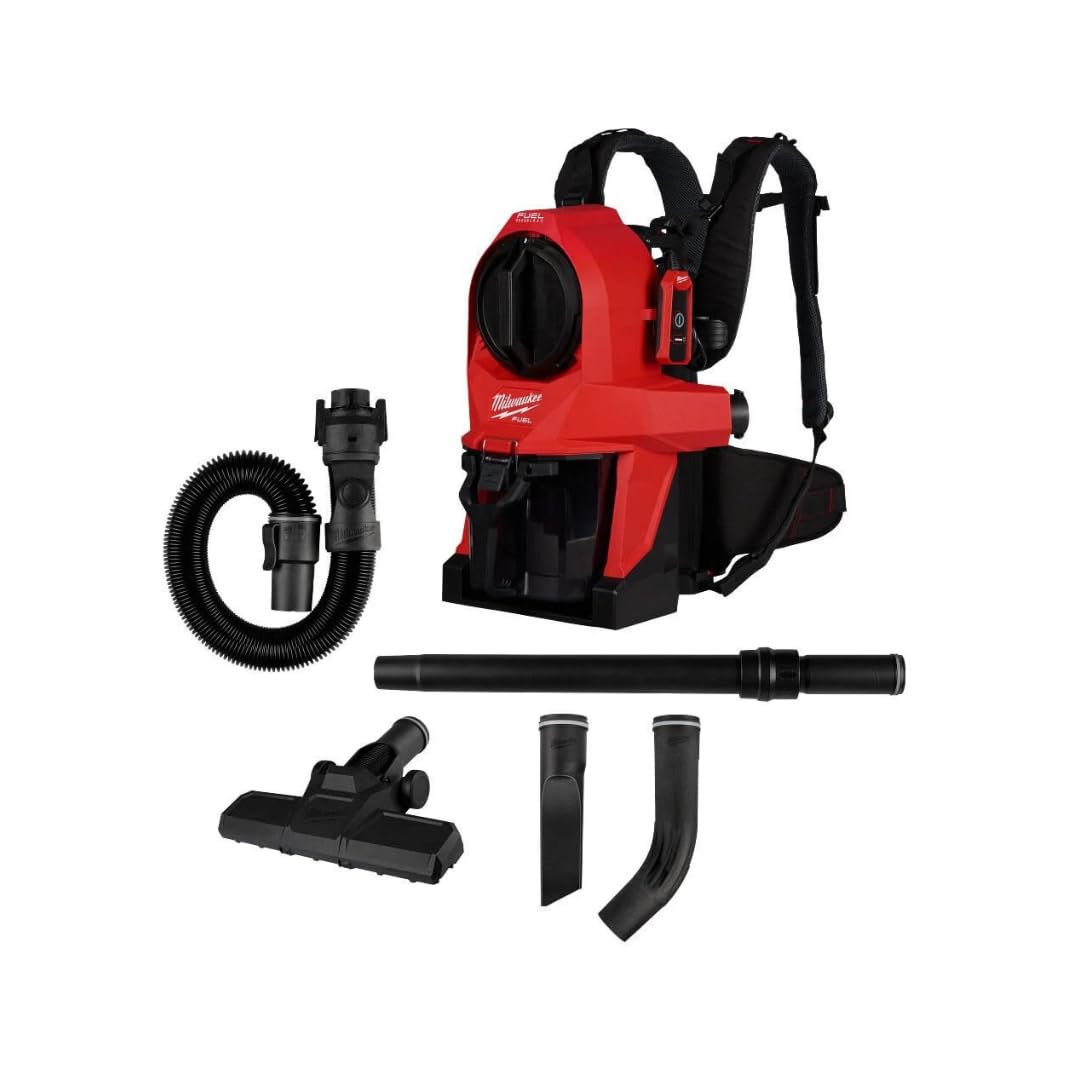
The job-site workhorse that trades battery life for sheer pulling power
If you already run Milwaukee’s M18 batteries (their 18V platform used across drills, saws, and lights), this is the backpack vacuum that slots straight into your kit. It is a cyclonic, bagless machine — meaning it spins debris out of the airflow instead of trapping it in a bag, so you empty a bin rather than buy replacement bags. With a cartridge filter and a HEPA filter in the box, it is built for picking up job dust, not just crumbs.
The trade-off is weight and appetite for power. At 15.3 lb it is 23% heavier than the Makita XCV09Z, and it measures 26.85″L x 9.96″W x 14.29″H — 56% more bulk than the Sanitaire Transport. That heft buys real suction that lifts rugs and handles hard surfaces cleanly. Even on the low setting, it pulls enough to get most of a house done, and there is no roller to clog with hair. The catch is the draw: continuous use drains a 5Ah battery in about 20 minutes, so a big pack is not optional for serious sessions.
What wins people over is how easy it is to live with day to day — the on-board storage for the flexible hose, telescoping wand, floor tool, and crevice tool keeps everything on the machine. The removable harness, integrated canister hook, and handle let you convert it from carried to dragged. It runs quieter than a wheeled shop vac, a difference owners notice on indoor jobs. The recurring gripe is battery life, and durability is the honest question mark — some units have broken down early — so treat it as a heavy-use tool rather than a gentle daily driver.
Where it pulls ahead
- Cyclonic bagless design means no replacement bags to buy
- Strong suction clears hard floors and lifts rugs
- On-board storage holds the hose, wand, floor tool, and crevice tool
- Quieter than a wheeled shop vac and runs on the M18 platform
What to weigh first
- Heavy 15.3 lb body and a 26.85″L x 9.96″W x 14.29″H footprint that takes up space
- Continuous use drains a 5Ah battery in around 20 minutes
- High power draw means big batteries are a real added expense
Reach for this if: you work in trades, cars, or garages and already own Milwaukee M18 batteries you can share across tools.
Look elsewhere if: you need marathon runtime for whole-house cleaning without a stack of spare packs.
2. Makita XCV09Z 18V X2 LXT Lithium-Ion (36V) Brushless Cordless 1/2 Gallon HEPA Filter Backpack Dry Vacuum, Tool Only

Buy the machine, not the batteries — if you are already inside Makita’s LXT world
This is the bare tool — the vacuum body with no batteries included — so it makes sense only if you already own Makita 18V LXT packs, because it runs two at once. That 18V X2 setup combines two 18V batteries for 36V of power. Light in the hand at 12.4 lb, it is a touch over 2.5 lb lighter than the Milwaukee above, and its low-profile pivoting head and aluminum telescoping wand let you reach under furniture and up high.
The headline number is runtime: up to 116 minutes of continuous operation on the normal setting, dropping to 33 minutes at max. The two-stage HEPA filter captures 99.97% of particles 0.3 microns and larger, which matters when you are chasing dog hair on hardwood or fine drywall dust. It handles those jobs well. The catch is capacity and airflow — the 1/2-gallon bag fills fast, suction fades as the bag fills, and cloth reusable bags clog quickly and choke airflow. Paper bags keep the pull much stronger, and owners often reuse them by emptying them out.
Where this sits against the M18 Fuel above is clear: the Milwaukee has the stronger, quieter, bagless pull, while this Makita runs longer on a charge and weighs less on your back. The honest limitation is suction, which several owners find weaker than they hoped — one put it plainly, “the suction is not all that great.” Run it as a lightweight, long-running cordless for light debris and hard floors rather than a deep-carpet machine.
Runtime beats muscle: up to 116 minutes on normal is the longest figure in this lineup, and the 12.4 lb carry makes it the easier pack for all-day light cleaning.
Keep spare bags handy: with only a 1/2-gallon bag, a big job means several empties, and paper bags hold the strongest suction.
Your pick if: you own Makita LXT batteries and want a lightweight backpack that runs a long time on hard floors and dog hair.
Pass if: you need deep-carpet suction or you have no 18V LXT batteries, since this body ships without them.
3. Sanitaire Transport Commercial Cordless Backpack Vacuum with Adjustable Wand, Dual 24V Batteries, Handheld Controls, SC580A

A commercial-grade backpack that cleans a whole house before the second battery dies
For anyone vacuuming a whole house in one go, the runtime here is the reason to look. It runs up to 70 minutes, dropping to 40 minutes on continuous Boost speed, and the dual 24V battery system lets you drain one pack then the other so you are never dead in the water. It measures 17.25″L x 21.25″W x 8.5″H, 56% more compact than the Milwaukee M18 Fuel.
The draw of the dual-battery approach is that a whole house gets vacuumed twice per charge, so the machine keeps pace with a full-clean routine rather than a quick touch-up. Sealed HEPA filtration captures 99.97% of 0.3 micron particles and smaller, which suits offices and homes where air quality matters. The handheld controls let you check battery life and cut power without shrugging the pack off your shoulders, and the clippable remote puts a control in your hand when you need it. At under 15 lb it wears comfortably, with the weight mostly in the two batteries.
Two honest notes. The included floor attachments divide opinion — the suction is fine for everyday debris but owners chasing larger messes sometimes swap in a stronger motorized head, and the older screw-style attachment connection is a two-handed job that is tough on stiff wrists. The charger’s fan runs loudly, so charge it in another room. It also costs a commercial-grade price, and a couple of units have failed early, so buy on the strength of the filtration and runtime rather than expecting a budget machine.
Made for: homeowners and cleaners who want one long-running pack that finishes the job without swapping mid-floor.
Trade-off to accept: the floor attachments are the weakest link and the connectors need both hands to swap.
4. Makita XCV10PTX 18V X2 LXT Lithium-Ion (36V) Brushless Cordless 1/2 Gallon HEPA Filter Backpack Dry Dust Extractor Kit, AWS Capable (5.0Ah)

The system piece that starts and stops itself when you fire up a dust-making tool
This one is a dust extractor, not a general vacuum — it is built to catch dust at the source while you cut, and that changes who should own it. The standout feature is the Auto-start Wireless System (AWS), which uses Bluetooth to power the extractor on and off automatically when you switch on a paired tool. For drywall work in finished, dust-sensitive spaces, that hands-free link is the whole point. It ships as a full kit with two 18V LXT 5.0Ah batteries and a dual-port charger, so unlike the bare-tool XCV09Z above, it is ready from the start.
Power is down slightly from the other Makitas here at 64 CFM, with 44″ of water lift and up to 62 minutes of runtime on normal, dropping to 33 minutes on high. The two-stage HEPA filter captures 99.97% of particles 0.3 microns and larger, and it comes with a 3-year limited warranty. Paired with a matching cutting tool, it works well in finished spaces and even handles carpeted stairs around the house.
Two things to sort out before you buy. First, the bent pipe suction tube is not in the box — you add it separately — and without it the machine cannot pick up properly. Second, the suction itself is the weak spot for some buyers; reports of it feeling soft and of batteries dropping quickly come up, so this is a specialist at-source dust tool rather than a replacement for a heavy-duty shop vacuum.
Built for a workflow: if you already run Makita tools, the wireless auto-start turns this into a hands-free dust system instead of another machine you switch on by hand.
Missing piece: the bent pipe is sold separately, so budget for it or the extractor cannot do its job.
Choose it when: you are cutting drywall or handling dusty jobs in finished or sensitive spaces and want extraction that starts with the tool.
Skip the idea of: using it as your main home vacuum, since suction is tuned for at-source dust, not deep cleaning.
5. Makita XCV09PT 18V X2 LXT Lithium-Ion (36V) Brushless Cordless 1/2 Gallon HEPA Filter Backpack Dry Vacuum Kit (5.0Ah)

The stairs-and-corners specialist that arrives with its own batteries and charger
Same vacuum core as the bare-tool XCV09Z above, but this one lands as a kit with two 5.0Ah batteries and a dual-port charger — so it is the version to buy if you do not already own Makita LXT packs. It keeps the big numbers: up to 116 minutes of continuous operation on normal, 33 minutes on max, and a two-stage HEPA filter capturing 99.97% of particles 0.3 microns and larger. The brushless motor generates 70 CFM with 44″ of water lift, and it includes the aluminum telescoping wand, bent pipe, crevice nozzle, floor nozzle, and flexible hose.
The place it earns its keep is reaching the spots a corded vacuum rarely gets to. Stairs and rooms without a nearby socket are exactly what this was built for, and it meets or exceeds the suction and battery life owners expected for those jobs. On low carpet and bare tile it cleans well, and a bag system keeps the machine itself tidy between empties. The flip side is the bag: it holds only 1/2 a gallon, so it fills fast and the value of buying a stack of replacements up front is real.
Here is the honest trade against the cheaper bare-tool version: you pay more for the included batteries and charger, but you also inherit the platform and its running costs. Suction is the most-discussed limitation, drawing more complaints than anything else here, and a floor attachment that press-fits and pops off — needing tape or a clamp — is a small frustration. Even fully charged it is better on light debris than deep carpet, and it is loud enough that earplugs help on long sessions. Parts of the handle have broken on some units and the batteries are costly to replace.
What owners count on
- Up to 116 minutes on normal and a full 5.0Ah battery kit included
- Ideal for stairs and rooms with no nearby outlet
- HEPA filtration captures 99.97% of particles 0.3 microns and larger
- Bag system keeps the machine clean and bags are inexpensive
The honest drawbacks
- Suction draws more complaints than any other feature for this model
- 1/2-gallon bag fills fast, so stock up on replacements
- Floor attachment can pop off under pressure
- Loud on extended runs and replacement batteries are pricey
Ideal for: anyone without existing Makita batteries who wants a ready-to-run kit for stairs and hard-to-reach floors.
Think hard if: deep carpet is your main surface, since softer suction limits how much you lift in one pass.
6. ProTeam GoFit 3 Cordless 4Ah, 3 qt. Commercial Backpack Vacuum with Xover Multi-Surface Telescoping Wand Tool Kit, 107774
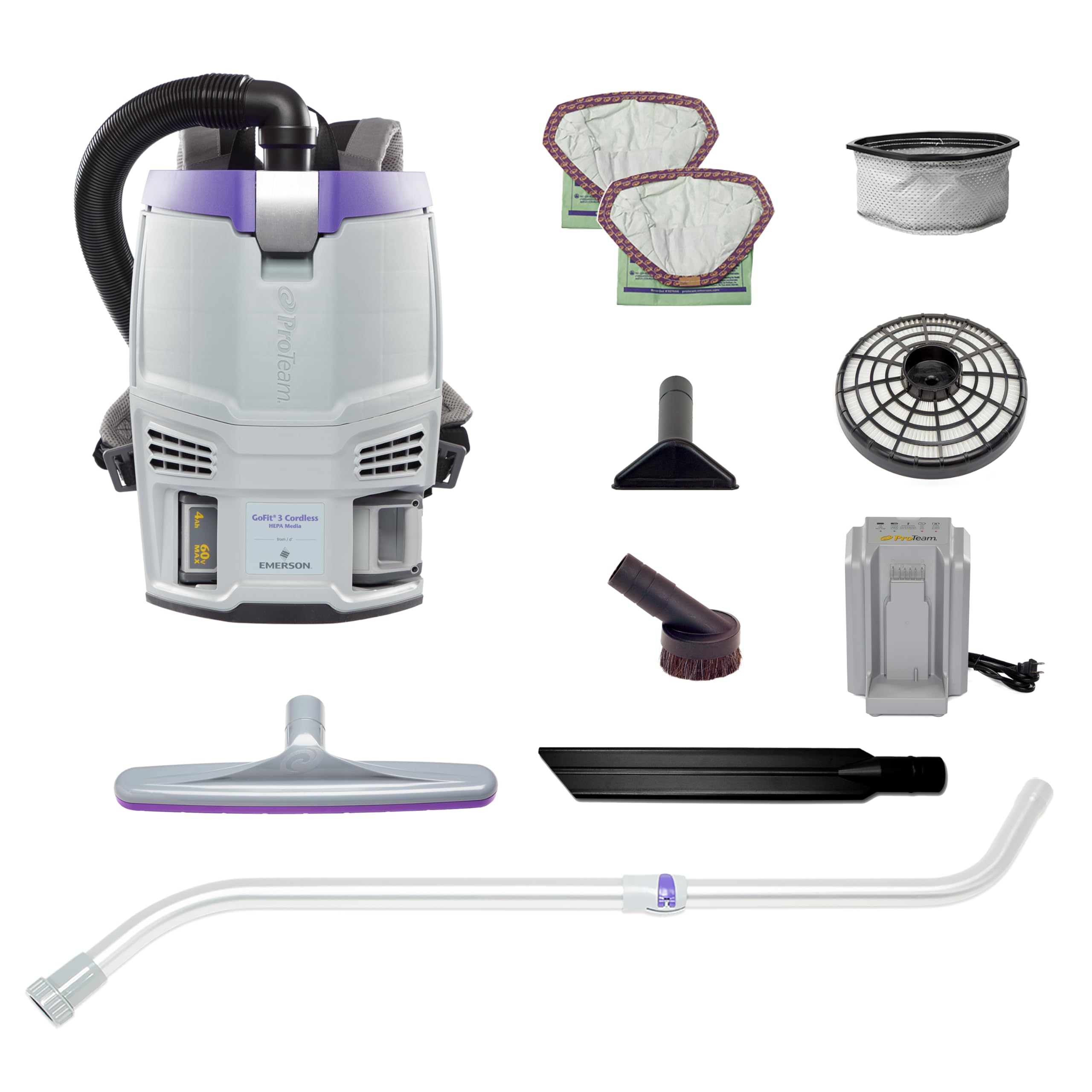
The lightest carry here, built with a smaller frame in mind
If a heavier pack wears you down fast, this is the one to strap on. ProTeam calls it their smallest cordless cleaning solution, weighing 12.8 pounds with the battery installed, and it is designed to suit a wide range of users with an interchangeable quick-adjust 4-step harness that needs no tools. It pairs a 3-quart bag with a high/low power switch so you can run low for detail work and switch to high for high-traffic areas. Runtime is approximately 51 minutes on low and 39 minutes on high with the 4Ah battery, and a full recharge takes about 61 minutes.
Where it works best against the other picks is hard floors. It glides on tile and bare floors with good suction, a low-profile head, and strong reach, and the swivel hose plus on-board attachment storage keeps everything in reach. On a multi-level home or a condo, the cordless freedom means no plugging and unplugging as you move room to room. The ProLevel filtration system and HEPA filter are built to trap soil and particles rather than letting them back out, and the machine is a documented American Lung Association partner for air-quality work.
The real caution is carpet. There is no rotary brush, so it is tuned for bare floors and struggles with lint and low suction on rugs — the included brush head drags on hardwood until you swap it. The 3-quart bag also fills quickly on big jobs, and the disposable bags add up. The advertised runtime is the number to plan around, and one weak point owners hit is the battery working loose in use. It is a light, comfortable machine for the right floors, not a carpet specialist.
Comfort first: at 12.8 pounds with the battery in, it is the easiest of the group to carry for long sessions, and the numbered straps adjust without tools.
Floors matter: count on strong performance on tile and bare floors and plan a different tool for wall-to-wall carpet.
Right for: smaller-framed cleaners and anyone prioritizing a light carry and quick tool-free fit for hard-floor work.
Not built for: wall-to-wall carpet, where the lack of a brush and low suction leave lint behind.
Understanding the Specs
Cordless runtime
The runtime figure is the number you feel by the end of a job. It is usually quoted on the vacuum’s normal setting, because max speed pulls far more power — a pack rated up to 116 minutes on normal can fall to around 33 minutes at max. Continuous heavy use drains a battery much faster, and a 5Ah pack under constant load might last only around 20 minutes. Match the runtime figure to how you clean, and budget for spare packs if you finish whole rooms in one pass.
HEPA filtration rating
A HEPA filter (High-Efficiency Particulate Air, a dense filter that traps very small particles) rated to capture 99.97% of particles 0.3 microns and larger keeps fine dust out of the air you breathe. Some systems are sealed, meaning the whole airflow path is closed off, which matters on commercial and dust-sensitive jobs. Disposable bags feed the filter and protect it, so small bags that fill quickly mean more frequent changes but also keep filtration at its best.
Battery system and voltage
Voltage and platform decide how you run and how you replace packs. An 18V X2 system pairs two 18V batteries for 36V of power, while a dual 24V setup lets you drain one battery then the other so you always have reserve. Bare tools ship without batteries and suit buyers already inside a brand’s platform; kits include the batteries and charger. Check whether you are buying a bare tool or a kit, because it changes both the real cost and the day you can first use the machine.
Harness weight and balance
What you feel on your back is not the printed number — it is how the mass is distributed and whether the harness adjusts to your frame. Much of the weight sits in the batteries, so a pack that spreads the load and offers quick height adjustment stays comfortable longer. A tool-free harness lets you fine-tune the fit without hunting for tools, and a lighter body helps on stairs and multi-level jobs.
FAQ
How long does a cordless backpack vacuum actually run on a charge?
Do I need a HEPA filter in a backpack vacuum?
What is the difference between a bare tool and a kit in this category?
Are backpack vacuums good on carpet?
Can I swap batteries mid-job with a dual battery backpack vacuum?
How much does a cordless commercial backpack vacuum weigh on your back?
How often will I need to empty the bag or bin?
Are cordless backpack vacuums quieter than corded ones?
Why is the bent pipe sometimes sold separately on dust extractors?
Can a cordless backpack vacuum replace my household upright?
Final Thoughts: The Verdict
For most buyers, the battery operated backpack vacuum winner is the Milwaukee Electric M18 Fuel 3-in-1 because it pairs the strongest suction with a bagless cyclonic design and slots into the M18 platform you may already own. If you want long runtime on hard floors and already run Makita packs, grab the Makita XCV09Z. And for finishing a whole house in one charge, the Sanitaire Transport is the one to reach for. Whichever you choose, buy around the runtime and filtration your floors demand, because those decide more of the job than peak suction.
How We Picked
We do not accept paid placement. Every pick is matched to a real buyer and a real use-case; we do not hands-on test units.
Sources & Methodology
Specifications: manufacturer listings and product documentation. Review insights: verified customer reviews, as of September 2026. Pricing: not shown on this page (it changes often); check the current price via the retailer link.
As an Amazon Associate, Gadgets Feed earns from qualifying purchases. This does not affect which products we feature.