
Our readers keep the lights on and my morning glass full of iced black tea. As an Amazon Associate, I earn from qualifying purchases.
Specs are compiled from manufacturer listings and verified buyer reviews and can change over time — please confirm the key details on the product page before buying.
If you want the short answer, buy the HAIBOXING 18872 first. It is the strongest all-round beginner buggy here because you get two 850mAh Li-Po batteries in the box, so a first session is not cut short by a dead pack. Everything below explains which of the other nine suits your yard, your kid’s age, and your appetite for repairs.
I’m Min — the founder and writer behind Gadgets Feed. This guide is built by comparing the manufacturers’ published specifications and the patterns across verified customer reviews, so you get each pick’s real strengths and trade-offs instead of marketing spin.
Ready-to-run means the transmitter, receiver, battery and charger all arrive together, so nothing extra is needed on day one. This breakdown of the best beginner rc buggy covers scale, speed, batteries, spares and the honest trade-offs.
Our Picks at a Glance


How To Choose The Best Beginner RC Buggy
A beginner buggy fails you in three ways: it is too fast for your space, the battery dies in the middle of a run, or the first crash breaks a part you cannot replace. Pick around those three risks and almost anything on this list will work out.
Match the scale to the space you actually have
A 1:18 buggy is roughly the size of a shoebox and turns a driveway into a track. A 1:10 buggy is four times the footprint and needs a park, a vacant lot, or a dirt track to stretch its legs. Buying the bigger one first is the most common beginner mistake.
Understand the battery before you understand the speed
Every buggy here runs on a Li-Po pack (a lithium-polymer rechargeable battery). A 2S pack stacks two cells for a calmer, cooler run, while 3S stacks three and makes the car noticeably quicker. If a buggy is billed as 2S/3S ready, it accepts both — so it can grow with you instead of being outgrown in a month.
Brushed versus brushless, without the jargon
A brushed motor uses physical carbon contacts inside, runs warmer, and lasts a shorter period before the brushes wear. A brushless motor spins without those contacts, so it runs cooler and longer. Brushed is friendlier to hand to a younger driver; brushless is what you buy if you want the car to still feel quick a year from now.
Parts and repairs decide how long it stays fun
Every one of these will eventually need an axle, a shock, or a gear. Before buying, check whether the maker lists a parts list or stock numbers — the models that do are the ones that stay running instead of becoming shelf clutter.
Quick Comparison
| Model | Best For | Scale | Drive | Runtime / Battery | Amazon |
|---|---|---|---|---|---|
| HAIBOXING 18872★ Best Overall | Best overall first buggy | 1:18 | 4WD | 35 min / 2× 850mAh Li-Po | Amazon |
| Losi Micro-BBest Indoor Racer | Carpet racing indoors | 1:24 micro | 2WD | 20 min / 350mAh 2S LiPo | Amazon |
| GoolRC WLtoys 144001Best Budget 4WD | Cheapest real 4WD racer | 1:14 | 4WD | About 20 min / 7.4V Li-ion | Amazon |
| Hosim M12 | Big-kid brushless speed | 1:14 | 4×4 | Up to 50 min / 2× 1500mAh | Amazon |
| ZD Racing BX12-1 | All-terrain brushless value | 1:12 | 4WD | 3S 2200mAh Li-Po | Amazon |
| ARRMA Typhon GROM (brushed) | Handing a kid a real hobby car | Small scale | 4X4 | 20+ min / 1400mAh 2S LiPo | Amazon |
| GoolRC WLtoys 124017 V2 | Speed on flat open ground | 1:12 | 4WD | 8 min / 2200mAh 7.4V | Amazon |
| CROBOLL SBK10-O-A | Tuning before you race it | 1:10 | 4X4 | — / 3S battery | Amazon |
| ARRMA Typhon GROM 223S BLX | Growing into 3S power | Small scale | 4X4 | 2S/3S / 1400mAh 2S LiPo | Amazon |
| RLAARLO SBK10-B-C | Serious 1:10 track days | 1:10 | 4WD | 15–35 min / 3S 2200mAh | Amazon |
In‑Depth Reviews
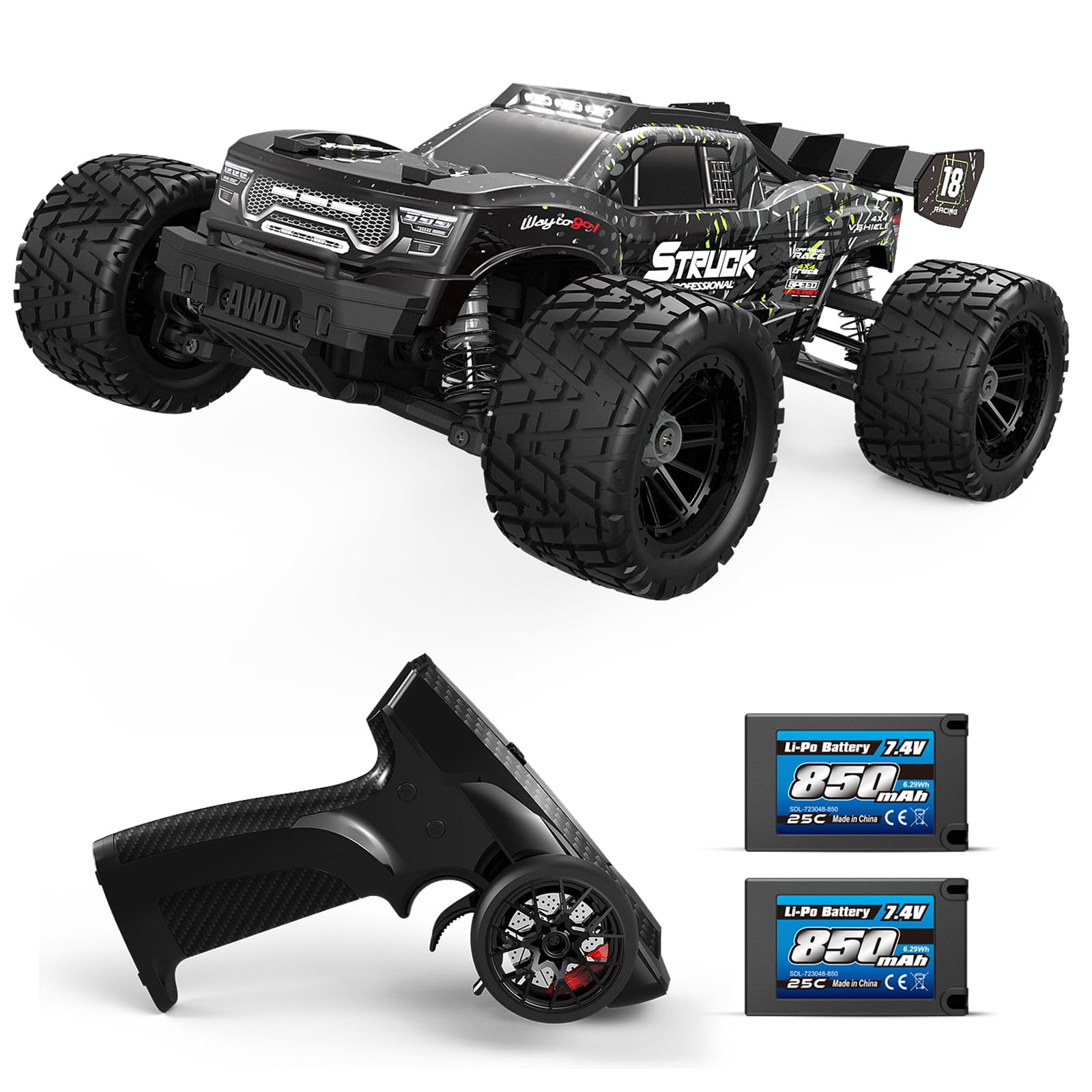
1. HAIBOXING 18872 1:18 RC Car, 4WD Off-Road Dune Buggy
Our pick — over 4.5★ from 100+ verified ratings; the strongest balance of quality and price.
An 8-year-old can unbox it and drive it properly, one-handed, in under ten minutes.
You get more drive time before the charger comes out, and that is why this one takes the top spot. Two 850mAh Li-Po packs (lithium-polymer batteries, the rechargeable kind used in RC cars) ship in the box, one already installed, and together they give over 35 minutes of run time. Buyers report it straight: “Includes two 850mAh Li-Po batteries (one pre-installed) providing over 35 minutes of runtime.” Compare that to the Losi Micro-B, which carries a single 350mAh pack and around 20 minutes — the Haiboxing holds a 2.4x larger battery capacity and runs for 75% longer, so you are not standing in the driveway waiting on a charger.
It is a sensible 1:18 scale, about 10.35 x 7.87 x 3.82 inches and 1.9 pounds, which means it lives in a backpack and runs fine on a small yard. The 2.4GHz radio reaches over 280 feet, plenty for a first driver. Front and rear differentials plus metal drive shafts mean the power actually gets to the ground on gravel and short grass instead of spinning one wheel. It is rated for ages 8 and up.
The honest catch is pace. A driver with decades in the hobby found it “a bit slow on the batteries it comes with” — a real limit of the stock setup, not a defect, and the reason kids take to it instantly. Two more things worth knowing: the new and old controllers are not compatible, so do not mix parts from an older Haiboxing, and the manual notes you should use a power adapter for charging rather than plugging the USB cable into whatever is nearest.
What Buyers Keep Coming Back To
- Two 850mAh Li-Po batteries included, delivering over 35 minutes of runtime between them — far more than the single-pack Losi Micro-B.
- 2.4GHz radio rated for a control range of over 280 feet, with anti-jam cut-off and overheat protection built into the circuit.
- Metal drive shafts, front and rear differentials, and a reinforced collision-resistant structure for beginner-grade impacts.
- Splash-proof electronics and adjustable shock absorbers for grass, gravel, and off-road surfaces.
Where It Comes Up Short
- Stock speed feels mild to anyone with RC experience, even though new drivers handle it easily.
- New and old Haiboxing controllers are not compatible, so replacement parts need to match this version.
Buy this if: you want the least fuss on day one — two batteries, a full parts manual, and a car a child can steer without coaching.
Look elsewhere if: you already own a fast buggy and want the same top-end thrill again.
2. Losi Micro-B 2 Wheel Drive Buggy White RTR LOS00007T1
A palm-sized racer that turns a living-room carpet into a real circuit.
Racing pedigree at micro scale is the whole point here. You get a TLR-inspired design with an aluminum chassis and oil-filled shocks, a Losi 65T brushed motor, and a top speed of 13+ mph. It arrives fully assembled with nothing extra required. Speed is where it holds its own against the HAIBOXING above — 13+ mph from something 152 g in weight is a genuinely quick package for indoor laps.
Runtime and battery are the trade-off you accept for that size. It uses a 350mAh 2S pack and Losi advertises roughly 20 minutes per 1-hour charge, and that smaller-cell setup is exactly why the larger Haiboxing above carries a 2.4x bigger battery. The stock USB charger is the weak link: an owner found the original charger often fails and could risk the battery, and there is at least one report of a charger overheating while in use. Buying a better charger up front is the single upgrade most owners would make first.
What wins people over is the driving feel. It is stable in the air off small jumps, lands predictably, and the acceleration is snappy enough to feel alive on carpet. Screws often come loose from the factory — particularly at the front steering and suspension — so a five-minute check with the hex driver before first use saves you slop later. Open axles collect hair and dust, which is a fair trade for how easy it is to pull apart and rebuild.
The honest verdict: this is the best indoor racer in the group, and the one to pick when your driving space is a hallway or a piece of carpet rather than a park.
Skip the stock charger: the included USB unit is the part most likely to disappoint, so budget for a proper 2S charger from the start and the buggy itself should serve you for years.
Reach for this if: your RC life happens indoors, you want race-bred geometry, and you value a buggy that a phone charger can top up.
Pass on it if: you want the buggy to double as an outdoor basher on grass and gravel.
3. GoolRC WLtoys 144001 4WD 60km/h 1:14 Scale RC Buggy
Metal everywhere at an entry price, and faster than the spec sheet admits.
This is the cheapest route into a real 4WD hobby buggy, and the hardware list reads like a more expensive car. Aluminum alloy chassis, metal differential, metal CVD shafts, metal oil-filled shocks, and a metal shock tower. A 20,000RPM 550 motor and 60A electronic speed control push a claimed 60km/h. Real owners put the usable figure nearer 28 mph on the stock setup — still brisk, and honest about where the hype ends.
The 2.4GHz radio is the strong point for a learner. Range is 100 metres (about 328 feet), and you can dial the throttle limit down to its lowest setting before handing the transmitter over. That is the feature that makes this workable for a teenager even though the manufacturer recommends it for 16 and up. It runs on a 7.4V lithium battery with a 30A discharge rating, quoted at around 20 minutes per charge, though several owners see closer to 10 minutes once they push it hard.
Do one thing before the first run: regrease the front and rear differentials. Multiple owners say the factory grease is thin and that skipping this step wears the gears and adds noise. A heavier marine or white lithium grease, reapplied every handful of hard runs, is the single best habit for keeping this car alive. The rear wing is also the first part to snap in a rollover, and heat is a factor — a small motor heatsink is a widely reported fix that keeps the ESC and motor happier.
The Case For It
- Metal differential, CVD shafts, oil-filled shocks and shock tower at the entry price point.
- Throttle limiting on the 2.4GHz radio lets a beginner start slow and build up.
- 100m control range with anti-interference so several cars can race together.
The Trade-Off
- Battery life is the weakest number in the block — quoted around 20 minutes, often nearer 10 in practice.
- Requires a differential regrease before first use; skip it and gears wear early.
The pick for you if: you enjoy tinkering, want metal parts and 4WD without spending much, and are happy to grease a diff before the first run.
Not the pick if: you want a car that needs zero prep and holds speed for a long session.
4. Hosim M12 Brushless RC Buggy 1:14 60KM/H 4×4
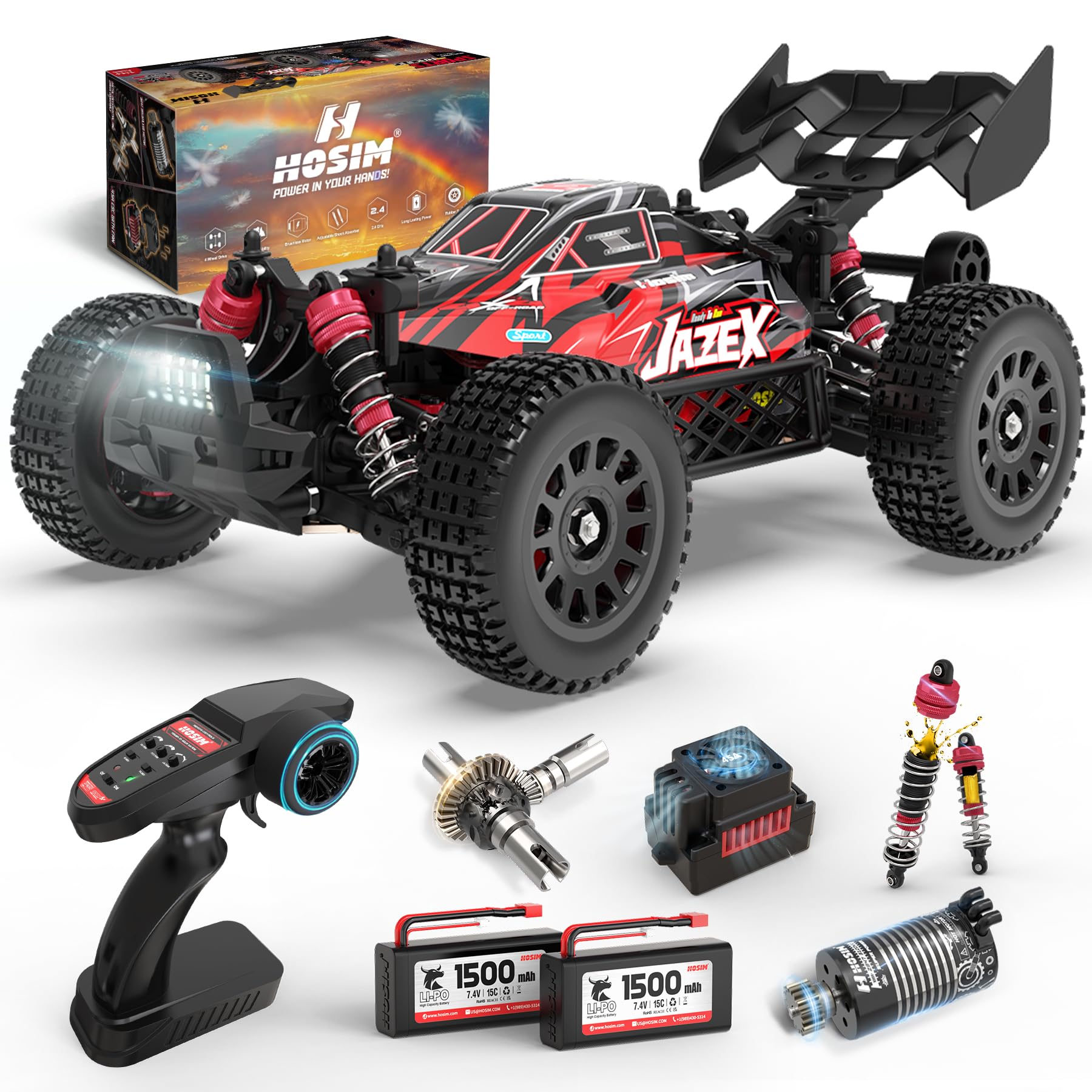
Two big batteries and a brushless motor make this the longest-running basher here.
Runtime is the headline. Two 7.4V 1500mAh batteries ship in the box, giving up to 50 minutes split into 25-minute sessions, and the packs use a flame-retardant casing with T-plug connectors. On top of that, a 2847 3100KV brushless motor paired with a 45A ESC and a metal heatsink plus cooling fans keeps the electronics in check during long runs. It is a 1:14 buggy with a fully metal-reinforced drivetrain — metal differential gears, hardened steel drive shafts, aluminum chassis and metal gearbox.
Speed is the other reason people buy it. Owners mention 50+ mph on the higher 2S/3S setup, and the 2.4GHz transmitter with a 3KG servo gives it sharp steering. The running gear is all-terrain ready, with knobby tires and oil-filled shocks built to survive jumps and rough ground. LED front headlights make evening runs possible without losing the car in a shadow.
The problem is parts. This is the biggest, most powerful car on the list and it earns its speed, but owners routinely note that front and rear dog bone axles can shear and that replacement parts are hard to find. The tall-grass warning is real too: grass wraps around the axles and strains the motor, and the motor does get hot enough to burn on a warm day, so supervision matters with younger drivers. Buy a couple of spare axles with the car and this becomes a very different ownership experience.
Where it shines: 50 minutes of crawling, jumping and top-speed passes from the two included packs — nothing else on this list matches that on-box runtime figure.
What to plan for: spare axles and a firm hand with the throttle in tall grass, because parts sourcing is the weakest link on a car this quick.
Choose this if: you want maximum power and playtime per charge, and you are fine keeping a small spares box.
Think twice if: a broken axle would end your fun rather than becoming a quick driveway fix.
5. ZD Racing 1:12 Brushless RTR RC Buggy 42 MPH
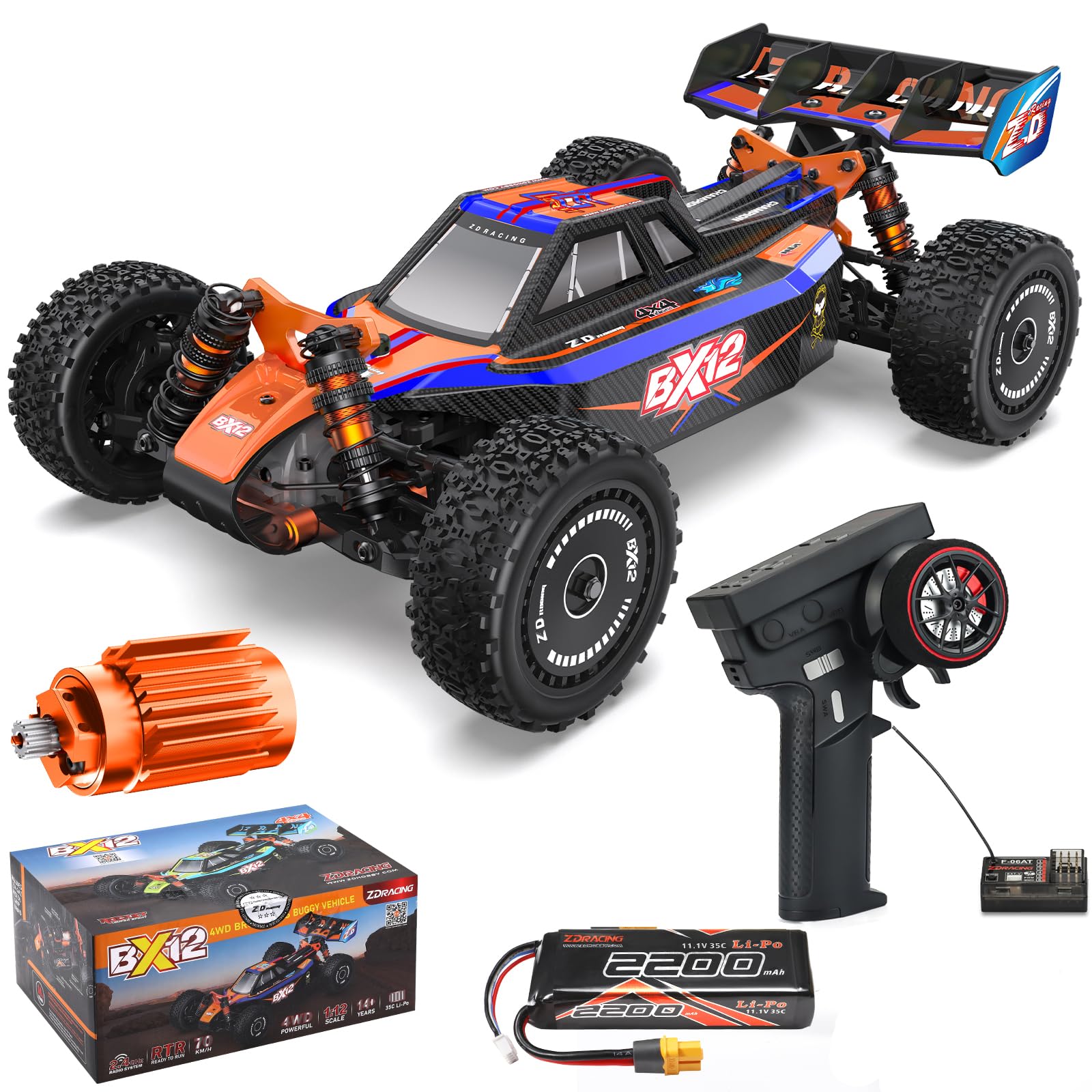
A 40+ mph brushless buggy with an upgrade path that will not outgrow a growing driver.
What gets this buggy its place is the drivetrain. A Rocket 2845 3600KV brushless motor and a 3S 2200mAh Li-Po battery push it toward 42mph, and one owner clocked 41 mph straight from the start without touching the pinion. It has independent suspension and a 4X4 system with an overload-limited slip group using 59TCNC high-carbon steel teeth in the differential, all under a 2mm-thick shell with a strong front anti-collision design.
Handling is the part that separates it. The 16x71mm metal hydraulic shock absorbers are adjustable and oil-filled, and the all-terrain tires use natural rubber with a fresh tread pattern. It works on the road and off it, and it includes three speed settings on the transmitter so a younger driver can start slow. A note on the remote: it needs to be adjusted above 25 on the dial or it will not move at all, so read the manual before you panic.
Two honest points. The motor gear wears fast — owners who run it hard grease the pinion gear with white lithium grease and get much longer gear life. One buyer also reports the extra battery advertised was not included, so order a spare separately rather than assume it arrives. Neither of those takes away from how much fun it is to drive, which is the single most-praised thing about it among owners.
Why Drivers Rate It
- Rocket 2845 3600KV brushless motor on 3S reaches 42mph — genuinely quick at this scale.
- Adjustable oil-filled 16x71mm metal shocks give it real off-road capability.
- Three speed settings on the transmitter let you hand it to a less experienced driver.
What To Watch
- The motor gear wears quickly without regular white lithium grease.
- Order any extra battery separately rather than assume it ships with the kit.
This is the one for: a driver who wants brushless 3S speed with adjustable shocks, ready to race from the start.
Not the right fit if: you want zero maintenance, since gear greasing is part of owning this car.
6. ARRMA Typhon GROM 4×4 RC Buggy, RTR, Blue/Silver

Buy the one that already works before you touch a single setting.
You can drive this the moment you open the box — nothing else to buy. The box includes the car, a Spektrum 2-in-1 ESC and receiver (an electronic speed controller that also handles radio signal), a MEGA 380 brushed motor, a 2.4GHz SLT2 transmitter (the handheld controller), a metal-geared servo (the steering motor), a 7.4V 1400mAh 2S LiPo battery with an S10 mini USB-C charger, and even 4 AA batteries for the transmitter. Customers note around 22 mph from the start — quick enough to excite a first-time driver without being unmanageable.
Build quality is what buyers keep coming back to. It has an enclosed metal gear drivetrain, independent suspension with oil-filled coil-over shocks, and a clipless body design that makes removing the shell quick. The hex hardware throughout makes maintenance far easier than a car held together with Philips screws.
The honest caveats are few but real. The brushed motor is the limiting factor if you want more speed later, and the 2-in-1 ESC/receiver unit means upgrades are more involved than on a car with separate electronics. The motor also runs hot on long hard sessions, so owners add a 30mm fan for the warmer months. Those are second-year considerations, not first-week problems.
Best for new owners: everything you need — batteries, charger, transmitter batteries — arrives in the same box, so there is no extra-shopping hurdle before the first run.
One trade-off to accept: the integrated electronics limit how far you can upgrade, so if you plan to go brushless later, buy the buggy that is built for it from the start.
Reach for this if: you want a genuinely hobby-grade car a young driver can own the moment the box opens.
Look at the brushless version if: you already know you want maximum speed later and can wait.
7. GoolRC WLtoys 124017 V2 Brushless 1:12 4WD 75KM/H

The one that makes you back away from the throttle the first time you pull it.
Speed is the entire reason this exists, and it delivers. A brushless motor pushes it to a claimed 75km/h, and the transmitter runs on a 2.4GHz system that reaches up to 120 metres with anti-jamming capability so multiple cars can race at once. Owners describe it as “rocket fast” as advertised and confirm the speed is achievable on a hard surface. The proportional throttle makes it easier to control than you would expect for something this quick.
It takes a beating better than the price suggests. A metal chassis, oil-filled shock absorbers (fluid-filled dampers that soak up bumps), and 4WD (all four wheels driven) give it stability on rough ground — beaches, snow, grass, and mountain trails all come up in the manufacturer’s list. It runs on a 7.4V 2200mAh rechargeable battery, and the honest number from the spec sheet is that a full charge takes 180 minutes while the run lasts about 8 minutes. That is a real limitation for anyone hoping to drive it all afternoon.
The reality is that this buggy belongs on open flat ground and needs room to breathe. At 50mph, crashes do not cost you time — they cost you parts, and reviewers point out needing to replace bearings, diffs and driveshafts after a year of hard running. It is not a toy to hand a child, and one owner notes you will want to dial back the throttle trim before anyone new takes a turn at the transmitter. Treat it as a first real speed car, not a first RC.
Why Speed Fans Love It
- 75km/h claimed top speed from a brushless motor with a metal chassis to hold up under it.
- 2.4GHz control with a 120m range and anti-jamming for multi-car racing.
- Upgradeable to 3S for even more pace once you have the space to use it.
The Cost Of That Pace
- Around 8 minutes of run time from a 180-minute charge, so a spare battery is essential.
- Crashes at 50mph break parts — bearing, diff and driveshaft replacements are part of the long-term picture.
Best for: a driver who has space to open it up — a park, a large lot, or a proper track — and wants real speed without spending heavily.
Avoid if: you want long sessions on a single charge or plan to hand it to a young beginner.
8. CROBOLL 1/10 Brushless RC Buggy, 4X4, 40+ mph
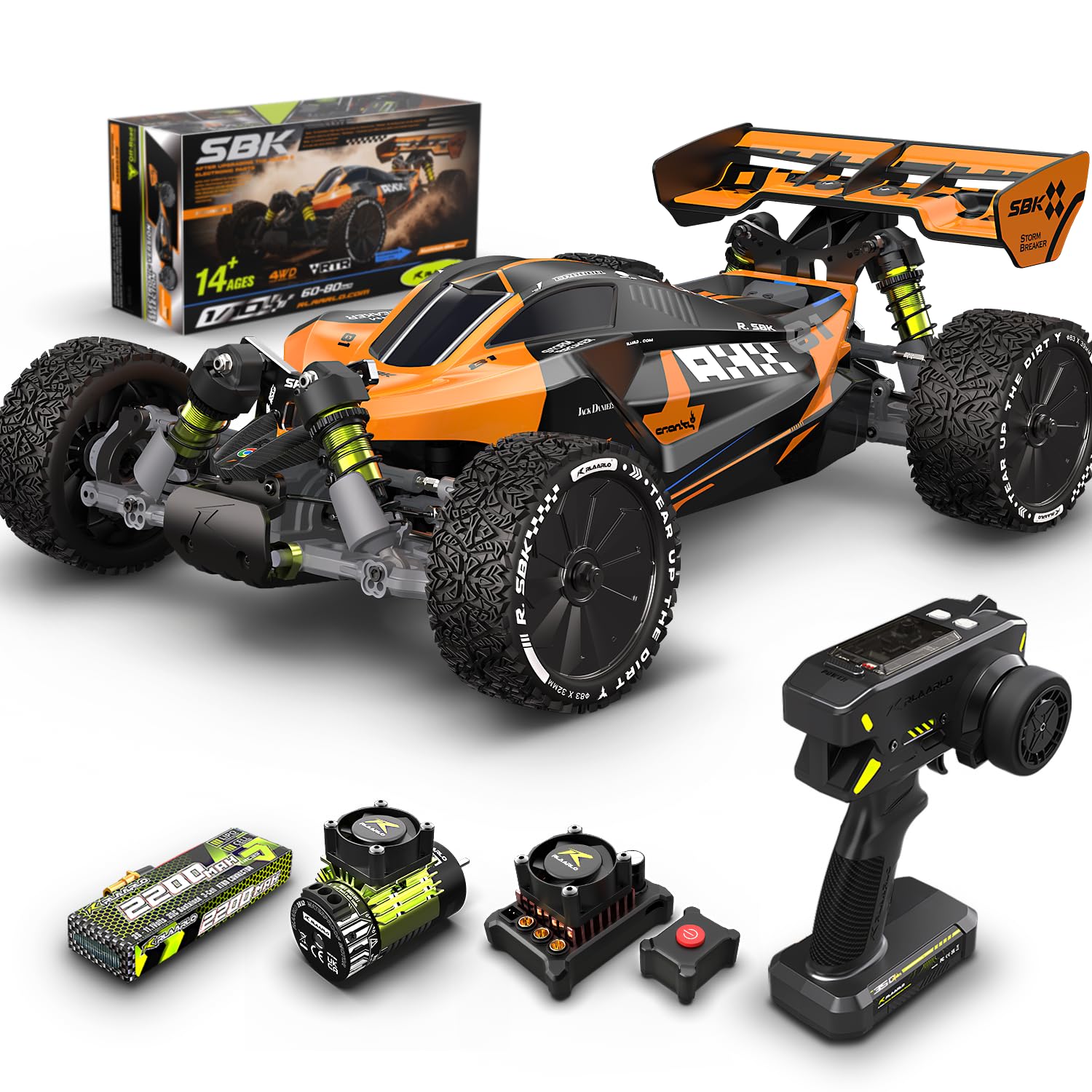
A 1:10 buggy built for people who want to take it apart and put it back faster.
You can turn the speed down while you learn, which is the single most useful feature here for a beginner. You can set throttle and steering to 25%, 50%, 75% or 100%, so a new driver builds confidence gradually without needing a second car. That pairs with a 2.4GHz 6-channel transmitter offering a control range of up to 350 metres, which is the longest in this comparison — the WLtoys 124017 V2 above manages 120 metres by comparison, so this is the one for running at full width on a bigger field.
The build is competition-grade. Aircraft-grade 7075-T6 aluminum alloy shock towers at 4mm, a 2.5mm aluminum chassis, carbon steel CVD, dog bone and drive shaft, and an 11kg high-torque servo for responsive steering. A 2852-3100KV brushless motor with a 45A ESC and a waterproof design with cooling fans and a metal heatsink powers it toward 40+mph. Two motor gears, a 16T and a 19T, are included so you can tune for speed or climbing. The kit also includes a telemetry wire for real-time battery voltage display on the transmitter.
Owners like how it looks and how it drives straight from the start — one owner reports it staying level through jumps at a proper track, only adjusting the shock positions and nothing else. The honest downside is that the stock gearing leaves it feeling slow to anyone used to a 3S rocket, and a couple of owners note brittle hinge-pin and shock-tower bolts, so an M3 hex bolt upgrade is a smart early purchase. It runs on 2S or 3S batteries, which is where the real performance lives.
Standout Features
- Throttle and steering limiter at 25%, 50%, 75% and 100% — a genuine learning feature for beginners.
- 6-channel 2.4GHz radio with up to a 350-metre range, the longest control range on this list.
- 7075-T6 aluminum shock towers and 2.5mm chassis built for aggressive off-road running.
Worth Knowing
- Slower than expected from the start on stock gearing; the speed comes with 3S and a motor gear change.
- Brittle hinge pins and small bolts — an M3 hex set is a sensible first accessory.
Pick this one if: you want a proper 1:10 track buggy with a long control range and adjustable speed limits for a beginner.
Look elsewhere if: you want it to feel fast on the very first battery without any tuning.
9. ARRMA Typhon GROM 4X4 223S BLX Brushless RC Buggy, RTR

The buggy you buy once, because it keeps up as your driving gets better.
You can start slow and crank it up later, because this one runs on both 2S and 3S batteries. It has a Spektrum 2838 4500Kv brushless motor (a motor with no brushes to wear out, rated at 4500Kv — the higher the number, the faster it spins per volt) and a 25A 2-in-1 brushless waterproof ESC and receiver that keeps newer drivers in line via Dynamic Stability Control (a gyro that smooths out rear-end slides) and throttle limiting. Shoppers say 58 mph from the start, and the DSC gyro’s three levels let you choose between drift (level 0) and dead-straight tracking (level 1).
Build quality and durability are the standout features here. The Typhon GROM’s parts are already installed — the “enhanced value package” means the popular upgrade parts come pre-fitted rather than arriving in a separate bag. It comes with a 2S LiPo and a USB-C charger so you can drive it immediately. A first-time hobby car owner reports pushing it through a puddle and several asphalt rolls without a single issue, and one who bashed it hard notes the wing tip was the only damage.
The honest catch sits in the included charger. One owner was clear: the smart charger that ships with the car will not charge a 3S battery, even though the car itself supports 3S. That means growing into the third cell requires buying both a bigger battery and a separate charger. Shock towers are integrated into the chassis, so a hard hit to a tower is a bigger repair than on a car with bolt-on towers. That is fair trade for how planted and quick it feels.
what separates it: the DSC gyro and throttle limiter turn a 58mph-capable brushless buggy into something a new driver can actually control, then dial it up as they improve.
The upgrade snag: to run 3S you will need to buy a battery and charger capable of it, because the included smart charger tops out at 2S — plan that cost if you intend to grow with the car.
The right buy if: you want a brushless buggy with a stability brain and plenty of headroom, and you are comfortable planning a 3S battery upgrade down the road.
Not the right buy if: you want one charger to cover every battery you will ever put in it.
10. RLAARLO 1/10 Brushless RC Buggy, 4×4, 50+ MPH, Carbon Fiber
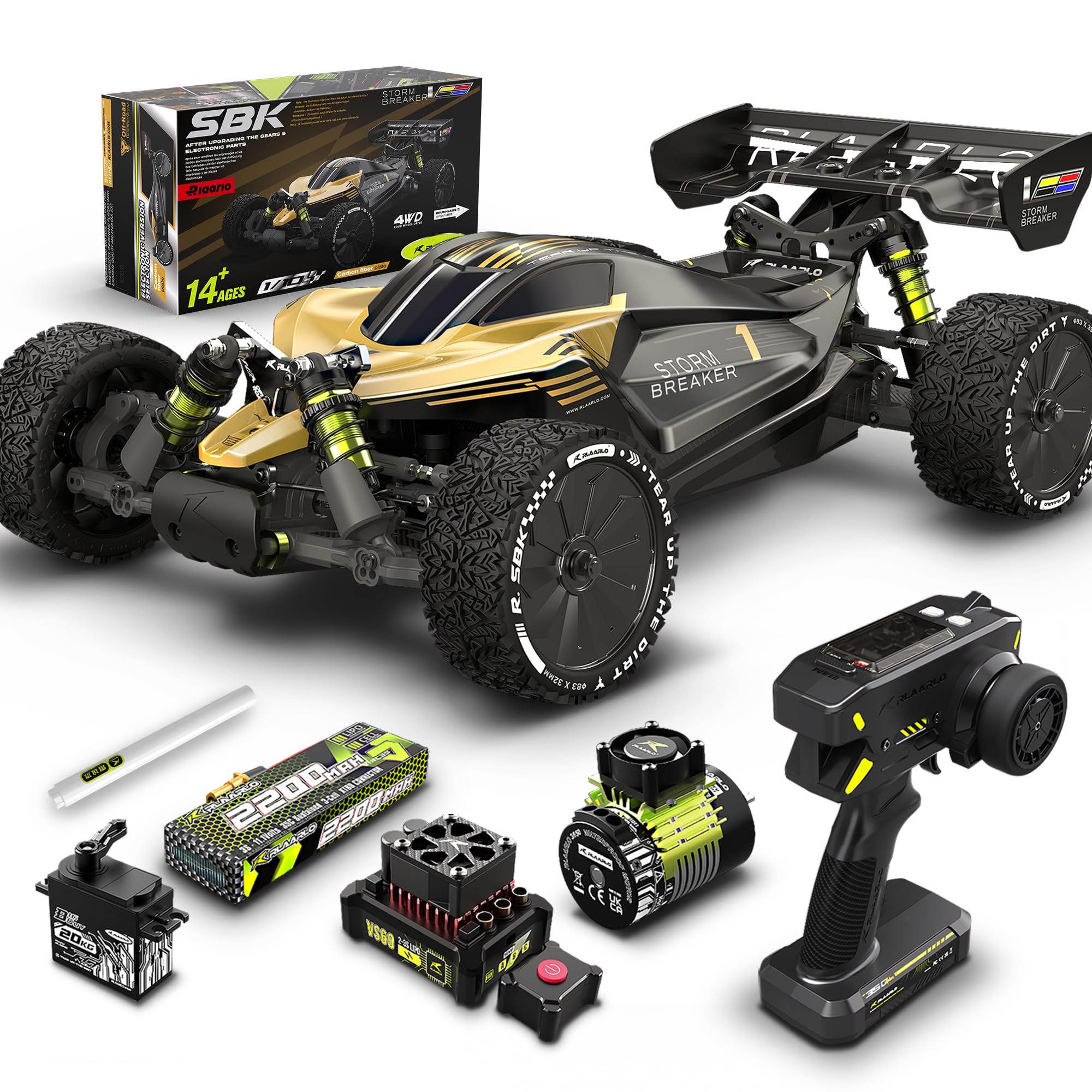
A proper 1:10 race buggy for the beginner who is serious from day one.
This is the top of the list for build quality and it shows in the hardware. A 3650-2650KV brushless motor with an integrated cooling heatsink, a 60A ESC and a 3S 2200mAh Li-Po battery put it at up to 50 MPH under recommended conditions. It is built around a 2.5mm aluminum alloy chassis with 4mm 7075 aluminum shock towers, metal oil-filled shocks and reinforced double A-arm suspension, and it carries a 20KG high-torque servo and sealed front and rear differentials. A 6-channel radio with a control range of up to 350 metres matches the CROBOLL above on range, the longest in this comparison.
You feel the difference in the corners. Front and rear anti-roll bars reduce body roll through corners, and adjustable ground clearance lets you adapt to dirt, gravel, grass, sand and pavement. Buyers report 15 to 20 minutes at full throttle and up to 35 on gentler runs — the largest usable window on this list. The package includes tools, decals, mounting hardware, battery accessories and upgrade-ready parts.
The honest catch is the ground clearance at stock. A couple of owners find it hangs up or cartwheels on gravel, driveway lips and sidewalk cracks, and the speed pinion is best left for flat pavement. Speed is also quoted as below the 50 MPH headline in stock form, with the owners hitting 40 to 44 mph rather than 50 straight from the start. Neither problem is fatal on a proper dirt track or a smooth park path — it is just a matter of using it on the surface the car was meant for. The one thing to know about service is that spare parts come from overseas, so if you break a suspension arm it may take a while to arrive.
The Premium Case
- 3650-2650KV brushless motor, 60A ESC and 3S 2200mAh Li-Po battery reaching up to 50 MPH.
- 2.5mm aluminum chassis and 4mm 7075 aluminum shock towers with double A-arm suspension.
- 20KG high-torque servo, sealed diffs and a 6-channel radio with up to a 350-metre control range.
Weigh This Up
- Low stock ground clearance struggles on gravel, driveway lips and sidewalk cracks.
- Owners mention 40 to 44 mph in stock form rather than the headline 50 MPH, and stock pinion is best on flat pavement.
Choose this if: you already know RC is your hobby and you want a 1:10 track buggy with real hardware from the start.
Wait on it if: your driving space is cracked sidewalk and gravel, where the low ground clearance will cost you.
Understanding the Specs
Scale, and What It Means ForYour Space
The scale number tells you how big the buggy is compared to a full-size racing buggy. A 1:14 or 1:18 car is small enough to drive on a driveway or in a yard, which makes it the friendlier first pick. A 1:10 buggy needs a park, a vacant lot, or a track to run properly. Buy too big too soon and you spend more time retrieving the car than driving it.
Battery Cells And Run Time
A 2S pack stacks two lithium-polymer cells and gives a calmer, cooler run; a 3S pack stacks three and makes the car noticeably quicker. The mAh number tells you how much energy the pack stores, so a 1400mAh pack generally runs shorter than a 2200mAh one. If a buggy is listed as 2S/3S ready it accepts both, which means it can grow with your driving instead of being outgrown.
Brushed Versus Brushless Motors
A brushed motor uses two physical carbon contacts inside to switch direction, so it runs warmer and wears out over time. A brushless motor spins without those contacts and therefore runs cooler and lives longer. Brushed motors are the calmer, cheaper option for a first buggy; brushless is what you buy when you want the car to still feel fast a year from now.
Control Range And Radio Systems
The control range is how far the car can travel before it loses the signal from your transmitter. A range of over 280 feet suits a yard; 120 metres (around 394 feet) or 350 metres handles a big field. All the radios here run on 2.4GHz, which lets several cars race at once without interfering with each other.
FAQ
Is a ready-to-run buggy really ready from the start?
Is a 1:10 buggy too big for a beginner’s driveway?
What is the difference between 2S and 3S batteries?
How long do these buggies actually run per charge?
Do I need to buy spare parts for a beginner buggy?
Can a brushless buggy be dialled down for a child?
Why does my buggy run hot after a few minutes?
Can I run these buggies in wet grass or on snow?
Can two of these buggies race at the same time?
What is the age recommendation for these buggies?
Final Thoughts: The Verdict
For most beginners, the winner is the HAIBOXING 18872, because it hands you two 850mAh Li-Po batteries, over 35 minutes of runtime and a 4WD drivetrain in a package a child can drive confidently on day one. If you want a brushless car with a stability system and room to grow, grab the ARRMA Typhon GROM 223S BLX. And for learning on a living-room carpet, the Losi Micro-B remains the one to reach for. One last nudge: the Haiboxing’s rating and its buyer feedback both point the same way, so if you only take one recommendation from this list, start there.
How We Picked
We do not accept paid placement. Every pick is matched to a real buyer and a real use-case; we do not hands-on test units.
Sources & Methodology
Specifications: manufacturer listings and product documentation. Review insights: verified customer reviews, as of September 2026. Pricing: not shown on this page (it changes often); check the current price via the retailer link.
As an Amazon Associate, Gadgets Feed earns from qualifying purchases. This does not affect which products we feature.