
Our readers keep the lights on and my morning glass full of iced black tea. As an Amazon Associate, I earn from qualifying purchases.
Specs are compiled from manufacturer listings and verified buyer reviews and can change over time — please confirm the key details on the product page before buying.
If you are shopping for a new graphics card, the answer is simpler than the spec sheets make it look: buy 16GB of video memory (VRAM — the card’s own dedicated memory that stores game textures) and you will not be replacing it in a year. An 8GB card can look fine in a review chart and then stutter the moment a modern game streams in detailed textures.
I’m Min — the founder and writer behind Gadgets Feed. This guide is built by comparing the manufacturers’ published specifications and the patterns across verified customer reviews, so you get each pick’s real strengths and trade-offs instead of marketing spin.
Below you will find eleven cards that all carry a true 16GB frame buffer, sorted by what they are actually good at. And yes, that includes the fastest and slowest options on the list. This is the guide to the best 16gb gpu for gaming, AI work, and everything in between today.
Our Picks at a Glance
How To Choose The Best 16GB GPU
Buying a graphics card is not about chasing the biggest number on the box. It is about matching four things to how you actually use your PC: memory capacity, memory type, physical size, and power draw. Get those right and your card will still feel current in three years.
Memory Capacity Beats Memory Speed
A 16GB card keeps more game textures loaded at once, which is why it avoids the stutter you see on 8GB cards when a new game streams in detail. For AI work and video editing, that same 16GB acts as a workspace for large models and render frames, so you finish jobs faster instead of hitting a memory wall.
Check Your Case And Power Supply First
Card length, slot thickness, and power connector count vary a lot in this tier. Some models here fit a compact case; others need a full-size tower. Before you buy, measure the space inside your case and check what wattage your power supply is rated for — it is the single most common reason a build will not post.
Quick Comparison
| Model | Best For | VRAM & Type | Boost Clock | Interface | Amazon |
|---|---|---|---|---|---|
| XFX Swift RX 9060 XT OC | Compact 1440p builds | 16GB GDDR6 | Up to 3320 MHz | PCIe x16 | Amazon |
| ASRock RX 9060 XT Challenger | Small form factor rigs | 16GB GDDR6 | Up to 3290 MHz | PCIe 5.0 x16 | Amazon |
| ASUS Dual RX 9060 XT | ITX and quiet builds | 16GB GDDR6 | Up to 3250 MHz | PCIe 5.0 x16 | Amazon |
| XFX Swift RX 9060 XT Triple Fan | Triple-fan cooling on a mid card | 16GB GDDR6 | Up to 3320 MHz | PCIe x16 | Amazon |
| ASRock RX 9070 Challenger | 1440p and 4K value | 16GB GDDR6 | Up to 2520 MHz | PCIe 5.0 x16 | Amazon |
| GIGABYTE RX 9070 XT Gaming OC | Serious 4K gaming | 16GB GDDR6 | 3060 MHz | PCIe 5.0 x16 | Amazon |
| ASUS Dual RTX 5060 Ti OC | AI tasks and quiet rigs | 16GB GDDR7 | 2632 MHz | PCIe 5.0 x16 | Amazon |
| PowerColor Hellhound RX 9070 XT | Silent high-end gaming | 16GB GDDR6 | 2460 MHz | PCIe x16 | Amazon |
| Sapphire Pulse RX 9070 XT | Overclocking headroom | 16GB GDDR6 | — | PCIe x16 | Amazon |
| PNY RTX 5070 Ti Epic-X | High-end NVIDIA creators | 16GB GDDR7 | 2295 MHz | PCIe x16 | Amazon |
| GIGABYTE RTX 5080 Gaming OC | Top-tier 4K and DLSS | 16GB GDDR7 | 2.73 GHz | PCIe 5.0 x16 | Amazon |
In‑Depth Reviews
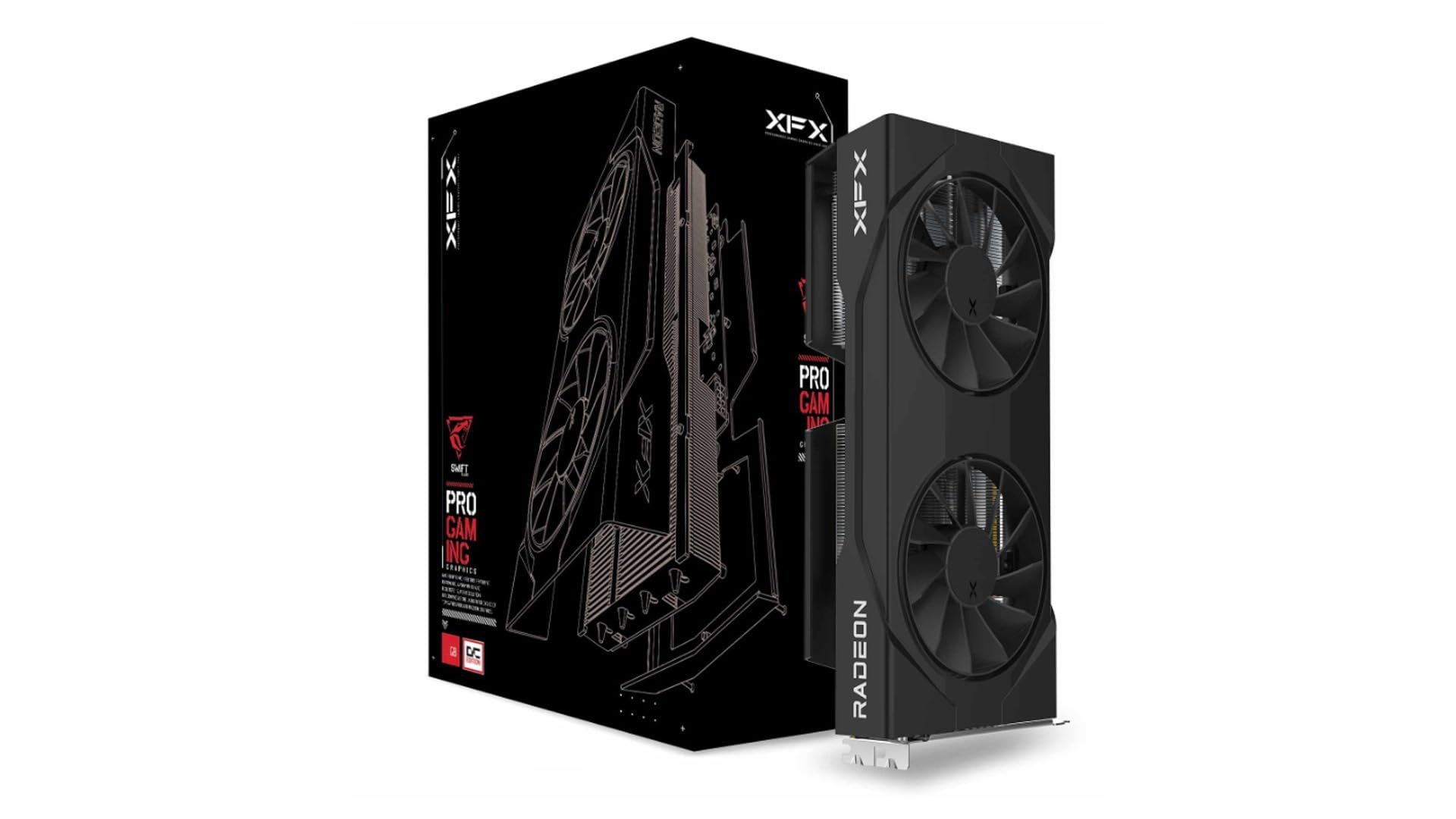
1. XFX Swift AMD Radeon RX 9060 XT OC Gaming Edition 16GB
The 4.8-star 1440p pick: 16GB GDDR6, a 3320 MHz boost clock, and a dual-fan cooler that stays quiet under load
The XFX Swift RX 9060 XT is the card that makes the most sense for most people building a 1440p (the resolution of 2560 x 1440 pixels, sharper than standard 1080p) gaming rig. It holds 16GB of GDDR6 memory (GDDR6 is the mainstream video memory used to store textures and frames), and that capacity is why it keeps playing smooth when games load up detailed scenes. Its boost clock (the top speed the card can briefly reach under load) climbs up to 3320 MHz, the fastest figure in the 9060 XT group on this list. The dual-fan cooler keeps it compact enough that fitting it in a normal case is not a puzzle.
What wins people over is performance — 48 buyers point to it as the card’s strongest trait — and that lines up with what they report in play. It runs cool, stays stable, and does not sag in the slot. One buyer who moved up from an RTX 3050 said the card runs “max settings at 100-200fps” with “no overheating” and a “compact 2-fan design” that “fits most cases.” Another replaced an RX 6500 XT and noted the new card is “two to three times better” and “makes no more noise, even under load.” Those are the two things that make a daily upgrade feel worth it: more frames, no extra racket.
The honest catch is minor and worth knowing up front. A few owners hit HDR error messages that delayed program loading, and a couple found they needed to keep adjusting software settings after a fresh install. It is a small slice of the experience, not the norm, and the fixes are well documented. If you mostly play in standard dynamic range and want a card you set up once and forget, this is the pick. So the real question is not whether it is quiet — it clearly is — but if you need more horsepower than a smooth 1440p card delivers.
What buyers keep telling us
- 16GB GDDR6 memory that handles modern game textures without running out
- Boost clock up to 3320 MHz — the highest among the 9060 XT cards here
- Reported to run cool, stay stable, and stay quiet under load
- Upgraded owners from older cards call the difference “two to three times better”
What to know before you click buy
- Some owners saw HDR error messages that slowed program loading, especially for VR setups
- Expect to recheck software settings once after install
- Slightly larger in person than photos suggest — measure your case bay
Grab this one if: you want a 1440p card that runs cool and quiet and will not age out on VRAM.
Step up only if: you already plan to chase 4K at high frame rates and need more raw power than a 9060 XT can give.
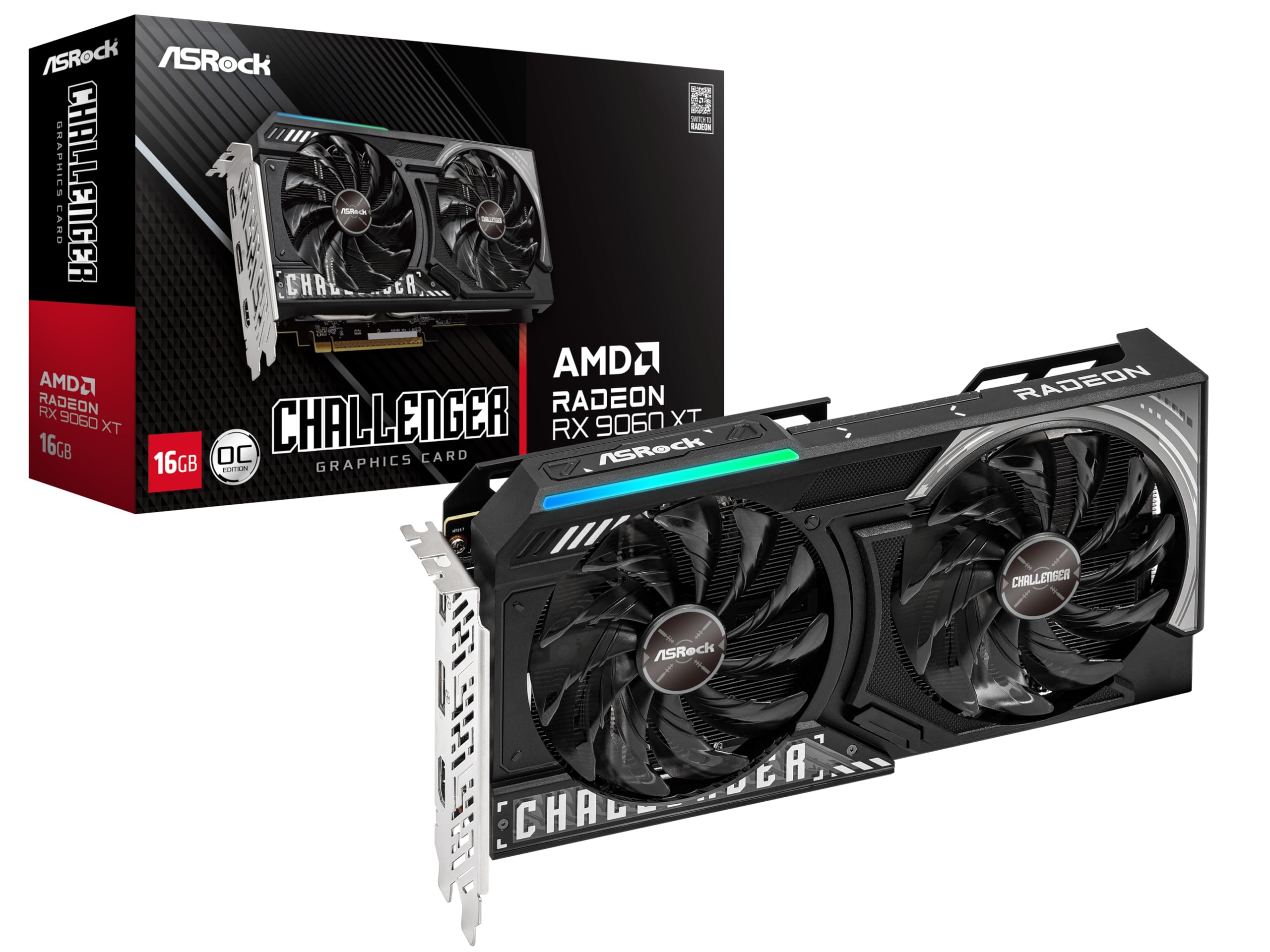
2. ASRock Radeon RX 9060 XT Challenger 16GB OC
A two-slot card built for small cases that still pushes 4K at 60 frames a second
For anyone building in a small form factor case, the ASRock Challenger is the 9060 XT that fits. It is a 2-slot card measuring 249 mm long by 132 mm wide by 41 mm tall, and it runs off a single 8-pin power connector — a recommended 550W power supply covers it. That compact footprint is exactly why it earns a spot here: you are not giving up frames to save space. The card packs 32 Compute Units (the processing blocks that render your games) with 3rd Gen Ray Tracing and 2nd Gen AI Accelerators inside AMD’s RDNA 4 architecture.
Its engine clock reaches up to 3290 MHz in boost, which is the second-highest on this list and a big part of why it handles 1440p so comfortably. Compared with the XFX Swift above, this card runs at 3290 MHz versus that card’s 3320 MHz, and the memory setup is a 16GB GDDR6 buffer running at 20 Gbps across a 128-bit bus (a 128-bit bus is a narrower data highway than the 256-bit cards further down). Owners love the performance, with 48 citing it as the standout, and 13 pointing specifically at frame rates. One buyer who moved from an RTX 3060 for College Football 27 said it runs Ultra settings at 105-120 frames per second at 1440p with temperatures in the 60s and lower power draw than before.
There is a heat-management note worth raising honestly. The dual-fan cooler is not as strong as the triple-fan designs on pricier cards, so it leans on your case having decent airflow to keep temperatures down. ASRock’s own listing warns the same. It also supports workloads outside gaming — buyers report running local AI models through ROCm and llama.cpp on it with good results. If your case breathes well, this is a genuine bargain; if your tower is tight on air movement, plan for it. For most compact builders, the trade is easy to accept.
Where it fits: owners who upgraded from an RTX 3060 or 3060 Ti consistently describe a jump in frame rate alongside lower temperatures and less noise than the card they replaced. The 0dB silent mode even stops the fans entirely when the card is idling.
The trade to weigh: fewer, smaller fans than the three-fan cards means cooling depends on your case having room to move air. A 750W-or-up power supply is the safe target if you plan to overclock.
Built for: small form factor builders who need a short, single-8-pin card that still games hard at 1440p.
Look elsewhere if: you have a big case and want the burliest cooler possible — the triple-fan options on this list cool more aggressively.
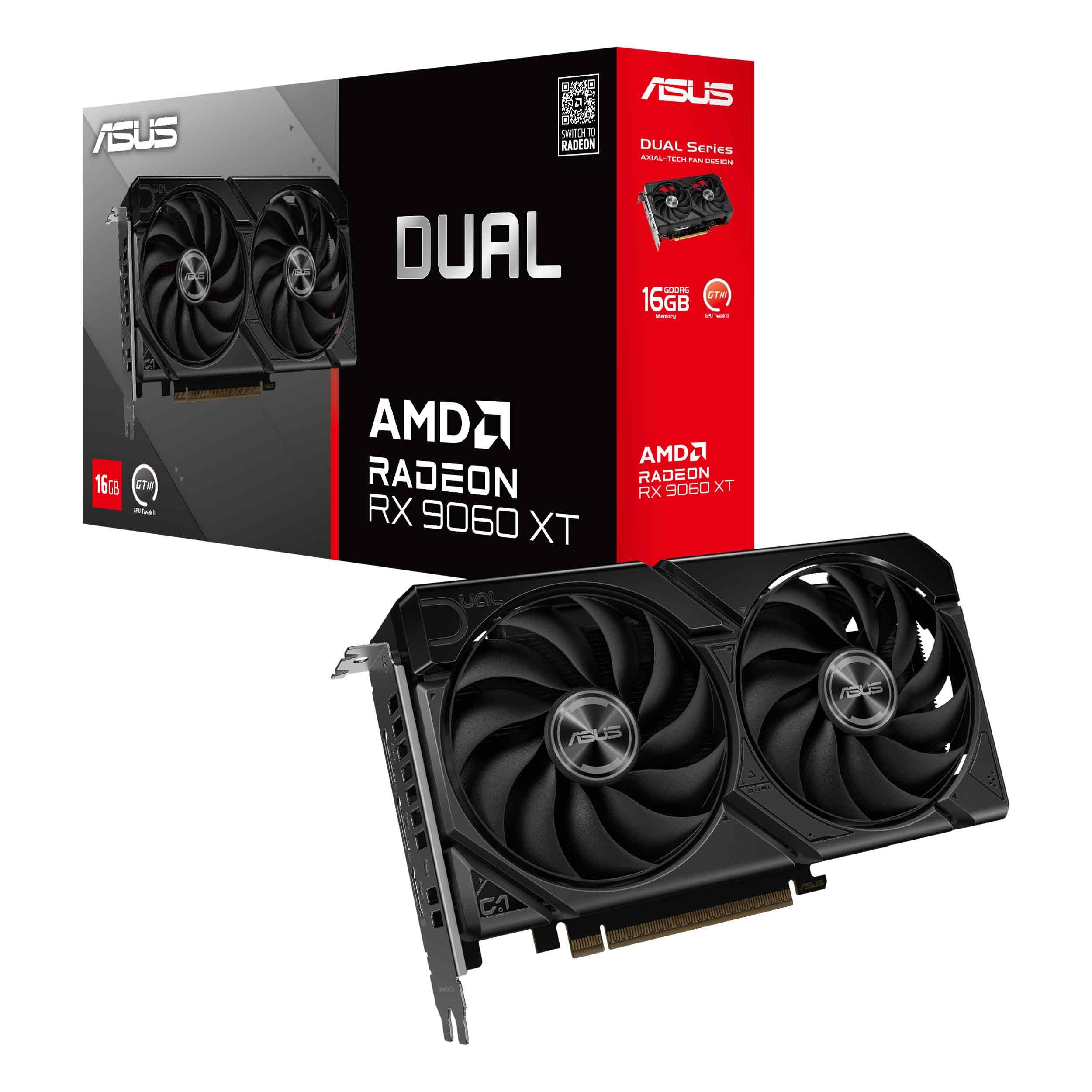
3. ASUS Dual Radeon RX 9060 XT 16GB GDDR6
The smallest card here at just 8 inches long, with two BIOS profiles to switch between
The ASUS Dual is the most compact card on this entire list, measuring 8 inches long by 4.7 inches wide at just 1.3 pounds — and it is built for people who need a 16GB GPU to fit an ITX (small form factor) case where a long card simply will not go. It compares directly with the XFX Swift RX 9060 XT OC further up, and here is the spread: the XFX Swift triple-fan model measures 10.63 inches long, so this ASUS card is meaningfully shorter and easier to slot in. Its boost clock reaches 3250 MHz in OC mode through ASUS’s GPU Tweak III software, or 3230 MHz in the default profile.
Two features do a lot of quiet work here. The 0dB technology stops the fans entirely during light gaming, and the dual BIOS switch lets you toggle between a Quiet profile and a Performance profile without touching software. Those axial-tech fans (a fan design with a smaller hub that allows longer blades and a barrier ring) push air down with more pressure than a standard fan layout. Performances leads what people praise, with 53 citing it, followed by price-to-performance at 30. A buyer who paired it with an i5-12600k and 32GB of RAM reported Destiny 2 hitting 180 frames per second at 1440p, capped at 120, with no overheating.
One thing to check before you commit: a few owners noticed the card’s performance is held back by a low power limit hardcoded into its VBIOS, and that limit stays in place even when you flip to the Performance BIOS profile. It is not a deal-breaker — the card still runs cool and does what a 9060 XT is supposed to — but if you plan on heavy manual overclocking, that ceiling is worth knowing about. For everyone building in a tight case who wants stability over squeezing extra speed, the compact size is the whole reason to pick this one.
Your pick if: case clearance is your biggest constraint and you want a card under 8 inches long with quiet-mode flexibility.
Think twice if: you intend to push aggressive manual overclocks — a hardcoded power limit in the card’s firmware will cap how far you can go.
4. XFX Swift AMD Radeon RX 9060 XT OC Triple Fan 16GB

The same 9060 XT silicon as the dual-fan Swift, with a third fan for extra thermal headroom
This is the three-fan sibling of the XFX Swift up top, and the difference shows in thermals more than raw speed. Its boost clock reaches up to 3320 MHz with a base clock of 1900 MHz and 16GB of GDDR6 running at a 20 GHz memory clock. The triple-fan cooler is the headline: owners in genuinely hot climates report gaming temperatures that never exceed 50°C on the GPU and 55°C on memory, even in ambient heat of 37-45°C. That is overkill cooling, which is exactly what you want on a card you plan to keep for years.
Performance is what this card is known for, with 57 people naming it the top strength. A few honest notes stand out too. This is a physically large card, and owners repeatedly say you should budget for a support bracket to prevent sag — the card is heavy enough that it matters. One buyer also flagged that the card’s white LED cannot be changed or switched off, a small cosmetic quirk if you want a fully dark build. A reviewer noted their card was upgraded from an RTX 3060 and called it “the best card,” running quiet with a big step up in frames.
Here is the value math to weigh. This card’s price sits above the dual-fan XFX, and the case-for-money and physical-size categories both landed as mixed reactions among owners — meaning some shoppers felt the price step was worth it for the extra cooling, and others did not. If you game in a warm room or run long sessions back to back, the thermal headroom justifies the move. If your room stays cool and your case has good airflow, the two-fan version delivers nearly the same frames for less. The choice depends on how hard you push your card.
The standout spec: up to 3320 MHz boost paired with a triple-fan cooler that keeps a card ticking in tropical heat where a smaller cooler would throttle.
Don’t overlook: its footprint. This is a large card that owners say benefits from a support bracket, and it needs a case with the depth to hold it.
Reach for this if: you run long gaming sessions in a warm room and want the extra fan headroom to keep temperatures flat.
Skip the upgrade if: your build is small and cool — the two-fan XFX up top gets you close on frames for a simpler fit.
5. ASRock Radeon RX 9070 Challenger 16GB OC

Moves up to the RX 9070 chip and a wider 256-bit memory bus for easy 1440p
Stepping up to the RX 9070 chip gives you a wider 256-bit memory bus than every 9060 XT on this list — that wider bus moves more texture data per clock, which is why 4K play feels steadier. The card packs 56 Compute Units and 3584 stream processors (the small cores that draw each frame) with 3rd Gen ray tracing and 2nd Gen AI accelerators. Its 16GB of GDDR6 runs at 20 Gbps, and the boost clock reaches 2520 MHz. One important note from the maker: this is a 2.5-slot card at 290 x 123 x 51 mm that needs two 8-pin power connectors and a recommended 700W power supply.
Cooling is a genuine strength here, and owners call out performance and cooling as the two things they praise most. A buyer said it runs “games at 4k +60FPS” and never exceeds 70°C at full load. That same buyer highlighted the 16GB VRAM as a plus for running local large language models, and praised Linux support. Another reported hitting an average of 152 frames per second in Call of Duty at 4K extreme and ultra settings, and singled out the value versus an equivalent NVIDIA card as the reason they picked it.
There is one compatibility caveat worth flagging plainly. An owner found this card would not work with an Oculus Rift CV1 headset, a known quirk with older HDMI direct-mode headsets, and reported no fix on the horizon for that aging hardware. If you are still rocking that exact old headset, plan around it. For everyone else, this is the smart price-to-value step up from the 9060 XT cards — more memory bandwidth, more compute units, and a maker that rates it for high-wattage power supplies because it genuinely draws more under load.
The right call if: you want a wide-bus 16GB card for smooth 1440p and 4K play without paying high-end prices.
Watch out if: you own an older Oculus Rift CV1 headset — owners mention direct-mode compatibility problems that were not resolved.
6. GIGABYTE Radeon RX 9070 XT Gaming OC 16GB

A 3060 MHz boost clock and WINDFORCE cooling that hold steady 4K frame rates
The GIGABYTE RX 9070 XT Gaming OC is the card for someone who wants to game at 4K without compromise and does not want to think about temperatures. Its boost clock runs at 3060 MHz, and it is cooled by GIGABYTE’s WINDFORCE system with Hawk fans and a server-grade thermal conductive gel that does the heat-transfer job. Performance is so consistently strong that 144 owners name it the card’s defining strength — the highest raw count in this entire roundup — with value for money following at 60. It is a big card at 11.34 inches long and about 1.78 kg, so measure your case bay before ordering.
The real-world numbers back up the reputation. Buyers describe Forza running at about 120 frames per second at max ray tracing and ultra settings while staying under 60°C, and Fortnite capped at 180 frames per second with uncapped runs reaching 380-400 frames at 1440p native. One owner summed it up as: “Easily achieving 160-220fps in 1440p on most titles.” Another reported Cyberpunk 2077 hitting 150 frames per second at max settings without frame generation. These are the kinds of figures you buy a 9070 XT for.
The one honest wrinkle is noise, which owners reported as mixed — some find the card completely silent, while others consider it loud under load. That back-and-forth usually depends on case airflow and fan curves rather than the card itself, so it is worth setting a custom fan profile if sound matters to you. There is also the physical size: a thick 2.2-inch-plus card that one builder had to work around in a compact mATX case. If your tower is mid-size or larger and you value sustained 4K performance over silence tuning, this is a very strong all-rounder.
Why owners rate it so highly
- 3060 MHz boost clock paired with a cooling system designed for sustained 4K sessions
- Reported to hold under 60°C under load while still pushing 4K native frames
- Strong pick for RGB builds that do not want obnoxious lighting
- Consistent frame rates in demanding titles like Forza, Fortnite, and Cyberpunk
Plan ahead for these
- Noise is a split verdict — some owners find it loud, others nearly silent, so tune the fan curve
- Large and heavy at 11.34 inches and roughly 1.78 kg — check your case clearance first
- Needs a stable install; some setups required a clean driver pass for best stability
This is your card if: you want a 16GB card that handles 4K at high frame rates and stays cool doing it.
Consider alternatives if: you are building in a compact case or need whisper-quiet operation as a top priority.
7. ASUS Dual GeForce RTX 5060 Ti 16GB GDDR7 OC Edition

The NVIDIA pick: 16GB of GDDR7 and 767 AI TOPS for AI work and video editing
If you do AI work or video editing alongside gaming, the RTX 5060 Ti 16GB is the natural NVIDIA answer. It runs on the NVIDIA Blackwell architecture with DLSS 4 (DLSS is NVIDIA’s AI upscaling that boosts frame rates). Its rated AI performance is 767 AI TOPS (trillions of operations per second for AI work) and its OC mode boosts to 2632 MHz.
Performance is what people praise most at 91, and quiet operation and cooling follow close behind. Owners describe staying under 60°C under load, with one reporting it can drive eight displays at once. A buyer who moved up from an RTX 2060 Super said it bumped their gaming from 1080p to 1440p with better frames and “temps now low 60s vs low 70s.” The card runs off a standard 8-pin connector and pulls 180W, so a 650W power supply is enough for most builds. It is also a compact 2.5-slot design, which makes it a comfortable fit for small cases.
Now the honest part: value is the sticking point. Owners still like the card, but several say the factory overclock is marginal — one noted the OC adds only about 1% over default. The recurring advice is to buy at or near list price rather than paying a premium. That said, if your work involves AI models, large texture sets, or heavy video exports, the combination of 16GB of GDDR7 and NVIDIA’s software ecosystem is hard to match at this tier. Buy it when the price is reasonable and it earns its keep.
Where it earns its money: 16GB of GDDR7 memory, 448 GB/s of bandwidth, and 767 AI TOPS make it a do-everything card for gaming plus AI and creative work, not just a gaming upgrade.
Know before you buy: the factory overclock is slim, so pay list price — not a markup — and factor in a 650W-or-better power supply.
Suits you if: you want one 16GB card that both plays modern games and runs AI or editing workloads.
Pass on it if: you only game at 1080p and want to spend as little as possible — a cheaper 9060 XT covers that easily.
8. PowerColor Hellhound AMD Radeon RX 9070 XT 16GB GDDR6

A 9070 XT that games and encodes video while staying near-silent under load
The Hellhound is PowerColor’s take on the RX 9070 XT, and it is built with a cooling-first mindset. It measures 327 mm long by 128 mm wide by 49 mm tall and weighs 1215 grams, and it runs on two 8-pin PCI Express power connectors with a minimum recommended system power of 800W — so check your power supply before you buy. Its boost clock reaches 2460 MHz, and it supports one HDMI 2.1 port and three DisplayPort 2.1 ports for multi-monitor setups. Notably, this card also takes on non-gaming work: owners praise its encoding throughput alongside its gaming performance.
Silence is the standout feature. Owners describe “minimal coil whine” and sustained load temperatures in the mid-50s, and a buyer running HEVC encoding as a workstation task praised it for staying nearly silent under full load with no crashes or throttling. A HomeStar gamer noted the card sits around 60°C under load and stays quiet, while a Doom Eternal player saw gains of 19% and a Halo Infinite player saw 30% over a previous card. The point of this design is consistency — you get high frame rates without it turning into a space heater or a hair dryer.
One note on compatibility: an owner ended up switching away to an NVIDIA card due to specific AMD game-related issues on some titles, even though they praised the Hellhound’s raw performance and quietness. That is the kind of thing that depends on a small number of games and drivers, not a flaw in the card itself. For most players running mainstream releases, the Hellhound delivers a very cool, quiet high-end experience. Just make sure your power supply can feed it before you build around it.
What it does best
- Runs sustained loads in the mid-50s to around 60°C with very low noise and minimal coil whine
- Handles gaming plus encoding and workstation tasks, not just frames
- Consistent high frame rates in demanding titles — a buyer saw 30% gains in Halo Infinite over their prior card
- Four display outputs for multi-monitor or ultrawide setups
The fine print
- Needs an 800W-or-better power supply and two 8-pin connectors
- A large 327 mm card — measure your case first
- A few owners moved to NVIDIA over game-specific driver issues, so verify your favorite titles work how you expect
Best matched to: builders with a strong power supply and a full-size case who want quiet, consistent high-end frames.
Cross it off if: your PC runs a modest power supply or your case is on the compact side — the 800W requirement and 327 mm length are firm limits.
9. Sapphire Pulse AMD Radeon RX 9070 XT Gaming 16GB

Sapphire’s 9070 XT: 64 Compute Units on a 256-bit bus, built for undervolting and overclocking
The Sapphire Pulse is another 9070 XT built for people who enjoy tuning their own card. It runs 64 Compute Units on a 256-bit memory bus with 16GB of GDDR6, and it supports AMD FidelityFX Super Resolution 4 with AI upscaling. The card is a touch wider than some 9070 XT designs, so a large case is the safe home for it. Customers note the practical payoff of its tuning headroom: one buyer applied a -75mV undervolt and +10% power limit to reach 3440 MHz, and noted it beats several competing 9070 XT designs in benchmarks. Its performance and value are the two things praised most.
What makes the Pulse stand out is how well it responds to an easy overclock. That same owner ran it stable after tuning, describing it as quieter and cooler than their previous card and capable of 4K. A buyer who plays at 1440p reported hitting 200+ frames per second with the card running quiet and cool, and noted there is no RGB lighting if a fully lit build is what you are after. The 256-bit bus with 16GB of memory is the reason it holds up at higher resolutions instead of falling over when textures get heavy.
Here is what to weigh honestly. Owners note the card really wants a large case with room to breathe, and the frame gains over an older mid-range card were described as solid but not transformative — one buyer saw only 30-40 frames per second more than their previous 6700 XT at 1440p. If you already own a strong 1440p card, this is more of a 4K-capable upgrade than a night-and-day jump. If you are coming from something older, it is a capable, tunable step up with real headroom for those willing to push it.
Made for: tinkerers who want a 9070 XT with headroom to undervolt and overclock and are not chasing RGB lighting.
Not the leap if: you already own a solid 1440p card — the gains are real but measured, and it wants a roomy case.
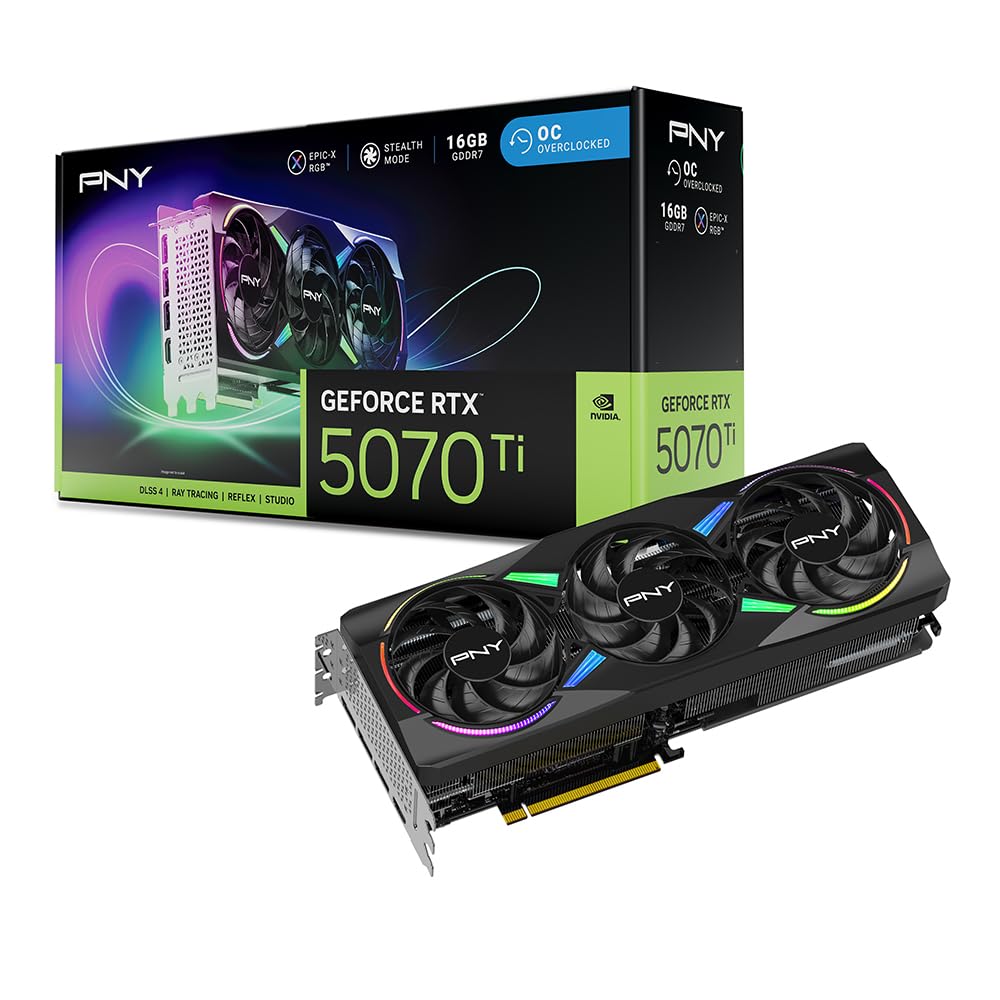
10. PNY NVIDIA GeForce RTX 5070 Ti Epic-X RGB OC 16GB
Triple 90mm fans, a vapor chamber, and 16GB of GDDR7 for NVIDIA creator builds
The PNY RTX 5070 Ti Epic-X is aimed at NVIDIA loyalists who want top-tier creator performance and customizable lighting. It runs on the Blackwell architecture with 5th-Gen Tensor cores for AI work, 4th-Gen ray tracing cores, and 16GB of GDDR7 memory. Its boost clock reaches 2295 MHz, and it uses a three-fan axial design with counter-rotation to cut turbulence, dually ball-bearing fans, and a Stealth Mode that stops the fans at low temperatures. Cooling is handled by a vapor chamber and an ultra-dense heatsink, backed by an open aluminum backplate. The card is about 11.8 inches long and needs a 16-pin cable that splits to three 8-pin connections.
What people value most is performance and how quiet it stays under heavy load. A builder running it on a 34-inch 240Hz monitor reported about 160 frames per second in Battlefield 6, and another praised its build quality with three fans while noting it draws 300W and handles 3440×1440 well. It also supports DLSS, DLAA, frame generation, and ray tracing. Its appearance earns praise too, with buyers calling it a visual centerpiece for a build — though the RGB lighting itself splits opinions, with some finding it beautiful and others saying it is not as customizable as they hoped.
Here is the fair read on value. Some buyers feel the 5070 Ti earns its place among high-end NVIDIA cards at the right price, while others note the cost puts it in a bracket where every dollar draws scrutiny. It also takes up serious space and needs a strong power supply for its 300W draw. What makes it worth considering is the complete package: strong raster gaming, plus the NVIDIA software stack and DLSS that many creators and streamers depend on. If those tools matter to your workflow, this is a solid pick; if you just want frames-per-dollar for gaming, a Radeon card lower on this list will stretch your budget further.
What it brings: 16GB of GDDR7, a vapor chamber and dense heatsink, and a design that stops its fans entirely at low temperatures for near-silent idle use.
Consider carefully: it runs 300W, needs a 16-pin to three 8-pin power cable, and its RGB is not as tunable as some owners expected.
Ideal for: NVIDIA-first builders who use DLSS, frame generation, and ray tracing in demanding games or creative work.
Considerate of your budget instead: if raw gaming frames per dollar is your main metric, cheaper Radeon picks on this list deliver more of it.
11. GIGABYTE GeForce RTX 5080 Gaming OC 16GB

The fastest card here: 2.73 GHz, 16GB of GDDR7, and DLSS 4 for 4K at high frame rates
The GIGABYTE RTX 5080 Gaming OC sits at the very top of this list, and it is the pick for someone who wants the highest frame rates available in a 16GB card. It runs on NVIDIA’s Blackwell architecture with DLSS 4, packs 16GB of GDDR7 on a 256-bit memory interface, uses PCIe 5.0, and cools itself with GIGABYTE’s WINDFORCE system. Its GPU clock reaches 2.73 GHz, and it is a big, heavy card at 13.46 inches long and 4 pounds — this is a full-size-tower component, not a compact option.
Performance is what nearly everyone talks about, and the numbers are impressive. Reviewers point out Cyberpunk and other AAA titles running at 1440p ultrawide without strain, and one described capping 4K gaming at around 60 frames per second with everything maxed and no upscaling. Temperatures stay low — shoppers say around 60-63°C under sustained load, with one pushing a 4-5 hour session in a warm room and still seeing around 65°C. A buyer summed it up simply: “super quiet, handles everything.” The RGB lighting is restrained, and the card also supports easy overclocking through GIGABYTE’s utility.
The honest trade-off is straightforward: this card is huge, it draws more power than anything else here, and it needs the right power connectors — connect all three 8-pin feeds or you may get no signal at all, a point one owner raised directly. It is also overkill if you game at 1440p, where cheaper cards on this list already max out your monitor. But if you want the strongest 4K gaming plus the best AI upscaling available today and your tower has the room, this is the card at the top of the heap, and it is the one to buy when your budget allows it.
The strengths
- Fastest GPU clock here at 2.73 GHz with 16GB of GDDR7 on a 256-bit interface
- Runs around 60-63°C under load even in long sessions, and stays very quiet
- DLSS 4 and frame generation boost frame rates dramatically in supported titles
- Easily overclockable and offers tasteful, restrained RGB for glass-panel builds
The realities
- Very large and heavy at 13.46 inches and 4 pounds — needs an ATX-size case
- High power draw that warms the case and requires all three 8-pin connectors seated firmly
- More performance than 1440p gaming needs — overkill unless you play at 4K
The top pick for: 4K gamers who want the strongest 16GB card with the best upscaling and can house a full-size tower card.
Not necessary if: you play at 1440p — the RX 9070 XT cards above deliver smooth high-refresh play for far less.
Understanding the Specs
VRAM And Memory Type
VRAM is the card’s own memory for holding game textures, and 16GB is the capacity that keeps modern titles running smoothly instead of stuttering when detail loads in. Memory type matters too: GDDR7 moves data faster than GDDR6, which is why the RTX 5060 Ti’s 16GB of GDDR7 on a 128-bit bus reaches 448 GB/s. A wider memory bus — like the 256-bit interfaces on the RX 9070 and RTX 5080 cards — moves more data per clock, which helps most at 4K.
Boost Clock And Cooling
Boost clock is the top speed the card reaches under load, measured in MHz or GHz — for example, 3320 MHz on the XFX Swift. Higher boosts help, but cooling sets how long a card can hold that speed. Twin-fan cards stay compact and fit small cases; triple-fan designs and vapor chambers run cooler and quieter, which matters in warm rooms or long sessions.
FAQ
Is 16GB of VRAM really necessary for gaming?
What size power supply do I need for a 16GB GPU?
Will a 16GB GPU fit in a small form factor case?
Is GDDR7 noticeably better than GDDR6?
Should I pick an AMD Radeon or an NVIDIA GeForce 16GB card?
How do I know if my case can fit a large graphics card?
Can a 16GB GPU run local AI models?
Do I need a support bracket for a heavy graphics card?
What is the difference between boost clock and game clock?
Do I need a dual BIOS switch on a 16GB GPU?
Final Thoughts: The Verdict
For most builders, the 16gb gpu winner is the XFX Swift AMD Radeon RX 9060 XT OC because it pairs the highest boost clock of the 9060 XT group with 16GB of GDDR6, cool quiet operation, and the most settled reputation in this tier — a 4.8-star card that owners describe as a two-to-three-times-better upgrade over the card it replaced. If your priority is fitting a compact case, grab the ASUS Dual Radeon RX 9060 XT at just 8 inches long. And for 4K play with real headroom, the GIGABYTE Radeon RX 9070 XT Gaming OC is the one to reach for, while the GIGABYTE RTX 5080 Gaming OC is the strongest 16GB card here if your budget and your case can stretch to it. Whichever you choose, buy the 16GB version — that frame buffer is the single decision that keeps your card relevant for years.
How We Picked
We do not accept paid placement. Every pick is matched to a real buyer and a real use-case; we do not hands-on test units.
Sources & Methodology
Specifications: manufacturer listings and product documentation. Review insights: verified customer reviews, as of September 2026. Pricing: not shown on this page (it changes often); check the current price via the retailer link.
As an Amazon Associate, Gadgets Feed earns from qualifying purchases. This does not affect which products we feature.