
Our readers keep the lights on and my morning glass full of iced black tea. As an Amazon Associate, I earn from qualifying purchases.
Specs are compiled from manufacturer listings and verified buyer reviews and can change over time — please confirm the key details on the product page before buying.
Fresh juice in seconds beats a morning of chopping, and a centrifugal juicer is the machine that does it — it spins a shredding disc and mesh basket at high speed so produce goes in whole and juice comes out fast. The trade-offs are real, though: these machines are loud, they leave wetter pulp than a slow cold-press (a juicer that crushes produce slowly for more juice), and a few cheap models quit when you push them past five minutes of continuous running. This guide sorts the eight models worth your counter space and tells you plainly which one fits your kitchen.
I’m Min — the founder and writer behind Gadgets Feed. This guide is built by comparing the manufacturers’ published specifications and the patterns across verified customer reviews, so you get each pick’s real strengths and trade-offs instead of marketing spin.
You will see exactly which chute widths cut your prep time, which motors hold up to fibrous beets, and how the top performers handle cleanup. The picks below cover every budget tier of centrifugal juicer.
Our Picks at a Glance


How To Choose The Best Centrifugal Juicer
Every centrifugal juicer works the same way — a spinning basket shreds produce against a mesh filter and flings the juice out by force. What separates a juicer you use daily from one that sits in a cabinet depends on four things: how wide the feed chute is (the tube you drop produce into), how strong the motor is, how long it can run before it needs to cool, and how many parts you have to scrub afterward.
Chute Width Decides Your Prep Time
The feed chute is the opening you drop produce into. A 2.4-inch chute fits more produce with less precutting, and a 3-inch or wider chute lets whole apples and oranges go straight in. If you juice daily, every extra half-inch of chute width saves you minutes of knife work and a dirty cutting board.
Watts, Motor Type, And Run Time
Higher wattage generally means more torque to push through hard carrots and fibrous celery without stalling. A full copper motor also handles heat better than a cheaper build, which matters because centrifugal juicers have a duty cycle — run them too long and the overload protection shuts the machine off until it cools. Check the manual’s stated maximum continuous run time before you buy.
Dishwasher-Safe Parts And Pulp Dryness
The fastest way to abandon juicing is a machine that takes fifteen minutes to clean. Look for detachable parts that are dishwasher-safe, and check whether a cleaning brush is included. Then judge extraction by pulp dryness: dry, crumbly pulp means the machine pulled most of the liquid out, while wet pulp means juice is going in the bin.
Quick Comparison
| Model | Best For | Motor | Feed Chute | Speeds | Amazon |
|---|---|---|---|---|---|
| Breville JE98XL Juice Fountain Plus★ Best Overall | Best Overall | 850W | 3 inch | 2 Speed | Amazon |
| QCen 500W Centrifugal JuicerBudget Entry | Budget Entry | 500W | 3 inch | 2 Speed | Amazon |
| Hamilton Beach HealthSmart CompactCompact Pick | Small Kitchens | 400W | 2.4 inch | 1 Speed | Amazon |
| GDOR 1200W Juicer | High Torque | 1200W | 3.2 inch | 2 Speed | Amazon |
| QCen 800W Centrifugal Juicer | Value Pick | 800W | Wide Mouth | 2 Speed | Amazon |
| nutribullet Juicer NBJ50100 | Easy Cleanup | 800W | 3 inch | 2 Speed | Amazon |
| KOIOS 1300W Centrifugal Juicer | Family Batches | 1300W | 3 inch | 3 Speed | Amazon |
| Oster JusSimple FPSTJE9010-000 | Large Capacity | 900W | Extra-Wide | 2 Speed | Amazon |
In‑Depth Reviews
1. Breville JE98XL Juice Fountain Plus, Silver
Our pick — 4.5★ from 16,500+ verified ratings; the strongest balance of quality and price.
The 850W workhorse with a 3-inch chute that made daily juicing routine.
An 850-watt motor drives the titanium-reinforced cutting disc and the Italian-made stainless steel micro mesh filter basket, and together they shred and strain in one pass. The juicer runs a 3-inch extra-wide feed chute, so whole apples and oranges go in without a knife. Two electronic speed settings let you drop to low for soft fruit and leafy greens, then switch to high for dense carrots and beets.
What wins owners over is the build — the motor and the stainless steel cutting system are regularly called the most reliable parts of the machine. The 35.2 fl oz juice jug carries an integrated froth separator, so you pour more juice and less foam into your glass, and the 2.6 qt pulp container detaches for quick emptying. The whole upper assembly breaks down for cleaning, and reviewers consistently describe it as fast and easy to take apart. Breville’s own customers sum it up as the juicer that processes 25 lbs. of oranges into 1.25 gallons of juice in one sitting.
The catch is real but livable: juice output draws mixed reactions, and the pitcher will overflow if you fill it past the top line. Some owners also note there is no seal between the top and bowl halves, so a small amount of leakage can happen. Fibrous beets want smaller pieces to protect the motor, and the cleaning brush is not included. Compared with the compact Hamilton Beach in this lineup, this Breville is a much larger machine — 14.09″D x 12.6″W x 16.42″H versus 6.02″D x 8.39″W x 12.64″H — so it claims real counter space.
What owners keep coming back for
- 850-watt motor with a titanium-reinforced disc and Italian stainless mesh basket for one-pass shredding and straining
- 3-inch extra-wide chute takes whole fruit, cutting prep time to almost nothing
- Two electronic speeds — low for soft produce, high for hard
- 35.2 fl oz jug with built-in froth separator plus a 2.6 qt detachable pulp container
- Easy to disassemble and clean, with sturdy build quality that holds up
Honest trade-offs to know
- Juice output gets mixed reactions — some get a lot, some get very little
- Large footprint and 10.1 pounds of weight on the counter
- No seal between the top and bowl halves can allow slight leakage
- The pitcher overflows if filled past the top line
- Cleaning brush not included
Best for: Anyone who wants a proven, powerful daily juicer and has the counter space to spare.
Think twice if: You have a tiny kitchen or prefer lighter, more compact machines — this one is a substantial appliance.
2. QCen Juicer Machine 500W Centrifugal Juicer with Extra Wide Feed Chute
The 500W rose-gold juicer with a 3-inch chute and a 5-minute duty cycle.
The 500-watt motor spins at 12,000 to 18,000 RPM across two speeds: setting one for soft produce like watermelon and orange, setting two for hard items like carrot and apple. The 3-inch wide mouth is designed to skip the chopping step, though in practice most fruit still needs cutting to fit. A safety locking arm stops the machine unless the cover is sealed, and an overload protection system shuts it off if it gets too hot.
Owners appreciate how quickly it assembles and how simple it is to break down for cleaning, and the blade and material are both stainless steel with BPA-free parts. It handles celery, apples, beets, grapefruit, lemons, carrots, and ginger well, with pulp that comes out moist rather than dry. The recurring honest point is the duty cycle: don’t run it continuously for more than 5 minutes, and if it shuts down from overheating, let it cool for 15 minutes before restarting. A few buyers report much shorter runtimes in practice — owners mention units that “stopped working after minutes,” with celery jamming and a smoking, burning smell on the first use, even against thin-cut apple slices under the timer.
Some owners also note the grating plate isn’t removable, which makes the crevices hard to clean, and a handful report the plastic chute cracking. The instructions are minimal, so a quick video helps. For its compact footprint and stainless steel construction, it’s an easy starter machine — just budget your sessions and feed ingredients one at a time to keep it cool.
Where it earns its keep: Light, frequent juicing sessions under five minutes, where assembly and cleanup speed matter more than raw power.
Where it asks patience: The 5-minute duty cycle and non-removable grating plate mean fibrous or messy jobs take longer and cleaning is fussier.
Worth grabbing if: You want a low-cost entry juicer and you’ll keep sessions short and simple.
Look elsewhere if: You plan long juicing marathons or heavy fibrous produce — the timer and heat limit will get in your way.
3. Hamilton Beach HealthSmart Compact Centrifugal Juicer Machine
The 400W compact juicer with a 2.4-inch chute, built for one glass at a time.
At 5 pounds and framed around a single on/off button, this is the machine for a small kitchen or a new juicing habit. The 400-watt motor includes a motor protection system to guard against wear, and the 2.4-inch round chute fits more produce with less precutting than a narrow-mouth juicer. There are no speed settings to manage — you press the button and juice pours straight through the spout into your glass.
The removable parts go in the dishwasher, which is the feature owners lean on most after daily use. The compact body fits into a cabinet, and reviewers describe it as quick and consistent for everyday fruits and vegetables. Some caution with lemons pith. The 20 fl oz capacity keeps it modest, so it’s built for single servings rather than batch juicing.
The honest edge is durability — a few customers note units giving out after several uses, and the plastic build feels lighter than the Breville or KOIOS. Extraction can also leave soaking-wet pulp, and it tends to leak a little from the sides of the pulp container. It’s also one of the louder machines; a smoothie-style appliance hum is normal here. For its compact size and dishwasher-safe parts, it’s a sensible first juicer — just don’t expect commercial-grade stamina.
The daily-grind view: If your habit is one glass each morning, this machine’s fast assembly, dishwasher-safe parts, and cabinet-storable size make it a low-friction daily pick.
The longevity question: A plastic build and mixed durability reports mean it rewards gentle use — small, consistent sessions rather than heavy weekend batch juicing.
Reach for this if: You want a small, dishwasher-cleanable juicer for single servings and limited counter space.
Consider a step up if: You plan to juice for a family or want a motor built to run hard for years.
4. GDOR 1200W Juicer, 3.2″ Wide Chute, Titanium-Enhanced Blade

The 1200W full-copper motor and 3.2-inch chute — the widest mouth in this roundup.
This is where the spec sheet gets genuinely impressive: a maximum 1200-watt full copper motor paired with a titanium-enhanced blade disc and a culinary-grade stainless steel micro mesh filter. The wide 3.2-inch chute is the biggest in this lineup, and reviewers point out it takes whole apples and beets with no lag. A 22 oz juice jug stores more juice per batch, and every detachable part is dishwasher safe. Dual speeds split soft fruit (oranges, tomatoes) from hard produce (apple, celery, carrot, kale).
The best thing about this machine is the crushing power — a full copper motor that holds high torque even at low speeds extracts more thoroughly and resists overheating better than a cheaper build. Owners call it the strongest juicer they’ve used, and the titanium cutting system produces a clear, pulp-free pour with refined dry pulp. The dual speeds let you back off for fragile produce, and the whole body is compact enough for easy storage.
Build quality is where this one earns a mixed note — most owners find it solid, but a few report the plastic housing feeling lighter than expected, and one owner reported the machine vibrating violently and smoking on the low setting with kale. A separate owner noted you have to watch your speed choice with certain vegetables, and cleanup is genuinely intense, according to one buyer. Compared with the QCen 800W above, this GDOR pairs a much higher 1200W motor with an even wider 3.2-inch chute — for hard-vegetable juicers who want maximum torque (turning force), that combination is the reason to step up.
The reasons to reach for this one
- 1200W full copper motor for high torque even at low speeds
- Widest chute in the roundup at 3.2 inches — whole fruit, no prepping
- Titanium-enhanced blade disc plus culinary-grade stainless steel mesh filter
- 22 oz juice jug, dishwasher-safe detachable parts, BPA-free
- Dual speeds for soft and hard produce
Things worth knowing before you buy
- Build quality draws mixed reactions — some think it feels light for a 1200W machine
- Cleanup is described as intense by some owners
- Speed choice matters with harder or fibrous produce
- Less review history than the Breville or KOIOS
Built for: Anyone who wants the highest motor wattage and the widest chute without paying premium prices.
Second thoughts for: Buyers who want a long review record backing the machine — this is a newer release.
5. QCen Juicer Machine 800W Centrifugal Juicer with Extra Wide Feed Chute
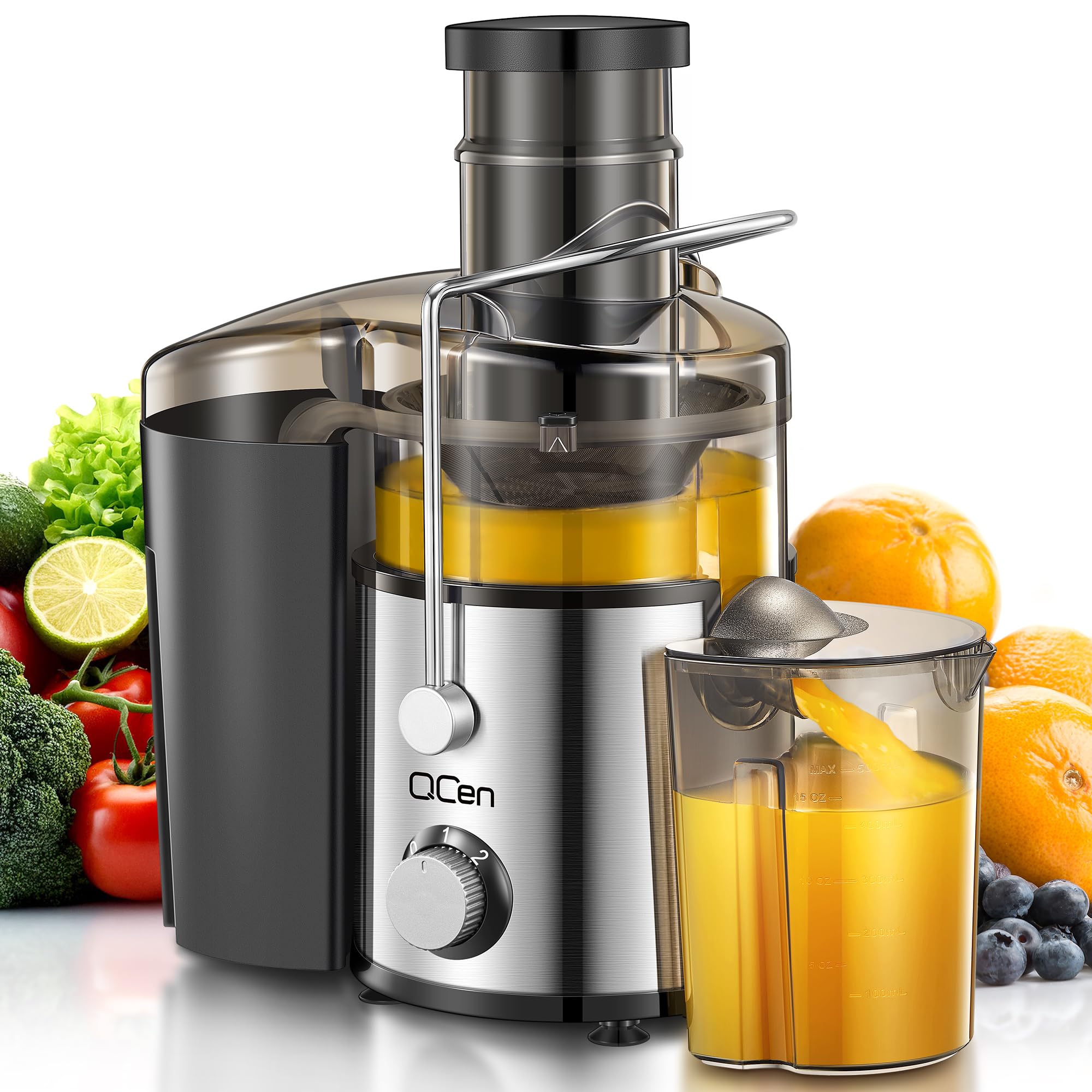
The 800W step up from QCen’s 500W — same compact body, more motor behind it.
Where QCen’s 500W model tops out, this 800-watt version keeps the same 12,000 to 18,000 RPM two-speed design with a wide-mouth chute and stainless steel parts. The locking arm keeps the machine off unless the cover is sealed, and the overload protection shuts it down if it overheats. Polished silver finish and BPA-free construction round out the package.
Owners praise the performance and the design — one describes how slowly feeding produce boost yield compared with ramming it through fast. It assembles and disassembles easily for cleaning, and a small cleaning tool reaches the tight spots a sponge can’t. It’s a good option for someone who wants QCen’s wide-mouth convenience without the 500W model’s tendency to bog down on fibrous produce.
The honest tension is reliability — a few shoppers say units that quit after the first or second use, while others find a unit that works great. Shipping heavy produce through too fast can jam it, so feed slowly. Like the rest of QCen’s lineup, this is a centrifugal juicer, not a masticating one, so juice yield will differ from a slow cold-press machine — it’s worth owning both if you’re serious. For the wide-mouth convenience and 800W spec, it’s a sensible middle-ground pick.
Where it fits: Between the 500W QCen above and the full-size machines, this 800W version offers more motor without jumping to a premium price tier.
The honest read: Reliability reports vary, so this is a machine to feed slowly and respect — not a set-and-forget batch juicer.
Fits best for: Everyday casual juicing where a wide-mouth chute and easy cleaning top the priority list.
Skip if: You need a machine that runs hard for long stretches — feed slowly or look at higher-wattage options.
6. nutribullet Juicer, 800W Juicer, Large 3″ Feed Chute
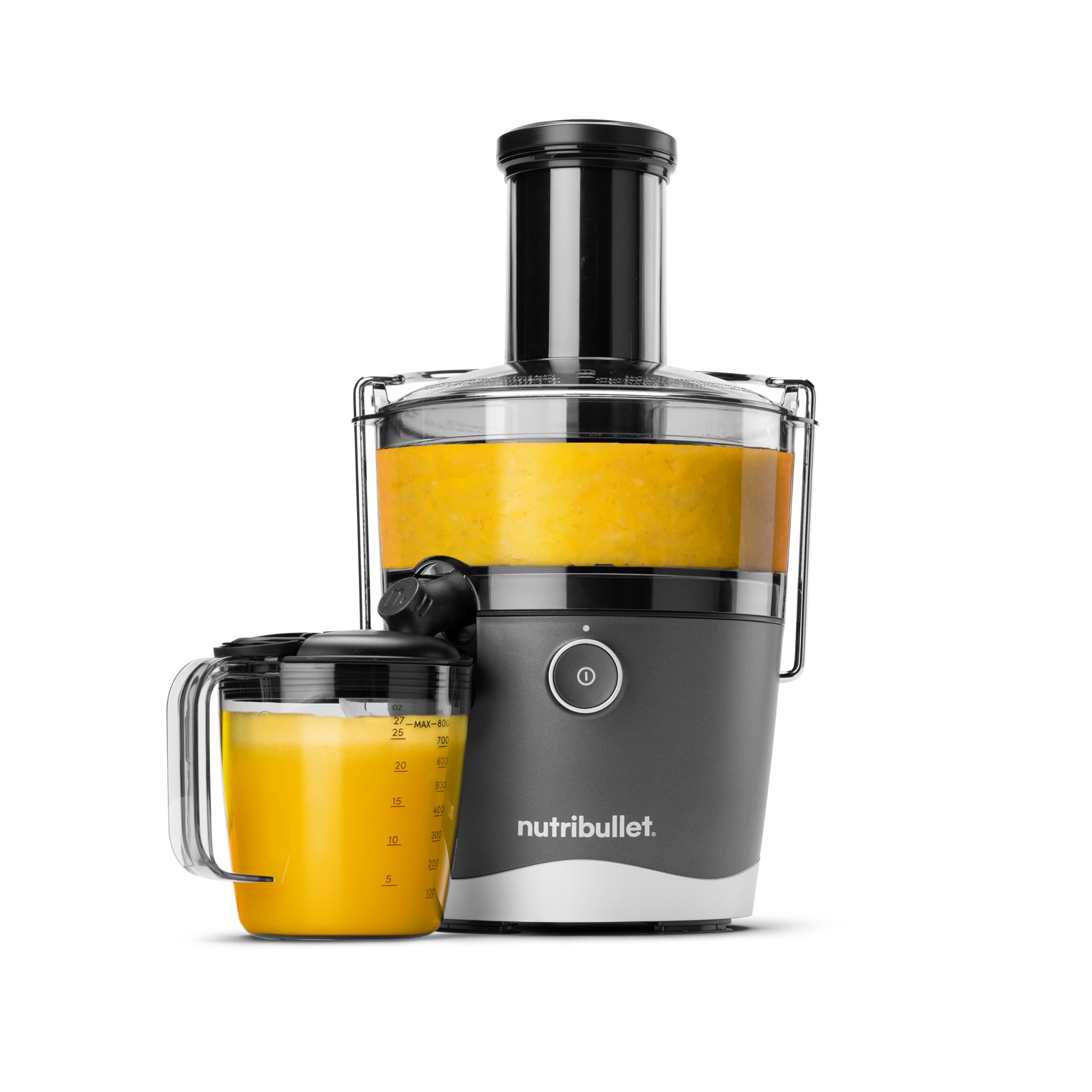
The 800W juicer built around cleanup — five dishwasher-safe parts and an included brush.
NutriBullet built this one around the parts-washing problem, so you spend less time scrubbing and more time drinking. An 800-watt motor base, a 1.5 L pulp basin (the bin that catches the leftover fiber) with a 3-inch wide feed chute, a stainless steel sieve, a 27 oz sealing juice pitcher with a froth separator lid, a food pusher, and a cleaning brush all come in the box. The pitcher seals and stores fresh juice for up to 48 hours for make-ahead grab-and-go. Dual speeds let you dial the machine for soft fruits or hard vegetables, and the no-drip spout keeps the counter clean.
What owners rave about is how easy it is to break down and clean — the sieve, pulp basin, and juice pitcher are all dishwasher-safe, and the included brush reaches into the sieve without fuss. The 3-inch chute makes prep work a breeze according to buyers, and the fast, smooth juice extraction with a generous pulp container keep sessions short. It doesn’t sit as tall as the Breville (16.02″ H vs 16.42″ H) and weighs a bit less — 7.1 pounds vs 10.1 pounds — so it feels less like a permanent counter fixture.
The trade-offs are worth taking seriously: it’s large and tall enough that owners note it won’t fit under a cabinet, and a few report it falling apart or breaking within a month. Some owners also say the pulp gets messy inside the bowl and takes a while to clean despite the easy disassembly, and one report describes the food pusher trapping water and needing careful drying. Extraction draws mixed reactions — some owners get plenty of juice, some less. Compared with the KOIOS 1300W later in this list, the NutriBullet offers a smaller motor but a comparable 3-inch chute and a bigger emphasis on the pitcher storage and cleanup side.
Best-under-the-cabinet question: Measure your clearance first — at 16.02 inches tall, buyers report it doesn’t slide into typical cabinet gaps.
The cleanup payoff: Dishwasher-safe sieve, pulp basin, and pitcher plus the included brush shorten the after-juice chore to a quick rinse.
Ideal for: Anyone who has abandoned juicing before because cleanup killed the habit.
Not the one if: You’re short on vertical counter clearance or want a more compact appliance.
7. KOIOS 1300W Centrifugal Juicer Machine with 3″ Wide Chute

The 1300W family-batch machine with a 35-ounce juice cup and a 100-ounce pulp bin.
You can juice for the whole family in one run without stopping to empty the bin. The 1300-watt all-copper motor spins up to 18,000 RPM (revolutions per minute, how fast the basket turns) and drives a titanium alloy-coated 304 stainless steel filter with precise pores to separate juice from foam. A 3-inch wide feed inlet skips the prep step entirely for whole apples, oranges, and cucumbers. Three intelligent speeds — soft, hard, and pulse — let you match the setting to the produce, and the numbers get serious here: a 35-ounce juice cup with a drip-proof spout pairs with a 100-ounce pulp container, so you can make enough juice for the whole family in one run without emptying the bin mid-session.
The cleaning is the other headline — every BPA-free part disassembles for a quick scrub, and the mesh filter takes a brush pass without any finger gymnastics. Safety features include a safety lock that keeps the machine off unless sealed, a non-slip base, and overheat protection. Owners describe pulp coming out bone-dry after juicing, and the machine pulverizes carrots, ginger, celery, and beets easily.
Two honest notes. The titanium filter dislikes hard pits — one owner reported the machine smoked and the plastic housing damaged after peach pits went in, then had the part replaced directly by KOIOS customer service. And the pulp hardens like spackle if left to sit, so clean immediately. Compared with the Oster 900W later in the list, this KOIOS carries a bigger 1300W motor and a wider spread of speed settings — three versus two — which matters if you switch produce often. For anyone juicing for a family that drinks a pitcher at a time, the 35-ounce cup and 100-ounce pulp bin are the reasons to step up.
Why families gravitate toward this model
- 1300W all-copper motor with torque to crush carrots and beets
- 35-ounce juice cup and 100-ounce pulp container for family-size batches
- Three speed settings — soft, hard, and pulse
- Full disassembly with a brush for quick cleaning on every BPA-free part
- Safety lock, non-slip base, and overheat protection
Downsides worth weighing
- Hard pits can damage the plastic housing — heed the manual
- Pulp hardens quickly; needs immediate cleaning after every use
- Some owners note pulp residue sneaking into the juice
- Heavier and larger than compact single-serving machines
Built to handle: Full-pitcher family batches, fibrous vegetables, and anyone who wants to skip pre-cutting entirely.
Watch out for: Stone fruit and hard pits, which the manual explicitly warns against — pit them first or risk the housing.
8. Oster FPSTJE9010-000 JusSimple 2 Speed Easy Juice Extractor
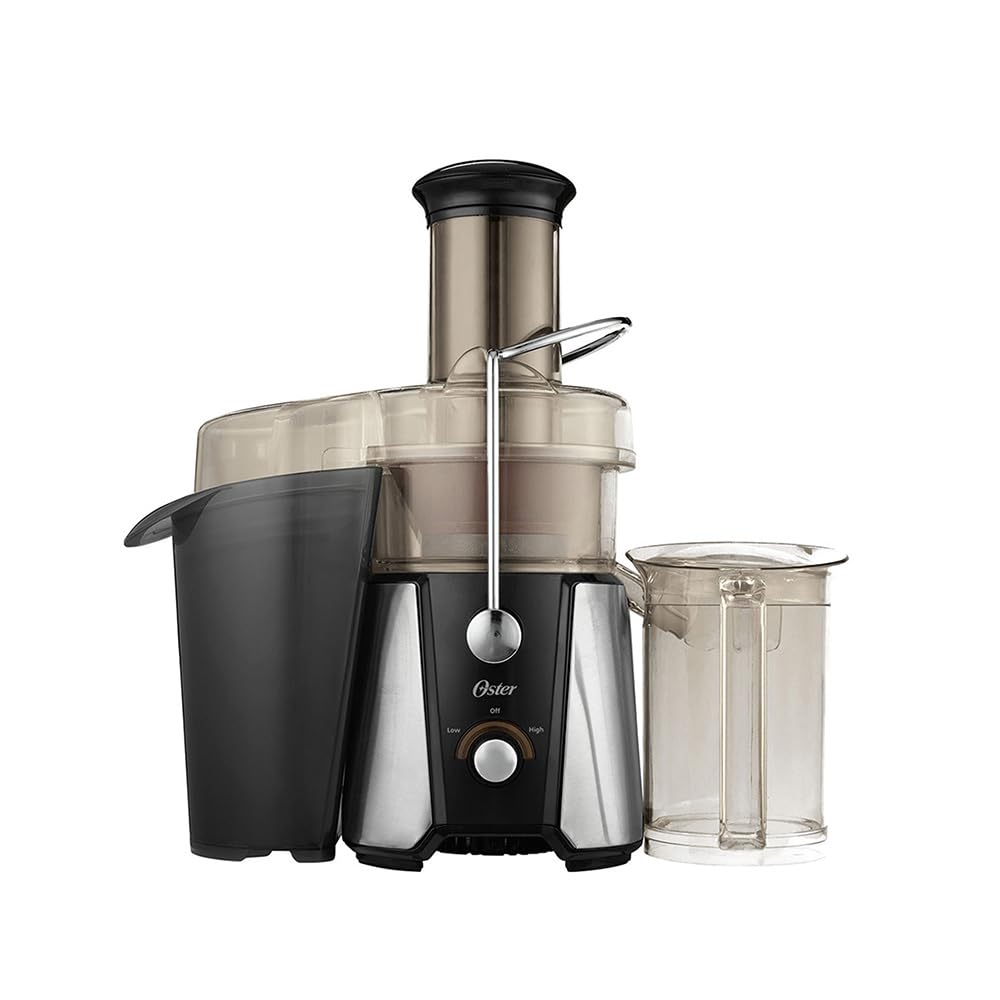
The 900W large-capacity machine with an extra-wide chute and an extra-large pulp collector.
Oster’s 900-watt JusSimple brings an extra-wide feed chute, an extra-large capacity pulp collector, and a Rinse ‘n Ready filter designed to be easy to clean. Two speed settings cover soft and hard produce, and the 32 fl oz pitcher is one of the bigger ones in this roundup. It handles green juices and all kinds of vegetables well, and owners describe it as dependable for larger juicing sessions.
The standout feature is real power for the footprint — the 900-watt motor pushes through coarse ginger, beets, and red cabbage when they’re cut small, and owners mention it beats the NutriBullet on stubborn items. The catch is size and cleanup: the machine is very large for a counter and takes significant space, and there are many parts to wash. Some owners mention a dangerously sharp blade dish to handle carefully. Extraction can be inconsistent — one reviewer describes pulp staying in the compartment and juice needing an extra strain — while others say it works well with very little pulp left behind.
At 9 pounds and 8″D x 18.25″W x 16″H, this is not a compact machine — it’s designed for kitchens with real counter estate. Owners do note it’s quieter than some competitors, which is a nice surprise for a 900-watt unit. If you value a big pulp bin and don’t mind an involved cleaning routine, it delivers. If you want minimal cleanup in a tighter footprint, the NutriBullet above is the better fit.
Standout strength: Extra-wide chute plus extra-large pulp collector and a 900-watt motor that handles tough root vegetables without complaint.
Real-world caution: It’s a large machine with a lot of parts to wash, and owners describe the blade dish as dangerously sharp — handle carefully.
Right for: Big, occasional juicing sessions where output matters more than counter space or quick cleanup.
Wrong for: Small kitchens, tight cabinet storage, or anyone who wants a low-maintenance cleanup routine.
Understanding the Specs
Motor Wattage And Run Time
Wattage tells you how much force the motor can put behind the spinning disc. Higher wattage — like the 1300W KOIOS or the 1200W GDOR — pushes harder through fibrous celery, beets, and kale without bogging down. Every centrifugal juicer, no matter the wattage, has a duty cycle: run it past the machine’s stated maximum continuous time and overload protection shuts it down until the motor cools. Respect the manual’s run limit and you’ll get years of service.
Chute Width And Prep Time
The feed chute is the opening where produce drops in. A 2.4-inch chute like the Hamilton Beach fits bigger pieces with less cutting. A 3-inch or wider chute — like the Breville, KOIOS, and the 3.2-inch GDOR — takes whole apples and oranges, which can cut minutes off every juicing session. If you juice daily, the extra chute width is the single spec most likely to keep you using the machine.
Pulp Dryness As An Extraction Signal
After a juicing run, squeeze the pulp. Dry, crumbly pulp means the machine pulled nearly all the juice out of the produce, and you got what you paid for. Wet, mushy pulp means the machine left juice behind in the bin. Two variables drive pulp dryness more than anything else: motor torque (higher tends to yield drier pulp) and feed speed (slower tends to yield drier pulp).
Dishwasher-Safe Parts And Cleaning Brush
The disassembly routine is what keeps juicing sustainable. A machine with detachable, dishwasher-safe parts saves you minutes of hand scrubbing after every session. A small included brush is worth its weight for the mesh filter, which traps fine fiber unless you scrub it. If a juicer doesn’t include a brush, budget for one.
FAQ
What is a centrifugal juicer and how does it differ from a masticating juicer?
How long can I run a centrifugal juicer continuously?
What size feed chute do I need to juice apples whole?
Do centrifugal juicers need to be cleaned immediately after juicing?
Can I juice beets and leafy greens in a centrifugal juicer?
Is higher wattage always better in a centrifugal juicer?
Why does my centrifugal juicer leak at the seam?
Are centrifugal juicers loud?
How many parts does a centrifugal juicer have to be cleaned?
Should I buy a whole-fruit juicer if I juice daily?
Final Thoughts: The Verdict
For most kitchens, the centrifugal juicer winner is the Breville JE98XL Juice Fountain Plus because its 850-watt motor, titanium-reinforced disc, 3-inch wide chute, and froth-separating jug form the most proven, dependable combination in this lineup. If you want the widest chute and the highest wattage without a premium price, the GDOR 1200W pairs a 3.2-inch opening with a full copper motor. And for family-size batches that fill a whole pitcher in one run, the KOIOS 1300W brings a 35-ounce cup and a 100-ounce pulp bin to the party. Whatever you pick, respect the duty cycle, clean immediately after every session, and let the pulp dryness tell you honestly whether your machine is pulling its weight.
How We Picked
We do not accept paid placement. Every pick is matched to a real buyer and a real use-case; we do not hands-on test units.
Sources & Methodology
Specifications: manufacturer listings and product documentation. Review insights: verified customer reviews, as of September 2026. Pricing: not shown on this page (it changes often); check the current price via the retailer link.
As an Amazon Associate, Gadgets Feed earns from qualifying purchases. This does not affect which products we feature.