
Our readers keep the lights on and my morning glass full of iced black tea. As an Amazon Associate, I earn from qualifying purchases.
Specs are compiled from manufacturer listings and verified buyer reviews and can change over time — please confirm the key details on the product page before buying.
If your lawn drinks water and goes brown anyway, compaction is usually the reason — and the right tool fixes it far faster than another round of fertilizer. The hard part is that “aerator” covers three completely different machines: a rolling spike roller you push, a hollow-tine corer you punch into the ground, and a tow-behind unit that pulls real plugs behind a tractor. Choosing the wrong type for your soil and your lawn size wastes a whole weekend and a lot of sweat.
I’m Min — the founder and writer behind Gadgets Feed. This guide is built by comparing the manufacturers’ published specifications and the patterns across verified customer reviews, so you get each pick’s real strengths and trade-offs instead of marketing spin.
What follows is a plain-English look at the differences that actually decide whether a machine works on your soil, so you can settle on the best lawn aerator for your yard the first time.
Our Picks at a Glance


How To Choose The Best Lawn Aerator
The biggest mistake first-time buyers make is grabbing a push aerator because it costs the least, then discovering it can’t break through their compacted clay. Type comes first, then size, then the small details.
Core it or spike it
Hollow coring tines are tubes that cut a small plug of soil out and drop it on top of the lawn, so air and water have an open channel to follow. Spike tines are solid points that push soil aside instead of removing it — faster and gentler on the turf, but they can close back up in soft ground. Neither is “better”; they solve two different compaction problems.
Match the machine to your acreage
A tow-behind unit with a 40-inch working width chews through a large lawn in a few passes while you sit on the tractor. A rolling or push spike aerator suits a small to mid-size yard where you can walk every row without your lower back objecting. On tight corners and steep unlevel ground, the hand tool still wins.
The one rule that beats every spec
Every manual on this list says the same thing: water the lawn thoroughly first, then aerate. Moist soil lets tines reach their full depth; dry, hard-packed ground stops them short no matter how many tines or how much ballast you’re running.
Quick Comparison
| Model | Best For | Aerator Type | Tines | Added Weight Capacity | Amazon |
|---|---|---|---|---|---|
| Brinly Tow Behind Plug Aerator with Universal Hitch, 40″★ Best Overall | Big lawns, real soil plugs | Tow-behind plug (core) | 24 plugging spoons | Up to 150 lb | Amazon |
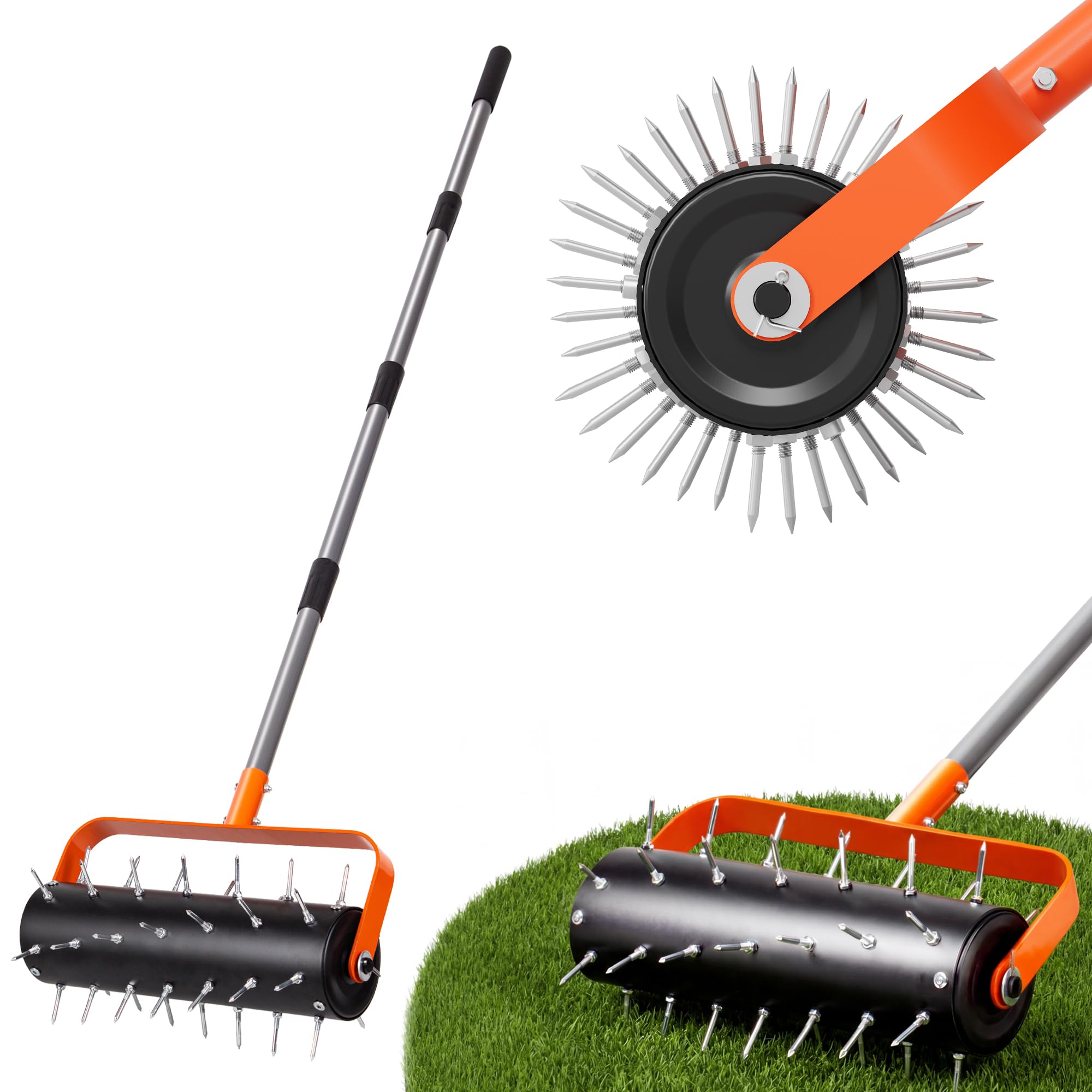
| Walensee Rolling Lawn Aerator, 42 SpikesBest Value | Lightweight push rolling on small yards | Manual rolling spike | 42 spikes | Fill roller with stones | Amazon |
| Suchtale 18-Inch Push Spike AeratorBudget Pick | Budget push spike on average lawns | Manual push spike | 5 star tines, 10 tips each | Weight tray for 16-inch bricks | Amazon |
| Landzie 42″ Hollow Tine Core Aerator | Tough compacted patches, small areas | Manual hollow-tine core | 3 stainless steel tines | — | Amazon |
| Seeutek 18 Inch Lawn Aerator, 3D Steel Tines | Adjustable-height push spike | Manual push spike | Five 8-inch 3D star tines, 10 tips each | Up to 220 lb | Amazon |
| Suchtale 40-Inch Tow Behind Spike Aerator | Mid-size lawns behind a rider | Tow-behind spike | 10 eight-inch star tines, 10 tips each | Up to 110 lb | Amazon |
| Brinly SAT2-40BH-P Tow Behind Spike Aerator, 40″ | Frequent tow passes, transport wheels | Tow-behind spike | 11 star tines, 12 tips each | Up to 150 lb | Amazon |
| Patented Rolling Lawn Aerator Manual Coring Tool | Owning your own coring machine | Manual rolling core | Rotary coring tines | Sand-filled wheels | Amazon |
| Craftsman 40 Inch Tow Behind Lawn Plug Aerator | Heavy tow-behind plug pulling | Tow-behind plug (core) | 24 galvanized coring points | Up to 140 lb | Amazon |
In‑Depth Reviews
1. Brinly Tow Behind Plug Aerator with Universal Hitch, 40″ – Flat Black
Our pick — over 4★ from 950+ verified ratings; the strongest balance of quality and price.
If you want actual plugs lifted out of the ground while you ride, this is the one.
Hollow plugging spoons remove soil instead of just poking it, and that is the whole reason this machine sits at the top. The Brinly packs 24 heat-treated, 16-gauge steel spoons that cut up to 3-inch plugs out of compacted ground, so water, seed, and fertilizer have an open path straight down to the roots. The plug design is narrower with sharpened ends, which lets it bite in with less weight than a blunt spike needs.
It also carries the most ballast of anything here: a fully enclosed tray that swallows up to 150 pounds of whatever you have lying around. The 40-inch width and 63.9-pound working weight mean a fair number of passes on a big lot, and there’s a single transport lever plus 10-inch semi-pneumatic rubber tread tires when you need to cross the driveway. Buyers report pulling 3-inch plugs after a rain and covering roughly two-thirds of an acre twice over, and owners mention: “”
The universal hitch is a single pin, so it fits every lawn tractor and most zero-turn mowers and ATVs without extra gear. Thing is, this is a real assembly project — the highest-volume complaint in the reviews is the paperwork, not the machine. Plan on a couple of hours, expect mislabeled bolts and vague tool lists, and bring a second set of hands. It’s the machine that rewards patience; the steel under it is heavy-duty US construction with welded tine sections that rotate independently to protect turf on turns.
Where this machine earns its keep
- 24 heat-treated, 16-gauge steel spoons pull genuine plugs up to 3 inches deep.
- Fully enclosed weight tray takes up to 150 pounds for deeper bite on hard clay.
- Single-pin universal hitch fits every lawn tractor and most ZTRs and ATVs.
- 10-inch semi-pneumatic tread tires and a transport lever make driveway crossings simple.
What nobody mentions until it’s in the driveway
- Budget the whole afternoon for assembly; hardware arrives mislabeled and instructions assume a second unit.
- Sharp spoons need gloves and care during any tine-plate work.
- Tines clog in bone-dry or waterlogged ground — treat this as a workable-soil tool.
Buy this if: you’ve got a tractor, a real lawn, and you want plugs coming up, not disappearing.
Keep looking if: you want something you can unbox and use in ten minutes, or you’re working a quarter acre by hand.
2. Walensee Rolling Lawn Aerator, Heavy Duty Manual Aerator with 42 Spikes
Four times the spike count of its push rivals, and light enough to hang on a garage hook.
The Walensee swings 42 heat-treated, 2-inch tine spikes where the Suchtale 18-inch push model runs 10, and that wider bite is why it rolls a lawn in noticeably fewer passes. At 11.82 pounds it is one of the lightest tools in this roundup, and the tines sit in a spiral arrangement so the roller turns in a smooth, even circle instead of juddering across the turf.
Here’s how you get the depth: that hollow roller holds stones, and the added weight drives the spikes further in. What wins people over is how simply it does the job — reviewers rate its core functionality and the build quality of the all-steel body highest, and the four-part handle adjusts to whichever height keeps you from hunching. Customers note: “”
The trade-off is honest: spike tines make holes by pushing soil aside, so a hard-packed high-traffic strip will resist deeper than loose ground. There’s also a known gap in the roller’s end caps that lets filler escape — a dab of silicone caulk closes it. Walensee’s own instructions are firm about stones only, never sand, and watering the lawn first.
Where it shines: 42 spikes versus the Suchtale push model’s 10 — a wider bite on the same pass, and the spiral layout rolls without the hop you get from straight-tine rollers.
Know before buying: the roller caps leak some filler, and the four-section handle feels light rather than premium. Both are fixable, and the steel underneath is what matters.
Reach for this if: you want a walk-behind that covers ground fast, takes up almost no shed space, and adapts to your reach.
Otherwise pick: a plug-pulling tool if you’re fighting dense clay or a lawn that dries out hard.
3. Suchtale 18-Inch Push Spike Aerator
A budget-entry push spike that asks for muscle before it asks for your wallet.
You get five steel tine wheels, each 8 inches across and carrying 10 uneven spike tips. Roll it across the lawn and it pushes spikes into the soil at a claimed 2 inches deep once you load the tray with a 16-inch brick or a cinder block. The handle folds down for storage, and the plastic rollers help you move it over rough ground. The whole thing goes together with the supplied picture instructions. So far, so simple.
The honest catch is the pushing. This is a workout tool as much as an aerator — reviewers consistently describe needing real bodyweight behind it, and a 6-foot owner can feel the short handle across the lower back after a lap. The five star wheels can also shear through grass instead of cutting clean holes if you rush them. If you’re broad-shouldered and working a modest lawn in prepared soil, it does the job for about the price of a tank of gas versus a tow-behind.
Grass it’s designed for: average, well-kept lawns rather than hard-pack or compacted clay. On bare dirt or freshly seeded ground it’s actually a tidy prep tool — you’re loosening surface for seed without adding mid-range spend.
The value case: five star-tine wheels, a fold-flat frame, and a weight tray that humbles machines costing three times as much. It’s a great entry point into manual aeration.
Ideal for: a healthy lawn, a strong back, and a small budget for the first aeration tool in the shed.
Step away if: your soil bakes hard in summer or your back already complains after an hour of pushing.
4. Landzie – Lawn Aerator Tool 42″, Hollow Tine Core Aerator
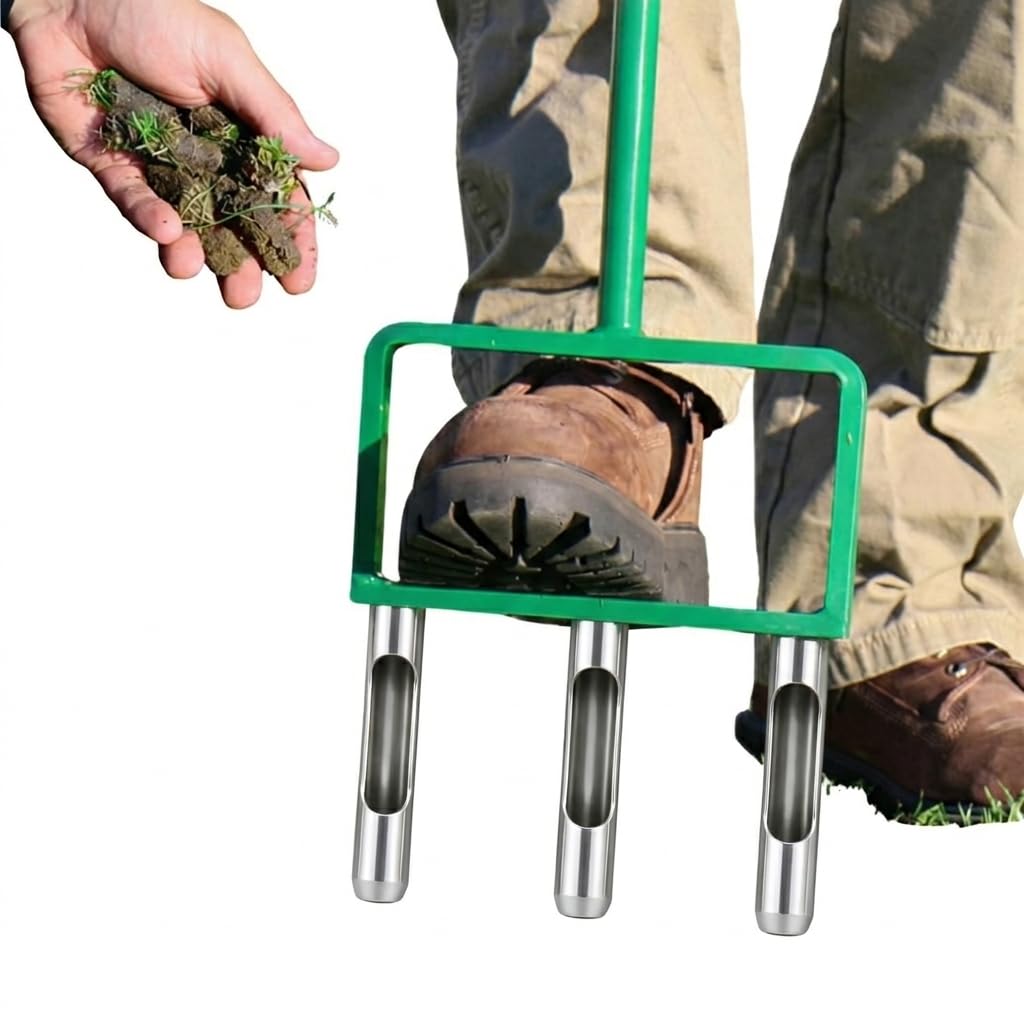
Three beveled stainless tubes that push a plug straight up and out — no unclogging, no waiting on parts.
This is the tool you reach for when compaction is concentrated in a few stubborn patches. Three solid stainless steel hollow tines cut down and pop old soil up in a steady rhythm, so air and water get a real channel rather than a punctured one. The beveled mouth is the standout detail — the tines are designed to clear themselves as you press and release, so you spend your effort aerating instead of prodding out plugs with a screwdriver.
It arrives assembled. The powder-coated frame is built to take a stomping, and the tines unscrew for cleaning or replacement. It weighs 5.6 pounds, which is why the whole thing depends on how you use it — work on recently watered ground and press straight down with your bodyweight, and the coring is quick and clean. Dry caliche will stop it dead.
Plan for small sections rather than the whole yard in one sitting. This is the machine for someone with a compact lawn, a handful of hard spots, or a garden bed that needs opening up — not a half-acre rescue mission.
What buyers love about the Landzie
- Beveled hollow tines self-eject plugs, so there’s almost no unclogging mid-job.
- Arrives fully assembled — no bolt bag, no picture-based instructions.
- Durable powder-coated frame meant to take repeated stomps.
- Tines unscrew for easy cleaning or replacement.
Its honest limitation
- This is a small-area tool — a full lawn takes hours and full-body effort.
- Needs soft, recently watered ground; dry compacted clay resists it.
- The pogo-style stomp saves your back but asks for good balance.
Best suited to: the homeowner with a patch here and there, or a bed to open up, who wants a tool that works the moment it arrives.
Look elsewhere if: you’re aerating anything past about a quarter acre in one go — your legs will file a complaint.
5. Seeutek 18 Inch Lawn Aerator, Upgraded Heavy Duty Manual Aerators Lawn Tool w/ 3D Steel Tines, 4 Wheels & Non-Slip Handle
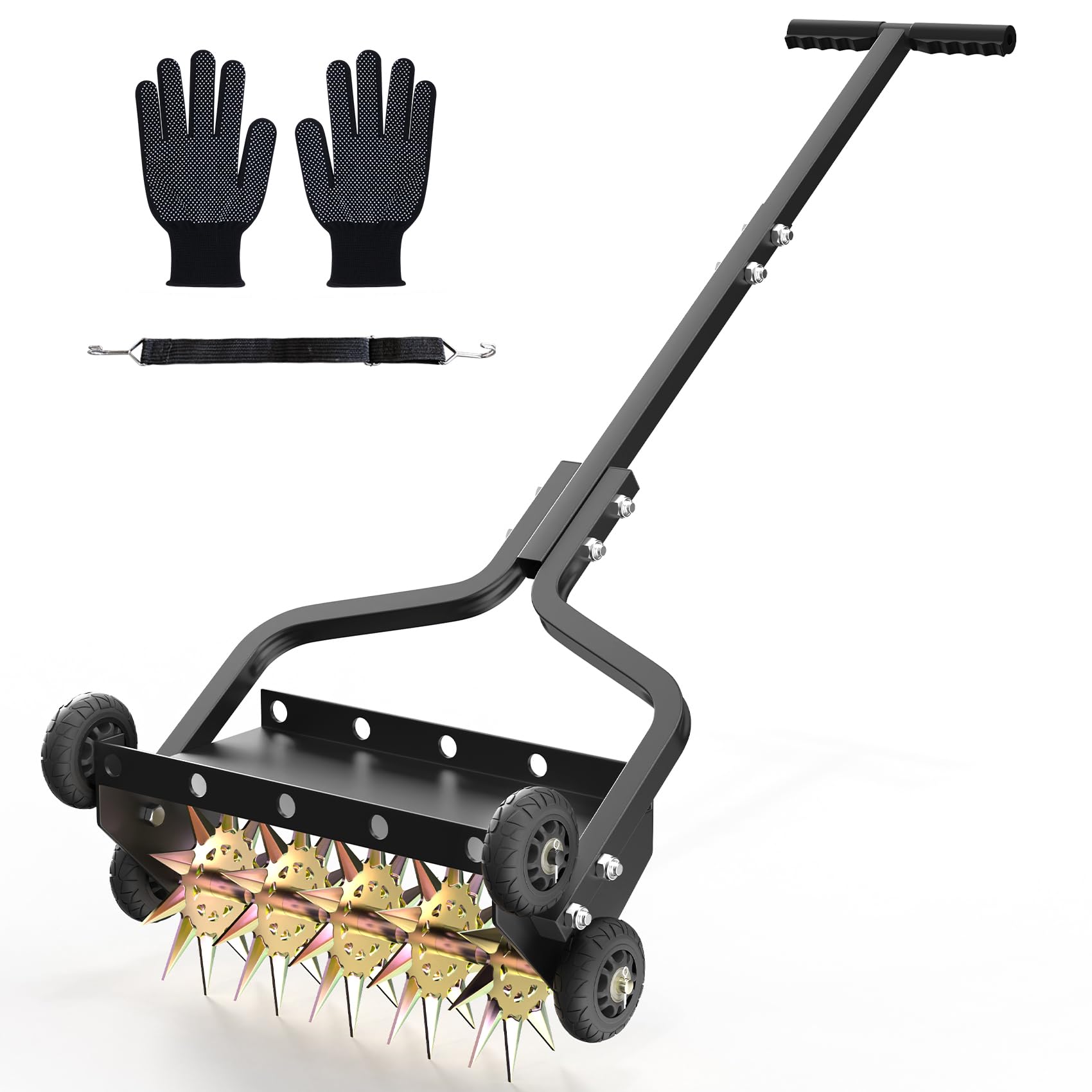
The push spike with the biggest weight tray here — load it up and let gravity do the digging.
Where most push aerators top out around a couple of cinder blocks, the Seeutek’s tray takes up to 220 pounds. That’s a genuine difference on stubborn ground, because added weight is what drives star tines past the surface. It carries five 8-inch 3D star-shaped tines, each with 10 sharp irregular tips, made from thickened galvanized steel and rated to penetrate up to 2 inches. Each star rotates independently, so you miss fewer spots when you turn.
The T-handle adjusts three different ways to keep your back out of the mix, and the four rubber wheels give it a stable, manageable roll compared to a two-wheel frame. Setup is deliberately light — handle and two wheels, with a strap to lock blocks onto the tray and a pair of protective gloves in the box.
The honest trade-off: adding weight (ballast) is a double-edged tool. Several owners find that loading too much makes it a chore, and that around 30 pounds of weight is the practical working balance on a wet lawn. It also needs a properly mowed surface, not tall grass. The 22-pound frame is heavier than the Walensee roller above, which cuts both ways on maneuverability.
Why buyers pick this one: five star-tine wheels plus a 220-pound tray gives you more bite-per-dollar than any other push spike here, and the adjustable height saves your shoulders.
One honest note: the included wheel shims can be short, so a couple of extra washers help tighten things up, and the instruction sheet is small print.
Good fit for: a lawn you mow on a schedule, hard soil that resists lightweight spikes, and an owner who doesn’t mind spending time on setup.
Less ideal for: anyone allergic to weight on the handle or working tall, unmowed grass.
6. Suchtale 40-Inch Tow Behind Spike Aerator with Galvanized Steel Tines

Spike-tine tow-behind built for someone who wants a rider to do the walking.
The pitch here is simple: hook it to a riding mower and let 10 steel star tines, each 8 inches across with 10 uneven spike tips, cut into the soil as long as the wheels turn. The 40-inch working width covers ground efficiently, and the tray accepts up to 110 pounds of added weight so those spikes sink properly into firmer lawns. The pin-style hitch clicks onto an ATV or rider without extra gear, and the extra-wide tow bar and 6 mm adjust handle are built to resist bending.
Reviewers point out how easily it tows behind a riding mower on a small-to-mid lawn, with the galvanized tines running clean through the day’s work. Assembly is the friction point — much like the bigger Brinly above, reviewers split roughly evenly between “followed the manual, no drama” and “wrestled it together.” Budget an hour.
Where it differs from a plug-pulling tow-behind: spike tines leave small holes rather than removing cores, which makes it gentler on already-thin grass and faster on a feeding schedule. On hard-packed ground it needs the tray loaded.
Worth knowing: the tray is the feature that carries this machine — loaded properly, this mid-range tow-behind rivals the more expensive units on a healthy lawn.
Suits: a homeowner with a riding mower who wants a spike-style tow-behind that keeps up with regular feeding and overseeding.
Skip if: you’re on very hard, bare clay where you actually need cores pulled, not just perforations.
7. Brinly SAT2-40BH-P Tow Behind Spike Aerator with Transport Wheels, 40″

More tine stars than the Suchtale tow-behind and a lever that lifts the whole rig off the turf.
Where the Suchtale 40-inch tow unit carries 10 star tines, the Brinly SAT2 swings 11 — each 8 inches across with 12 spike tips — so it covers slightly more ground per pass and works soil up to 2 inches deep with a tray that accepts up to 150 pounds. The tines are the talking point: Brinly’s patent-pending 3-D tines in galvanized steel are shaped to resist bending, so a clay lawn doesn’t roll them over.
what separates it from a bare spike roller is the transport mode. A single lever engages turf-tread wheels so you roll across concrete driveways and sidewalks without dragging the tines — a small thing until you’ve scarred a walkway once. The frame is all steel with a double tow bar, a 5/8-inch solid steel axle, and nylon spacers between each star.
The honest friction: several shoppers say the transport wheels failing under hard use, and gear owners roundly flag the assembly instructions as confusing with bolts that overrun their holes. A 3-D-printed or improvised bearing spacer trick has been popular among owners who worked through the wobble. The good news is that value and sturdiness are the two things buyers rate highest, so once you’re set up, this machine earns its keep for years.
Why owners keep it for years
- 11 tine stars with 12 tips each beat the Suchtale tow-behind’s 10-star setup on coverage.
- Transport wheels let you cross hard surfaces without dragging the tines.
- Patent-pending 3-D tines in galvanized steel resist bending in compacted soil.
- 150-pound tray plus 5/8-inch solid steel axle for durable depth on hard ground.
Friction worth counting
- Transport wheels are the recurring failure point under frequent use.
- Assembly directions can frustrate; some owners add a spacer to stop tine wobble.
- Sharp tines demand gloves during any handling.
Best for: a seasoned tow-behind user who values coverage and transport-cycle convenience over worrying about an occasional part swap.
Think twice if: you want out-of-the-box simplicity or you’re going to leave the rig hooked to the tractor year-round and never use the raised mode.
8. Patented Rolling Lawn Aerator Manual Coring Tool Compacted Soil Loosening
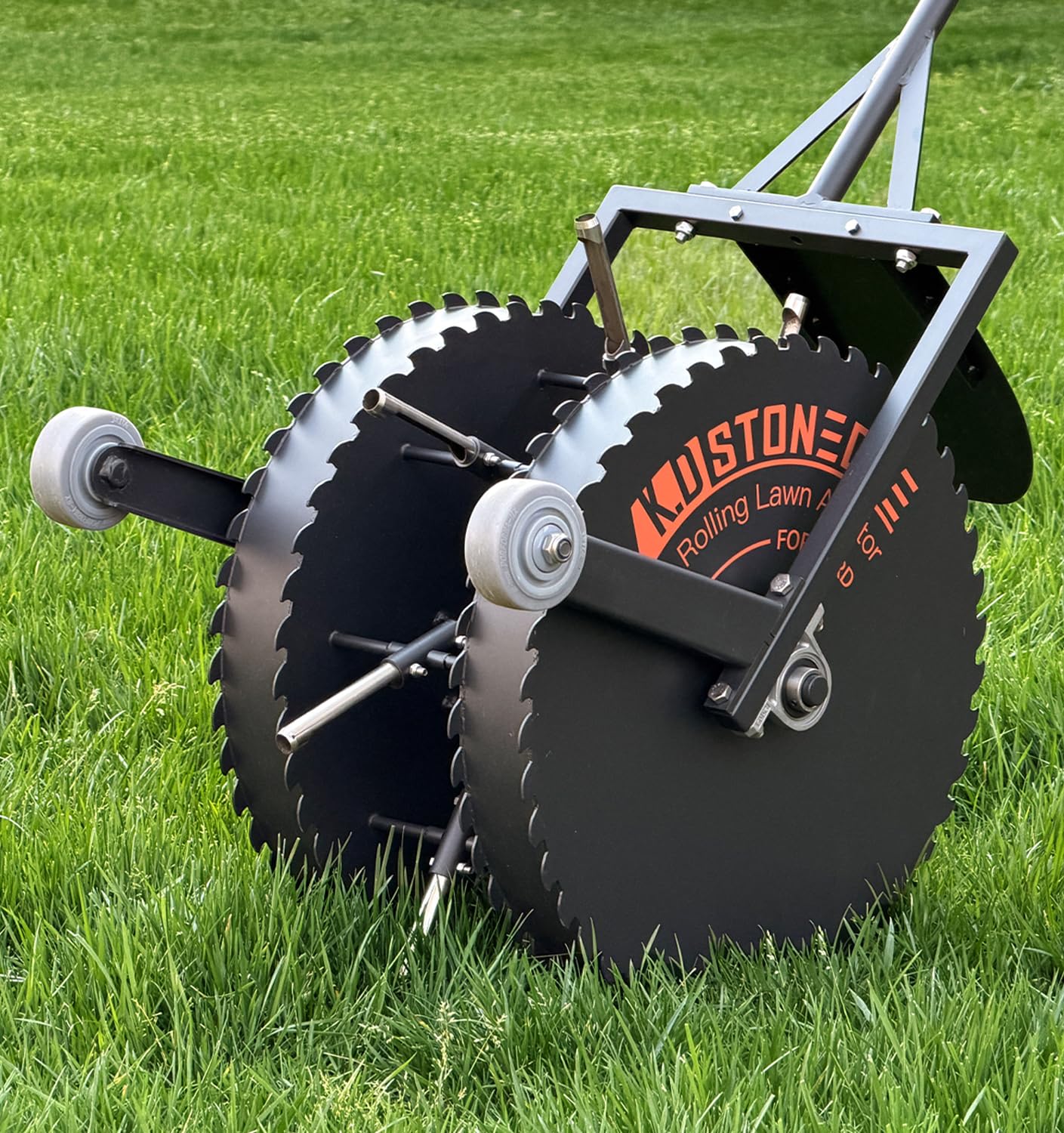
A push-along rolling corer that pulls real plugs without a tractor or a rental truck.
The unique angle on this one is the sand-filled wheel design. Instead of hauling cinder blocks to a tray, you pour sand into the wheels themselves, which raises the machine’s own ballast — and lets the whole thing ship in a box you can lift. From there it uses a patented rotary coring design: the tines rotate as they cut, extracting soil plugs on the move rather than stomping them out one press at a time like the Landzie above.
Buyers consistently call out the value: owning it beats booking a rental each season. Owning this beats booking a rental each season, and it’s a repeated line across the reviews that a homeowner can crawl a few rows at a time in spring and fall instead of paying a service. On wet ground the coring is deep and clean, with plugs popping from the tines without need for a clearing tool. On drought-hard ground it still punches through where lighter spike tools give up.
Two things to know before you commit. The sand-filling is fiddly — a funnel and a 45-degree angle make short work of it, but you’ll spend a good few minutes at it. And it’s a workouts-first tool: reviewers describe it as a full-body push, closer to dragging a sled than steering a mower. It needs a big push but rewards it with coring you’d otherwise rent.
What earns this a spot
- Rotary corer pulls real plugs — the same category of result as a tow-behind, at a walk-behind’s cost.
- Sand-filled wheels mean no trips back and forth to the cinder block pile.
- Buyers report the rotary tines holding up over thousands of square feet on clay.
- Modular design means a DIY owner can tighten or replace a part without a service call.
Where owners hit friction
- Sand-filling the wheels is slow without a funnel.
- Pushing it is a genuine workout — not a job for a casual afternoon.
- Cores can crumble into small pieces when the tines spring back, so you won’t always see perfectly round plugs.
The right call for: a homeowner on heavy clay who wants core-style aeration without a tractor or a rental appointment, and doesn’t mind sweat equity.
Not for: anyone who wants a leisurely pass over the lawn, or a bad back that dislikes extended pushing.
9. Craftsman 40 Inch Tow Behind Lawn Plug Aerator with 24 Galvanized Steel Coring Points and 140 lb Weight Tray

Same 24-point coring as the Brinly, with flat-free tires and a lift handle that stores flat.
It’s tempting to lump the two 40-inch plug aerators together, but the differences matter once it’s on the hitch. The Craftsman carries 24 galvanized steel coring points, exactly the spoon count of the top pick, pulling plugs up to 3 inches deep — but the working geometry and final weight are different. It tips the scale at 78.8 pounds and is built with a 140-pound weight tray rather than the Brinly’s 150-pound one. Flat-free tires mean no air pressure to check before you hook it up, and a lift handle release points the whole rig vertical for wall storage.
It carries a 3-year limited warranty and is built by Agri-Fab in Sullivan, Illinois. Performance and value for money are the two things buyers rate highest — it tows well, punches soil cleanly, and comes back year after year for spring and fall sessions.
The snag that surfaces is assembly: multiple owners clock in at one to three hours and one review flags a bolt description in the manual that doesn’t match the hardware you get. Budget time and read step plans carefully. Once built, it’s a heavy, quiet workhorse that earns the space it takes in the shed.
The pitch: a plug-pulling tow-behind with 24 points and a lift handle for storage, riding on flat-free tires that stay put season after season.
The catch: heavy enough that assembling it away from the shed means moving it twice.
Choose when: you want pull-behind coring without the transport-wheel complexity, and you’ll leave the machine on the hitch in a proper lawn tractor life.
Pass if: you’d rather not dedicate an afternoon to assembly, or your only parking spot is a concrete pad — a 78.8-pound machine is not built to move casually.
Understanding the Specs
Tine type: spike vs core
Spike tines are solid points, and they push soil aside to make a hole. Core tines are hollow tubes that cut out a plug and deposit it on the lawn, leaving an open channel for water and air. Spike units pass faster and leave less mess; core units open the soil deeper because they remove material instead of compacting it sideways. The straight trade-off: speed on the turn versus depth into the soil.
Penetration depth and how you get it
Depth is set by three things in combination: tine length and shape, how much ballast you’ve loaded, and how wet the ground is. Spike tines on the roller-style machines here are typically specified at 2-inch depth. Plug machines on this list cut up to 3 inches. Watering the lawn thoroughly first is the single biggest lever, since dry hard ground will stop any tine short of its rated depth.
Weight tray capacity
The tray is where you add concrete block, bricks, or sand to force the tines down. The spread on this list is wide — anywhere from a push aerator that takes a brick to a tow-behind built to swallow 150 pounds. Loading the tray moves a spike aerator from skimming to actually cutting. Just remember that manually pushed units get harder to move as the tray fills, so there’s a working ceiling.
Working width and lawn size
A 40-inch tow-behind covers ground much faster than an 18-inch push aerator — you’ll make far fewer passes across a large lawn. On a small or irregular yard, the tow-behind’s size is a liability and the hand tools win on corners and tight spots. Match the machine to the acreage before you match it to a budget.
FAQ
What’s the difference between a spike aerator and a plug aerator?
How deep should a lawn aerator actually penetrate?
Can I use a tow-behind aerator on a small lawn?
How much weight should I add to the aerator tray?
Do I need to water my lawn before aerating?
Is a manual coring tool like the Landzie or the rolling corer hard on your back?
How often should I aerate my lawn?
What kind of weight should I put in the tray or roller?
Will a tow-behind aerator work with my riding mower or ATV?
Does aerating remove thatch and help seed?
Final Thoughts: The Verdict
For the best mix of coverage, real plug removal, and long-term durability, the Brinly Tow Behind Plug Aerator is the pick I’d put first — 24 heat-treated spoons, a 150-pound tray, and a universal hitch that fits the tractor you already own. If you’re after a walk-behind for a smaller lawn at a friendlier price, the Walensee Rolling Aerator delivers 42 spikes and rolls easily on a small-to-mid yard. And for hard clay and scattered high-traffic patches, the Landzie Hollow Tine Core Aerator arrives fully assembled and pops clean plugs from the first step. Whichever you pick, water the lawn first — that one habit turns any of these from a workout into a win.
How We Picked
We do not accept paid placement. Every pick is matched to a real buyer and a real use-case; we do not hands-on test units.
Sources & Methodology
Specifications: manufacturer listings and product documentation. Review insights: verified customer reviews, as of September 2026. Pricing: not shown on this page (it changes often); check the current price via the retailer link.
As an Amazon Associate, Gadgets Feed earns from qualifying purchases. This does not affect which products we feature.