
Our readers keep the lights on and my morning glass full of iced black tea. As an Amazon Associate, I earn from qualifying purchases.
Specs are compiled from manufacturer listings and verified buyer reviews and can change over time — please confirm the key details on the product page before buying.
If your curves wander and your resaw cuts drift, the saw is usually the problem, not you. The right band saw machine gives you a stable table, blade guides that hold the blade on track, and enough motor to push hardwood without stalling. This guide breaks down eight real machines — from compact benchtop models for garage shops to full 14-inch saws built for resawing thick slabs — so you can match the saw to the work you actually do.
I’m Min — the founder and writer behind Gadgets Feed. This guide is built by comparing the manufacturers’ published specifications and the patterns across verified customer reviews, so you get each pick’s real strengths and trade-offs instead of marketing spin.
You want the best band saw machine for your bench, your budget, and the wood you cut. So each machine below is ranked by what it does best in a real shop. The picks run from a 1.75 HP resaw workhorse with a 13-inch capacity (it can slice boards up to 13 inches tall) to a 3-amp benchtop that tucks under a garage shelf. Every pick is judged on motor power, cutting depth, and how it holds a blade through real cuts.
Our Picks at a Glance

How To Choose The Best Band Saw Machine
Before you buy a band saw machine, answer one honest question: what is the tallest board you need to slice, and how hard is that wood? Everything else flows from that answer — the wheel size (the diameter of the wheels that spin the blade), the motor amps (how much electrical current the motor draws, which sets its cutting power), the table tilt, and the fence design (the guide you slide wood against for a straight cut).
Match the resaw capacity to your thickest stock
Resaw capacity is the maximum height of material the saw can cut in a single pass. A 3-1/8-inch capacity handles veneers, hobby boards, and scrollwork, while a 6-inch or 13-inch capacity lets you slice thick hardwood into bookmatched panels. If you plan to turn bowl blanks, split thick slabs, or resaw wide boards for furniture, you need real capacity here — not a decorative number.
Motor power and blade speed work as a team
A motor rated 1.75 HP (horsepower) drives hard hardwood at a steady rate, while 3-amp and 3.5-amp motors handle precise curves and softwood without complaint. Blade speed, measured in FPM (feet per minute), decides how clean the surface is: slower speeds track curves better, and 1500-2600 FPM sits in the sweet range for most home woodworking. If a saw offers two speeds, low speed cuts hardwoods and high speed glides through softwoods.
Blade guides are where accuracy lives
Ball-bearing guides and tool-less adjusters hold the blade on track through curves. Cheaper saws use Allen-screw guides that require re-truing after heavy cuts, while premium models offer spring-loaded tool-less guides top and bottom. If you cut a lot of curves or reblade often, tool-less is worth the upgrade.
Quick Comparison
| Model | Best For | Motor / Power | Cutting Depth | Blade Length | Amazon |
|---|---|---|---|---|---|
| JET 14″ Woodworking Band Saw★ Best Overall | Resawing thick hardwood | 1.75 HP | 13″ resaw | 116 inches | Amazon |
| SEESII Benchtop Band SawBest for Small Shops | Garage shops and curve work | 3A / 350W, 900 RPM blade speed | 3-1/8″ height, 8″ width | 55 inches | Amazon |
| SHOPMAX 4.2 Amp 10-inch Benchtop Band SawBest for Woodcarving | Woodcarving and craft cutting | 4.2 A | 4.5″ depth, 10″ width | 67.4 inches | Amazon |
| Ryobi BS904G 9″ Bandsaw | Light-duty and job-site cuts | — | — | 62 inches | Amazon |
| WOODSKIL 9-Inch Band Saw | Beginner craft projects | 3 A / 1/2 HP, 2500 FPM | 3-1/2″ depth, 9″ width | 59.5 inches | Amazon |
| WEN Band Saw with Stand, 10-Inch | Small workshops, weekend work | 3.5 A, two-speed | 6″ deep, 9-3/4″ wide | 72 inches | Amazon |
| Rikon 10 Inch Bandsaw | Small-space curve and carving work | — | — | 70.5 inches | Amazon |
| QD-KYOHO 10-Inch Dual-Speed Bandsaw | Dual-speed hardwood/softwood work | 5.3 A / 1/2 HP, dual speed | 4-3/4″ height, 9-5/8″ width | 70-1/2 inches | Amazon |
In‑Depth Reviews
1. JET 14″ Woodworking Band Saw, 1.75 HP, 13″ Deep-Cut Resaw Capacity
Our pick — 4.5★ from 150+ verified ratings; the strongest balance of quality and price.
A 1.75 HP floor-standing saw with 13 inches of resaw capacity for slicing thick hardwood in one pass.
If you resaw hardwood — splitting thick boards into thinner panels for furniture, boxes, or veneer — the 1.75 HP capacitor-run motor is the reason this saw earns the top spot. That motor pairs with a 116-inch blade loop to cut a 13-inch resaw capacity in a single pass. The result: you slice a tall slab in one go instead of flipping the work and matching two cuts. Stack that against the SEESII benchtop, which manages 3-1/8 inches of cutting height — this JET handles over four times the resaw height.
The 14-inch wheels spin that 116-inch blade loop, and the blade range runs from 1/8-inch blades for tight scroll cuts to 3/4-inch blades for fast resawing. The 360 sq. in. ground cast-iron table tilts 0–45° right on a diecast-and-steel trunnion, so bevel cuts stay clean. A machined-aluminum resaw fence with an easy-read scale is included, and every unit is backed by JET’s 5-year warranty with parts support. Buyers report it will “cut 6″x8″ seasoned oak easily.”
The honest trade-off here is weight and setup time. This machine ships heavy, needs a helper to stand it upright, and runs on a 20A circuit at either 115V or 230V — a home circuit decision you should plan before it arrives. Owners also flag that blade guide adjustment takes some patience, which is normal for any floor saw. Once tuned, the quality of build is what wins people over most — it is the single quality owner after owner raves about.
What Earns The Top Spot
- 1.75 HP motor cut a 6″x8″ seasoned oak block without complaint, per owner reports
- 13″ resaw capacity slices thick stock in one pass — no second machine needed
- 360 sq. in. cast-iron table tilts 0–45° right on a steel trunnion
- 5-year warranty and full parts support, with a resaw fence in the box
What To Plan Around
- Heavy enough that assembly needs a second set of hands
- 20A circuit recommended at 115/230V — check your breaker first
- Blade sold separately, so budget a blade on day one
Reach for this if: you resaw thick hardwood or need a machine that grows with a serious home shop.
Think twice if: you are space-constrained or want a saw you can move yourself — the floor footprint and weight are real.
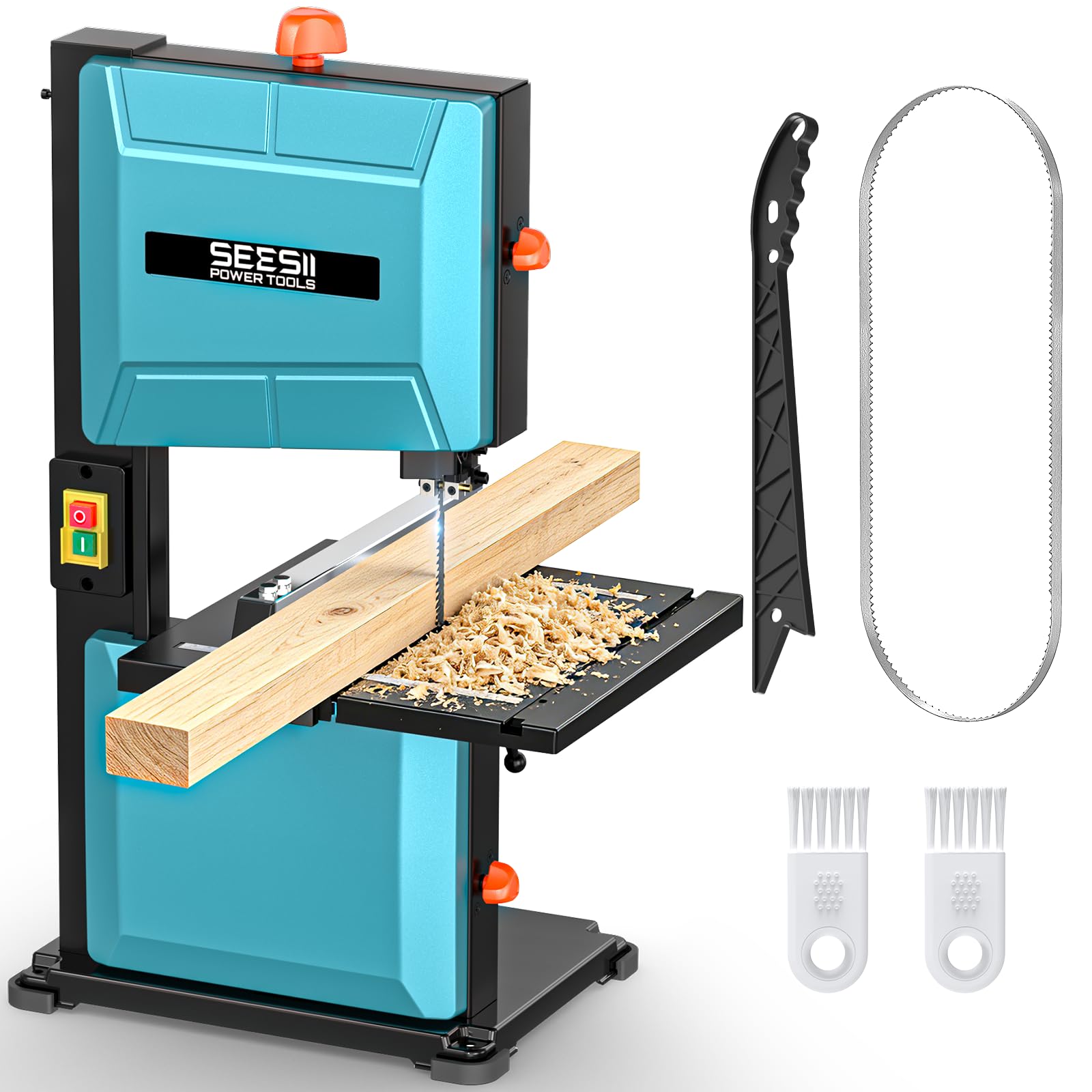
2. SEESII Benchtop Band Saw for Woodworking: 3A-120V Bandsaw with 8″ Cutting Width
A 3-amp benchtop with an 8-inch throat for cabinet doors and curves on a small workbench.
Garage-shop builders who need real precision without giving up the parking spot will appreciate what this saw packs into a small frame. The 350-watt motor (operating on standard 120V/60Hz) drives the blade at 900 RPM for efficient cuts through wood, plastic, and soft metals. The 8-inch throat handles cabinet doors, lumber resawing, and curved cuts in plywood. Set that against the JET, whose 116-inch blade loop and 13-inch resaw capacity are designed for floor-standing work — this SEESII is a fraction of the footprint and cuts in a completely different weight class.
The 3-1/8-inch adjustable cutting height adapts to materials from 1/8-inch veneers up to 3-1/8-inch hardwoods with tool-free height control. The 0-45° tilting worktable relies on rack-and-pinion adjustment, so you cut miters for picture frames or beveled tabletops without flipping the workpiece. A precision miter gauge locks securely at common angles, and the 12″ x 12″ steel worktable has laser-etched measurement grids plus a non-slip texture. The dual power buttons are a thoughtful safety function for homes with kids — accidental activation is prevented by the independent start/stop design.
What wins people over is the value — it does its job well for a machine in this class. Owners mention it is the “second one ordered after trying a different brand,” still going strong and preferred over similarly priced models. The recurring gripe is the blade guide adjustment, which takes a little dialing-in before the saw cuts cleanly. And 3-1/8 inches of height caps you out well below what a floor saw can do. If you mostly build jewelry boxes, toy parts, and picture frames, that ceiling never bothers you.
Best for tight benches: the 8-inch throat and 17″ x 12″ footprint let this saw live on a small workbench without dominating the garage.
The real ceiling: 3-1/8 inches of cutting height means anything thicker than a thick paperback spine will not fit — resawing a 6-inch board here is off the table.
Pick this one if: your work is curves, small parts, and soft-metal trim, and the saw lives on a bench.
Step up if: your projects include resawing anything taller than a few inches — go with a floor saw.
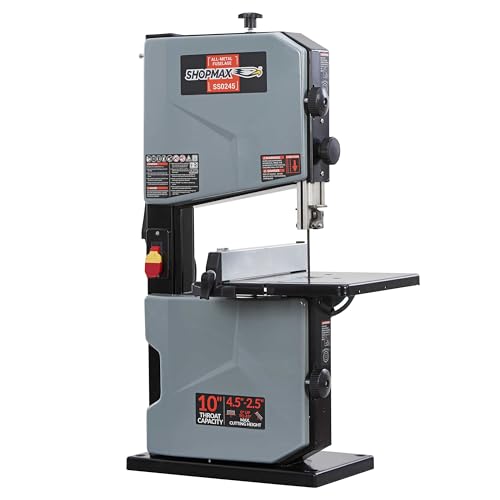
3. SHOPMAX 4.2 Amp 10-inch Benchtop Band Saw
A 4.2-amp benchtop with 4.5 inches of cutting depth for carving blanks and shaping curves.
Woodcarvers and crafters who want a rubber-band-simple saw for cutting blanks and shaping curves will like the ratio of power to size on this SHOPMAX. The 4.2-amp induction motor cuts up to 4.5 inches deep and 10 inches wide, which is deeper than several of the 9-inch benchtops on this list. The quick worktable tilts up to 45 degrees for bevel work, and the 67.4-inch blade runs widths from 0.14 inches to 0.47 inches — enough range for both straight cuts and tight curves. Compare that to the Woodskil below at 9-inch width and 3-1/2-inch depth — the SHOPMAX wins on both cutting dimensions.
A ball-bearing setup runs the blade for smooth, accurate tracking. A steel fence replaces the miter gauge for small band saws, giving more stable, safer cuts when you are working curves. The dust port connects to a Shopmax dust extractor (sold separately), and a suction connector is included for a cleaner workspace. Assembly is partial — hardware bag and stand are in the box.
Owners praise the build — a top-quality, solid machine that runs smooth and quiet, with serious cutting power for woodcarving and crafting. One owner plans to weld a wheeled base for the naturally heavy machine. The recurring caveat worth knowing: 4.2 amps limits how hard you can push thick hardwoods, and a handful of owners have had trouble getting blades to stay on without careful tracking setup. It is the kind of saw that rewards a five-minute tension check before each session.
Carver-friendly: 4.2 amps on a benchtop frame delivers smooth curves in hardwood blanks without a floor saw’s footprint.
Weight you feel: “naturally heavy — user plans to weld a wheeled base” is how owners handle the 54.7-pound frame in a workshop.
Suits: carvers and crafters who cut blanks and shapes more than they resaw wide boards.
Look elsewhere if: you need heavy resaw capacity — 4.5 inches is the ceiling for depth.
4. Ryobi BS904G 9″ Bandsaw Green

A 37.3-pound 9-inch saw for pine derby cars, small repairs, and job-site quick cuts.
Weekend woodworkers who need a saw for small parts and portable work site projects know this Ryobi by reputation. It runs on a 62-inch high-speed steel blade, sits on a 31″ x 18″ x 11″ footprint at 37.3 pounds, and reaches a 45-degree cutting angle for bevels. At just over 37 pounds it is the lightest floor-style option on this list — which is exactly the point. Job-site use, trailer use, garage-corner use: all places a heavier 54.7-pound or 61.8-pound machine becomes a chore. The trade-off is capability: the 10-inch WEN above cuts up to six inches deep versus the Ryobi’s smaller class, and owners know it.
Owners praise the saw’s effectiveness most — it does what a small band saw should do well. One woodturner reports it is perfect for light, basic cuts and specifically recommends it as a job-site saw because it is very portable and light. Another buyer reports it cut pine derby cars at a church AWANA event “amazing,” calling it great for the weekend warrior. The 30-day limited warranty is short, and one owner reported a unit failing within three months — a reminder that this is a light-use machine, not a heavy-duty workhorse.
The quiet truth on this one: it is designed for simple cuts, and pushing it beyond that leads to disappointment. If your projects live in the small-wood category, the Ryobi delivers. If you plan to resaw hardwood or cut thick stock regularly, spend up to a 10-inch class machine instead.
Made for: pine derby, scrollwork, small stock, and light-use crafts where a portable saw matters.
Avoid if: you need heavy resawing or thick-stock cutting — a light-duty machine tops out fast.
5. WOODSKIL 9-Inch Band Saw, 3-Amp Benchtop Bandsaw, 2500 FPM Blade Speed
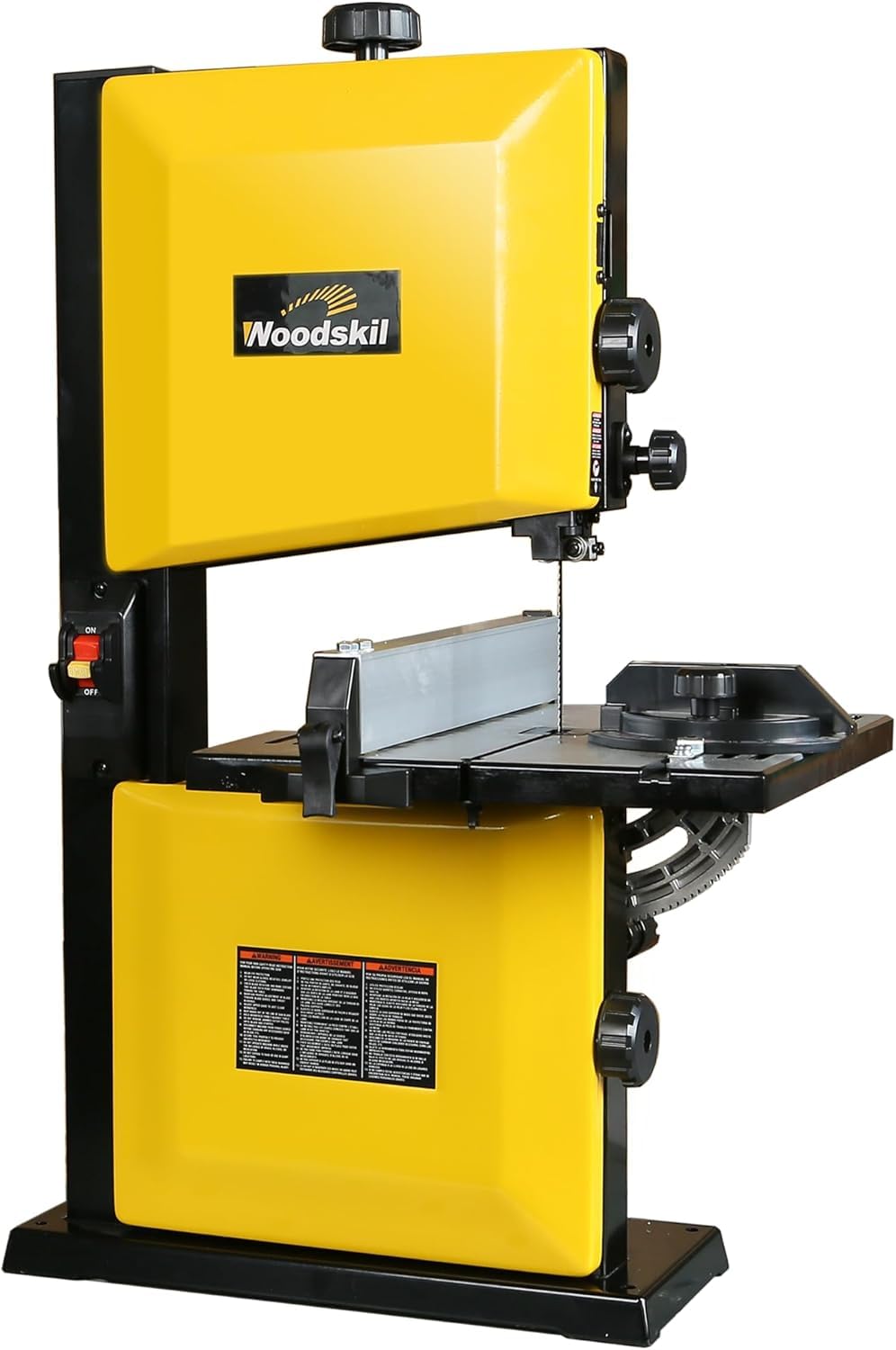
A 3-amp benchtop running a 2500 FPM blade for clean cuts at a beginner price.
Beginner woodworkers shopping their first real saw should look hard at this one — the numbers are the story. The 1/2 HP motor spins at 1720 RPM and sends the blade along at 2500 FPM, which keeps the cutting surface neat instead of ragged. A 59.5-inch blade runs widths from 1/8 to 3/8 inches, cutting up to 3-1/2 inches deep and 9 inches wide. The sturdy cast aluminum table tilts 0° to 45° and pairs with a 120-degree miter gauge. A rip fence handles straight cuts; the saw handles curves and multi-angle work too.
The steel base is worth calling out — it deadens the vibration that plagues lighter benchtops, and a 2-1/2-inch dust exhaust port plus a dust brush on the saw wheel keep the workspace sane. Owners rave about the value most, and quality ranks right behind it. Customers note the saw “cuts through 3/4 inch stock like butter” and that it handles hardwood slowly but reliably. The bendable miter gauge bar is a known quirk — one owner straightened it in a vise and got it sliding smoothly. The fence is described as crude but functional.
The caveats here are honest and small: accuracy can land off by 1/32 to 1/16 inch on tight rips, and blade durability is the least-loved aspect. But if you are an experienced woodturner or a first-time buyer, this is a serious value machine at a benchtop price — the kind of saw that quietly outperforms its class.
Numbers That Earn The Spot
- 2500 FPM blade speed delivers clean cuts without back-and-forth sawing
- 3-1/2″ depth x 9″ width, with a 120° miter gauge and rip fence in the box
- Steel base kills vibration and holds the saw stable through cuts
- 2-1/2″ dust port plus wheel brush keep the shop cleaner than most benchtops
Reasonable Quirks
- Accuracy can drift 1/32–1/16″ on tight rips
- Miter gauge bar sometimes arrives slightly bowed and needs a quick straighten
- Rip fence is functional but not premium — expect to set it carefully
The best first saw: if you are new to band saws and want precision without overspending.
For the more exacting: if every rip needs to be dead-on within 1/32″, budget for a higher-end fence and blade upgrade.
6. WEN Band Saw with Stand, 10-Inch, 3.5-Amp, Two-Speed (BA3962), Black

Six inches of cutting depth and a stand — weekend-warrior math done right.
Home-shop woodworkers who want a floor saw without a floor-saw budget should start here. The 3.5-amp motor cuts up to six inches deep and 9-3/4 inches wide — putting it two feet in front of every other benchtop in the depth column. That 6-inch capacity is the single most-bragged-about spec by owners. The saw runs on 72-inch blades from 1/8 to 1/2 inches, and the spacious 14-1/8 x 12-1/2 inch cast aluminum work table bevels up to 45 degrees. Two blade speeds (1520 FPM or 2620 FPM) let you cut hardwoods slowly or softwoods quickly with a belt change.
A work light, a 3-in-1 dust port, a fence, a miter gauge, and a 3/8-inch blade (6 TPI) are all included, plus a 2-year warranty. Owners praise the saw for cutting 5.5″ x 6.5″ hardwood blocks into thin pieces and resawing 4-inch poplar without drift on the stock blade. Assembly is straightforward and the saw runs accurately from the start with minor tuning.
Two recurring caveats worth knowing upfront: the work light placement is awkward (one owner relocated it), and the fence benefits from an added clamp to hold firm. A stock 3/8-inch blade can dull quickly on cupped stock — a 1/2-inch resaw blade is the fix most owners make. Adjusting blade tension and bearings, then taking slow cuts, keeps this saw humming for years.
The 6″ argument: no other benchtop-class machine here matches six inches of cutting depth — the resawing difference is real.
Why owners stay: “for the money, this bandsaw is perfect for the DIY guy that is a weekend warrior wood worker” is the review that keeps showing up.
Fits best: the DIY woodworker who wants a stand-mounted saw with real cutting depth.
Not the one if: you need industrial-duty cycle times — this is a weekend-warrior machine.
7. Rikon 10 Inch Bandsaw With Stand

Tool-less blade guides and a quick-release tensioner make reblading painless.
Carvers who reblade often will appreciate the design details most. Spring-loaded tool-less upper and lower blade guides let you swap and adjust without hunting for an Allen key, and a quick-release blade tension system resets the tension lever with one motion. The machined cast-iron table includes a 3/4″ x 3/8″ miter gauge “T” slot, and a 70.5-inch high-carbon steel blade runs the cut. The rugged welded steel column and frame keep the whole machine steady, and the large blade tension hand wheel makes dialing in tension easy.
At 25.75″ x 17.5″ x 59″ and 61.8 pounds, it is compact enough for small shops and sturdy enough to hold steady while cutting. Reviewers point out the saw is “extremely helpful to precut my carvings,” with easy assembly and a stand sturdy enough to keep the saw planted through cuts. The included 3/8-inch blade cuts well right from the start; several owners swap in 1/4-inch 14 TPI blades for tighter curve work.
The one consistent gripe: the rip fence can drift roughly 1/8 inch under light pressure despite a clean base, which shows up during 2×4 resaw tests. Owners also note a dust collector is worth adding since the saw is smaller than expected in person. Beyond that, this Rikon handles tight curves well and earns owner loyalty on build quality and operation.
Design-led premium: tool-less guides and quick-release tension make reblading a 30-second job instead of a chore.
One honest caveat: the included rip fence can drift up to 1/8 inch under pressure, so plan on clamping or upgrading for precision resaw work.
Ideal for: carvers and small-shop woodworkers who value tool-less blade changes over maximum capacity.
Rethink if: you rely on the rip fence for tight resaw accuracy — plan an upgrade.
8. QD-KYOHO 10-Inch Dual-Speed Bandsaw, 1/2 HP, 5.3-Amp

A pure-copper-motor benchtop that nails the hardwood/softwood speed swap.
Woodworkers running a two-speed workflow finally get a clean answer here. A 5.3-amp, 1/2 HP low-noise motor drives this saw at either 1515 FPM (for hardwoods) or 3280 FPM (for smooth softwood cuts) — the speed you want is one belt adjustment away. The 70-1/2 inch blade cuts up to 4-3/4 inches high and 9-5/8 inches wide. The 20.5 x 17.5 inch tabletop tilts right by 45 degrees and left by 5 degrees, so miters stay flexible without forcing the workpiece. The 1/2 HP motor easily handles 3/4-inch red oak, per owner reports.
The build spec is more substantial than the size suggests: high-quality steel plate construction, a pure copper motor, and a precision-ground cast iron table that keeps the work surface flat and stable. The upper and lower guide structure adjusts the blade vertically and horizontally. A detachable dual-sided fence lets you work from either side, and quick-release blade tension shortens the blade swap. The 2.5-inch dust extraction port connects to a shop vacuum.
What owners appreciate most: setup is quick and instructions are well done. Shoppers say ~45-minute assembly and friendly features like tool-free blade guide and tension adjustments. The recurring trade-offs: blade guide adjustments take some dialing-in, and the fence has an occasional shift on the unanchored end when clamped. Owners say the machine is quieter than their old 9-inch saw, easy to blade-track, and semi-portable thanks to a sturdy top handle — though a full shop-to-shop move is best planned with help.
What Stands Out
- 5.3-amp pure-copper motor cuts 3/4″ red oak without strain
- Dual speeds (1515 / 3280 FPM) match hardwood and softwood in seconds
- Table tilts right 45° and left 5°, with a detachable dual-sided fence
- Precision-ground cast iron table stays flat through demanding cuts
Worth Knowing
- Blade guide adjustments take some dialing-in to get right
- Rip fence end shifts when clamped — plan on an extra clamp
- Bulky enough that stairs and shop moves call for a second set of hands
Best fit: dual-speed cutters who swap between hardwood and softwood regularly.
Look elsewhere if: you want a bolt-it-on-and-forget-it fence straight from the start.
Understanding the Specs
Motor Power
Motor size is measured in horsepower (HP) for larger saws and amps for benchtop machines. A 1.75 HP motor powers through hard maple without slowing; a 3-amp or 3.5-amp motor is plenty for softwoods, curves, and light hobby work. If you plan to resaw thick hardwood regularly, more horsepower means the blade keeps its speed and the cut stays clean — stall the motor and the surface shows it. Check your circuit before you buy: some larger saws want a 20A circuit and run on 115V or 230V.
Resaw Capacity and Cutting Depth
Resaw capacity is the tallest board a saw can slice in one pass, and cutting depth is the same spec labeled on benchtop models. A 3-1/8-inch benchtop handles veneers and small parts but falls short the moment you want to split a 6-inch board. A 6-inch or 13-inch capacity opens up real resaw work — bookmatched panels, bowl blanks, and thick slab splitting. Match this number to the thickest stock you actually cut, not to the number on the loudest box in the store.
Blade Speed (FPM)
FPM stands for feet per minute — how fast the blade travels through the wood. Slower speeds in the 1500 FPM range track curves better and reduce burning on hardwoods; higher speeds up to 3280 FPM give a smoother finish on softwoods. Two-speed saws let you pick the right one without changing anything but a belt position. On single-speed benchtops, the FPM usually sits between 900 and 2600, which covers most home-shop work.
Blade Length and Width Range
Blade length must match the machine — a 55-inch blade only fits a machine built for it, and 116-inch blades live on 14-inch wheel saws. Blade width matters for the job, not the machine: 1/8-inch blades take tight curves, 3/8-inch blades are the all-rounder, and 1/2-inch to 3/4-inch blades handle fast, straight resaw cuts. Buy blades by width range, not just length, so a single saw can do scroll work and resawing both.
FAQ
What is the difference between a benchtop band saw and a floor-standing band saw?
How much resaw capacity do I actually need?
Do I need to buy a blade separately for these band saw machines?
What blade width should I use for cutting curves versus resawing?
Is a dual-speed band saw better than a single-speed model?
Can a band saw machine cut metal, or is it wood-only?
How long does a band saw blade last before it needs replacing?
What electrical circuit does a band saw need?
Do I need a dust collector with a band saw machine?
How much setup time should I expect for a new band saw?
Final Thoughts: The Verdict
For serious home-shop resawing, the JET 14″ Woodworking Band Saw is the best band saw machine on this list — the 1.75 HP motor, 13-inch resaw capacity, and 116-inch blade loop do work a benchtop simply cannot touch. If you want a dual-speed benchtop with the strongest motor and cleanest setup, grab the QD-KYOHO 10-Inch Dual-Speed Bandsaw. For first-time buyers who want precision at a value price, the WOODSKIL 9-Inch Band Saw is the one to reach for. And if light-duty curves and small-project portability matter most, the Ryobi BS904G still earns its spot for weekend work. Take a look at your thickest board, match it to the resaw capacity column, and pick from there — that one number settles the right saw for you.
How We Picked
We do not accept paid placement. Every pick is matched to a real buyer and a real use-case; we do not hands-on test units.
Sources & Methodology
Specifications: manufacturer listings and product documentation. Review insights: verified customer reviews, as of September 2026. Pricing: not shown on this page (it changes often); check the current price via the retailer link.
As an Amazon Associate, Gadgets Feed earns from qualifying purchases. This does not affect which products we feature.