
Our readers keep the lights on and my morning glass full of iced black tea. As an Amazon Associate, I earn from qualifying purchases.
Specs are compiled from manufacturer listings and verified buyer reviews and can change over time — please confirm the key details on the product page before buying.
A bivy sack is a waterproof shell that wraps your sleeping bag so you can sleep outdoors without a tent. The right one keeps rain off your bag, traps some of your body heat, and stuffs small enough to disappear into your pack. The wrong one turns into a sweat box by midnight.
I’m Min — the founder and writer behind Gadgets Feed. This guide is built by comparing the manufacturers’ published specifications and the patterns across verified customer reviews, so you get each pick’s real strengths and trade-offs instead of marketing spin.
Below you’ll find what actually separates a good shell from a clammy one, plus the picks that hold up in real weather. Everything here is chosen to work as a reliable best bivy sack — whether you’re thru-hiking, bikepacking, or keeping one in a bug-out bag.
Our Picks at a Glance

How To Choose The Best Bivy Sack
The single biggest mistake buyers make is treating waterproofing as the only number that matters. A bivy that blocks every drop of rain but can’t let your breath escape will leave your sleeping bag soaked from the inside by morning. Water resistance and breathability have to work as a pair.
Waterproof Rating, Explained in Plain Terms
A waterproof rating is measured in millimeters of water column (mmH2O or mm) — a lab test where a column of water is pressed onto the fabric until it leaks through. Higher numbers mean the fabric resists more water pressure before it gives up. The Litume shell is rated to 12,000mmH2O, the Snugpak’s top fabric carries 5,000mm, and the AquaQuest Pharaoh sits at 10,000mm. For steady rain you want a shell that holds up, but remember: every sealed millimeter also traps moisture inside unless the fabric also breathes.
Mummy Cut vs Rectangular Cut
A mummy-style bivy tapers toward the feet to follow the shape of a mummy sleeping bag, which cuts weight and dead space. A rectangular or generous-cut cover fits whatever bag you already own and leaves room for layers, but it packs bigger and can feel bulkier in your pack. Check the maker’s stated dimensions against your bag before ordering — the Litume is built strictly for mummy bags, while the Mil-Tec cover is cut generously to swallow a range of bags.
Condensation: The Real Enemy
Your body puts out moisture all night, and in a sealed shell that moisture has nowhere to go. It condenses on the cold inner surface and drips onto your bag. Mesh panels, two-way zippers you can crack open, and hood drawcords that keep your face clear all help. If you camp in humid or freezing conditions, prioritize ventilation over an extra thousand millimeters of waterproofing.
Quick Comparison
| Model | Best For | Waterproof Rating | Weight | Length x Width | Amazon |
|---|---|---|---|---|---|
| Sierra Madre Emergency Sleeping Bag★ Best Overall | Emergency kits and car storage | Waterproof & windproof (no rating given) | 6 oz | 14″L x 10″W | Amazon |
| Mil-Tec Trilaminate Sleeping Bag CoverToughest Shell | Durability-first campers | 5.0mm water column | 1.33 kg | 88.58″L x 33.5″W | Amazon |
| Litume Bivy Sack Sleeping Bag Cover | Stealth camping and backpacking | 12,000mmH2O | Under 400g | 85″L x 33″W | Amazon |
| Sierra Designs Backcountry Bivy | Ultralight bikepacking | Waterproof/breathable top (no rating given) | 16 oz | 80″L x 36″W | Amazon |
| AquaQuest Pharaoh Bivy Sack | Tentless sleeping in rain | 10,000mm | 1.1 lbs | 85″L x 36″W | Amazon |
| Snugpak Stratosphere | Four-season bivvy camping | 5,000mm top / 8,000mm bottom | 2.5 lbs | 91″L x 32″W x 20″H | Amazon |
| Outdoor Research Helium Bivy | Light alpine and backcountry travel | Waterproof and seam-taped (no rating given) | Not listed | 82.01″L x 25.98″W x 19.49″H | Amazon |
In‑Depth Reviews
1. Sierra Madre Emergency Sleeping Bag, Waterproof Thermal Bivy Sack
Our pick — over 4.5★ from 700+ verified ratings; the strongest balance of quality and price.
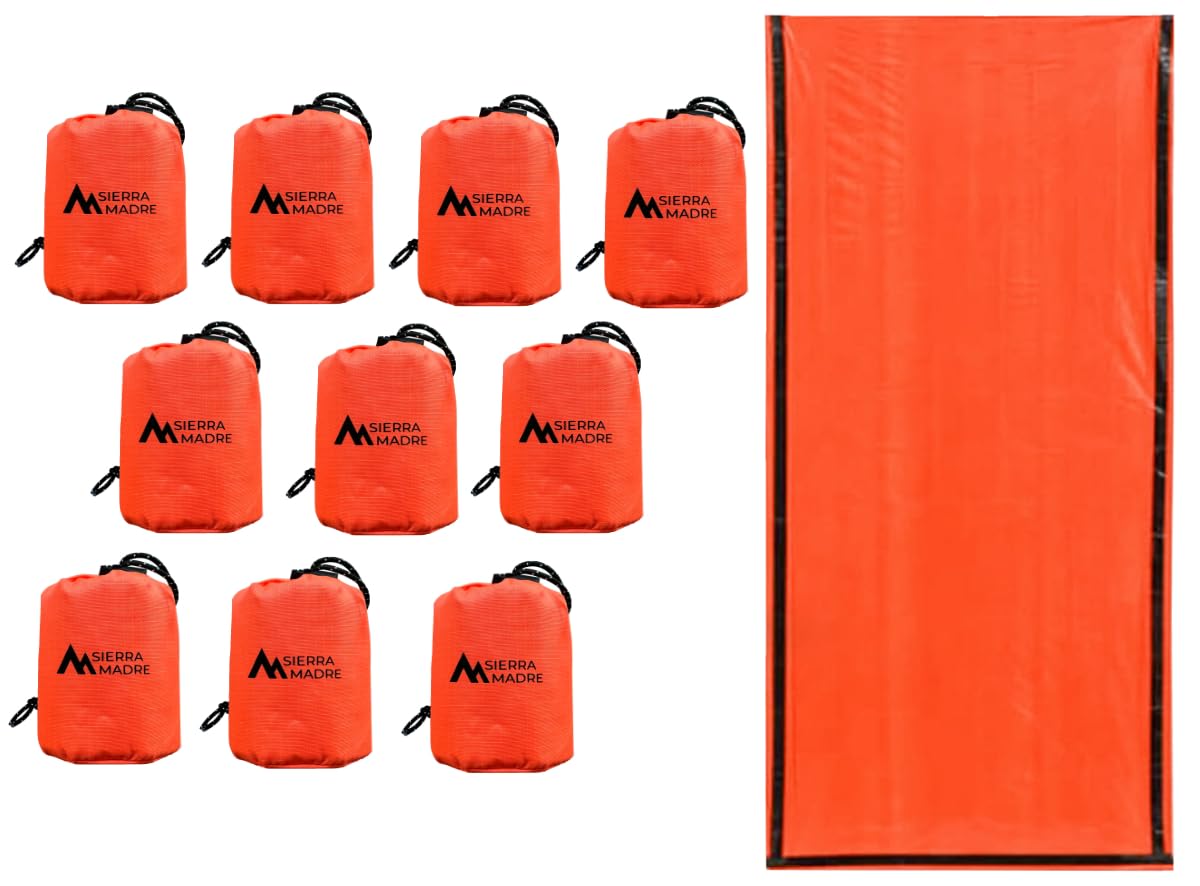
Six ounces of mylar that bounces your own body heat straight back at you.
This isn’t a shell you sleep in under the stars — it’s the thing that saves you when the plan goes wrong. The fabric is a NASA insulation material made of polyethylene, the same reflective mylar family that space blankets come from, and the maker states it reflects 90% of body heat. The specs list a higher figure of over 95%, so treat the exact number as approximate. What matters is the principle: instead of warming the air around you, it sends your own radiated heat back to your skin.
At just 6 ounces, this is the lightest pick here by a wide margin, and it packs into a 14″ x 10″ footprint — small enough to live in a glove compartment, a bug-out bag, or the bottom of a daypack. For comparison, the Mil-Tec cover measures 88.58″ x 33.5″ unfolded against this one’s 14″ x 10″ packed, so one is a full sleeping system and the other is a pocketable backup. The material is tear-resistant PET (a strong plastic film) rather than a flimsy film, so it survives multiple uses if you fold it back into the drawstring stuff sack instead of crumpling it.
Where It Delivers
- 6 oz and pocket-sized, so it never gets left behind on a trip
- Reflective polyethylene sends heat back instead of relying on trapped air
- Rated for users up to 7 feet tall
- Reusable, not a single-use disposable blanket
Where It Doesn’t
- No breathability — it’s a sealed reflective shell, so it isn’t built for a full night of comfort camping
- No waterproof rating figure is published, only the waterproof and windproof claim
The pattern in buyer feedback is consistent: people who keep several of these on hand — one in the car, one at home, one packed for a trip — and they describe it as a value piece. As one owner put it, “I hope I never have to test their claim of arctic weather protection… I have 5 in all.” That’s the honest read on this product: it’s insurance, and insurance you never open is insurance that worked.
Buy it for: building a survival kit, glovebox, or bug-out bag where six ounces of insurance is worth owning.
Don’t buy it for: planned camping nights where you want a breathable shell you actually sleep inside.
2. Mil-Tec Trilaminate Durable Waterproof Lightweight Breathable Tactical Outdoor Camping Hiking Generous Cut Sleeping Bag Cover with Zip Closure
A generous-cut cover built to outlast every trip you throw at it.
The headline here is the trilaminate build — three layers bonded into one fabric with a 5.0mm water column rating, which is the maker’s measure of how much water pressure the material holds back before it seeps through. That same build is what buyers reward most: quality is the thing they single out above everything else, followed closely by durability and water resistance. This is the cover you buy if you’d rather replace a zipper years from now than a whole shell every season.
At 88.58″ long and 33.5″ wide, it’s cut generously enough to swallow bags and pads that a mummy-fit shell would squeeze. The two-way side zipper, snap fastener cover flap, and elastic head area with hook-and-loop closure add up to a cover that seals well against wind and rain. Buyers have slept through nights of near-constant rain and come out dry — one summed up the experience this way: “Very high quality. Only spent two nights in it so far, but it was raining nearly non stop on both of those nights. Stayed dry and couldn’t ask for better results.”
The trade-off is weight and space. At 1.33 kg, it’s the heaviest shell in this lineup, and the recurring gripe in buyer feedback is exactly that — it’s heavy, bulky, and almost tent-sized when packed. Some note a right-side zipper that’s awkward depending on which way you sleep, and internal condensation that needs airing out in the morning. Treat it as a durability-first choice, not a fast-and-light one.
The pack-weight reality: a cover this size needs a pack that can spare the room, so it suits car campers, canoe trips, and basecamp setups more than long thru-hikes.
Reach for this if: you want a rugged, generously sized shell that shrugs off abrasion and heavy rain.
Look elsewhere if: every ounce counts and you’re counting grams in a small pack.
3. Litume Bivy Sack Sleeping Bag Cover – Waterproof Mummy-Style, Compact & Lightweight Shelter for Stealth Camping Backpackers Wild Bushcraft Equipment Outdoor Survival
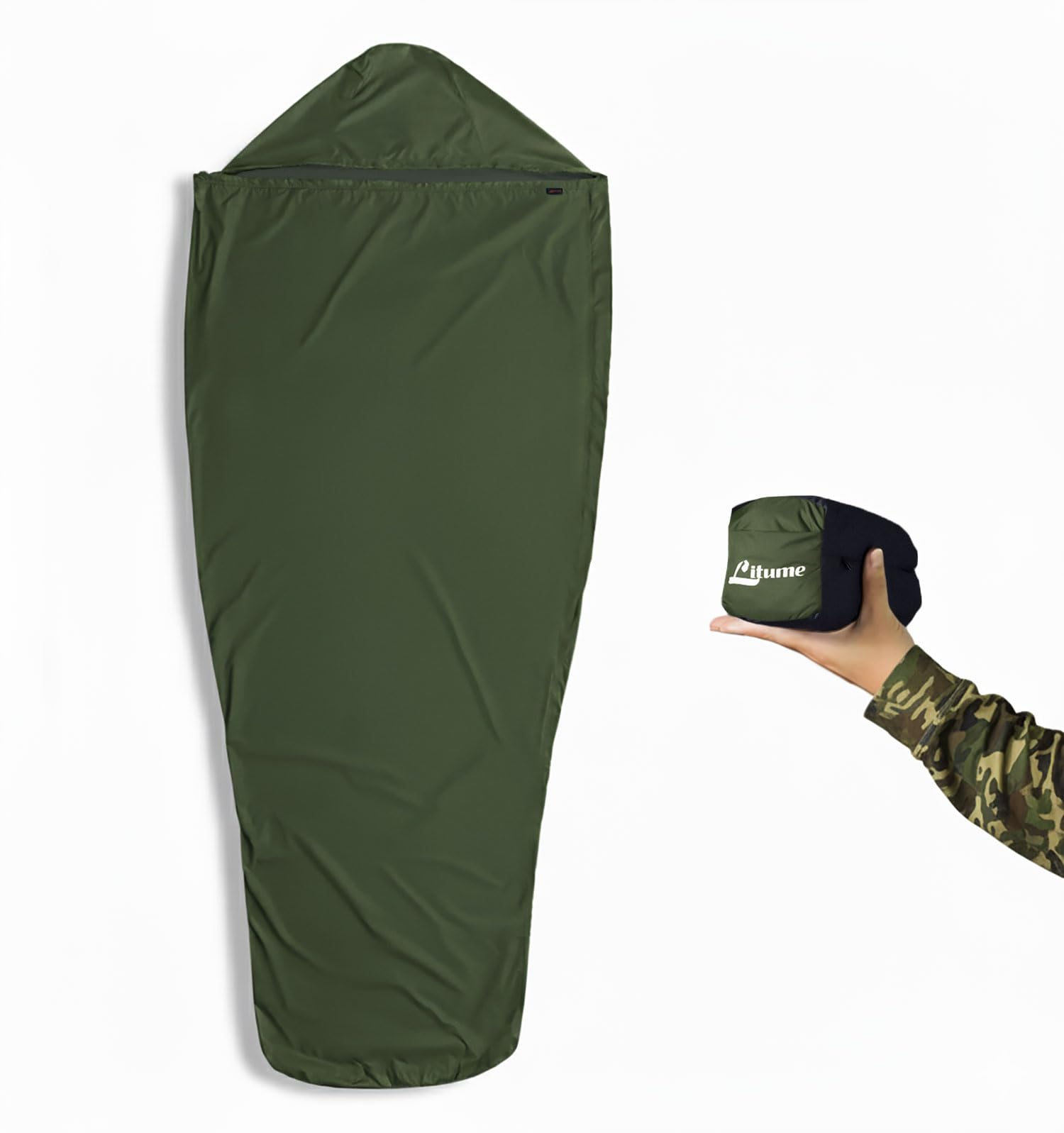
The highest waterproof rating on this list, in a shell that folds to the size of your fist.
Start with the number that earns its place: the back fabric is rated to a water resistance of up to 12,000mmH2O under the JIS L1092B test, effectively sealing out the kind of rain that punishes most shelter choices. It’s built from 40D nylon ripstop with a waterproof-breathable coating, fully seam-sealed with waterproof zipper covers. That rating, plus the sealed seams, is what buys you a genuinely weather-tight shell without a tent overhead.
Then look at the weight: under 400g, folding down to 17.5 x 8.5 centimeters, which slides into a pack without a second thought. The mummy-style cut and spacious footbox suit tapered bags, and an elastic drawcord on the hood snugs the opening around your head for full coverage. A side semi-open YKK zipper is the only way in and out.
That zipper is where buyer patience gets tested. It opens only partway, so entering and exiting means twisting into the shell rather than stepping in — and several owners describe it as fiddly or a tight squeeze. The 3-star feedback tends to come from the same place: used in humid or damp conditions as a warmth layer, some found it ran hot and clammy inside, which is why it’s best treated as a weather shell over your bag rather than a substitute for insulation. The fabric is OEKO-TEX certified (tested for harmful substances) and hand-wash only to keep the coating intact.
What Earns It A Spot
- 12,000mmH2O rating with fully sealed seams and waterproof zipper covers
- Under 400g and folds to 17.5 x 8.5 cm for packable carry
- Mummy-style cut with a spacious footbox and adjustable hood drawcord
- OEKO-TEX certified fabric, hand-washable to preserve the coating
The Honest Catch
- Semi-open zipper opens only partway, making entry and exit awkward
- Built for mummy bags specifically, not rectangular sleeping bags
The mic-drop spec: a 12,000mmH2O shell that weighs under 400g is the balance of protection and packability most backpackers are hunting for.
But think twice if: you sleep in a rectangular bag, or you want a shell you can step into easily.
4. Sierra Designs Backcountry Bivy Bag for Backpacking, Camping, Bikepacking and Mountaineering, Ultralight, Minimalist Waterproof/Breathable Top Fabric

A roomy, airy shell that packs down to the size of a water bottle.
The specs here are built around living space: an 80″ x 36″ footprint, a large U-shaped opening that makes getting in and out simple, and a mesh window panel for ventilation when the weather plays nice. The top uses a waterproof/breathable fabric, the sides are mesh and nylon, and the whole thing is 20D nylon ripstop. At 16 ounces it’s a genuinely ultralight shell you can justify carrying on a bikepacking trip.
Where it earns its keep is fitting everything. Buyers report their full sleep pad slides inside, along with a pillow and an 88-inch mummy bag, and it stuffs down to roughly the size of a 1-liter water bottle. A guy line loop lets you raise the peak height when you want more headroom, and the small mesh bug opening keeps insects out without blocking airflow.
The honest limitation is that this shell blocks weather but doesn’t add much warmth, and condensation is the recurring theme in buyer notes — especially around the foot area. Several describe it turning sauna-like with the flap fully closed, so the practical routine is keeping the flap open unless it’s actually raining. The bottom is thinner fabric than some heavier gear, so pairing it with a ground pad is smart. Some buyers also suggest going up to the larger size if you’re broad in the shoulders.
Best used as: a lightweight weather shell over a real sleeping bag, not a standalone warmth layer.
Fits best: bikepackers and mild-weather backpackers who pack small and value ventilation and interior room.
Skip if: you need a bivy that adds warmth on its own in freezing conditions.
5. AquaQuest Pharaoh Bivy Sack, Waterproof Outer Shell for Sleeping Bag, Minimalist Stealth Shelter, Olive Drab
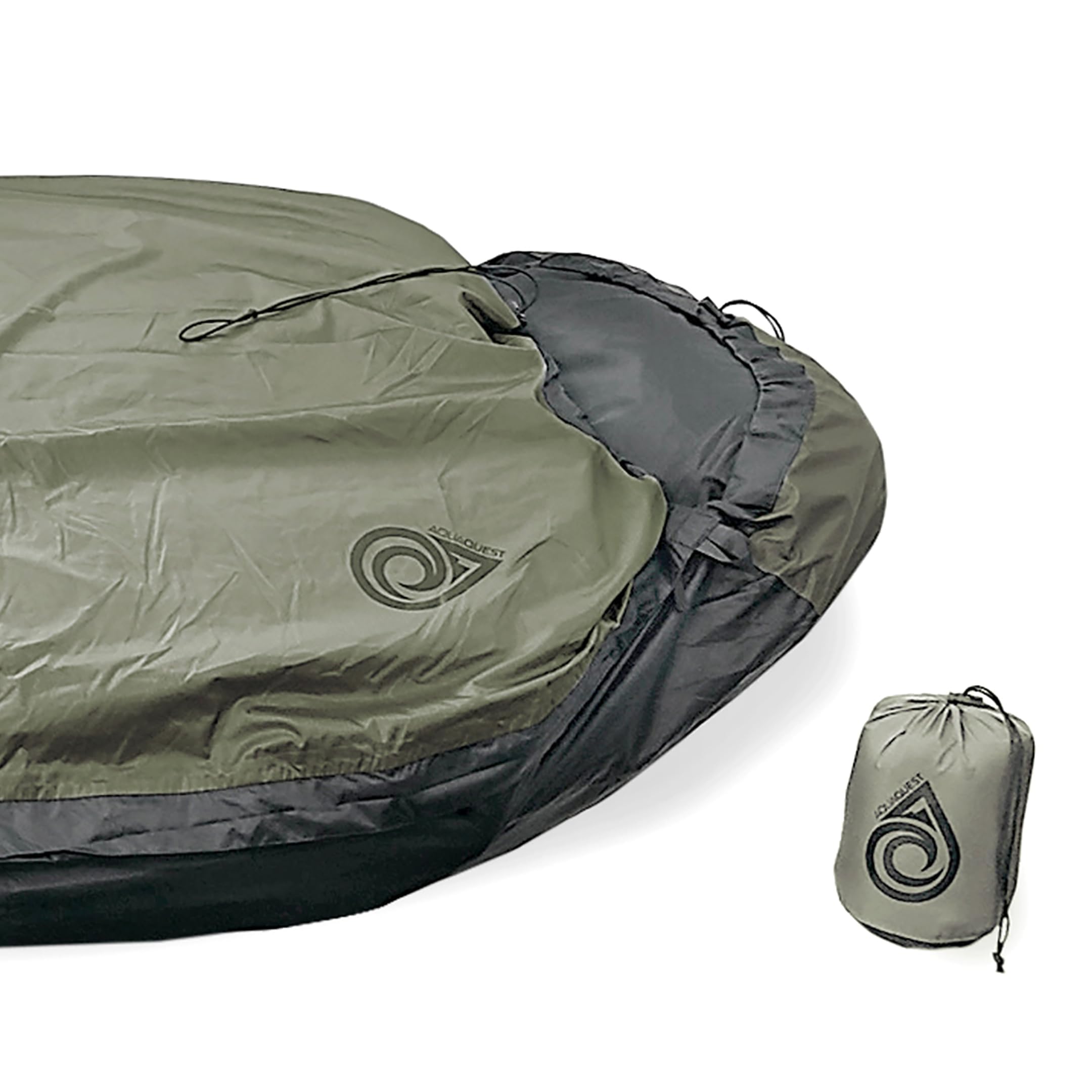
The shell owners keep coming back to when the forecast says rain, all night.
There’s a reason water resistance is the aspect buyers praise most here. The 70D nylon shell carries a waterproof rating of 10,000mm and a moisture vapor transmission rating of 10,000 gr/m2/day, which means it holds back serious rain while still letting sweat vapor pass through. Owners mention staying bone dry in heavy rain in the Rockies, while tents around them took on water — the kind of trip where the shell is doing the job you bought it for.
It covers sleepers up to 6’6″ with room to spare, fits most single sleeping bags and pads inside its 85″ x 36″ footprint, and weighs just 1.1 lbs. Zipper access on both sides is a thoughtful touch, and an elasticated drawstring hood lets you cinch down when the weather turns nasty. It packs into a built-in cylindrical stuff sack measuring 9″ long by 5″ diameter, so you’re not hunting for a separate bag. AquaQuest also backs all its products with a lifetime warranty.
The friction points in buyer feedback are worth knowing. The hood opening runs large, and some find the drawstring can’t fully close it, so the top of your bag can stay exposed to drip. Others dislike sleeping with the zipper on the opposite side from where their bag opens. And the material is loud enough when you roll over that it’s been noted as a nuisance when camping near others. None of it breaks the shell — it just shapes who it suits.
Confident pick for: tentless campers who want dry, breathable protection across a long rainy night.
Worth considering against: if you need a hood that seals completely tight or a quiet fabric, look closely at the fit before committing.
6. Snugpak | Stratosphere | Shelter | 1 Person | 5000mm 100% Waterproof Outer

A bivy and a tent got married, and the result actually has headroom.
This is the pick for anyone who has tried a classic bivy and hated the coffin feel. Aluminum poles with screw-lock tips prop up a canopy over your head and shoulders that’s roughly 2 feet tall — enough to sit up, read, or watch the mesh window without lying flat against the fabric. Interior dimensions run 91 inches long, 32 inches wide, and 20 inches tall, sized for one person with a full-length side zip. It’s a shelter and a weather shell in one, which explains why it sits at the premium end.
The weatherproofing is split: the top fabric is 50D nylon ripstop with a 5,000mm waterproof polyurethane coating, and the heavier 210T nylon bottom carries an 8,000mm coating, so the ground side takes the worst of it. All seams are taped and sealed, and a rollaway No-See-Um mosquito net in the head canopy keeps bugs out while a back mesh section adds airflow. Setup is fast — buyers consistently call it easy to put up and take down, and it packs to a compact 12″ x 5″ at 2.5 lbs. A basic repair kit with a pole sleeve, tensioner, spare cord, and patch materials is included.
The recurring honest complaints cluster around moisture and comfort trade-offs. Some report water pooling at the feet or a small zipper leak under a hose test, and condensation builds in heavy weather because ventilation is limited — a tarp over the top helps in a real downpour. The mesh head area keeps it from feeling claustrophobic, but taller and bulkier sleepers note the fit is snug in the shoulders. Bring a warm bag; the shell won’t compensate for a thin one.
what separates it
- Two poles create roughly 2 feet of sit-up headroom no classic bivy offers
- Dual coatings: 5,000mm top fabric and 8,000mm bottom fabric with taped seams
- Packs to 12″ x 5″ at 2.5 lbs, with a basic repair kit included
- Rollaway No-See-Um mosquito net and back mesh for ventilation
Where It Falls Short
- Condensation builds in heavy weather; ventilation is limited when fully sealed
- Some report a small zipper leak or foot-end pooling under sustained rain
- Shoulder space is snug for bulkier or taller sleepers
Made for: campers who want tent-like headroom and weather protection in one packable package.
Not the pick if: you need a featherweight shell for long-distance ultralight trips.
7. Outdoor Research Helium Bivy
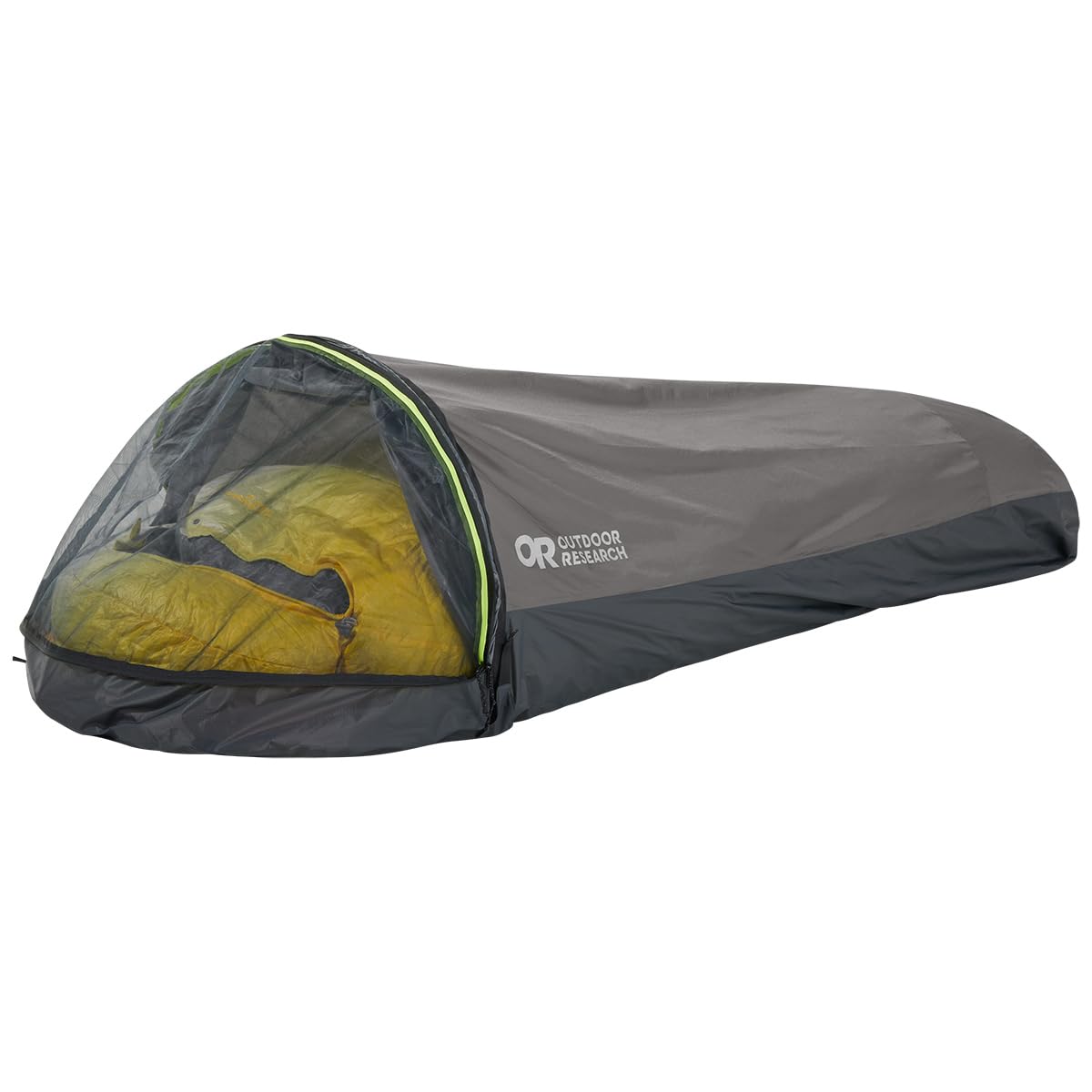
Light, seam-taped, and built for the climber who counts every gram.
For backcountry travel where weight and packability decide everything, the Helium strips things down. It’s a single-pole A-frame shelter with a clamshell opening, internal fly fasteners, and a mesh design for ventilation. The specs list it as waterproof, windproof, insect-proof, breathable, and abrasion-resistant, with seams taped and sealed. Four stake loops and a guy line let you tension it down when the wind picks up.
Buyers consistently describe it as super light and packing very small, and as dependable shelter for trips where your sleeping bag alone won’t cut it. One owner carried it 100 miles without trouble, and it held up across alpine and desert conditions globally. At 82.01″ long and 25.98″ wide it fits a tall sleeper — a 6’3″ owner reported fitting inside fine — though the narrow 25.98″ width is part of what keeps it so packable.
Comfort is the aspect buyers are most split on, and it depends on who you are. The slim cut is exactly what makes it light, but several buyers warn it’s not for anyone who dislikes tight spaces, and one blunt review put it as feeling like being in a coffin. The clamshell door (a door that opens like a shell) and mesh panel help a lot compared to older bag-style bivies, but you should already know how you feel about confined spaces before ordering. Some also note the door could use a design update for use in wind.
What you’re buying: a gram-counting alpine shelter that’s light and packable, sized for a lean, narrow fit.
Suits: fast-and-light backcountry travelers who want minimal weight and a taped, weatherproof shell.
Sidestep it if: you get restless in tight spaces — the narrow dimensions are the definition of this design.
Understanding the Specs
Waterproof Rating in mmH2O
This number tells you how much water pressure a fabric holds back before it leaks. It’s measured by pressing a column of water against the material in a lab. A rating around 5,000mm handles steady rain; higher numbers like 10,000mm and up give more margin against driving rain and wet ground. The Litume lists up to 12,000mmH2O (JIS L1092B), the AquaQuest Pharaoh lists 10,000mm, and the Snugpak splits it between a 5,000mm top fabric and an 8,000mm bottom fabric. A higher number isn’t automatically better — a sealed, unbreathable fabric traps your own moisture inside.
Breathability and Condensation
Breathability describes how readily your body’s moisture vapor passes out through the fabric. It’s often described with a moisture vapor transmission rating in gr/m2/day — the AquaQuest Pharaoh lists 10,000 gr/m2/day. When a shell can’t move that vapor out, it condenses on the cold interior and wets your bag. That’s why mesh panels (the Sierra Designs window and bug net, the Snugpak head canopy mesh) and crackable two-way zippers matter. In humid or freezing weather, ventilation beats raw waterproofing for a genuinely dry night.
Weight and Packed Size
Weight decides whether the bivy actually goes on the trip. Shells here range from the 6-ounce Sierra Madre and the under-400g Litume up to the 2.5-pound Snugpak. Packed size matters just as much: the Litume folds to 17.5 x 8.5 cm, the Snugpak to 12″ x 5″, and the Mil-Tec packs near tent-sized at 1.33 kg. If you’re backpacking or bikepacking, weigh both tiny emergency shelters and full shells against the space you have.
Cut, Fit, and Length
A mummy cut tapers to follow a mummy bag, saving weight; a generous cut fits a range of bags and layers but packs bigger. Check the maker’s stated length against your height and bag: the Mil-Tec runs 88.58″ long, the Snugpak 91″, and the Helium 82.01″. The Outdoor Research Helium is notably narrow at 25.98″ wide, which keeps it light but snug. The AquaQuest covers up to 6’6″, and the Sierra Madre is rated for up to 7 feet. Material strength also varies — the Litume uses 40D nylon and the Helium uses 20D ripstop, so thicker fabric trades weight for toughness.
FAQ
What is the difference between a bivy sack and a sleeping bag?
Will a bivy sack keep me warm in winter?
Why does my bivy sack get wet inside?
Can I use a bivy sack without a tent?
Does a bivy sack need a waterproof rating like a tent?
Are bivy sacks reusable or single use?
Will a bivy sack fit a rectangular sleeping bag?
Is a bivy sack worth it over a tent?
How do I stop a bivy hood from letting rain in my face?
Final Thoughts: The Verdict
For the widest range of buyers, the best bivy sack on this list is the Sierra Madre Emergency Sleeping Bag — it weighs just 6 ounces, reflects 90% of your body heat, and packs so small it can live in a glovebox or bug-out bag, and it holds a 4.7 rating across hundreds of owners. If you want a shell you actually sleep inside on rainy trips, the AquaQuest Pharaoh pairs a 10,000mm waterproof rating (it can handle heavy rain without leaking) with 1.1-lb portability, and the Snugpak Stratosphere gives you roughly 2 feet of sit-up headroom when a flat bivy feels too tight. The Sierra Designs Backcountry Bivy is the one to grab if ventilation and pack size top your list, and if durability at the cost of weight is your trade-off, the Mil-Tec cover handles it.
How We Picked
We do not accept paid placement. Every pick is matched to a real buyer and a real use-case; we do not hands-on test units.
Sources & Methodology
Specifications: manufacturer listings and product documentation. Review insights: verified customer reviews, as of September 2026. Pricing: not shown on this page (it changes often); check the current price via the retailer link.
As an Amazon Associate, Gadgets Feed earns from qualifying purchases. This does not affect which products we feature.