
Our readers keep the lights on and my morning glass full of iced black tea. As an Amazon Associate, I earn from qualifying purchases.
Specs are compiled from manufacturer listings and verified buyer reviews and can change over time — please confirm the key details on the product page before buying.
If you want a daily matcha latte without paying café prices, a culinary-grade powder in a big resealable pouch is the smart buy — as long as you know which bags actually dissolve clean and which ones turn into bitter green sludge. This guide covers eight real options, what each one does best, and who should skip it.
I’m Min — the founder and writer behind Gadgets Feed. This guide is built by comparing the manufacturers’ published specifications and the patterns across verified customer reviews, so you get each pick’s real strengths and trade-offs instead of marketing spin.
Every pick here is judged on dissolve quality, flavor, and pouch size, so you can brew a better cup at home. Finding the right budget matcha really depends on matching the grind and grade to the way you actually drink it.
Our Picks at a Glance


How To Choose The Best Budget Matcha
Spending less on matcha does not mean settling for a chalky, bitter cup. It means picking the right grade for the way you drink it, then checking three things on the label before you buy.
Culinary grade versus ceremonial grade
Culinary grade is grown and ground for mixing — lattes, smoothies, and baking — rather than drinking as plain whisked tea. It tends to carry a stronger, earthier flavor that stands up to milk and sugar. Ceremonial grade is meant for drinking straight with hot water, so if you plan to make iced lattes, culinary is the smarter use of money.
Scoop size and how far a pouch stretches
A single half-teaspoon serving is enough for most cups, which is why a larger pouch can last months of daily use. Look for the stated serving count or the scoop size on the bag — that number tells you more about real value than the sticker on the tin.
Origin, certifications, and freshness
Japanese-grown matcha from regions like Uji, Kagoshima, or Nishio is the marker most buyers watch for. A USDA Organic label and an airtight or resealable pouch both matter, because matcha fades in color and flavor once air gets to it. Store the pouch in the fridge to keep the bright green longer.
Quick Comparison
| Model | Best For | Pouch Size | Grade | Serving Count | Amazon |
|---|---|---|---|---|---|
| Jade Leaf Matcha Powder, Organic Culinary Grade, 100g / 3.53oz★ Best Overall | Everyday lattes and smoothies | 100g / 3.53oz | Culinary | — | Amazon |
| MatchAiA Organic Matcha Powder, Premium Culinary Grade, 150g/5.3oz PouchBest Value | Value-size daily lattes | 150g / 5.3oz | Culinary | — | Amazon |
| Maeda Shiki Matcha Green Tea, 1-OunceTaster’s Pick | Trying matcha in small amounts | 1oz | Green tea powder | — | Amazon |
| PANATEA Certified Organic Matcha Green Tea Powder, 16 Oz Tin | Households that go through matcha fast | 16oz | Culinary | — | Amazon |
| MRM Nutrition Superfoods Matcha Green Tea Powder | Clean energy without a coffee crash | 6oz | Superfood powder | 42 | Amazon |
| Organic Matcha Green Tea Powder, 1 Pound by NATUREBELL | Volume buyers and bakers | 16oz / 454g | Culinary | 151 | Amazon |
| HANDPICK Japanese Organic Matcha Green Tea Powder | Sweet, aromatic daily cups | 3.53oz | Organic Japanese | 100 | Amazon |
| Kenko Matcha Green Tea Powder, USDA Organic Culinary Grade | Baking and blended drinks | 100g / 3.5oz | Culinary | 50 | Amazon |
In‑Depth Reviews
1. Jade Leaf Matcha Powder, Organic Culinary Grade, 100g / 3.53oz
Our pick — 4.5★ from 83,500+ verified ratings; the strongest balance of quality and price.
The everyday bag that turns café money into at-home lattes
This is the safest first purchase in the category. The 100g / 3.53oz resealable pouch is a single-ingredient matcha from Uji and Kagoshima, Japan, grown without harmful chemicals and carrying a USDA Organic label. That means one ingredient in your cup — no sweeteners, no fillers, no label to decode.
What wins people over, consistently, is how it behaves in a mug. A half-teaspoon shot blended into hot water or milk comes out smooth and clump-free, and the fine texture carries over into smoothies and baked goods. The label claims roughly 225 full-size matcha lattes or up to 454 traditional usucha servings per pouch, which undercuts café prices on a per-cup basis. As one buyer puts it, the pouch makes 15 16-ounce lattes for far less per cup than a café charges.
Comparing it to the Maeda Shiki bag lower down: Jade Leaf packs 3.53 ounces against a 1-ounce bag, so one opens and the other does not. The one honest catch is price-per-ounce at the register — a recurring gripe from heavy drinkers is that a big warehouse-club tin of similar Japanese matcha costs less per gram. If you drink three cups a day, that math matters; if you make one or two, it does not.
What earns it the top slot
- Fine, smooth texture that dissolves without clumping
- USDA Organic, 100% Japanese, one ingredient — no sweetener
- Bulk resealable pouch cuts the per-cup cost well below café prices
Where it costs you
- Price per ounce runs higher than warehouse-club alternatives
- Smaller bags than some bulk-focused competitors
Reach for this if: you want an easy, verified starting point for daily matcha lattes and smoothies from a Japanese, organic, one-ingredient pouch.
Look elsewhere if: you drink three or more cups a day and want to shave the per-ounce cost as low as it goes.
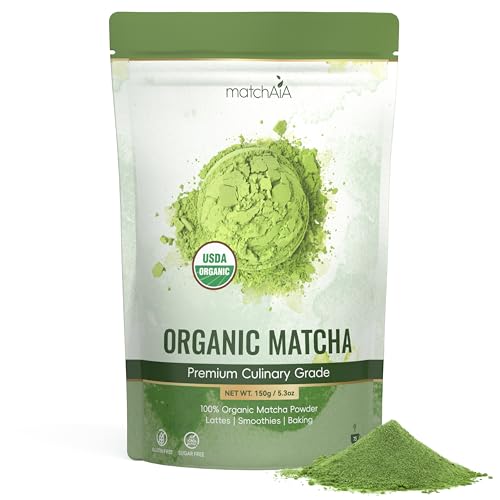
2. MatchAiA Organic Matcha Powder, Premium Culinary Grade, 150g/5.3oz Pouch
A stone-ground pouch that quietly out-sizes most bags in this price band
Here is the number that matters: 150 grams. Against the Maeda Shiki bag further down, this pouch carries 5.3 ounces versus 1 ounce — the comparison facts here land at a 5.3x gap in weight and units. That is the raw reason latte drinkers reach for this one over a tiny tin.
Made from shadow-grown leaves and ground on stones, the texture here is silky and the color is vivid green in milk. Flavor lands earthy with a slight edge — not grassy, not bitter. As the review pages sum it up, buyers report “You can’t beat the price and quality of this matcha! A little goes a long way! Great flavor!” The 14,000-acre tea garden behind it and the USDA organic certification round out the label.
The recurring gripe is honest and predictable: this is not ceremonial grade, so drinkers looking for an intense, plain-water cup will find it mild, and a few note a metallic or fishy edge next to pricier Japanese brands. If you are making matcha-coffee lattes, frappes, or smoothies, that edge mostly disappears under milk.
The case for it: a bigger stone-ground pouch than the bag size suggests, at a value-tier price that stretches daily latte routines further than most competitors in the same bracket.
Where it stumbles: it clumps if you do not sift, and it is not the bag for someone chasing a bold straight-whisked cup.
The clean verdict: if you want the most powder for the money and drink matcha in milk or a blender, this is the pouch to grab.
Avoid it if: you drink your matcha plain with hot water and want the concentrated ceremonial-style punch.
3. Maeda Shiki Matcha Green Tea, 1-Ounce
A small, all-natural tin that outperforms pricier latte matchas on flavor
Buy this one if you want to taste before you commit to a big bag. At 1 ounce, it is a genuinely small tin — the smallest in this lineup — but the flavor punch it delivers is why buyers keep coming back despite the size.
Flavor leads everything here, and the tin is all natural with no artificial colors or flavors, made in the United States. It carries fine texture, a good umami core, and low astringency that drinks clean in a latte or over yogurt. The dimension figure is 2.16 x 2.16 x 2.95 inches against the Jade Leaf pouch at 0.75 x 5.5 x 5.5 inches — a 2.9x gap in shape — so this tin sits comfortably on a spice rack where a wide bag will not.
The honest trade-off is size versus price. That is the recurring complaint, and it is fair: this is a try-it tin, not a daily-driver bag. If you fall in love with the flavor, you will be reordering sooner than you would with a 100-gram or 1-pound pouch.
Why flavor purists choose it: a small all-natural tin with fine texture and low astringency that drinks closer to premium ceremonial than its size suggests.
The size catch: one ounce disappears fast if you drink matcha daily, so it suits tasters and occasional sippers more than heavy rotations.
The right buyer: someone testing whether they like matcha, or who wants a small flavor benchmark before committing to a bulk pouch.
skip it if: you have already locked in daily matcha and want the lowest cost per cup.
4. PANATEA Certified Organic Matcha Green Tea Powder, 16 Oz Tin

A full-pound tin built for cooks, bakers, and matcha-sharing households
Sixteen ounces in a sturdy metal tin is a serious amount of matcha. If you bake with it, blend smoothies weekly, or brew for a whole house, this is the format that keeps you from reordering every month.
The strongest signal here is quantity and lasting power — the review pages consistently highlight the generous serving size and how long a tin lasts. Flavor is where opinion splits: some buyers find it delicious and refined with a fairly strong, energy-forward cup, while others describe it as bland or chalky compared with finer-ground bags.
Where it clearly pulls ahead: it is not trying to be a straight-tea ceramic cup. Culinary use is where it lands — smoothies, baked goods, and coffee-syrup mixes. A buyer who wants to drink it plain with hot water will get a stronger, less delicate cup than a smaller fine-milled bag would deliver.
Where it shines
- A full-pound tin that genuinely lasts in a busy kitchen
- Naturally contains antioxidants, vitamins, minerals, amino acids, and EGCG catechins
- Holds up well when mixed into smoothies, lattes, and baked goods
What to expect honestly
- Taste is divisive — some find it bland or chalky next to finer-ground bags
- Not the best pick for straight whisked tea
Built for: households that bake with matcha, blend it daily, or want one big tin to cover a family’s cup rotation.
Not for: drinkers who want a refined plain-water cup or small-batch flavor above all else.
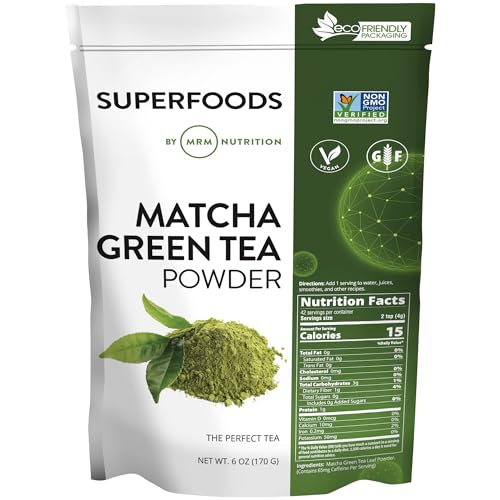
5. MRM Nutrition Superfoods Matcha Green Tea Powder, 42 Servings
A superfood-focused tub that leans into the energy side of matcha
If you drink matcha for the calm focus rather than the café flavor, this unsweetened tub is built for that. It is unsweetened, vegan, gluten-free, and finely ground from whole green tea leaves with no added sugars, flavors, or fillers.
Unlike the tea-estate picks here, MRM has been trusted since 1996 and is owned by a clinical dietitian and biochemist, positioning this as a superfood powder first and a tea second. That shows in the format — it is a 6-ounce tub built around 42 stated servings, and the review pages focus heavily on how it lands in your body, not just on the flavor.
The honest split is on taste: some buyers love the matcha flavor in vanilla almond milk with a touch of maple, and others find it very bitter. Value opinions divide too, which mostly depends on whether you treat it as a coffee swap or a baking ingredient.
Best as: a clean, unsweetened energy powder for morning smoothies, almond-milk lattes, or a matcha swap for coffee.
Know before you buy: it splits opinions on taste — some love it, some find it sharply bitter — so it rewards drinkers who already know they like a strong, unsweetened matcha flavor.
Right fit: someone who wants a vegan, unsweetened superfood powder with a clear energy focus and treats it as a coffee replacement.
Wrong fit: a sweet-tooth latte drinker who wants a mild, milky-cup flavor out of the tin.
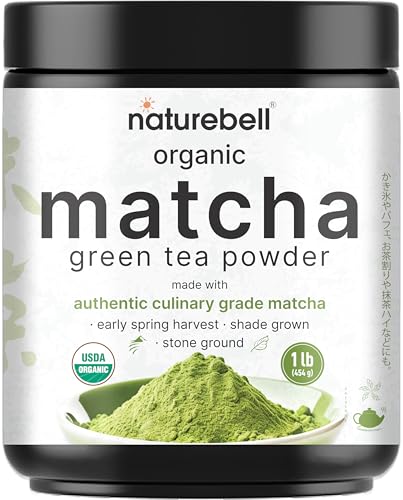
6. Organic Matcha Green Tea Powder, 1 Pound by NATUREBELL
One pound, 151 servings, zero sugar — the volume buyer’s daily driver
Stated outright: 1lb (454g) of culinary-grade matcha that covers 151 servings at one scoop a day. For anyone who drinks a matcha latte most mornings, that is the pouch that stops the monthly reorder treadmill.
It is unsweetened, zero sugar, dairy-free, and tested by a third-party lab — and notably, the label states it is not exposed to radiation and does not contain GMOs, gluten, soy, dairy, wheat, eggs, fish, shellfish, tree nuts, or fillers. The powder is finely stone-ground from early spring leaf harvest, which is the marketing promise behind its color and dissolve.
Flavor and mixability are the strong suits. Buyers consistently report it dissolves cleanly in hot water and lattes, leaving little residue at the bottom of the mug, and the mild earthy flavor avoids the grassy bite that turns people off culinary matcha. Comparing it side by side with a competitor in the same price band, drinkers report this one tastes brighter, less bitter, and holds its color in milk. The one recurring nit is mixability at high concentration — a few drinkers note it does not dissolve quite as easily as the very finest powders.
What the pound buys you
- 151 servings per bag and 454g of powder — a genuinely long runway
- Unsweetened with zero sugar and dairy, so you control the flavor
- Mixes well in hot water with little leftover sediment
The fine print
- Mild flavor — not the bag for someone wanting a bold straight-tea cup
- Some drinkers find it dissolves a touch slower than the finest powders
If value per serving is your metric: this is the pouch to buy, full stop — half a kilo of unsweetened culinary matcha you will not finish quickly.
But know: the flavor is mild, so it plays best under milk, not in a plain cup.
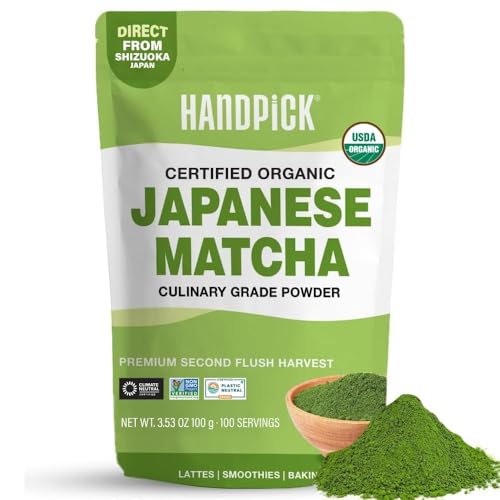
7. HANDPICK Japanese Organic Matcha Green Tea Powder, 100 Servings
Shade-grown, stone-ground, and the smoothest, sweetest cup in the lineup
If you want a matcha that smells as good as it tastes, this is the pouch built around aroma. Grown in the shade to deepen color, hand-picked, and stone-ground into a fine powder, this is a Japanese organic matcha with a Non-GMO verification behind it.
The pouch itself is resealable, sealed to hold the vibrant green and earthy flavor between scoops, and it states 100 servings — though drinkers note it lasts beyond that because you control the portion. Flavor and quality are the two clear standouts; buyers describe it as earthy, aromatic, not chalky, and sweet enough to drink nearly plain. As owners put it, “This is my go to matcha, the taste and quality are great!!! I would recommend it to anyone.”
The honest catch is twofold. Solubility is mixed — some drinkers find it needs a proper sift and whisk to avoid clumps. And while the pouch holds a generous amount, a few buyers find it does not stretch quite as far as the label’s 100-serving claim. Neither undercuts the flavor; both are worth knowing before you commit.
Why it earns the “sweetest cup” label: a shade-grown Japanese organic matcha with noticeable aroma and a smooth, velvety mouthfeel that drinks well nearly unsweetened.
The one caveat: this powder rewards a sift-and-whisk routine — skip either and you may hit clumps, unlike the smoothest dissolving powders in this list.
Snag it if: you brew a mindful daily cup or latte and want a sweet, aromatic Japanese organic matcha you can drink close to plain.
Pass if: you want a set-and-forget powder that dissolves without sifting, or you are chasing the deepest per-serving economy.
8. Kenko Matcha Green Tea Powder, USDA Organic Culinary Grade, 100g Bag
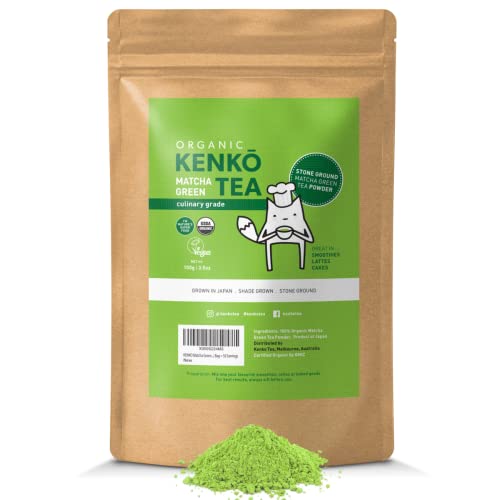
A Nishio-sourced bag that bakes better than it brews
Kenko pulls from the Nishio region of Japan, first-harvest early May, shade grown and hand-picked before stone grinding on granite mills. It is USDA Organic, non-GMO and gluten-free, and the maker states it performs heavy-metal safety tests and radiation testing every month. The 100g bag covers 50 stated servings.
Where this bag shines is the color and baked-good flavor. Drinkers consistently call out a vivid green and a rich, earthy taste in cookies, cupcakes, and overnight oats — and the color is what separates it in a blender shake, where it mixes cleanly without graininess. Comparing it against the Jade Leaf bag at the top of this list, some drinkers find Kenko dissolves less cleanly in hot lattes, so the two land on different uses even though both are culinary grade.
The honest limitation is clumping. This is a powder that responds to a sift and a proper whisk, and a few drinkers find it struggles in near-boiling water without one. Treat it as a baking and blended-drink matcha and it holds up; treat it as a fuss-free hot latte powder and it may disappoint.
What makes it a baker’s pick
- Sourced from the Nishio region of Japan, first-harvest, shade grown
- USDA Organic with monthly heavy-metal and radiation testing stated
- Vivid green color and strong flavor in baked goods and blended drinks
Honest limits
- Clumps easily and needs sifting — especially in near-boiling water
- Less ideal for a hot latte than finer-milled bags at the top of this list
The right kitchen for it: bakers and smoothie makers who want vivid color and strong green-tea flavor in cookies, cupcakes, and blender drinks.
Not the pick if: your main use is a quick hot latte you want to whisk and drink without sifting.
Understanding the Specs
Grade: culinary vs ceremonial
Culinary grade is grown and ground for mixing into milk and recipes — it carries a stronger, earthier flavor that stands up to sweetener. Ceremonial is intended for a plain whisked cup with hot water. Labels in this list range from “Culinary Grade” to “Superfood Powder” to “Organic Japanese,” which tells you the intended use more than the price does.
Pouch size and serving count
Stated amounts range from 1 ounce up to a full pound across this lineup. Where a bag states servings — 42, 50, 100, 151 — that number helps you estimate real value far better than package dimensions. A 100g / 3.53oz pouch is enough for daily drinkers, while a full pound is a bulk-format commitment.
Origin and certifications
Japanese origin from a named region — Uji, Kagoshima, Nishio — is a real quality marker worth checking on the label. USDA Organic, Non-GMO, vegan, and gluten-free certifications each tell you something concrete about how the leaf was grown and handled, and whether the finished powder fits a specific diet.
Texture and dissolve behavior
Stone-ground matcha tends to dissolve cleanly and clump less, especially when sifted first. Several bags in this list call out stone grinding specifically, and review patterns follow — the finest-milled powders dissolve with a whisk, while coarser or chunkier grinds need a sift to avoid clumps in milk or water.
FAQ
Is culinary grade matcha good enough to drink as tea?
How many lattes do I actually get from a 100g bag?
Why does my matcha taste bitter and what fixes it?
Do I really need a bamboo whisk and sifter?
Is it worth paying more for ceremonial grade on a budget?
How should I store matcha to keep it fresh?
Does matcha have caffeine and how does it compare to coffee?
Which bag in this list is best for baking?
Do these matcha powders contain added sugar or fillers?
Can I use matcha for cooking beyond lattes and smoothies?
Final Thoughts: The Verdict
For most buyers, the budget matcha winner is the Jade Leaf Matcha Powder, Organic Culinary Grade, 100g / 3.53oz because it pairs an organic, single-ingredient Japanese pouch with a smooth, clump-free grind that works in lattes, smoothies, and baked goods without a fuss — and the per-cup math handily beats café prices. If you want the most grams for the money and drink your matcha in milk, grab the MatchAiA 150g Pouch, which packs 5.3 ounces of stone-ground powder against the 1-ounce Maeda Shiki tin. And for the truly bulk-minded baker who wants a full pound of unsweetened matcha that lasts months, the NATUREBELL 1 Pound bag is the one to reach for. One nudge: Jade Leaf’s smooth texture and organic Japanese sourcing make it the safe first pick — the most-raved-about traits on that bag are quality and flavor, and it clears the bar for nearly every daily use.
How We Picked
We do not accept paid placement. Every pick is matched to a real buyer and a real use-case; we do not hands-on test units.
Sources & Methodology
Specifications: manufacturer listings and product documentation. Review insights: verified customer reviews, as of September 2026. Pricing: not shown on this page (it changes often); check the current price via the retailer link.
As an Amazon Associate, Gadgets Feed earns from qualifying purchases. This does not affect which products we feature.