
Our readers keep the lights on and my morning glass full of iced black tea. As an Amazon Associate, I earn from qualifying purchases.
Specs are compiled from manufacturer listings and verified buyer reviews and can change over time — please confirm the key details on the product page before buying.
Battery cables are the one car part nobody thinks about until a slow crank on a cold morning leaves them stranded. And the shelf is crowded with lookalike cables that quietly differ where it counts — the metal inside the jacket. The single most important thing to know before you buy: whether the conductor is pure copper or copper-clad aluminum, and how many strands carry the current. A fat cable built from copper-coated aluminum will sag under a heavy starter or winch load, while a properly stranded pure-copper cable the same size runs cooler and last far longer. Get those two details right and a cheap cable can beat a thicker one.
I’m Min — the founder and writer behind Gadgets Feed. This guide is built by comparing the manufacturers’ published specifications and the patterns across verified customer reviews, so you get each pick’s real strengths and trade-offs instead of marketing spin.
Each cable below is a proven automotive pick with one job it does better than the rest. The crowd-pleaser so far is a 4 AWG pair that holds 4.8 stars across 500+ ratings, and it tells you a lot about what buyers actually reward. Here is the shortlist of the best automotive battery cables, sorted by what each one does best.
Our Picks at a Glance
How To Choose The Best Automotive Battery Cables
You want a cable that carries full starter current without heating up. Three things decide that: what the conductor is made of, how thick it truly is, and how it will be terminated. Get those right and the cable outlasts the battery. Get them wrong and you have a hot, inefficient run that wastes current and can damage a winch or starter.
Conductor material is the first decision
Pure annealed copper (OFC) is the gold standard for high-current DC work, because it carries amperage with far less resistance than aluminum. Copper-clad aluminum (CCA) wraps a thin copper skin over an aluminum core — it is lighter and cheaper, but generates more heat and more voltage loss under heavy load. If you are running a winch, a high-draw inverter, or a long starter cable, pay the extra for real OFC. If the run is short, the load is moderate, and cost matters, CCA can be the sensible compromise.
Gauge is not always an exact number
The gauge number on the jacket is a nominal size, not a guarantee. Some cables marketed as 1/0 or 0 gauge are physically closer to a 2 gauge when measured. On the flip side, a high strand count in a smaller gauge can outperform a low-strand cable one size up. The takeaway: check the strand count and the actual copper diameter, not just the label.
Terminals and crimping are where good cables go wrong
A perfect cable mated to an undersized lug or a loose crimp will heat up and fail. Match your lug bore to the stud you are bolting to (3/8 inch is common), and match your crimper die to your cable gauge. If you do not own a crimper, look for a set that arrives with lugs already crimped and heat-shrink tubing pre-installed — that removes the biggest installation risk.
Quick Comparison
| Model | Best For | Gauge / Conductor | Length | Rated Current / Voltage | Amazon |
|---|---|---|---|---|---|
| A ABIGAIL 4 AWG Battery Cable 4FT★ Best Overall | Everyday battery-to-battery runs | 4 AWG Pure Copper (tinned lugs) | 4 FT (Red + Black) | 85 A / 12 V | Amazon |
| Shirbly 1/0 AWG Flexible Battery CablePremium Pick | Marine & outdoor dual-battery | 1/0 AWG OFC (1703 strands) | 1 FT (Red + Black pair) | 600 V | Amazon |
| Geosiry 6 Gauge Battery Cable 15FT | Long custom routing on a budget | 6 AWG OFC (423 strands) | 15 FT (Red + Black) | 600 V | Amazon |
| Ruikarhop 40FT 1/0 Battery Cable CCA | Big CCA runs on a tight budget | 1/0 AWG CCA | 40 FT (Red + Black, with lugs) | 250 A / 12 V | Amazon |
| GEARit 0 Gauge Wire 25FT Each | Custom audio & chassis grounds | CCA (nominal 0 GA) | 25 FT (Red + Black) | — | Amazon |
| Shirbly 2 Gauge Battery Cable 10FT | High-current starter & inverter runs | 2 AWG OFC (1070 strands) | 10 FT (Red + Black) | 600 V | Amazon |
In‑Depth Reviews
1. A ABIGAIL 4 AWG Battery Cable 4FT
Our pick — over 4.5★ from 500+ verified ratings; the strongest balance of quality and price.
Pure copper, sealed ends, and the size most ordinary battery jobs actually need.
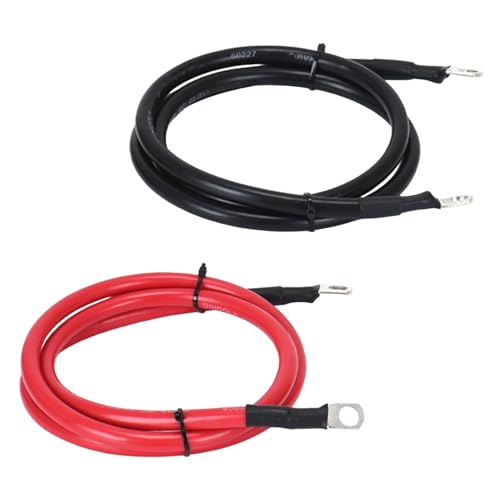
The A ABIGAIL 4 AWG set is the cable most people should buy first. It is a 4-gauge pure copper pair — one red positive and one black negative — cut to 4 feet each, with a 3/8 inch ring terminal (a looped metal connector) already fitted at both ends. The lugs are tinned copper, meaning they carry a thin protective coating that resists the corrosion that quietly eats bare copper over a few winters. Each run is rated to 85 amps at 12 volts, which covers everything from a golf cart battery swap to an outboard motor hookup. The cable ends are sealed with heat shrink tubing, so moisture cannot creep into the wire strands.
What wins people over is how solid the whole package feels out of the bag — the tinned lugs, the flexible PVC jacket, and the crimps all get the same review: well-made. It is also the most-used cable in this group by a wide margin, which is your best signal that it holds up in real ownership. Two buyers put it simply — one calling it “A solid well built product” noting “Good Crimps,” another using it as “Perfect extensions for my lithium battery swap.” In practical terms, if you are connecting two batteries together or adding a clean ground, this is the length and the gauge that does it without fuss.
Where the honest limit sits: the terminals run a shade smaller than some buyers picture. A 4-foot length is also generous for tight installations, so measure before you commit. Keep the lugs dry and torqued and they will outlast the battery. For a first purchase or a straight replacement, this is the safe, well-proven answer.
What Earns It First Place
- 4 AWG pure copper with tinned lugs keeps corrosion off the part that touches your battery post
- Both ends arrive with 3/8 inch ring terminals and sealed heat shrink, cutting installation time
- 85 A at 12 V is enough headroom for golf carts, outboards, and dual-battery setups
- Consistently rated as heavy-duty and well-fitting across the largest review base here
Small Things To Know
- Some buyers find the terminal rings run slightly smaller than expected
- 4 feet is generous — confirm your routing distance before ordering
Buy this if: you want a proven, ready-to-bolt pair for battery-to-battery links, grounds, or a lithium swap.
Think twice if: you need a long custom run or a specific terminal size — measure and check the ring bore first.
2. Shirbly 1/0 AWG Flexible Battery Cable (1FT Pair)
An ultra-fine stranded copper pair built to bend into spaces thicker cables refuse to go.
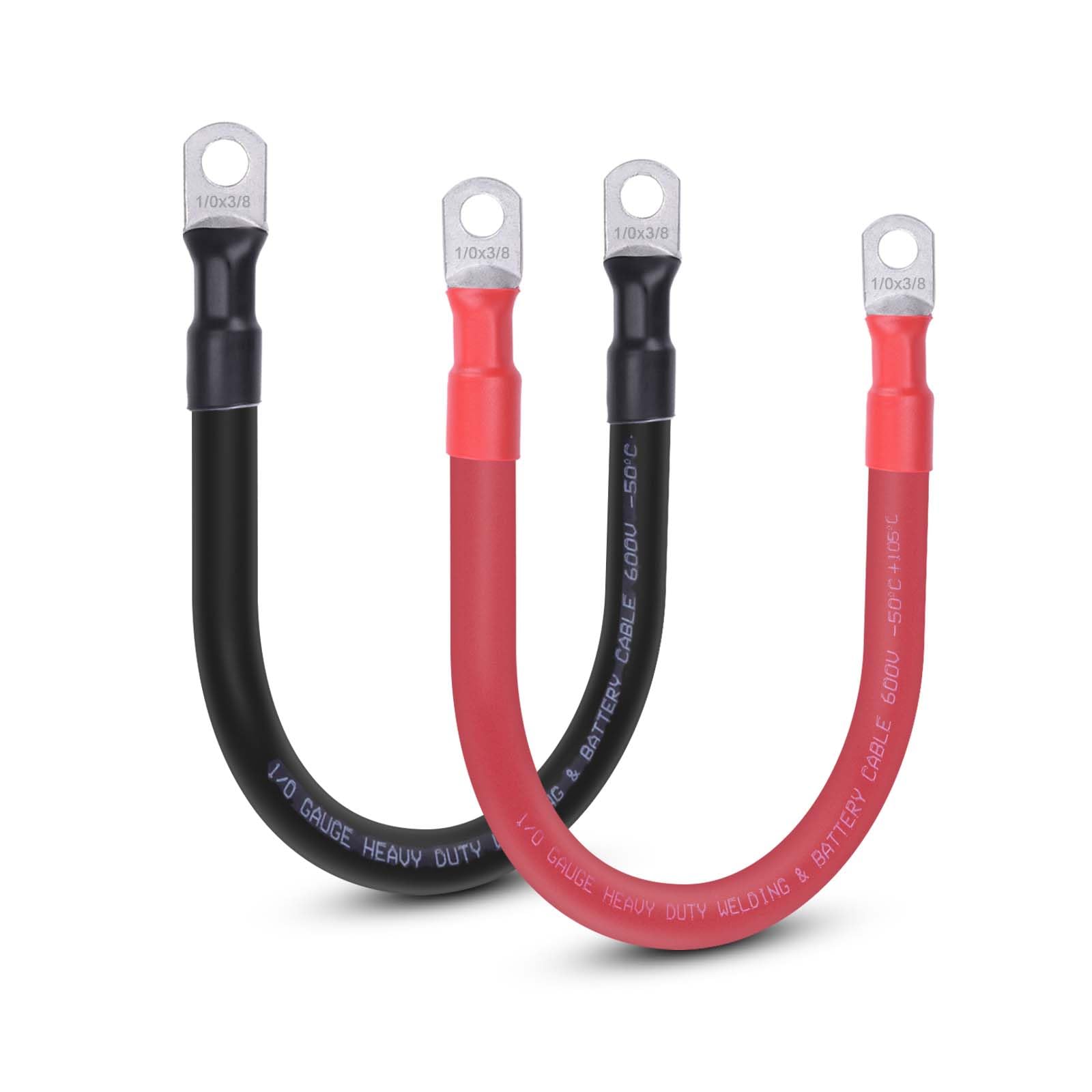
If you are working inside a sealed battery box, a marine locker, or a spot too tight for a stiff cable, this is where you end up. The Shirbly 1/0 AWG is built from 1703 individual strands of 0.2mm copper wire — that extremely high strand count is exactly what makes a fat cable feel soft and limber instead of rigid. It is wrapped in solvent-resistant EPDM rubber insulation, rated to 600 volts, and listed to hold up between -58°F and +221°F. Shipped as a 1-foot red and 1-foot black pair with 3/8 inch terminals already crimped and 3:1 dual-wall adhesive heat shrink on the ends. Against the 6 gauge above at 423 strands, the Shirbly packs 1703 — that finer, denser copper is why it bends where the stiffer cable would fight you.
Owners describe exactly that feel. One calls it “Stout,” saying “Exactly what I hoped for. Very sturdy and flexible considering they’re 1/0 copper cables. Terminals are very thick. Mine are in a sealed battery box, but I would have no problem with them being exposed, they look nice.” The tin-coated copper lug is closed-ended, so moisture, acid, and solvents stay away from the core — a real advantage for anything mounted outdoors. It also earns frequent comparisons as a clean replacement in odd jobs, with several buyers noting it worked great as a direct swap for an electric fireplace feed.
The catch is honest: one foot is short. If you need to reach across an engine bay or run between two distant terminals, this length will not do it. And the EPDM jacket, while built for solvent, will shrug off a lot — but the terminal still deserves a light coat of protectant if it lives outside. What you are paying for here is the fine-strand flexibility and the marine-ready copper, and on both counts it delivers.
Where the value lives: the 1703-strand conductor and pre-crimped thick-copper lugs make this a premium feel at a modest length. Buy it for tight, short, high-quality runs and consider it a like-for-like upgrade over a standard stiff cable.
Reach for this if: you need a flexible, marine-grade pair for a short jumper or a tight battery-box connection.
Look elsewhere if: your run is longer than a foot — you will need the longer Geosiry or the 2 AWG pair instead.
3. Geosiry 6 Gauge Battery Cable, 15FT Red + 15FT Black
Enough oxygen-free copper to run the full length of a UTV or camper and still bend around corners.
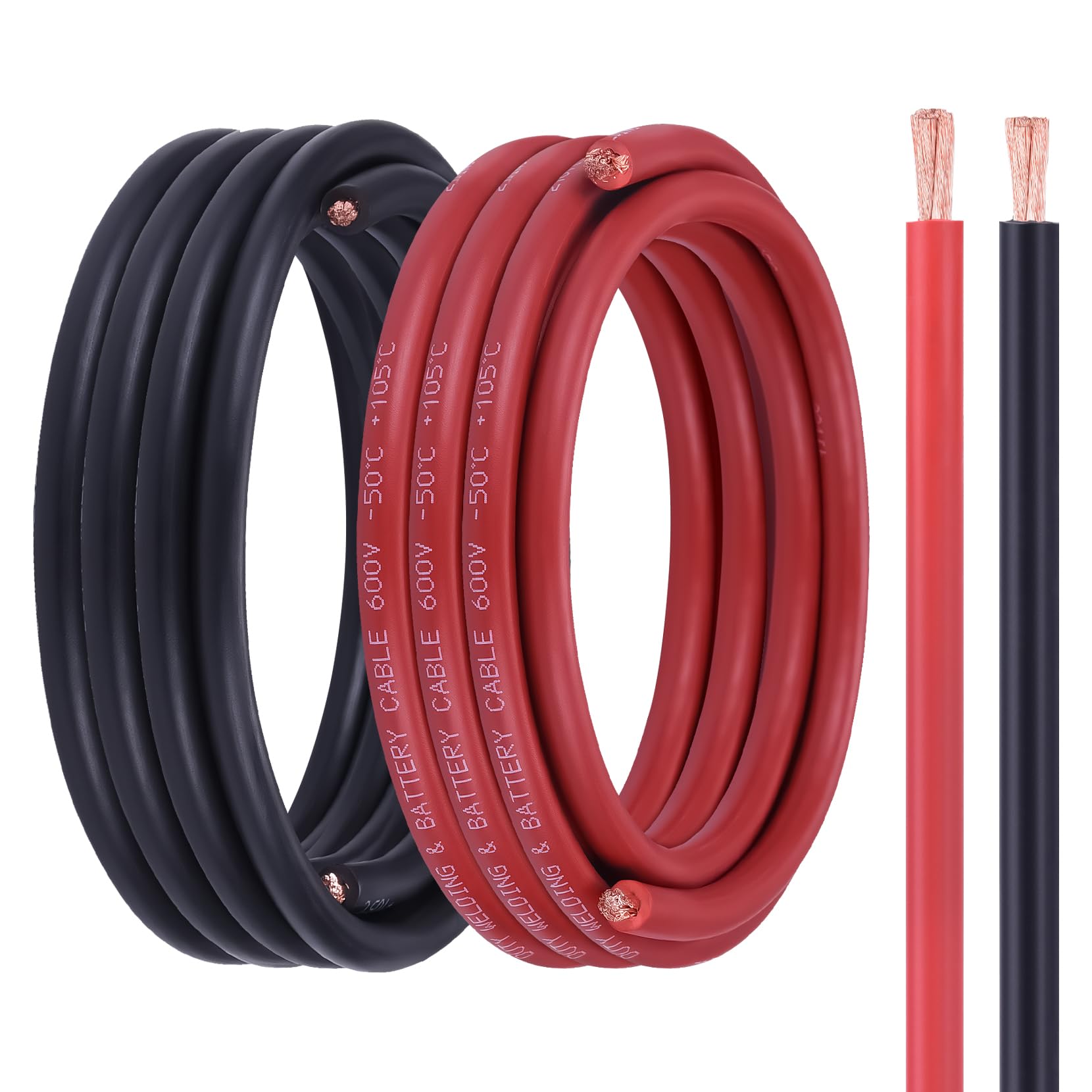
The standout number here is length: 15 feet of red and 15 feet of black, both 6 gauge. That is 15 feet to a side versus the 1-foot pair above — a 15-to-1 gap that turns this from a jumper into a genuine full-run cable. It is made from 100% fully annealed oxygen-free copper (OFC) with 423 strands of 0.2mm wire, rated to 600 volts, and wrapped in a solvent-resistant EPDM jacket. Heat and abuse ratings sit between -122°F and +221°F, and the copper content means it crimps and carries current cleanly. The length comparison is no small thing — running power to a winch at the back of a UTV or a remote RV battery typically needs this much cable, and the shorter premium pair simply cannot cover it.
Reviewers confirm it holds up under real routing. “Great product,” one writes, “It’s flexible enough to run the length of a JD Gator. I would buy again.” Others note it crimps well and carries current without heating up, and a car-wiring buyer says it seems accurate to gauge and length. The flexible copper plus heavy insulation make it easy to snake through tight frames.
The honest trade-off, and it echoes through this listing’s reviews: a minority question the purity of the copper, with a couple of buyers believing the strands are copper-plated rather than solid copper all the way through, and one noting a sizing mismatch against the advertised gauge. Those are real cautions worth weighing before you commit. Treat this as a value-tier long-run cable for general automotive and generator work — and if your current draw is genuinely high, size up rather than stretch this one thin.
Why The Length Wins
- 15 feet per side covers full UTV, camper, and generator runs that short cables cannot
- 423-strand OFC copper crimps cleanly and carries current without heating up
- EDPM jacket resists heat, abrasion, moisture, oil, and corrosion
- Rated to 600 V and built for harsh outdoor and marine conditions
Worth Double-Checking
- A few buyers question whether every strand is pure copper versus copper-plated
- One reviewer found the gauge arguably closer to 8 AWG than 6
Best matched to: UTV, RV, and generator owners who need serious reach at a value-tier price.
Hold off if: you are feeding a high-draw inverter or winch — step up in gauge rather than running this long and thin.
4. Ruikarhop 40FT 1/0 Battery Cable CCA

Matchstick-thick 1/0 cable by the armload, with lugs and heat shrink already in the box.
This is the volume play: 20 feet of red plus 20 feet of black — 40 feet total — of 1/0 gauge cable, rated to 250 amps at 12 volts, and it lands with matching lug terminals and 3:1 heat-shrink tubes so you are not chasing parts separately. For truck battery relocation, amp power/ground runs, or a trolling motor feed, that much heavy cable in one kit is exactly what the job eats up. The jacket is a rugged flexible PVC, and the red and black are clearly coded so you can tell power from ground across a long run. If you are wiring a whole battery relocation or an amp, the sheer footage versus the short premium pairs is the reason to look here.
The thing buyers agree it gets right is function and value — it starts a car faster than a tired factory cable, and it rations out as “twice the cable for half the price” among a crowd that is wiring on a budget. One owner calls it “Overkill, But in the Best Way Possible,” noting it handles high amperage easily and that the vivid red jacket is very flexible and easy to route. It is one of the highest-rated cables in this group on its functional score, which is a strong signal for a value-tier kit.
Be clear-eyed about the conductor, because this is where they are honest with you: it is CCA — copper-clad aluminum — not pure copper, and buyers who understand that say so plainly, pointing out it runs hotter with more loss than solid copper under sustained high-current loads. The gauge is also not strict AWG by some owners’ measurements. That makes this a great fit for moderate-to-heavy casual use, but a poor fit for a continuous high-draw solar or inverter setup where pure copper matters. For a 250-amp occasional pull, it does the job.
Go for it if: you need a large quantity of heavy cable for a relocation or amp install and want terminals included.
Choose pure copper instead if: your setup draws current continuously — CCA runs hotter and loses more under sustained load.
5. GEARit 0 Gauge Wire, 25FT Each

Fifty feet of paired red-and-black cable for people who want to measure, cut, and route their own way.
If your project is a custom build — a dual-battery layout, a chassis ground, an amp run in a truck — the value here is flexibility of a different kind: it comes as bulk 25-foot red and 25-foot black, uncut, so you decide every length. The idea is to measure, cut, and pair each run with your own 0 gauge terminals and heat shrink for a professional finish. It is built from copper-clad aluminum (CCA), which keeps it lighter in hand and easier to route than solid copper of the same size, and the stranded core bends through trunks, panels, and battery compartments without kinking. The matching red/black pair also makes power and ground runs easy to trace later during service.
The reviews come back most on flexibility and installation: it bends through tight turns, and it crimps nicely with compression lugs, a detail that matters because a clean crimp is the difference between a cable that holds and one that heats up. The recurring, honest caveat is sizing and material — buyers measure it closer to thin 1 AWG than a true 1/0, and some find the strands stiff and, being CCA, less tolerant of heavy sustained current. It is a buyer’s cable: outstanding value for the thickness if you know you are getting value-tier CCA. It also handles demanding draw in the field, with one owner running a 12,000-pound winch hard and reporting zero heat damage to the power cable.
So buy this when you want room to fabricate your own runs and you are willing to supply your own terminals. Buy it not for a bolt-on, pre-terminated job — no lugs are included — and not for a continuous high-amperage feed where pure copper is the smarter call.
The value proposition: two full 25-foot spools of thick paired cable for custom fabrication. It is the best fit for a builder with a crimper and a plan, not a plug-and-play replacement.
Made for: DIY installers fabricating custom amp, battery, or ground runs who own their own crimping tools.
Not the one for: a quick, pre-terminated replacement — there are no lugs in the box, and the CCA core suits moderate loads better than constant heavy draw.
6. Shirbly 2 Gauge Battery Cable, 10FT Red + 10FT Black

Heavy 2 gauge pure copper with a strand count that stays supple at ten feet.
For a starter-to-battery run or an inverter feed, this Shirbly pair pairs serious copper with real length: 10 feet of red and 10 feet of black in 2 gauge. It is 1070 strands of 0.2mm annealed oxygen-free copper, wrapped in solvent-resistant EPDM rubber, rated to 600 volts, and rated for temperatures from -58°F to +221°F. The thick jacketing resists heat, wear, tear, moisture, oil, and corrosion, and the copper is soft enough to bend into shape by hand — helpful when you are threading a heavy cable through a bulky engine bay. This is the cable to pick when the job is short but the current is not: battery-to-starter, block-to-chassis grounding, or powering an inverter.
Owners tend to land on the same two words — quality and flexibility. One calls it a “Great cable” with a “high strand count, flexible jacket.” Another reports upgrading a golf cart to lithium and finding it made a noticeable difference in how the cart ran. A third says the core is full AWG size and crimps into appropriate lugs with a secure hydraulic crimp. On a heavy 100-amp load it holds without fuss, which is exactly the point of stepping up to 2 gauge.
Two things to know before you order. First, the rubber jacket arrives with a strong chemical smell that needs airing out for a few days — harmless, but worth setting aside in the garage, not the living room. Second, the wire does not come with lugs, so budget for 2 AWG spade terminals and heat shrink to finish the job properly. Lengths also run close to but not perfectly exact, so if you are cutting to a precise measurement, plan a little margin.
Where This Shines
- 1070-strand pure copper stays flexible enough to hand-bend at ten feet
- 600 V rating and -58°F to +221°F temperature range suit harsh engine bays
- Thick EPDM insulation resists heat, moisture, oil, and corrosion
- Handles a 100 amp load without issue
Flat Honest Notes
- Fresh rubber jacketing has a strong smell that needs airing out for days
- No lugs included — you will need 2 AWG terminals and heat shrink
- Lengths run close to, but not exactly, the stated measurement
Pick it when: you need heavy pure copper for a starter, inverter, or ground run and want length plus flexibility.
Be prepared for: supplying your own 2 AWG lugs and giving the jacket a few days to off-gas before install.
Understanding the Specs
Gauge and Strand Count
Gauge is the cable’s thickness rating — the lower the number, the thicker the copper, and the more current it can carry without heating. But gauge alone does not tell the whole story. Strand count measures how many fine copper threads make up the conductor. A cable with more, finer strands bends more easily, resists fatigue, and handles vibration better than a low-strand cable of the same gauge. This is why a 1/0 AWG cable built from 1703 strands feels far more flexible than a stiffer cable of similar size. Serious buyers check both numbers: the gauge for how much power it carries, and the strand count for how it will behave in a tight engine bay or a moving vehicle.
OFC vs CCA Conductor
The metal inside the jacket is the single biggest quality divide. Pure oxygen-free copper (OFC) carries current with low resistance and low heat, making it the choice for winches, inverters, starters, and anything drawing sustained heavy current. Copper-clad aluminum (CCA) uses an aluminum core under a copper skin — lighter and cheaper, suited to lighter handling and moderate loads, but it generates more heat and loses more voltage under heavy draw. Neither is “bad”; they are built for different jobs. Match the conductor to the load: OFC for constant high-current work, CCA for shorter or lighter runs where budget matters more than peak efficiency.
FAQ
What gauge battery cable do I need for a car starter?
Is pure copper better than CCA for battery cables?
Can I use these cables for a dual battery setup?
What size ring terminal fits my battery stud?
How long do automotive battery cables last?
Do I need a special crimper for heavy gauge battery cable?
Can battery cables be used for solar and marine applications?
How do I keep battery cable terminals from corroding?
Can I cut a longer battery cable shorter to fit my run?
Final Thoughts: The Verdict
For most people, the automotive battery cables winner is the A ABIGAIL 4 AWG Battery Cable 4FT because it pairs pure copper and tinned, sealed lugs with the 4-gauge size most battery-to-battery jobs actually call for — and it does it as the best-proven pick in this group. If tight, flexible, marine-ready copper is what your install needs, the Shirbly 1/0 AWG pair is the one to reach for. For a full-length run in a UTV or camper, grab the Geosiry 6 Gauge 15FT set. And when heavy 2-gauge copper for a starter or inverter is the job, the Shirbly 2 Gauge 10FT pair finishes it cleanly.
How We Picked
We do not accept paid placement. Every pick is matched to a real buyer and a real use-case; we do not hands-on test units.
Sources & Methodology
Specifications: manufacturer listings and product documentation. Review insights: verified customer reviews, as of September 2026. Pricing: not shown on this page (it changes often); check the current price via the retailer link.
As an Amazon Associate, Gadgets Feed earns from qualifying purchases. This does not affect which products we feature.