
Our readers keep the lights on and my morning glass full of iced black tea. As an Amazon Associate, I earn from qualifying purchases.
Specs are compiled from manufacturer listings and verified buyer reviews and can change over time — please confirm the key details on the product page before buying.
If you drive anything bigger than a hatchback, you already know the feeling: you’re easing backward, craning your neck, and still guessing at the last two feet. A backup camera for car use fixes that in an afternoon of driveway work. The catch is that these kits are not one-size-fits-all — some slot into your cigarette lighter and run forever, some ask you to splice into reverse lights, and some replace your whole rear-view mirror. The wrong pick means a screen that dies in a heat wave, a mirror you can’t read in daylight, or a wire that stops three feet short of the dash. This guide sorts the eight kits worth considering by how you’ll actually use them, so you end up with a camera that works the first time you shift into reverse.
I’m Min — the founder and writer behind Gadgets Feed. This guide is built by comparing the manufacturers’ published specifications and the patterns across verified customer reviews, so you get each pick’s real strengths and trade-offs instead of marketing spin.
You’ll see which kits are truly plug-and-play, which sensors fight the dark, and which screens survive a Texas summer. Here is the practical breakdown of the best backup camera for car buyers who want to see behind them.
Our Picks at a Glance


How To Choose The Best Backup Camera For Car
A backup camera is one of the few car upgrades you can install yourself in an afternoon and feel every single time you park. But the market splits hard: some kits are pure plug-and-play and some demand real wiring work. Get the wiring style right first, because that decision drives everything else.
Wired or wireless: pick your wiring style first
A wired camera sends its picture through a physical video cable, which means zero signal drops and no lag when you shift into reverse — you press R and the image is already there. The trade-off is routing that cable from your trunk to your dash, which is the part most people underestimate. A wireless camera skips the cable run, but wireless kits are the ones buyers report freezing or stuttering mid-park, because a radio signal has to survive your car’s metal body.
Power source: USB, cigarette lighter, or reverse light
How a camera gets its power changes your whole install. A USB-powered monitor means no cutting into your car’s wiring at all — you use the port you already have. A cigarette-lighter kit is equally simple and often lets the camera run all the time as a second rear-view mirror. Tapping the reverse light wire is the cleanest look, because the screen only fires up when you actually back up, but it asks more of you in labor.
Screen size and where it lives
You want a screen you can read at a glance without it hogging your dash, and a 4.3-inch monitor hits that balance for most cabins. Step up to a 7-inch screen and it is easier on older eyes and fits truck cabs, but it eats real dashboard space. Some kits clip over your factory mirror instead, which keeps the cabin clean but can wash out in bright daylight depending on how the glass faces the rear window.
Waterproofing and night vision
The camera lives outside, so its IP rating is the difference between a unit that survives road salt and one that fogs up by winter. An IP rating is a two-digit seal score for dust and water — higher is better. Night vision comes from either white LEDs or infrared, and infrared is the one that keeps working when a bright white light just bounces back at you.
Quick Comparison
| Model | Best For | Monitor Size | Waterproof Rating | Field Of View | Amazon |
|---|---|---|---|---|---|
| LeeKooLuu USB Plug and Play★ Best Overall | Fastest no-cut install | 4.3″ | IP69 | 150 degrees | Amazon |
| YIMU K4302Best Value | Best value all-rounder | 4.3″ | IP69K | 150 degrees | Amazon |
| FEISIKE ADC711Best Night Vision | Dark-climate drivers | 4.3″ | IP68 | 150 degrees | Amazon |
| Jensen BUCAM100J | Radio-screen upgrade | — | IP67 | 170 degrees | Amazon |
| eRapta AGQT01 | Trailer and RV hitching | — | IP69K | 149 degrees | Amazon |
| VECLESUS VT1 | Clean mirror-look cabins | 4.3″ | IP68 | 149 degrees | Amazon |
| LeeKooLuu 7-Inch Wireless LK10 | Large-screen truck towing | 7″ | IP69 | 150 degrees | Amazon |
| AUTO-VOX T9 | Full mirror replacement | 9.35″ | — | 140 degrees | Amazon |
In‑Depth Reviews
1. Backup Camera Ease Install for Car – USB Plug and Play
Our pick — over 4★ from 150+ verified ratings; the strongest balance of quality and price.
Runs off the USB port you already own, so there is no fuse box to fight.
If you want the least intimidating install on this list, this is it. The monitor draws its power from a USB cable plugged into a port your car already has, which means no cutting, no fuse taps, and no professional help. LeeKooLuu lists a 15-minute install, and owners confirm it in practice. The whole kit is small too — the monitor measures 5″L x 3.1″W x 0.78″H — so it tucks onto a windshield mount without eating dashboard real estate.
You get a 4.3-inch LCD screen showing 1080P HD (a sharp, high-definition picture), with a 150-degree field of view. That wide angle is what stops a parking-lot pillar from sneaking up on your rear quarter panel. The SC1346 color image sensor (the chip that turns light into the picture) works with optical anti-shaking technology to fight the blur you get on washboard roads and speed humps. The housing carries an IP69 waterproof rating — sealed against dust and high-pressure water spray — which matters when a truck throws slush at your bumper. It switches itself to night vision automatically, helped by 6 white LEDs and an anti-halo chip that stops headlights from smearing the picture. The ABS-TC housing is rated to keep working from -22°F to 176°F, so a Texas summer does not cook it.
What wins people over here is the picture-and-value pairing: sharp image quality for a modest outlay, and an install most owners finish themselves. The one recurring caveat is the suction cup mount — it sags in heat, and a windshield or vent mount holds far better, so budget for that swap. Owners also praise the adjustable grid lines that slide left, right, up and down, and a brightness and contrast control that lets you tune the image to your cabin’s light.
The case for going USB
- Zero wiring into the car — power comes from an existing USB port
- 1080P image with a 150-degree lens that catches curbs and pillars
- IP69 sealed housing rated from -22°F to 176°F
- Adjustable grid lines you can move left, right, up or down
What to plan around
- The suction cup mount loses grip in heat — a windshield or vent mount is the fix
- Some buyers find the guide lines sit slightly off true
- The 4.3-inch screen is fine solo but small if you want a big rear view
Reach for this if: you want the shortest possible path from box to working reverse camera without touching your car’s wiring.
Think twice if: you drive a big-bumper truck and want a large monitor — the 4.3-inch display is compact by design.
2. YIMU Backup Camera System with License Plate Backup Reverse Camera
The cable run is the real gift here — it reaches where the short kits fall short.
If you drive an extended-cab pickup or a long van, this is where your money goes furthest, because wire length is where this one separates from the pack. Much of that depends on the 26-foot power cable in the box, a length that lets you route from a tailgate to a front dash with slack to spare. YIMU’s listing calls for a 10-minute two-step setup: connect the camera to the monitor with the 4-pin video power cable, then plug into a cigarette lighter or USB port. You can also tie it to the reversing lights so it fires up the moment you shift into reverse.
Consider the size difference between this and the USB kit above — YIMU’s package is 7.7″L x 4.6″W x 3.02″H against the LeeKooLuu’s 5″L x 3.1″W x 0.78″H. That extra bulk is what buys you the longer harness and the second bracket. The YIMU camera runs a 1/3-inch image sensor behind a 150-degree wide-angle lens, and the monitor is a 4.3-inch LCD with adjustable brightness, contrast and saturation. You can drag the parking grid lines around, resize them, or switch them off entirely, which is handy when factory-fitted lines never quite match your bumper.
The dual-bracket design is the quiet win — the license plate frame comes pre-installed, and YIMU throws in a small second bracket so you can mount the camera on the front or side of the vehicle instead. Functionality is the quality buyers rave about most, with trailer hitching a common use case. YIMU covers the system with a 2-year warranty, a 30-day money-back guarantee, and lifetime technical support. The bugbear is cable routing — owners describe threading it through a frame as fiddly work, even though the cable itself is long enough.
Where it earns its keep: a 26ft power cable plus a pre-installed license-plate bracket means this suits long-wheelbase vehicles that leave short kits stranded.
The honest catch: with a 4.3-inch monitor, anyone with less-than-perfect close vision will want a bigger screen, and a few owners mention the picture can look small from a truck seat.
Pick this one for: a pickup, RV or trailer where the cable distance is the dealbreaker.
Not the one for: someone who wants a large display without adding a separate screen.
3. FEISIKE Backup Camera, 1080P IR Night Vision with Monitor
Infrared night vision that does not blind itself with white light in the dark.
For anyone who backs out of a dim driveway or a poorly lit lot every night, this is the one to weigh first. FEISIKE uses true infrared night vision rather than the weak white assist light many budget units rely on, which means the camera lights the scene without washing out your own view. Owners consistently describe the night picture as clear, and it holds up in heavy rain too, thanks to an IP68 waterproof seal — dust-tight and protected against water immersion.
FEISIKE claims a 5-minute setup, the fastest here: connect camera to monitor, then plug into a cigarette lighter. The monitor is a 4.3-inch LCD, and the camera shoots at a 1920-pixel effective still resolution through a 150-degree wide-angle lens. One genuinely useful difference from rivals: you can flip the mirroring on the monitor with a setting instead of cutting a wire, so a roof-high mount does not leave you with an upside-down picture. The parking grid lines can be resized and moved around, same as the YIMU.
Two practical limits keep this from being the universal pick. First, the 12V power cord is short, which restricts where the monitor can sit — a long dashboard or deep console can leave you stretching. Second, there is no dimmer, and the screen runs bright at night, so a few buyers find it glaring after dark. Neither is a defect; both are placement problems you can plan around. What owners respond to most is the sheer functionality — it works every time they shift into reverse, day or night, and the value holds up.
Why dark-climate drivers pick it: true IR night vision plus a no-wire-cutting mirror flip makes this the easiest low-light setup to live with nightly.
Plan your layout ahead: the short 12V cord and an undimmable screen mean you should decide exactly where the monitor mounts before you start.
The right call for: a driver who reverse-parks after dark and wants a screen that reads clearly without blasting light back at them.
Look elsewhere for: a sedan with a long dash and no close 12V outlet — the short cord will frustrate you.
4. Jensen BUCAM100J HD Backup Camera

A camera-only upgrade for when your new radio already has a screen.
If you have swapped in an aftermarket head unit with RCA video input, this is the piece that completes it — and it is the only pick here that ships without its own monitor. That is not a shortcoming, it is the point: you wire it straight into the display you already have, using the standard RCA connection, and gain a 170-degree viewing angle. That is the widest lens on this entire list, wider than the 150-degree kits above it, which means fewer head-swivels when you are checking a corner.
Low light is handled well for a unit in this class. The 0.1 lux rating describes how little light it needs to form a usable image — a very dim figure, which is why customers note a bright, readable picture that sunlight does not wash out. The IP67 housing shrugs off heavy rain, snow, ice and debris, and the surface-mount design tucks flat against the vehicle so it looks factory-fitted rather than bolted on. At 9 ounces it is not going to tug at a mounting bracket.
Two real caveats. The supplied RCA cable is short, so an RV or a long truck needs the longer cable sets sold separately. And video quality draws mixed feedback — most love the picture, though some find contrast hard to set. Both are solvable, but budget for the cable. Jensen includes a 2-year warranty that stretches to 4 years once you register the product — long cover for an accessory at this level.
What a camera-only kit gets you
- 170-degree viewing angle — the widest lens on this list
- 0.1 lux rating for usable low-light image
- IP67 sealed against rain, snow and road debris
- Warranty stretches from 2 years to 4 years on registration
Know before you buy
- No monitor in the box — you need an existing RCA display
- Short RCA cable; long vehicles need a longer set
- Some owners find the contrast tricky in bright sun
Buy it if: your head unit, radio or navigator already has an RCA video input waiting for a camera.
skip it if: you have no screen yet — you would be paying for half a system.
5. eRapta Backup Camera License Plate Rear/Front View AGQT01
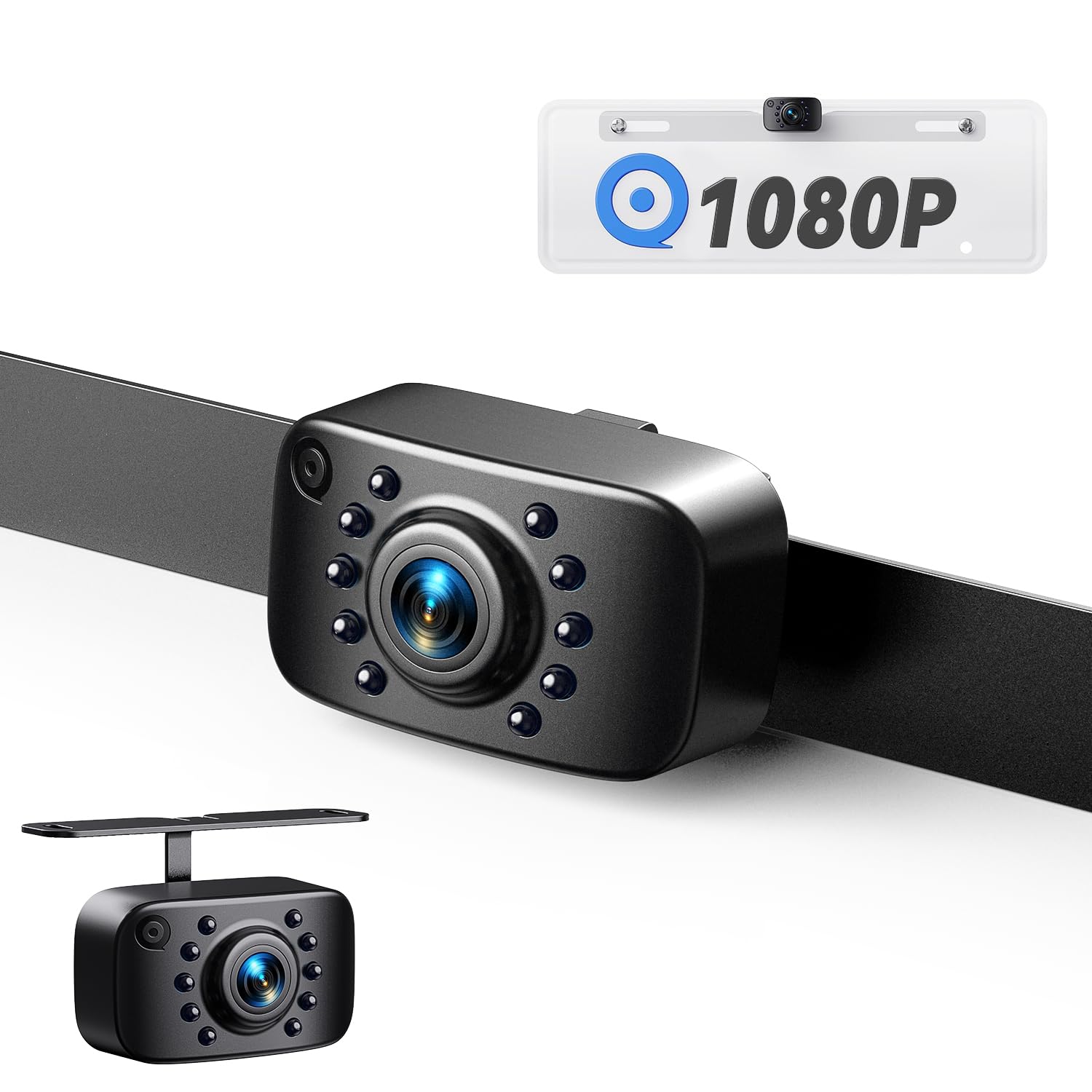
The trailer-hitching favorite — a metal-bodied camera built to be mounted and forgotten.
This is the kit that comes up again and again for anyone backing a trailer onto a hitch or watching a rear bumper all day. eRapta’s camera is housed in hard metal with a high-density impermeable shell, carrying an IP69K waterproof rating — the highest seal class here, rated against high-pressure, high-temperature water jets. That makes it a strong fit for a pickup or RV that lives outside. It takes a 12-24V DC power supply and reaches the cabin on a 26-foot AV cable, so long wheelbases are no problem.
You can plug this into more cars than the fixed-format kits, because it speaks both AHD and CVBS — the two video signal types different head units expect — and plugs into RCA video ports on radios, DVD players and OEM navigators. One practical note from the maker: most vehicles built before 2012 use the CVBS type, and if yours does, you cut the blue wire before use — so it is worth checking your car’s signal type first. The picture runs 1080P AHD with a 149-degree field of view.
Owners back up the day-and-night image quality in numbers, and the install gets the same endorsement: connect to the reverse lights, run the AV cable to your screen, done. Two honest caps on the praise. One reviewer found the real output tops out below the advertised HD, with washed-out daytime contrast, and a separate buyer had the video freeze twice while backing into a campsite. Those are individual experiences, not the norm, but if your setup depends on a live feed at a critical moment, this is worth knowing.
Why it dominates the towing crowd: an IP69K metal housing plus both AHD and CVBS support means it drops into nearly any existing screen with a 26ft run.
One thing to verify first: confirm whether your vehicle is AHD or CVBS before installing, since pre-2012 cars need wire cut to match.
Made for: trailer haulers and RV owners who want a rugged camera feeding a screen they already have.
Second-guess it if: you want a wired, wireless-free monitor in the box or a guaranteed 1080P output you can verify yourself.
6. VECLESUS VT1 1080P Wired Car Backup Camera Kit

Clips over your existing mirror for a dash free of screens and dangling wires.
If your pet peeve is extra gadgets cluttering the dashboard, this is the tidy route. The 4.3-inch monitor clips over your factory rear-view mirror, so when it is off you still have a mirror, and when you reverse the image appears where your eyes already go. Power comes two ways — a car charger for plug-in simplicity, or the included hard-wire kit into your fuse box for a concealed install at 9-24V. Run it as a continuous rear view or wire the green reversing lead so it fires up only when you back up.
The VECLESUS camera uses a CCD chip for 1080P HD and carries an IP68 waterproof rating for rain and road spray. Full-color night vision helps you pick out objects in the dark. A 33ft extension video cable runs from camera to mirror, plenty for a truck or larger vehicle. And there is a practical ceiling to note in VECLESUS’s own spec — the clip stretches to 80mm max, so a vehicle with a bigger mirror, like a Jeep Wrangler or Nissan Titan, needs a different approach.
The honest trade-off here is daylight legibility: because the mirror glass faces your bright rear window, contrast can wash out during the day, then read perfectly at night. That is a trade-off of the mirror format itself, not a fault — plenty of owners find the look clean and the picture good enough to park safely. Weight is another consideration: at about 14.56 ounces, the mirror unit is heavier than the OEM part and can vibrate on the factory mount. The upside is a quality build that owners who value a factory-fitted look keep coming back to.
Why the mirror format wins fans: a 4.3-inch clip-on monitor and a 33ft cable keep the view in your line of sight with nothing stuck to the dash.
Only real snag: the mirror glass can read washed out in bright daylight; it is crisp again after dark, so night driving is where it shines.
Perfect for: someone who wants a factory-look mirror upgrade and drives more at night than in glaring sun.
Look past it if: your mirror is larger than 80mm, or you want a bright daytime display — a dash-mounted screen serves better.
7. LeeKooLuu HD 1080P 7 Inch Wireless Backup Camera for Truck

A 7-inch wireless screen that skips the cable run entirely — if your signal cooperates.
For a big rig or a truck with a long bed, screen size is the deciding factor, and this is the largest wired-free option on the list. The 7-inch monitor gives a much bigger rear view than the 4.3-inch kits above, and it mounts on a windshield suction cup. Wireless means no fishing a video cable from bumper to dash — connect the monitor to power and the camera to the reverse light, and the pair is pre-paired so it works immediately. LeeKooLuu lists a 15-minute install, and the camera fits the standard license-plate mounts on trucks like the F-150, Silverado and Ram 1500.
The feature that stands out is split-screen mode — it supports up to 2 backup cameras, so you can watch front and rear at once, switching views with a single click of the CH button. The lens is a 150-degree wide angle at 1080P, and the IP69 waterproof housing is rated from -22°F to 176°F, so it takes rain and snow without complaint. Night vision is automatic. It even works well as a continuous rear-view screen while towing, which is why it fits the tear-drop and trailer crowd.
The trade-off with any wireless kit is signal reliability, and this one is no exception — a chunk of reviewers point out the image freezing or stuttering, and a few hit a “No Signal” screen after install. It is the inherent risk of going wireless to save the cable run, so weigh that against the convenience. One buyer did find the camera sits over the license plate’s state name, worth checking on a tightly spaced plate.
Why it’s the big-screen pick
- 7-inch monitor — the biggest fixed-screen display here
- Split-screen support for up to 2 cameras with one-click switching
- IP69 housing rated from -22°F to 176°F
- Pre-paired wireless setup in about 15 minutes, no cable to the dash
Where wireless bites back
- Wireless signal can freeze or stutter, and a few units show “No Signal”
- The included suction cup mount is flimsy; Velcro on the dash works better
- Mounting can require drilling on some vehicles
Go wireless here if: you want a large, easy-to-read screen for towing and don’t want to run a cable through the cab.
Prefer wired instead if: you cannot tolerate even a rare signal freeze — a cabled kit above is the safer bet.
8. AUTO-VOX OEM Rear View Mirror Camera with 9.35” 1080P Monitor

Replaces your whole mirror with a 9.35-inch streaming display that also records.
This is the one to consider if you want the mirror gone and a big screen in its place. AUTO-VOX replaces your factory mirror entirely with a 9.35-inch streaming media monitor mounted on an OEM bracket, so it looks built in rather than added on. The package includes 4 different adapters to fit most vehicles, and the full-touch streaming screen shows a real-time rear view with enough width to read road signs and number plates. It also doubles as a dash cam, recording continuously and loop-recording over the oldest files when the card fills, with a manual emergency lock so an important clip cannot be overwritten.
The picture is 1080P AHD with auto brightness that adjusts to ambient light, so the view behind you keeps its detail as the day fades. Wiring is a physical cable, so the signal stays stable without interference or lag out to 33ft — a real advantage over the wireless kits if reliability matters more than install ease. The parking lines can be dragged to match different vehicle sizes, and the lens covers a 140-degree viewing angle. A 0.1 lux rating means it can form an image in very low light.
What owners rely on is the build quality and the continuous-rear-view workflow — many run it as a full-time mirror while driving, which beats a reverse-only screen for watching traffic behind. Support gets mentioned warmly too, with free upgraded brackets and adapters shipped out. The recurring grumble is heat: some units refuse to power on above 90°F until the interior cools, and the complex wiring makes for a longer install. Neither ruins the package, but neither is a secret either.
The standout spec: a 9.35-inch streaming mirror with 1080P AHD and built-in loop recording — a camera and dash cam in one factory-look unit.
The heat caveat: a handful of shoppers say the unit will not power on in extreme summer temperatures until the cabin cools, so a shaded parking spot helps.
Spring for this if: you want the full mirror replacement, a big streaming screen, and recording all in one tidy install.
Keep shopping if: you park in blistering sun all day and need a screen that never hesitates to boot.
Understanding the Specs
IP Waterproof Ratings
An IP rating is a two-number seal score for dust and water, and it decides whether a camera survives road spray and salt. IP67 handles rain, snow and debris; IP68 adds protection against water immersion; IP69 and IP69K go further, sealed against high-pressure, high-temperature water jets. If your camera sits low on a bumper that sees winter slush, aim for IP68 or higher.
Signal Type: AHD vs CVBS
AHD and CVBS are two ways a camera sends its video to a screen. AHD carries the higher-resolution image; CVBS is the older, lower-detail standard. Many vehicles built before 2012 use the CVBS type, so some cameras let you switch between the two by cutting a wire before install. Confirm what your car supports before you buy, or you may get a picture that never quite matches the spec sheet.
Field Of View and Lux
Field of view is the lens angle in degrees — the wider it is, the more of your rear bumper and flanks you can see, which is what catches a curb or a small child. A lux rating measures how little light the sensor needs to form an image; a low figure like 0.1 lux means it still works in a dark driveway. Widen the angle to see more, and check the lux figure for night confidence.
Resolution vs Reality
“1080P” is the headline number, but the true output depends on the signal path and your display. A camera feeding a budget screen may top out lower than its label suggests, and buyers have noticed exactly that on some cheap units. The practical rule: match the camera’s resolution to what your monitor or head unit can actually show, so you are not paying for detail the screen throws away.
FAQ
Can I install a backup camera myself without professional help?
Is a wired or wireless backup camera better for signal stability?
What does an IP69K waterproof rating mean for a car camera?
Will a backup camera fit my older vehicle?
Do I need a monitor or can I use my existing car screen?
How do I power a backup camera without hardwiring to the car?
Does a wide viewing angle matter more than resolution?
What is the difference between white LED and infrared night vision?
Where should I mount the camera and monitor?
Do I need to check my vehicle’s video signal type before buying?
Final Thoughts: The Verdict
For most drivers, the backup camera for car winner is the LeeKooLuu USB Plug and Play because it delivers a sharp 1080P image through your car’s existing USB port with no fuse-box work, and its 4.3-inch screen fits where a bigger one would not. If you drive a long-wheelbase truck or trailer and need the cable to actually reach, grab the YIMU K4302 and its 26-foot cable. And for a factory-look, no-dash-clutter cabin with recording built in, the AUTO-VOX T9 mirror replacement is the one to reach for. Whichever you pick, match the power source, signal type and screen size to how you actually park, and you will get a clear view the first time you shift into reverse.
How We Picked
We do not accept paid placement. Every pick is matched to a real buyer and a real use-case; we do not hands-on test units.
Sources & Methodology
Specifications: manufacturer listings and product documentation. Review insights: verified customer reviews, as of September 2026. Pricing: not shown on this page (it changes often); check the current price via the retailer link.
As an Amazon Associate, Gadgets Feed earns from qualifying purchases. This does not affect which products we feature.