
Our readers keep the lights on and my morning glass full of iced black tea. As an Amazon Associate, I earn from qualifying purchases.
Specs are compiled from manufacturer listings and verified buyer reviews and can change over time — please confirm the key details on the product page before buying.
The right audiology hearing aid lets you follow a conversation without asking anyone to repeat themselves; the wrong one just amplifies the room into a blur. Clear speech in the rooms you actually live in is what separates a hearing aid that works from a drawer ornament. This guide translates the specs into plain words, flags the features that matter for mild-to-moderate hearing loss, and matches picks to different ears, budgets, and daily routines.
I’m Min — the founder and writer behind Gadgets Feed. This guide is built by comparing the manufacturers’ published specifications and the patterns across verified customer reviews, so you get each pick’s real strengths and trade-offs instead of marketing spin.
Below are the differences that decide whether a device stays comfortable all day, which models use real digital processing instead of a basic volume boost, and where each pick earns its place. Every pick here is an over-the-counter option for mild-to-moderate hearing loss, so the choices all sit within the same shelf — what changes is how they handle sound, fit, and battery. Every pick here is an OTC audiology hearing aid for mild-to-moderate loss, so the real differences come down to channel count, fit, and battery.
Our Picks at a Glance

How To Choose The Best Audiology Hearing Aid
An audiology hearing aid is a small wearable device that makes speech easier to follow for people with mild-to-moderate hearing loss. The models on this list all use real digital processing, not a simple amplifier — the difference is how many channels they process, how they handle background noise, and how they fit your ear. Here are the things that decide whether a device earns a place in your daily routine.
Matching the fit to your ears and glasses
Behind-the-ear (BTE) models sit behind the ear with a thin tube running to a dome inside the canal. Receiver-in-canal (RIC) designs place the speaker itself in the canal, which usually feels lighter. If you wear eyeglasses, look for a model that mentions glasses in its own description — a few on this list are shaped to sit alongside frames without pressure.
Digital channels and speech clarity
Channels are the separate frequency bands the chip processes independently. More channels mean the device can boost the parts of speech that carry consonants while leaving other frequencies alone. More channels let the chip boost consonant frequencies while leaving the rest alone, so voices stay natural instead of loud-but-muddy. Look for the chip name and channel count when the listing gives them.
Rechargeable runtime and charging cases
A rechargeable aid uses an internal lithium battery instead of tiny disposable cells. The runtime figure tells you how many hours you get on one charge, and the charging case’s “extra charges” figure tells you how long the whole kit lasts away from a wall outlet. For travel, a case that holds three or four extra charges matters as much as daily runtime.
Noise reduction, feedback control, and app support
Feedback is the whistle you hear when sound loops back through the device. Noise reduction softens the room so speech stands out. Some models carry a smartphone app for adjusting volume, bass, and treble per ear — useful if your hearing loss differs between ears. Others use a single physical button to cycle volume and modes, which some wearers find simpler than an app.
Quick Comparison
| Model | Best For | Fit | Battery System | Key Processing Spec | Amazon |
|---|---|---|---|---|---|
| EarCentric EasyCharge★ Best Overall | Everyday wearers who want a spare charger in the bag | Behind-the-Ear | Up to 12 days with portable case | 118 dB sensitivity | Amazon |
| Ceretone OTC A18ANamed-Chip Pick | Users who want a named chip and Knowles speaker | In-the-Ear | 25–30 hrs per charge, 2-hr full recharge | Intricon 16-channel chip | Amazon |
| Vivtone Lucid508Long-Runtime Pick | Users who want 125 hrs of backup power | Behind-the-Ear | 25 hrs + case backup to 125 hrs | Peak gain up to 41 dB | Amazon |
| MDHearing VOLT | Wearers who want button control and two mics | Behind-the-Ear | All-day rechargeable | 2 directional mics, 4 presets | Amazon |
| ELEHEAR Beyond | Seniors who want an app and remote audiologist care | Receiver-in-canal | 20 hrs + 4 case charges (100 hrs total) | Up to 50 dB gain, 24 dB attenuation | Amazon |
| ELEHEAR Beyond (Champagne Gold) | Wearers who want nine dome sizes for a snug fit | Receiver-in-canal | 20 hrs + 4 case charges (100 hrs total) | 50 dB amplification, 17% speech boost | Amazon |
| ELEHEAR Beyond Pro | Wearers who want app-tuned sound and translation | Receiver-in-canal | 20 hrs + 4 case charges, 15-min fast charge | VocClear 2.0, 8500 Hz, 8 ms latency | Amazon |
| Audien Ion Pro 2 | Wearers who want UV self-cleaning and profiles | Behind-the-Ear | 16 hrs, up to 48 hrs with case | 3 modes, 6 profiles | Amazon |
| Sennheiser All-Day Clear | Prescription users wanting an all-day self-fitting pick | In-Ear (RIC) | Up to 24 hrs continuous | Self-fitting app, BT streaming | Amazon |
In‑Depth Reviews
1. EarCentric EasyCharge Rechargeable Hearing Aids for Seniors and Adults
Our pick — over 4★ from 5,000+ verified ratings; the strongest balance of quality and price.
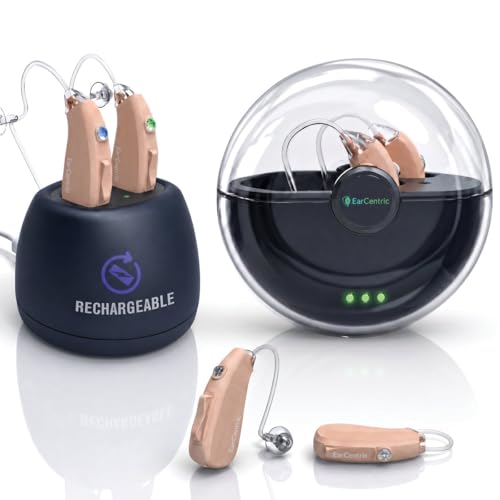
Two chargers in one box — one for your nightstand, one for your carry-on.
This pick earns its spot on charging, not on a flashy number. You get a desktop dock that stays plugged in at home plus a portable case that travels with you. The aids run three days on one charge, and that case holds three more full charges on top — up to 12 days away from a wall outlet. For weekend trips, hotel stays, and long drives to visit family, that removes the “where’s my plug” scramble entirely.
You can wear this all day without your ear feeling weighed down: it weighs 1.2 ounces, and audio sensitivity is rated at 118 dB (a measure of how faint a sound the aid can pick up). That 1.2 ounces is dramatically lighter than the Ceretone in-the-ear model above, which weighs 10.5 ounces. The behind-the-ear shape uses multiple ear domes (soft tips that sit in your ear canal) and both regular and long tubes, so you can fine-tune the fit if you wear glasses or have a smaller ear canal.
What wins people over is the hearing clarity itself. Voices come through clearly in lectures, church, and meetings, even from the back of a room, and the aids follow multiple conversations in groups without forcing you to turn your head. Several owners describe hearing things they hadn’t heard in years. There’s a real caveat worth knowing: the noise cancellation is the mixed piece here, so in a genuinely loud restaurant the benefit is smaller than in a quiet room. As buyers report, “I can hear again! Very clear, comfortable and easy to set up.” That chimes with the broader pattern across reviews — clarity and setup ease are the headline strengths, and the trade-off is noise handling in the loudest rooms.
Sending this home with you
- Portable charging case carries three extra charges on top of three days per fill
- Two chargers included — dock for home, case for travel
- Fits a wide range of ears with multiple domes and both regular and long tubes
- Works alongside glasses and stays put during activity
- Beige coloring stays fairly discreet under hair
Worth knowing before you click
- Noise cancellation in the noisiest rooms is the most-mixed piece of the feature set
- Behind-the-ear fit is visible if you wear your hair up
- One owner reports a short lifespan before the aids died and recommends buying an extended warranty
Reach for this if: you want one device for home and travel and you’re level-headed about a warranty — the two-charger setup is the real draw.
Look elsewhere if: you mostly need to hear through a busy restaurant or a crowded family gathering, where noise handling is the softer spot.
2. Ceretone OTC Hearing Aids for Seniors, Intricon® 16-Channel Digital Chip
Sixteen separate processing channels from a chipmaker most buyers have never heard of.
Fifteen minutes after opening the box, most buyers have this one dialed in. That’s the pattern: the devices are simple to use, the most useful setting is easy to find, and the in-the-ear shape fits well once you seat it correctly. This is an in-the-ear (ITE) design, so it tucks into the canal rather than sitting behind the ear, and the beige shell keeps it inconspicuous.
The engine room here is what separates it from the cheaper amplifier-style devices. An Intricon-made 16-channel digital sound processing chip splits the sound into 16 separate frequency bands and processes each one — that’s the “16-channel” number in the model name. A Knowles-branded speaker is paired with it. The practical effect: advanced wind noise reduction that cuts the shrill whistle that plagues basic aids in breezy outdoor settings, and speech that stays clear rather than turning into a muddy roar.
Runtime is a genuine strength. Up to 25–30 hours of continuous use, with 100+ hours of total battery life and a full recharge in just two hours. Control is by a single ergonomic button — a short press cycles 6-volume levels, a long press cycles 5 hearing modes, and the device remembers both settings for next time. It also warns you when the battery is low. That button cycling is the main friction point owners mention: moving between the five modes means holding the button repeatedly. On the flip side, one owner in particular ran into a loud whining noise and too much background feedback and returned the pair — worth taking seriously if you have a hard time with feedback-prone ears. As customers note, “Returning, loud wining noise, too much background feedback. Cost too much for that!” That’s the minority experience, not the pattern, but it’s the one to know about.
Real strengths here: the 16-channel digital chip and Knowles speaker are named components, not a generic description, and the 25–30 hour runtime with 100+ hours total and a 2-hour recharge beats most in-the-ear picks on stamina. Multiple users describe hearing clear speech and finding the most useful mode without much fuss, and the six volume levels plus five hearing modes give real room to tune by environment.
The honest friction: that same button-driven interface is the recurring gripe. Cycling five modes with repeated long presses is fussy, and a small number of ears — particularly those where feedback is hard to control — will find the whistling gets in the way. There’s a 60-day free trial and a 365-day warranty if you need to test it.
Best suited to: buyers who want a genuinely chip-forward in-the-ear design with clear names on the parts and stamina to spare.
Think twice if: you have an ear that’s historically prone to feedback, since a small share of users report whistling that was hard to dial out.
3. Vivtone Rechargeable Hearing Aids for Seniors Adults, Advanced Multi Channel Digital BTE with Recycle Charging Case
Five full days of hearing without ever finding a wall outlet.
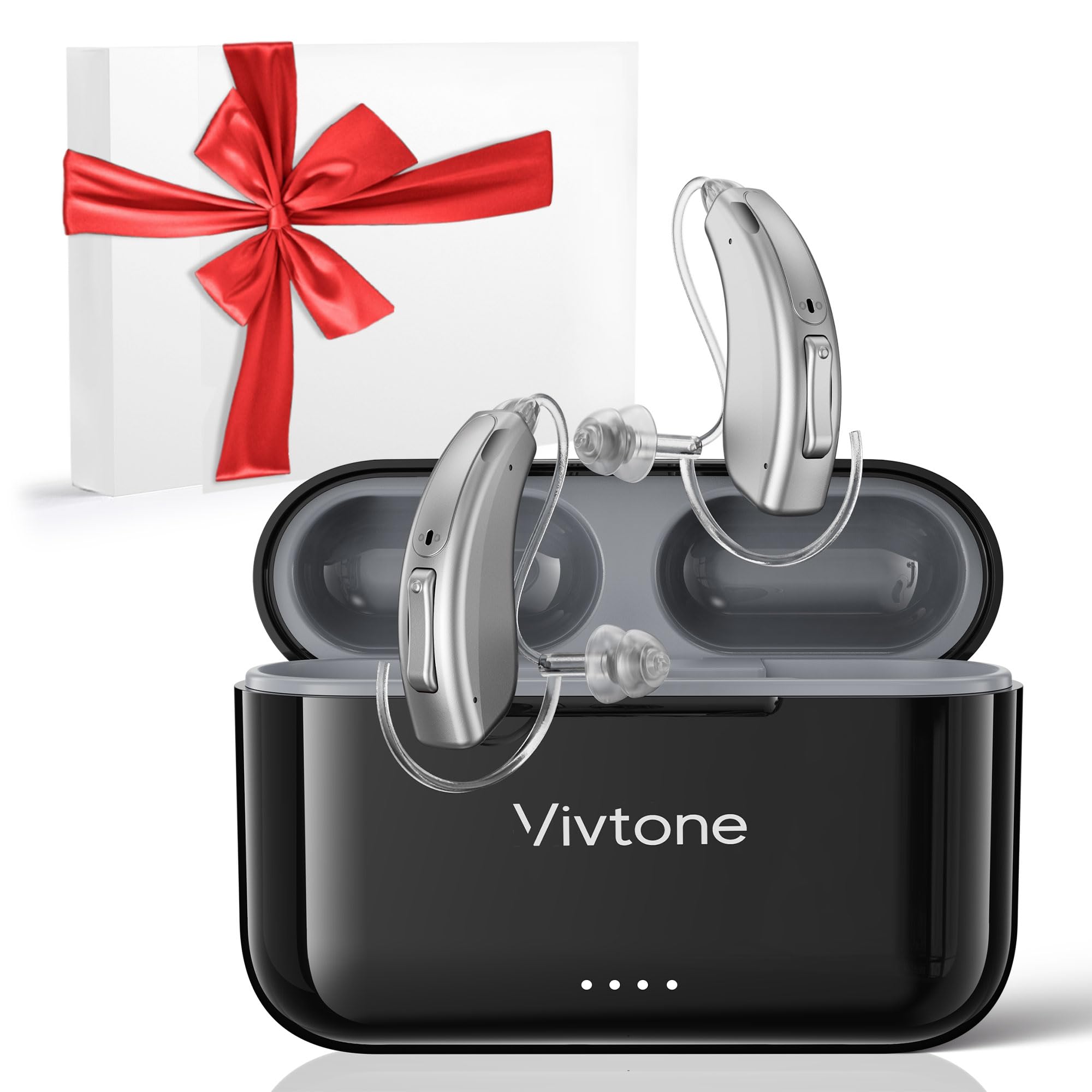
The charging case here is the headline. Both hearing aids run for 25 hours on a single charge, the case recharges them four additional times, and that stacks to 125 hours of backup power — the longest backup figure on this list. A full charge on the aids takes two hours. For someone who hates remembering to plug things in, that kind of headroom removes the anxiety entirely.
Peak sound gains reach up to 41 dB, which the maker positions for mild to significant hearing loss. Three environment modes handle different rooms — Quiet for normal settings, Noisy for background reduction focused on human voice, and a tinnitus masking mode for ringing in the ears. The BTE shape uses medical-grade materials, sits nearly invisible behind the ear, and auto-turns on or off when you lift the aids out of the case or set them back in.
The pattern across verified reviews lands on reliability and value for money as the two things buyers praise. An owner with a long history of prescription aids describes this as the second Lucid 508 they’ve owned, easy to use, with excellent sound and an auto on/off they actively like. A small set of experiences went the other way — one user found the sound too amplified and echoing no matter how they adjusted the volume, and another pair quit charging just after the 30-day return window closed. Those aren’t the norm, but they are the pattern to know: this model lands for most, and the outliers are usually tied to feedback sensitivity or a defective unit rather than the core design.
What to actually weigh: the 41 dB peak gain and 125-hour backup power combine into the strongest runtime story in this group, and the tinnitus masking mode is uncommon at any price. The auto on/off removes a button press from your morning, and the quiet/noisy modes give you a simple way to tell the device what kind of room you’re in.
The catch: adjustability is the mixed piece here, and a handful of ears simply won’t find a setting that feels right — the same complaint you’ll see on feedback-prone OTC aids anywhere in this space. Customer service does seem to fight above its weight when something goes sideways, which softens the risk.
Worth it for: buyers who want maximum runtime between charges and a self-masking tone for tinnitus relief.
Keep looking if: you’ve had a hard time finding a comfortable setting on past aids — adjustability is the softer edge here.
4. MDHearing VOLT OTC Hearing Aids for Seniors – Behind-the-Ear
Designed to sit alongside your glasses without rubbing all day.
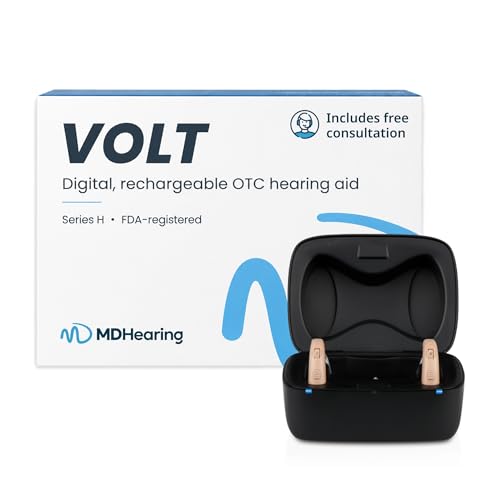
Most behind-the-ear aids force a compromise with eyeglasses; the VOLT is contoured specifically to accommodate frames. The design sits comfortably alongside your glasses and stays virtually invisible, with a slim 1.25″ length and 0.25″ width profile keeping it out of the way. Two directional microphones and four preset audio settings handle the sound — the presets automatically filter feedback and echoes, so voices come through with less room color.
The controls are on the device itself, not buried in an app. Volume and program range are wide, batteries are rechargeable, and multiple earpiece options let you find a seal that works. An owner with slight to moderate hearing loss describes the fit as good and the controls as easy, with a full-day charge that held up. That tracking with the design’s purpose — a button-driven, glasses-friendly, no-app-needed device.
Honesty requires noting the pattern here is more divided than the other picks on this list. Sound quality draws descriptions of “tinny” from some owners, and a smaller set report units that stopped working within about six months. Those are real complaints, and they pull the overall score down; the flip side is that plenty of owners with mild-to-moderate loss report hearing better than they had in years, particularly when the device is set up with the support team’s help. If you’re an eyeglass wearer with straightforward hearing loss and you want a button-first device with no app requirement, this is worth considering. If you have complex hearing loss or you want reliable tech support from the manufacturer, look carefully at how the warranty and support threads read before committing.
Best fit for: eyeglass wearers who want a button-control device without an app, and who appreciate the glasses-first contouring.
Where it can fall short: sound quality is the thinnest part of the package, and a small share of reviewers point out reliability problems within the first year — a real risk to weigh against the price.
Take a look if: glasses compatibility and a simple button interface are your top two priorities.
Move on if: you need richer sound or you’d rather have a manufacturer with a longer, more consistent reliability track record behind the device.
5. ELEHEAR Beyond OTC Hearing Aids for Seniors, AI Powered Speech Enhancement

An app-driven pair with an actual audiologist on the other end of the wire.
VocClear AI technology delivers a maximum gain of up to 50 dB and 24 dB of noise attenuation, which is why the maker positions it for mild to moderate hearing loss. The RIC (receiver-in-the-canal) design places the speaker inside the canal itself, keeping the housing barely noticeable, and multiple dome sizes plus a soft contouring shell handle comfort across different ear shapes.
The app side is where the value lives. ELEHEAR’s app runs on both iOS and Android and gives you volume adjustment, AI translation, serene sound relief, telephone speech enhancement, and user-customized compensation — that last one means you can dial the sound to your specific ears, not just pick a preset. The ElePro Audiologist Remote Care Service lets you send your setting in for professional tweaks without a clinic visit. Runtime is up to 20 hours on a single charge, and the included charging case adds four more full cycles for a total of 100 hours.
What wins people over is the overall functionality — the Bluetooth connection works cleanly, phone calls and text alerts route through the aids, and the app is well-liked as a control surface. First-time users in particular describe it as a workable way to stop missing sounds they’d grown used to losing. The mixed piece is sound quality itself: some owners find it clear and natural, while others describe a tinny character or squealing at higher pitches. A 7.5-month follow-up notes that speech frequencies are handled well but music is only OK, and noise cancellation struggles in a busy restaurant. Those are the fair caveats for a pair at this price point.
What stands out: the 50 dB maximum gain, 24 dB noise attenuation, remote audiologist service, and app-customizable compensation are all genuinely useful if you want to tune your own hearing rather than accept one preset.
Where to go in with open eyes: sound quality is a mixed bag. Some ears hear it as natural; some hear a tinny edge or squeal at higher pitches. That’s the trade-off for the flexibility.
Good match if: you want app control, remote professional tuning, and translation, and you’re willing to spend some time dialing your ears in.
Consider something else if: you want a plug-and-play acoustic experience with no app-based learning curve.
6. ELEHEAR-Beyond OTC Hearing Aids for Seniors, 50dB, AI Noise Cancellation

Nine dome sizes, four scene modes, and 50 dB in a champagne gold shell.
This is the cosmetic twin of the Beyond above, but the dome and mode story is what separates it. The VocClear AI technology boosts speech clarity by 17% and cuts 24 dB of background noise, and the champagne gold shell keeps the device looking more like a personal accessory than medical hardware. Nine dome sizes ship in the box — more than most rivals — which matters a lot if you have small ear canals or sensitive ears that fight a standard dome.
You can switch between four scene modes right from the ELEHEAR app, and tune volume, frequency, sound directionality, and environment profiles. Runtime is up to 20 hours per charge with four additional case charges for 100 hours total, and a 15-minute fast charge tops you up enough for 6 hours of runtime — a real advantage if you forgot to charge overnight and need to leave the house in a hurry. Bluetooth connectivity reaches approximately forty feet according to owner reports, which covers moving between rooms.
Performance and value for money are the two things buyers mention most positively — the device works as well as substantially more expensive alternatives for many users, and the adjustable settings cover different listening environments. The mixed piece is noise handling: some ears report crisp clear sound and improved hearing, while others describe unnatural tone or a sense of being bombarded by ambient sounds they couldn’t hear before. Charging is also a mixed area — a small number of users report an earpiece that needed a charger reset to wake up on the first night.
The real draw: nine dome sizes is a lot of fit flexibility, the 15-minute fast charge for 6 hours of runtime is among the most useful features on this entire list, and the four scene modes give quick environment switching via a one-tap app tap.
What to watch: the “unnatural sound” and ambient-overload reports suggest a fit and adjustment learning curve — some users need to spend an evening tuning domes and profiles before it feels right.
The right call if: you want champagne gold cosmetics, the widest dome selection here, and a fast-charge top-up for busy mornings.
Better elsewhere if: you want the app to feel invisible from day one — this one rewards a bit of dialing in.
7. ELEHEAR-Beyond Pro Bluetooth Hearing Aids for Seniors, 30% Clearer Speech
Eight-millisecond latency, 8500 Hz highs, and real-time translation in 20 languages.
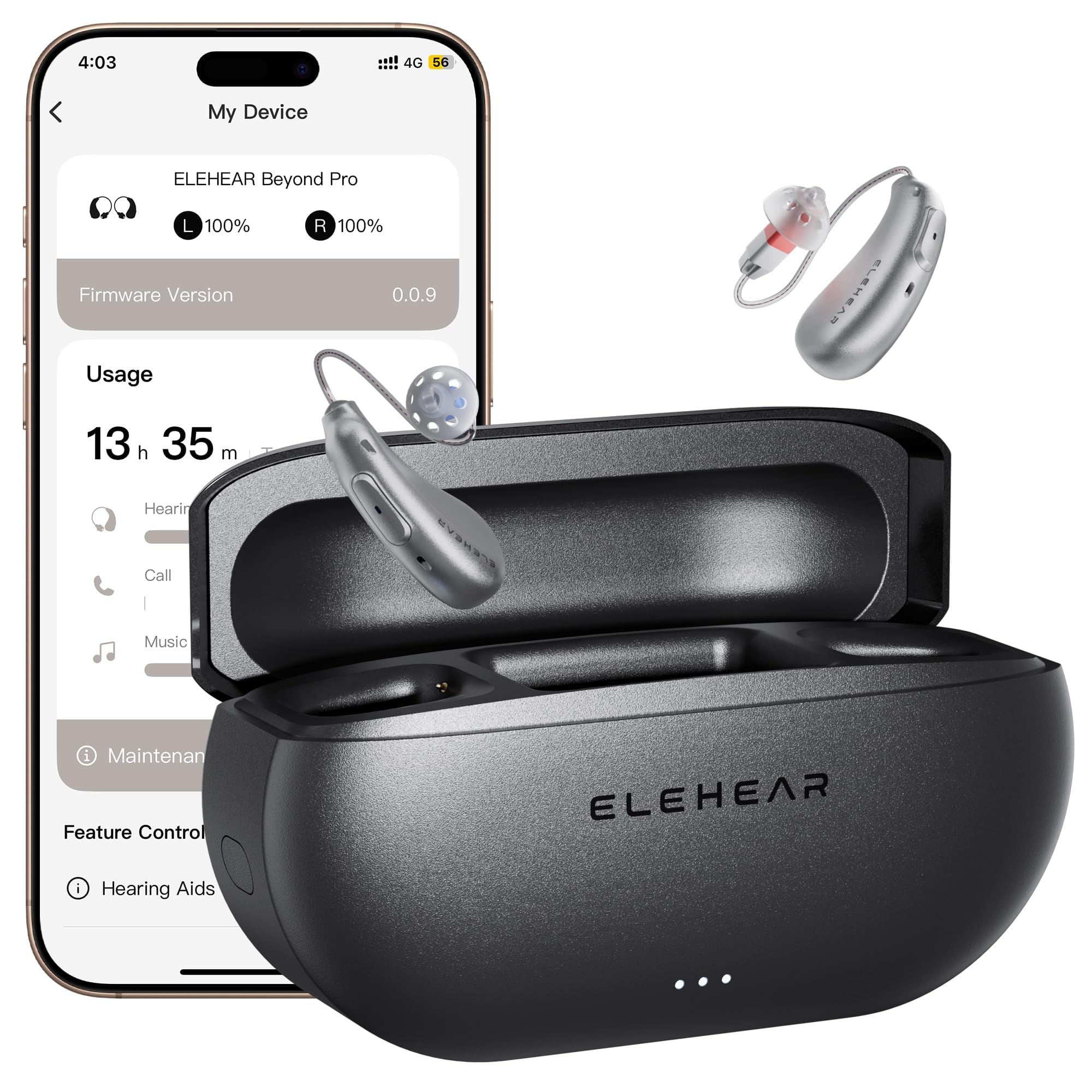
VocClear 2.0 technology is the engine, and the manufacturer rates it for 30% clearer speech than its predecessor. Frequency response reaches up to 8500 Hz, which is unusually high for OTC aids and matters most when you want the crisp edges of speech — the “s” and “th” sounds that carry intelligibility — to come through. Latency is 8 milliseconds, low enough that lip-sync stays tight during streaming or calls. A Music mode is included for anyone who wants richer tone when listening to music.
The 15-minute fast charge is repeated here, delivering 6 hours of use from a very short top-up. Runtime is up to 20 hours on a full charge, and the case adds four full charges on top. Real-time AI translation is the other standout — built-in support for 20 languages, including Spanish, French, Italian, Japanese, and Chinese, handled by your voice with no separate interpreter app. If you travel, that single feature can be the deciding factor.
Wearers who came from prescription aids are the ones who report the biggest jump. A 72-year-old with seven years on prescription devices describes this one as beating their Costco and other prescription aids on build, charging case, pairing, and in-app audiologist program. The mixed pieces show up when you push the hardware hard: sound quality is the splitter, and a few users describe tinny tone, feedback in noisy rooms, or intermittent Bluetooth sync failures on calls. Practically speaking, this pick rewards users with mild-to-moderate loss who want full app control and a low-latency Bluetooth connection — it’s the pick for someone who is willing to use the app’s deeper settings rather than a set-and-go user.
Where this wins: the 8 ms latency, 8500 Hz high-frequency response, in-app audiologist programming, and 20-language translation are the deepest feature set on this list. Battery life with streaming is generous, and the fast-charge performance matches the flagship tier.
Honest caveats: sound quality is a divider — some ears love it, some call it tinny — and a smaller group reports feedback in noisy rooms and the occasional Bluetooth hiccup on calls. Bluetooth streaming to a phone is the strength; the pure-hearing side is where opinions split.
Pick this one if: you want translation, app-deep programmability, and low-latency Bluetooth in one device, and you’ll use the app to tune it.
Skip this one if: you want a simpler button-driven device or you have severe loss — this one is spec’d for mild to moderate.
8. Audien Ion Pro 2 Advanced OTC Hearing Aids for Seniors & Adults
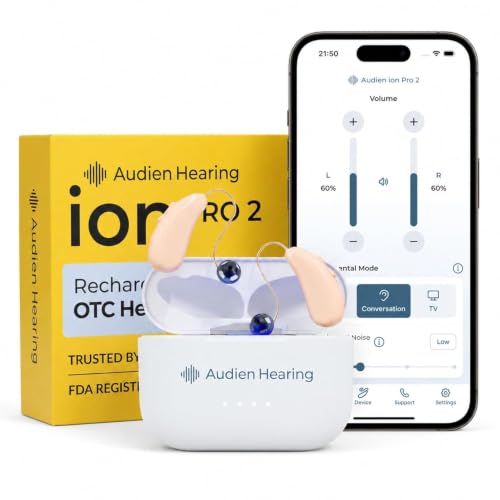
Charges and disinfects itself — the only pick on this list that does both.
UV sanitizing technology builds into the charging case and cleans the aids automatically while they charge — a feature you won’t find anywhere else on this list. The sound engine comes from a collaboration with Grammy-winning sound engineers, and you get three hearing modes plus six custom hearing profiles for personalization, with only a two-button interface for volume and modes.
Battery figures are geared toward heavy streaming users. Up to 16 hours of hearing per charge, 7+ hours of streaming, and up to 48 hours total with the charging case. Streaming audio is boosted for calls, music, and TV, and the device keeps FDA-compliant hearing amplification levels, which means it caps output for safety. Compatibility runs a bit narrower than the other picks: iPhone 11 or newer (iOS 13+) and select Android devices running Android 13+, including Samsung Galaxy S20 or newer. Check your phone before you buy.
The pattern across verified reviews is that buyers with straightforward setups describe the device as working exactly as advertised — simple to use, easy to pair, and clearly better at reducing background noise than the options they tried before. The mixed pieces are the app and the overall value equation. A small minority report app issues or sticker-price hesitation, and one user returned the pair the same day after experiencing noise, static, and volume fluctuations during setup. That last note is a good reminder that even a well-liked OTC aid can land wrong on the first try — if it does, the return window is your friend.
Reasons this one earns its keep
- UV self-cleaning case does the hygiene work for you
- Up to 48 hours total with the charging case, 16 hrs per charge, 7+ hrs streaming
- Six hearing profiles and three modes offer real personalization
- Developed with Grammy-winning sound engineers
- FDA-registered OTC — no prescription or hearing test required
Points to know before ordering
- Phone compatibility is limited to iPhone 11 or newer (iOS 13+) and select Android on Android 13+ including Samsung Galaxy S20 or newer
- Functionality and value are mixed — a small group reports app hiccups or price hesitation
- Not for severe hearing loss — spec’d for mild to moderate only
Order this for: UV self-cleaning, deep streaming features, and a phone that matches the compatibility list.
Pass on this if: you have an older phone or an Android outside the supported range, or you don’t want to lean on an app for setup.
9. Sennheiser All-Day Clear Bluetooth Hearing Aids, Self-Fitting, FDA Cleared

Set up in a few minutes in an app — no audiologist appointment needed.
The Sennheiser name is the reason most buyers look here first, and the design language matches the audio brand: a proven receiver-in-canal (RIC) shape in a light grey shell, with self-fitting done through the app in a few minutes. Setup is designed to skip the appointment entirely — the app walks you through personalization options. Once configured, the device automatically adjusts to the sound environment around you, and built-in Bluetooth lets you take hands-free calls, stream music and podcasts, and follow phone audio with a tap.
Runtime is up to 24 hours of continuous use on a single charge, which is the longest single-charge figure on this list. The kit is generous: 8x ear tips (S/M/L), wax guards, cleaning brush, wall plug, and USB cable all ship in the box. The 30-day risk-free trial makes it a real try-before-you-commit option.
The pattern across reviews is that prescription-aid users tend to be the ones who rate this highest — describing it as usable as a primary device with exceptional sound, easy 3-step app customization, and a battery that runs all day or longer. The mixed pieces are sound quality (which splits between crisp and tinny), the charging case (which needs a wall outlet — it has no internal battery), and durability (an owner past one year describes a receiver wire failure and reports trouble getting replacement ear tips). The reliability strength that most reviewers praise is real, but if you need a well-buffered support structure around the device, this one has shown occasional friction. For a buyer who wants Sennheiser tuning, the longest single-charge runtime on this list, and app-based self-fitting without an audiologist visit, it’s a solid premium pick.
Standout specs: up to 24 hours of continuous battery, 8x ear tips plus wax guards and cleaning kit in the box, self-fitting app setup in a few minutes, and the longest single-charge runtime in this lineup.
What to know: the charging case has no internal battery so it needs to stay plugged in — a real annoyance if you travel. Sound quality and value are mixed, and a past-warranty repair story on the receiver wire is worth factoring if you need long-term service security.
A strong option for: buyers who want the Sennheiser name, 24-hour battery, and a self-fitting app that skips the audiologist visit.
Consider alternatives if: you need a travel-ready charging case or long-term service security past the first year.
Understanding the Specs
Digital Channels and Chipset
Channels are the separate frequency bands the chip inside a hearing aid processes. An Intricon 16-channel digital chip, for example, splits incoming sound into 16 separate bands and adjusts each one — which is why voices come through more naturally than with a simple amplifier. Look for a named chip and channel count when the listing gives them, because off-brand “clear sound” claims tell you nothing about the actual hardware.
Gain, Noise Attenuation, and Frequency Response
Gain is measured in decibels (dB) and describes how much the device can amplify sound — 41 dB and 50 dB are the figures on this list, and each is meant for mild to moderate hearing loss. Noise attenuation is also in dB and tells you how much background noise the device can suppress. Frequency response in hertz tells you how high a pitch the device can reproduce — 8500 Hz is high enough to keep consonant sounds crisp.
Rechargeable Runtime and Backup Charging
A rechargeable hearing aid uses an internal lithium battery instead of tiny disposable cells. The “runtime” figure tells you how long the aids run per charge. The charging case adds backup charges — some cases here give three or four extra charges on top of the aids’ own runtime, which is the figure that matters for travel and weekend trips. A “fast charge” feature can top you up in as little as 15 minutes.
Fit Type and Comfort
Behind-the-ear (BTE) designs sit behind the ear with a tube running into the canal; receiver-in-canal (RIC) designs place the speaker in the ear itself and usually feel lighter. In-the-ear (ITE) designs sit inside the canal. For glasses wearers, a specific “designed around glasses” contour can mean the difference between a comfortable all-day fit and pressure points. Multiple dome sizes are included on most of these to match different canal shapes.
FAQ
What is the difference between an OTC hearing aid and a personal sound amplifier?
Will a hearing aid work with my eyeglasses?
How long does a rechargeable hearing aid last on a charge?
Can a hearing aid amplify music the way earbuds do?
Do I need a hearing test before buying an OTC hearing aid?
Will feedback or whistling be a problem with these hearing aids?
Can I wear a hearing aid all day without taking breaks?
Is an OTC hearing aid strong enough for moderate hearing loss?
Do hearing aids with Bluetooth work with my phone?
How long does the manufacturer warranty cover a hearing aid?
Can I take a hearing aid through airport security and on a plane?
Are rechargeable hearing aids better than ones that use disposable batteries?
Does a higher price mean a better hearing aid?
Final Thoughts: The Verdict
For most buyers, the audiology hearing aid winner is the EarCentric EasyCharge because it solves the two problems that keep hearing aids in a drawer — remembering to charge them and finding them when you travel. The desktop dock plus portable case holding three extra charges means you’re free from outlet anxiety, and the clarity for lectures, meetings, and group conversations is what most buyers spend their money to recover.
If you want a serious in-the-ear device with named parts and a proper channel count, reach for the Ceretone with the Intricon 16-channel chip — you get branded components and 25–30 hour runtime per charge. If you want app-deep tuning, remote audiologist care, and Bluetooth streaming with 20-language translation in one device, go with the ELEHEAR-Beyond Pro. And if you’re a prescription-aid veteran who wants the longest single-charge runtime on this list with a self-fitting app, the Sennheiser All-Day Clear rewards the leap.
If runtime is your single highest priority, the Vivtone Lucid508 won’t leave you stranded — 125 hours of backup power through the case is the longest here. If you want UV self-cleaning and deep streaming features in a small shell, the Audien Ion Pro 2 earns its spot as long as your phone matches its compatibility range. And if UV self-cleaning plus the widest dome selection matters more than price, the ELEHEAR-Beyond in champagne gold is the one to click.
How We Picked
We do not accept paid placement. Every pick is matched to a real buyer and a real use-case; we do not hands-on test units.
Sources & Methodology
Specifications: manufacturer listings and product documentation. Review insights: verified customer reviews, as of September 2026. Pricing: not shown on this page (it changes often); check the current price via the retailer link.
As an Amazon Associate, Gadgets Feed earns from qualifying purchases. This does not affect which products we feature.