
Our readers keep the lights on and my morning glass full of iced black tea. As an Amazon Associate, I earn from qualifying purchases.
Specs are compiled from manufacturer listings and verified buyer reviews and can change over time — please confirm the key details on the product page before buying.
Most people who buy a car power inverter get burned by the same trap: they see a big number on the box, plug in a microwave or a power tool, and the thing shuts down or buzzes. The fix is simpler than it looks. You match two specs — continuous watts and waveform type — to what you actually want to run, then make sure the cables and your battery can carry the load. Get those right and your inverter just works, quietly, every trip.
I’m Min — the founder and writer behind Gadgets Feed. This guide is built by comparing the manufacturers’ published specifications and the patterns across verified customer reviews, so you get each pick’s real strengths and trade-offs instead of marketing spin.
Below you’ll find seven inverters ranked by what they actually power and who they suit, from pocket-sized road-trip units to heavy-duty 3000W workhorses. If you want the short answer: match continuous watts to your biggest load and pick pure sine wave for anything with a motor or a sensitive chip inside. That single decision is what separates a car power inverter you keep for years from one that dies in a month.
Our Picks at a Glance

How To Choose The Best Car Power Inverter
To pick the right inverter, answer three questions: how many continuous watts (the power it can deliver all day, not just in a burst) your devices need, what kind of waveform (the shape of the AC electricity) they can handle, and how you’ll wire it to your battery. Answer those and the shortlist shrinks fast.
Continuous Watts vs Peak Watts
Continuous watts are the power the inverter can deliver all day long — the number that matters for running a fridge for hours or charging a laptop on a long drive. Peak (or surge) watts are a short burst for motor startup, which is why a compressor-driven appliance may briefly need far more than it draws while running.
Size your inverter against the continuous rating, then add headroom for surge. An inverter rated 3000W continuous with 6000W peak can swallow the startup jolt of a window AC or a power tool without tripping, while a 500W unit is built for laptops, phones, and small TVs.
Modified Sine Wave vs Pure Sine Wave
Modified sine wave inverters are a stepped approximation of household AC — fine for simple resistive loads like a lamp or a phone charger, but a poor match for anything with a motor or sensitive electronics. Pure sine wave inverters reproduce grid-quality AC, so fridges, coffee makers, CPAP machines, and audio gear run without hum or flicker.
If you’re unsure: for laptops, phones, and small fans a modified sine wave unit often suffices, but the moment you add a compressor, a laser printer, or medical-grade equipment, pure sine wave is the safer call.
Wiring: Cigarette Lighter vs Direct Battery Clips
The vehicle cigarette lighter socket typically supports up to 150W only. For higher-power devices from 150W to 500W, connect directly to a 12V battery with the included clips. Above that, you’re into hardwired territory with proper gauge cables — thin cables are the number-one cause of overheating and voltage drop under heavy load.
Quick Comparison
| Model | Best For | Continuous Power | Waveform | AC Outlets | Amazon |
|---|---|---|---|---|---|
| TOPBULL 3000W (003 inverter)★ Best Overall | Campers and home solar backup | 3000W (6000W peak) | Modified Sine Wave | 2 | Amazon |
| OLTEANP 500WBudget Champion | Road trips and mobile offices | 500W | Modified Sine Wave | 2 | Amazon |
| JARXIOKE 1100W | Off-grid solar and small electronics | 1100W (2200W peak) | Pure Sine Wave | 2 | Amazon |
| TOPBULL 3000W (MSW_003) | Tools and RV power on the road | 3000W | Pure Sine Wave | 2 | Amazon |
| LANDERPOW 3000W | Heavy loads and hardwired installs | 3000W (6000W surge) | Pure Sine Wave | 3 | Amazon |
| BELTTT 2000W | Truck and RV daily power | 2000W (4000W surge) | Pure Sine Wave | 2 | Amazon |
| BELTTT 3000W | Running appliances one at a time | 3000W (6000W peak) | Pure Sine Wave | 2 | Amazon |
In‑Depth Reviews
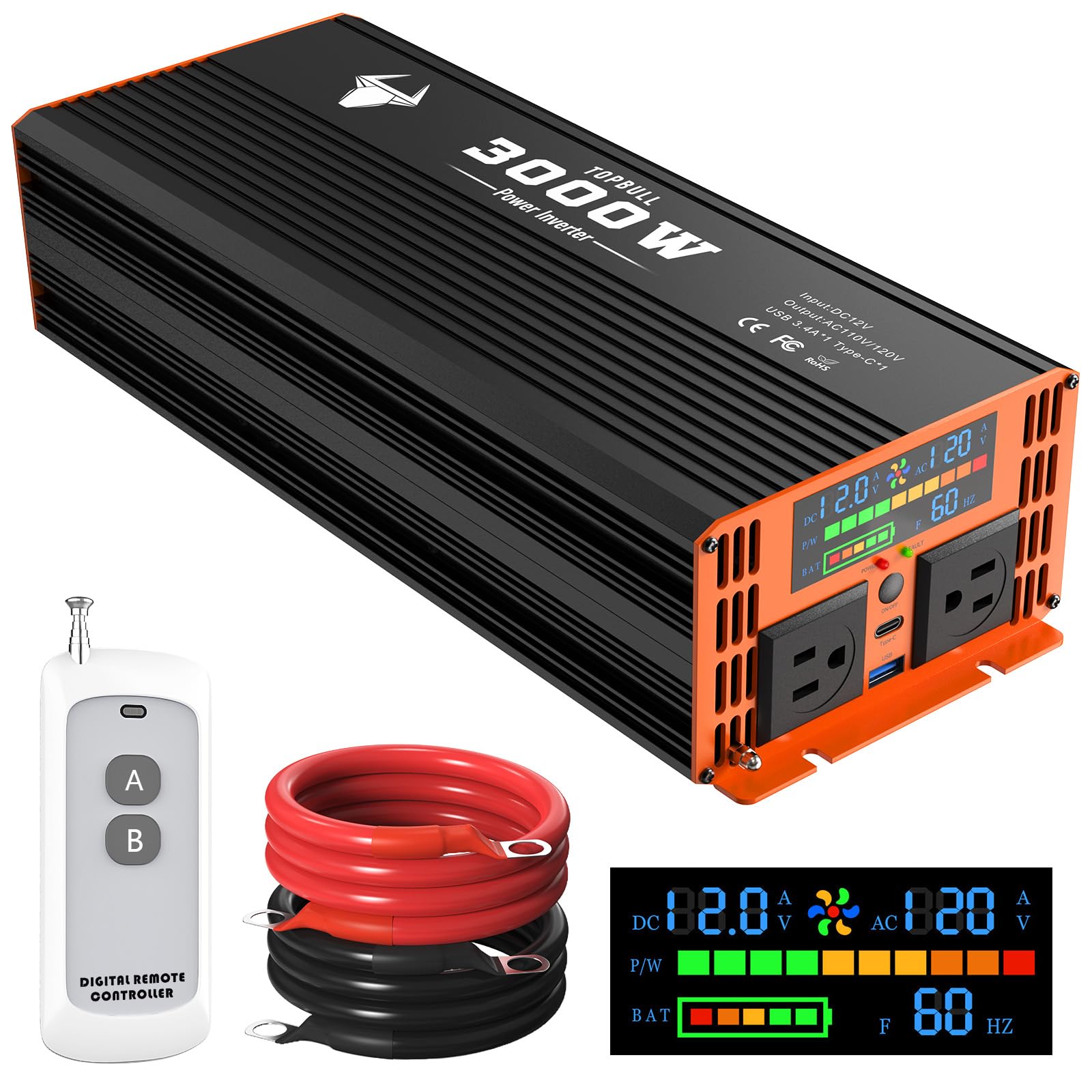
1. TOPBULL 3000 Watt Power Inverter 12V DC to 120V/110V AC
Our pick — over 4.5★ from 450+ verified ratings; the strongest balance of quality and price.
The camper’s workhorse — 3000W of steady power that shrugs off a compressor startup.
If you’re building out a van or want a solar backup that just runs, this is the pick. It delivers 3000W continuously (the power it holds all day) and 6000W peak (a short surge for motor startups), so a fridge, a coffee machine, or a power tool kicks on without the inverter quitting. That continuous rating is the single number that matters here, and it clears the next best big unit — the BELTTT 3000W — on price while matching its output class.
Wiring is where it shines for permanent installs. A remote control drives it from up to 200 feet away, so you switch the whole system on from inside the RV without crawling to the battery bay. The color LED screen shows voltage, power, and working status in real time — handy when you want to watch your battery drop as a load runs. And the housing is a metal shell with impact and weather resistance, plus two high-power 20A AC sockets, a 3.4A USB port, a 30W Type-C port, and a grounding terminal.
What wins people over is the sheer value: It runs up to five industrial fans without a stutter, and van builders use it for home solar backup.. It’s also quiet — the dual smart fans kick in only as needed rather than droning constantly — and the included pure copper cables are ready to use from the start. The honest catch is waveform: this is a modified sine wave unit, so it’s built for motors, fans, and basic electronics, not for a CPAP or delicate audio gear that wants grid-clean AC. An occasional durability note shows up too, but the steady power and the price are what owners keep coming back to.
What Owners Rave About
- 3000W continuous, 6000W peak — enough for fridges, tools, and coffee machines
- 200ft wireless remote for on/off from anywhere in the rig
- Real-time color display shows voltage, power, and working status
- Fans run only as needed, so it stays quiet under light loads
- Comes with high-quality ready-to-use cables and 2× 20A AC sockets
Where It Falls Short
- Modified sine wave — not ideal for CPAP machines or sensitive audio gear
- Best wired straight to a 12V battery, not through a lighter socket
- Physically large at 16.22″L × 6.1″W × 3.54″H, so plan your mounting space
Reach for this if: you’re wiring a van, camper, or home solar bank and want maximum continuous watts for the money.
Look elsewhere if: you need pure sine wave for medical or high-end audio gear — step up to a pure sine wave unit.
2. OLTEANP 500W Power Inverter 12V DC to 110V/120V AC
The glovebox-sized road-trip unit that keeps laptops and phones topped up on the move.
For anyone who just wants to run a laptop, a mini fridge, or a coffee maker on a road trip without hauling a battery bank, this 500W inverter is the easy grab. It converts your car’s 12V DC into 110V/120V AC household power up to 500W continuous, which covers laptops, tablets, small TVs, game consoles, and a good chunk of small electronics. Compared to the bulky 3000W units above, it’s tiny — think shoebox — so it tucks away when not in use.
The smart part is the LCD screen. It shows input voltage, output voltage, and battery status in real time, plus protection codes like OL (overload), HI (high voltage), LO (low voltage), and OH (overheat). That readout turns troubleshooting into a glance instead of a guess. On the port side you get two AC outlets plus USB charging, so a phone, a camera, and a small device can all run at once.
Buyers report it performs exactly as advertised, and the display is the feature people mention again and again — it shows both the battery input and the voltage output clearly. One road-tripper powered a laptop, coffee maker, and mini fridge on a trip without a hiccup, and the cooling fan kept it from overheating on long drives. The real caveat is power routing: the cigarette lighter socket supports up to 150W only, so for anything from 150W to 500W you run the included alligator clips straight to a 12V battery. It’s also a modified sine wave unit, so skip it for fridges and sensitive medical devices.
Best money on entry-tier: 500W continuous with a real-time LCD, dual AC outlets, and USB charging in a compact body.
The cable reality: lighter socket maxes at 150W — bring the alligator clips for the heavier gear.
The pick for road-trip charging: laptops, phones, and small electronics with a clear voltage readout.
Wrong tool for: running a fridge, microwave, or air conditioner — that needs a pure sine wave unit with far more watts.
3. JARXIOKE 1100 Watt Pure Sine Wave Power Inverter 12V DC to 110V/120V
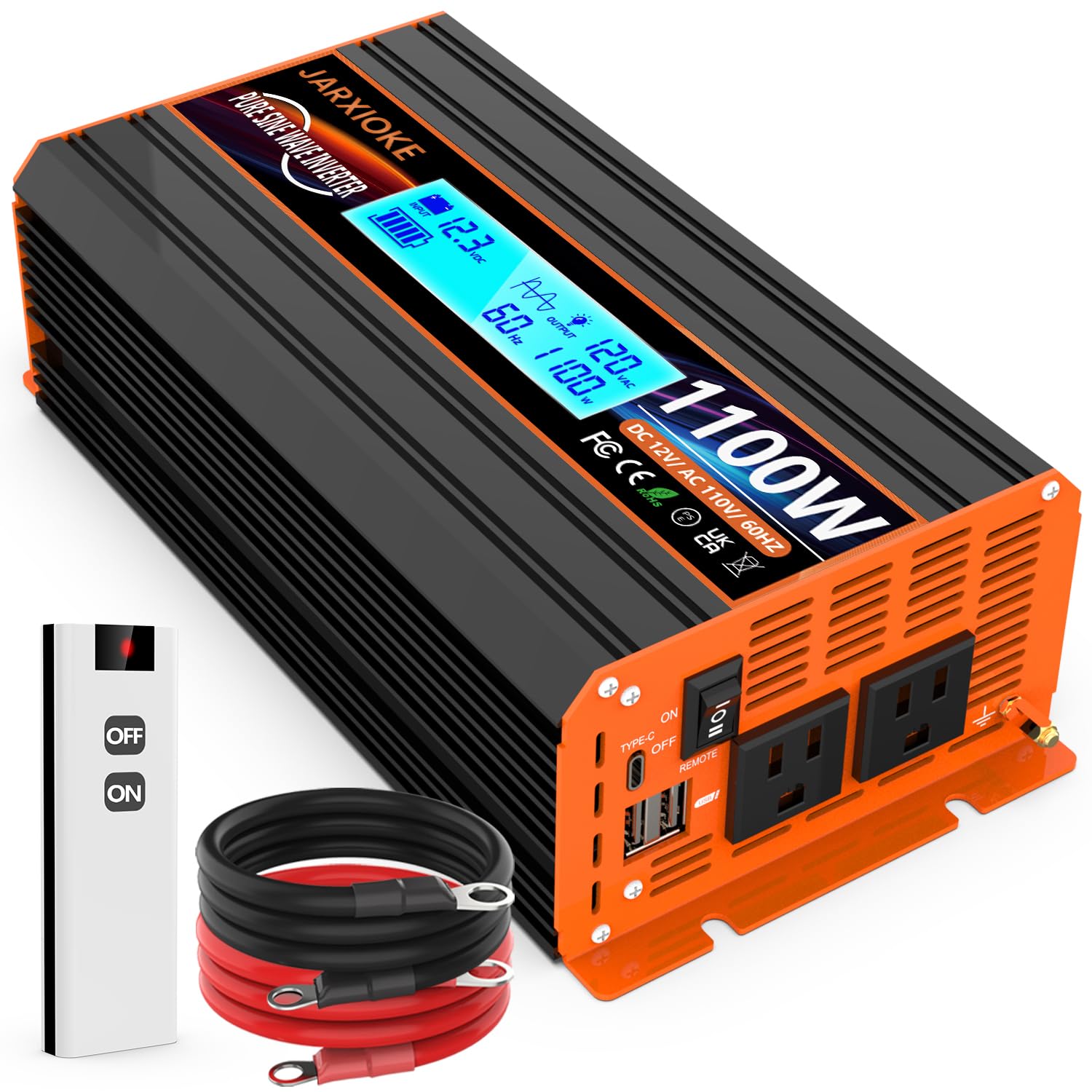
Grid-clean power for solar builds — 1100W of pure sine wave without the hum.
If your devices are fussy — a stereo, a compressor fridge, or anything with a sensitive chip — pure sine wave is the spec that matters, and this 1100W unit delivers it. True pure sine wave means the AC output matches what comes out of your household wall socket, so motors run smoothly and gear stays hum-free. It holds 1100W continuously with 2200W peak, and conversion efficiency above 90% keeps wasted energy low so your battery lasts longer between charges.
Control is the standout. A wireless remote turns it on and off from up to 100 meters (roughly a football field) — one caveat the maker notes: switch the inverter itself off first, then use the remote to power it on. The light display and audible alarm keep you posted on battery status, and the aluminum housing handles drops and impacts. Safety is thorough: over voltage, low voltage, overload, short circuit, overheat, reverse polarity, automatic restart, and GND leakage protection for lightning, with the unit backed by AIG product liability. You also get dual AC outlets, dual USB ports, and Type-C ports.
What wins owners over is performance — it’s the most-discussed strength here. One DIY solar builder powers a garage freezer with it and found it handled compressor surge better than a prior 1000W inverter, running reliably for a year and a half through 105°F heat. The recurring gripe is the fans: they whine loudly in 90°F-plus heat and can put a squeal on AM radio. There’s a small single 40A fuse rather than per-outlet breakers, and the remote itself needs an A23 battery. For a pure sine wave unit at this wattage, though, the value holds up well.
Clean-power verdict: true pure sine wave with 90%+ efficiency, ideal for solar and sensitive electronics.
What to know: loud fans in hot weather and a single fuse instead of per-outlet breakers.
Built for: DIY solar setups and off-grid gear that needs clean, grid-quality AC power.
Not the one for: quiet bedroom installs — the fans get loud once the heat climbs.
4. TOPBULL Power Inverter Car/Home 12V DC to 110V/120V AC for RV, Truck
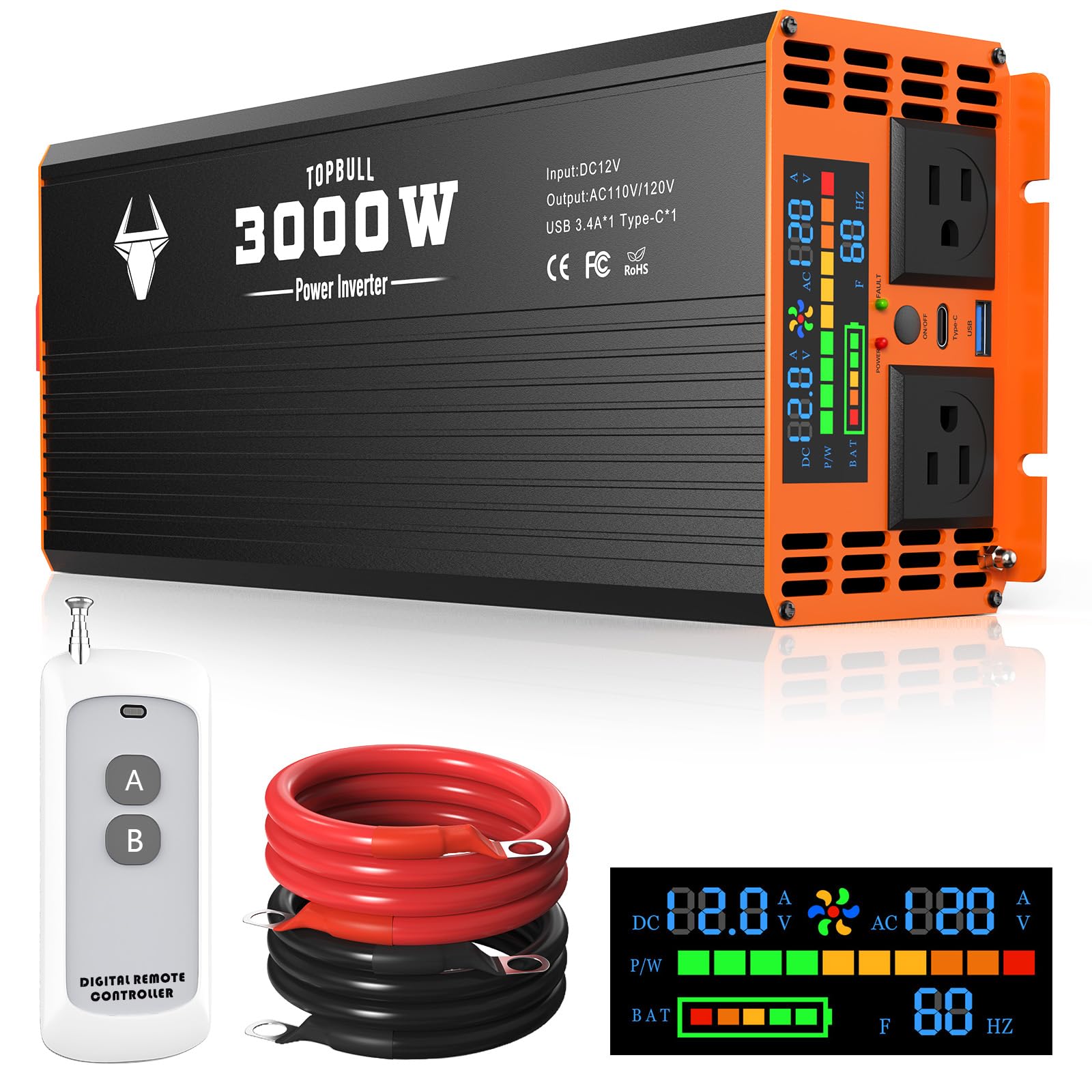
A 3000W pure sine wave beast that runs tools, Starlink, and laptops without breaking a sweat.
This is the pick when you need serious wattage and you want it clean. It pushes a 3000W continuous load through pure sine wave output (grid-quality AC that motors, compressors, and sensitive electronics expect), so your gear runs smoothly — the same clean waveform the JARXIOKE delivers, but at nearly triple the continuous watts. Two 20A/120V AC outlets take high-current devices and industrial tools, and you also get a 3.4A USB fast-charge port, a 30W Type-C port, and a grounding terminal.
The kit is what separates it from most rivals. It ships with a 200ft wireless remote for one-button shutdown and restart, a color LED display showing battery charge, output power, input voltage, fan status, and output frequency, plus two pure copper battery cables, a ground wire, and eight spare fuses. That last detail matters — spare fuses on hand mean a blown protection fuse doesn’t sideline your whole setup. Ten layers of protection cover low and high voltage, overload, short circuit, overheat, reverse connection, ground fault, overcurrent, earth leakage, and the battery itself.
Owners routinely single out the build and performance — this unit runs a big load like a Starlink terminal, two laptops, and a fan simultaneously, and One job-site report says it powered an SDS MAX demolition hammer driving 8ft ground rods for two hours.. The dual silent fans keep it quiet, the aluminum alloy shell resists corrosion and rust, and the compact footprint slides under a truck seat. It’s rated for all 12V and 12.8V batteries. The mild caveat: it’s a premium unit, so if your loads are light, a smaller inverter covers you for far less.
Why It Earns Its Spot
- 3000W continuous pure sine wave — clean power for tools and sensitive gear
- 200ft wireless remote with one-button shutdown/restart
- Full kit: 2 copper cables, ground wire, and 8 spare fuses included
- Color LED display shows charge, power, voltage, fan status, frequency
- Corrosion-resistant aluminum housing fits under a truck seat
Weight It Against
- Premium pricing — more than you need if your loads are light
- Pure sine wave at this scale means a real battery bank behind it
- Best hardwired, not run through a lighter socket
The one to beat for heavy loads: crews, RVers, and off-grid users who want 3000W of clean sine wave.
Overkill if: you only charge a laptop and a phone — a smaller unit saves you money here.
5. LANDERPOW 3000W Pure Sine Wave Inverter 12V DC to 120V AC 6000W Peak
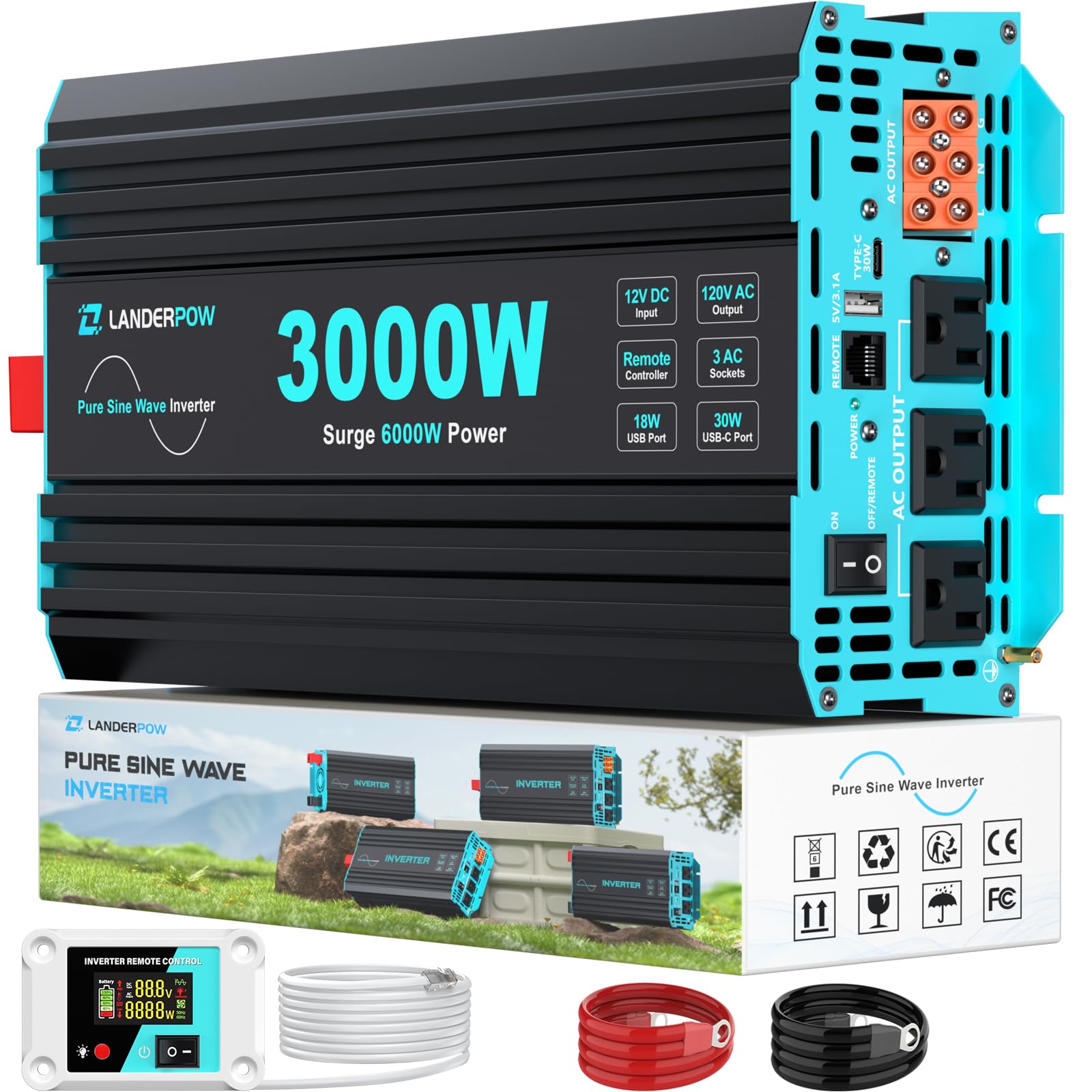
Three AC outlets and a hardwire terminal — built for jobs that need more than two plugs.
For hardwired installs where you want the inverter feeding a breaker panel or a dedicated circuit, this 3000W pure sine wave unit is the flexible choice. It delivers 3000W continuous with 6000W surge at above 91% efficiency, meaning it handles heavy startups from a coffee machine, a window AC, or power tools while keeping clean, grid-quality power for microwaves, laptops, CPAPs, and LEDs. Where most rivals stop at two outlets, this gives you three AC outlets plus a hardwired terminal for high-current gear.
Device charging is covered too — a 5V/3.1A USB port and a 30W PD port work alongside the AC side. It comes with two 1AWG/2 FT thickened pure copper battery cables that resist heating and keep conversion efficiency high. The 15ft wired remote has a smart LED screen that tracks battery levels, output, and errors in real time, so you can monitor and shut down from the cab. Six protections cover undervoltage, overvoltage, overload, overheating, short circuit, and reverse connection, and coverage runs three years total — a one-year no-hassle replacement plus two more years of support.
Quality is what owners praise most, and the power is right behind it — One user reports running a 10,000 BTU AC unit without issue.. The seller support earns frequent mention for answering within hours. The honest trade-off is draw and cabling: you really need a large lithium battery and a charger to feed it properly, and one owner found the included cables too thin under a heavy load and swapped to 1AWG copper. Its 3 AC outlets sit close together, so chunky plugs can crowd each other — a short power strip solves that.
For the hardwire crowd: 3 AC outlets, a hardwire terminal, and a 15ft wired remote with a live LED readout.
Budget the whole system: a big lithium battery and quality cables are part of the real cost.
Suits you if: you’re wiring an off-grid or van setup and need three outlets plus a hardwire feed.
Think twice if: you want a plug-and-go lighter-socket unit — this one wants a proper battery bank.
6. BELTTT 2000W Pure Sine Wave Inverter 12V DC to 120V AC, 4000W Surge

The daily-driver truck inverter — 2000W of clean power that runs mini-fridges and microwaves on repeat.
If your inverter lives in a truck or RV and runs every day, the point is reliability at moderate wattage, and this 2000W pure sine wave unit is built for exactly that. It puts out 2000W continuous with up to 4000W peak surge and better than 93% conversion efficiency, so a mini-fridge, a 700W microwave, or a small AC unit gets clean power without straining. That efficiency edge over the JARXIOKE’s 90%-plus rating means a touch less wasted energy on long days.
The layout is practical for concealed installs. You get dual AC sockets, a 20A outlet, a 5V/2.1A USB port, a hardwire port, and a remote controller on a 23ft cable — long enough to hide the inverter under a seat and still control it from the dash. The bright LCD displays input and output voltages, battery and load status, and fault codes for quick troubleshooting. It ships with two 2AWG 3ft battery cables and six 45A fuses, and protections cover undervoltage, overvoltage, overload, over temperature, short circuit, and reverse connection.
Build quality earns the most praise, with special notice for the soldered metal tabs on the circuit board that cut the resistance — and the fire risk — of bolted lugs, plus battery cables that bolt on behind hard plastic shells. The recurring gripe is cable gauge: the spec sheet says 2AWG, but a few buyers received thinner 6AWG wire and upgraded it themselves for heavy loads. Fans also spin up the moment a load hits, which a minority find louder than expected.
Why It Works Daily
- 2000W continuous, 4000W surge with 93%+ efficiency
- 23ft wired remote keeps control at the dash
- Dual AC, 20A outlet, USB, and hardwire port on one unit
- LCD shows voltages, battery status, and fault codes
- Two 2AWG cables and six spare 45A fuses included
The Fine Print
- A few units shipped with thinner cables than the 2AWG spec — check yours on arrival
- Fans engage the instant load increases, which some find loud
- 2000W won’t run two big appliances at once
Ideal for: truckers and RV owners who run an inverter every single day at moderate loads.
Skip if: you need to run heavy appliances simultaneously — go 3000W instead.
7. BELTTT 3000W Pure Sine Wave Inverter 12V DC to 120V AC, 6000W Peak

Semi-truck muscle — 3000W of pure sine wave that runs a microwave and fridge all day.
For truck drivers and RVers who lean on an inverter every day, this 3000W pure sine wave unit is the top-tier choice in this group. It delivers 3000W continuous with up to 6000W peak surge and above 93% conversion efficiency, so a 1200W microwave, an Instant Pot, a coffee maker, or a mini-fridge runs on clean grid-quality power. It’s the same 3000W pure sine wave class as the TOPBULL MSW_003 above and the LANDERPOW, but this one leans on a wired 23ft remote rather than wireless control.
The feature set covers a full truck build: dual AC sockets and a 20A outlet, a 5V/2.1A USB port, a hardwire port, and the remote controller on its 23ft cable. It ships with two heavy 1/0AWG 3ft battery cables and nine 45A fuses, plus protections for undervoltage, overvoltage, overload, over temperature, short circuit, and reverse connection. The LCD shows input and output voltages, battery and load status, and fault codes.
Performance is the strength owners rave about — it powers a microwave, a coffee maker, a laptop, and chargers every day in a semi truck, and One report runs a 12,000 BTU mini split air conditioner around the clock.. The catch is load management: it’s happiest running one big appliance at a time, and A user who ran a microwave and an espresso maker together tripped a 300A breaker in under 30 seconds until they unplugged one.. Plan your big loads separately and it’s a steady daily companion.
What Stands Out
- 3000W continuous, 6000W peak, 93%+ efficiency
- Runs a microwave, fridge, or 12,000 BTU mini split
- 23ft wired remote with clear status display
- Ships with 1/0AWG cables and nine 45A fuses
- Full protection suite: over/under voltage, overload, overheat, short circuit, reverse connection
Before You Buy
- Run one big appliance at a time — simultaneous heavy loads can trip a breaker
- Full 3kW needs a large lithium or marine deep-cycle bank
- Wired remote, so you’ll route a cable rather than use wireless control
Made for: semi-truck and RV owners who want 3000W of clean sine wave run every day.
Size up only if: you plan to run multiple heavy appliances at once — this one wants them in sequence.
Understanding the Specs
Continuous Watts and Peak Surge
Continuous watts are the power the inverter can supply all day — the rating you compare across models. Peak surge is a brief spike for motor startup, like a fridge compressor or a power tool kicking on. Both the LANDERPOW and BELTTT 3000W units list 3000W continuous with a 6000W surge. Match the continuous number to your biggest steady load, then make sure the surge covers the startup.
Waveform: Modified vs Pure Sine
Modified sine wave is a stepped version of household AC — fine for lamps, chargers, and simple electronics, but a poor fit for motors or sensitive gear. Pure sine wave matches the AC waveform from the utility grid, so compressors, audio equipment, and medical devices run smoothly without hum. If your load has a motor or a delicate chip inside, spend the extra on pure sine wave.
LCD and Remote Monitoring
A built-in display turns the inverter from a black box into a readable gauge. Models here show input and output voltage, battery charge, load status, and fault codes like overload or overheat for fast troubleshooting. A remote — wireless or wired on a long cable — lets you switch power on and off from the cab without reaching the battery bay.
Battery Cables and Gauge
Thin cables are the most common cause of heat and voltage drop under heavy load. Inverters in this group ship with cables rated 1AWG, 2AWG, or 1/0AWG, thickening as power climbs. Copper conducts better than the cheaper alternatives, so pure copper cables stay cooler and keep efficiency high. If you run a big load and the cables feel warm, a heavier gauge fixes it.
FAQ
What size car power inverter do I need for a laptop and charging phones?
Can I plug a car power inverter into the cigarette lighter socket?
What is the difference between modified sine wave and pure sine wave in a car inverter?
Will a 3000W inverter run a refrigerator or air conditioner?
Do I need pure sine wave for a CPAP machine?
How long can a car inverter run off my battery without draining it?
Why do I need thick battery cables with a high-wattage inverter?
Can I run two appliances at once on one car power inverter?
Is a wireless remote or a wired remote better on a car power inverter?
What does a pure sine wave inverter cost compared with a modified sine wave one?
Final Thoughts: The Verdict
For most people wiring a camper, van, or solar bank, the car power inverter worth starting with is the TOPBULL 3000W — it pairs 3000W of continuous power with a 6000W surge, a remote that reaches 200ft, and ready-to-use cables, all at a price the fancier pure sine wave units can’t approach. If you want grid-clean power for sensitive electronics, grab the TOPBULL 3000W Pure Sine Wave. And for hardwired builds that need three outlets plus a hardwire terminal, the LANDERPOW 3000W is the one to reach for. The TOPBULL 3000W holds 4.6 stars across 400+ ratings, and the reason is plain: it just runs.
How We Picked
We do not accept paid placement. Every pick is matched to a real buyer and a real use-case; we do not hands-on test units.
Sources & Methodology
Specifications: manufacturer listings and product documentation. Review insights: verified customer reviews, as of September 2026. Pricing: not shown on this page (it changes often); check the current price via the retailer link.
As an Amazon Associate, Gadgets Feed earns from qualifying purchases. This does not affect which products we feature.