
Memorizing the 206 bones, their landmarks, and every organ’s spatial relationship is the foundational grind of medical school. A static textbook diagram can only take you so far; the real leap in retention happens when you can pick up, rotate, and examine a three-dimensional replica. The difference between a student who struggles on practical exams and one who excels often comes down to the quality of the model they study with—the accuracy of the foramina, the feel of the articulations, and the number of detachable components that allow for active recall.
I’m Min — the co-founder and writer behind Gadgets Feed. I’ve spent countless hours researching the detailed specifications, customer feedback, and anatomical accuracy of dozens of models to pinpoint the ones that actually help future doctors and physical therapists master human anatomy.
Whether you’re drilling bone markings for an osteology exam or visualizing how the heart fits inside the thoracic cavity, this guide to the best anatomy models for medical students will steer you toward the right study companion for your curriculum.
How To Choose The Best Anatomy Models For Medical Students
The right model for your study needs depends on the specific course you’re taking and the level of detail your curriculum demands. Not all models are created equal—some prioritize durability, while others focus on high-fidelity replication of bone markings. Here are the key considerations.
Anatomical Accuracy and Bone Markings
The primary purpose of a medical anatomy model is to help you identify specific structures like the infraorbital foramen, the lambdoid suture, or the articular facets of vertebrae. Look for models cast from real human specimens, as they replicate the texture, grooves, and foramina faithfully. Student reviews frequently call out models with labeling errors, so check feedback on accuracy before committing to a purchase.
Assembled vs. Disarticulated vs. Torso Models
A fully assembled skeleton is great for understanding spatial relationships and joint movement, but if you need to study individual bones up close, a disarticulated set is superior. Torso models with removable organs serve a different purpose—they help you visualize how the heart, lungs, and digestive system sit relative to the skeleton. Many students eventually buy one of each type for comprehensive coverage.
Build Quality, Material, and Included Accessories
Medical-grade PVC is the standard for durability and easy cleaning. Check whether the model comes with a rolling stand for mobility, a dust cover for protection, and printed study guides or numbered stickers for active recall. The weight and stability of the base matter—a top-heavy model that tips over is a hazard in a busy study space.
Quick Comparison
On smaller screens, swipe sideways to see the full table.
| Model | Category | Best For | Key Spec | Amazon |
|---|---|---|---|---|
| Axis Scientific Life Size Skeleton | Full Skeleton | Long-term study & classroom use | 206 bones, 5.5 ft, 3 guides, 189 numbered stickers | Amazon |
| Evotech Disarticulated Skeleton (67 inch) | Disarticulated Skeleton | Osteology & individual bone study | 67 inch life-size, PVC, laminated poster included | Amazon |
| Houseables Disarticulated Skeleton | Disarticulated Skeleton | Detailed bone identification drills | 203 bones, 3-part skull, 62 inch life-size | Amazon |
| Giantex 70.8″ Skeleton with Stand | Full Skeleton | Teaching demonstrations & lab reference | 70.8 inch, rolling stand, detachable arms/legs | Amazon |
| breesky Human Skeleton (70.8 in) | Full Skeleton | Kinesiology & joint movement study | 70.8 inch, nervous system included, 3 posters | Amazon |
| EVOTECH SCIENTIFIC 15-Part Torso | Torso Organ Model | Organ spatial relationships & A&P | 15 detachable pieces, 11 inch, oak-wood base | Amazon |
| QWORK Skull & Brain (11 Parts) | Skull & Brain Model | Cranial anatomy & neuroanatomy basics | Life-size, 11 parts, numbered markers 32+55 | Amazon |
In‑Depth Reviews
1. Axis Scientific Life Size Skeleton Model
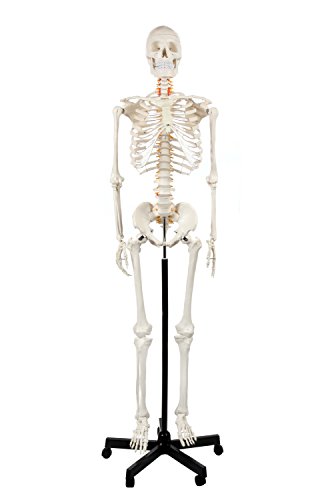
The Axis Scientific skeleton stands out as the most complete package for serious medical students. It features all 206 bones with fully articulated joints that allow for realistic demonstration of flexion, extension, and abduction. The pelvic-mounted rolling stand provides a stable, mobile base that keeps the skeleton balanced during active study sessions, and the 24.6-pound weight gives it a heft that cheaper models lack.
What truly separates this model is the included educational toolkit: a 27-page terminology guide, a product manual, and 189 numbered stickers for self-labeling. This active recall feature alone makes it easier to drill bone markings systematically. The medical-grade PVC construction and stainless steel hardware ensure it holds up to years of daily use, and the 3-year US-based warranty provides peace of mind.
User feedback confirms that most bone markings are visible and accurate, though some students note that a few landmarks are harder to discern and recommend using it alongside a detailed textbook. Assembly is straightforward at 10-15 minutes, but reattaching the skull after removal can be tricky due to the pin mechanism. For the price point, the depth of included material makes it the best long-term investment for pre-med, nursing, and PT students.
Why it’s great
- Comes with 27-page terminology guide and 189 self-labeling stickers for active recall practice
- Pelvic-mounted rolling stand offers superior stability and mobility compared to base-only stands
- Medical-grade PVC and stainless hardware backed by a 3-year US-based warranty
Good to know
- Skull reattachment pin assembly requires careful handling
- Some bone markings are subtle and need textbook cross-referencing
- Stand components can feel slightly flimsy despite the skeleton’s sturdy build
2. Evotech Disarticulated Human Skeleton (67 inch)

The Evotech disarticulated skeleton is the go-to choice for students who need to pass osteology exams with confidence. Cast directly from a real male skeleton, it simulates the texture, structure, and size of human bones with impressive fidelity. The complete set includes the skull, spine with cartilage connections, pelvic model, and articulated left hand and foot, plus a laminated poster identifying various bones in the skeletal system.
Medical students and PT school candidates specifically praise this model for its detailed bone markings, including the foramina, canals, sutures, and processes on the skull that are critical for identification tests. The skull splits in half to allow both internal and external examination. User reviews report that at-home identification drills were invaluable for achieving high exam scores, with one student crediting this skeleton for a significant grade improvement in anatomy and physiology.
Potential drawbacks include sharp molding seams along some bones that require light sanding with a nail file, and the fact that the ribs and thoracic cartilage are not designed to be assembled into a full thoracic cage without specialized tools. The disarticulated nature means you won’t see joint movement, but for individual bone study, this is the most detailed option in its tier.
Why it’s great
- Direct mold cast from real male skeleton replicates accurate bone texture and foramina details
- Skull splits in half for both internal and external structure examination
- Proven track record for helping students pass college-level A&P and PT school exams
Good to know
- Sharp molding seams on some bones require light sanding before use
- Ribs and thoracic cartilage cannot be assembled into a complete cage without special tools
- No articulated joints; designed purely for disarticulated bone study
3. Houseables Disarticulated Human Skeleton (62 inch)

This Houseables set delivers an impressive 203 bones and 23 intervertebral discs at a price point that undercuts many competitors. The three-part skull features a detachable cap for internal examination, and the set provides both disarticulated (right) and articulated (left) hands and feet for comparison—a thoughtful design choice that helps students understand how individual bones connect into functional units.
Nursing students and A&P learners particularly appreciate the detail level, which shows cracks, grooves, and articulating surfaces clearly. Each bone comes bagged and labeled, making it easy to inventory and study one region at a time. The included detailed anatomical chart provides a useful reference, though some students prefer to create their own labeling system with numbered stickers for targeted active recall.
The main limitation is the 62-inch height, which is slightly shorter than the average adult male, meaning some proportions are subtly off. The plastic material is robust but lacks the heavy feel of more expensive PVC blends. Several verified buyers reported passing their exams with this model, confirming its practical value for hands-on identification.
Why it’s great
- Includes both disarticulated and articulated hands/feet for comparative study
- Each bone bagged and labeled for organized region-by-region learning
- Proven exam success track record among nursing and A&P students
Good to know
- 62-inch height is slightly shorter than life-size adult male proportions
- Plastic construction feels less dense than higher-priced PVC alternatives
4. Giantex 70.8″ Human Anatomical Skeleton with Stand

The Giantex skeleton offers an imposing 70.8-inch height—true to life for a tall adult male—making it ideal for classroom demonstrations and anatomy lab references. The detachable arms and legs, along with the movable jaw and head cover, allow for focused study of individual regions. The mobile stand with casters and stainless steel holder means you can reposition it effortlessly between study stations.
X-ray and radiology students specifically appreciate the anatomically correct proportions and the ability to remove the skull, atlas, and axis to examine cervical spine articulation. The joints move smoothly, enabling realistic demonstration of pronation and supination, which is critical for kinesiology and PT coursework. The light weight relative to its size makes it easy to transport, and the polished finish is simple to clean with a damp cloth.
Assembly is quick at roughly two minutes, but the stand base has a reported tendency to feel unstable. Some units arrive with a warped pelvis or mismatched color between the ribs and sternum, and the plastic teeth are overly perfect compared to natural dentition. The lack of assembly instructions and an extra metal piece that doesn’t clearly fit can frustrate first-time builders. Despite these quirks, the overall value for a full-size articulated skeleton is strong.
Why it’s great
- True 70.8-inch height matches tall adult male anatomy for realistic proportions
- Movable joints enable demonstration of pronation, supination, and cervical spine articulation
- Lightweight construction and rolling stand allow easy repositioning between study areas
Good to know
- Stand base can feel unstable; warped pelvis reported in some units
- Plastic teeth look overly uniform compared to real human dentition
- Assembly instructions are missing and some hardware pieces have unclear fit
5. breesky Human Skeleton Model (70.8 in) with Nervous System

The breesky skeleton is uniquely differentiated by its inclusion of the nervous system, a rare feature that adds significant educational value for students studying nerve pathways alongside skeletal anatomy. Standing 70.8 inches tall and made from high-quality PVC, it offers 206 articulated bones with detachable and movable head and joints. The five-wheel rolling bracket makes movement effortless across classroom or clinic floors.
Physical therapy and kinesiology students consistently praise this model for its smooth joint movement and accurate bony landmarks. One user reported scoring a 94 on their bones anatomy exam specifically because of the hands-on study this skeleton enabled. The included three posters provide visual reinforcement, and the capability to disassemble the skeleton into parts for close inspection allows for focused review of specific regions like the shoulder girdle or pelvis.
The main criticism centers on the sacral attachment to the stand, which some users found to be less secure than ideal. The stand itself is functional but basic, and the PVC material, while easy to clean, doesn’t have the premium weight of some competitors. For the price including the nervous system detail, though, this is a compelling option for students who need to understand the relationship between the skeletal and nervous systems.
Why it’s great
- Unique inclusion of nervous system detail adds educational depth beyond pure skeletal study
- Five-wheel rolling bracket allows smooth repositioning within classroom or clinical settings
- Proven exam results with users reporting high scores after hands-on study sessions
Good to know
- Sacral attachment to the stand can feel less secure than desired
- Stand construction is functional but lacks the sturdiness of premium alternatives
6. EVOTECH SCIENTIFIC 15-Part Human Torso Model

The EVOTECH SCIENTIFIC torso model shifts the focus from the skeletal system to the internal organs, making it an essential complement to a skeleton for comprehensive anatomy study. It includes 15 detachable pieces: trunk, brain, heart, esophagus and aorta, four lung pieces, skull cap, stomach, diaphragm, liver, pancreas and spleen, and intestines. The portable 11-inch size fits into a backpack, and the oak-wood base provides a stable, attractive display.
Medical students who used this model in anatomy class found it extremely helpful for understanding the spatial relationships between organs—where the heart sits relative to the lungs, how the diaphragm separates the thoracic and abdominal cavities, and the arrangement of the digestive tract. The hand-painted details are vivid, and the parts fit together securely enough for repeated disassembly and reassembly. The included colorful educational brochure offers basic labeling support, though some students prefer to supplement it with their own notes.
The primary drawback is the brochure, which users consistently describe as useless for detailed study. A more significant issue is that the lungs tend to fall out of place after repeated manipulation; some owners use museum wax to hold them in position. The small parts also pose a choking hazard, so this model is not suitable for households with very young children. For deepening organ system knowledge, however, it’s a solid mid-range choice.
Why it’s great
- 15 detachable parts provide comprehensive visualization of organ spatial relationships
- Portable 11-inch size fits in a backpack for study on the go
- Secure fit of parts allows repeated disassembly and reassembly without collapse
Good to know
- Included brochure is too basic to be useful for serious study
- Lungs tend to fall out of place after repeated handling; museum wax may help
- Small parts pose a choking hazard—not suitable around young children
7. QWORK Human Skull and Brain Anatomy Model (11 Parts)
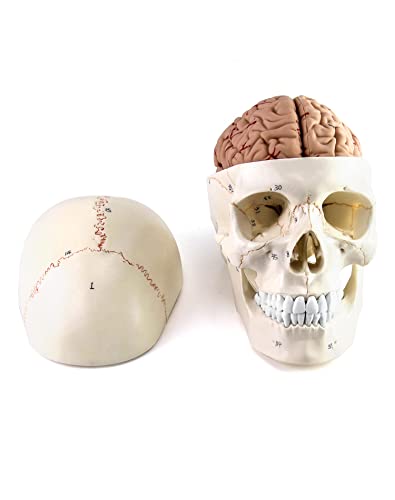
The QWORK skull and brain model packs a surprising amount of detail into an entry-level package. The life-size skull comes in three parts, while the brain decomposes into eight components: sagittal section, cerebral hemisphere, cerebellum, and brainstem. The numeric marker system—32 markers for the brain and 55 for the skull—provides a structured way to test yourself on identification, making this a focused tool for cranial and neuroanatomy review.
High school and college educators have found this model particularly useful for teaching, noting that the robust PVC construction holds up well in classroom environments. The light weight (3.52 pounds) makes it easy to pass around during group study sessions. The skull and brain together allow students to understand how the brain sits within the cranial cavity, a relationship that’s hard to grasp from diagrams alone.
The most significant caveat is that the labeling contains several errors. Verified users have noted that marker #10 labels “Cheekbones” instead of “Zygomatic bone,” #16 labels “Herringbone stitch” instead of “Lamboid Suture,” and #35 labels “The orbit under the hole” instead of “Infraorbital Foramen.” Working students recommend using the model solely for the physical anatomy and relying on an external textbook or professor for correct terminology. For the price, it’s a capable supplement but not a stand-alone resource.
Why it’s great
- Life-size skull with 8-part brain allows study of brain-cranial cavity relationship
- 87 numbered markers provide structured self-testing for identification practice
- Lightweight 3.52-pound PVC construction is classroom-friendly and easy to handle
Good to know
- Labeling contains multiple errors—use only for physical anatomy, not terminology
- Marker language is informal and not aligned with medical nomenclature
- Best used as a supplement alongside a reliable textbook or professor guidance
FAQ
How many bones should a full-size anatomy skeleton have for medical study?
What is the difference between an articulated and a disarticulated skeleton model?
Are expensive anatomy models significantly more accurate than budget options?
Final Thoughts: The Verdict
For most users, the anatomy models for medical students winner is the Axis Scientific Life Size Skeleton Model because it combines superior anatomical accuracy with the most comprehensive study support—three guides and 189 numbered stickers for active recall. If you need to drill individual bones in detail, grab the Evotech Disarticulated Skeleton with its cast-from-real-specimen fidelity. And for organ spatial relationships, nothing beats the EVOTECH SCIENTIFIC 15-Part Torso Model.