
Our readers keep the lights on and my morning glass full of iced black tea. As an Amazon Associate, I earn from qualifying purchases.
Specs are compiled from manufacturer listings and verified buyer reviews and can change over time — please confirm the key details on the product page before buying.
If you print miniatures, cosplay armor, or a mailbox plate for the front yard, the material you load decides whether the job finishes clean or fights you for 20 hours. This guide sorts the 9 picks worth your money — printed resin for detail work, PETG for tough outdoor parts, ABS for heat, and PLA for beginners.
I’m Min — the founder and writer behind Gadgets Feed. This guide is built by comparing the manufacturers’ published specifications and the patterns across verified customer reviews, so you get each pick’s real strengths and trade-offs instead of marketing spin.
Every spool below is judged on the metric that actually matters — whether it feeds, fuses, and holds up after the print cools. Here’s how to pick the right 3d printing material without buying twice.
Our Picks at a Glance


How To Choose The Best 3D Printing Material
Your printer only does what the spool in the feeder lets it do. Pick the wrong material for the job and you get warp, string, or a failed print 14 hours in. Pick right and everything downstream — first layer, layer fusing, final strength — gets easier.
Match the material to what the part has to survive
Indoor display pieces and miniatures want PLA or resin: easy printing, tight detail, low fuss. Parts that get bumped, left in a hot car, or bolted to something structural want PETG (tough like ABS, forgiving like PLA) or ABS itself. Heat is the dividing line — ABS holds its shape where other plastics soften.
Check diameter tolerance before anything else
Filament is sold at 1.75mm, but the real number is the tolerance beside it. A ±0.02mm roll feeds in a consistent stream; a ±0.05mm roll varies enough that thick and thin spots can disrupt your flow rate mid-print. For resin, look at the UV wavelength range — an 395-405nm resin is what most LCD, DLP, and SLA printers cure with.
Know what your feeder can grip
Spool diameter and inner bore matter more than most buyers expect. Some AMS and automatic feeder systems only reliably drive standard-diameter spools; a narrow 53mm bore or a smaller-diameter spool can slip, pinch, or jam. Measure your feeder’s axle first if you run an enclosed multi-color setup.
Quick Comparison
| Model | Best For | Type | Diameter / Tolerance | Total Weight | Amazon |
|---|---|---|---|---|---|
| SUNLU Water Washable Resin★ Best Overall | Zero-alcohol resin detail work | Photopolymer Resin | 395-405nm UV | 2000g | Amazon |
| Creality Hyper ABSTop Performer | High-speed functional parts | ABS | 1.75mm | 1kg | Amazon |
| FLASHFORGE ABS ProBest Finish | Heat-resistant color-changing prints | ABS | 1.75mm / ±0.02mm | 1kg | Amazon |
| SUNLU PETG 2kg | Tough parts on a budget | PETG | 1.75mm / ±0.02mm | 2kg | Amazon |
| Dynta 250g PLA 6-Color | Beginner starter kit | PLA | 1.75mm / ±0.02mm | 1.5kg | Amazon |
| YOUSU Glow PLA 4-Pack | Party glow & special effects | PLA (Glow) | 1.75mm / ±0.03mm | 1kg | Amazon |
| TECBEARS PETG 4kg Bundle | Bulk PETG for frequent printers | PETG | 1.75mm / ±0.02mm | 4kg | Amazon |
| SUNLU High Speed PETG 4kg | Fast printing and matte finishes | PETG | 1.75mm | 4kg | Amazon |
| ANYCUBIC PLA 10kg Bundle | Ten-color production runs | PLA | 1.75mm / ±0.02mm | 10kg | Amazon |
In‑Depth Reviews
1. SUNLU 2kg Water Washable 3D Printer Resin
Our pick — over 4.5★ from 600+ verified ratings; the strongest balance of quality and price.
The resin that lets you skip the alcohol entirely and still pull razor-sharp detail
If you’re printing miniatures, statues, or anything with fine lines you actually want to see, this is the block to start on. It’s a photopolymer resin (a liquid plastic that hardens when UV light hits it) built for LCD, DLP, and SLA printers, and it cures under 395-405nm UV light — the wavelength most 2K, 4K, and 8K resin printers already output. At 2000g (4.4 pounds), the bottle holds double the volume of the 1kg spools here, so it takes more shelf space.
Where it earns its place is cleanup. The water-washable chemistry means you rinse prints with water instead of isopropyl alcohol, so you’re not buying liters of IPA every few weeks. SUNLU tested the formula across multiple printer brands, so it cures predictably on most LCD, DLP, and SLA machines. Users who print statues keep two liters on hand as their go-to. Buyers report the low-shrink formula holds fine details steady, with one saying they printed objects “as thin as.010 (3 sheets of paper).”
The trade-off is honest: this is a regular resin, not a tough engineering blend, so thin features break easier than they would in a high-impact material. Odor sits somewhere in the middle — most users find it mild and fading fast after the print, though the red variant carries a stronger smell and wants a well-ventilated room.
The case for it
- Water cleanup replaces pricey isopropyl alcohol on every print
- 395-405nm cure works with most LCD, DLP, and SLA printers
- 2000g bottle is double the volume of a standard 1kg spool
What will annoy you
- Standard-resin brittleness — thin features snap if you’re rough
- The red variant smells stronger and needs good ventilation
The best fit: Detail-focused printers who want to drop the IPA budget line entirely.
Look elsewhere if: You need max impact strength for pieces that get dropped or flexed.
2. Creality Hyper ABS Filament 1.75mm
An ABS built to run at 350mm/s without turning your enclosure into a warping experiment
Regular ABS (acrylonitrile butadiene styrene — a tough, heat-resistant plastic) usually fights you on high-speed printers: it cools too slow and warps off the bed. Creality’s Hyper formula fixes that with high fluidity and a fast-cooling blend made specifically for speed. Its 19kJ/m² impact strength is close to double a typical PLA spool’s, so parts survive drops that would chip a display model.
It runs on a wide range of machines: Creality’s own K1, K1 Max, K1C, Ender-3 V3 series, plus Bambu Lab, Anycubic Kobra 2, ELEGOO Neptune 4, AnkerMake M5 and M5C, Flashforge Adventurer Pro, Prusa, and FLSUN V400 printers. The ±0.05mm dimensional accuracy (how much the filament’s thickness varies along the strand) keeps flow steady. Buyers regularly report Hyper ABS is noticeably easier to print than standard ABS, with one writing that “Hyper ABS is way easier to print than regular ABS.”
Here’s the catch, and it’s the most common one: spool winding. A handful of rolls arrive with strands fused or tangled, which can kill a long print — as owners put it, tangles “ruined a 22 hour print.” Check for crossed strands before you commit to a big overnight job.
Who should load this: Anyone running a high-speed enclosed printer who needs heat-resistant functional parts.
Worth knowing: ABS still benefits from an enclosure and a heated bed, so an open-frame starter printer isn’t the ideal home for it.
Pick this if: You want a functional, high-temp ABS you can run at full printer speed.
skip it if: You’re printing large sealed parts where a single tangle derails the whole run — rewind or inspect first.
3. FLASHFORGE ABS Pro Filament Burnt Titanium
The heat-resistant ABS that hides layer lines and shifts color as you turn the print
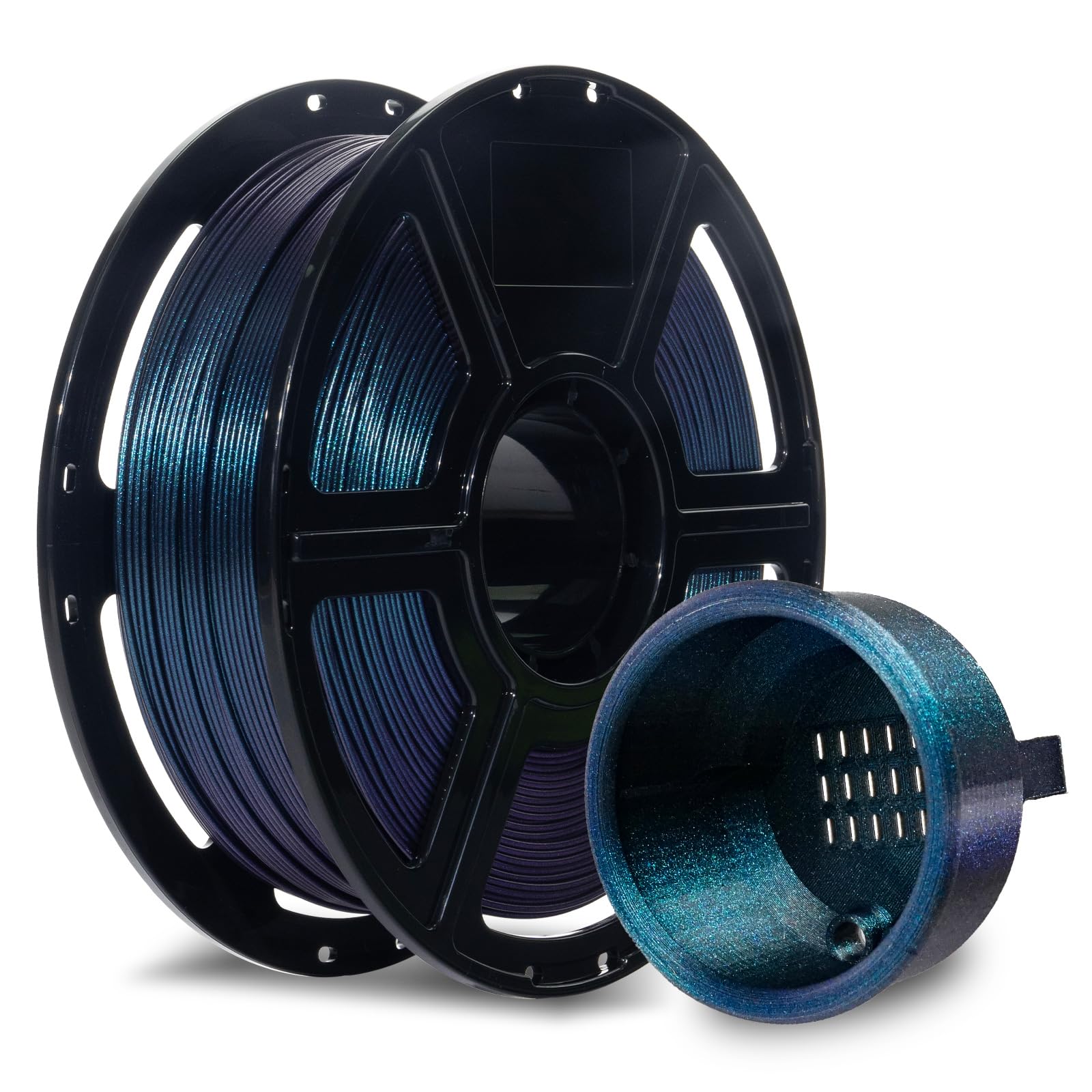
Most ABS is a plain workhorse you cover with paint. This one’s a showpiece. The Burnt Titanium pigment is a chameleon color-changing material — special pigments flip the color depending on the light and viewing angle, and the effect conceals layer lines instead of exaggerating them. Diameter accuracy is ±0.02mm with 99% size accuracy, tighter than the ±0.05mm tolerance on the Creality Hyper above, which means the flow stays even and your layers come out consistent.
FLASHFORGE designed it to print without pre-drying or parameter tweaking — a genuinely rare property for ABS, which normally absorbs moisture and needs a dryer. The strong bed adhesion gives you a stable first layer, and the bridging performance resists delamination (layers separating after cooling). Heat deformation stays below 90°C, so car-interior parts hold shape where PLA would soften. Owners mention near-black metallic blue with blue-purple highlights and a subtle fine glitter, and note the iridescent sheen is strongest when printed in the lower temp range of 220-240°C.
Two things to know before you buy. First, it’s more hygroscopic than typical ABS — a print that comes out crisp can turn rough, stringy, and dull a week later if it sits out, so store it sealed and dry it if quality drops. Second, ABS carries the usual printing odor, and some owners find this blend slightly more brittle than classic ABS.
Why it stands out
- Chameleon pigment hides layer lines and shifts color in different light
- ±0.02mm accuracy with 99% size consistency
- Holds shape below 90°C — useful for car-interior and outdoor parts
The fine print
- Unusually moisture-hungry for ABS — store it sealed and dry when needed
- ABS odor during printing; some find it more brittle than standard ABS
Buy it for: Display pieces and functional parts where the finish matters as much as the strength.
Think twice if: You leave spools open for weeks — this one punishes that habit.
4. SUNLU PETG Filament 1.75mm 2kg Black+White
Two full spools of the material that prints like PLA and survives like ABS
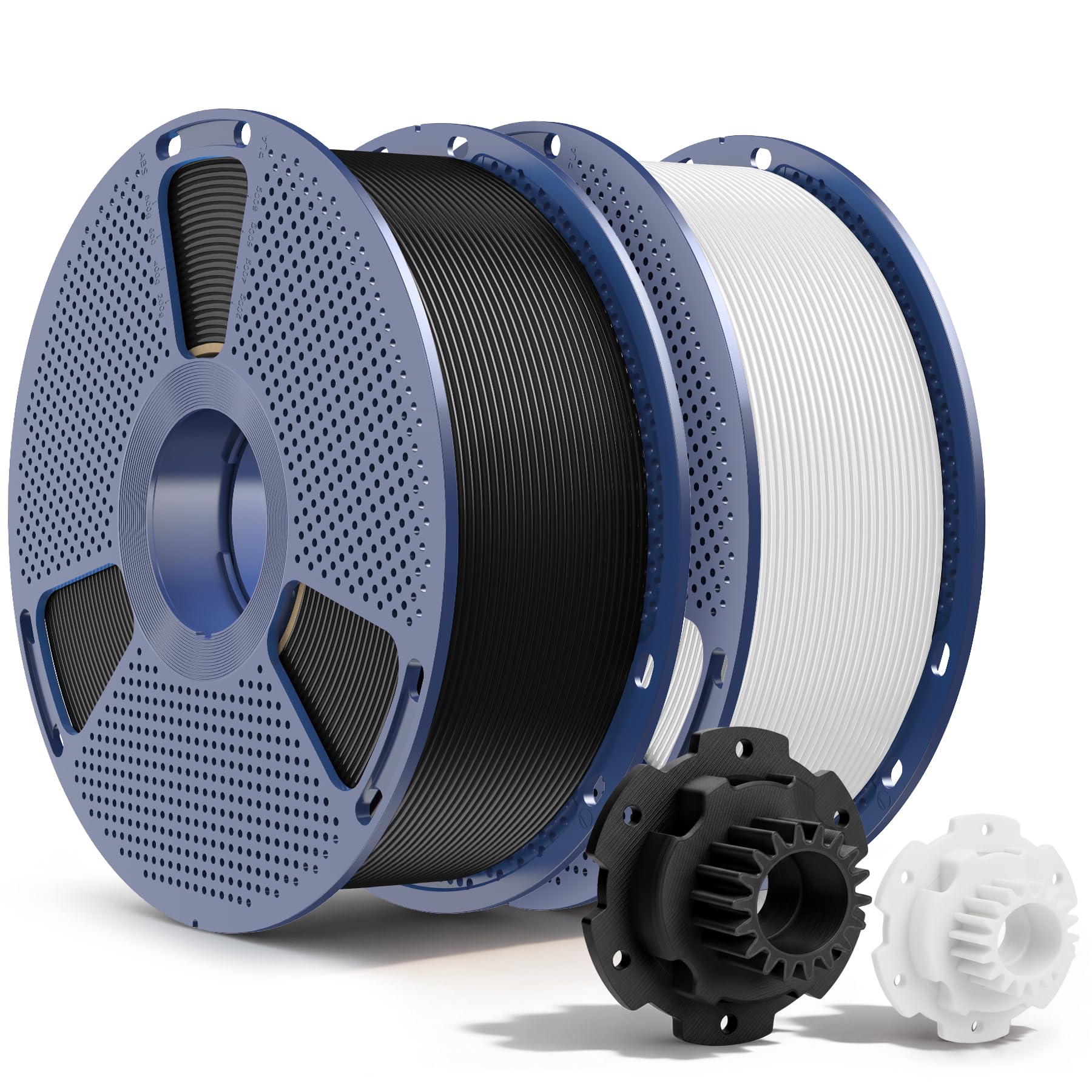
PETG (polyethylene terephthalate glycol — a plastic that blends PLA’s easy printing with ABS-level toughness) is the safest first upgrade for anyone tired of PLA parts breaking. This bundle gives you two 1kg spools, and the low shrinkage and strong layer adhesion mean minimal warping and fewer failed first layers. The ±0.02mm diameter accuracy keeps the extrusion pressure steady, which is why it feeds without clogging or bubbles. Each spool is dried and vacuum-sealed before it ships.
Owners run this on Bambu Lab machines and report prints that come out smooth — some compare the finish to glass. The reliability is the standout: consistent quality, wide material variety, and predictable results batch after batch. It resists outdoor heat and UV, and one buyer’s mailbox address plate printed with zero filament or printer issues.
The honest caveat here isn’t performance, it’s color. The 2kg format limited to Black and White trades variety for volume — if you want orange or green in the same tough PETG, you’ll need a different bundle. And like all PETG, you’ll dial in strings and zits on the first couple of prints before it runs clean.
Where it delivers: Reliable, string-free printing on modern machines at a bundle-friendly quantity — no surprises mid-roll.
The one snag: Restricted to Black and White, so creative multi-color projects need a second purchase elsewhere.
Load this if: You print functional parts in neutral colors and want a predictable PETG that feeds clean.
Move on if: You need a rainbow of colors in one box — this bundle is strictly two-tone.
5. Dynta 250g PLA 3D Printer Filament 6 Colors
Six small spools that let a brand-new printer owner try every color before committing
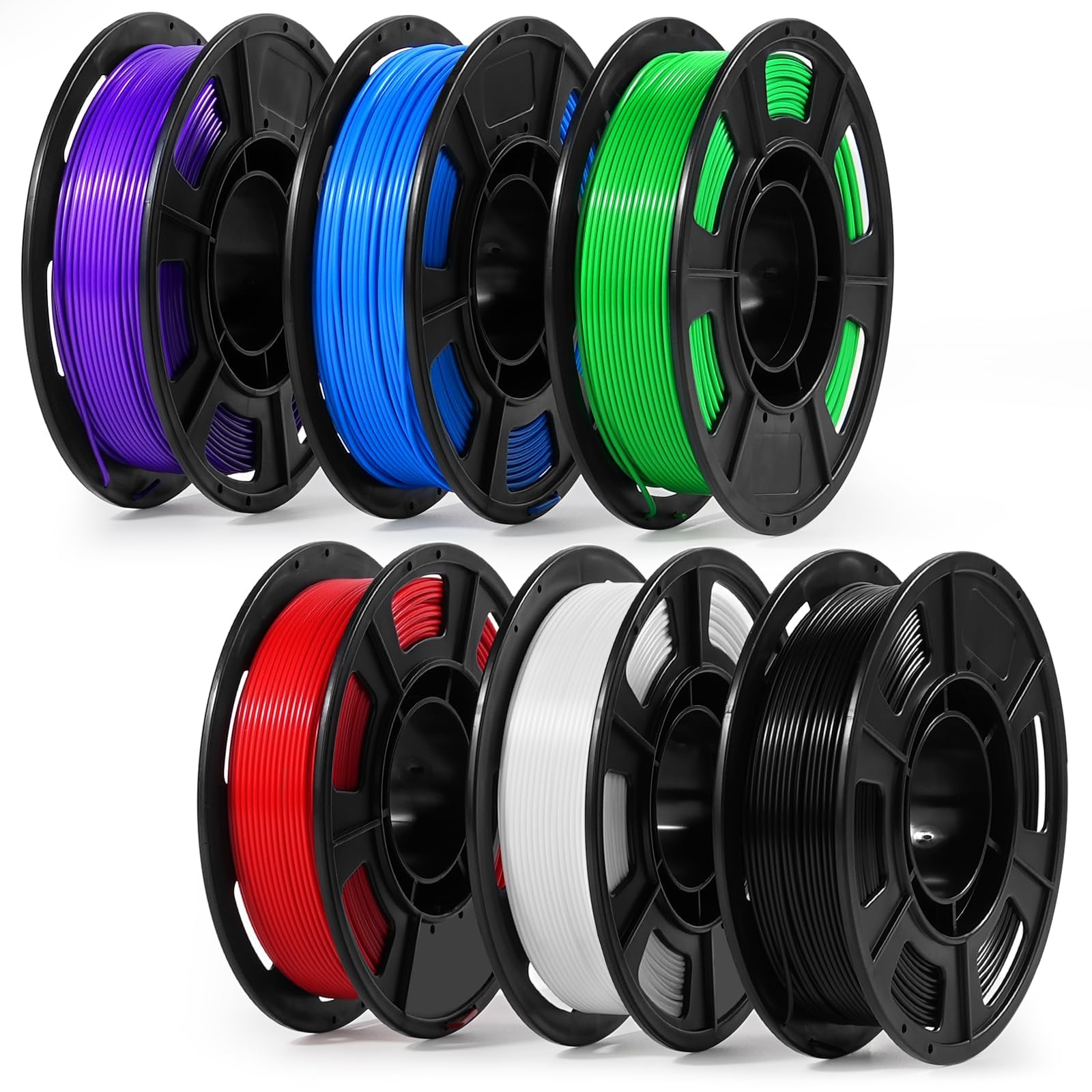
This is the kit you hand someone who just unboxed their first 3D printer. Six 250g spools — black, white, red, green, blue, purple — total 1.5kg, the same material quality as a full-size spool but spread across colors so you can experiment without buying six full rolls. The 1.75mm filament holds ±0.02mm accuracy for smooth extrusion, and Dynta recommends a 190-230°C nozzle with a 45-60°C bed, which covers the default range on almost every starter machine.
The 53mm universal narrow spool is the piece to check. It’s designed to fit Creality Ender-3 V3 series, Bambu Lab A1 mini, FLASHFORGE Adventurer 5M and most FDM printers without a custom bracket. But if your printer has an extra-thick spool axle over 53mm, the spool won’t seat — measure before you order. Made from renewable plant resources, the PLA itself is straightforward and forgiving for everyday prints and educational use.
Two honest limits. Each spool holds just 250g, so heavy print volume burns through one fast — and a few customers note the smaller spools don’t feed cleanly in Bambu’s AMS system, where the winding can cause feed errors. Respooling onto a standard spool fixes that, but it’s extra work.
What beginners get
- Six 250g colors — try everything without full-spool commitment
- ±0.02mm accuracy on durable 1.75mm filament
- 53mm narrow spool fits most mainstream printers without a bracket
Where it falls short
- 250g per spool runs out fast on bigger jobs
- Winding sometimes causes feed errors in enclosed multi-color systems
Ideal for: A first printer that needs variety and forgiveness more than raw capacity.
Not ideal for: Long single-color production runs — you’ll respool or buy full-size rolls instead.
6. YOUSU Glow in The Dark PLA Filament 4-Pack

Four spools of phosphorescent PLA that keep glowing long after the lights go out
This pack exists for the fun factor: green, blue, purple, and rainbow PLA laced with phosphorescent material that absorbs light energy and glows in the dark. To charge the effect, you expose the print to sunlight or UV light for 30 minutes and it radiates afterward. The green is the brightest and the purple dimmest, which lines up with how glowing pigments normally behave. At 1.75mm diameter with ±0.03mm accuracy, the tolerance is slightly looser than the ±0.02mm rolls in this group but still tight enough to feed smoothly through most FDM printers.
Festive projects are where this earns its keep — Halloween decorations, Christmas ornaments, cosplay pieces, glow sticks, and figurines. Four 250g spools let you mix colors without committing to a full kilogram of any one hue. Owners printing fast report clean layers, smooth feed, and minimal stringing, sometimes out-performing standard high-speed PLA.
The catch is baked into the glow itself. Charging source matters — bright sunlight produces a strong glow while LEDs and fluorescents barely register, and some buyers ultimately felt the effect fell short. Glow pigment is also abrasive, so a 0.6mm nozzle helps prevent wear-related clogging on longer runs.
The verdict: A niche pick that delivers on its promise when used with the right light source and printing setup.
Be aware: The four 250g spools are small, and glow pigment is abrasive — a 0.6mm nozzle reduces wear risk.
Reach for it if: Your prints are meant to entertain — party pieces, kid gifts, and Halloween builds.
Look past it if: You need load-bearing parts or consistent color across a big print batch.
7. TECBEARS PETG Filament 1.75mm 4kg Bundle
Four kilos of tough PETG in blue, red, orange, and gray for people who print constantly
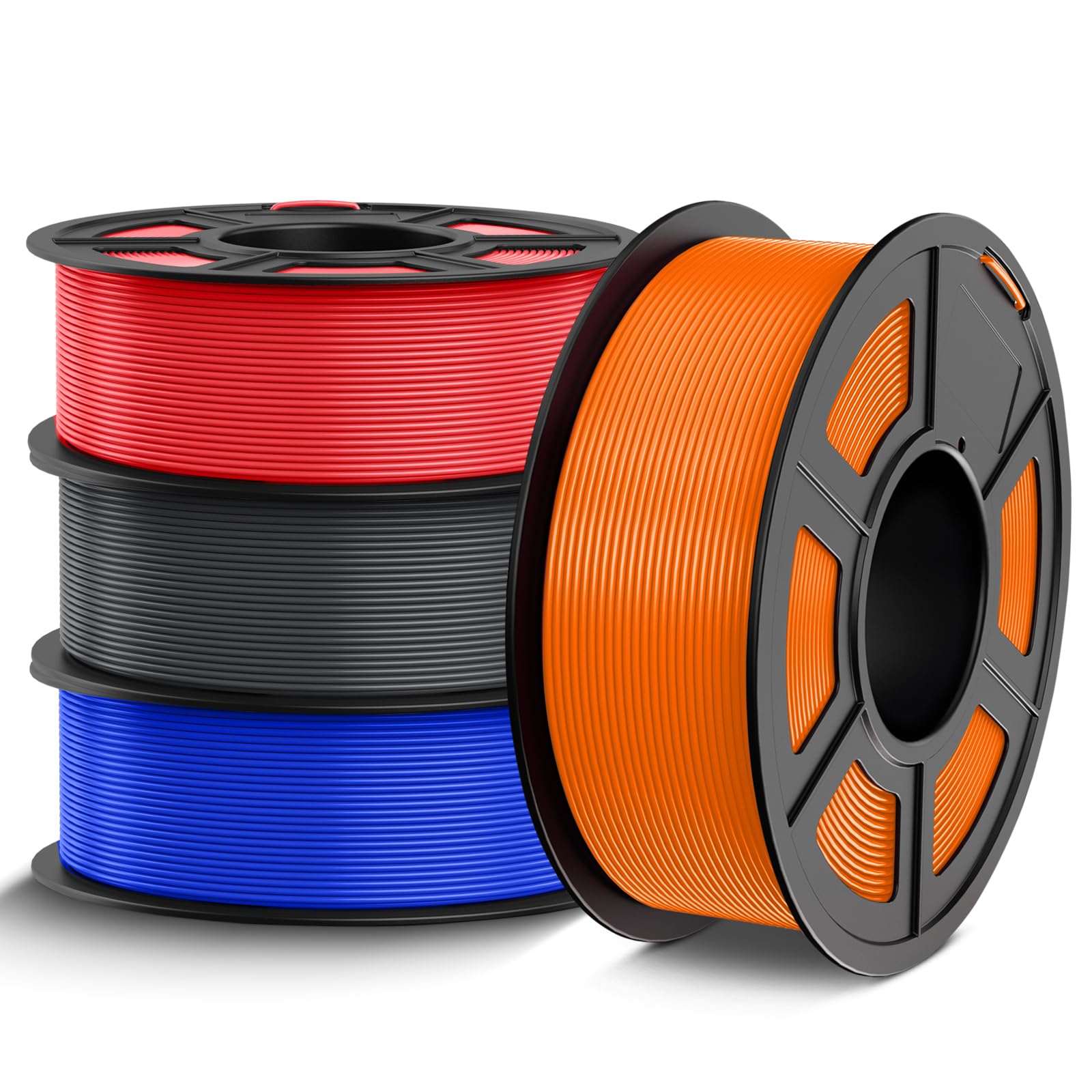
If you go through a spool a week, buying singles gets old. This bundle hands you four 1kg spools — blue, red, orange, and gray — in a material that combines PLA’s easy printing with ABS-level toughness. Impact resistance is strong, along with resistance to acids, alkalis, and weather, so it suits shatterproof prototypes, brackets, and outdoor parts. The ±0.02mm accuracy and low shrinkage keep dimensions stable, cutting cracking and warping during printing.
The winding is done neatly to avoid tangling, twisting, or breaking during printing — which is why reviewers point out good layer bonding, good bed adhesion, and no stringing on tuned machines. The high transparency and gloss give clear parts and a shiny professional finish, and buyers describe the prints as bright and vibrant. It runs well on both Bambu and Prusa machines.
Two fit notes to weigh. First, the colors don’t always match their labels — the “red” leans orange-red rather than a true red, and a couple of hues print lighter than expected. Second, a few buyers find the side openings in the spools snag the PTFE guide tubes in an AMS system. Neither ruins the material, but check your feed path before committing to a large multi-color job.
Why frequent printers like it
- 4kg across four colors — bulk quantity without buying singles
- ±0.02mm accuracy and low shrinkage for stable dimensions
- Acid, alkali, and weather resistance suits tough outdoor parts
Watch for
- Red prints closer to orange-red than true red
- Spool side openings can snag guide tubes in AMS feeders
Best for: High-volume printers who want a tough PETG stocked in four colors and don’t mind label-to-print color quirks.
Less suited to: Buyers who need exact color matching for a client-facing job.
8. SUNLU High Speed PETG Filament 1.75mm 4kg

PETG tuned to melt fast enough to keep up with a 600mm/s printer
Standard PETG struggles above moderate speeds — it can’t melt and extrude fast enough to keep up, so prints get blobby or under-extruded. SUNLU reworked the formula for enhanced fluidity, letting this PETG print anywhere from 30mm/s up to 600mm/s. That range means it’ll run on an older slow printer and also keep pace on a modern high-speed machine without swapping spools. Four 1kg spools — sky blue, mint green, pink, and orange — give you a full stock.
You can dial in temperature for the speed you’re running. SUNLU recommends 230-240°C for 50-100mm/s, 240-255°C for 100-300mm/s, and 255-270°C for 300-600mm/s, with a 70-80°C bed. The matte finish is the other standout: instead of the glossy sheen of most plastics, prints come out with a soft, even matte texture that looks noticeably less plastic. Owners running Bambu Lab machines report clean, long prints without babysitting once the spool is dry.
Here’s the practical trade-off. This PETG is very hygroscopic — it absorbs moisture fast and needs roughly 6-8 hours of drying before use, even fresh out of the package, or you’ll get popping, stringing, and zits. And the color is deliberately pale across the line; if you want deep saturation, this isn’t the batch.
The strong point: A speed range that works on any printer, from a slow starter machine to a top-speed production setup.
What to expect: A drying routine is not optional here — skip it and quality drops fast.
Pick it when: You run a high-speed printer and want PETG that keeps up with the head.
Hold off if: You don’t have a filament dryer — this spool demands one.
9. ANYCUBIC PLA 10kg Multicolor Bundle

Ten kilograms of PLA across ten colors for shops that go through filament fast
This is the production-floor pick. Ten 1kg spools — black, white, texture grey, clear, red, blue, green, orange, yellow, and purple — give you a full palette without repeat orders. Each spool runs 1.75mm ±0.02mm accuracy with low shrinkage and stable printing dimensions, which keeps the layer fusion consistent for smooth bridging. It runs across a wide range of temperatures and speeds, so it fits mainstream printers on the market.
The standout feature is the intelligent identification chip built into the filament. It integrates with the ACE Pro system for automatic identification of printing information, so the machine reads the spool without manual entry. Each spool is dried for 24 hours before packaging and vacuum-sealed with desiccants, then wound without crossing turns to cut clogging and under-extrusion. The larger spool inner bore is a deliberate design choice to keep feeding smooth. Shoppers say it holds up to long print sessions and comes out consistent and fuss-free.
The one honest note worth flagging: production at scale is hard, and buyer experience with individual rolls varies — occasionally a spool like the white arrives wound less neatly than the others. For a ten-roll bundle, that’s a rare miss rather than a pattern.
Why it wins on volume
- 10kg across 10 distinct colors for heavy print schedules
- Intelligent identification chip works with the ACE Pro system
- Dry-packed and vacuum-sealed with desiccants before shipping
The honest note
- Occasional individual spools arrive wound less neatly than the rest
- You commit to the full ten-color set — no customizing the palette
The right buyer: Anyone running a print shop, classroom, or gift-production schedule who wants the full palette stocked at once.
Not the right buyer: Hobbyists who only need one or two colors — you’re paying for range you may not use.
Understanding the Specs
Diameter Tolerance
Filament is sold at 1.75mm, but the ± number beside it tells you how much the strand’s thickness actually varies along the spool. A ±0.02mm tolerance (like the FLASHFORGE ABS Pro, SUNLU PETG, and ANYCUBIC PLA above) means thick spots and thin spots stay within a very tight band, so the extruder pushes the same volume of plastic every second. A looser ±0.05mm tolerance (like the Creality Hyper ABS) still prints well, but the flow rate fluctuates slightly more, which can show up as subtle layer inconsistencies on precision parts.
Cure Wavelength for Resin
Resin is not melted like filament — it’s cured when UV light hardens it. The wavelength range printed on the bottle has to match what your printer’s light source emits. The SUNLU Water Washable resin cures under 395-405nm UV light, which is the standard output range for most 2K, 4K, and 8K LCD, DLP, and SLA printers. If your machine outputs outside that range, the resin won’t fully cure and prints stay tacky — always match the wavelength to your printer’s light source before buying.
FAQ
Will 1.75mm filament fit every FDM 3D printer?
Is water-washable resin really as good as isopropyl alcohol resin?
How long can I leave PETG filament on the spool before it needs drying?
What does the ± in ±0.02mm diameter tolerance actually mean?
Will ABS filament work on a printer without an enclosure?
Is glow-in-the-dark PLA safe to print with a standard nozzle?
How much filament does a typical small print use?
What is the difference between PETG and ABS for functional parts?
Can I use the same nozzle for PLA, PETG, and ABS?
Final Thoughts: The Verdict
The crowd favorite in this set is the SUNLU Water Washable Resin — 4.7 stars across 600+ ratings — because it prints sharp detail and kills the alcohol bill at the same time. If you want high-speed functional parts that hold up to heat, grab the Creality Hyper ABS. And for a beginner who wants to try every color without committing to a single full spool, the Dynta 6-Color PLA kit is the one to reach for.
How We Picked
We do not accept paid placement. Every pick is matched to a real buyer and a real use-case; we do not hands-on test units.
Sources & Methodology
Specifications: manufacturer listings and product documentation. Review insights: verified customer reviews, as of September 2026. Pricing: not shown on this page (it changes often); check the current price via the retailer link.
As an Amazon Associate, Gadgets Feed earns from qualifying purchases. This does not affect which products we feature.