
Building a machine that can flawlessly handle multi-GPU rendering, AI model training, or complex simulation means every component decision is under a microscope. The wrong GPU selection can bottleneck an entire 4-GPU topology, wasting thousands on underutilized PCIe lanes and mismatched VRAM pools. This guide dissects the most capable workstation configurations available now.
I’m Min — the co-founder and writer behind Gadgets Feed. I’ve spent countless hours analyzing the thermal profiles, VRAM bandwidth, and PCIe lane configurations of the latest workstation GPUs to find which setups genuinely deliver for multi-GPU workflows.
Whether you’re deploying for deep learning inference, 3D rendering farms, or large-scale data science, these picks represent the current pinnacle of what a 4 gpu workstation can achieve.
How To Choose The Best 4 GPU Workstation
Selecting the right components for a 4-GPU build requires focusing on the motherboard’s PCIe lane count, the power delivery system, and the physical space inside the chassis. A consumer-grade desktop often lacks the required slots and cooling for four professional-grade cards.
VRAM Capacity and Memory Type
For AI and simulation workloads, VRAM is often the primary constraint. Cards with 48GB or 96GB of memory allow you to load larger models without splitting them across cards. ECC memory, found on NVIDIA RTX A-series and PRO-series cards, corrects single-bit memory errors, which is critical for long-running scientific computations where a single bit flip can invalidate hours of work.
PCIe Lane Configuration
Four GPUs require a motherboard and CPU that support enough PCIe lanes. A typical workstation CPU like an Intel Xeon W or AMD Threadripper offers 64 or more lanes, allowing each GPU to run at x16 or at least x8. Running four GPUs on a consumer platform with only 20 lanes forces them into x4 or x1 modes, crushing bandwidth for data-intensive tasks.
Thermal Management
Four GPUs generate substantial heat. Look for cards with a double-flow-through or blower-style cooler that exhausts hot air out the back of the case. Cards that dump heat into the chassis interior can cause thermal throttling, especially when tightly packed in a multi-GPU configuration.
Quick Comparison
On smaller screens, swipe sideways to see the full table.
| Model | Category | Best For | Key Spec | Amazon |
|---|---|---|---|---|
| NVD RTX PRO 6000 Blackwell | Professional | Massive AI models, scientific simulation | 96GB GDDR7 ECC | Amazon |
| PNY NVIDIA RTX A6000 | Professional | High-end 3D CAD, data science | 48GB GDDR6 ECC | Amazon |
| HP OMEN 45L (RTX 5090) | Pre-built | High-end rendering and AI inference | RTX 5090 32GB GDDR7 | Amazon |
| Skytech Legacy 4 (RTX 5090) | Pre-built | Versatile gaming and workstation tasks | RTX 5090 32GB GDDR7 | Amazon |
| PNY NVIDIA Quadro RTX A5000 | Professional | Budget-friendly professional rendering | 24GB GDDR6 ECC | Amazon |
| Thermaltake LCGS View i570 | Mid-range Pre-built | GPU-compute entry point for startups | RTX 5070 12GB GDDR7 | Amazon |
| Alienware Aurora ACT1250 | Mid-range Pre-built | Compact multi-GPU capable desktop | RTX 5070 12GB GDDR7 | Amazon |
In‑Depth Reviews
1. NVD RTX PRO 6000 Blackwell

The RTX PRO 6000 Blackwell represents the absolute ceiling of single-GPU capability for professional workstations. Its 96GB of GDDR7 ECC memory and 1.8 TB/s bandwidth allow for local fine-tuning of 70B parameter LLMs without sharding, a feat impossible on any consumer card. The double-flow-through cooler is designed for the sustained 600W power load these cards demand in multi-GPU racks.
Beyond raw VRAM, the 4th-gen RT Cores and 5th-gen Tensor Cores deliver up to 3x the performance of the previous generation for ray tracing and AI training. The inclusion of PCIe Gen 5 support ensures that four of these cards can saturate a workstation’s bandwidth without bottlenecks. For simulation and engineering, the certified drivers and ECC memory provide the stability that GeForce cards simply cannot guarantee.
The major consideration is the thermal exhaust design: hot air is expelled into the case interior rather than out the back. In a four-card configuration, you must engineer aggressive chassis airflow to prevent thermal throttling. The OEM packaging also means you won’t get a retail box, but the 3-year manufacturer’s warranty provides peace of mind.
Why it’s great
- 96GB GDDR7 ECC memory handles the largest AI models locally
- PCIe Gen 5 doubles bandwidth for data-intensive multi-GPU topologies
- Universal MIG allows partitioning one card into secure isolated instances
Good to know
- Hot air exhaust enters the case interior, requiring exceptional chassis airflow
- OEM packaging from resellers can introduce quality control risks
- Requires a motherboard and PSU capable of supporting 600W per card
2. PNY NVIDIA RTX A6000

The RTX A6000 is the established workhorse of the professional GPU market, and for good reason. Its 48GB of GDDR6 ECC memory, combined with second-gen RT Cores and third-gen Tensor Cores, makes it a robust choice for complex 3D CAD, photorealistic rendering, and data science model training. The dual-slot, full-height form factor is standard for multi-GPU server racks.
Third-generation NVLink allows you to pair two A6000s to pool their memory into a single 96GB addressable space, which is invaluable for datasets that exceed 48GB. The blower-style cooler exhausts heat out the back of the chassis, making it far easier to stack four A6000s without inducing thermal throttling compared to cards that dump heat internally. Professional users also benefit from ISV certification for applications like SolidWorks and CATIA.
The primary concern here is pricing and sourcing. At the premium end of the market, verifying that you are receiving new, unused cards is essential, as some resellers have been known to pass off used mining or compute cards as new. The A6000 also lacks the raw memory bandwidth of the newer GDDR7-based PRO 6000.
Why it’s great
- 48GB ECC memory is sufficient for most professional rendering and simulation tasks
- Blower-style cooler exhausts heat out the back, ideal for dense multi-GPU setups
- NVLink support allows memory pooling across two cards for larger datasets
Good to know
- Market saturation with used or counterfeit cards requires careful vendor selection
- GDDR6 memory bandwidth is outpaced by newer GDDR7 offerings
- Peak 300W power draw, while efficient, still demands adequate PSU headroom for four cards
3. HP OMEN 45L Gaming Desktop (RTX 5090)

The HP OMEN 45L bridges the gap between gaming aesthetics and workstation-grade performance with its RTX 5090 GPU and Intel Core Ultra 9 285K processor. The RTX 5090’s 32GB of GDDR7 memory and 4th-gen Tensor Cores deliver exceptional AI inference and rendering performance for a single-GPU system. The 64GB of DDR5 RAM and 2TB NVMe SSD handle large project files without struggle.
The patented OMEN CRYO CHAMBER cooling system isolates the liquid cooler radiator, pulling fresh air from the top of the chassis to cool the CPU. This design prevents the GPU’s exhaust from pre-heating the CPU cooler, which is a common issue in tightly packed multi-GPU cases. The tool-less access and industry-standard form factor make it easy to add a second GPU later if your motherboard supports it.
The 2TB SSD may feel cramped for users storing multiple large AI models or rendering projects. Additionally, because this is a pre-built system, you are limited to the motherboard and PSU HP selects, which may restrict your ability to add three more GPUs without significant upgrades.
Why it’s great
- RTX 5090 with 32GB GDDR7 provides top-tier AI and rendering performance out of the box
- CRYO CHAMBER cooling keeps CPU temperatures isolated from GPU exhaust
- Tool-less access and standard form factor simplify future component upgrades
Good to know
- Single-GPU configuration limits multi-GPU scaling potential without major modifications
- Storage capacity (2TB) may be insufficient for large-scale AI model repositories
- Pre-built components may not meet the exact specifications ordered, as reported by some users
4. Skytech Legacy 4 Gaming PC (RTX 5090)

The Skytech Legacy 4 pairs the AMD Ryzen 9 9950X3D processor with the NVIDIA RTX 5090, creating a powerhouse for both GPU-compute tasks and CPU-bound rendering. The 64GB of 6000MHz DDR5 RAM and a 4TB Gen4 NVMe SSD provide substantial memory and storage for handling large datasets. The 1200W Gold-rated PSU with ATX 3.0 support is ready for transient power spikes from high-end GPUs.
The 420mm AIO liquid cooler for the CPU ensures thermal headroom for sustained all-core workloads, which is critical when the CPU is also feeding data to the GPU. The X870 motherboard provides PCIe Gen 5 support, future-proofing for faster storage and potential multi-GPU expansion. The system ships with no bloatware, a welcome detail for users who need a clean environment for simulation and development work.
The primary limitation for a 4-GPU configuration is the physical case size and the X870 motherboard’s PCIe lane configuration. While excellent as a single-GPU workstation, building a true 4-GPU rig would likely require a different chassis and a Threadripper or Xeon platform to support the necessary PCIe lanes.
Why it’s great
- AMD Ryzen 9 9950X3D offers exceptional multi-threaded CPU performance for rendering
- 4TB Gen4 NVMe SSD provides ample storage for large AI models and project files
- 1200W ATX 3.0 PSU delivers robust power delivery for high-end GPUs
Good to know
- Consumer platform limits PCIe lanes for multi-GPU expansion to more than two cards
- Some units have shipped with lesser components than advertised, requiring verification upon arrival
- Case and motherboard may not support the physical clearance for four dual-slot GPUs
5. PNY NVIDIA Quadro RTX A5000

The RTX A5000 is a strong entry point into the professional Quadro ecosystem without the cost of the higher-end A6000 or PRO 6000. With 24GB of GDDR6 ECC memory and 8192 CUDA cores, it can handle complex CAD models and moderate-sized neural networks. The dual-slot design and under-300W power draw make it one of the easiest professional cards to cool in a multi-GPU setup.
The ECC memory is critical for users running long-duration simulations where data integrity cannot be compromised. The card also features 4x DisplayPort 1.4 outputs, supporting up to 8K displays. For rendering in applications like Revit, users have reported significant frame rate improvements over consumer cards, thanks to optimized drivers.
The 24GB VRAM is the card’s limiting factor for AI workloads. Large language models or high-resolution 3D textures may exceed this capacity, forcing you to split workloads or upgrade. Additionally, there have been reports of resellers sending used cards in new packaging, so diligent inspection is advised.
Why it’s great
- 24GB GDDR6 ECC memory provides professional reliability at a lower entry price
- Low 300W power draw simplifies thermal and power management in multi-GPU builds
- ISV-certified drivers ensure stability in professional CAD and simulation software
Good to know
- 24GB VRAM is insufficient for large-scale AI model training or massive 3D datasets
- PCIe Gen 4 interface may bottleneck newer CPUs with Gen 5 support
- Counterfeit or used cards sold as new require careful vendor vetting
6. Thermaltake LCGS View i570-170 Gaming Desktop
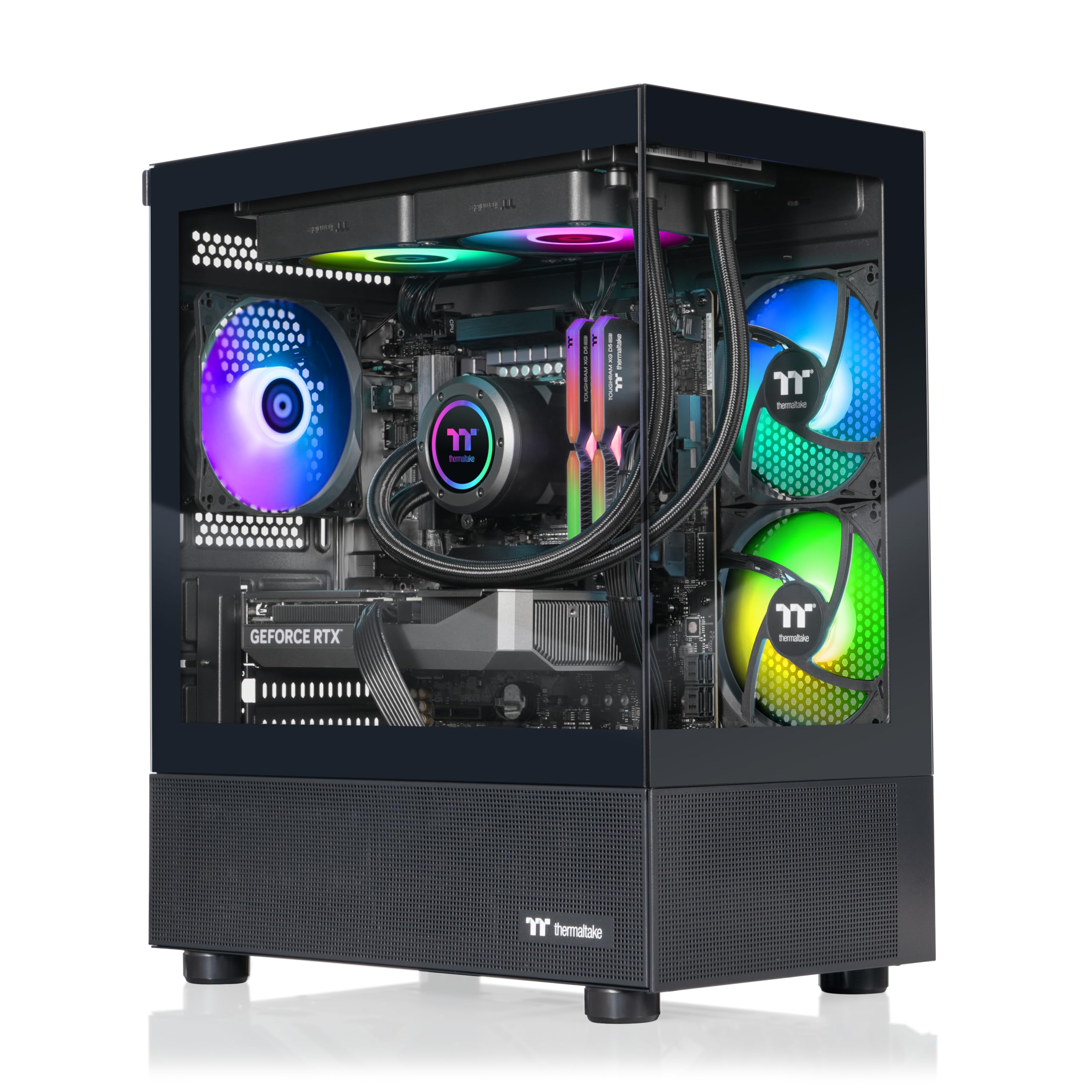
The Thermaltake LCGS View i570 is built around an Intel Core i9-14900KF and an NVIDIA RTX 5070. While this is a gaming desktop at its core, the i9 CPU and RTX 5070’s 12GB of GDDR7 memory provide a capable platform for GPU-compute tasks like video rendering or moderate machine learning inference. The 240mm liquid cooler keeps the CPU under control during extended workloads.
The system runs with minimal bloatware, a positive sign for users wanting a clean Windows install. Reported performance in modern games at high settings confirms the RTX 5070 is no slouch, but the 12GB VRAM will be a hard limit for professional 3D or AI applications. The chassis supports standard ATX components, allowing for GPU upgrades down the line.
The 12GB VRAM and the single-GPU configuration mean this system is not suited for a true 4-GPU workstation role. It is best viewed as a budget-friendly entry point for someone who needs a capable desktop now and plans to build a dedicated multi-GPU server later. A handful of reports mention slightly noisy fans under load.
Why it’s great
- Intel Core i9-14900KF provides excellent CPU performance for rendering and encoding tasks
- 240mm liquid cooling keeps CPU thermals in check during sustained workloads
- No bloatware ensures a clean software environment out of the box
Good to know
- 12GB VRAM is insufficient for most professional AI and large-scale 3D workloads
- Single-GPU system requires complete re-build for multi-GPU expansion
- Fan noise can be audible under extended load
7. Alienware Aurora Gaming Desktop ACT1250
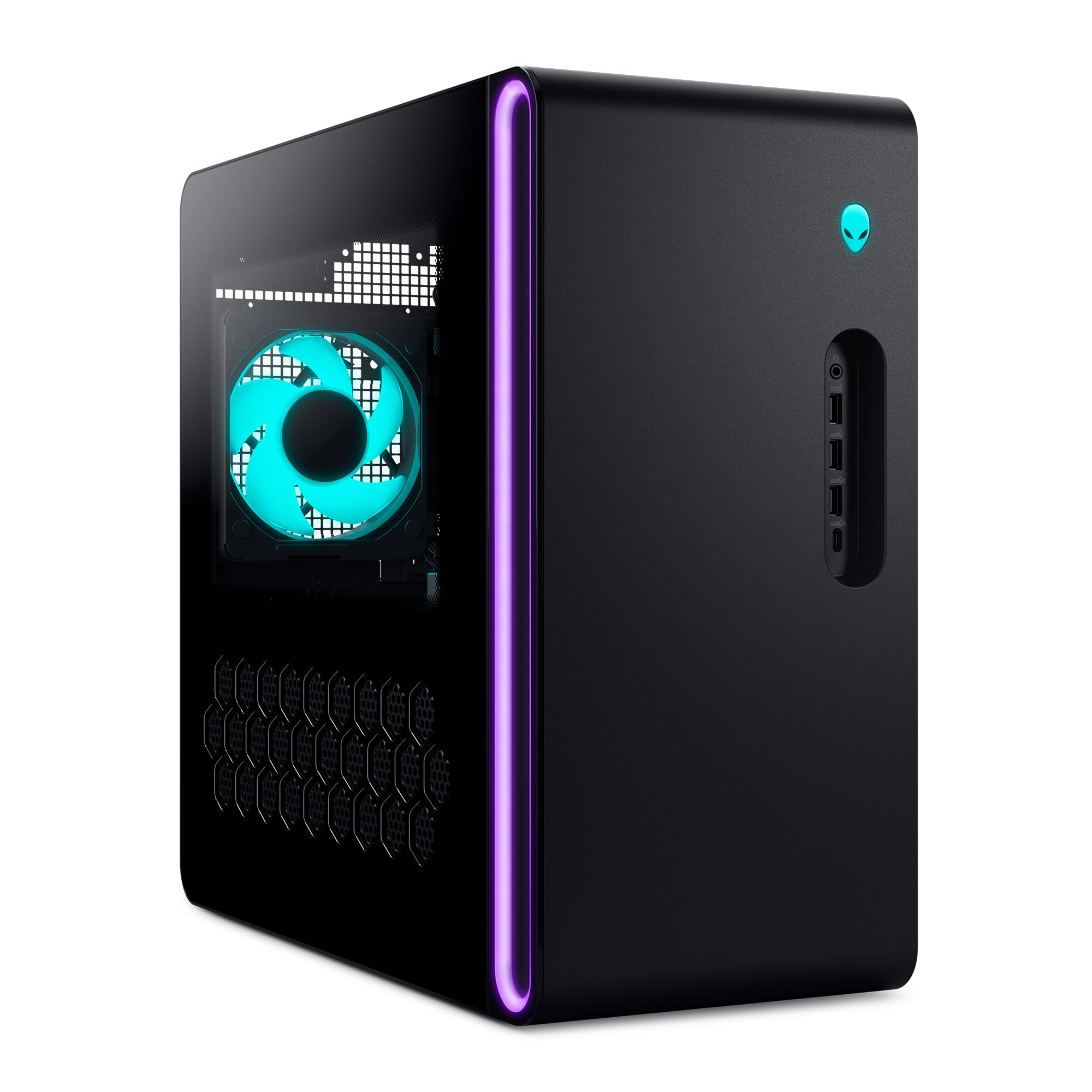
The Alienware Aurora ACT1250 presents a streamlined pre-built option with an Intel Core Ultra 7 265F processor and an RTX 5070 GPU. Its compact chassis and 1000W Platinum-rated PSU offer a solid foundation. The RTX 5070, with 12GB of VRAM, is capable of running GPU-accelerated tasks for small to medium projects, though the 265F processor lacks the extreme core counts of HEDT platforms.
The Alienware Command Center provides granular control over power states and fan curves, which is useful for maintaining stable performance during long rendering sessions. The 1TB NVMe SSD is adequate for the OS and active projects. The chassis supports some component upgrades, but the proprietary motherboard and power supply may limit expansion to multiple GPUs.
The 12GB VRAM and single 16-lane PCIe slot make this system unsuitable for a multi-GPU workstation. Its primary use case is as a general-purpose performance desktop that can handle occasional GPU compute. Reports of units arriving with missing hardware (like HDMI ports) or failing to start within weeks underscore the importance of thorough inspection upon delivery.
Why it’s great
- 1000W Platinum-rated PSU provides clean, efficient power for the RTX 5070
- Alienware Command Center offers detailed system monitoring and power profile control
- Compact form factor saves desk space compared to full-tower workstation chassis
Good to know
- 12GB VRAM and single-GPU slot preclude any serious multi-GPU workload
- Proprietary motherboard and PSU limit the scope of upgrades
- Quality control issues have been reported, including incomplete units and power failures
FAQ
Can I mix consumer GeForce cards with professional Quadro cards in the same system?
How many PCIe lanes does a quad-GPU workstation need?
Is a pre-built workstation better for multi-GPU setups than a custom build?
What is the power supply requirement for four high-end GPUs?
Final Thoughts: The Verdict
For most users, the 4 gpu workstation winner is the NVD RTX PRO 6000 Blackwell because its 96GB GDDR7 ECC memory and PCIe Gen 5 support offer the most headroom for AI and simulation without relying on complex NVLink configurations. If you want a proven mid-range card with ECC and NVLink, grab the PNY NVIDIA RTX A6000. And for a budget-conscious entry point into professional rendering, the PNY NVIDIA Quadro RTX A5000 provides stable performance for smaller workloads.