
Our readers keep the lights on and my morning glass full of iced black tea. As an Amazon Associate, I earn from qualifying purchases.
Specs are compiled from manufacturer listings and verified buyer reviews and can change over time — please confirm the key details on the product page before buying.
Most people shopping for a budget 10-inch subwoofer want the same two things: bass you can actually feel, and a sub that does not fall apart or sound muddy a year in. That is exactly what this list separates. Every pick here uses a genuine 10-inch driver, and each one has a clear reason to exist — a shallow one that fits under a seat, a powered box that installs in minutes, or a home-theater sub that digs down to 28Hz.
I’m Min — the founder and writer behind Gadgets Feed. This guide is built by comparing the manufacturers’ published specifications and the patterns across verified customer reviews, so you get each pick’s real strengths and trade-offs instead of marketing spin.
The tricky part is that a car sub and a home sub are built for completely different jobs, so you have to match the box and the power to your space before you buy. This breakdown covers the best Budget 10 Inch Subwoofer options for both setups, with the wattage and voice-coil details spelled out in plain words.
Our Picks at a Glance


How To Choose The Best Budget 10 Inch Subwoofer
Before you compare any model, answer two quick questions. First, is this going in your car or in your living room? Second, do you want the sub to include its own amplifier, or will you run a separate amp? Those two answers narrow the field more than any spec sheet will.
RMS vs max power: which number matters
Max power (the peak wattage a sub can survive for an instant) is the number on the box. RMS power (the wattage it handles continuously) is the number that tells you how hard you can actually play it, hour after hour, without cooking the voice coil. A sub rated for 300W RMS and 1200W max handles 300 watts all day long. Match your amplifier to the RMS figure, not the peak, and the sub will last. Sensitivity, measured in dB (decibels, the standard unit for loudness per watt of input), matters too — a more efficient sub gets louder on the same amp.
Powered vs passive: the install question
A passive sub is just the driver — you supply the amplifier and wire it to a box. A powered sub (sometimes called active) has the amplifier built into the enclosure, so you run one power wire and one signal cable and you are done. Powered designs are simpler to install and harder to get wrong. Passive designs give you flex to choose your own amp and voice-coil wiring. Neither is “better” — the powered route is for anyone who wants it working this weekend.
Box size, mounting depth, and voice coil
Mounting depth (how deep the magnet and frame sit below the mounting surface) decides whether a driver will physically fit behind a seat or under a shelf. Voice-coil configuration — single voice coil (SVC) or dual voice coil (DVC) — controls how you wire the sub to your amp for a 2-ohm, 4-ohm, or 8-ohm load. Dual-coil models let you match more amps; single-coil is simpler to wire. Check both before you commit, because a sub with the wrong depth will not fit the box you already have.
Quick Comparison
| Model | Best For | Power Handling | Enclosure / Setup | Driver Mount | Amazon |
|---|---|---|---|---|---|
| PIONEER A-Series TS-A2500LS4★ Best Overall | Behind or under a car seat | 300W RMS / 1200W max | Shallow mount, sealed box | 10-inch shallow | Amazon |
| KICKER Comp 10-inch (25cm)Budget Champion | Budget car bass, long-term | 300W peak, 30-500 Hz | Custom box, your amp | 10-inch, 4-ohm | Amazon |
| PIONEER A-Series TS-A250D4Most Configureable | Flexible amp matching | 400W RMS / 1300W max | 1.0 cu ft vented / 0.7 sealed | 5.875-inch depth | Amazon |
| Planet Audio P10AW | Tight underseat space, powered | Powered, built-in amp | Under-seat, passive radiator | Low profile, 10-inch | Amazon |
| Rockford Fosgate R2D2-10 | Small-box accuracy | 250W RMS / 500W max | Sealed or vented | 4.319-inch depth | Amazon |
| onn. Roku Wireless Subwoofer | Roku soundbar add-on | 150W peak | Wireless, freestanding | 10-inch (25.4 cm) driver | Amazon |
| Rockville RVB10.1A | One-box car install | 300W RMS / 500W peak | Powered MDF enclosure | 10-inch, angled box | Amazon |
| Sound Storm LOPRO10 | Under-seat, powered, cheap | Powered, built-in amp | Under-seat, low profile | 10-inch, 3-inch tall | Amazon |
| Jamo Studio Series S 810 | Home theater on a budget | 150W Class-D | Slot-ported, bass reflex | 10-inch polyfiber | Amazon |
| Dayton Audio Classic CS1000 | Music and movies, tight bass | 180W Class-D | Braced cabinet, RCA/LFE | 10-inch, floor standing | Amazon |
| Fluance DB10 | Movies plus stereo music | Ported, front firing | Front-ported MDF cabinet | 10-inch long-throw | Amazon |
In‑Depth Reviews
1. PIONEER A-Series TS-A2500LS4 Shallow-Mount 10″ Subwoofer 1200W Max
Our pick — over 4.5★ from 500+ verified ratings; the strongest balance of quality and price.
A slim 10-inch that punches out of a tight space without asking for a giant box.
The number that makes this sub the top of the list is 300W RMS (the wattage it can run continuously without cooking, versus the 1200W max it can survive in a burst). RMS is the figure that matters on long drives, because that is the power it handles hour after hour. Pair it with a 300W amp and you get the volume owners describe as going louder than they would ever want to listen. That is the whole point of a shallow-mount sub: strong output in a form that slides behind or under a seat.
Two things drive that performance. The cone is Glass-Fiber and Mica Reinforced IMPP (a stiff molded composite that resists flex, so the bass stays clean instead of smearing when the volume climbs). Efficiency is 85 dB, which is a genuinely high figure for a 10-inch car sub — it means this woofer converts amp power into sound more efficiently, so you do not need a monster amp to get loud. Compared with the Pioneer TS-A250D4 further down this list, the shallow-mount LS4 is the more efficient of the two (85 dB vs 74 dB), while the D4 makes more nominal power (400W vs 300W). For a car with no room for a full-size box, the LS4 is the one to reach for.
What wins owners over is the sound quality. Buyers describe it as impressively loud with good sound quality, and note it stays clear without excessive reverberation rather than turning into one messy blur. One verified owner summed it up: “I was apprehensive buying this, but when paired with pioneer amp at 300w RMS this thing is impressively loud and good sound quality.” The foam surround is described as durable, and there is no distortion reported at real listening levels. The 4-ohm single voice coil keeps the wiring simple — one coil, one straightforward load for your amp. A couple of buyers report the output is more of a strong in-car thump than a window-shattering wall of bass, so if you want to rattle the whole block, this is not that sub. For genuine bass in a space-constrained install, it is the crowd favorite here — 4.6 stars across 500+ ratings.
Where This Sub Wins
- 300W RMS of continuous power handling — loud enough to satisfy without pushing the amp
- 85 dB efficiency means more volume from the same amplifier
- Shallow-mount form fits behind or under seats in tight vehicles
- Glass-Fiber & Mica Reinforced IMPP cone holds its shape at high volume
Worth Knowing Before You Buy
- Output is strong in-car bass, not window-rattling SPL — a fit note, not a defect
- 4-ohm single voice coil gives you one wiring option, not the flexibility of a dual-coil sub
Best for: drivers who need real bass but have almost no room behind or under the seat.
Think twice if: you want to run two subs in a big box — the shallow-mount depth suits compact installs, not huge enclosures.
2. KICKER Comp 10-inch (25cm) Subwoofer, 4-Ohm, RoHS Compliant
A budget Comp that owners keep coming back to after years of abuse.
Start with the frequency response: 30-500 Hz. That range means this sub can reach down to the deep, chest-press bass notes and still cover the upper bass region, so it blends cleanly with your door speakers instead of just thumping in isolation. Sensitivity is 86.2 dB, which is high for a 10-inch driver — a high number here means the sub turns amp watts into sound more efficiently, so a modest amplifier gets it moving. Peak power handling is 300 watts, and the 4-ohm impedance is the most common load for car amps, so wiring is a single straightforward match.
The real story with a Kicker Comp is durability. Owners consistently run these for years on the same amp and box — one long-time buyer ran a set for about 8 years before replacing it, then noting the new ones sound amazing, “I mean they THUMP!” A custom-box install in a Cherokee XJ paired with a D-class Fosgate amp and a Kenwood head unit gets described as worth the money and powerful enough for loud cruising. The enclosure reviews are equally consistent: well-packed, well-built workmanship, and a fully sealed box that keeps the driver protected. A 10-inch Kicker fits flush both sides in a proper box, with the cutout edge fitting fine.
One honest catch every buyer should plan for: this is a raw driver, not a kit, so you must supply your own amp, wiring, and box. The 4-ohm single-coil setup keeps that simple, but you are still building the system. If you already have a box and amp and just need the driver, this Comp slots straight in. If you want plug-and-play, look at the powered boxes instead. The sound quality is the headline — it is what owners rave about most, and it is a big part of why this sub holds 4.6 stars across 300+ ratings.
The value read: a bare driver with no amp or box, but at a value-focused price it is among the most reliable entry points into real car bass.
Reach for this if: you already have an amp and box and just want a proven replacement driver.
Look elsewhere if: you want the amplifier and enclosure handled for you in one purchase.
3. PIONEER A-Series TS-A250D4 10″ Subwoofer 1300W Max
The wiring-flexible Pioneer that lets your amp run at its best load.
The headline here is the dual 4-ohm voice coil. A dual voice coil means the sub has two coil windings you can wire in different ways, and the TS-A250D4 lets you set it up at 2, 4, or 8 ohms — so you can match almost any amplifier and pull its full rated output. That flexibility is worth real money if you already own an amp and want to run it efficiently instead of wasting watts into the wrong load. Continuous power handling is 400W (the RMS figure), with 1300W max for short peaks.
Pioneer recommends a 1.0 cu ft vented box or a 0.7 cu ft sealed box, with a mounting depth of 5.875 inches. Those are practical numbers to check against your space before ordering — if you already have a box, measure it first. Compared with the shallow-mount Pioneer TS-A2500LS4 above, this D4 is the one with more continuous power on tap (400W vs 300W), which makes it better suited to a box in the trunk. The trade-off runs the other way too: that shallow-mount sub is far more efficient at 85 dB versus this sub’s 74 dB, so it gets louder per watt. If space is tight, the shallow one wins; if you have room for a proper box and want more headroom, this D4 is the pick.
The patterns across the reviews point to this being a clean, simple upgrade rather than a competition sub. Owners describe it as sounding great and doing the job without being the hardest-hitting option out there, and several praise it specifically as a factory-sub replacement that keeps your interior looking stock. Sound quality dominates the positive notes. The honest catch, and the one to size properly, is durability — feedback on longevity is mixed, with some units running for a long stretch and a few quitting early, so buying from a seller with a solid return path is smart. Fit gets positive mentions too, especially in the 2024+ Mustang B&O spot, where one owner swapped it into a 2024+ Mustang in about an hour using three bolts, a trim ring, and light Dremel trimming. It holds 4.5 stars across 400+ ratings.
The Strong Points
- Dual 4-ohm voice coil wires to 2, 4, or 8 ohms for wide amp compatibility
- 400W RMS gives more continuous headroom than the shallow Pioneer above
- Glass-Fiber & Mica Reinforced IMPP cone for a rigid, detailed bass surface
- Popular as a stock-sub replacement that keeps the factory look
The Trade-Offs
- Lower efficiency at 74 dB — you need a stronger amp to match the shallow sub’s loudness
- Longevity feedback is mixed; some units run long, a few quit early
- Needs a specific box: 1.0 cu ft vented or 0.7 cu ft sealed
Buy it if: you want to squeeze maximum output from the amp you already own and have room for a real enclosure.
Pass if: you are space-limited — the shallow-mount sub above is the smarter fit there.
4. Planet Audio P10AW 10 Inch 1000 Watt Powered 4 Ohm Under Seat Car Subwoofer
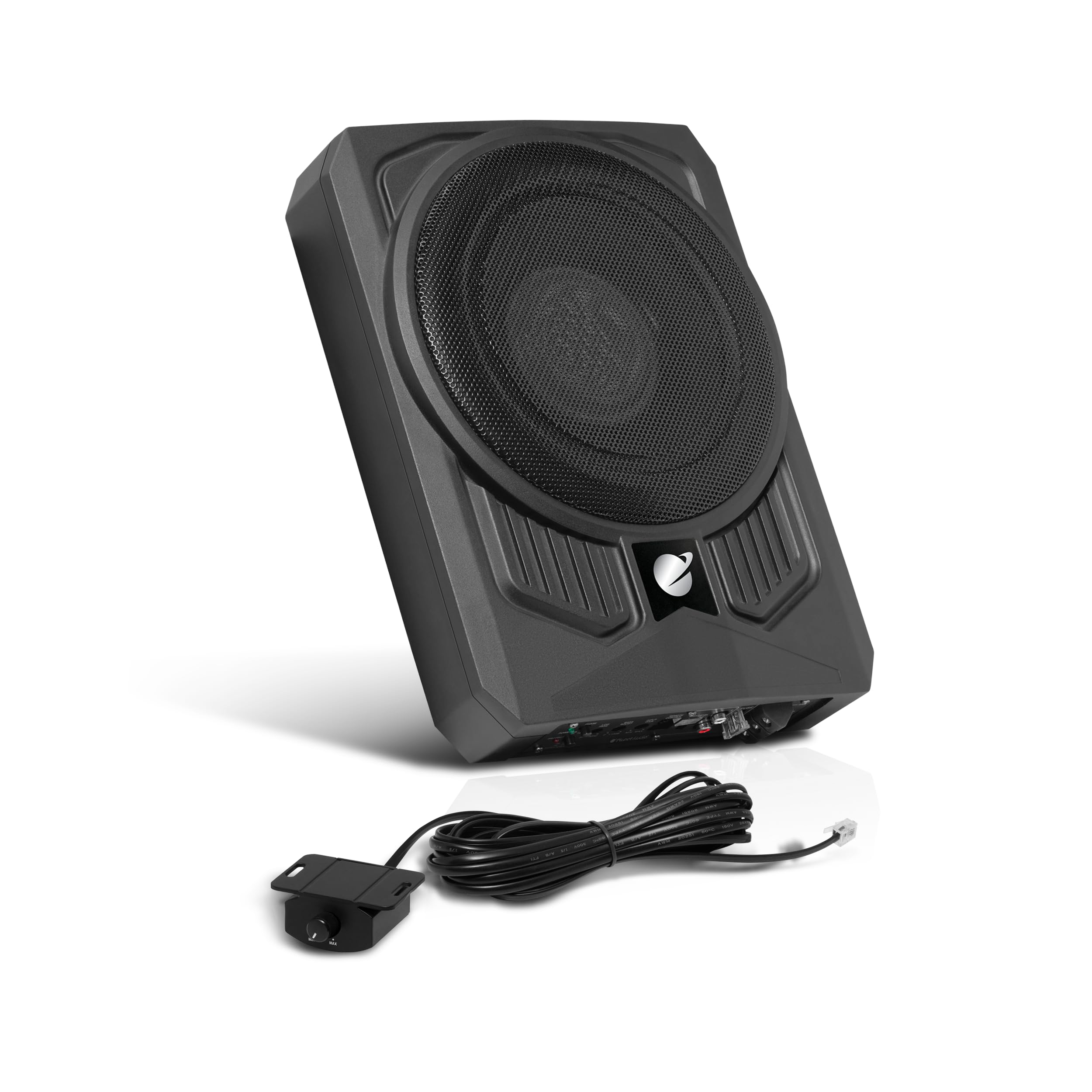
A compact powered box that tucks under a seat and supplies its own amp.
This one answers the space problem and the wiring problem at once. It has a built-in amplifier, so you do not need to buy or install a separate amp — you feed it power and a signal and it works. The footprint is genuinely low-profile at 3.15 inches tall, which is what lets it slide under a seat or behind a folding bench, and it weighs about 10.5 pounds, so it is easy to reposition if the bass sounds wrong in one spot. A passive radiator (a driver with its magnet removed, used to move air and boost the low end) enriches the bass without the chuffing noise you get from a ported box.
For tuning, you get a variable low-pass filter (which strips the high notes so only bass reaches the sub), variable bass boost, variable gain control, and a remote subwoofer control you can keep up front. It takes both high-level inputs (for a factory radio with no RCA output) and low-level RCA inputs, so it connects to almost any head unit. The cone is aluminum with a rubber surround, and it carries thermal, short, and overload protection circuits. The only catch is the advertised power — owners are skeptical that it truly hits 1000 watts, so treat the powered-box convenience as the reason to buy, not the peak number. The sound quality is what owners rave about: it delivers all the bass they need and more, with several noting it stays clear even at high volume when matched with a decent amp.
Durability is the one thing to weigh honestly. A few units have failed within a month or six months of purchase, and the reliability feedback sits mixed overall, so if you want the strongest odds of a long service life you might lean toward the smoother track record of the Pioneer or Kicker picks above. For buyers who want bass now in a cramped truck or two-door cab, though, the under-seat form and built-in amp are tough to top at a value price. It holds 4.0 stars across 100+ ratings — solid for a powered box at this level.
Where it shines: the 3.15-inch profile fits under seats and behind folding benches where a normal box cannot go.
What to note: a built-in amp removes the install work, but reliability feedback is mixed, so buy with a clear return path.
Good fit when: you want powered bass tucked out of sight with no external amp to mount.
Reconsider if: maximum long-term reliability is your top priority.
5. Rockford Fosgate R2D2-10 Prime R2 2-Ohm DVC 10” Subwoofer

A dual-coil Rockford built to run clean in a small sealed box.
Power handling is 250W RMS with 500W max, and the dual 2-ohm voice coils give you the wiring freedom to run a single-coil-equivalent 4-ohm load or a 1-ohm load, depending on your amp. The mounting depth of 4.319 inches and cutout diameter of 9.125 inches are the numbers to check against your box — if it fits, it drops in cleanly. The mica-injected polypropylene cone resists flex, and the spider venting in the basket keeps the motor (the magnet and coil assembly) running cooler than most budget drivers, which is a feature Rockford usually reserves for pricier models. Frequency response starts at 28 Hz, so it reaches the deep notes.
What owners mention most is the sound, then the value. This sub is loud enough to shake mirrors in a well-tuned install, and it thrives in small boxes — the whole reason people choose a 10-inch Rockford is bass output without needing a huge trunk-hogging enclosure. Owners describe deep, punchy, tight bass that never goes sloppy, and a few note that wiring the dual 2-ohm coils to an old amp lets them get maximum volume out of gear they already own. It works well in both sealed and ported environments, and one owner ran it in an old bandpass box and got deep, punchy results without sloppiness. Build quality and reliability get consistent praise, and it is popular as an OEM replacement — a direct swap for a blown factory Rockford keeps the install simple. It holds 4.5 stars across 400+ ratings.
Here is the honest part: Rockford’s own description calls this a Prime sub, which is their entry line, so it is not the loudest thing on the block. Owners agree — it delivers great bass for a value price rather than ground-shaking SPL. If you want the absolute deepest, loudest output and have the amp to feed it, the Pioneer TS-A250D4 above makes more continuous power. If you want tight, accurate bass in a small box from a brand with a reputation for reliability and a full one-year warranty, this is the one.
What It Does Best
- Dual 2-ohm voice coils wire for flexible load matching
- Mica-injected polypropylene cone and vented basket keep the motor cool
- Performs in sealed or vented boxes with a 4.319-inch mounting depth
- Reliable build with a full 1-year warranty
Where It Holds Back
- Not the loudest 10-inch at 250W RMS — output, not volume record, is the point
- Dual-coil wiring takes a bit more thought than a single-coil hookup
The pick for: a small sealed-box build where you want accurate bass and long-term reliability from a trusted name.
Not the pick for: a bass-competition setup chasing maximum SPL.
6. onn. Roku Wireless Subwoofer – 10″ Driver with 150W Peak Power for Enhanced Home Theater Bass (Renewed)

The no-wiring way to give a thin Roku soundbar real low end.
This is the home-theater option — a wireless, freestanding sub with a 10-inch driver (listed as 25.4 centimeters) and 150W peak power. The wireless connection is the whole appeal: it pairs with a Roku soundbar over the air, so there is no signal cable to run across the room. That is a different job from every car sub on this list, which need wiring and an amplifier. If your Roku soundbar sounds thin and you want to fix that without fishing cables, this is the tool. Place it in a corner or near a wall where the bass can bounce and it fills the room far better than the soundbar alone.
Setup is where it earns its keep. Owners describe pairing as quick and easy, with an automatic software update during setup, and a big improvement to the soundbar’s output. The star key on the Roku remote adjusts sound mode, bass, and treble, so you can dial in the low end without hunting through menus. Being a renewed unit, it arrives in generic but product-specific packaging, and customers note it works well with the Roku Streambar Pro. Bass is deep enough to feel, and one buyer confirmed reliable wireless range up to 25 feet from the soundbar.
The honest catches are two. First, connectivity feedback is mixed — while it pairs easily for many people, some units simply will not connect at all, so read the pairing steps carefully on first setup. Second, being renewed, condition varies: most arrive in excellent shape, but a few show dust or scuffs, and the occasional unit arrives defective and needs a replacement. Neither is a deal-breaker at this value price, but go in expecting a refurb. It holds 4.1 stars across the ratings, a fair score for a renewed wireless sub.
Why owners like it: wireless pairing with no signal cable, plus remote control of bass and treble.
The catch: as a renewed unit, condition varies, and a few report pairing failures — a fit note for patient buyers.
Made for: Roku soundbar owners who want easy, cable-free bass in a small room.
Better to skip if: you need a guaranteed out-of-box connection or dislike refurbished gear.
7. Rockville RVB10.1A 10″ Active Powered Car Subwoofer with Enclosure

A self-contained bass box that drops into the trunk and just works.
Everything is in one piece here: a 10-inch sub, a built-in Class AB amplifier (a sturdy amp design that runs clean at moderate output), and an MDF enclosure built with anti-vibration construction to keep the box from buzzing. Continuous power is 300W RMS with 500W peak. That built-in amp is the big convenience — no separate amplifier to buy, mount, or wire, which removes the most intimidating part of a car-audio install for a first-timer. Frequency response starts at 35 Hz, and the tapered box is angled at the back so it fits snug against a trunk wall or seat back.
It connects to almost anything. RCA inputs and high-level inputs mean it works with both aftermarket head units and factory radios, and the adjustable bass boost plus low-pass crossover let you shape the sound to your taste. Reviewers point out installs done in under five minutes using existing wiring, and a swap of a dead factory sub with this box in its place. A prior Rockville amp owner moving to their first amp-and-sub combo had it running in a 2011 BMW 328i by tapping the factory under-seat wires for the high-level input. If you want bass in the trunk without a wiring project, this gets you there in an evening.
Two honest notes come up in the reviews. First, this sub needs a break-in period before it sounds its best — owners describe it as underwhelming right from the start, then tightening up into solid, crisp bass once it has some hours on it (owners put the break-in at roughly 90 hours of play). Do not judge it in the first ten minutes. Second, some shoppers say a noticeable smell from the powered enclosure at first, which fades over time. Neither is a reason to walk away — they are reasons to be patient. It holds 4.5 stars across 400+ ratings, and the sound quality is what owners praise. For a one-box solution at a value price, few things are easier.
Why It Works
- Built-in Class AB amplifier means no separate amp to buy or mount
- 300W RMS through a 10-inch driver with 500W peak headroom
- RCA and high-level inputs fit factory and aftermarket radios alike
- Anti-vibration MDF enclosure with a tapered back for tight spaces
Plan For This
- Needs a break-in period before it sounds its best
- A few buyers notice an initial smell from the enclosure that fades
Ideal when: you want a one-piece powered bass box you can install in an afternoon.
Not ideal when: you want to choose your own amplifier or build a custom box.
8. Sound Storm Laboratories LOPRO10 10 Inch 1200 Watt Under Seat Car Subwoofer

A powered sub thin enough to vanish under a bench seat.
The defining number here is the profile: 3 inches tall and about 13 pounds, sized to slide under a seat or behind a bench in a spatially challenged vehicle. Like the Planet Audio above, this is a powered sub — the amplifier and woofer are combined into one unit, so you run power, signal, and switch it on with no external amp to mount. It uses a MOSFET power supply (a type of power stage that switches efficiently, runs cooler, and handles more current), and it weighs enough to stay put but little enough to reposition easily.
Connection options are broad: it takes high-level inputs for a factory radio with no RCA out, low-level RCA inputs for aftermarket head units, and includes a remote control so you can adjust bass from the front seat. There is a variable low-pass filter to keep high notes out of the sub and a variable bass boost so you can dial in the low end to taste. It fits under the rear bench of a 95 Ford F250 extended cab, dropping right into the same spot the factory sub vacated, and a 4Runner owner reported it still running great after 16 months. That is genuinely useful for anyone who has a factory sub cavity and nothing to put in it.
Sizing its weak point honestly: the advertised 1200W peak is widely treated as inflated — one buyer estimated the real amp output at closer to 200W, well under the 1200W peak rating. So buy it for the under-seat slim form and the convenient built-in amp, not the big number on the box. Sound quality is what owners praise most, and the slim fit is why they pick it over a box. Some units stop working after a few months, so keep the return path clear. It holds 3.9 stars across a large ratings base — a fair score for an inexpensive powered slim sub.
What makes it useful: a powered sub at 3 inches tall that fits factory sub cavities and tight under-seat spaces.
What to weigh: the peak power figure is inflated per owners, and a few units fail early, so buy with a return path in mind.
Worth it if: fitting a powered sub in an impossibly tight space is the whole problem you are solving.
Look past it if: you want accurate power ratings or maximum long-term reliability.
9. Jamo Studio Series S 810 Subwoofer (Black)

A slim, stylish home sub that upgrades a small speaker system on a budget.
For a living room rather than a vehicle, this is a compact powered home-theater sub: a 10-inch polyfiber woofer with a 150W bottom-mounted Class-D amplifier (a cool-running, efficient amp design that suits home subs). It uses a bass reflex slot port, which reinforces the low end by moving air through a wide slot rather than a round tube, and the cabinet is built to disappear into a media setup. It pairs naturally with the matching Jamo Studio Series S 803 HCS home cinema system, so if you already run Jamo speakers, this slots straight into the family.
The practical upside is size and look. Owners love how it fits in a tight space and still looks like a piece of furniture rather than a black box, and it makes small bookshelf speakers sound much better — one buyer paired it with PreSonus Eris Accent BT bookshelf speakers and got a big improvement for a modest outlay. Controls sit on the bottom of the cabinet, which keeps the front clean; you adjust them once and leave them, usually through your AV receiver. Bass not being audiophile-grade for music is noted honestly by owners, but for movie effects it adds the rumble the mains cannot produce.
Where it asks for effort is tuning. Buyers report it can sound too loud or distorted at the default twelve-o’clock settings, so you need to calibrate it against your room before judging — a bit of gain adjustment and it comes good. The bottom-mounted controls take a little reaching around, and there is a fair amount of value built in here for the price, though feedback on sound quality overall is genuinely mixed, so consider your priorities. It holds 4.4 stars across the ratings — a solid result for a budget home sub.
Its balance: a compact, good-looking home sub that lifts small speakers for movies without dominating the room.
Set-up note: it needs real tuning; the out-of-box settings run hot, so calibrate before you judge the sound.
Best suited to: a small-to-mid room where looks and footprint matter as much as output.
Not the one for: deep-bass music listening where you need maximum low-end authority.
10. Dayton Audio Classic CS1000 – 10″ 180W Powered Subwoofer

A tightly built home sub tuned for clean, accurate bass over boom.
The core spec is a 180W Class-D amplifier driving a 10-inch driver in a rigid, braced cabinet — bracing is internal reinforcement that stops the box walls from flexing, which is what keeps the low end tight instead of boomy. Frequency response reaches down to 28 Hz, so it will reproduce the deep effects and bass notes that smaller speakers miss. That combination of a braced box and a controlled amp is exactly what separates a sub that stays clean when pushed from one that turns to mush. It is a floor-standing design meant for a room, and it is the premium pick of the home options here.
Connectivity is flexible: stereo RCA, LFE (the single dedicated bass channel cable most AV receivers use), and speaker-level inputs, so it integrates with almost any system — a full surround receiver or a simple two-channel setup. There is auto-on (it powers up when it senses a signal) and straightforward controls for quick tuning, plus a five-year warranty that is one of the longest on this list. Owners describe the build and finish as excellent and note the sound as tight and articulate for music, with movie bass that punches without getting muddy. The music and home-theater split is where it holds its ground best.
Two honest notes to plan around. First, the auto-on feature needs a fairly strong signal to trigger and will cut off at low volumes, so very quiet listening may have it dropping out — not a defect, just a quirk to know. Second, it wants careful placement and gain tuningfor your room, so a little patience up front pays off. At higher gain settings it holds authority without muddy distortion. It holds 4.7 stars across 100+ ratings — the highest score of any home sub here.
What Earns It the Top Home Spot
- 180W Class-D amp in a rigid, braced cabinet for tight, controlled bass
- Reaches down to 28 Hz at the low end
- Stereo RCA, LFE, and speaker-level inputs fit almost any system
- 5-year warranty and a wood-grain finish with a swappable grille
The Fine Print
- Auto-on needs a strong signal and cuts off at low volume
- Boomy if you push gain above the balance — tune it to your room
The one to choose for: a music-first home system where you want accurate bass and a long warranty.
Only skip it if: you mostly watch movies at very low volume, where the auto-on quirk will annoy you.
11. Fluance DB10 10-inch Low Frequency Ported Front Firing Powered Subwoofer

A front-ported box designed to sit against a wall and still sound clean.
The 10-inch long-throw driver is the heart of this home sub — a longer excursion lets the cone move more air, which is what produces deep bass without distortion. It is front-firing and front-ported, meaning the bass port exits the front face, so you can place the cabinet against a wall without choking the airflow. That is a real convenience in a room where furniture limits where you can put a sub. A tuned MDF wood cabinet and a high-performance amplifier are designed to work together for warm, controlled low end, and auto power-on turns it on or off by sensing the incoming signal, saving power when nothing is playing.
Buyers describe the bass as clean and deep, and it pairs well with bookshelf speakers to fill out a system — one buyer matched it to JBL 250B bookshelf speakers and a Fluance receiver for clean, punchy bass. It arrives double-boxed with padding and is known for surviving shipping without a scratch. The auto power-on and 80Hz crossover keep the setup simple, and the black ash finish looks good enough to leave in the open. It carries a 2-year manufacturer’s warranty and lifetime customer support.
Be honest about the low end: this is a budget sub, and its output trails off below roughly 40 Hz, so it is not the sub for people chasing rumbling movie-cannon effects in a big room. In a small or medium space and for music plus dialogue, it delivers a clean, unobtrusive bass that blends rather than booms. The efficiency and value are what owners praise most, and the front-ported design makes placement far easier than a rear-ported box. It holds 4.4 stars across 300+ ratings — a dependable result for the home-theater role.
Why it earns a spot: the front-firing, front-ported design lets you place it against a wall in a tight room.
Its honest limit: output trails off below about 40 Hz, so it favors music and small rooms over deep movie effects.
Fits best when: you need a clean, well-made sub that can sit against a wall and blend with bookshelf speakers.
Less suited if: you want room-shaking sub-40Hz output for a large home theater.
Understanding the Specs
RMS Power vs Max Power
Max power is the peak wattage a sub can survive in a brief spike — it looks impressive on the box but tells you little about real use. RMS (root mean square) is the wattage the sub can handle continuously, hour after hour, without overheating the voice coil. Match your amplifier to the RMS figure. A sub listed at 300W RMS and 1200W max will happily run day to day at 300 watts; the 1200W is only for momentary peaks. Buying to the RMS number is how you avoid cooking a driver.
Sensitivity, Frequency Response, and Impedance
Sensitivity, measured in dB (decibels, the loudness unit), tells you how efficiently a sub converts amp power into sound — a higher number means more volume from the same amplifier. Frequency response, stated in Hz (hertz, cycles per second), shows how low the sub reaches; 28 Hz or 30 Hz is deep bass, while 35 Hz or higher starts to trail off before the deepest notes. Impedance, in ohms, is the electrical load the sub presents to your amp — 4 ohms is the common car-audio figure, and dual voice coils let you wire for 2, 4, or 8 ohms to match your amplifier.
Sealed vs Ported Enclosures
A sealed box traps air behind the driver, which gives tighter, more controlled bass and a smaller footprint — great for accuracy and small spaces. A ported (or vented) box adds a tuned opening that reinforces the low end for more output, at the cost of a larger cabinet and slightly looser control. A passive radiator is a third route: it uses a magnetless diaphragm instead of a port to move air, which enriches bass without the chuffing noise a port can produce. Match the enclosure to the bass character you want, not just the size you can fit.
Voice Coil, Mounting Depth, and Setup
Voice-coil configuration — single (SVC) or dual (DVC) — decides your wiring options, since dual coils can be combined for a 2-ohm, 4-ohm, or 8-ohm load. Mounting depth and cutout diameter are physical fit specs: check them against your box or factory cavity before ordering, because a driver that is too deep will not seat. Finally, powered subs have the amp built in and need only power and a signal, while passive subs need an external amplifier. Your setup — factory radio or aftermarket, car or home — decides which of those you can use.
FAQ
Will a 10-inch subwoofer fit under my car seat?
What is the difference between a 4-ohm and a 2-ohm subwoofer?
Do I need a separate amplifier for a passive 10-inch subwoofer?
How much power do I actually need for a 10-inch subwoofer?
Is a sealed or ported box better for a 10-inch subwoofer?
Can I add a home subwoofer like the Jamo S 810 to a soundbar or receiver?
How long do 10-inch subwoofers typically last?
What does sensitivity in dB mean for a subwoofer?
Will a rear-ported home sub sound bad against a wall?
Do powered under-seat subwoofers really produce deep bass?
Final Thoughts: The Verdict
For most people, the budget 10 inch subwoofer winner is the Pioneer A-Series TS-A2500LS4 because its shallow-mount form fits tight vehicle spaces while its 300W RMS handling and 85 dB efficiency deliver genuinely loud, clean bass from a modest amp. If you want the wiring freedom to match almost any amplifier and have the room for a real box, grab the Pioneer A-Series TS-A250D4. And for a home theater setup rather than a car, the Dayton Audio Classic CS1000 is the one to reach for, with its braced cabinet, 28 Hz low end, and 5-year warranty. That top car pick holds the higher overall score at 4.6 stars, though the under-seat Sound Storm LOPRO10 carries a far larger ratings base — a reminder that a slim, powered box solves a problem the shallow driver cannot.
How We Picked
We do not accept paid placement. Every pick is matched to a real buyer and a real use-case; we do not hands-on test units.
Sources & Methodology
Specifications: manufacturer listings and product documentation. Review insights: verified customer reviews, as of September 2026. Pricing: not shown on this page (it changes often); check the current price via the retailer link.
As an Amazon Associate, Gadgets Feed earns from qualifying purchases. This does not affect which products we feature.