
Our readers keep the lights on and my morning glass full of iced black tea. As an Amazon Associate, I earn from qualifying purchases.
Specs are compiled from manufacturer listings and verified buyer reviews and can change over time — please confirm the key details on the product page before buying.
You have a 50-amp generator inlet, a Level 2 EV charger, or a hot tub feed to wire, and the cable has one job: push heavy current through four conductors without overheating, cracking, or fighting you during the pull. The catch is that 6/4 SOOW cable looks almost the same from listing to listing. Yet the strand count, jacket thickness, and amp rating (the highest steady current the cable is built to carry) swing enough to change how your weekend goes. This guide cuts straight to the picks owners actually finish projects with — a generator inlet wired in a weekend, a Tesla wall charger fed from the panel, an RV pedestal that survives a lawn.
I’m Min — the founder and writer behind Gadgets Feed. This guide is built by comparing the manufacturers’ published specifications and the patterns across verified customer reviews, so you get each pick’s real strengths and trade-offs instead of marketing spin.
Every cable here is genuine 6 AWG four-conductor SOOW. Four conductors means the cable carries hot, neutral, ground, and a second hot — the layout 240V equipment like a NEMA 14-50 outlet needs. That also means the real differences come down to amp rating, strand count, and how the jacket handles tools. Weigh those three against your run and the right 6/4 so cord picks itself.
Our Picks at a Glance
How To Choose The Best 6/4 SO Cord
Four-conductor 6-gauge cable feeds anything that pulls serious current and needs both a neutral and a ground: a 50-amp generator inlet, a 240V Level 2 EV charger, a welder, or a hot tub circuit. Every option here meets that same size requirement. So your decision rests on four numbers and one material — the amp rating, the voltage rating, the strand count, and the temperature range the jacket (the outer rubber skin that protects the wires) is built to survive.
Match the amp rating to your breaker, not the other way around
A 50 A maximum current rating means the cable carries a full 50-amp load without overheating — exactly what a NEMA 14-50 outlet (the standard four-prong 240V plug) or a 50-amp generator inlet demands. A 45 A rating still works for many real installations, but the margin is thinner. So if your breaker is 50 amps, start there. Buyers who charge an EV or back-feed a house panel consistently land on 50 A cable because the safety margin does the thinking for them.
Strand count and jacket thickness drive how the job feels
Stranded copper — many thin wires twisted together rather than one solid core — is what lets a fat 6-gauge cable bend around a panel corner instead of kinking. Fewer, thicker strands mean a stiffer cable that fights you through tight conduit. More, finer strands mean a flexible cable that feeds through awkward bends with less swearing. The jacket is a second trade-off: thicker rubber protects better outdoors but fights you at the stripper, and a softer jacket cuts fast but scores easily. Neither is wrong — it is a question of whether your run is a straight pull or a fight through an LB fitting.
Know which 240V equipment needs the fourth wire
Four-conductor cable carries hot, neutral, ground, and a second hot — the configuration 50-amp equipment like NEMA 14-50 outlets, RVs, and Level 2 chargers require. Three-conductor cable is for simpler loads that need only hot, neutral, and ground. If your device has a four-prong plug or a four-terminal inlet, you need four conductors. Picking a three-conductor cable for a four-wire device is the most common beginner mistake in this category.
Quick Comparison
| Model | Best For | Max Current | Voltage Rating | Length | Amazon |
|---|---|---|---|---|---|
| 10ft 6/4 SOOW Cable Portable Power Cable★ Best Overall | All-around generator and EV feed | 50 A | 600V | 10 ft | Amazon |
| 10′ 6/4 SOOW Wire Cord Cable Portable PowerBest for EV Install | Short EV receptacle runs | 45 A | 600V | 10 ft | Amazon |
| IronBox Electric 6/4 SOOW Bulk Cable | Work-shop and data center wiring | 50 A | 600V | 10 ft | Amazon |
| PDTXCLS 64050 6/4 SOOW 50 ft Cable | Long surface runs for RV and generator | — | — | 50 ft | Amazon |
| Bghdas 75ft 6/4 SOOW Portable Power Cable | Very long outdoor power runs | — | 600V | 75 ft | Amazon |
In‑Depth Reviews
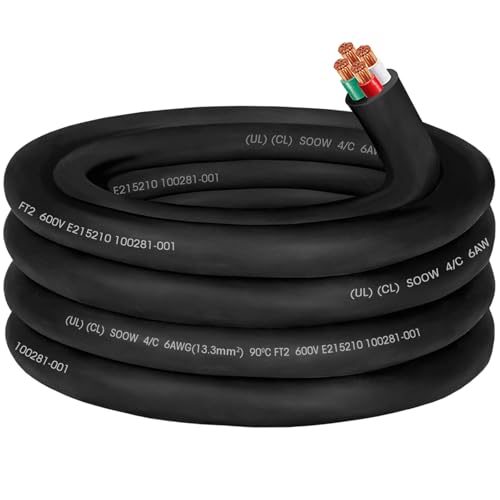
1. CLLOMAGY 10ft 6/4 SOOW Cable Portable Power Cable
Our pick — over 4.5★ from 200+ verified ratings; the strongest balance of quality and price.
The 50 A, 600V pick owners reach for on generator, EV, and RV jobs.
This is the 10-foot cable we lead with because of one number: a 50 A maximum current rating. That is the highest figure in this list, and it tops the 45 A on the ACDC pick below. That extra headroom is what lets you feed a NEMA 14-50 outlet or a 50-amp breaker without watching the gauge. The 600V rating (the voltage ceiling the insulation is built to withstand) means the copper carries your 240V load with a wide safety margin, so you are not at the edge of the wire’s capacity every time the generator fires.
What wins people over is the whole package for the money: a four-conductor, oxygen-free copper build, oxygen-free meaning the copper is refined to resist corrosion. It is rated for temperatures most homes never see, whether you are burying it near a hot tub or dragging it across a lawn, and it is rated for outdoor sun and rain plus oils, acids, and chemicals. In the hand, the jacket’s outer diameter gives it a genuinely solid, heavy feel. Buyers report a year of EV charging through it with no quality degradation. The same buyers have wired car lifts, generator inlets, and house back-feed setups with it.
The honest catch is the thickness. This is real 6-gauge rubber, and its core makes feeding it through a tight conduit or bending it around a panel corner a two-person job rather than a finesse move. Owners mention the sheathing scores easily when cut, so take your time with the stripper and plan your strip points before you commit the blade. If you want a cable that feels light and cooperative, this is not that; if you want one that survives years of generator and EV duty, it is.
Where it earns its keep
- 50 A max current and 600V rating handle full 50-amp generator and EV loads
- Flexible enough for tight 50-amp generator outlet boxes yet thick enough for the job
- Rated for outdoor sun and rain plus oils, acids, and chemicals
- Oxygen-free copper conductors with high corrosion resistance and strong heat dissipation
The reality check
- The 6-gauge core is genuinely heavy and stiff at the ends — expect a wrestle in tight panels
- The rubber sheath and inner wire covers are soft and can score when you cut
- You strip slowly, not fast, if you want clean terminations
Buy this if: you want one 10-foot SOOW cable that covers generator, EV, and RV duty without second-guessing the amp rating.
Look elsewhere if: your run is long enough that 10 feet falls short, or you want a softer jacket that handles like a power tool cord.
2. ACDC 10′ 6/4 SOOW Wire Cord Cable Portable Power
A dead-simple 10-footer for anyone running a short, clean feed from panel to outlet.
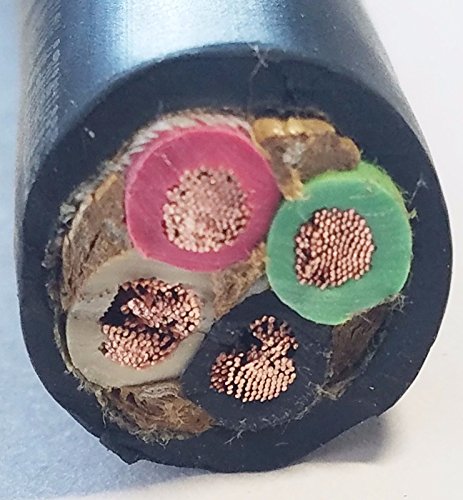
133 copper strands at 0.0141 gauge earn this cable its spot. That many fine strands make it cut and terminate easily, which matters when you are stripping rubber indoors with limited elbow room. Its 600V rating matches the ceiling across this category, so the conductors are ready for your voltage. The limiting number is the 45 A maximum current rating, which sits under the 50 A on the CLLOMAGY above — enough for plenty of setups, less margin if your breaker runs a full 50 amps.
The best-feeling thing about this one is how readily it works with your hands — easy to cut, easy to work with, and it arrives exactly as described. Post-hurricane Houston buyers who could not find 6 AWG wire in any store grabbed this instead and, in their words, it worked perfectly and is very well constructed. One Tesla owner wired a garage wall charger with it and found it just the right length from the panel to the charger, with no waste. There is even a legitimate surprise in the spec: the manufacturer stamps it MSHA approved (Mine Safety and Health Administration approved — a built-for-rough-service credential) that you rarely see on short cable.
Buy it knowing you are choosing an easy-to-work, short, fixed-length cable and pairing it with the equipment its 45 A rating supports. If you want a 10-foot run for a garage wall charger or a generator inlet a few feet from the breaker panel, this does that job without complaint.
Why it wins the short run: 133 strands of 0.0141 wire cut and flex cleanly, which is exactly what you want when the run is a couple of feet and the terminations are the whole job.
Where it caps out: the 45 A maximum current rating is the honest limit — plenty for many installs, less margin than the 50 A cables above.
The smart pick for: short, tidy EV receptacle or generator-inlet runs where easy stripping beats raw amp headroom.
Skip if: your breaker is a full 50 amps and you want the maximum margin a 50 A-rated cable provides.
3. IronBox Electric 6/4 SOOW Bulk Cable
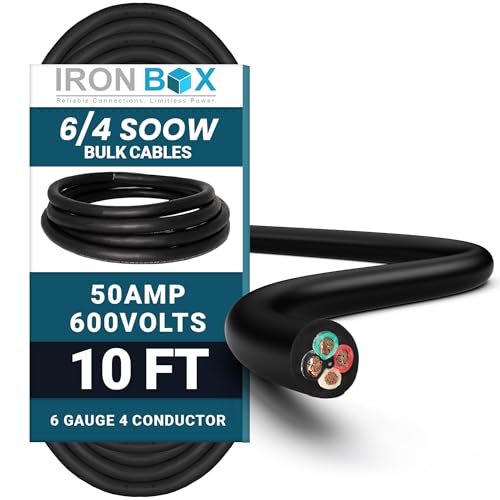
Bulk wire with braided copper and a 50-amp ceiling, built for shops that keep the spool loaded.
Braided copper is what puts this cable on the list. Braiding means the copper strands are woven, not laid straight, so it stays flexible where a solid-core cable goes stiff — exactly what you need when you push a 6-gauge core through planned conduit or terminate into lugs. Electrically it matches the top pick: a 50 A maximum current rating with a 600V rating and a full four-conductor layout, aimed at industrial and residential jobs like wiring circuits, generators, or data-center runs.
What buyers come back for is the working quality. It pulls through a planned run as advertised, it takes a male plug on both ends cleanly for a shop-built generator cord, and one owner fed a home Tesla charger from a 50-foot roll without a hiccup. Another owner who built their own generator cord with 50A connectors called it out as a genuinely better alternative to a pre-assembled cord. The water and oil resistance is the jacket doing its real job in a garage, a shop, or outdoors, so spills and rain wipes off instead of soaking in.
Here is your planning note: the insulation on this cable is thicker than a standard NM-B equivalent (NM-B is the flat indoor house wire), so the finished diameter is noticeably bigger and the terminals can be a tighter fit than you expect — measure your lugs and box entries before you cut. It also sells in fixed lengths, so an urgent 4-foot job may mean buying more cable than the run needs. Neither is a fault; it is the trade-off of buying proper bulk wire rather than an off-the-shelf adapter.
Reach for this if: you are wiring a shop, generator circuit, or data center and want braided 50 A bulk cable you can cut to length.
Size it first if: your terminals are tight, because the thicker-than-expected jacket and diameter need measuring before the cut.
4. PDTXCLS 64050 6/4 SOOW 50 ft Cable

Fifty feet of four-conductor SOOW for the run where ten simply will not reach.
Fifty continuous feet of 6-gauge, four-conductor SOOW is the whole point here. When your RV pedestal, generator pad, or detached panel sits a real distance away, that single 50-foot length spares you a chain of shorter cords and the extra connection points that come with them. It is built for hard usage in the field: flexibility for small motors and track systems, high tensile strength, and resistance to oils, solvents, moisture, and flame.
Owners who used it this way are the loudest voices on the listing. It connects a 50-amp generator line to a house electrical panel, and per the reviews it holds a straight path to the charger with flexibility you can feel in your hands. Customers note using it on a 50-amp EV receptacle from breaker panel to outlet as the clean solution. One buyer wired a hot tub with a 50-amp GFCI (a ground-fault circuit interrupter — a breaker that shuts off power when current leaks) using it and reported no issues. Others run it exposed across a lawn as an RV cable and expect multiple seasons.
The recurring note is about the sheath: a few buyers find the rubber casing a touch thin compared to the heaviest cables, and one describes the diameter as smaller than expected for a 50-foot run. If your installation is uncovered and scrapes concrete or a hard edge, add protective conduit or a grommet where it enters a box. For most surface runs on a lawn or through a garage, the cable does exactly what the job calls for — and it is the pick that gets you there in one piece where a 10-foot coil cannot.
What you get for the distance: fifty feet of four-conductor SOOW so a 50-amp run reaches a pedestal, a generator pad, or a detached panel in one piece.
Plan around this: the jacket is the subject of the only real gripe — thinner than the beefiest cables and worth guarding where it contacts a hard edge or rubs on concrete.
The right call for: a 50-amp run long enough that a 10-foot cable falls well short, wired for RV pedestals, generator-to-house feeds, or a hot tub.
Think twice if: your run is short and your priority is the thickest possible jacket, since this one favors length over bulk.
5. Bghdas 75ft 6/4 SOOW Portable Power Cable
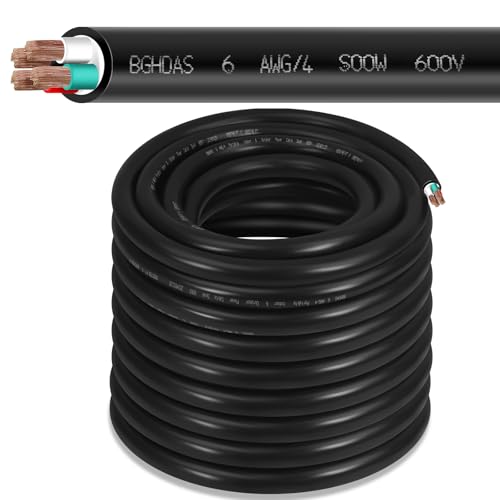
Seventy-five feet of flexible 6/4 SOOW for the outdoor job no short cable can reach.
Seventy-five continuous feet of 6 AWG four-conductor SOOW is the headline here. That length suits a construction-site feed, a temporary event run, a generator staged well back from the house, or a welding setup parked across a yard — and it spares you daisy-chaining shorter cables with the extra plugs that come along. The oxygen-free copper (OFC, copper refined to resist corrosion) conductors are stranded and rated by the maker for higher conductivity and better heat dissipation than ordinary copper, and the PVC jacket resists oils, acids, water, and chemicals.
The practical magic is the flexibility of that long run. At a 21.7mm wire diameter, this is thick cable, but the multi-strand OFC build bends enough to pull through a flex conduit or coil onto a hook without turning into a barbed-wire situation. One buyer stripped the outer insulation down to the inner wires and ran them through flex conduit for a generator inlet. Reviewers point out no overheating at 30-plus amps, with the four conductors providing solid grounding. Owners also run it to temporary outdoor air handlers and report the sheath holds up over repeated use.
Read the fine print before you order: this is a four-conductor cable with no separate ground wire, so if your equipment expects a distinct ground conductor in addition to the four wires, that is a mismatch to sort out first. Buyers also note the price per foot still beats a big-box store, but if you actually only need ten feet, the longer coil is more cable than the run demands. Match the length to the job and the rest of the harness is solid.
Grab this when: your run needs genuine distance — a long outdoor feed, a construction-site drop, or a generator parked far from the load.
Know before you buy: it is four conductors with no separate ground wire, so confirm your equipment does not need a distinct ground first.
Understanding the Specs
Amp Rating (Maximum Current)
The amp rating is the highest steady current the cable is built to carry before it risks overheating. A 50 A rating matches a 50-amp breaker and a NEMA 14-50 outlet directly, so it is the number that tells you whether the cable can feed your equipment at full load. If your generator, EV charger, or welder demands a full 50 amps, choose a cable rated for it and leave the 45 A options for lighter loads or shorter, cooler runs. Never pick a cable by gauge alone; the amp rating is what keeps the wire inside its safe working current with a margin.
Strand Count and Jacket Type
Strand count is the number of thin copper wires twisted into each conductor, and it is what separates a bendy cable from a stiff one. More, finer strands mean the cable flexes and pulls through conduit without kinking, which is why braided or oxygen-free multi-strand constructions feel easier to work with than a solid core. The jacket type — SOOW’s rubber and PVC (a flexible plastic outer skin) — decides how well the cable survives oils, solvents, water, sunlight, and abrasion, and how easy it is to strip. A thicker jacket protects better in rough service but slows you down at the terminations, so weigh how much abuse your run faces against how much elbow room your workspace has.
FAQ
Is 6/4 SOOW cable the same as 6/3 cable?
Can I use this cable to charge an electric car?
What does the SOOW rating actually mean?
How many amps can 6/4 SOOW cable handle?
Can I bury 6/4 SOOW cable directly in the ground?
Why is this cable so stiff and hard to work with?
Is 600V overkill for a 240V home circuit?
Can I run 6/4 SOOW through conduit?
Final Thoughts: The Verdict
The strongest all-around choice is the CLLOMAGY 10ft 6/4 SOOW Cable — its 50 A maximum current rating and 600V construction cover generator, EV, and RV duty without you having to guess, and it is the cable owners keep recommending after the job is done. If your run is short and easy stripping matters more than amp headroom, the ACDC 10′ 6/4 SOOW Wire Cord Cable is the tidy choice. And when the distance itself is the deciding factor, the PDTXCLS 64050 6/4 SOOW 50 ft Cable gets you there in one piece — match the amp rating and jacket to your breaker and run length and the pull will hold up for years.
How We Picked
We do not accept paid placement. Every pick is matched to a real buyer and a real use-case; we do not hands-on test units.
Sources & Methodology
Specifications: manufacturer listings and product documentation. Review insights: verified customer reviews, as of September 2026. Pricing: not shown on this page (it changes often); check the current price via the retailer link.
As an Amazon Associate, Gadgets Feed earns from qualifying purchases. This does not affect which products we feature.