
Whether you are a weekend warrior chasing a new personal best on the local climb or a daily commuter who wants hard proof that you logged 50 miles this week, a reliable bicycle odometer is the unsung hero of your handlebars. The old days of finicky wheel magnets and tangled wires are dead — today’s GPS-powered units deliver speed, distance, and route data straight from the sky.
I’m Min — the co-founder and writer behind Gadgets Feed. I focus on market research and spec analysis for the cycling tech space, evaluating satellite lock times, display contrast ratios, and battery endurance to find the units that deliver real value without the premium badge.
This guide cuts through the noise to help you pick the perfect best bicycle odometer for your riding style, whether you need hyper-accurate GPS tracking or a simple, long-lasting display.
How To Choose The Best Bicycle Odometer
Choosing the perfect bicycle odometer comes down to matching your riding habits with the right technology. The key decision points involve how the device gets its data, how long it lasts, and how you plan to use that information.
GPS vs. Wheel Sensor: Two Different Worlds
The most fundamental choice is between a pure GPS unit and one that relies on a wheel magnet and spoke sensor. GPS odometers require no wiring or physical installation — they lock onto satellites and automatically track your speed, distance, and route. Wheel-mounted sensors (often wireless) offer instant speed readouts and work indoors on trainers, but they require careful calibration of your wheel circumference and are prone to magnet misalignment. For most riders, a GPS unit provides cleaner installation and richer data, while stationary cyclists should consider models that also support external sensors.
Battery Life: Hours Matter More Than Days
Battery capacity is a defining metric for bicycle odometers. Entry-level units often promise around 25 hours of continuous GPS operation, while premium models stretch to 40 or even 60 hours on a single charge. Consider your longest planned rides — a century ride or multi-day tour requires a unit that won’t die halfway. Also check whether the device uses a modern USB-C port for faster top-ups or an older micro-USB connection that takes longer to refill.
Display Readability in All Light
A bicycle odometer is useless if you can’t read the screen at a glance. Look for a large LCD panel (2.4 to 2.9 inches) with auto-backlight functionality that adjusts based on ambient light. Models using FSTN (Film Super Twisted Nematic) glass technology offer the best contrast in direct sunlight and remain visible through polarized sunglasses. The font size of the speed and distance numbers should be bold enough to read without squinting, especially when you’re bouncing over rough terrain.
Data Connectivity and Ecosystem
Modern odometers are not just standalone devices — they are data hubs. Bluetooth connectivity lets you sync rides to a companion app (like CoospoRide, XOSS, or iGPSPORT) and then push that data to Strava or TrainingPeaks. ANT+ compatibility is critical if you want to pair additional sensors like a heart rate monitor, cadence sensor, or power meter. If you plan on growing your cycling setup, choose a unit that supports dual-protocol (Bluetooth and ANT+) to keep your options open.
Quick Comparison
On smaller screens, swipe sideways to see the full table.
| Model | Category | Best For | Key Spec | Amazon |
|---|---|---|---|---|
| iGPSPORT BSC100S | Mid-Range | Versatile data tracking | 40-hour battery life | Amazon |
| CYCPLUS M1 | Premium | Ultra-long endurance | 60-hour battery, 2.9” screen | Amazon |
| COOSPO BC107 | Premium | Compact with ANT+ power meter | IP67 waterproof, dual-satellite | Amazon |
| iGPSPORT BSC100S (Alt) | Premium | ANT+ sensor ecosystem | Five-satellite support | Amazon |
| XOSS G+ | Mid-Range | ANT+ heart rate & cadence | 25-hour battery, IPX7 | Amazon |
| Bikevee (GPS) | Budget | Large display at low cost | 28-hour battery, 2.4” screen | Amazon |
| COOSPO BC26 | Budget | Entry-level GPS simplicity | 25-hour battery, 2.3” screen | Amazon |
In‑Depth Reviews
1. iGPSPORT BSC100S
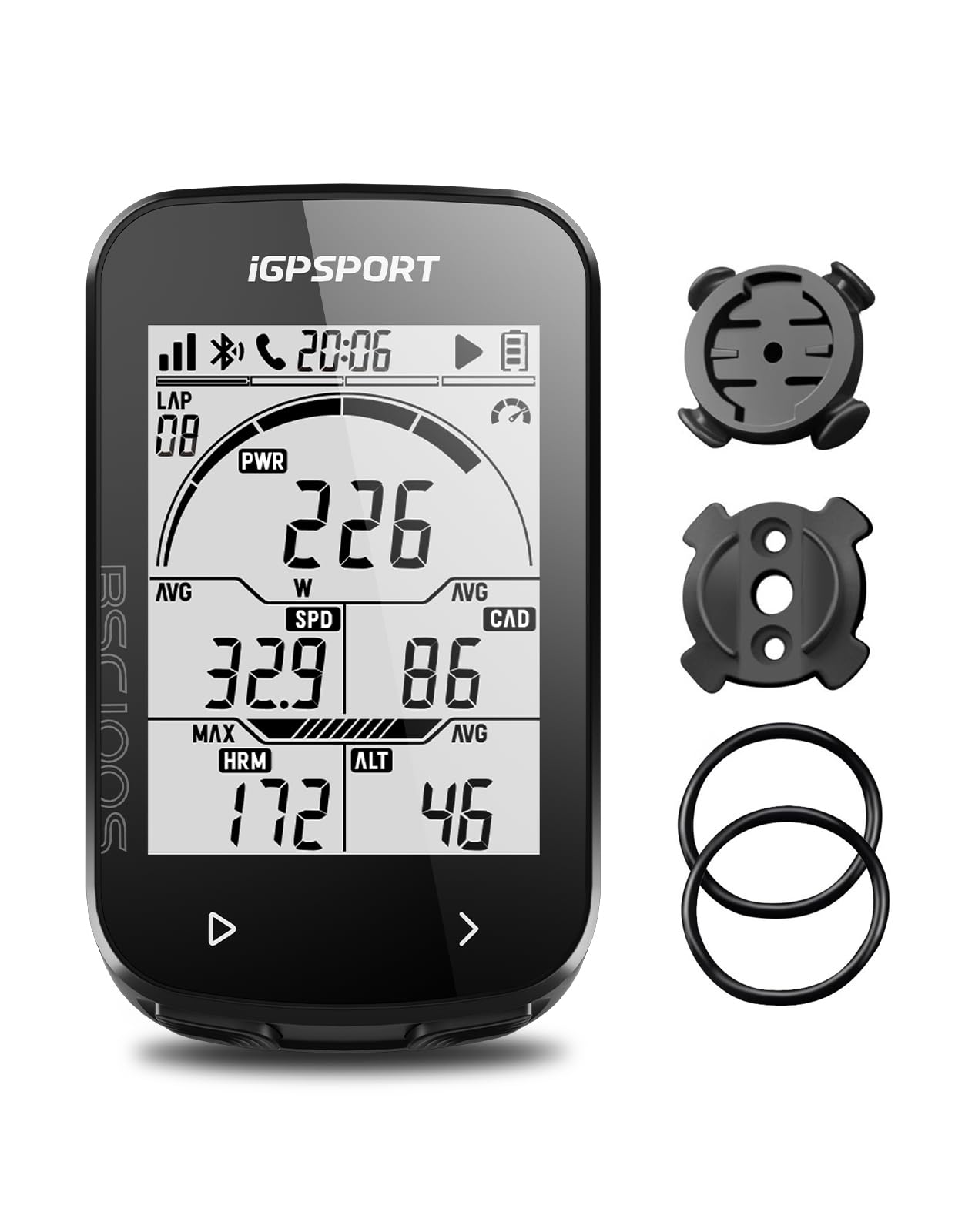
The iGPSPORT BSC100S strikes an exceptional balance between feature density and affordability. Its 2.6-inch anti-glare LCD provides a clear readout of over 40 riding data points while supporting five global satellite constellations (GPS, Beidou, GLONASS, Galileo, QZSS) for impressively fast and accurate positioning. The 40-hour battery life is a standout claim, and user reports consistently confirm it outlasts many rides without significant drain — even after 25-mile sessions the battery indicator barely flickers.
Connectivity is a strong suit here: Bluetooth and ANT+ dual-protocol mean you can pair speed, cadence, and heart rate sensors alongside your smartphone. Data syncs seamlessly to the iGPSPORT app and then pushes to Strava or Komoot. Despite its low cost, the unit includes an auto-backlight feature and IPX7 waterproof rating, making it a reliable companion in rain or shine. The USB-C charging port is a welcome modern touch that reduces downtime between rides.
Some users note that the included rubber band mount can feel flimsy and the instruction manual is frustratingly sparse — you’ll want to look up the online version. The screen fonts run small for older eyes, and the two-button interface takes a ride or two to master. That said, for a mid-range unit that checks every practical box without breaking the bank, the BSC100S is the clear all-around winner.
Why it’s great
- 40-hour battery life with USB-C charging
- Five-satellite support for fast, accurate GPS lock
- ANT+ and Bluetooth 5.0 for sensor expansion
- Large 2.6-inch anti-glare screen
Good to know
- Molded mount can break; no mounting arm included
- Manual is near-useless; find setup guide online
- Small fonts may be hard to read while riding
2. CYCPLUS M1 GPS Bike Computer

The CYCPLUS M1 is the endurance champion of this list, boasting a massive 1200mAh battery that delivers over 60 hours of continuous operation. Its 2.9-inch FSTN LCD screen is the largest in this roundup, utilizing glare-free technology that remains deeply readable even under direct summer sun. The screen auto-illuminates based on sunrise and sunset times — a thoughtful touch that removes one more distraction from your ride. The unit also features a Swiss-made navigational chip for dynamic GPS positioning that performs admirably even in cloudy or partially wooded environments.
ANT+ sensor pairing is instant and stable, supporting speed, cadence, heart rate, and power meter simultaneously. The free CYCPLUS FIT app syncs data via Bluetooth and pushes to Strava or TrainingPeaks. Several users reported that initial GPS distance readings were slightly inflated (by 5-10 percent in dense tree cover), but after a few rides the accuracy stabilized to within a mile or two over 30-mile rides. The IPX6 rating means it can handle rain, though it falls short of the IPX7 standard found on most competitors.
On the downside, the temperature reading consistently runs 6-8°F too warm, and the gradient display is considered useless by experienced riders. The device also defaults to UTC time, requiring a manual time-zone setting during first setup — fail to do this and the auto-backlight schedule will be off. If your priority is raw battery life and screen real estate for long tours or multi-day events, the CYCPLUS M1 is an easy recommendation.
Why it’s great
- 60+ hour battery from 1200mAh cell
- Large 2.9-inch FSTN glare-free screen
- ANT+ syncs with all major sensors
- Two-year warranty and responsive support
Good to know
- GPS accuracy degrades under heavy tree cover
- Temperature sensor reads high by ~7°F
- No turn-by-turn navigation or notifications
3. COOSPO BC107

The COOSPO BC107 is engineered with a clear philosophy: pack the most important features into the smallest, most robust chassis possible. Weighing just 140 grams and wrapped in glass-filled ABS with a TPU bumper, this unit feels built to survive tumbles and rough handling. Its 2.4-inch LCD is compact but punchy, and the auto-backlight adjusts smoothly to ambient conditions. The IP67 rating means it can survive submersion in up to one meter of water for 30 minutes — a genuine advantage over the IPX7 and IPX6 ratings of its peers.
Global positioning is handled by GPS and Beidou satellites, with the option to turn off GPS entirely for indoor trainer sessions. The BC107 supports ANT+ sensors exclusively (no Bluetooth sensor pairing), which is a deliberate limitation that keeps costs down while serving power meter and cadence sensor users. The CoospoRide app is mature and reliable, offering firmware updates, route map downloads, and .fit file syncing to Strava. One reviewer logged 500 miles over ten days and saw the battery drop only to 75 percent — suggesting real-world endurance far exceeds typical claims.
The biggest catch is that Bluetooth is reserved solely for phone-to-app communication — you cannot pair a Bluetooth speed or cadence sensor. This is a significant limitation if you already own Bluetooth-only accessories. Additionally, the BC107 does not come with an extension mount out of the box, so you will need to purchase one separately if your handlebar space is tight. For riders who prioritize compact durability and ANT+ sensor integration above all else, the BC107 is a superb choice.
Why it’s great
- IP67 waterproof rating (submersible)
- Compact, rugged design with TPU bumper
- ANT+ works with power meters and HR sensors
- Excellent battery performance in real-world use
Good to know
- No Bluetooth sensor pairing (ANT+ only)
- Extension mount sold separately
- App auto-sync with Strava can glitch
4. iGPSPORT BSC100S (ANT+ Edition)

This variant of the iGPSPORT BSC100S retains the same core hardware — a 2.6-inch anti-glare LCD, 40-hour battery life, and five-satellite positioning — but leans heavily into the ANT+ ecosystem. It supports power meters, heart rate monitors, speed sensors, and cadence sensors from any brand using the ANT+ protocol, automatically reconnecting to previously paired devices at the start of each ride. The 40 hours of GPS runtime is validated by user reports, with many noting the battery drops very little over multi-hour sessions.
Ten auto-control functions simplify the riding experience: auto-backlight, auto-record, auto-pause, auto-lap, auto-sleep, and auto-data upload, among others. The device pairs with the iGPSPORT app for firmware updates and custom data fields, and it pushes ride data directly to Strava and TrainingPeaks. Smart notification support means incoming calls pop up on the screen, though you cannot reply. The screen remains readable through polarized sunglasses, and the included mount is sturdy enough for rough road conditions.
The downsides mirror the standard BSC100S: the instruction manual is terrible, the rubber band mount can be confusing to install, and the app displays ads. Some users experienced initial altitude and distance inaccuracies — the unit over-reported climbing by 2,000-2,500 feet and distance by 8-10 miles on the first few rides — but these issues self-resolved after five rides as the GPS data normalized. For riders wanting a straightforward computer with robust ANT+ support and excellent battery life, this version is a strong contender.
Why it’s great
- Five-satellite support for fast, reliable GPS lock
- ANT+ compatibility with all major sensor brands
- 40-hour battery with auto-control functions
- Syncs to Strava and TrainingPeaks
Good to know
- Initial GPS data may drift for first 5 rides
- App shows ads and has poor instructions
- No navigation or turn-by-turn directions
5. XOSS G+

The XOSS G+ has become a fan-favorite for its ability to punch well above its price bracket. It offers both ANT+ and Bluetooth connectivity — a feature combination rarely seen at this level — allowing you to pair heart rate monitors and cadence sensors while also syncing wirelessly to the XOSS app. The GPS lock time is remarkably fast at under 10 seconds in open areas, and the 500mAh battery delivers a solid 25 hours of runtime, enough for multiple week-long commutes or several weekend rides between charges.
The 1.8-inch LCD is smaller than the competition, but the display data is well-organized and the auto-backlight ensures nighttime readability. The IPX7 rating means rain is not a concern, and the included handlebar mount uses rubber bands for a secure fit. Syncing to Strava is automatic once you link your account in the XOSS app, and the device records speed, distance, time, altitude, and temperature. Many users report the G+ outperformed their previous + computers in both speed tracking and elevation accuracy.
The main drawbacks are the compact screen size (roughly 1.5 inches by 1.25 inches of active display area) and the fact that it cannot record indoor trainer sessions since it requires a GPS signal for distance and time. A small number of users experienced Bluetooth pairing difficulties, particularly with Pixel phones, and app support responses can be slow. If you can live with the smaller display, the XOSS G+ delivers an unbeatable feature-per-dollar ratio.
Why it’s great
- ANT+ and Bluetooth dual-protocol at a budget price
- Fast GPS lock (under 10 seconds)
- Solid 25-hour battery life
- Seamless automatic Strava uploads
Good to know
- Small 1.8-inch display is hard to read at speed
- No indoor trainer mode (requires GPS)
- Occasional Bluetooth pairing issues with some phones
6. Bikevee GPS Bike Computer
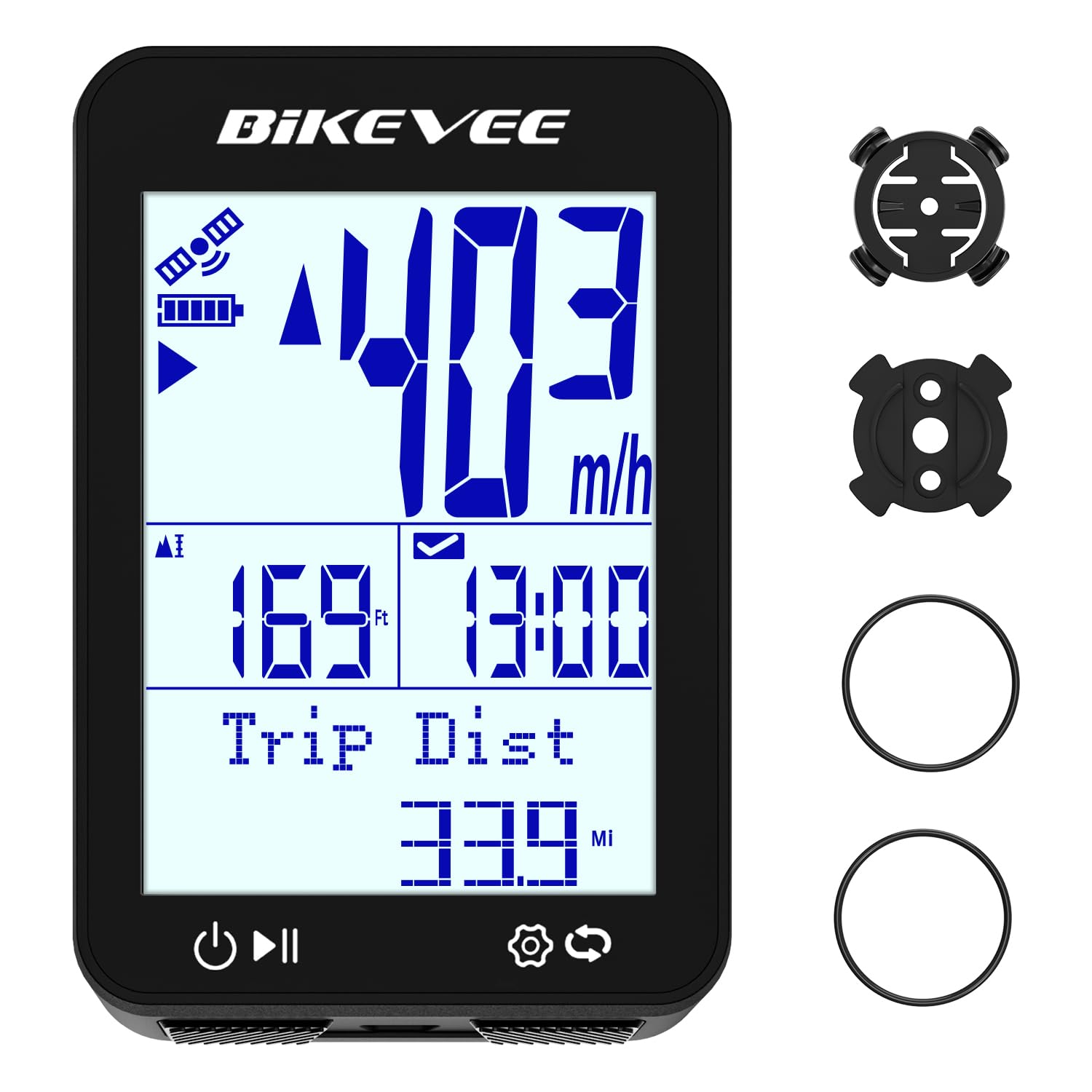
The Bikevee GPS bike computer is a no-frills device that focuses on doing the basics exceptionally well. Its 2.4-inch LCD is one of the largest in the budget tier, and the auto-backlight activates automatically in low light — a feature usually reserved for pricier units. With a 650mAh battery rated for 28 hours of continuous use, it comfortably outlasts many competitors at the same price. USB-C charging is a welcome convenience that ensures you can top up quickly before a ride.
The unit uses pure GPS positioning, meaning there are no wheel sensors or magnets to install — just mount the included bracket, charge it, and go. It tracks speed, average speed, max speed, distance, ride time, temperature, altitude, gradient, and ascent distance. The IPX7 rating means heavy rain is not a problem. Several users have praised its clarity for older eyes, with one noting it was perfect for a golf cart application where they just needed an accurate mile counter without complex wiring.
On the negative side, GPS acquisition can be slow — one reviewer reported it took nearly half a mile to lock onto satellites. The display always shows altitude (no way to hide it) and the time displays exclusively in 24-hour military format with no option to switch. The main data page is not configurable, so you cannot rearrange which metrics appear on the home screen. For riders who want a large, simple display with solid battery life and zero installation fuss, the Bikevee delivers outstanding value.
Why it’s great
- Large 2.4-inch screen with excellent readability
- 28-hour battery with USB-C charging
- No wires or magnets — pure GPS simplicity
- IPX7 waterproof for all-weather riding
Good to know
- GPS lock can take up to 0.5 miles to acquire
- Display always shows altitude; no customization
- Time only in 24-hour military format
7. COOSPO BC26

The COOSPO BC26 is purpose-built for the entry-level rider who wants GPS functionality without the complexity of sensor ecosystems. Its 2.3-inch FSTN segment-code LCD offers superb sunlight readability with an auto-backlight that senses ambient darkness and activates automatically. The dual GPS positioning (GPS and Beidou) provides accurate tracking of current speed, average speed, max speed, total distance, trip distance, cycling time, and altitude — covering all the essentials a new cyclist needs to monitor progress.
Setup is refreshingly simple: mount the unit, charge it, and the CoospoRide app guides you through first-time configuration. The device supports .fit file export to Strava, so you can share your rides with friends. The IPX7 rating ensures rain is not a problem, and the 25-hour battery life is sufficient for most weekly riding routines. The max speed alarm is a neat safety feature that can be toggled on or off — it alerts you with a beep when you exceed your set speed threshold.
The critical limitation is that the BC26 does not support pairing with external sensors of any kind. No speed sensor, no cadence sensor, no heart rate monitor. This makes it useless for indoor trainer riding since GPS signals are not available indoors. It also does not include an extension mount in the box, requiring a separate purchase if you have a crowded handlebar setup. For absolute beginners who just want to track outdoor rides with zero sensor hassle, the BC26 is a clean, affordable starting point.
Why it’s great
- Large, sunlight-readable 2.3-inch FSTN LCD
- Auto-backlight with ambient light sensing
- Dual GPS positioning for accurate tracking
- Max speed alarm for safety awareness
Good to know
- No external sensor support (no cadence/HR)
- Cannot be used for indoor trainer riding
- Extension mount not included in box
FAQ
Can a GPS bicycle odometer work indoors on a smart trainer?
What is the difference between ANT+ and Bluetooth for bike sensors?
How accurate are GPS bicycle odometers compared to wheel sensors?
Final Thoughts: The Verdict
For most users, the best bicycle odometer winner is the iGPSPORT BSC100S because it delivers a large 2.6-inch screen, 40-hour battery life, and dual-protocol sensor support at a mid-range price that beats everything under . If you want ultimate battery endurance for multi-day tours, grab the CYCPLUS M1 with its 60-hour runtime and 2.9-inch display. And for compact durability with IP67 waterproofing and ANT+ power meter support, nothing beats the COOSPO BC107.