
The hunt for the right 4-track recorder is no longer about battling tape hiss or praying the levels don’t clip. Today’s modern digital workstations have shrunk to palm-size, offering crystal-clear preamps, 32-bit float recording that forgives all gain sins, and the ability to lay down four independent tracks simultaneously. Whether you are a field recordist capturing nature’s ambience, a musician sketching song ideas, or a videographer needing clean scratch audio under a camera rig, the right portable multitrack device has become the most crucial link in your signal chain.
I’m Min — the co-founder and writer behind Gadgets Feed. I spend hundreds of hours cross-referencing published specs, decoding customer feedback on noise floors and preamp quality, and measuring feature sets against price brackets to separate genuine pro tools from overhyped novelties.
This guide ranks the top contenders across budget-friendly to premium tiers so you can confidently pick the best 4 track cassette recorder that matches your actual workflow without paying for channels you will never plug into.
How To Choose The Best 4 Track Cassette Recorder
Selecting a 4-track recorder today requires looking beyond the channel count and examining the supporting architecture: preamp quality, available inputs, and the recording format that determines your post-production flexibility. The wrong choice means fighting noise floors or being capped at stereo recording when you need four discrete microphones.
Preamps, Phantom Power, and Self-Noise
The preamp is the heart of any portable recorder. Higher-grade units like Tascam’s HDDA architecture provide up to 64 dB of clean gain with exceptionally low self-noise, which matters when you’re capturing quiet acoustic sources or ambient field recordings. Look for locking XLR connectors with individual phantom power switches (48V for condenser microphones) so you can mix dynamic and condenser mics without adapters.
Recording Format: 32-Bit Float vs. Traditional 24-Bit
32-bit float recording is the single biggest innovation in portable multitrack gear. It captures an enormous dynamic range without clipping, meaning you never have to ride the gain knob during a live performance — adjust levels in post-production without noise penalty. Traditional 24-bit recorders require careful level setting but often offer longer battery life and lower cost. If you record unpredictable sources (loud band rehearsals, outdoor interviews), 32-bit float is a game-changer.
Input Configuration and Simultaneous Track Count
Not all 4-track recorders let you record four inputs at once. Some offer only two XLR inputs with the third and fourth channels limited to the built-in microphones or a stereo 3.5mm jack. Check whether the device supports 4-channel simultaneous recording (each channel discrete) or merely 2-track stereo with additional overdub tracks. For videographers and podcasters capturing multiple speakers, discrete 4-track simultaneous recording is essential for post-sync and level separation.
Quick Comparison
On smaller screens, swipe sideways to see the full table.
| Model | Category | Best For | Key Spec | Amazon |
|---|---|---|---|---|
| Zoom H4 Essential | Premium Handheld | Musicians & Filmmakers | 32-bit float / 192kHz, 19.4mm X/Y mics | Amazon |
| TASCAM Portacapture X8 | Premium Multitrack | Pro Field & Studio Recording | 192kHz/32-bit float, 4 XLR/TRS combo, touchscreen | Amazon |
| Zoom LiveTrak L6 | Mixer/Recorder | Synth Players & Live Performers | 10 tracks, 32-bit float, 3-band EQ, MIDI I/O | Amazon |
| Zoom R12 | Touchscreen Multitrack | Portable DAW Alternative | 8 tracks, touchscreen editing, drum loops | Amazon |
| Zoom H5 (Renewed) | Interchangeable Capsule | Versatile Field Recording | 4-track simultaneous, interchangeable mic capsules | Amazon |
| TASCAM DR-60DmkII | Camera-Mount Recorder | Videographers & DSLR Users | HDDA preamps, 4-channel, 96kHz/24-bit | Amazon |
| Zoom M4 MicTrak | Compact 32-Bit Float | Timecode-Synced Video | 32-bit float, built-in timecode generator | Amazon |
| Tascam DP-006 | Budget PocketStudio | Songwriters & Demo Recording | 6-channel PocketStudio, built-in mono mic | Amazon |
| TEAC W-1200B | Dual Cassette Deck | Cassette Archiving & Mix Tapes | Dual deck, USB output, pitch control | Amazon |
In‑Depth Reviews
1. Zoom H4 Essential Handheld Recorder

The Zoom H4 Essential represents a true generational leap in the handheld 4-track category. Its 19.4mm X/Y microphone capsule is the largest on any portable recorder, delivering rich, detailed stereo imaging with a wide dynamic range that captures everything from whispered dialogue to loud acoustic instruments without a hint of distortion. The 32-bit float recording engine operates at up to 192kHz, meaning you can completely ignore the gain knob during a live session and fix levels in post without introducing noise.
Two dedicated XLR/TRS combo inputs with phantom power let you plug in professional condenser microphones while the built-in mics handle ambient or reference capture. The battery life stretches to approximately 20 hours in power-saving modes, and the interface is straightforward with a responsive menu system. At just 243 grams, it disappears into a camera bag or backpack.
The H4 Essential is the most well-rounded 4-track recorder on the market, combining pro-grade 32-bit float recording, excellent built-in mics, and portable ergonomics at a price that undercuts similarly specced competitors. For musicians, filmmakers, and field recordists who want one device that does it all without compromise, this is the pick.
Why it’s great
- 32-bit float recording eliminates gain-setting anxiety
- Large 19.4mm X/Y mics produce detailed stereo audio
- Lightweight design (243g) with excellent battery life
Good to know
- Onboard mics are still prone to handling noise without a shockmount
- Post-processing is required to normalize 32-bit float files
2. TASCAM Portacapture X8

The Portacapture X8 redefines what a portable multitrack recorder can be, packing a 3.5-inch color touchscreen, four locking XLR/TRS combo inputs with individual phantom power, and Tascam’s HDDA mic preamps known for their ultra-low noise floor. It supports up to 192kHz/32-bit float recording across eight virtual tracks, and its detachable 14.6mm large-diaphragm condenser mics can be positioned in both A-B and X-Y configurations. The intuitive “Launcher” system lets you choose a recording application (music, podcast, field recording, ASMR) that automatically configures the mixer and effects.
The touchscreen interface is genuinely responsive after a firmware update, and Bluetooth control (with the optional AK-BT1 adapter) offers remote start/stop and level monitoring. Build quality is solid despite the plastic chassis, and the four XLR inputs provide an unmatched level of input flexibility for serious field production or small-band capture.
Battery life sits around 5-6 hours with phantom power active, and the onboard speaker is more a reference monitor than a critical listening tool. The stock mics feel slightly fragile compared to the robust body. Still, the X8 competes directly with recorders costing twice as much, making it a compelling choice for professionals who need 4-input simultaneous recording in a compact form factor.
Why it’s great
- Four XLR/TRS combo inputs with individual phantom power
- Detachable large-diaphragm mics for flexible positioning
- Touchscreen with application-based setup presets
Good to know
- Plastic mic housing feels less durable than the body
- Battery life is moderate with phantom power engaged
3. Zoom H5 Four-Track Portable Recorder (Renewed)

The Zoom H5 has earned its reputation as a workhorse in the portable 4-track space, thanks to its interchangeable capsule system that allows you to swap the detachable X/Y mic for shotgun, mid-side, or even external input capsules. The included XYH-5 capsule features shock-mounted mics to reduce handling noise, and the two XLR/TRS combo connectors with selectable phantom power and a -20dB pad handle both line-level instruments and professional microphones.
Four-track simultaneous recording means you can capture two external mics plus the built-in stereo pair for a complete ambient-plus-spot mix. The H5 runs on 2 AA batteries with roughly 20 hours of life without phantom power, and records directly to SD/SDHC cards up to 32GB. The renewed models available offer significant savings while maintaining the same build and audio quality as new units.
The H5’s modular design future-proofs your rig — invest in different capsules for different recording scenarios without buying a whole new recorder. The preamps are clean enough for most professional work, though they don’t match the ultra-low noise of Tascam’s HDDA architecture. For flexibility and value, the H5 remains a benchmark.
Why it’s great
- Interchangeable capsule system adapts to any recording scenario
- Shock-mounted X/Y capsule reduces handling noise
- Excellent battery life at 20 hours on 2 AA batteries
Good to know
- Preamp noise floor is higher than HDDA-equipped units
- Limited to 32GB SD cards via SDHC slot
4. Zoom LiveTrak L6 Mixer/Recorder

The Zoom LiveTrak L6 is a compact mixer and 32-bit float recorder that records 10 discrete tracks plus a stereo mix to SD cards up to 1TB. While it functions primarily as a live sound mixer, its 2 combo XLR/TRS inputs and 4 stereo 1/4-inch inputs make it a formidable 4-track recorder for synth players, podcasters, and small bands. The 32-bit float recording ensures clip-free capture without any gain setting — a huge advantage for unpredictable live performances.
Each channel gets a full strip with 3-band mid-sweepable EQ, AUX sends, pan, and onboard effects including delay, echo, and reverb. The L6 also doubles as a 32-bit float audio interface for Mac, PC, iOS, and Android while simultaneously recording to SD card. MIDI I/O via 3.5mm jacks and four assignable sound pads add DAWless flexibility for triggering samples or backing tracks.
The form factor is remarkably compact (8.78 x 4.49 x 1.83 inches, 1.4 pounds) and battery-powered, making it ideal for crowded synth desks or mobile live rigs. The lack of Hi-Z inputs is a minor limitation for direct guitar connection, and there’s no overdubbing — tracks are recorded dry as multitrack WAVs. For live multitrack capture with onboard mixing, the L6 is a powerhouse.
Why it’s great
- Records 10 discrete tracks plus stereo mix simultaneously
- Onboard 3-band sweepable EQ and effects per channel
- Compact and battery-powered for mobile use
Good to know
- Only 2 XLR/TRS combo inputs, remaining channels are line-level
- No Hi-Z input for direct guitar connection
5. Zoom R12 Multi-Track Portable Recorder

The Zoom R12 bridges the gap between a portable recorder and a DAW, offering 2 XLR/TRS combo inputs, 8 virtual tracks, a touchscreen for onboard editing, and built-in drum loops and effects. This is a self-contained songwriting workstation that lets you overdub, arrange, and mix without a computer. The touchscreen works well with a stylus for precision editing, and the physical faders and knobs feel reassuringly premium.
It records at CD-quality (48kHz/24-bit) and supports USB-C connectivity for file transfer or use as an audio interface. Battery life is decent with AA batteries, and the unit also accepts power from a USB-C power bank. The AI noise reduction and built-in compressor are surprisingly effective for cleaning up vocals or reducing background hum in field recordings.
The included manual is notoriously sparse, and the learning curve is steeper than simpler recorders — users recommend watching third-party tutorials to unlock the R12’s full potential. For musicians and podcasters who want to edit and produce in the field without a laptop, the R12 is a unique and capable tool that packs a surprising amount of power into a portable package.
Why it’s great
- Onboard touchscreen editing, effects, and drum loops
- 8 virtual tracks for overdubbing and arrangement
- USB-C powered and compatible with power banks
Good to know
- Manual is sparse and learning curve is steep
- Does not include an SD card for saving recordings
6. TASCAM DR-60DmkII

The TASCAM DR-60DmkII is purpose-built for videographers who need clean 4-channel audio capture under a DSLR rig. Its slim profile fits neatly below a camera cage, and the two locking XLR connectors with 48V phantom power deliver up to 64dB of clean gain via Tascam’s HDDA preamps. The additional two channels accept a stereo 3.5mm input for wireless or lavalier mics, giving you a total of four simultaneous input channels at up to 96kHz/24-bit WAV resolution.
Physical gain knobs for each of the two XLR channels eliminate menu diving, and the Dual Record mode creates a safety track at a lower level to prevent clipping in case of unexpected peaks. The limiter and high-pass filter are genuinely useful for controlling dynamic sources. A forward-facing LCD is visible even in direct sunlight, and tripod sockets on both the top and bottom make mounting flexible.
Battery life is the DR-60DmkII’s weakest link — roughly 4 hours with phantom power active. The headphone amp is slightly hissy (though this doesn’t affect recorded audio), and channels 3/4 share a single gain control. For videographers who prioritize clean, redundant audio capture under the camera, this is still the go-to choice.
Why it’s great
- Ultra-clean HDDA preamps with 64dB of gain
- Dual Record mode creates a safety track
- Compact form fits perfectly under a DSLR cage
Good to know
- Battery life is only ~4 hours with phantom power
- Channels 3/4 share a single gain knob
7. Zoom M4 MicTrak Handheld Recorder

The Zoom M4 MicTrak targets filmmakers and video professionals who need reliable timecode synchronization without an external generator. The built-in timecode generator works with apps like Tentacle Sync to deliver frame-accurate sync across multiple cameras and recorders. The 4-track 32-bit float recording engine ensures clip-free capture, while the stereo X/Y capsule provides a decent built-in stereo image for reference or ambient tracks.
Two XLR/TRS inputs with professional-quality preamps handle external microphones, and the USB-C port serves as an audio interface. The body uses a specialized finish to reduce handling noise, though some users still find it sensitive to touch. At under a pound, it’s one of the lightest 4-track recorders with timecode capability, making it ideal for gimbal or drone-mounted shoots.
Build quality concerns are the main drawback — the chassis feels plasticky and the power slider has a cheap action. RF interference has been reported near wireless transmitters, and the included sock-style windscreens are inadequate for outdoor use. For timecode-synced shoots where price is a priority, the M4 offers unique value that no other recorder in this bracket currently matches.
Why it’s great
- Built-in timecode generator for multi-camera sync
- 32-bit float recording eliminates gain issues
- Very lightweight at under one pound
Good to know
- Build quality feels plasticky and fragile
- Handling noise and RF interference can be problematic
8. Tascam DP-006 6-Channel POCKETSTUDIO

The Tascam DP-006 is a true pocket multitrack studio, offering 6 virtual tracks (2 simultaneous recording tracks) and a built-in mono microphone for quick acoustic sketching. This is not a field recorder for location sound, but a songwriting tool for musicians who want to capture and layer ideas without a computer. The unit records WAV files to SD or SDHC media, and the simple interface is immediately familiar to anyone who has used a multitrack machine.
The design is showing its age compared to modern touchscreen models, but the core functionality remains solid. The built-in mic is adequate for voice memos and acoustic guitar, and the XLR input (via a 1/4-inch adapter) handles dynamic mics for better vocal takes. Battery life is approximately 9 hours on 2 AA batteries, and the compact size fits in a jacket pocket.
The DP-006 lacks XLR combo jacks, phantom power, and the ability to record more than 2 tracks at once, which limits its use for anything beyond basic overdubbing. For the budget-conscious songwriter who wants a tactile, distraction-free multitrack recorder for demo creation, the DP-006 is a charming and affordable entry point into 4-track style recording.
Why it’s great
- True pocket-sized multitrack for songwriting on the go
- Simple, intuitive interface requires no manual
- Good battery life at approximately 9 hours
Good to know
- No XLR inputs or phantom power
- Only 2 simultaneous recording tracks available
9. TEAC W-1200B Dual Cassette Deck
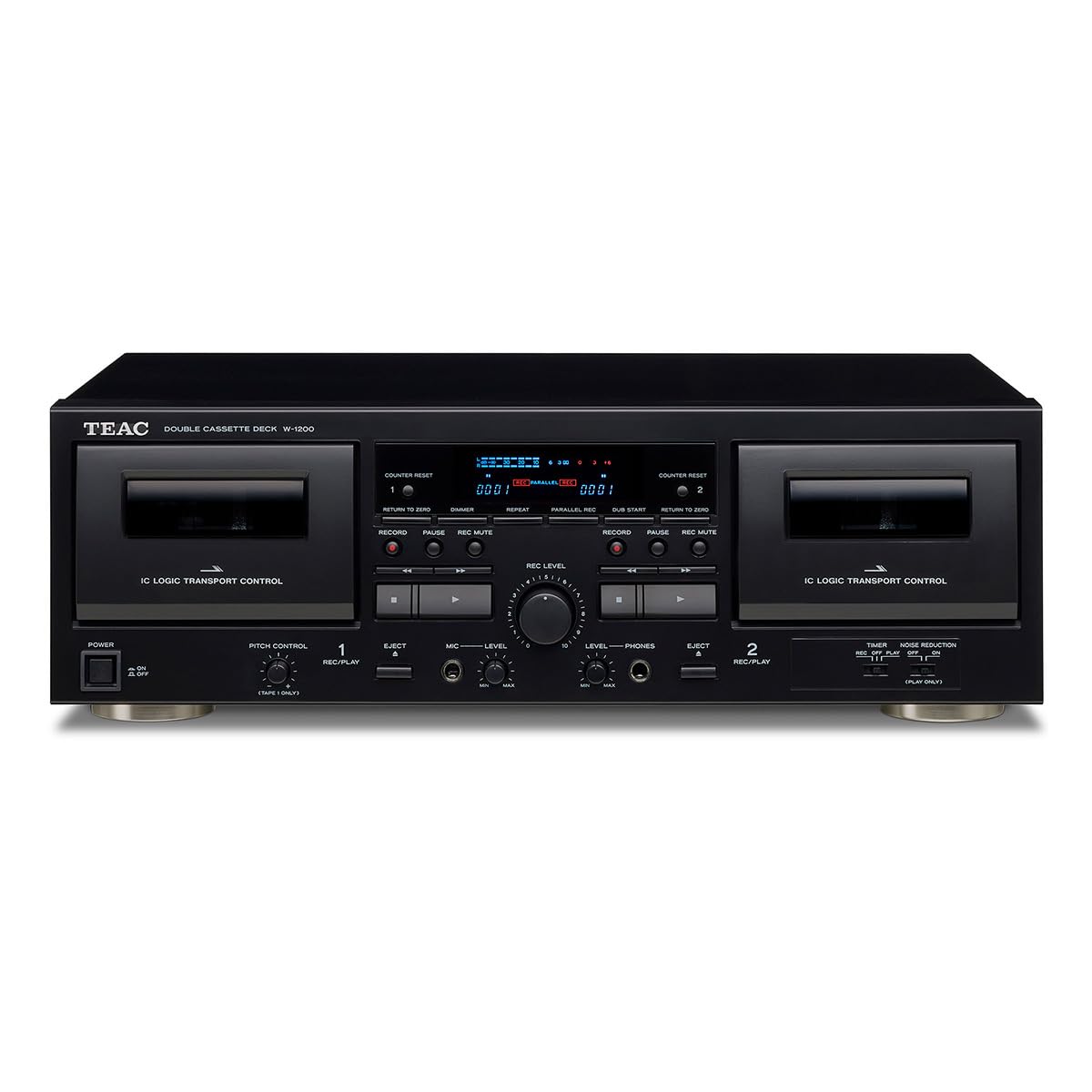
The TEAC W-1200B is a modern dual cassette deck built for the Tape Revival era. It features two independent one-way mechanisms that each allow recording and playback, with support for Type I (Normal) and Type II (Chrome) tapes for recording, plus Type IV (Metal) playback. The W-1200B is the only product on this list that delivers true analog 4-track recording in the traditional sense — you can record on both decks simultaneously for parallel dubbing, or use the mic input for karaoke-style overlays.
A USB output lets you digitize tapes at up to 48kHz/16-bit PCM to a computer, preserving your analog library in CD-quality digital format. The built-in noise reduction effectively suppresses the characteristic tape hiss, and the 12% pitch control is a useful feature for correcting off-speed recordings. The remote control adds convenience, and the dimmable fluorescent display with level meters looks right at home in any studio setup.
This is a niche product for purists who want the warmth and character of analog tape, or for archivists digitizing extensive cassette collections. The W-1200B is not a portable field recorder — it’s a 5-pound desktop unit. For musicians who want the sound of tape saturation and the ritualistic workflow of cassette culture, the TEAC W-1200B delivers exactly what it promises: a modern, reliable dual cassette deck with the convenience of USB transfer.
Why it’s great
- Modern dual cassette deck with reliable transport mechanisms
- USB output for high-quality digital archiving
- Supports Type I and II recording with pitch control
Good to know
- Not a portable recorder — it’s a desktop unit at 5 pounds
- Left tape bay may require azimuth adjustment out of the box
FAQ
Do I need 32-bit float recording for my 4-track projects?
What is the difference between 4-track simultaneous and 4-track overdubbing?
Why do some 4-track recorders have poor battery life?
Can I use a modern cassette tape in a 4-track digital recorder?
Final Thoughts: The Verdict
For most users, the best 4 track cassette recorder winner is the Zoom H4 Essential because its 32-bit float recording, large built-in X/Y mics, and portable design cover virtually every use case from music production to field recording. If you need maximum input flexibility with a touchscreen interface, grab the TASCAM Portacapture X8. And for timecode-synced video shoots where frame accuracy is critical, nothing beats the Zoom M4 MicTrak.