
A 110-volt welder that sputters on ⅛-inch steel is a tool-shaped disappointment. The narrow category of compact, plug-anywhere welders has matured past the old “toy welder” stigma, but separating a machine that genuinely burns rod from one that just makes noise requires looking at peak amperage, duty cycle at that peak, and the quality of the arc control circuitry — not the brand decal.
I’m Min — the co-founder and writer behind Gadgets Feed. This guide is the result of cross-referencing dozens of technical spec sheets, analyzing user-uploaded weld photos on forums, and studying the failure modes that pop up when a machine is asked to run 7018 rod or feed flux-core wire without birdnesting inside the liner.
Every machine here was selected because it delivers a stable arc characteristic, not just a high advertised amp number. This roundup exists to help you find the best 110 welder for your specific project thickness and skill level without wasting money on a unit that can’t maintain penetration on a cold morning in the garage.
How To Choose The Best 110 Welder
Picking a 110-volt welder is an exercise in matching a machine’s real-world current delivery to the thickness of metal you plan to fuse. The market floods with units boasting 160 or 200 peak amps, but that number is often a marketing spike — the usable sustained amperage at a reasonable duty cycle is 20 to 30 percent lower. Understanding duty cycle, input voltage sensitivity, and process capability (flux-core vs. solid-wire MIG vs. stick vs. TIG) is the only way to avoid a garage ornament.
Duty Cycle and Thermal Mass
A 110-volt circuit can physically supply only about 1,800 to 2,400 watts of sustained power (at 15 to 20 amps). A cheap inverter that weighs eight pounds simply lacks the copper windings and heat sink to run at 140 amps for more than a few minutes. Look for units that publish a duty cycle at a specific amperage — a machine that says “160A at 20%” is realistically a 120A continuous welder at best. Premium units use heavier transformers or IGBT modules paired with active fan cooling to push that window wider.
Arc Stability and Control Type
On a 110-volt circuit, line voltage can sag when a compressor kicks on in the same garage. A good inverter compensates automatically; a bad one drops the arc or lets the rod freeze. Synergic control (where the machine sets wire speed and voltage based on thickness) is a genuine boon for beginners. Manual pots give pros finer adjustment. Multi-process machines add complexity in the form of switching between MIG, stick, and lift TIG — verify that the switchover is quick and that the machine stores parameters for each process.
Torch Quality, Cable Length, and Ground Clamp
Many entry-level units ship with a copper-clad aluminum stinger or a ground clamp that barely opens ½ inch. The first upgrade on a budget machine is often the electrode holder and ground cable. A machine with a 10-foot lead gives you far more workspace maneuverability than a 6-foot lead. Pay attention to the connector standard — Dinse 25 vs. Dinse 35 — because aftermarket torches and accessories need to mate correctly.
Quick Comparison
On smaller screens, swipe sideways to see the full table.
| Model | Category | Best For | Key Spec | Amazon |
|---|---|---|---|---|
| PrimeWeld MIG180 | MIG / Stick / Spool Gun | Aluminum & thick steel MIG | 180A / 110-220V / Spool Gun | Amazon |
| Lincoln Electric Weld-Pak 90i FC | Flux Core Only | Sheet metal & thin steel | 90A / 120V / 15 lbs | Amazon |
| Forney 271 Easy Weld 140 MP | 3-in-1 MIG / Stick / TIG | Farm & ranch repair | 140A / 120V / All-metal case | Amazon |
| ARCCAPTAIN iControl ARC205 Pro | Stick / Lift TIG | 6010 rod & portable stick | 205A peak / 120-240V / 8.2 lbs | Amazon |
| Bestarc 165A MIG165 | 4-in-1 MIG / TIG / Stick | DIY & RV mods | 165A / 110-220V / Synergic | Amazon |
| YESWELDER 160A YWM-160 | 4-in-1 MIG / TIG / Stick | Bodywork & fabrication | 160A / 110-220V / Dual-mode | Amazon |
| ARCCAPTAIN TIG200PACDC | AC/DC TIG / Stick / Spot | Aluminum TIG & thin metal | 200A / 110-220V / Pulse | Amazon |
| Weldpro 200A TIG200-KT26 | 5-in-1 AC/DC TIG / Stick | Precision TIG with foot pedal | 200A / 110-220V / Pulse + Pedal | Amazon |
| Weldpro Digital TIG 250GD | Pro AC/DC TIG / Stick | Thick aluminum & heavy steel | 250A / 220V / Water-cooled ready | Amazon |
In‑Depth Reviews
1. PrimeWeld MIG180

The PrimeWeld MIG180 sits at the top of this list because it solves the two biggest problems of a 110-volt welder: aluminum capability and sustained duty. At 180 peak amps on 220 volts (and roughly 130 usable amps on 110 volts), this machine runs flux-core, solid-wire MIG with gas, and stick. The real headline is the included spool gun — a dedicated aluminum-feeding torch that prevents the birdnesting that kills standard MIG setups on 4043 wire. Owners report welding 3/16-inch aluminum plate with zero feed issues, a feat most competitors simply can’t match without buying a separate spool gun for several hundred dollars.
The build quality punches well above the price point. The drive system accepts standard Tweco consumables, and the gas solenoid and regulator are included in the box — not sold separately. Professional welders in forums have compared its weld bead on mild steel directly against a Miller 215, noting that the PrimeWeld arc is smooth and the wire speed control is fine enough for 0.023-inch wire on 22-gauge sheet metal. The 55-pound weight means it’s not a lunchbox portable, but the top-mounted handle makes it manageable for shop-to-truck moves.
On the downside, the included manual is basic, and the stock MIG gun feels adequate rather than premium — expect to upgrade to a 200-amp Tweco-style gun if you regularly push past ⅜-inch steel. The voltage and wire-speed pots are manual, so there’s no synergic one-knob mode for total beginners. That said, the settings chart on the inner panel is accurate enough that most users dial in a good bead within three test welds. For anyone wanting a do-it-all machine that seriously does aluminum, this is the pick.
Why it’s great
- Included spool gun enables reliable aluminum MIG welding right out of the box
- High-quality arc character that competes with welders costing twice as much
- Standard Tweco consumables make replacement parts easy to find at any weld shop
Good to know
- At 55 pounds, it’s heavy for a portable inverter — not a toss-in-the-truck machine
- Manual controls without synergic assistance, so there’s a steeper learning curve for raw beginners
- Stock MIG gun is fine for light work but should be upgraded for heavy or continuous welding
2. Lincoln Electric 90i FC Weld-PAK

Lincoln Electric’s Weld-Pak 90i FC is a focused tool designed for one thing: running flux-core wire on a 120-volt circuit with an exceptionally smooth, inverter-based arc. At 90 amps output, it’s not going to burn ¼-inch plate in a single pass, but it excels where most 110-volt flux-core machines fall apart — controlling spatter and maintaining a stable arc on thin 14- to 18-gauge sheet metal. The inverter power source delivers a noticeably cleaner weld than the old-school transformer flux-core boxes that weigh 40 pounds and run on a two-position rocker switch.
The control interface is refreshingly simple: two knobs — one for voltage, one for wire speed — with an infinitely adjustable voltage dial instead of the clunky high/low toggle. This infinite adjustability lets you fine-tune the arc for different thicknesses without guessing. The unit is shoebox-sized at 15 pounds and ships with a metal carrying case that doubles as storage. Users restoring classic cars consistently report that the 90i FC is the best tool they’ve found for welding in body panels without burning through, and the torch is nimble enough for tight frame corners.
The trade-off is process limitation: this machine is flux-core only. It cannot run solid wire with shielding gas, nor stick, nor TIG. It also only accepts 1-pound spools, which means frequent wire changes on longer projects. The shoulder strap is a poor substitute for a proper handle, and the duty cycle is modest — figure 3 to 4 minutes of weld time at max output before the thermal cutout kicks. But for thin-gauge automotive and sheet-metal work, this is the most refined, portable flux-core welder at its price.
Why it’s great
- Infinitely adjustable voltage dial allows precise arc tuning impossible on rocker-switch welders
- Extremely lightweight and compact (15 lbs) — genuine one-hand portability
- Low spatter output with smooth, inverter-driven arc on thin sheet metal
Good to know
- Flux-core only — no gas MIG, stick, or TIG capability
- Accepts only 1-pound wire spools, not 2-pound or 10-pound spools
- Duty cycle is short at max output; plan for cooldown intervals on longer runs
3. Forney 271 Easy Weld 140 MP

The Forney 271 Easy Weld 140 MP is a rare breed — a multi-process 120-volt welder that does all three processes (MIG with gas, flux-core, stick, and lift TIG) without feeling like a compromise on any of them. It delivers 140 amps of real inverter power, which is enough to weld ¼-inch steel with multiple passes or burn ⅛-inch 6013 rod with a smooth arc that sticks and runs without the rod freezing that plagues weaker stick welders. The all-metal case inspires confidence on job sites where a plastic shell would crack on the first drop.
The controls use a 3-position process switch and infinite voltage and wire speed adjustments, giving the user genuine command over the bead profile. The synergic assistance is basic — it’s not a fully automatic machine — but the “Easy Weld” branding is earned: beginners in forums report laying down acceptable beads within their first hour. The 140 MP also runs well on 15-amp household circuits, a key compatibility point for garage users who don’t have a dedicated 20-amp outlet. The machine includes a 20-amp to 15-amp adapter, though running at full power on a 15-amp breaker may trip it on long beads.
The stick arc is where this machine punches above its weight. Multiple verified buyers with farm and ranch repair needs report that it runs 6013 and 7018 rods cleanly on everything from gate hinges to trailer hitches. The included 10-foot MIG gun and 8-foot electrode holder are adequate but not premium — several owners recommend upgrading the brass-to-copper connections for heavy stick work. Forney’s customer support is consistently described as responsive and helpful, which matters for a first-time buyer who may need setup guidance.
Why it’s great
- All-metal case construction is genuinely rugged and outlasts plastic competition
- Runs 6013 and 7018 stick rods smoothly, unusual for a 120V multi-process welder
- Generator-friendly inverter with minimal electrical noise on 15-20A circuits
Good to know
- No 240V option — limited strictly to 120V input for its 140A peak
- Stock MIG gun and ground clamp feel lightweight; heavy users will want to upgrade them
- Lift TIG is functional but basic — serious TIG work requires a dedicated machine
4. ARCCAPTAIN iControl ARC205 Pro
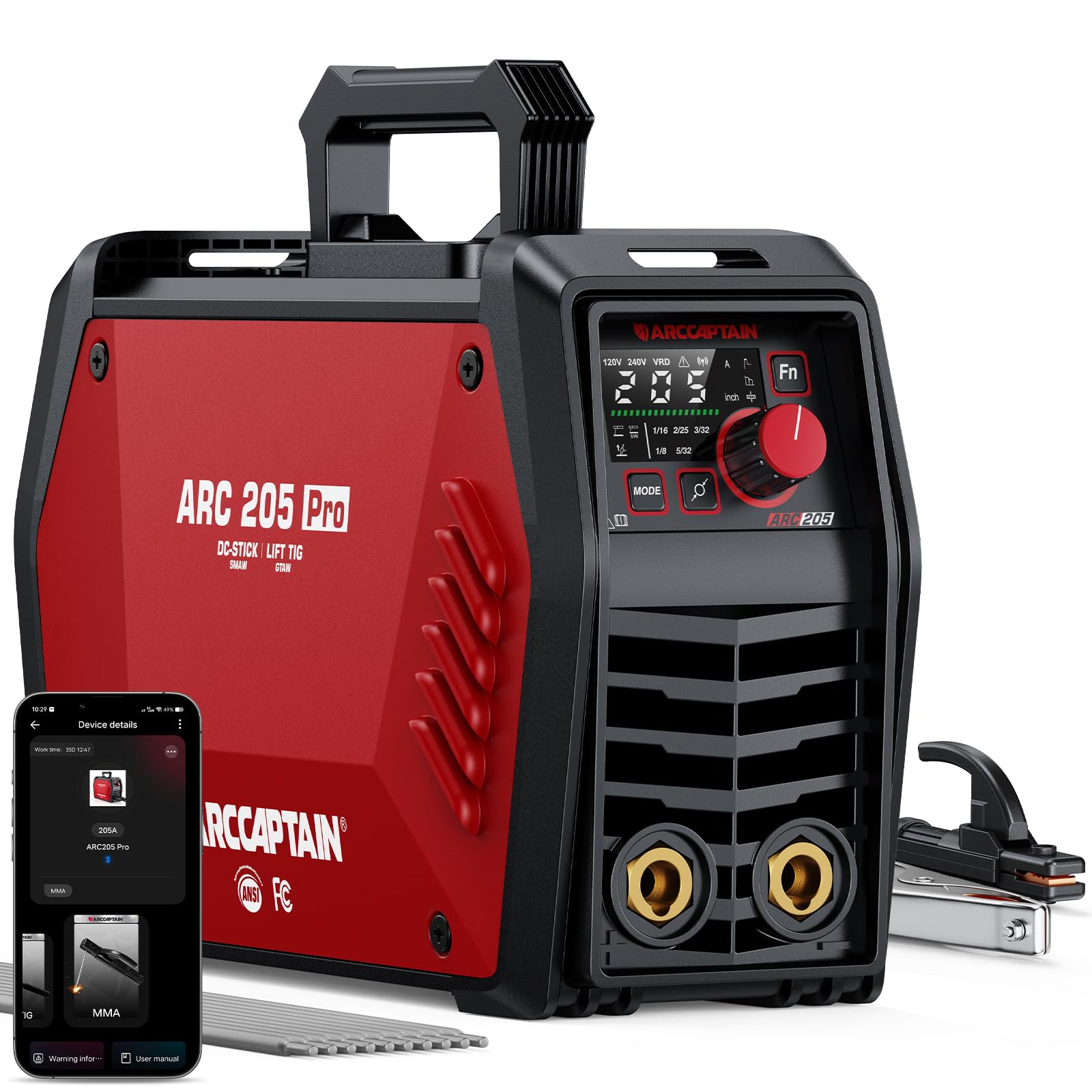
This is possible because of advanced IGBT inverter technology and a compact transformer design that doesn’t sacrifice duty cycle. On a 120-volt circuit, it delivers 20 to 150 amps; on 240 volts, it hits the full 205-amp peak. Certified welders in user reviews confirm that this unit can run 6010 rod — the notoriously finicky deep-penetration rod — with the hot start set to 10 and arc force at 30. That is a rare capability at any price, let alone in a lunchbox-sized machine.
The iControl feature adds an app-based remote control via Bluetooth, which lets you adjust amperage, switch between stick and lift TIG modes, and monitor machine status from up to 10 meters away. While the app is a novelty for some, it genuinely helps when you’re tacking in an awkward position and need to bump the heat without crawling back to the machine. The large LED display shows amperage in imperial units, and the knobless interface uses a simple menu — fewer buttons than most stick welders, which actually reduces confusion for first-time stick users.
The included accessories are the weak point: the electrode holder and ground clamp use copper-clad aluminum conductors and cheap Dinse 35 connectors. Several experienced buyers replace the stinger and ground clamp with solid-copper versions within the first week, noting a measurable improvement in arc stability and reduced cable heating at sustained 130-amp stick welding. The machine itself is built to last, with a smart fan that only runs when needed, reducing dust intake. For a mobile welder who needs to throw a machine in the truck and run 6010 on fence posts or equipment, this is the lightest, most powerful option available.
Why it’s great
- Only 8.2 pounds but delivers a genuine 205-amp peak for 6010 rod capability
- Bluetooth app control allows remote amperage adjustment from awkward weld positions
- Smart fan cooling reduces dust ingestion and extends inverter lifespan
Good to know
- Copper-clad aluminum cables and cheap stinger — budget for solid-copper replacement
- Dinse 35 connectors are non-standard for some common aftermarket torches
- Lift TIG mode works but requires a separate torch purchase
5. Bestarc 165A MIG165
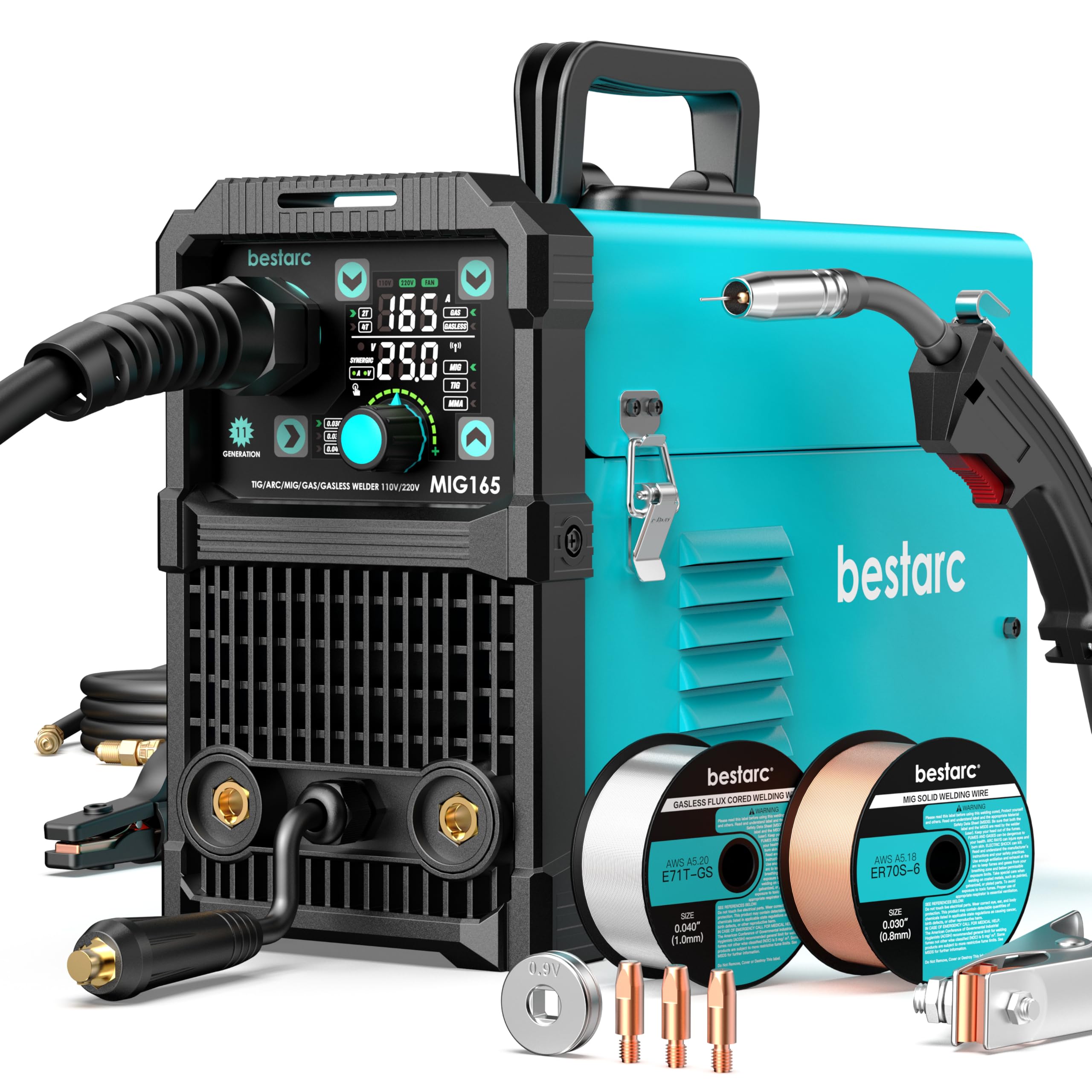
The Bestarc MIG165 is the most beginner-friendly MIG welder in this lineup because it uses synergic control — you dial in the metal thickness and the machine automatically sets the voltage and wire feed speed, then lets you fine-tune the voltage in a ±3V window. This lowers the barrier to entry dramatically: a user who has never touched a MIG gun can set the thickness to ⅛ inch, pull the trigger, and lay a solid bead without math or guesswork. The 165-amp peak is enough for ¼-inch steel in a single pass with flux-core wire, and the dual-voltage auto-sensing (110V or 220V) means you can plug into any standard outlet without switching internal taps.
The large LED digital display is positioned so you can read it through a hood lens without lifting your helmet — a small detail that saves significant time when dialing in adjustments. The 4-in-1 capability covers solid-wire MIG with gas, flux-core MIG, lift TIG, and stick. Drive rollers are included for both 0.030 and 0.035 inch wire, and the machine ships with a partial spool of flux-core wire and some solid wire to get started. The 13.7-pound weight is light enough to carry with the included shoulder strap, and the cyan-colored case is distinctive on a cluttered workbench.
Experienced welders note that the stick mode is competent but not the machine’s strong suit — max stick amps are around 130A, which limits you to ⅛-inch rods. The ground clamp is a typical low-cost unit that benefits from replacement. Some early-production units had overly tight spool tension and a short gun lead, but the current revision includes a longer torch cable and knurled drive rolls. For a DIYer building trailers, repair gates, or fabricating RV add-ons, the synergic MIG mode alone makes this the easiest path to good-looking welds on 110 volts.
Why it’s great
- Synergic control automates wire speed and voltage, drastically reducing the learning curve
- Large LED display readable through a welding helmet hood
- Dual-voltage auto-sense works on 110V and 220V without manual rewiring
Good to know
- Stick mode is limited to about 130A maximum, ruling out larger electrodes
- Stock ground clamp and spool spring tension may need initial adjustment
- Gas MIG requires purchasing a separate shielding gas tank
6. YESWELDER 160A YWM-160
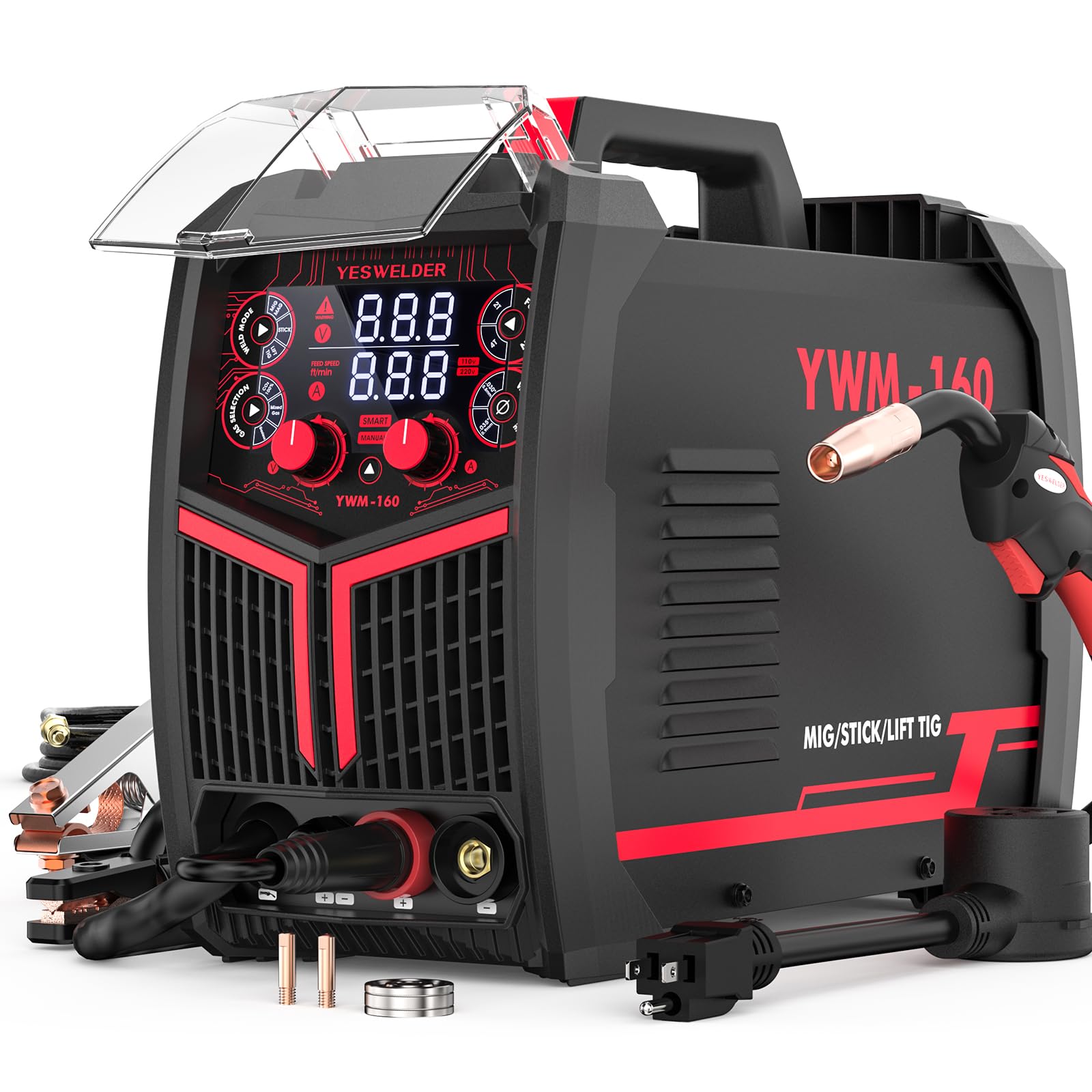
The YESWELDER YWM-160 is a workhorse 4-in-1 that often flies under the radar but delivers consistent performance at a price that undercuts most multi-process machines with similar capability. The 160-amp peak on the 220-volt input runs 0.030-inch flux-core wire through ¼-inch steel without issue, and the synergic smart mode sets baseline parameters automatically. The manual control override lets experienced users dial in their preferred voltage and wire speed independently, which is a missing feature on some entry-level synergic-only units. The 19.4-pound weight keeps it portable while still providing enough thermal mass for a reasonable duty cycle.
One standout detail is the wire feeding system — this machine handles both 2-pound and 10-pound spools without modification, a convenience that saves constant spool swapping compared to units limited to 1-pound rolls. The included 220V-to-110V adapter is functional but physically large; some users prefer to omit it when running on 110V for a cleaner setup. The stick mode starts hard — users report that striking an arc initially takes some practice — but once the arc is established, the weld penetration is solid and consistent. The lift TIG mode is basic and requires a separate torch purchase.
Build quality is respectable for the price point, with a metal-and-plastic composite chassis that feels more solid than the cheapest imports. The large LED display is bright enough for outdoor work. Several user reviews from experienced fabricators who normally use Miller and Lincoln machines praise the YESWELDER as a capable backup or home-garage welder, noting that the arc quality on 220-volt MIG mode is close to what they get from professional equipment. The main compromises are the slightly clunky 110V adapter and a manual that could be more detailed on stick welding settings.
Why it’s great
- Accepts both 2-pound and 10-pound wire spools, reducing changeover frequency
- Synergic smart mode with full manual override works for all skill levels
- Arc quality on 220V MIG mode receives praise from professional welders
Good to know
- Stick arc strike can be finicky on first use — some practice needed
- 110V adapter is bulky and cumbersome to position near the machine
- Lift TIG requires a separate torch purchase and has limited functionality
7. ARCCAPTAIN TIG200PACDC

The ARCCAPTAIN TIG200PACDC is the machine for anyone who needs to TIG weld aluminum without spending thousands. It delivers true AC TIG with adjustable balance (cleaning action) and adjustable AC frequency, which are the two controls that determine whether your aluminum weld bead comes out clean or contaminated. The 200-amp peak on 220 volts handles up to 5mm aluminum, and the square-wave and triangular-wave pulse settings allow the user to dial back heat input significantly — essential for welding thin-wall tubing or sheet aluminum without warping or burn-through. The MCU digital control system manages all parameters: pre-flow, upslope, peak current, base current, downslope, and post-flow.
The 7-in-1 label covers DC TIG, DC pulse TIG, AC TIG, AC pulse TIG, square-wave AC, triangular-wave AC, and stick MMA. The spot TIG mode is a bonus for tacking without a foot pedal (though the pedal is sold separately). The large LED screen clearly displays all parameters, and the 2T/4T/spot trigger modes give the operator full control over torch function. The machine weighs 26.5 pounds, which is heavier than a portable stick welder but reasonable for a full-featured AC/DC TIG unit. The included WP-26 torch, flow meter, and ground clamp are serviceable to start.
Multiple experienced TIG welders confirm that this machine produces professional-grade aluminum welds at a budget price point, with stable arc starts and responsive AC balance control. The ground clamp included in the box is undersized for sustained 140+ amp TIG work — several users report swapping it out immediately. For a hobbyist or small shop that needs AC TIG capability for aluminum fabrication, this unit delivers function that was impossible to find at this price point even three years ago.
Why it’s great
- Full AC TIG control with adjustable balance and frequency for clean aluminum welds
- Pulse and triangular-wave settings allow precise heat management on thin material
- MCU control system manages all standard TIG parameters upslope through post-flow
Good to know
- Foot pedal uses proprietary XS12 connector — not standard DIN or RJ45
- Included ground clamp is undersized for sustained high-amp TIG welding
- Water cooling is not supported; long-duration high-heat TIG sessions may exceed duty cycle
8. Weldpro 200A TIG200-KT26
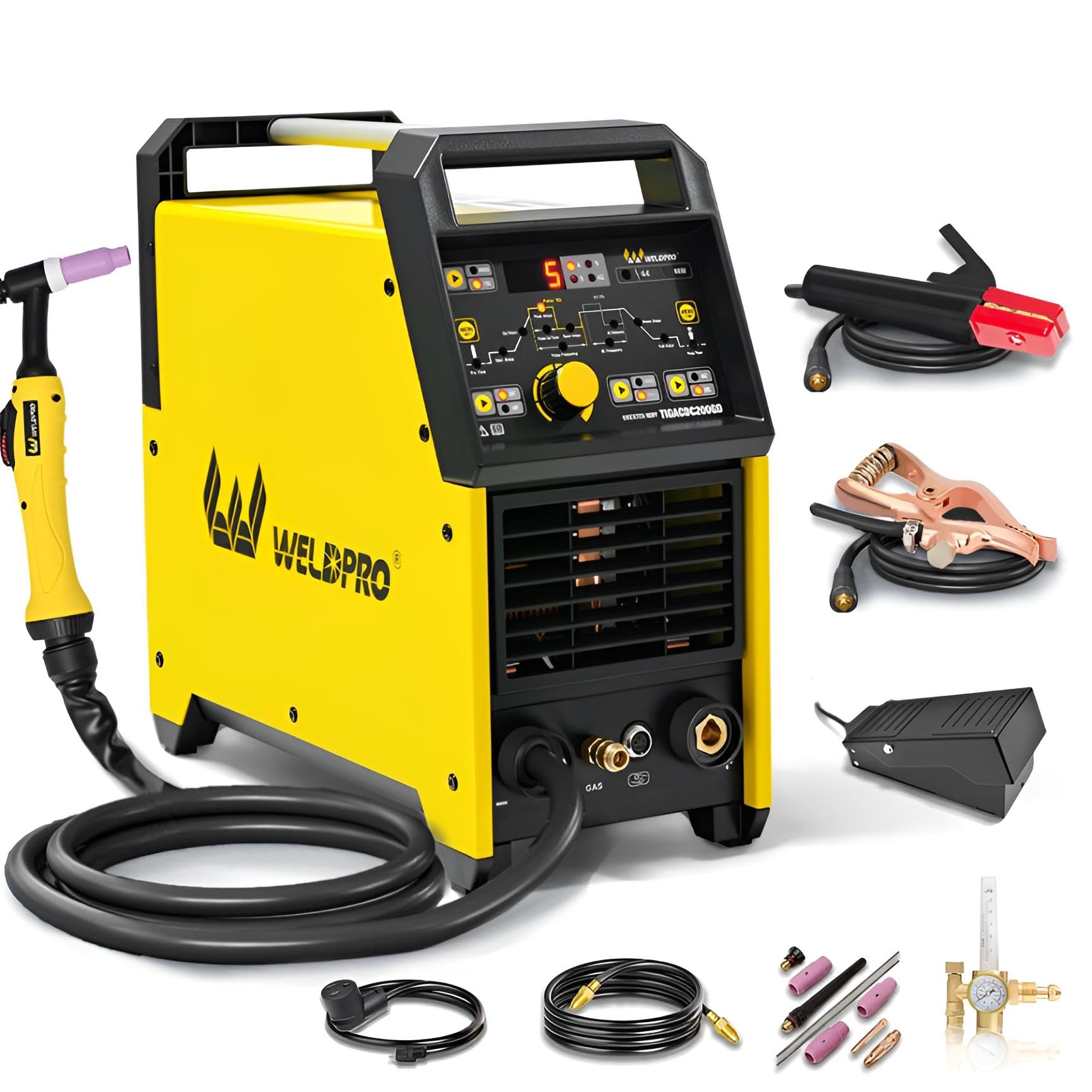
The Weldpro 200A TIG200-KT26 is a 5-in-1 AC/DC TIG welder that stands out because it ships with a genuine rocker-style foot pedal for hands-free amperage control and a premium CK17 flex torch. The CK torch alone is a major value add — it’s a favorite among TIG welders for its flexibility and gas lens compatibility, and buying it separately costs over . The machine offers AC TIG, DC TIG, AC pulse, DC pulse, and stick modes, with fully adjustable parameters: 0.5-200Hz pulse frequency, adjustable peak and base amperage, upslope and downslope, and 2T/4T trigger modes. The auto-sensing dual voltage (110V/220V) means it switches seamlessly between a household outlet and a shop outlet.
The build quality is noticeably denser than the ARCCAPTAIN TIG200PACDC, with a 61.8-pound shipping weight reflecting heavier transformer and heat sink construction. The 40% duty cycle at 200 amps (on 220V) is competitive for this class. Users report that the high-frequency non-contact arc start is reliable and does not cause radio interference on sensitive electronics in the shop. The stainless steel exhaust work reviews are consistent — multiple fabricators report using it for 16-gauge and 18-gauge 304 stainless with excellent bead appearance and no tungsten contamination.
The included flow meter is functional, though one reviewer noted that the gauge on their unit was inaccurate from the factory — the seller replaced it promptly. The work clamp spring is extremely stiff and small, making it difficult to clamp onto thick table edges. The AC balance control is labeled opposite of the Miller convention, which is a minor frustration if you are used to Miller’s numerical cleaning action scale. Still, for the money, this is the best-equipped AC/DC TIG package on the market, with the CK torch and foot pedal making it ready to weld aluminum out of the box rather than requiring hundreds of dollars in upgrades.
Why it’s great
- Includes a premium CK17 flex torch and rocker foot pedal, saving significant upgrade costs
- High-frequency non-contact arc start is reliable and clean on stainless and aluminum
- 40% duty cycle at 200A on 220V allows sustained welding without overheating
Good to know
- Work clamp spring is extremely stiff and the opening is small
- AC balance scale is reversed from Miller convention — requires recalibration if you are trained on Miller
- Gas-cooled torch gets hot on long-duration, high-amp runs — water cooling not supported
9. Weldpro Digital TIG 250GD

The Weldpro Digital TIG 250GD is the flagship of this roundup and the only unit here capable of sustained 250-amp AC/DC output with a water-cooled torch option. This is a machine built for the semi-professional or pro-level fabricator who welds thick aluminum plate (up to ½ inch or more) and needs the duty cycle to handle production work. The digital control panel includes a memory function that stores up to 9 weld parameter sets, so you can instantly recall your settings for common joint configurations. The pulse TIG settings are highly adjustable, and the SSC rocker-style foot pedal is widely considered the best in the industry for this class of machine.
The torch selection is a differentiator — you can order the 250GD with a CK Worldwide superflex #26 air-cooled torch or a CK #20 water-cooled torch with 25-foot cables. The water-cooled option requires purchasing a separate cooler, but the rear electrical receptacle is already wired for it, making integration straightforward. Users report that the water-cooled setup lets them weld aluminum continuously at 200 amps without the torch getting too hot to hold — a capability that costs well over from Lincoln or Miller. The stick MMA function is also capable of running ⅛-inch 7018 rods with excellent arc force control.
The package weight is 92 pounds, so this is not a mobile welder in the conventional sense — it’s a shop machine. The 220-volt NEMA 6-50 plug is standard for larger welders. The main critiques mirror the Weldpro 200A: the work clamp is stiff, and the AC balance scale takes some getting used to if you’re trained on Miller equipment. The manual could be more comprehensive on the memory function programming. But for a shop that needs professional AC/DC TIG capability at roughly half the cost of the big-name alternatives, the 250GD delivers genuine value without corner-cutting on the torch or pedal.
Why it’s great
- 250A output with water-cooled torch option enables continuous high-amp aluminum welding
- 9-memory presets store weld parameters for quick recall on repeat jobs
- Premium CK torch and SSC foot pedal are genuinely professional-grade components
Good to know
- 92-pound weight requires a cart or stationary shop setup — not for mobile use
- Requires a NEMA 6-50 outlet; will not run on standard household 110V
- Water cooler and cart are sold separately, adding to the total investment
FAQ
Can a 110 volt welder weld 1/4 inch steel in a single pass?
What is the difference between synergic MIG and manual MIG control?
Can I run a 110 welder on a 15-amp household circuit?
Is it better to buy a dedicated flux-core welder or a multi-process machine?
Do I really need AC/DC TIG to weld aluminum?
Final Thoughts: The Verdict
For most users, the best 110 welder winner is the PrimeWeld MIG180 because it offers the widest usable process range — MIG with gas, flux-core, stick, and the critical spool gun for aluminum — all within a machine that delivers a premium arc character and accepts standard Tweco consumables. If you want a dedicated thin-gauge flux-core welder that is incredibly portable and spatter-free, grab the Lincoln Electric 90i FC. And for AC/DC TIG aluminum welding with professional components at a hobbyist budget, nothing beats the Weldpro 200A TIG200-KT26 with its included CK torch and foot pedal.