
An at-home weather station turns your backyard into a personal meteorological hub, delivering real-time temperature, humidity, wind speed, and rainfall data directly to your display. Whether you’re a gardening enthusiast protecting sensitive plants or a homeowner tracking incoming storms, the right station replaces guesswork with data you can trust.
I’m Min — the co-founder and writer behind Gadgets Feed. I’ve spent countless hours analyzing sensor accuracy, wireless range specifications, display readability under various lighting conditions, and connectivity requirements to separate the genuinely useful stations from the ones that clutter your countertop with useless data.
This guide breaks down the essential specs and real-world performance of seven models to help you confidently choose the best at home weather station that matches your specific monitoring needs and living situation.
How To Choose The Best At Home Weather Station
Choosing the right weather station means matching its sensor capabilities, display design, and connectivity to your specific property layout and how you plan to use the data. A station that excels in an open backyard may struggle inside a dense urban apartment, while a model built for remote monitoring might overcomplicate a simple need for morning temperature checks.
Sensor Range and Number of Channels
The wireless range between the outdoor sensor and the indoor display determines how far apart they can be placed while maintaining a reliable connection. Look for a stated range of at least 300 feet in open air, though walls, metal siding, and insulation will reduce effective distance. If you need to monitor multiple locations — a greenhouse, a garage, and a backyard, for example — choose a station that supports three or more sensor channels instead of a single included sensor.
Display Readability and Backlight
A weather station display sits in your home for years, and you’ll glance at it daily. The screen size, contrast, font weight, and backlight adjustability determine whether you can read the temperature from across the kitchen or need to walk up and squint. Models with wide viewing angles and multiple brightness levels — including a dim setting for nighttime — offer the best experience. Avoid displays that wash out when viewed from just slightly above or below eye level.
Connectivity: Offline vs. Wi-Fi
Offline stations display data only on the console and require zero network setup — they simply work. Wi-Fi connected stations transmit data to apps and cloud services, enabling remote checking, historical data logging, and integration with smart home systems. Wi-Fi adds convenience but introduces setup complexity and potential connectivity issues. If you only need current conditions at home, an offline station is simpler and more reliable. If you travel or want to track trends over months, choose Wi-Fi.
Quick Comparison
On smaller screens, swipe sideways to see the full table.
| Model | Category | Best For | Key Spec | Amazon |
|---|---|---|---|---|
| LFF Wireless Weather Station | Mid-Range | Multi-location monitoring | 3 sensors, 330ft range | Amazon |
| La Crosse S77925-INT | Mid-Range | Atomic time accuracy | Self-setting atomic clock | Amazon |
| Sainlogic SA6 12-in-1 | Premium | Rainfall and wind tracking | ±1mm rain accuracy | Amazon |
| La Crosse V21-WTH Wi-Fi | Premium | Wind speed history | Wi-Fi + AccuWeather data | Amazon |
| Sainlogic Smart WiFi | Premium | Long-term data export | 2-year data storage | Amazon |
| Ambient Weather WS-1965 | Premium | Smart home integration | All-in-one sensor array | Amazon |
| Ambient Weather WS-3000-X5 | Premium | Multi-room sensor network | 5 remote sensors, SD logging | Amazon |
In‑Depth Reviews
1. LFF Wireless Weather Station

The LFF station distinguishes itself with three included wireless sensors that each display their own temperature and humidity readings, making it the only multi-sensor package in this roundup at its price tier. Each sensor operates on a separate channel (1, 2, and 3), allowing you to monitor your backyard, garage, and sunroom simultaneously from the single 7.5-inch color touchscreen console. The 330-foot open-air transmission range gives you real flexibility for sensor placement across larger properties.
The 12-in-1 feature set includes a self-calibrating atomic clock that syncs to WWVB signals, dual alarms with snooze, a six-icon weather forecast based on barometric pressure trends, and three adjustable brightness levels for the backlight. The power adapter keeps the screen on continuously, while battery-only operation automatically dims the display after 10 seconds to conserve power. Setup requires patience — each sensor must be assigned its channel before the console can recognize all three.
Real-world performance data from users shows the atomic clock locks reliably when positioned with the rear of the unit facing Colorado, and the sensors calibrate closely to each other when placed side-by-side during initial testing. The display graphics are described as sleek and modern, with large legible fonts suitable for reading across a room. Some users noted the viewing angle narrows when the unit is mounted above eye level, and the power adapter plug may need a slight wire bend to seat fully into the console.
Why it’s great
- Includes three outdoor sensors for multi-zone monitoring.
- Large 7.5-inch color touchscreen with adjustable backlight.
- Atomic clock with dual alarms and snooze function.
Good to know
- Sensor channel assignment must be done before pairing.
- Display dims after 10 seconds on battery power only.
- Viewing angle narrows when mounted above eye level.
2. La Crosse Technology S77925-INT

The La Crosse S77925-INT delivers a wide 8.98-inch color LCD with dynamic forecast icons and trend arrows, plus a 24-hour barometric pressure graph that shows rising or falling trends at a glance. The display layout is notably uncluttered, with large temperature and humidity numbers that are easy to read from across a living room. The atomic clock self-sets to WWVB and includes a crescendo alarm with 10-minute snooze, plus customizable high/low alerts for both temperature and humidity.
This station is AC-powered with a constant backlight that offers adjustable brightness, though the display’s readability drops significantly when viewed from above eye level — the screen washes out with an orange-green tint. Wall mounting below eye level solves this effectively. The included outdoor sensor (TX141TH-B) operates on 433 MHz and reliably connects up to about 40 feet through interior walls, but the station does not support the multi-sensor scanning feature with the included sensor type.
User reports highlight the display’s vibrant colors and easy setup process — one reviewer had the remote sensor connected within minutes of unboxing. The barometric calibration requires a 7-10 day settling period before forecast icons become fully accurate. The unit records daily high/low values that auto-reset, and you can cycle through dew point and heat index views. A common workaround for the off-angle readability issue is placing the display on a low shelf or kitchen counter where it sits below natural eye line.
Why it’s great
- Wide, colorful display with excellent contrast at eye level.
- Atomic clock with automated Daylight Savings adjustment.
- Customizable HI/LO alerts for temperature and humidity.
Good to know
- Display readability washes out when viewed from above.
- Multi-sensor scanning is not supported with this model.
- Barometric forecast stabilizes only after ~7-10 days.
3. Sainlogic 12-in-1 Weather Station SA6

The Sainlogic SA6 packs a professional-grade rain gauge with ±1mm accuracy under 15mm of rainfall into a single all-in-one outdoor sensor array that measures temperature, humidity, barometric pressure, wind speed, and wind direction. The 6.5-inch HD color display uses oversized fonts specifically designed for readability from a distance, making it a strong option for older users or anyone who checks conditions frequently throughout the day. This model has no Wi-Fi — data stays on the console only.
The outdoor array transmits on a wireless connection that Sainlogic claims maintains stability through trees and light structures, making it suitable for farms, orchards, and large gardens. The display shows indoor and outdoor temperature ranges (0°C-60°C indoor, -40°C-60°C outdoor), humidity from 10%-99%, barometric pressure from 300-1100 hPa, moon phase, calendar, dew point, and “feels like” temperature. The adjustable backlight works in bright daylight and low-light evenings without washing out the screen.
User feedback notes that assembly of the outdoor sensor array takes some care but is straightforward, and the display connected quickly out of the box. Some users found the instruction manual disorganized, making the initial setup screen harder to locate for configuration changes. The display’s limited viewing angle means it works best when positioned directly in front of the user rather than off to the side. Data accuracy is reported as reliable when compared against reference thermometers after the sensors settle.
Why it’s great
- Professional-grade rainfall measurement with ±1mm accuracy.
- All-in-one sensor array measures wind, rain, and pressure.
- Large, bold fonts excellent for quick glances from a distance.
Good to know
- No Wi-Fi connectivity — display-only data access.
- Instruction manual is poorly organized.
- Display has a limited off-angle viewing range.
4. La Crosse Technology V21-WTH Wi-Fi
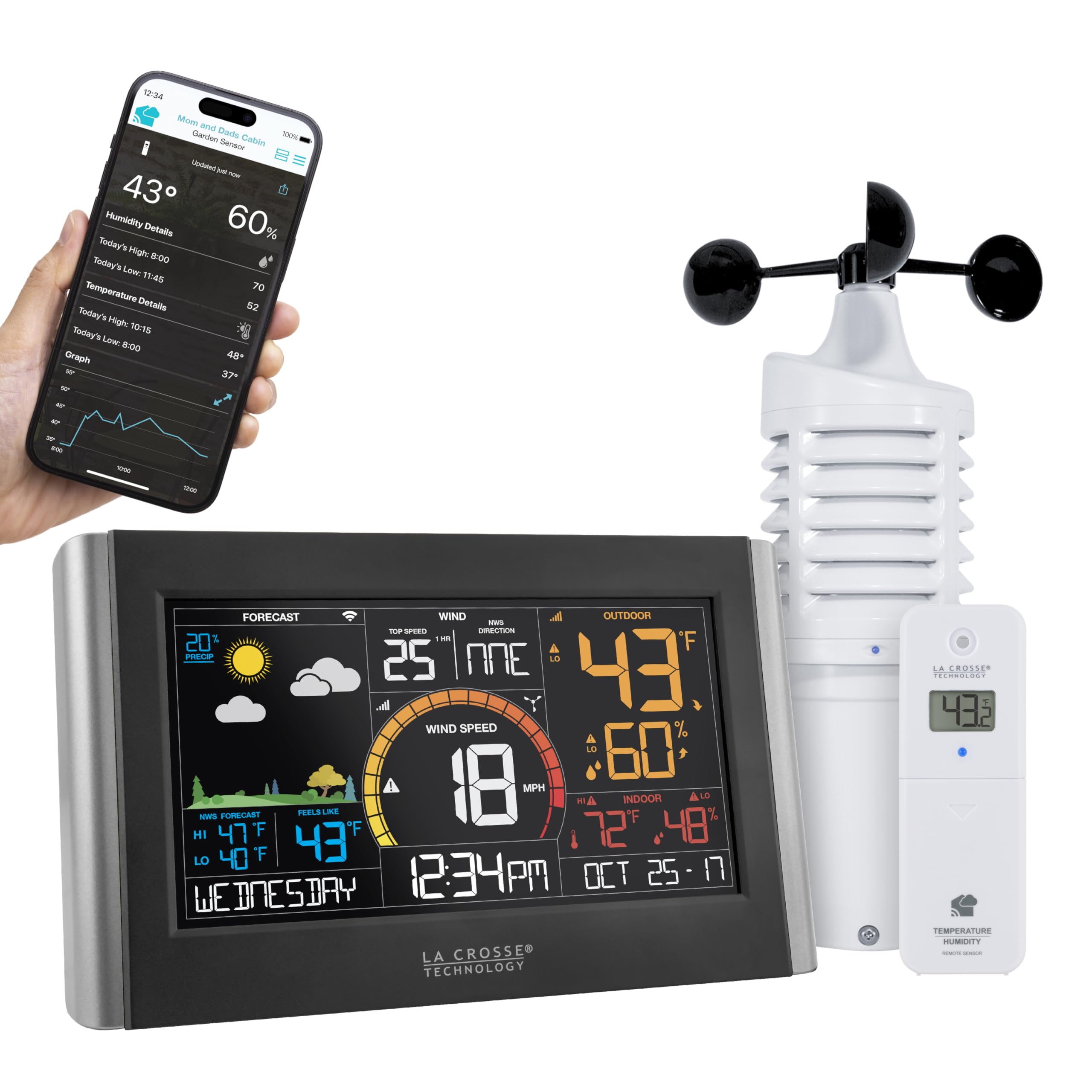
The La Crosse V21-WTH breaks away from offline-only stations by integrating Wi-Fi for AccuWeather forecasting, internet time sync, and remote monitoring via the La Crosse View app. The station includes separate sensors for indoor/outdoor temperature and humidity plus a dedicated wind speed and direction sensor with an impressively detailed history log spanning 1 hour, 24 hours, 7 days, month, and year. This separate sensor design means you can replace individual components if one fails rather than swapping the whole array.
The display presents dynamic forecast icons with tendency indicators and pushes data to the app for remote checking. Wi-Fi setup requires a 2.4 GHz network — the manual explicitly notes that routers using 5 GHz for media streaming and 2.4 GHz for everything else should work fine, but users with mesh networks reported connectivity failures. The console is AC-powered and keeps the backlight on constantly with adjustable brightness, though the viewing angle is noticeably narrow and there is no auto-dimming feature for nighttime.
Wind sensor accuracy is a standout feature — one user in a high-wind area reported the station tracked gusts up to 42 mph without lag or dropouts. The free app tier provides basic remote data access, while a premium plan adds extended features. Multiple users noted that tech support from La Crosse was helpful during setup troubleshooting. The biggest concern raised in reviews was a previous-generation system whose wind sensor failed after roughly one year of use, making long-term durability a watch-point for this model.
Why it’s great
- Wi-Fi connectivity for remote app monitoring and AccuWeather data.
- Wind speed sensor with detailed multi-period history logging.
- Separate sensor components allow individual replacement.
Good to know
- Wi-Fi setup requires 2.4 GHz network (not compatible with 5 GHz).
- Display has narrow viewing angles and no auto-dimming.
- Some users reported wind sensor failure after ~1 year outdoors.
5. Sainlogic Smart WiFi Weather Station
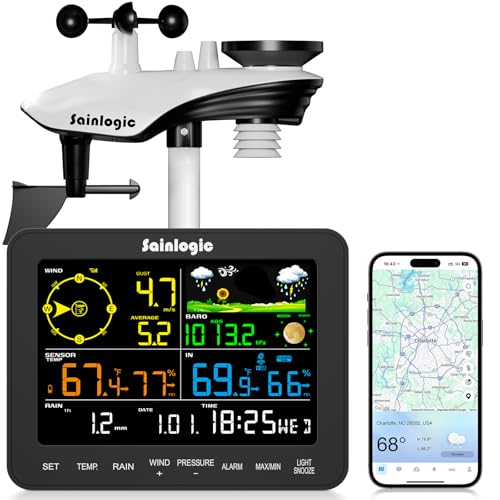
The Sainlogic Smart WiFi station adds app-based AI-driven weather monitoring to the same hardware platform as the SA6, with the critical addition of up to two years of data storage and Excel-export capability. The display console uses enlarged bold fonts for temperature and humidity — specifically designed for middle-aged and elderly users — and the Weatherseed app delivers real-time alerts for temperature, humidity, and barometric pressure changes directly to your smartphone. The rain gauge matches the professional ±1mm accuracy found in the offline model.
Wi-Fi setup requires a 2.4 GHz network and takes approximately three steps through the app, but the connection’s reliability is a mixed bag in real-world use. Multiple users reported the Wi-Fi dropping out within the first week, requiring manual resets to restore connectivity. The Weatherseed app itself received harsh feedback for inaccuracies in wind speed readings and a user interface described as difficult to navigate. The rain gauge worked well for some users but failed during a heavy storm for one reviewer.
Battery life in the sensor array averaged roughly three weeks in one case, which is notably shorter than competitors that report months on a single set. On the positive side, the display itself is bright, the indoor/outdoor humidity monitoring works reliably, and the 2-year data export feature is genuinely useful for agricultural users or hobbyists tracking seasonal patterns. The U.S.-based phone support (available weekdays 10 AM to 6 PM Eastern) is a welcome resource for troubleshooting.
Why it’s great
- Two years of data storage with Excel export capability.
- Large, bold fonts ideal for quick readability.
- U.S.-based phone support available during business hours.
Good to know
- Wi-Fi connection can drop out and require manual resets.
- App accuracy for wind speed is questionable.
- Sensor battery life is shorter than competing models.
6. Ambient Weather WS-1965

The Ambient Weather WS-1965 is the most complete smart-enabled station tested, bundling an all-in-one sensor array that measures temperature, humidity, barometric pressure, wind speed, wind direction, and rainfall into a single outdoor unit that reports updated data every 16 seconds. The color LCD console is compact at 6.13 inches wide but presents all metrics in an organized layout. Wi-Fi connectivity pushes data to the Ambient Weather Network and Weather Underground, enabling remote monitoring and integration with IFTTT, Google Home, and Alexa.
Setup requires more technical carefulness than simpler stations — the 45-page manual is thorough but not always intuitive. The outdoor sensor array must be perfectly level for the rain gauge to report accurately, and the package lacks a dedicated leveling accessory. The Wi-Fi setup is browser-based rather than app-driven, which some users found kludgey compared to modern smart home devices. Once configured, the station runs reliably with no connectivity issues reported across typical 85-foot ranges.
Users praise the accuracy of real-time data and the durability of the sensor array, which combines alloy steel and polycarbonate construction. The Ambient Weather Network allows you to customize dashboard tiles and share hyperlocal conditions. The small display size means it’s harder to read from across a room compared to the larger screens on the LFF or La Crosse models. The station is a strong entry point for anyone wanting smart home weather automation without paying premium-tier prices for similar feature sets.
Why it’s great
- 16-second sensor updates with all-in-one measurement array.
- Smart home compatible with IFTTT, Alexa, and Google Home.
- Weather Underground integration for community data sharing.
Good to know
- Setup requires leveling the sensor array for rain accuracy.
- Wi-Fi configuration is browser-based, not app-based.
- Display is small and harder to read from across a room.
7. Ambient Weather WS-3000-X5
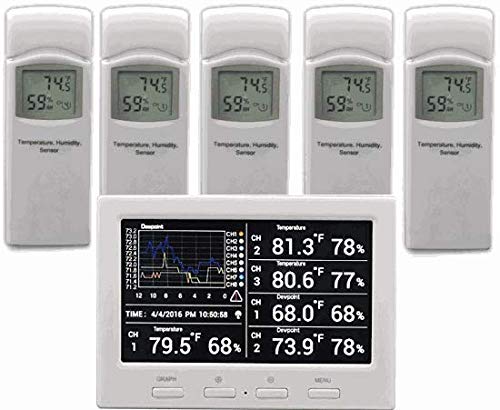
The Ambient Weather WS-3000-X5 takes a specialized approach by focusing on temperature and humidity monitoring across up to eight wireless channels, with five thermo-hygrometer sensors included in the box. Each sensor is compact (4.75 x 1.5 x 0.6 inches) and features its own small LCD showing the current reading, making it easy to label and place in specific rooms, crawlspaces, greenhouses, or attics. The console itself is small (3.25 inches square) with a graphical display that charts data trends over time.
The standout feature is the included PC software and micro-SD card slot for advanced data analysis and logging. You can extract temperature and humidity data directly to a computer for graphing, programming custom alerts, and long-term archiving. The sensors transmit on 915 MHz and have demonstrated reliable range of approximately 100 feet through walls. Battery life in the sensors is exceptional — multiple users reported the original batteries still working after months or even years of continuous operation.
User reviews spanning over five years of use highlight the WS-3000-X5’s longevity and accuracy, with sensors staying within 0.1°F of each other after years of deployment. The display includes a screen scheduling feature that turns the backlight off during set hours, plus an alarm function. The main drawback is the tiny chart area on the console — you need the PC software to see meaningful trend visualization. The unit lacks Wi-Fi, so remote monitoring is not possible without connecting it to a computer running the software.
Why it’s great
- Five sensors included with their own individual displays.
- SD card and PC software for advanced data logging and graphing.
- Exceptional battery life — sensors last years on one set.
Good to know
- Console display chart area is very small.
- No Wi-Fi — requires PC connection for data analysis.
- Limited to temperature and humidity only (no wind or rain).
FAQ
How far can the outdoor sensor be from the display?
Do I need Wi-Fi for a home weather station to work?
How accurate are the rain gauges on these stations?
Can I add extra sensors to my weather station later?
Why does my weather station display an inaccurate forecast at first?
Final Thoughts: The Verdict
For most users, the best at home weather station winner is the LFF Wireless Weather Station because its three included sensors and large 7.5-inch touchscreen deliver exceptional value without needing Wi-Fi complications. If you want professional-grade rainfall and wind data with a bold display, grab the Sainlogic SA6. And for smart home integration with remote monitoring, nothing beats the Ambient Weather WS-1965.