
Our readers keep the lights on and my morning glass full of iced black tea. As an Amazon Associate, I earn from qualifying purchases.
Specs are compiled from manufacturer listings and verified buyer reviews and can change over time — please confirm the key details on the product page before buying.
If your kitchen still smells like last night’s fish fry and your new cabinets give off that weird chemical tang, the fix is not a plug-in freshener — it is a purifier with real activated carbon inside. Carbon is the part that actually grabs gases, fumes, and odors, while a HEPA filter handles the dust, pollen, and pet dander. Most cheap purifiers skimp on the carbon layer, which is exactly why so many people buy one and still smell dinner three hours later. Below you’ll find nine machines that all include genuine carbon filtration, sorted so you can match one to your room size, your noise tolerance, and how much filter upkeep you’re willing to take on.
I’m Min — the founder and writer behind Gadgets Feed. This guide is built by comparing the manufacturers’ published specifications and the patterns across verified customer reviews, so you get each pick’s real strengths and trade-offs instead of marketing spin.
Room size decides almost everything here, so start by measuring the space you actually want clean. Carbon gets used up faster than HEPA, so plan on replacing that layer more often than the particle filter. The picks below cover everything from a nightstand unit to a whole-floor workhorse, and each one explains what its carbon stage really does for air purification systems for removing vocs and odors.
Our Picks at a Glance
How To Choose The Best Air Purification Systems For Removing VOCs And Odors
Two filters do two different jobs, and mixing them up is the fastest way to waste money on the wrong machine. A HEPA filter is a dense mat of fibers that traps solid particles — dust, pollen, smoke particles, pet dander — by physically catching them as air passes through. Activated carbon is a porous sponge-like material that grabs gas molecules instead. VOCs (volatile organic compounds — the chemical fumes off-gassing from paint, new furniture, cleaners, and adhesives) and cooking odors are gases, so only the carbon layer can catch them. A purifier with a token sprinkle of carbon will move air but leave the smell behind.
Match the coverage number to your actual room
Coverage ratings are usually quoted as the largest space the unit can clean once in an hour, which is the weakest possible standard. A machine rated for a big room in one hour will clean that same room far faster at its top speed, and a smaller room much faster still. If you cook often or live somewhere with wildfire seasons, choose a unit that can turn your room over several times an hour rather than exactly once. Also note that coverage figures assume a normal ceiling height and a closed room — an open floor plan is much harder to clean than the square footage suggests, and many buyers simply run two smaller units instead of one giant one.
Carbon is the consumable you will replace most
Activated carbon saturates. Once its pores are full of the gases it has absorbed, it stops working and the odors come back — this happens long before a HEPA filter wears out. That is why the carbon stage sets your real running cost, not the purchase. If you cook heavily, burn candles, or live near traffic, expect to swap carbon more often than a light user would. Buying genuine replacement filters matters too: an overstuffed third-party carbon pad can restrict airflow and slow the whole machine down, and a filter that does not seal properly lets dirty air slip past the carbon entirely.
Quick Comparison
| Model | Best For | Max Coverage | Filtration Stages | Weight | Amazon |
|---|---|---|---|---|---|
| WINIX 5520★ Best Overall | Large rooms on a mid-range budget | 1,882 sq ft in 1 hr | True HEPA + carbon + washable pre-filter | 13.3 lb | Amazon |
| Clorox Medium Room TurboSmallest Footprint | Small bedrooms and kitchens | 1,000 sq ft in 1 hr | Pre-filter + True HEPA + active carbon | 5.2 lb | Amazon |
| Coway Airmega 100Best Night Light | Bedrooms with a soft night light | 810 sq ft in 1 hr | Pre-filter + deodorization + HEPA | 7.5 lb | Amazon |
| PuroAir 400 | Big open living spaces | 2,000 sq ft in 1 hr | Pre-filter + HEPA + activated carbon | 14.73 lb | Amazon |
| AirDoctor AD2000 | Bedrooms and home offices | 1,220 sq ft in 1 hr | Pre-filter + carbon/VOC + UltraHEPA | 7.98 lb | Amazon |
| Austin Air it | Travel and small spaces | — | VOC carbon wrap + HEPA | 12 lb | Amazon |
| Blueair Signature SP4i | Large open-plan homes | 3,385 sq ft in 1 hr | 7-stage HEPASilent + activated carbon | 6 kg | Amazon |
| AirDoctor AD3500 | Medium-large family rooms | 2,520 sq ft in 1 hr | Pre-filter + carbon/VOC + UltraHEPA | 24 lb | Amazon |
| AirDoctor AD5500 | Whole-home and extra-large rooms | 4,172 sq ft in 1 hr | Pre-filter + carbon/VOC + UltraHEPA | 34 lb | Amazon |
In‑Depth Reviews
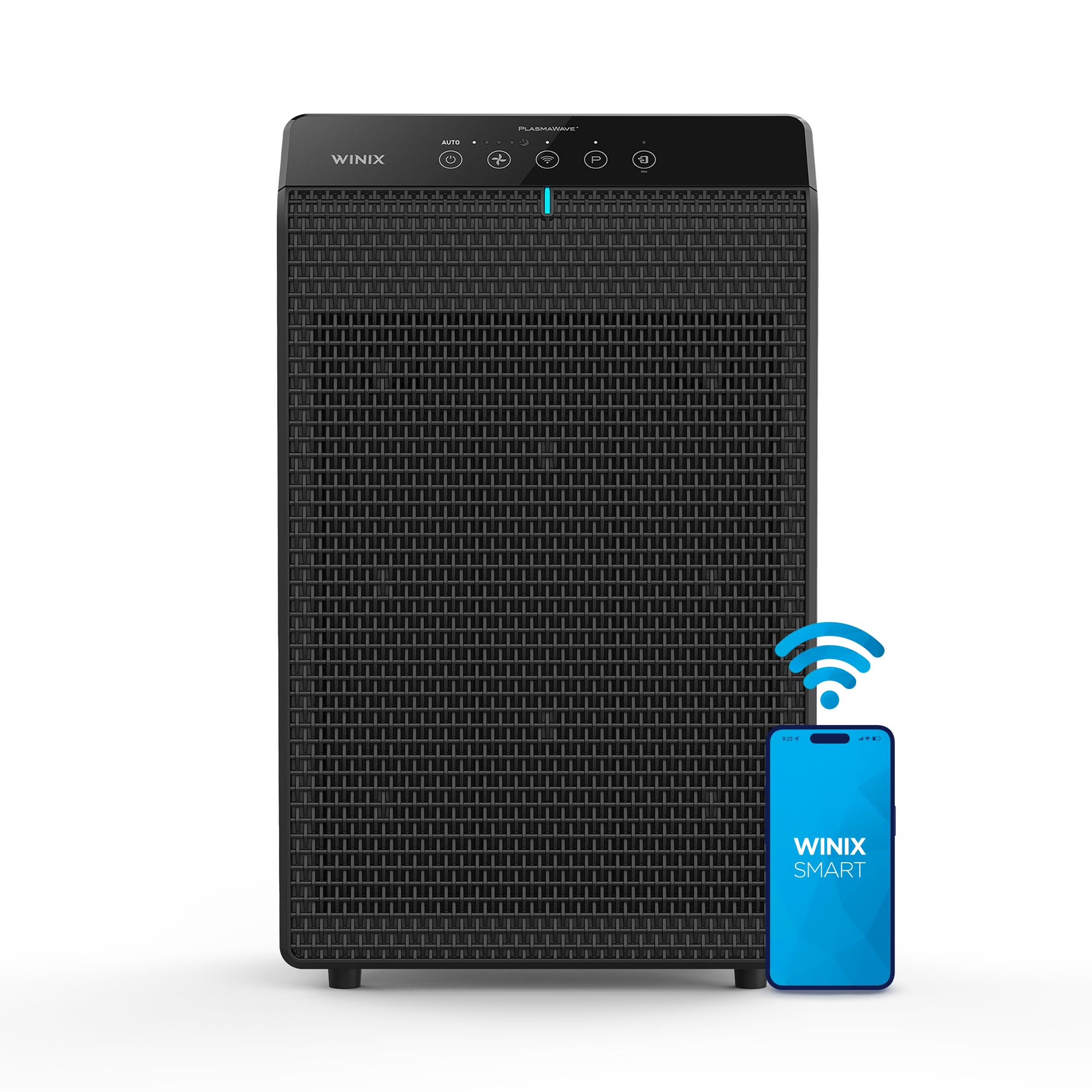
1. WINIX 5520 Air Purifier
Our pick — over 4.5★ from 32,000+ verified ratings; the strongest balance of quality and price.
Big open rooms get a carbon-and-HEPA combo that measures and reacts on its own.
The reason this one tops the list is scale: it cleans 1,882 sq ft in 1 hour, and it will still handle 941 sq ft in 30 minutes, 627 sq ft in 20 minutes, or 470 sq ft in 15 minutes when you want a fast blast after cooking. That is a lot of turnover for a machine that weighs 13.3 pounds, which makes it one of the easier large-room units to slide into a corner and forget. Its Advanced Odor Control Carbon Filter is the layer that targets VOCs and everyday household smells from cooking, pets, and smoke. That carbon pad also sits ahead of the True HEPA filter, which the maker says helps stretch the HEPA’s life.
What wins people over is raw cleaning muscle. Across tens of thousands of owners, effectiveness is the trait that comes up most, and noise sits right behind it — which tells you this thing cleans hard without making a racket. On its slowest speed it drops to 23.5 dB, a level close to the hum of a fridge. Automatic Sleep Mode does the thinking for you: when the room goes dark the unit quiets down on its own, then returns to Auto Mode when the lights come back. The built-in air quality sensor does the same job in daylight, nudging fan speed up or down as it reads the room. A washable fine mesh pre-filter sits at the front and catches the biggest particles before they ever reach the carbon.
The trade-off is the app. It is there, it works, and it lets you schedule and monitor remotely, but responsiveness is the recurring gripe — treat it as a bonus rather than the main control panel, and you will be perfectly happy with the physical buttons. Durability is also the one place opinion splits, though the pattern leans toward years of constant use rather than months. Buyers report: “5-min setup, sturdy matte black, magnetic front panel, 3 filters.” That magnetic panel is a genuinely nice touch when you are swapping the carbon every few months.
The case for it
- Cleans 1,882 sq ft in 1 hour, so it keeps up in genuinely large rooms
- 23.5 dB on low, with a Sleep Mode that kicks in automatically when the room darkens
- Odor Control Carbon Filter built specifically for VOCs, cooking smells, and pet odors
- Washable mesh pre-filter catches big particles and helps the HEPA last longer
Where it stumbles
- The app lags behind the on-unit controls
- At 13.3 pounds it is far heavier than the compact Clorox option
- Aftermarket carbon pads that are overfilled can restrict airflow
Buy it if: you have a big primary room — a living area, an open kitchen — and you want the air handled without touching a dial.
Be aware: the app is the weak link, so plan on using the buttons and remote for daily control.
2. Clorox Medium Room Turbo Air Purifier
A 5.2-pound box you can carry one-handed between the bedroom and the kitchen.
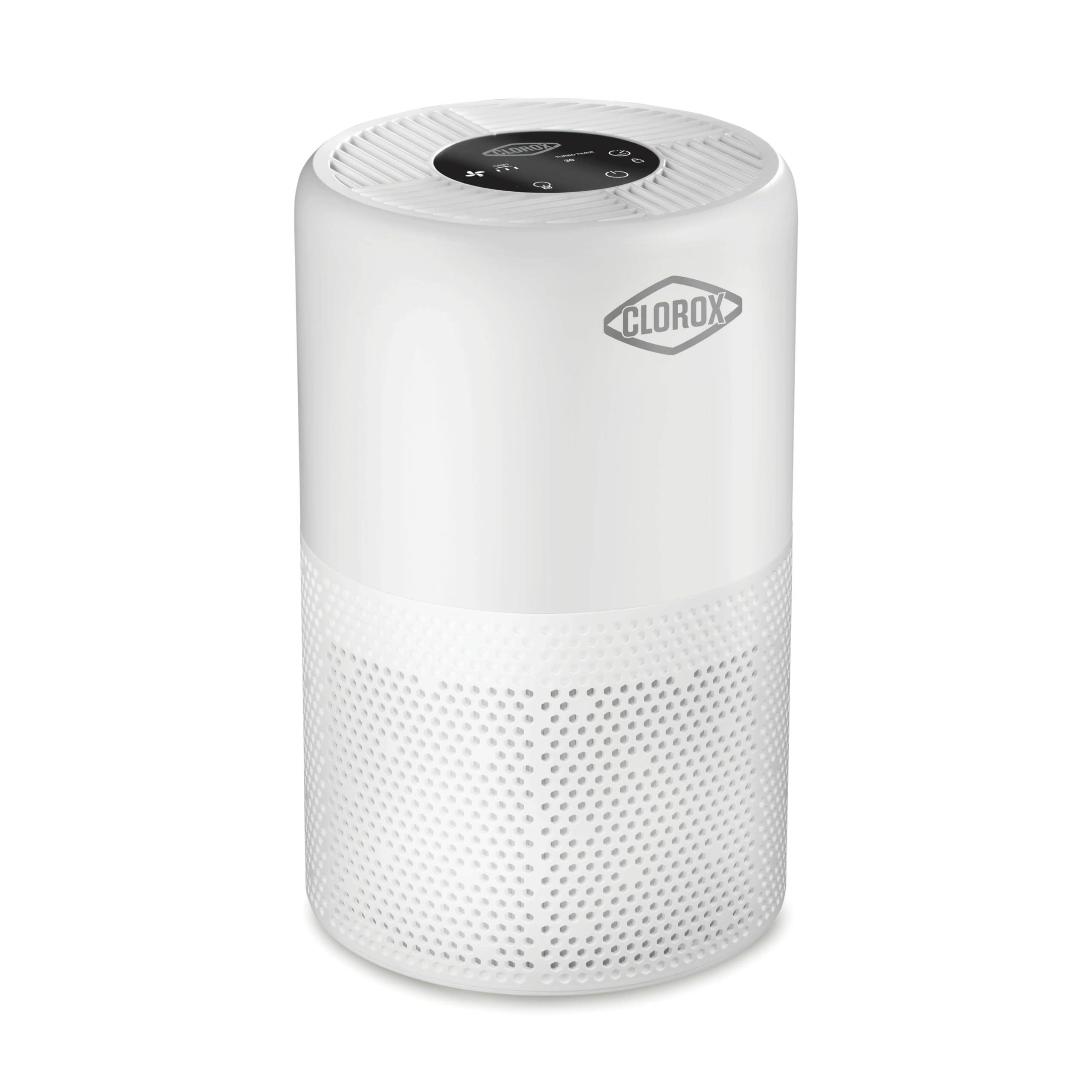
Portability is where this one lives. At 5.2 pounds it is the lightest purifier on this list, and it is nowhere near the 13.3 pounds of the WINIX above — a difference you feel every time you move it room to room. The 360° design pulls air in from every direction, which means you can tuck it in a corner and it still works. Its three-stage setup runs a pre-filter for large particles, a True HEPA layer that captures 99.97% of allergens and particulates, and an active carbon filter that reduces VOCs and odors. For a small unit, that carbon stage is doing real work rather than acting as decoration.
The Turbo Timer is the feature that earns its spot. Set it for 10, 20, or 30 minutes and it ramps airflow to clear smoke or cooking odors fast, then you dial back down. You get four speeds from low to turbo and a display brightness control with on, dim, and off settings. In a 215 sq ft room it cycles the air up to 5 times per hour; in a space up to 1,000 sq ft it manages once an hour. That rating is generous in practice — a 1,000 sq ft apartment great room with a kitchen is a stretch for one unit, and the honest move for a space that big is two.
Quiet operation is the theme through the owner reports; Stage I is near silent and even the higher speeds stay relatively calm, though Turbo is audible if you are sitting right next to it. Two easy-to-spot nits: there is no built-in air quality sensor, so nothing auto-adjusts for you, and the fan speed indicator light is small and dim enough that reading it is fiddly. Filter changes are straightforward — the top-mounted controls are clearly marked and the filter itself swaps easily. The maker suggests checking the filter area monthly and replacing every 6 to 12 months.
Fit check: this is a one-or-two-room machine, not a whole-floor machine. It shines in bedrooms, kitchens, and small family rooms, and pairs well with a 3D printer or a home office setup where you want continuous light-duty cleaning.
Worth knowing: the Turbo mode is the loudest setting, so run it while you are cooking and switch to low before you go to bed.
Reach for this if you need real carbon filtration in a tiny room and want to move the unit around by hand.
Look elsewhere if you want the purifier to sense the air and adjust itself — this one needs you to pick the speed.
3. COWAY Airmega 100
A bedroom unit with a deodorization layer and a glow you can actually sleep next to.
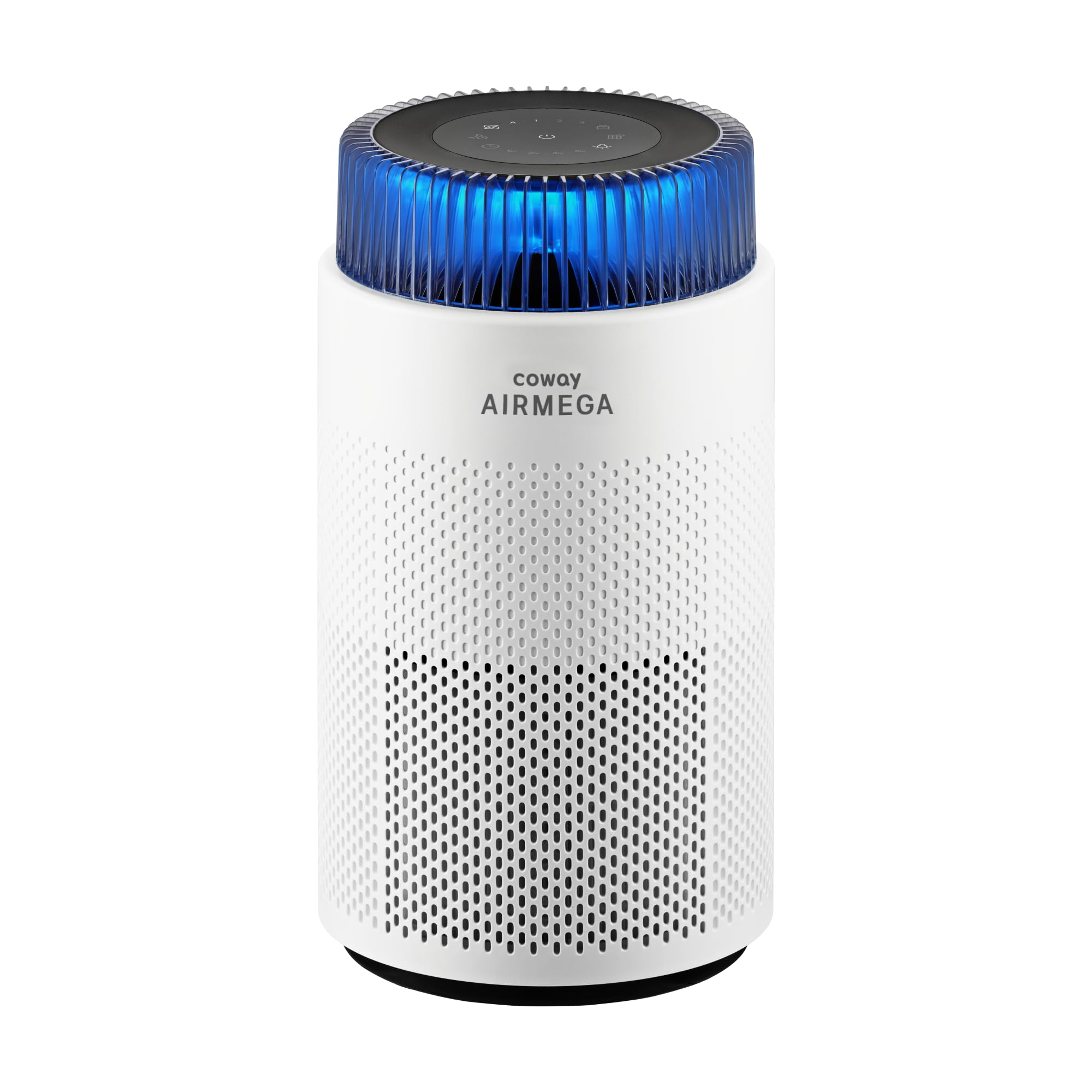
What sets the Airmega 100 apart is a build that fits a nightstand: at 8.66 x 8.66 x 15.55 inches it is noticeably more compact than the WINIX, whose bulkier 8.3 x 13.6 x 22.7 inch body takes up real floor space. Coverage runs to 405 sq ft in 30 minutes or 810 sq ft in 60 minutes, so a standard bedroom gets turned over several times if you push the fan. The filter stack is a pre-filter, a deodorization filter, and a HEPA layer that reduces 99.97% of 0.3 micron particles — and, just as importantly for this list, the system also reduces volatile organic compounds and odor.
Quality is the trait owners come back to most here, and the soft ambient light runs a close second — a glow dim enough to leave on all night without keeping anyone awake. That light ties into Sleep Mode, which switches the AQI display and touch-button lighting off and drops the fan to its lowest speed. A built-in monitor drives Auto Mode, adjusting fan speed in real time as the air changes. If you would rather be in charge, a three-stage manual control gives you low, medium, and high. The light toggle is a running favorite in the reviews, which makes a small omission sting: there is no mute button, and the button beeps are loud enough to set off a noise-sensitive dog. A quieter model in the range does have that mute.
Noise is the one genuinely divided topic. On low it is very quiet — quiet enough that owners say they cannot tell whether it is on at all, and one long-running joke in the reviews is that a spouse’s snoring stopped after this arrived. Higher settings draw more complaints, so treat this as a low-speed bedside machine rather than a fan you run wide open. Air quality improvement, value, and odor control all draw mixed reactions, which tracks with that pattern. The filter light came on for some owners around the 5-month mark, so budget for replacements sooner than the marketing suggests. It carries a 2-year warranty.
Standout detail: the ambient light plus Sleep Mode combination is what makes this a bedroom pick specifically — most purifiers have a light you end up taping over.
The honest catch: the beeps are not defeatable on this model, so a light sleeper or a nervous pet may notice every button press.
The right call for: a bedroom or small office where you want odor reduction and a soft night light in one unit.
Thinking twice makes sense if: you plan to run it at high speed for long stretches or you need silent buttons.
4. PuroAir 400
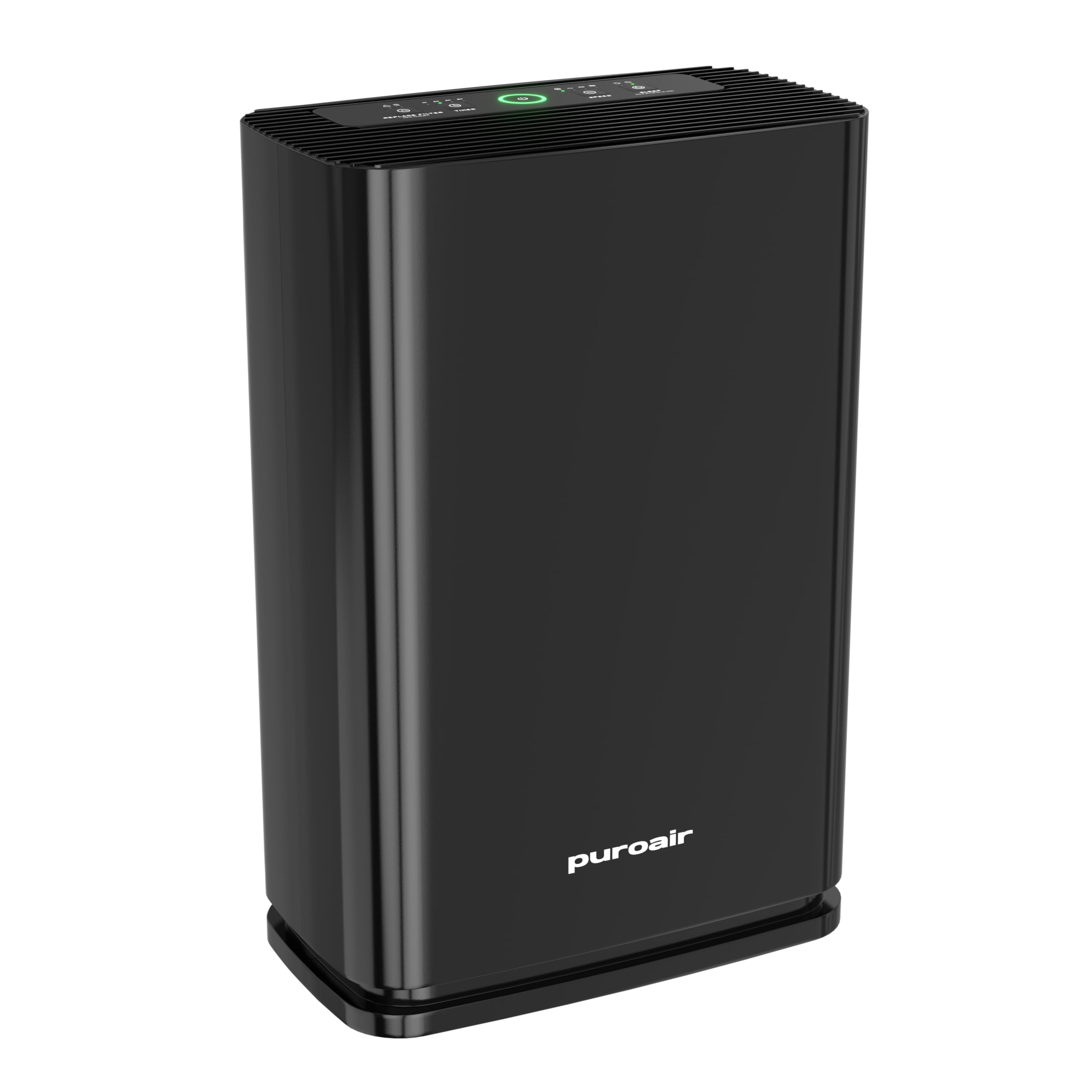
A big-room workhorse that goes to work on musty basements and stale closed-up rooms.
Start with the number that matters: 2,000 sq ft cleaned in one hour. That puts it well past the 810 sq ft of the Airmega above and right alongside the delivery of the WINIX. The three-layer stack is a pre-filter, a HEPA filter, and activated carbon, and the maker states it filters up to 99.9% of pollutants including dust, pollen, smoke, pet dander, and VOCs. That carbon layer is why it works on smells rather than just particles.
Performance is the headline in owner feedback, with quiet operation close behind. A smart particle sensor monitors the air and ramps power up when it detects pollution, then eases back — so the unit handles the bad-air moments without you watching it. Bought-in-quantity behavior is striking here: plenty of buyers order two, three, or four at once and distribute them through the house, one in the living room, one per office, one in the bedroom. The recurring real-world scene is a damp or musty space — basements, older homes with a lingering moldy smell, rooms shut up through heat and humidity — where the stale odor noticeably fades. Sleep quality and morning congestion come up often too.
The carbon stage refreshes with genuinely affordable replacement filters, which is the detail that makes running this machine long-term practical rather than painful. Setup is simple enough that the instructions barely get read: insert the filter, turn it on. Value is the one polarizing topic — some owners feel it earns its keep easily, others feel the outlay is steep for what it is. That split is normal for a large-room unit at this level of output.
Built for: open living areas, basements, and any room where you want the machine to detect a problem and fix it on its own.
Fair warning: the price draws a genuine split of opinion, so weigh it against how much of the house one unit can reach from where you plan to park it.
Pick this one: for a large main living space if you would rather buy one capable unit than scatter small ones.
Consider a smaller pick: if your target room is a single bedroom — you would be paying for coverage you never use.
5. AirDoctor AD2000
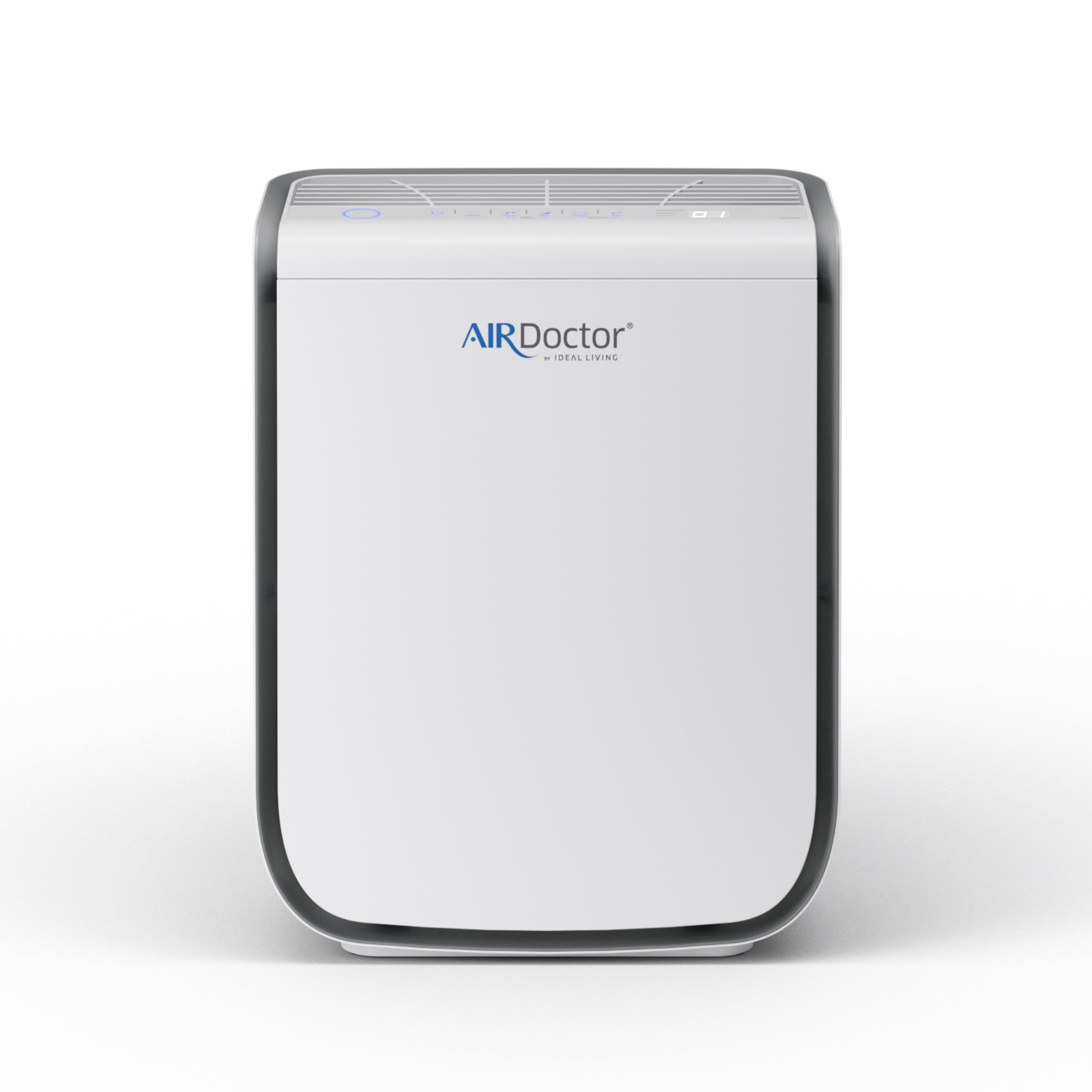
A compact bedroom unit whose carbon filter leans on potassium permanganate for stubborn gases.
The pieces you are paying for here are the carbon and the speed. Coverage runs to 305 sq ft in 15 minutes and up to 1,220 sq ft in an hour — that 15-minute figure is what separates it from the once-an-hour ratings most units quote, because it means a bedroom gets fully cycled in a single short blast. The three stages are a Pre-Filter, a Premium Activated Carbon filter, and an UltraHEPA filter. That carbon is built to reduce toxic gases, odors, pet smells, cooking fumes, gas emissions, wildfire smoke, and VOCs, using activated carbon plus potassium permanganate — a compound that breaks down gases rather than just trapping them.
Auto Mode leans on the AirDoctor Halo, a PM2.5 sensor that reads the air continuously and displays color-coded quality levels, adjusting fan speed and firing up Boost when things get bad. You also get a timer, a filter indicator, and four fan speeds. Owners describe it running around the clock in an apartment with the sensor doing the adjustments, which is exactly what the auto system is for. Effectiveness is the most-praised trait, with air quality right behind, and a sensitive nose is a recurring theme — people with allergy-prone family members notice the difference fast.
Two things to plan around. The carbon stage should be replaced every 6 months and the UltraHEPA every 12 months, so upkeep is part of the deal. Value for money draws the most criticism, which is fair to know going in. There is also a real inconsistency in the reviews around the sensor: one owner had a unit that stayed on a blue reading through visible smoke and had to swap it out, and the replacement worked as expected. That reads as a rare bad unit rather than the norm, but it is worth a quick smoke test in your first week. The indicator lights themselves draw mixed feelings. FSA and HSA eligibility is a plus if you have either account.
What earns the money
- Cleans 305 sq ft in 15 minutes, fast enough for a quick pre-bed cycle
- Carbon layer includes potassium permanganate to break down gases, not just absorb them
- Halo PM2.5 sensor shows color-coded quality and drives Auto Mode for you
- FSA and HSA eligible, so pre-tax dollars can go toward it
Plan around this
- Carbon replaced every 6 months and UltraHEPA every 12, so running cost adds up
- Value for money is the most criticized point in owner feedback
- Occasional units have shipped with a sensor that reads incorrectly
Best matched to: a bedroom, nursery, or home office where the unit runs day and night and reacts on its own.
Skip the upgrade to this if: you only want light-duty cleaning a few hours a day — the filter schedule is more upkeep than a casual user needs.
6. Austin Air it Room Air Purifier with VOC Carbon Wrap

A small steel-bodied unit with a carbon layer built around chemicals and gases.
The VOC Carbon Wrap is the whole point of this model — it is designed to filter out chemicals, gases, and VOCs rather than just particles, which is what makes it feel purpose-built for urban apartments and hotel rooms that smell of cleaner or fresh paint. The filtration also captures airborne particles as small as 0.3 microns, including dust, pollen, pet dander, bacteria, viruses, and allergens. Physically it is a compact 8.38 inches tall and 12 pounds, small enough to sit on a nightstand.
The travel angle is unusual and genuinely useful. Owners who already run the larger Austin Air units at home bought this smaller one specifically to pack for trips, and for anyone dealing with asthma and bad allergies, hotel stays become far less of a gamble. The dander and dust handling comes up repeatedly, and one detail that keeps resurfacing is the filter lifespan — owners describe running the same filter for years on this small unit, with one reporting a 5-year filter life. That is a radically different running-cost model from everything else on this list. Build quality is the other signature: it is made of durable steel, and the common description is a unit that looks like it will keep going for many years.
Noise is the honest fault line. At its quietest this unit draws no complaints at all, but on the top setting it is loud — the recurring description is that it sounds like wind, and a couple of owners flatly said they would not stay in the room while it runs. One owner loved the build and the effectiveness but sent it back because it was simply not quiet enough for sleeping beside. If your bedroom is the target, treat that as the deciding factor. If you plan to run it during the day or on the road, it is a non-issue. This one is on the premium end.
Why the price holds up: the long filter interval and steel construction push running costs down compared with units that need carbon swapped every few months.
Who it is not for: a light sleeper who wants the purifier running at the bedside all night — the high setting is genuinely loud.
The pick for: frequent travelers, small bedrooms, and anyone who wants a carbon stage aimed squarely at chemicals and gases.
Not the one if: whisper-quiet top-speed operation is a requirement rather than a preference.
7. BLUEAIR Signature SP4i
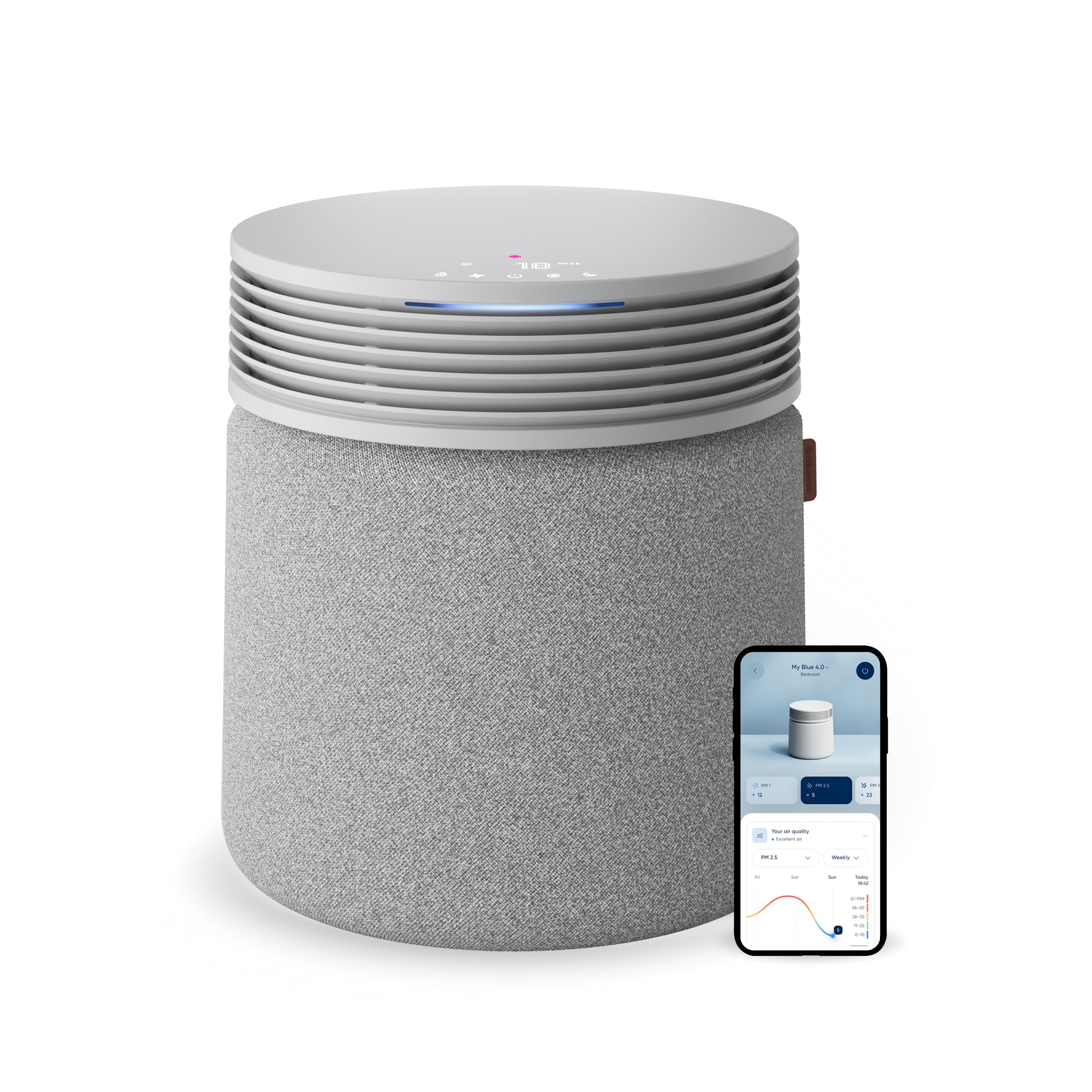
A furniture-grade unit that clears an enormous space and doubles as a side table.
Coverage is the headline: 705 sq ft in 12.5 minutes and 3,385 sq ft every hour. For an open-plan home or a big living area that is a serious amount of air moved, and it explains why this sits in the premium tier. The filtration is a 7-stage HEPASilent system that captures 99.97% of airborne particles down to 0.3 microns. OdorFence Technology is the layer that handles this list’s priority — it breaks down odors, gases, and VOCs, which is why kitchen smells are a recurring theme in owner comments. Chief among the standout details is the noise floor: it runs as low as 23 dB, a level owners describe as quieter than the Dyson TP01 and Blue Air 211 they owned previously.
Smarts are a big part of the value. Auto Mode adjusts purification based on changing indoor air conditions, and the Blueair app lets you control fan speed, schedules, and settings from anywhere — a lock feature on the app even earned a mention for being cat-proof. The air quality indicator is built into the air outlet and shows real-time pollution levels in five colors from blue for excellent to red for poor, plus a subtle animation while the unit is actively cleaning. The design is deliberately furniture-like and can stand in as a side table, and interchangeable pre-filters let you change the look.
The honest split is on noise at the top end and on price. Some owners find it very quiet, others note it can get loud on higher settings — the same pattern as most high-output machines, so set your expectations at the low and mid speeds. Value draws mixed opinions too. There is also a real warning worth taking seriously: one unit arrived clicking and vibrating right from the start, which that buyer traced to shipping damage from a box with no padding. If yours arrives with odd noises, that is a return, not a break-in period. Pollen season is where this machine earns its keep — owners mention noticeably cleaner air within an hour of switching it on, and further reduction in dust over the following week.
Where the money goes: the 3,385 sq ft hourly rating, the 7-stage HEPASilent stack, and the OdorFence carbon layer together make this one of the highest-capacity units here.
The catch: on the highest speeds it draws noise complaints, and one unit showed up damaged in transit — inspect it in the first few days.
Worth it for: large open-plan homes, houses with pets and kids, and anyone who wants app control and a unit that looks like furniture.
Overkill if: your largest room is a bedroom — you would be paying for capacity you never use.
8. AirDoctor AD3500
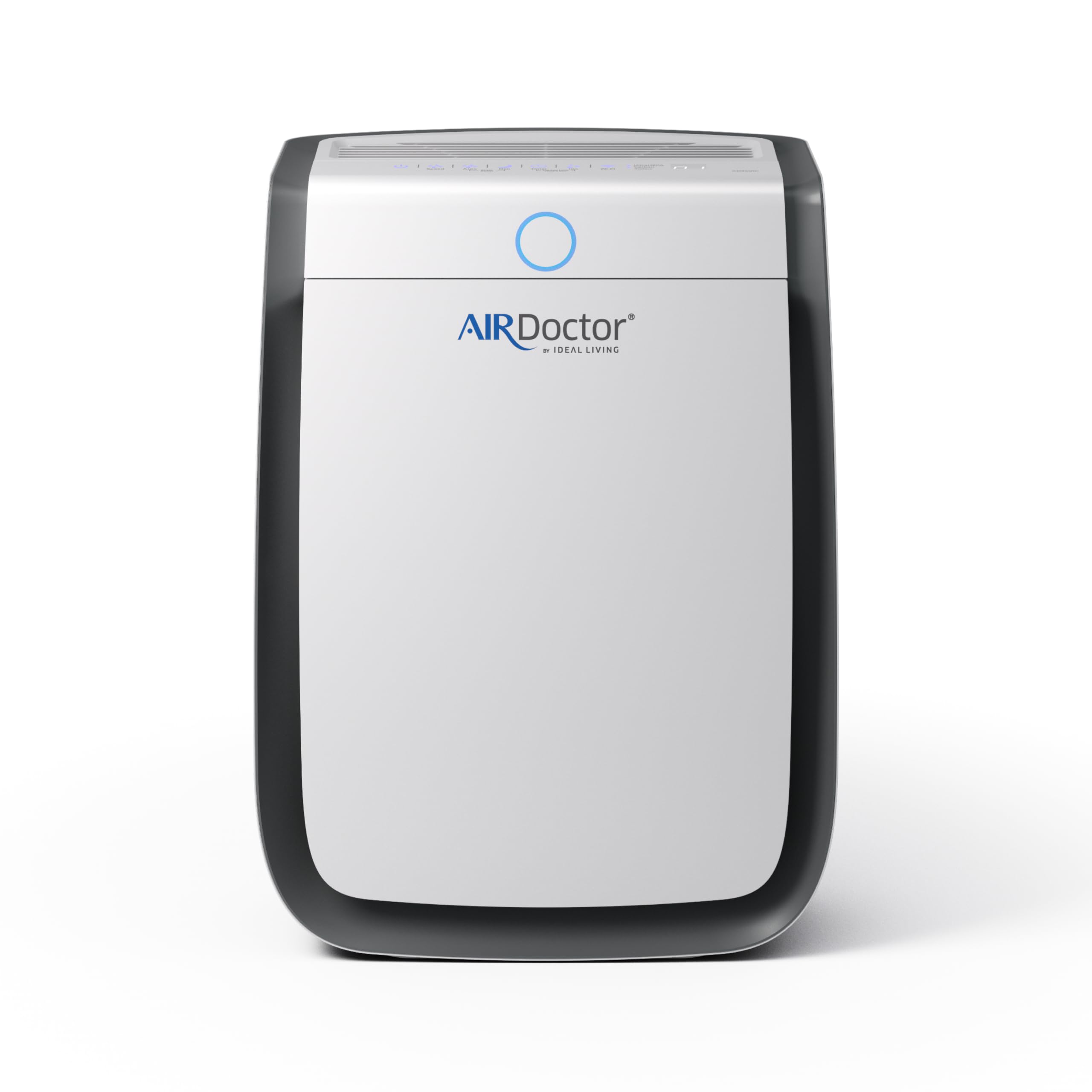
The medium-large room unit that visibly drags dust across the floor on high.
Take the coverage first: 630 sq ft in 15 minutes and up to 2,520 sq ft in an hour. That is a step up from the 1,220 sq ft hourly rating of the AD2000 above, and it is aimed at the rooms a family actually lives in — living rooms, kitchens, main bedrooms. The three-stage stack is a Pre-Filter, a Premium Activated Carbon filter, and an UltraHEPA filter. That carbon layer, made with activated carbon and potassium permanganate, targets toxic gases, odors, pet smells, cooking fumes, gas emissions, wildfire smoke, and VOCs. Runtime is where the smell result shows up, and the pattern in the feedback is striking.
What people describe is a house that stops needing candles. A recurring comment is visitors asking how the home smells so fresh without deodorizers, and another recurring scene is the carbon stage clearing cooking odors — one owner measured roughly 90% odor removal near the stove. Auto Mode plus the AirDoctor Halo, a PM2.5 sensor with color-coded quality levels, does the reacting: it ramps up during cooking, candles, dishwasher cycles, and burnt toast, then settles back down. High mode is visibly strong. Customers note the carbon filter lasting around 6 months, matching the maker’s guidance, while the UltraHEPA is rated for 12-month intervals.
Filtration effectiveness is the most-praised quality and cleaning performance is close behind, which reinforces that this is a working machine rather than a quiet background one. Cost is where the friction lives. Filter replacement prices come up repeatedly, and one owner running the unit continuously dropped it to 4 stars purely over running cost — which is the honest trade of a machine that clears smells this well. Turbo mode is loud, and it is bulky, so plan a spot rather than planning to tuck it away. Upkeep is simple: vacuum the inside, and reset the carbon filter indicator by holding the timer and ion buttons for three seconds.
Strongest point: the combination of a real carbon/VOC layer and an auto sensor that reacts within seconds to cooking, candles, and smoke.
The real cost: replacement filters are the main complaint, and running two of them constantly adds up — budget for the consumables, not just the unit.
Suits: kitchens, family rooms, and medium-to-large living spaces where cooking and pet smells are the daily problem.
Second-guess it if: you want a machine you can quietly forget about in a small bedroom — the bulk and the filter cost are wasted there.
9. AirDoctor AD5500

The biggest unit here, built to cover an open floor plan in one go.
This is the capacity ceiling of the group. At 34 pounds it is also the heaviest, so this is a machine you place once and leave in position. It is designed for open floor plans and whole-home use rather than a single bedroom. The filtration is the same three-stage approach as the AD2000 and AD3500 — Pre-Filter, Premium Activated Carbon, and UltraHEPA — with the carbon layer built to reduce toxic gases, odors, pet smells, cooking fumes, gas emissions, wildfire smoke, and VOCs, and the UltraHEPA capturing 99.99% of airborne particles at 0.003 microns.
Auto Mode runs on the AirDoctor Halo, a PM2.5 sensor that reads air in real time and displays color-coded quality levels, with Boost kicking in when needed. This model gives you six fan speeds rather than four, plus a timer and a filter indicator. Performance is the standout in owner feedback, with air quality right behind and quiet operation showing up repeatedly as well — a rare combination at this size. Owners describe whole-home air quality improving within hours of switching it on, and dust reduction is a common theme. The scent-free freshness angle is where it earns its keep: homes that used to smell closed up simply do not anymore. Like its siblings, it is FSA and HSA eligible.
Having a negative note is part of the honest picture here: value for money is the aspect owners criticize most. That is not about performance — it is about running costs. Carbon is rated for 6-month replacement and the UltraHEPA for 12 months, so on a whole-home machine those consumables add up fast. There is also one outlier review worth flagging: a unit that emitted a fabric-softener-like scent even with the ionizer switched off, which bothered an odor-sensitive household and was returned. Reading it as a one-off rather than a pattern is fair, but it is a reason to test-run this in the first week if you are chemically sensitive. Given that whole-home coverage claim, verify it against your actual square footage before committing.
What you are buying: enough capacity to cover an entire open floor plan from one position, with six fan speeds and full auto sensing.
Where the money really goes: the filter schedule — carbon every 6 months and UltraHEPA every 12 — which is what owners flag most.
Made for: large open-plan homes and anyone who wants one machine covering the whole space.
Not worth it if: you need cleaning in one or two rooms — a smaller unit will do the same job for far less upkeep.
Understanding the Specs
Activated carbon and VOC removal
Activated carbon is a porous material that traps gas molecules — the chemical fumes, cooking odors, and pet smells that a HEPA filter cannot catch. Some premium units add potassium permanganate to the carbon, a compound that chemically breaks down certain gases rather than simply holding them. The carbon stage saturates over time and is the filter you replace most often, which is why it sets your long-term running cost. A unit that reduces VOCs and odors with a genuine carbon layer is the requirement for this category; a thin carbon pad that only deodorizes will not keep up with a working kitchen.
HEPA and UltraHEPA filtration
A HEPA filter is a dense mat of fibers that traps solid particles — dust, pollen, smoke particles, and pet dander — by physically catching them as air passes through. Standard HEPA captures a high percentage of particles down to 0.3 microns. Some machines use UltraHEPA, which is designed to capture particles at 0.003 microns, a smaller size than the HEPA standard target. HEPA does not remove gases or odors; it works alongside the carbon stage, not instead of it. The two filters together do the job — carbon for gases, HEPA for particles.
Coverage ratings and air changes
Coverage is quoted as the largest room a unit can clean once in an hour, which is the weakest realistic standard. A machine rated for a big room in one hour cleans that room faster at high speed, and a smaller room much faster still. Coverage figures also assume normal ceiling height and a closed room, so an open floor plan is harder to clean than the raw square footage suggests. For kitchens and wildfire season, look for a unit that can turn your room over several times an hour, or plan on running two smaller units instead of one large one.
Decibels, auto sensors, and filter life
Decibels measure sound on a scale where each 10 dB step is roughly a doubling of perceived loudness, so a 23 dB reading is dramatically quieter than a 40 dB one. Auto sensors monitor air quality and adjust fan speed for you; a PM2.5 sensor reads the smallest breathable particles while an AQI indicator shows color-coded quality. Two maintenance facts drive long-term cost: genuine replacement filters keep the seal tight and airflow correct, and an overfilled third-party carbon pad can restrict airflow and slow the whole unit down. Follow the manufacturer’s replacement interval for your usage level.
FAQ
What actually removes VOCs and odors from the air?
How often should I replace the carbon filter in an air purifier?
Will a purifier rated for a large room work in a smaller one?
Can I use a third-party carbon filter instead of a genuine replacement?
Is an air purifier with a carbon filter worth it if I only have mild odors?
How loud is an air purifier at 23 decibels?
Do air purifiers with carbon filters help with wildfire smoke?
Should the purifier run all day or only when I notice a smell?
How do I set up a purifier for a bedroom and kitchen at the same time?
What is the difference between HEPA and UltraHEPA filtration?
Final Thoughts: The Verdict
For most homes, the air purification systems for removing vocs and odors winner is the WINIX 5520, because it pairs an Odor Control Carbon Filter built for VOCs and cooking smells with enough capacity to clean 1,882 sq ft in an hour, all while sitting at 23.5 dB on its slowest speed. If your priority is a compact unit you can carry between rooms, the Clorox Medium Room Turbo brings a Turbo Timer and a True HEPA plus carbon stack in a 5.2-pound body. And for whole-home coverage where cooking fumes and pet odors are constant, the AirDoctor AD5500 handles up to 4,172 sq ft in an hour with its three-stage carbon and UltraHEPA filtration. Whichever you choose, remember that the carbon filter is the part doing the odor work — keep it fresh, and the machine keeps earning its place in your home.
How We Picked
We do not accept paid placement. Every pick is matched to a real buyer and a real use-case; we do not hands-on test units.
Sources & Methodology
Specifications: manufacturer listings and product documentation. Review insights: verified customer reviews, as of September 2026. Pricing: not shown on this page (it changes often); check the current price via the retailer link.
As an Amazon Associate, Gadgets Feed earns from qualifying purchases. This does not affect which products we feature.