
Choosing your first interchangeable-lens camera is the single most consequential gear decision an aspiring photographer makes, and the wrong pick can stall your progress before you learn what an aperture ring does. The entry-level market is flooded with bodies that promise professional results but deliver smartphone-level frustration, forcing you to fight slow autofocus, tiny viewfinders, and menus designed by algorithm instead of logic.
I’m Min — the co-founder and writer behind Gadgets Feed. I have spent countless hours analyzing the sensor performance, autofocus speed, and real-world usability metrics that separate a rewarding learning tool from an expensive paperweight on this specific product shelf.
After combing through the latest specifications and user experiences across mirrorless and DSLR formats, this guide ranks only the models that genuinely accelerate your learning curve and deliver tangible image-quality gains, making it the definitive camera for amateur photographers who refuse to settle for mediocre first results.
How To Choose The Best Camera For Amateur Photographers
Every new photographer faces a fork in the road: DSLR versus mirrorless, APS-C versus full-frame, kit lens versus body-only. The right choice depends on how you intend to shoot — casual portraits, travel snapshots, or fast-moving kids and pets. Prioritize three pillars: autofocus reliability, lens ecosystem affordability, and the physical size you will actually carry every day.
Sensor Format and Megapixel Reality
A larger sensor gathers more light, giving you cleaner images in dim conditions and better background blur. Full-frame sensors are the gold standard but cost more and demand bigger lenses. APS-C sensors strike the best balance for most amateurs, offering excellent image quality in a lighter package. Do not chase megapixels: any 20–26 MP APS-C sensor will produce sharp prints up to A2 size. Prioritize dynamic range and noise performance over pixel count.
Autofocus System Performance
Phase-detection autofocus points covering most of the frame, combined with subject recognition (eyes, faces, animals, vehicles), is non-negotiable for capturing spontaneous moments. A system with 425 phase-detect points will track a running child across the frame; a 9-point system will lose focus the instant the subject moves off-center. Look for real-time eye AF and compatibility with your preferred lens line.
Lens Ecosystem and Upgrade Path
The body is a temporary home for your sensor, but lenses are a lifelong investment. Canon’s RF-S, Sony’s E-mount, Fujifilm’s X-mount, and Nikon’s Z-mount each have distinct price points and third-party support. Choose a mount with affordable prime lenses (like a 35mm f/1.8 or 50mm f/1.8) that let you experiment with depth of field without spending a fortune. Avoid dead-end systems with limited future glass options.
Quick Comparison
On smaller screens, swipe sideways to see the full table.
| Model | Category | Best For | Key Spec | Amazon |
|---|---|---|---|---|
| Sony Alpha 6700 | Mirrorless | Best Overall – Hybrid King | 26 MP | 759 AF Points | Amazon |
| Sony Alpha a7 III | Mirrorless | Best Value Full-Frame | 24.2 MP Full-Frame | Amazon |
| FUJIFILM X-T30 III | Mirrorless | Best Film Simulation Experience | 425 AF Points | Amazon |
| Nikon Z50 II | Mirrorless | Best Dual-Lens Kit | 20.9 MP | 231 AF Points | Amazon |
| Fujifilm X100VI | Compact | Best Everyday Walkaround | 40.2 MP | Fixed 23mm | Amazon |
| OM SYSTEM OM-5 Mark II | Mirrorless | Best Weather-Sealed Travel | 20 MP | 6.5 Stops IBIS | Amazon |
| Nikon Z 7II | Mirrorless | Best High-Resolution | 45.7 MP Full-Frame | Amazon |
| Sony Alpha A6100 | Mirrorless | Best Budget Autofocus | 425 AF Points | Amazon |
| Canon EOS Rebel T7 Bundle | DSLR | Best Budget DSLR Bundle | 24.1 MP | 9 AF Points | Amazon |
| Panasonic LUMIX G85 | Mirrorless | Best IBIS on a Budget | 16 MP | 5-Axis IBIS | Amazon |
| Canon EOS R100 | Mirrorless | Best Entry-Level Mirrorless | 24.1 MP | 143 AF Points | Amazon |
In‑Depth Reviews
1. Sony Alpha 6700

The Sony Alpha 6700 represents the peak of APS-C engineering with its 26 MP back-illuminated sensor and dedicated AI processor that handles subject recognition with near-psychic accuracy. Its 759 phase-detection points cover the entire frame, making it the most forgiving camera for an amateur learning fast-moving subjects like kids or pets — the camera rarely loses the eye. The 4K 60p oversampled from 6K and 4K 120p high-frame-rate modes also future-proof your video work without demanding a body.
The body feels dense and premium despite its compact dimensions, with a deep grip that suits larger hands better than the A6xxx series. Battery life is class-leading thanks to the NP-FZ100 pack, rated for over 550 shots per charge. The BIONZ XR processor delivers snappy menu responses and near-instant wake-up from sleep, so you never miss a candid moment while the camera boots.
Be aware that the menu system is labyrinthine — Sony’s infamous nested tabs take patience to customize. The stabilization is good but not great for walking video without a gimbal, and the high ISO performance, while improved, still trails full-frame competitors in extreme low light. For a capable hybrid shooter ready to grow into premium lenses, this body is the current benchmark.
Why it’s great
- AI-based real-time tracking locks onto subjects in any lighting
- 26 MP sensor delivers high dynamic range and low noise for an APS-C
- Compact body with professional-grade battery life and dual card slots
Good to know
- Sony menu system is complex and requires upfront customization
- In-body stabilization not strong enough for smooth handheld walking video
- Higher price point compared to entry-level APS-C mirrorless options
2. Nikon Z50 II

The Nikon Z50 II is a brilliantly conceived first mirrorless camera thanks to its two-lens kit methodology — the 16-50mm VR standard zoom paired with the 50-250mm VR telephoto zoom covers 24-375mm equivalent. That instant telephoto reach is what amateur nature and sports shooters need to frame birds, distant mountains, and field action without buying a second lens immediately. The 20.9 MP DX sensor is multiple times larger than any phone, delivering lifelike color separation even at dusk.
The Picture Control button and 31 built-in presets remove the intimidation of manual editing — you tweak the aesthetic in real-time on the high-res electronic viewfinder and share via SnapBridge in seconds. The autofocus tracks nine distinct subjects including birds and airplanes, and the dedicated Night Portrait mode produces natural-looking flash shots indoors. The body is compact enough for a small daypack with both lenses.
The flip-out LCD screen, while nice for vlogging, consumes battery faster than usual, and the kit includes only one battery — a spare is strongly advised. The kit lenses are optically decent at moderate apertures but lack the sharpness of premium Z glass, a trade-off typical for all-in-one bundles. For the amateur wanting maximum reach with minimal up-front complexity, this package is a standout.
Why it’s great
- Two-lens kit covers wide to telephoto without extra purchases
- 31 Picture Control presets allow instant creative styles
- Subject-recognition AF tracks birds, airplanes, people, and pets
Good to know
- Battery life suffers with heavy screen usage; carry a spare
- Kit lens optical quality is decent but not premium-level sharp
- No in-body stabilization; relies on lens VR for shake reduction
3. Sony a7 III

The 15-stop dynamic range means you can underexpose highlights by several stops and rescue them in post without ugly noise — a safety net every learning photographer needs when the exposure dial spins the wrong way.
The NP-FZ100 battery lasts around 710 shots per charge, which is roughly double what older mirrorless bodies managed, and the in-body stabilization works for both stills and video. The ergonomics are top-tier for a Sony body: the deep grip and logical button layout feel natural during all-day shoots. The 28-70mm kit lens is a competent starter, but the real story is that you can mount inexpensive third-party primes like the Sony 50mm f/1.8 and immediately achieve dreamy bokeh that no kit zoom can touch.
The menu system is Sony’s classic deep rabbit hole, and 4K video requires a fast UHS-II SD card that is not included. The weather sealing is moderate — this is not a camera for monsoon hikes. Still, as a single purchase that delivers professional-grade results for several years, the a7 III represents the best dollar-to-image-quality ratio in the full-frame space.
Why it’s great
- Full-frame 24.2 MP sensor with 15-stop dynamic range for shadow recovery
- 693-point phase-detection AF is fast enough for sports and wildlife
- Outstanding battery life — rated at 710 shots per charge
Good to know
- Sony menus are notoriously complex; requires setup time
- 4K video demands a fast UHS-II card sold separately
- Weather sealing is adequate but not robust for heavy rain
4. FUJIFILM X-T30 III
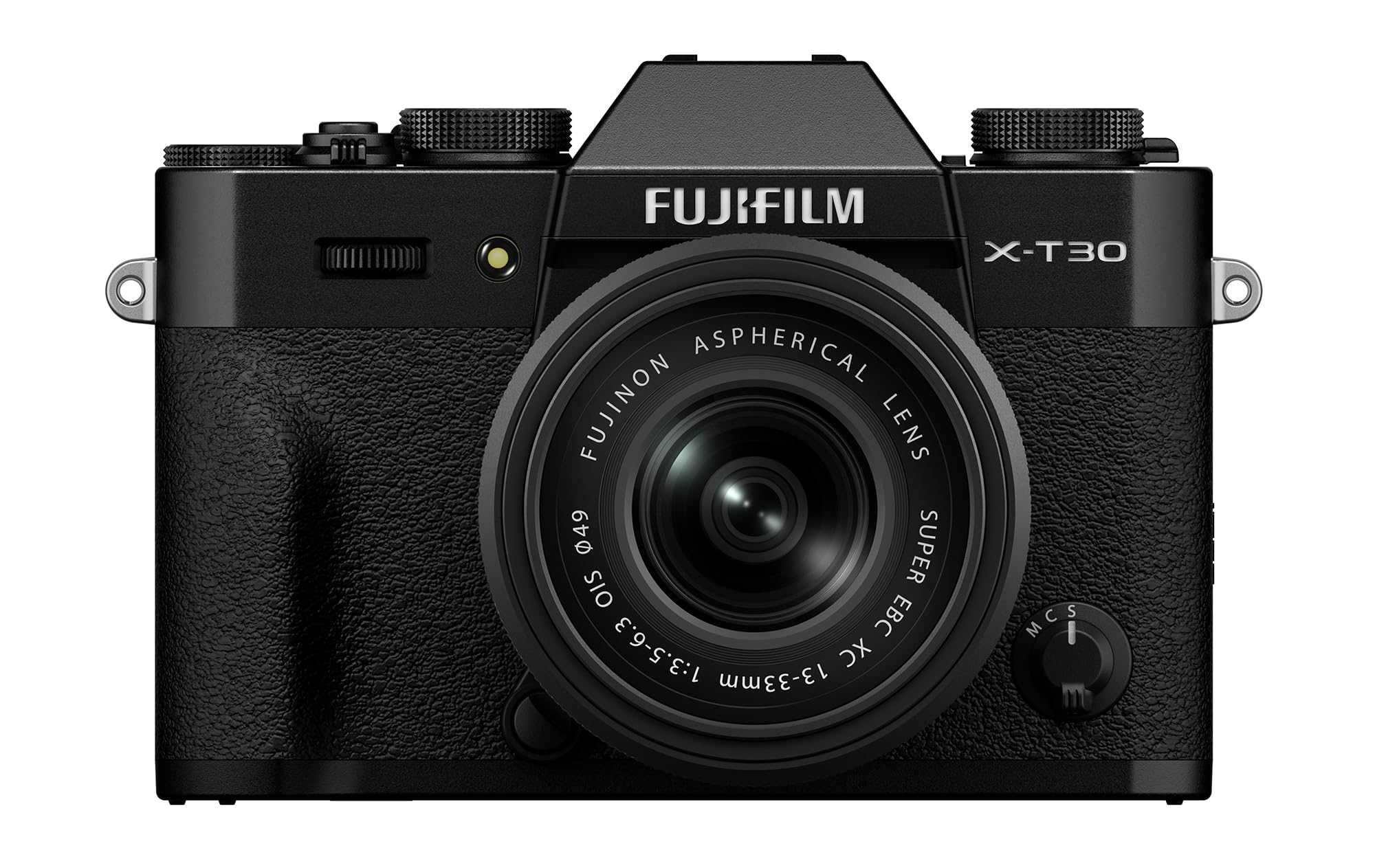
The FUJIFILM X-T30 III brings the company’s celebrated Film Simulation magic to a smaller wallet — 20 built-in recipes including Provia, Velvia, Astia, and the newest REALA ACE mean you can achieve stunning, printable results straight out of camera without downloading a single editing app. Combined with the X-Trans CMOS 4 sensor and X-Processor 4, this camera delivers color science that professional fashion and portrait shooters pay thousands for in a body weighing under 380 grams.
The 425-point phase-detect autofocus with AI-powered subject detection (people, animals, birds, cars, motorcycles, and planes) is snappy and reliable even in modest indoor light. The XC13-33mm f/3.5-6.3 OIS kit lens provides a versatile wide-to-normal equivalent range, and the camera body features a pop-up flash for fill light in tricky contrast scenes. The tactile control layout with dedicated shutter speed and ISO dials teaches the exposure triangle intuitively, making the learning process physical rather than submerged in menus.
No in-body stabilization is included, which means low-light handheld shots will show shake with non-OIS lenses, and no battery charger ships in the box — you charge inside the camera via USB-C. The kit lens is slow at the telephoto end, making indoor action tough without a faster prime. For the amateur who prioritizes gorgeous colors and a rewarding hands-on shooting experience, the X-T30 III is unmatched at its price tier.
Why it’s great
- 20 Film Simulation recipes deliver professional color without editing
- Analog-style dials visualize shutter and ISO for fast learning
- Compact and featherweight at 378g — ideal for travel
Good to know
- No in-body stabilization; relies on lens OIS
- No battery charger included — USB-C only
- Kit lens aperture is slow, challenging indoor action shots
5. Nikon Z 7II

The Nikon Z 7II is the ultimate resolution monster for the amateur who wants to crop deeply and print large — 45.7 megapixels on a full-frame sensor means you can shoot a landscape with a wide lens and extract a sharp 8×10 from a 50% crop. The 493 phase-detection points perform reliably in continuous AF, and the dual card slots (CFexpress/XQD plus UHS-II SD) give you fail-safe backup on every shoot, a feature rarely seen at this price ceiling.
The built-in intervalometer with exposure smoothing creates flicker-free day-to-night time-lapses right in the camera, and the 2-axis tilt touchscreen plus a large electronic viewfinder make composition easy in any orientation. The IBIS provides around 5 stops of shake correction, and compatibility with over 360 F-mount Nikkors via the FTZ adapter means you can leverage decades of used glass. The 24-50mm kit zoom is compact, though its variable aperture is not ideal for low light.
Battery life is just average for a mirrorless — expect around 380 shots per charge, so spares are mandatory on a full day outing. The 45.7 MP files are unforgiving of camera shake and demand fast, expensive memory cards; budget for that when considering the cost of entry. For the detail-obsessed amateur who scrutinizes every pixel, the Z 7II delivers breathtaking resolution at a price that undercuts Sony’s a7R equivalents.
Why it’s great
- 45.7 MP sensor enables massive cropping without losing detail
- Dual card slots (CFexpress + SD) for work-from-shoot redundancy
- Built-in time-lapse with exposure smoothing produces polished results
Good to know
- Very large RAW files require fast, expensive memory cards
- Battery life is average; carry at least one extra battery
- Kit lens is adequate but does not leverage the sensor’s full resolution
6. FUJIFILM X100VI

The FUJIFILM X100VI is a cult classic reimagined with a 40.2 MP X-Trans CMOS 5 HR sensor and, for the first time, up to 6.0 stops of in-body image stabilization — the feature that previous X100 shooters begged for. The fixed 23mm f/2 lens (35mm equivalent) forces you to learn composition through your feet rather than a zoom ring, a discipline that accelerates photography skills faster than any kit zoom. The built-in 4-stop neutral density filter lets you shoot wide open in bright sunlight for cinematic motion blur.
The 20 Film Simulation modes, including the new REALA ACE profile, produce images with such pleasing color and contrast that you will likely stop editing entirely. The hybrid viewfinder switches between optical and electronic, giving you an uncluttered optical window when you want to frame without simulation and a data-rich EVF when you need exposure preview. The body is smaller than most mirrorless ILCs, fitting into a jacket pocket.
The price is high for a camera with a non-interchangeable lens, and digital teleconverter crop modes (1.4x and 2x) are software-based, reducing resolution to around 20 MP effective at 2x. Battery life is adequate but not stellar — around 350 shots. For the amateur who values image quality, portability, and a distraction-free shooting experience over zoom flexibility, the X100VI is a lifelong companion.
Why it’s great
- 40.2 MP sensor with 6-stop IBIS — first X100 with stabilization
- 20 Film Simulations produce finished images straight from camera
- Hybrid OVF/EVF and compact body encourage creative shooting
Good to know
- Fixed 23mm lens means no zoom — framing is all physical movement
- High price for a non-interchangeable lens camera
- Digital teleconverter crops the sensor rather than optically extending
7. OM SYSTEM OM-5 Mark II
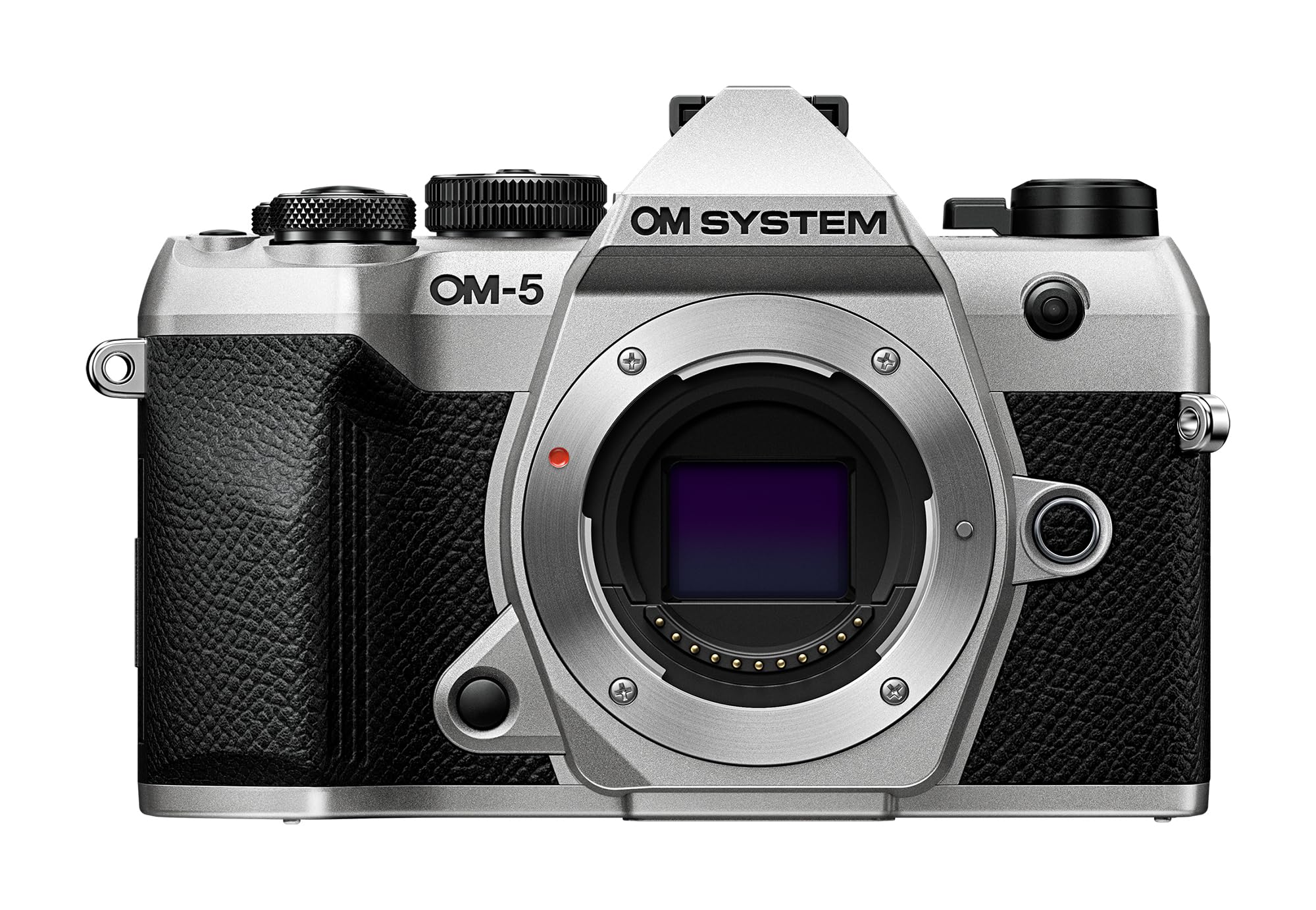
The OM SYSTEM OM-5 Mark II is built for the amateur who shoots in the elements — it is weather-sealed to IP53 standards, surviving rain, dust, and freezing conditions that would send most cameras back to the bag. The 20 MP Micro Four Thirds sensor combined with the brand’s legendary 6.5–7.5 stop 5-axis IBIS means you can handhold at 1/4 second shutter speed and still get a sharp frame, a game-changing ability for twilight cityscapes and indoor museum shots without a tripod.
The computational photography button unlocks high-resolution multi-shot mode (up to 50 MP), live ND simulation, focus bracketing for macro or product shoots, and night vision mode. The body is exceedingly compact and light at roughly 370g, and the updated menu borrows the cleaner layout from the OM-1. The Silver body finish gives it a classic film-era look that turns heads. The USB-C port simplifies fieldwork without a dedicated charger.
Battery life with the small BLX-1 pack is only middling — around 310 shots with IBIS active — so carrying two spares is recommended for a full day. The Micro Four Thirds sensor produces slightly more noise than larger APS-C sensors at high ISO, though the IBIS partially compensates by allowing slower shutter speeds. For the outdoor enthusiast who demands a lightweight, rugged body, this is the best travel camera in its class.
Why it’s great
- Industry-leading 6.5–7.5 stop IBIS for ridiculously slow handheld shots
- Fully weather-sealed for rain, dust, and cold conditions
- Computational photography modes (Live ND, high-res, focus stacking)
Good to know
- Small battery — carry at least two spares for a full day
- Micro Four Thirds sensor shows more noise at high ISO than APS-C
- Menu structure is vastly improved but still has a learning curve
8. Sony Alpha A6100

The Sony Alpha A6100 packs the same 24.2 MP APS-C Exmor sensor and 425-point phase-detection AF system found in far pricier Sony siblings, making it the cheapest gateway to Sony’s legendary autofocus speed. Real-time Eye AF for humans and animals works with uncanny reliability, letting an amateur frame a moving dog and trust the camera to keep the eye in focus — a trust that builds confidence fast. The 11 fps continuous shooting with AF/AE tracking is fast enough to capture a flying frisbee.
The 180-degree tiltable touchscreen facilitates selfie and vlog framing, and the microphone input opens up better audio for recording. The kit 16-50mm power zoom lens collapses to a pancake size, making the whole package small enough to slide into a slim messenger bag. The compact form factor and lightweight body encourage daily carry, which is the most important habit for any beginner photographer.
The electronic viewfinder is small and low-resolution compared to the A6400 or Fujifilm competitors — it is usable but not delightful. The menu system is Sony’s older, confusing layout, and there is no in-body stabilization, so kit lens OIS is your only shake reduction. The battery life is around 400 shots. For the budget-conscious amateur who prioritizes autofocus capability above all else, the A6100 is a ridiculous value proposition.
Why it’s great
- 425-point phase-detect AF with Real-time Eye AF for humans and animals
- 11 fps continuous shooting captures fast-moving subjects
- Lightweight, compact body with 180-degree tilt screen for vlogging
Good to know
- Electronic viewfinder is small and low-resolution
- No in-body stabilization — relies on lens OIS
- Sony menu system is clunky and unintuitive
9. Canon EOS Rebel T7 Bundle
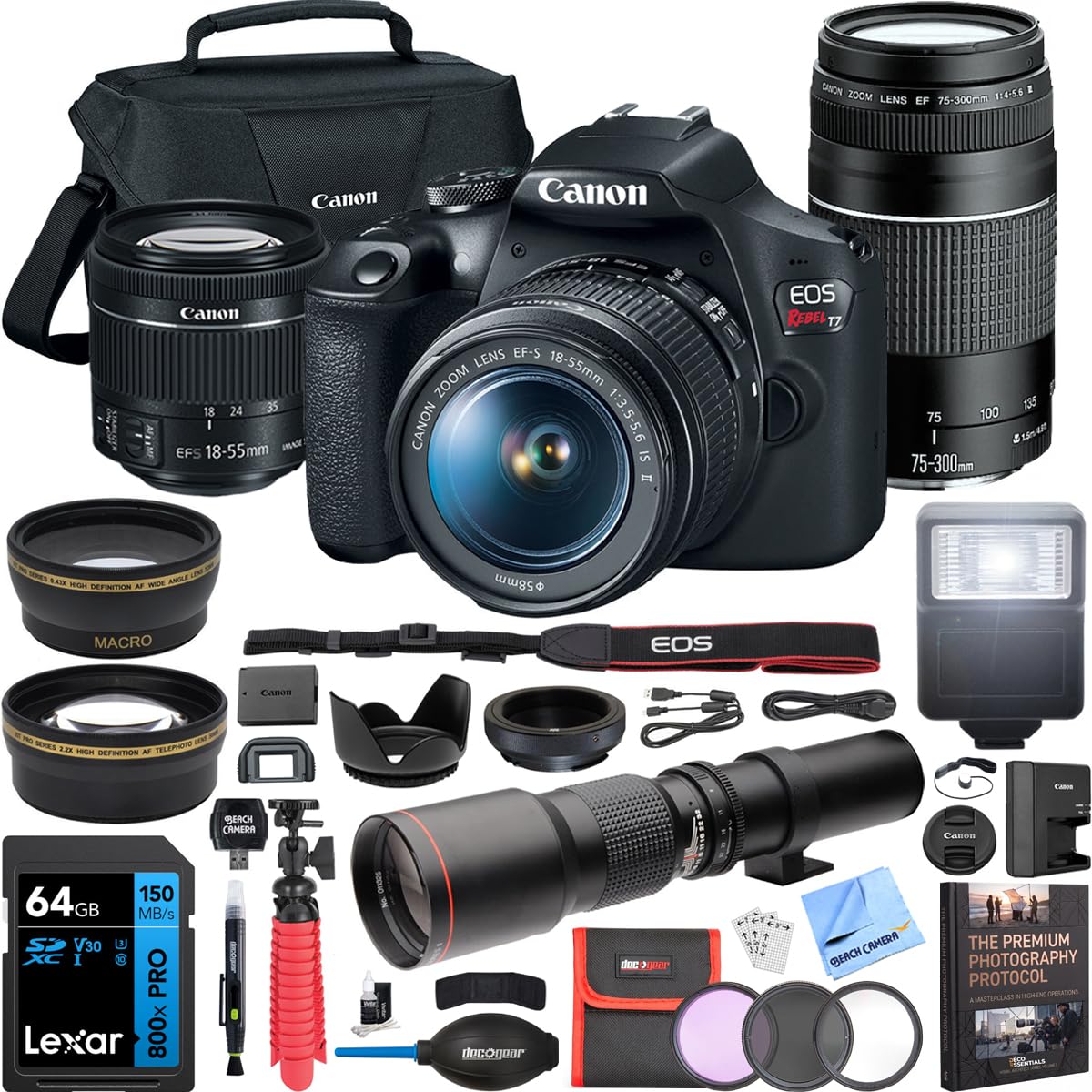
The Canon EOS Rebel T7 bundle is the definitive starter DSLR package for the budget-minded shooter who wants to learn photography fundamentals with a traditional optical viewfinder and extensive accessory ecosystem. The 24.1 MP APS-C sensor and DIGIC 4+ processor produce capable JPEG and RAW files, and the dual zoom kit (18-55mm plus 75-300mm) gives you a 29-480mm equivalent range to experiment with wide landscapes and compressed telephoto portraits. The included 500mm preset telephoto and macro filters deliver marginal but fun creative reach.
The optical viewfinder has zero lag and shows the real-world scene, which many beginners find less disorienting than an EVF. The 13-item bundle includes a flash, tripod, filters, memory card, and cleaning kit — everything you need for a first year of shooting without incremental purchases. A built-in Wi-Fi and NFC let you transfer images to your phone for social sharing.
The 9-point AF system is primitive compared to mirrorless systems — it will lose focus on moving subjects that stray from the center cluster. The 3 fps burst speed is insufficient for sports or active pets. The battery life reported by some users is short, with reports of fewer than 20 shots from a full charge in one experience, though this may be a defective unit issue. For a learning tool that introduces you to the craft without breaking your budget, the T7 bundle delivers raw value.
Why it’s great
- Large 13-item bundle includes lenses, flash, tripod, and accessories
- Optical viewfinder with zero lag — great for learning framing
- Canon EF/EF-S lens ecosystem is affordable and vast
Good to know
- 9-point AF system is very slow compared to modern mirrorless
- 3 fps burst is too slow for any kind of action photography
- Some users report dud batteries with very short life spans
10. Panasonic LUMIX G85

The Panasonic LUMIX G85 democratizes professional-grade stabilization for amateurs with its 5-axis in-body dual image stabilization, which works in concert with the O.I.S. kit lens to produce up to 5 stops of shake correction. That means you can shoot sharp stills at 1/15 second and smooth 4K handheld video with a confidence that bodies twice the price struggle to match. The 16 MP Micro Four Thirds sensor lacks a low-pass filter, boosting fine-detail resolving power by nearly 10% over earlier MFT sensors.
The magnesium-alloy body is weather-sealed, offering splashes and dust protection that most entry-level cameras lack. The 3-inch tilt-and-touch LCD is responsive for touch-to-focus, and the high-res OLED live viewfinder with 2360K dots provides a bright, lag-free viewing experience. The G85 includes exclusive Panasonic features like 4K Photo mode (30 fps burst) and Post Focus, which lets you choose the focus point after the shot — a brilliant learning tool for understanding depth of field.
Autofocus in 4K video is acceptable but not class-leading, hunting a bit in low-light conditions relative to phase-detect systems. The 16 MP sensor is outmatched by similarly priced APS-C options for stills resolution and low-light noise performance. The battery life is below average. For the video-oriented amateur or anyone who needs rock-solid stabilization on a tight budget, the G85 remains a unique value.
Why it’s great
- 5-axis IBIS plus OIS lens — stabilization rivaling premium bodies
- Weather-sealed magnesium alloy body for outdoor use
- 4K Photo and Post Focus modes are excellent learning tools
Good to know
- 16 MP MFT sensor shows more noise at high ISO than APS-C
- Video autofocus hunts in low light
- Below average battery life
11. Canon EOS R100

The Canon EOS R100 is the smallest and lightest body in the EOS R series, offering the easiest path into Canon’s modern mirrorless RF mount for the absolute beginner. Its 24.1 MP APS-C sensor paired with the DIGIC 8 processor delivers sharp, true-to-life JPEGs with the famed Canon color science, and the included RF-S 18-45mm f/4.5-6.3 IS STM lens provides a versatile walkaround range with optical image stabilization for steady handheld shots.
The Dual Pixel CMOS AF covers 143 zones across the frame, delivering smooth and accurate autofocus in stills and video. Face and eye detection works reliably for portraits, and animal/vehicle detect modes are available. The camera supports 4K video at up to 24 fps, HD at 120 fps for slow motion, and has built-in Wi-Fi and Bluetooth for quick wireless image transfer to a smartphone. The menu interface is Canon’s user-friendly system, widely considered the least intimidating for new shooters.
Control is limited: the single control dial and sparse external buttons mean you will be diving into menus for critical adjustments like ISO, aperture priority, and manual exposure. The electronic viewfinder is small and low-resolution, and the 6.5 fps burst is modest. The RF-S lens system is still young, with a smaller selection of affordable lenses compared to Sony E-mount or Fujifilm X-mount. For a clean, lightweight entry into a premium mirrorless ecosystem, the R100 fits the bill.
Why it’s great
- Smallest and lightest body in the Canon EOS R series — highly portable
- Dual Pixel CMOS AF with 143 zone coverage delivers smooth face tracking
- Canon JPEG color science produces pleasing skin tones out of camera
Good to know
- Single control dial limits quick manual adjustments
- EVF is small, low-resolution, and cramped
- RF-S lens ecosystem is still limited compared to Sony or Fujifilm
FAQ
Should I buy a DSLR or a mirrorless camera as a complete beginner?
Is a 24.2 MP sensor enough for printing large photos?
Final Thoughts: The Verdict
For most users, the camera for amateur photographers winner is the Sony Alpha 6700 because its AI-based autofocus and 26 MP sensor give beginners the highest keeper rate while leaving room to grow into serious glass. If you want film-like colors and a tactile learning experience, grab the FUJIFILM X-T30 III. And for full-frame image quality and maximum value, nothing beats the Sony a7 III.