
Our readers keep the lights on and my morning glass full of iced black tea. As an Amazon Associate, I earn from qualifying purchases.
Specs are compiled from manufacturer listings and verified buyer reviews and can change over time — please confirm the key details on the product page before buying.
If your room smells stale, your nose runs every morning, or you can see dust settling on the shelves an hour after you wipe them, the fix is a purifier with enough clean-air output for the space you actually live in. Too small a unit and you will hear the fan working hard while the air stays hazy. Too large and you paid for capacity you never use. This guide cuts straight to the models that solve the problem, sorted by how well they handle real rooms with real pets, cooking, and pollen.
I’m Min — the founder and writer behind Gadgets Feed. This guide is built by comparing the manufacturers’ published specifications and the patterns across verified customer reviews, so you get each pick’s real strengths and trade-offs instead of marketing spin.
You will learn which room-size claims hold up, why a higher clean-air number is not always the right answer, and how filter costs shape the true long-term picture. Below, the picks are ranked so you can match the right air cleaner for room to the space you actually have.
Our Picks at a Glance


How To Choose The Best Air Cleaner For Room
The single biggest mistake buyers make is buying for the wrong room. A purifier that leaves a tiny bedroom spotless can be overwhelmed by an open-plan living room with a kitchen attached. Start by measuring your space in square feet, then look for a unit whose stated coverage matches that number — not just at its lowest setting, but at a setting you can actually live with.
Match The Clean-Air Delivery Rate To Your Room
CADR stands for Clean Air Delivery Rate — a number, measured in CFM (cubic feet per minute), that tells you how much filtered air the machine pushes out. Higher is better for larger rooms. A unit rated 391 CFM will move far more air than one rated 115 CFM, which matters most in an open living area. If you have high ceilings or an odd-shaped room, aim higher than you think you need.
Understand What The Filter Stages Actually Do
A pre-filter catches the big stuff — hair, lint, large dust. The HEPA layer is the workhorse that traps fine particles like pollen and dander. A carbon layer handles odors and cooking smells. Some models use washable pre-filters you can rinse and reuse, which cuts down on how often you buy a whole new filter set. Check whether replacement filters are easy to find and what the manufacturer recommends for replacement intervals, because that cost runs for the life of the machine.
Watch The Noise Numbers Separately From The Speed
Nearly every purifier is quiet on its lowest setting and loud on turbo. The question is whether the mid-range is tolerable while you sleep. Look for a stated decibel floor — a low number like 23.5dB or 27dB is genuinely near-silent. A separate sleep mode that dims or kills the display lights matters more than you expect, especially if the unit sits near your bed.
Quick Comparison
| Model | Best For | CADR | Room Coverage | Weight | Amazon |
|---|---|---|---|---|---|
| Levoit Core 600S-P★ Best Overall | Whole-home and open-plan spaces | 391 CFM | 2,933 sq ft per hour | 13.7 lb | Amazon |
| DREO DR-HAP008Budget Champion | Dorm rooms and small bedrooms | 115 CFM | 178 sq ft (4.8 ACH) | 5.57 lb | Amazon |
| Levoit Core 200S-PMost Popular | Bedrooms, nurseries and offices | — | 140 sq ft (4.8x per hour) | 6.6 lb | Amazon |
| GermGuardian AC4825E | Small bedrooms with allergy concerns | — | 153 sq ft per 12.5 min | 8.55 lb | Amazon |
| Clorox Turbo Air Purifier | Medium rooms and quick odor clearing | — | 215 sq ft (5x per hour) | 5.2 lb | Amazon |
| Winix 5510 | Large rooms and wildfire smoke | — | 1,882 sq ft in 1 hour | 13.3 lb | Amazon |
| Shark Clean Sense HP102PET | Pet households and real-time air feedback | — | 500 sq ft (1 ACH) | 5.85 lb | Amazon |
| AirDoctor AD3500 | Very large rooms and deep particle capture | — | 2,520 sq ft in 1 hour | 24 lb | Amazon |
| NuWave OxyPure | Extra-large spaces and low filter costs | 664.6 m³/h | 2,934 sq ft in 60 min | 26 lb | Amazon |
In‑Depth Reviews
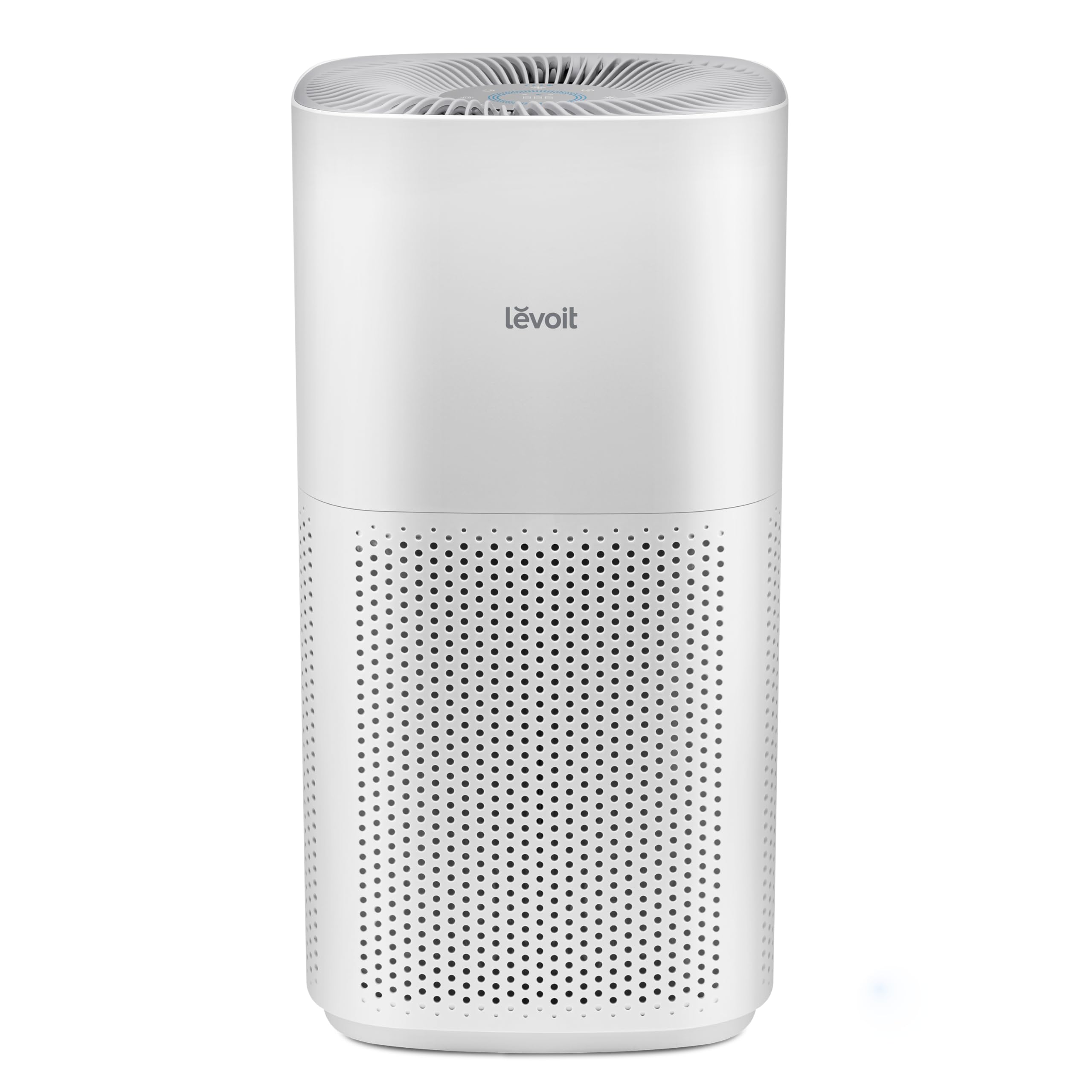
1. Levoit Smart Air Purifiers for Home Large Room up to 2933 Ft², Core 600S-P
Our pick — over 4.5★ from 24,500+ verified ratings; the strongest balance of quality and price.
One machine that actually keeps up with a wide-open living space and three shedding pets.
If your problem room is not a bedroom but the whole downstairs, this is the one that stops the cycle. A CADR of 391 CFM (Clean Air Delivery Rate — cubic feet of filtered air pushed out per minute) tells you it moves serious volume, enough to clean a 2,933 sq ft space once an hour or a 606 sq ft space every 12.5 minutes. That is what makes it work in a living room with a kitchen attached, or a basement you actually use. For scale, the DREO lower on this list delivers 115 CFM — a far smaller throughput meant for a single small room.
Filtration is a 3-stage system with 99.97% efficiency for particles in the 0.1–0.3 micron range (a micron is one-millionth of a meter), which covers the pollen, dust, and animal dander that keep allergies humming. Auto Mode reads the air and adjusts fan speed for you, so you are not standing there fiddling with a dial. And per Levoit, this unit stays HEPA-grade even in Sleep Mode when you use the Original Filter — the mode you will leave it in overnight. Buyers running it against Oklahoma pollen and three cats logged a PM2.5 reading of 600 on arrival; after two hours on high, the air cleared and allergy symptoms eased within 24 to 48 hours.
What wins people over is raw effectiveness — it is the thing buyers talk about more than any other feature, and it holds up. Noise runs second, and the consensus is that Sleep Mode is genuinely silent while the top speed is not. The recurring trade-off is the top-end volume: treat high speed as a daytime-only mode and let Auto take over at night. It is also the heavyweight of the group at 13.7 pounds against the DREO’s 5.57 pounds, so plan on finding it a permanent spot rather than carrying it room to room. The crowd data backs the performance story at 4.7 stars across 24,000+ ratings — buyers compare it against other brands for weeks and still keep this one.
The case built on 2,933 sq ft
- 391 CFM CADR clears 606 sq ft every 12.5 minutes, so an open plan never drifts stale
- Sleep Mode stays HEPA-grade with the Original Filter — overnight filtration without the volume
- Auto Mode adjusts fan speed on its own, so you set it and leave it
Where it asks more of you
- Top speed is loud enough to interrupt conversation — keep it to daytime
- 13.7 pounds means it lives where you put it
- The base unscrews more easily than it should, so handle it carefully when moving
Reach for this if: you are purifying an open-plan room, a basement, or a whole-floor footprint and want one unit instead of three.
Look elsewhere if: your goal is a whisper-quiet bedside unit for a 150 sq ft bedroom — the smaller picks below suit that job better.
2. DREO Air Purifier for Home, HEPA Sleep Mode, DR-HAP008 (Dreo 338)
A dorm-sized purifier with a real-time air quality readout you can actually watch change.
Here is the number that decides whether this belongs in your room: 115 CFM, AHAM Verified (independently tested by the Association of Home Appliance Manufacturers), refreshing a 178 sq ft space every 12.4 minutes. That footprint is a dorm room, a small bedroom, or a home office — not a living room. At 5.57 pounds it is light enough to move one-handed, and at 9.21 x 9.21 x 14.21 inches it tucks into a corner without being in the way. The Levoit Core 600S-P above weighs more than twice as much at 13.7 pounds, which tells you how differently these two are built.
The PM2.5 monitor is the standout feature here. A high-precision sensor tracks fine particles in real time (PM2.5 means particles 2.5 microns or smaller — the ones that get deepest into your lungs), and the LED display shows AQI levels from 1 to 999. The 4-color RGB light — blue, green, orange, red — tells you at a glance whether the room is clean or needs help. Buyers describe watching the readout spike to 999 with smoke in the air and then drop to 1–5 once the unit catches up. That instant feedback is what makes the machine feel like it is doing something.
The recurring gripe is nothing more than ambition: this is a small-room device and buyers who expect it to handle a big open space will find its ceiling fast. Powered by DREO TurboPure with 360° spiral airflow and a 3-in-1 filter (pre-filter, high-efficiency filter, activated carbon), it is an ENERGY STAR certified unit using roughly 125 kWh annually. Sleep Mode turns the display lights off entirely. Odor removal and quiet operation are what owners praise most after performance, and the 363 ratings at 4.7 stars read as genuinely satisfied buyers.
The small-room specialist: if your space is 178 sq ft or less — a dorm, a nursery, a single bedroom — the combination of AHAM verification, a live PM2.5 readout, and a 5.57-pound body makes this the value play. The 4-color indicator alone is worth more than you expect in daily use.
Size honestly: this covers up to 856 sq ft at one air change per hour, but the meaningful cleaning figure is the 178 sq ft at 4.8 air changes per hour. Read the second number, not the first, or you will be disappointed.
Best for: a small bedroom or dorm where you want proof the air is changing, not just a quiet hum.
Not for: an open-plan living area — you would need several, and one larger unit serves that layout more cleanly.
3. Levoit Air Purifier for Home Pets Bedroom Dorm Room, Smart & Voice Control
The compact apartment staple that fits on a nightstand and still moves real air.
Levoit’s Core 200S-P earns its spot on sheer consistency — 4.6 stars across a massive volume of ratings, with quality the single most-praised trait. The working spec you care about is coverage: it refreshes a 140 sq ft room 4.8 times per hour through a 360° air intake. That is a bedroom, a nursery, an office, or a small apartment — exactly the places where you want clean air but do not have floor space to spare.
The quiet story is the one that sells it. Noise levels drop as low as 27dB (about as quiet as a whisper), and a Display Off button kills every light on the unit for uninterrupted sleep. Filtration is real: the Main Filter removes 99.97% of dust, pollen, and dander in the 0.1–0.3 micron range, while the Nylon Pre-Filter and High-Efficiency Activated Carbon Filter take the larger particles and absorb odors and fumes. Owners with vision impairment specifically lean on the app control, which doubles as a remote, plus app-based filter-life monitoring and even outdoor air quality display.
The predictable limitation is throughput: 140 sq ft at 4.8 air changes is a single-room figure, and in a larger space it becomes a background hum rather than a solution. High speed is a bit loud, though owners consistently describe it as useful white noise rather than a nuisance. Filter replacement is described as cheap and easy, and the auto filter-reorder feature handles the reminder for you. It is also the definition of compact — roughly the footprint of a game console.
Why it keeps selling: it is small enough to disappear into a room, quiet enough to run all night, and it has an app that actually does useful things — filter-life tracking, scheduling, and outdoor air quality readout. For a bedroom or a dorm room, the combination is hard to argue with.
The honest ceiling: 140 sq ft is the meaningful number. In an open living space this becomes a supplementary unit, not the primary one — pair it with a higher-CADR machine if the room is large.
Choose it if: you want a nearly silent bedside purifier with app control and a footprint small enough to forget about.
skip it if: your room exceeds a couple hundred square feet and you expect a single compact unit to clear it.
4. GermGuardian HEPA Air Purifier Tower – 22″ – Gray – AC4825E

A slim tower that earns its keep on odor control and small-room circulation.
The GermGuardian AC4825E has been around long enough to have a devoted following, and the reason is straightforward: it circulates and filters a 153 sq ft bedroom every 12.5 minutes, or a 743 sq ft space once an hour. The tall, narrow tower shape (22 inches high, 8.55 pounds) means it takes up floor space a squarer unit could not — which suits a corner beside a bed or a hallway.
Filtration is True HEPA with a stated 99.97% capture of allergens as small as 0.3 microns, trapping dust, pollen, and pet dander, plus an activated carbon layer for cooking and pet scents. There is an optional UV-C light that helps reduce airborne particles. The unit is CARB Certified, ETL Certified, and Zero Ozone Verified, and it has three speeds including a quiet sleep mode. One reviewer noted a days-old skunk odor cleared from a bedroom within a day. Another sums up the small-room experience well: “Instant fresher air.”
The trade-off here is noise at the higher end. The consensus is that it is reasonably quiet on low and medium — owners compare low to a laptop fan — but speeds two and three are loud enough to bother a light sleeper. That is a fit issue, not a fault: buy it for a room you are not sleeping in, or accept the mid-speed hum. The blue UV indicator light is another known quirk that bothers some buyers, though it can be turned off. Filter replacement runs annually and is a genuine long-term saving versus units that demand more frequent swaps.
What the tower gets right
- True HEPA at 99.97% capture for particles as small as 0.3 microns
- Optional UV-C light plus activated carbon for odors and fumes
- Narrow tower shape fits where squarer units cannot
- Annual filter replacement keeps long-term costs down
The honest caveats
- Higher speeds are loud enough to disturb sleep
- The bright UV indicator light is off-putting for some buyers
- Small-room coverage only — 153 sq ft is the number to respect
Suits you if: you want proven True HEPA plus UV-C in a slim footprint and can run it below the top speeds most of the time.
Think twice if: your priority is a silent bedroom unit on the highest setting — that is not this machine’s strength.
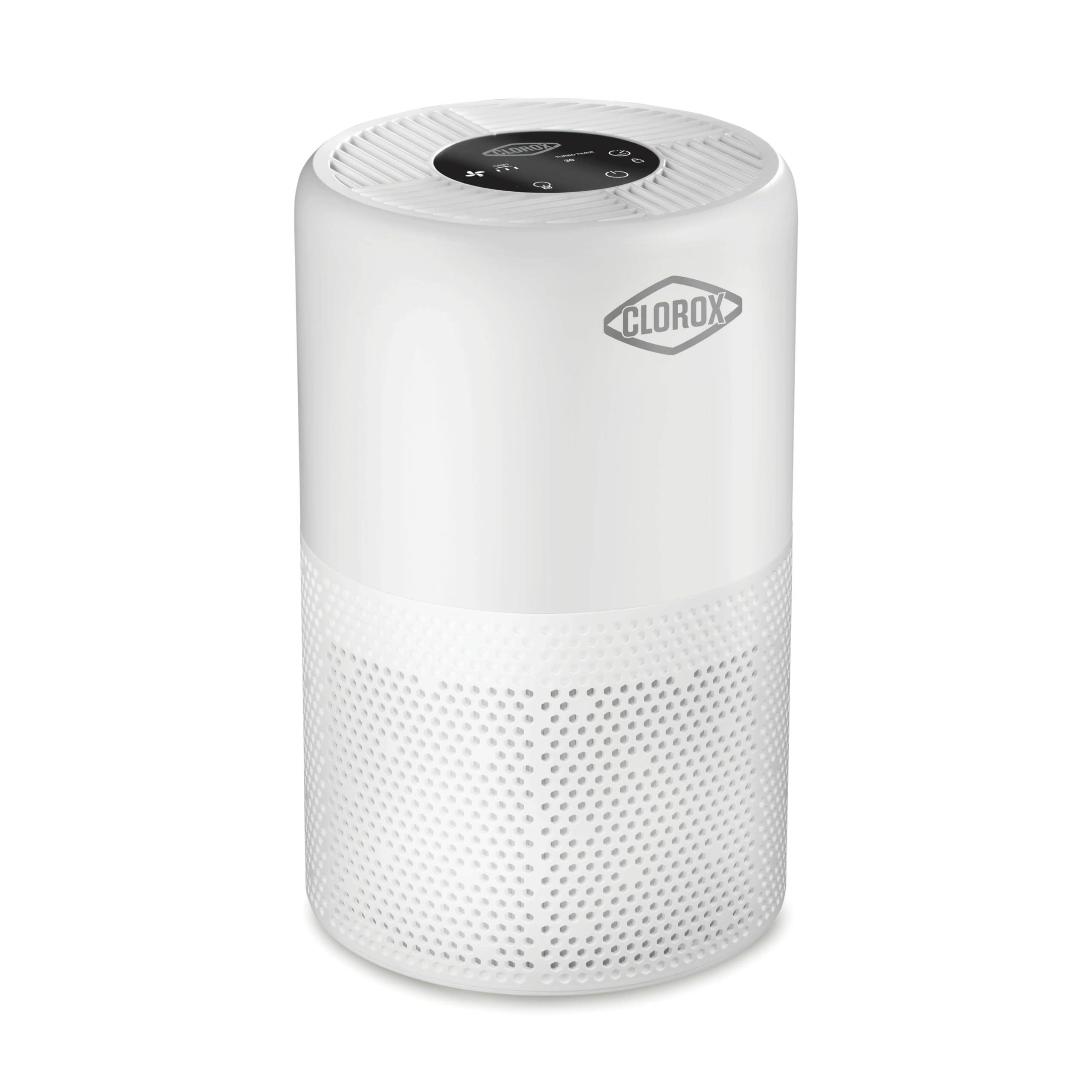
5. Clorox Medium Room Turbo Air Purifiers for Home With True HEPA Filter
The one you hit the Turbo button on after burning dinner — and it clears the room.
What makes this Clorox unit different from the compact purifiers is the short-burst power. The Turbo Timer gives you 10, 20, or 30 minutes of maximum airflow, so you can clear cooking smoke, wildfire haze, or a spike in pollen without leaving the machine on high all evening. It cleans a 215 sq ft room up to five times per hour and a room up to 1,000 sq ft once an hour, both from a 360° airflow pattern that pulls air in from every direction.
Filtration is three stages: a pre-filter for large particles, a True HEPA filter capturing 99.97% of allergens and particulates, and an active carbon layer that reduces VOCs (volatile organic compounds — the gases cooking and cleaning products give off) and odors. Underneath the filters sits the quiet story owners keep returning to. Buyers describe it as very quiet, small, and simple to operate, and several mention sleeping better with it running. The controls sit on top, clearly marked, with a brightness setting across on, dim, and off.
The honest caveat is speed control — you get four speeds but no automatic particle sensor, so you decide when to move from low to turbo. The fan speed indicator light is a known minor irritant for older users. And it is a medium-room machine at heart: one owner with a large apartment found it covered a big great room well but would size up for anything larger. The 360° design and easy filter changes are its day-to-day satisfaction points.
The Turbo advantage: the 10, 20, or 30-minute timer is the feature that makes this worth owning. You do not have to run a purifier on high for hours after cooking — you press the timer, walk away, and the machine handles the burst. For anyone who cooks strongly or lives in a fire-prone region, this is the feature that separates it from the pack.
What it lacks: there is no automatic particle sensor, so this unit trusts you to decide when air quality needs attention — unlike the DREO and Shark units on this list that react on their own. If you prefer a machine that reads the room for you, note that gap.
Reach for it if: you want manual control, a burst mode for cooking and smoke, and a small body you can move between rooms.
Look elsewhere if: you want the purifier to sense air quality automatically and adjust itself without your input.
6. WINIX 5510 Air Purifier for Home Large Room Up to 1881 Ft² in 1 Hr

The large-room workhorse that senses darkness and quietly puts itself to sleep.
Clean a large room fast: the Winix 5510 is AHAM Verified at 392 sq ft and cleans up to 1,882 sq ft in one hour — 941 sq ft in 30 minutes, 627 sq ft in 20, and 470 sq ft in 15. That progression is what makes it useful in a big living space, because the short-window numbers are what you actually experience when smoke drifts in and you need the air clear before dinner. It runs True HEPA capturing 99.99% of airborne allergens including pollen, dust, smoke, and pet dander as small as 0.3 microns.
The automated sleep mode is the standout, and it works differently from most. The unit senses when the room darkens and switches itself into a quiet energy-efficient Sleep Mode, then returns to Auto Mode when the light comes back. At its slowest, it is nearly silent at 23.5dB. Filtration runs four layers — a washable fine mesh pre-filter, an advanced odor-control carbon filter for VOCs and cooking and pet smells, the True HEPA layer, and a PlasmaWave ionizer that can be disabled. App control lets you schedule and monitor remotely.
The fair pushback is the app, which some buyers describe as laggy or unresponsive — the machine itself gets high marks, but the phone experience is the weak link. A separate observation worth noting: aftermarket carbon filters can be overfilled and may restrict airflow, so stick with Winix-brand filters for the intended performance. The rest of the picture is durability. Buyers report five years of constant use with no smoke smell getting through and no mechanical issues. It is 13.3 pounds, a fixture for one room rather than a unit you carry around.
The strengths that hold up
- Cleans 1,882 sq ft in one hour and 470 sq ft in just 15 minutes
- 23.5dB at its lowest — near silent for overnight use
- Light-sensing sleep mode transitions automatically with the room
- Washable pre-filter and disableable PlasmaWave ionizer give you control
Worth knowing before you buy
- The companion app gets dinged for lag and occasional unresponsiveness
- Aftermarket carbon filters may restrict airflow — stick with Winix filters
- 13.3 pounds makes it a fixed installation rather than a portable one
Built for: a large living room or kitchen where you want fast smoke and odor clearing plus overnight silence.
Consider another if: the app experience is central to your decision — the hardware is excellent but the software is the weaker half.
7. Shark Clean Sense Air Purifier with Pet Filter, HP102PET, White

A pet household purifier that shows you a live air-quality percentage and reacts to it.
The number that makes this Shark worth a look is on the front panel, not the spec sheet: a live air-quality percentage displayed between PM 1.0 and PM 10, where a higher percentage means fewer particles. Watch it climb as the room clears. CleanSense IQ adjusts fan speed in real time based on those readings, so the unit reacts to a dog walking through the room or something cooking on the stove without you touching a control. Coverage runs up to 500 sq ft at one air change per hour from an 8.66 x 8.66 x 14.56 inch, 5.85-pound body.
Filtration exceeds standard HEPA requirements. The Anti-Allergen NanoSeal traps 99.98% of large, small, and micro-sized particles, based on IEST-RP-CC007 testing for 1 to 0.2 microns. The control panel shows real-time air quality, filter life, fan speed, Eco mode, and more. In a household with dogs and cats — several owners describe running one per room — the pet filter and the visible air-quality feedback are what make it feel like it is doing something rather than running on faith. It sits at 4.6 stars across several hundred ratings.
The one aspect that gives buyers pause is filter life, which is the recurring friction point in the feedback. Shark recommends replacing filters every 6 to 12 months depending on use, and that is a running cost to plan for. The consolation is the price of the filters themselves — buyers selecting this over a Dyson specifically called out the fair filter pricing. The unit is otherwise described as compact, quiet, and easy to move between rooms, and the display dims for sleep.
The pet-household read: if you have dogs or cats, the combination of the pet filter, the 99.98% capture rating, and the live air-quality percentage is genuinely useful. You see the machine working harder when the pets stir and easing off when the air clears.
Budget for filters: the 6 to 12 month replacement schedule is the true ongoing cost here. Buyers chose this partly because Shark filters cost less than some competitors’, but plan for the recurring line item regardless.
Right for you if: you want visible, real-time feedback on air quality and a filter designed around pet dander.
Look at a bigger unit if: your room exceeds 500 square feet — the coverage here is honest but limited to a small room.
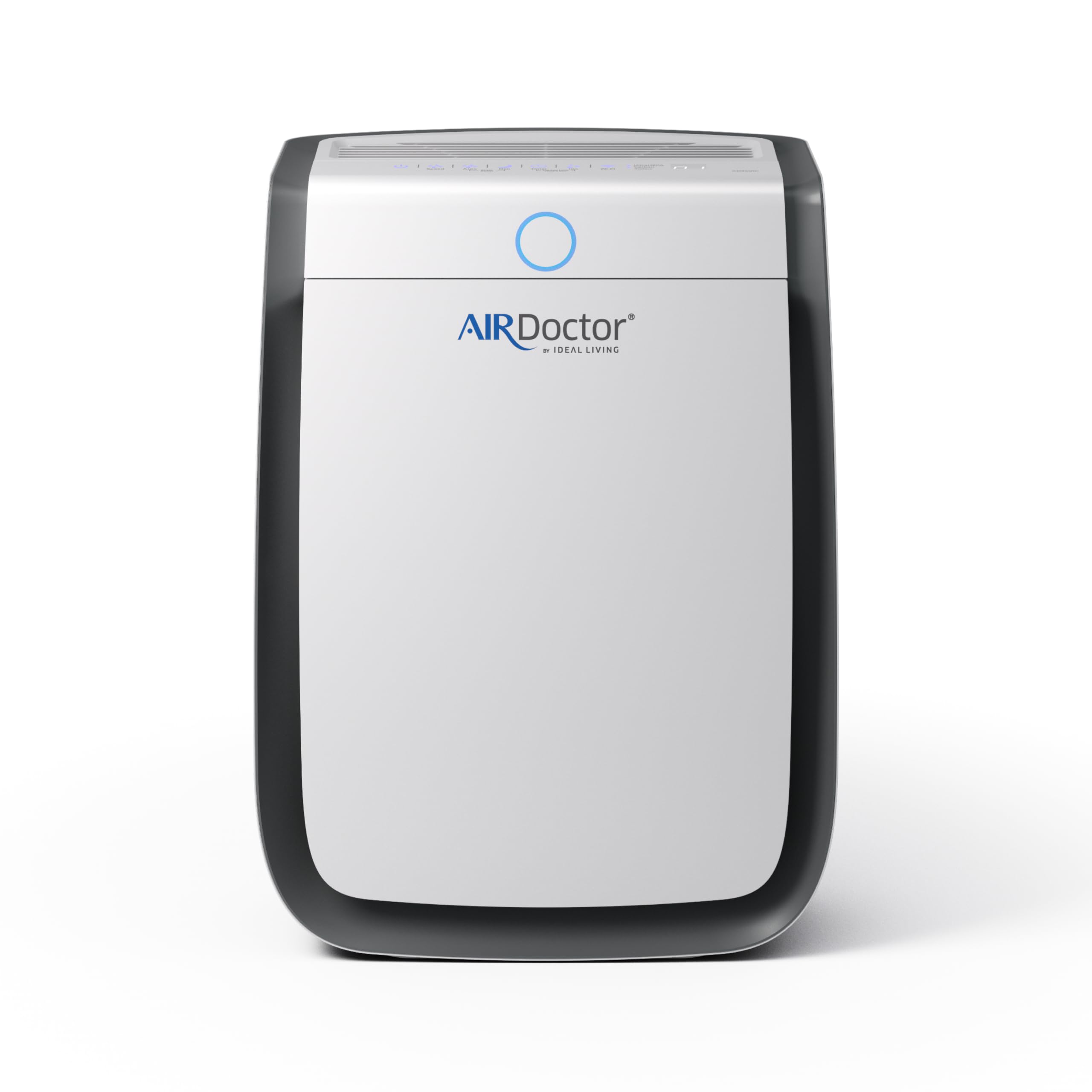
8. AIRDOCTOR AD3500 Air Purifier
The large-room heavyweight built for serious filtration and a color-coded air readout.
If your concern is the finest airborne particles, this is the machine that answers it. The AirDoctor AD3500 uses UltraHEPA filtration to capture 99.99% of airborne particles at 0.003 microns — smaller than the standard HEPA threshold. It cleans 630 sq ft in 15 minutes and up to 2,520 sq ft in one hour, which lands it firmly in the whole-floor, very-large-room category. The 24-pound body (19.87 x 27.16 x 12.38 inches) reflects the seriousness of the build.
Under the UltraHEPA layer sit a Pre-Filter and a Premium Activated Carbon filter made with activated carbon and potassium permanganate to absorb and break down gases, odors, pet smells, cooking fumes, and VOCs. The Halo display shows color-coded air quality based on real-time PM2.5 readings from built-in sensors, and Auto Mode adjusts fan speed and activates Boost when it detects a problem. A timer, filter indicator, and four fan speeds round out the controls. Buyers running it report Auto Mode reacting instantly to cooking and candles, and near the oven it clears a substantial share of cooking smells.
Two fair caveats. First is size — at 24 pounds and three dimensions well past a foot, this needs a committed corner. Second is Turbo noise, which several owners note is loud but fast; the machine on low settings is quiet enough for sleep, with a night mode that dims the bright blue display. Filter replacement follows a schedule: carbon every 6 months and UltraHEPA every 12 months, so budget accordingly. It is also FSA and HSA eligible, which is worth checking against your own plan if you have that option.
For the particle-sensitive: the UltraHEPA layer’s 99.99% capture at 0.003 microns is the headline for anyone who wants the finest filtration target available in this list. That is the differentiator you are paying the premium for.
Size and schedule: the 24-pound body requires real estate, and the every-six-month carbon / every-twelve-month UltraHEPA replacement cycle is a fixed cost. Neither is a flaw — both are what a machine at this filtration level requires.
The right call if: you want the finest particle capture available and can give it a permanent spot in a large room.
Overkill if: you are purifying a single small bedroom — the compact picks above make more sense there.
9. Nuwave OxyPure Ultra Clean Air Purifier for Extra Large Room, Office

The extra-large-room purifier whose washable filters cut the running cost dramatically.
For dimension, the OxyPure is the largest unit here: 2,934 sq ft in 60 minutes or 586 sq ft in 12 minutes, at a CADR of 664.6 m³/h. That places it alongside the Levoit Core 600S-P and AirDoctor AD3500 as a whole-floor purifier, and its 26-pound body (14.25 x 14.25 x 26.25 inches) confirms the intended scale. If you have high ceilings or an open-concept space that smaller units cannot touch, this is one of three picks built for it.
The design principle underneath is different from everything else on this list: reduce the cost of ownership by washing rather than replacing. The 5-layer filtration runs a never-rust stainless-steel pre-filter, an ozone emission removal filter that eliminates toxic ozone, plus HEPA/Carbon and Bio-Guard filters. The stainless pre-filter and Bio-Guard filter are washable and reusable, and the ozone emission removal filter is reusable too. Owners mention the washable filters last a long time and save on the ongoing replacements. It is WiFi capable with an app for both Android and iPhones, so you can monitor and control remotely.
The fair read on the downsides: high speeds are on the loud side, and the manual is a known weak point — buyers describe it as poorly translated and hard to follow for filter maintenance. Performance itself is not in question; it detects smoke and works harder during forest fires, and it clears strong cooking smells like Indian food and fish within minutes. The multi-layer filtration is the reason for the extra weight and size, and that is the tradeoff you accept for the coverage and low filter cost.
Where it pulls ahead
- 2,934 sq ft covered in 60 minutes — one of the three largest here
- Washable and reusable pre-filter, Bio-Guard, and ozone filters cut ongoing replacement costs
- WiFi capable with app control on Android and iPhone
- 5-layer filtration including an ozone emission removal filter
The honest trade-offs
- High speeds are loud enough to notice
- The manual is difficult to follow for filter maintenance
- 26 pounds and a 26.25-inch height require a dedicated spot
Pick it if: you have a very large space and want to minimize the lifetime cost of replacement filters through washable media.
pass on it if: you want a light, portable unit or clear, easy-to-follow maintenance instructions in the box.
Understanding the Specs
CADR (Clean Air Delivery Rate)
This is the number you should compare first. It is measured in CFM (cubic feet per minute) and tells you how much filtered air the purifier pushes out. A higher CADR means faster cleaning in a larger room. When comparing units, look at the room-size figure tied to the highest acceptable speed — not the marketing headline. A unit that clears 178 square feet at 4.8 air changes per hour will feel very different from one that clears 2,933 square feet once per hour, even though both sound impressive.
Filtration Stages
Most purifiers use a pre-filter for large particles, a HEPA layer for fine particles like pollen and dander, and a carbon layer for odors and gases. The HEPA standard is a capture efficiency of 99.97% for particles down to 0.3 microns; some units in this list use materials rated to catch even smaller particles. Washable pre-filters reduce replacement frequency, which affects your ongoing cost. Check what the manufacturer recommends for filter replacement intervals before you buy.
FAQ
How do I know what size air purifier my room needs?
What does CADR mean and why does it matter?
Is a washable filter as good as a replaceable HEPA filter?
How loud are these purifiers at night?
Do I need a purifier with a PM2.5 sensor?
How often should I replace the filter?
Can I run an air purifier 24 hours a day?
What is the difference between True HEPA and a HEPA-type filter?
Will an air purifier help with pet dander and odors?
Should I leave the purifier on high speed all the time?
Can a purifier handle whole-house levels of smoke?
Final Thoughts: The Verdict
For most rooms, the air cleaner for room winner is the Levoit Core 600S-P because its 391 CFM CADR is the number that keeps up with an open plan, and Auto Mode plus a HEPA-grade Sleep Mode means it works without your involvement — backed by 4.7 stars across more than 24,000 ratings. If you want fast smoke and odor clearing with a manual Turbo timer, grab the Clorox Turbo Air Purifier. And for pet households that want to watch the air quality climb in real time, the Shark Clean Sense HP102PET is the one to reach for.
How We Picked
We do not accept paid placement. Every pick is matched to a real buyer and a real use-case; we do not hands-on test units.
Sources & Methodology
Specifications: manufacturer listings and product documentation. Review insights: verified customer reviews, as of September 2026. Pricing: not shown on this page (it changes often); check the current price via the retailer link.
As an Amazon Associate, Gadgets Feed earns from qualifying purchases. This does not affect which products we feature.