
Our readers keep the lights on and my morning glass full of iced black tea. As an Amazon Associate, I earn from qualifying purchases.
Specs are compiled from manufacturer listings and verified buyer reviews and can change over time — please confirm the key details on the product page before buying.
A beach tent is only as good as the moment the wind picks up and the sand starts flying. That is the real test, and it is the one most shoppers never think about until they are standing on the sand holding a bent pole. The tents below all shade you from the sun and all pack into a bag, but they split sharply on setup time, anchor systems, and how much open floor you actually get once the family sits down.
I’m Min — the founder and writer behind Gadgets Feed. This guide is built by comparing the manufacturers’ published specifications and the patterns across verified customer reviews, so you get each pick’s real strengths and trade-offs instead of marketing spin.
You want shade you can set up alone, a tent that stays put in the sand, and enough room to actually sit down. Those three things decide whether a beach tent earns its spot in your trunk. Here is how the best camping tent for beach options compare.
Our Picks at a Glance
How To Choose The Best Camping Tent For Beach
On open sand you are fighting two things at once: the sun overhead and the wind coming off the water. A tent that ignores either one ends up folded in your trunk by noon. So the shopping question is not “which tent is biggest” — it is which tent still stands and still shades once the breeze fills in.
Start with the anchor system, not the fabric
Sand is loose, so a tent cannot rely on friction the way a camping tent does on dirt. Look at what comes in the box: sandbags you fill on site, stakes long enough to bite, and guy lines that let you tension the frame. A tent with a thick frame and no way to pin it down will still walk across the beach in a gust. Fill the sandbags completely and bury them — that is the difference between a tent that survives the afternoon and one that does not.
Decide if you want pop-up or pole-assembled
Pop-up tents (the ones that spring open from a coiled frame) go up fastest, often in a minute or two, and they suit a parent juggling kids and gear. Pole-and-sleeve tents take longer because you thread fiberglass rods through fabric channels, but they tend to hold a more rigid shape in wind and pack down flatter. Neither is better in the abstract — a pop-up saves you setup time, a pole tent often holds steadier when the wind is steady too.
Match the floor plan to how you actually sit
A tent rated for six people is usually rated that way with everyone seated and no gear. Two adults in beach chairs plus a cooler and a bag eat a surprising amount of floor. If you plan to keep chairs inside, size up one tier from your headcount. An extended front mat — a flap of waterproof floor that unfolds out the front door — adds a sand-free zone for shoes and toys without adding to the tent’s shaded footprint, which is a genuinely useful feature on a sandy day.
Read the UPF number and the ventilation together
UPF 50+ is the standard top rating for sun-blocking fabric; it is the clothing-and-shade equivalent of saying the fabric lets very little UV through. But a sealed shell that blocks the sun also traps heat. Mesh windows and openable doors and back panels let the sea breeze cross through, and that airflow is what keeps the inside usable on a hot afternoon. Shade without airflow turns a tent into an oven.
Quick Comparison
| Model | Best For | Floor Area | Weight | Capacity | Amazon |
|---|---|---|---|---|---|
| OutdoorMaster Beach Tent★ Best Overall | Families wanting the most shade for the money | 46.25 sq ft | 4.8 lb | 4–5 people | Amazon |
| OAOA Beach Tent with Extended MatMost Floor Space | Groups who want a separate play-and-picnic mat | 86.6″ x 59.6″ interior | 5.17 lb | 3–6 people | Amazon |
| Gorich Beach Tent Sun ShelterBest Airflow | Two adults who want privacy doors and airflow | 41.69 sq ft | 5.9 lb | 1–2/3/4–5 people | Amazon |
| Elegear CumbreX Beach Tent | Big families who want an expandable canopy | Expands with canopy | 6 lb | 4–5 people | Amazon |
| Elegear 360° Removable Canopy Pop Up | Couples and small families wanting 1-second setup | 109″ x 94.5″ | 3.7 kg | 4–6 people | Amazon |
| Old Bahama Bay Pop Up Beach Tent | Anyone who wants true pop-up-in-seconds convenience | 81″ x 54.5″ | 8.2 lb | 3–4 people | Amazon |
| Rhino Valley 10 x 10 FT Beach Tent | Big groups wanting a full shade pavilion | 100 sq ft | 8.7 lb | 4–8 people | Amazon |
| Oileus XX-Large Pop-Up Beach Tent | Families who want instant shade with an awning | 37.6 sq ft | 5 lb | 4–6 people | Amazon |
| COZEER 10x10FT Beach Shade Canopy | Large groups plus beach gear on the sand | 100 sq ft | 4.74 kg | Up to 8 people | Amazon |
In‑Depth Reviews
1. OutdoorMaster Beach Tent for 3/4/6/8 Person
Our pick — over 4★ from 650+ verified ratings; the strongest balance of quality and price.
The roomiest shade per dollar here, with a floor big enough for a family to actually spread out.
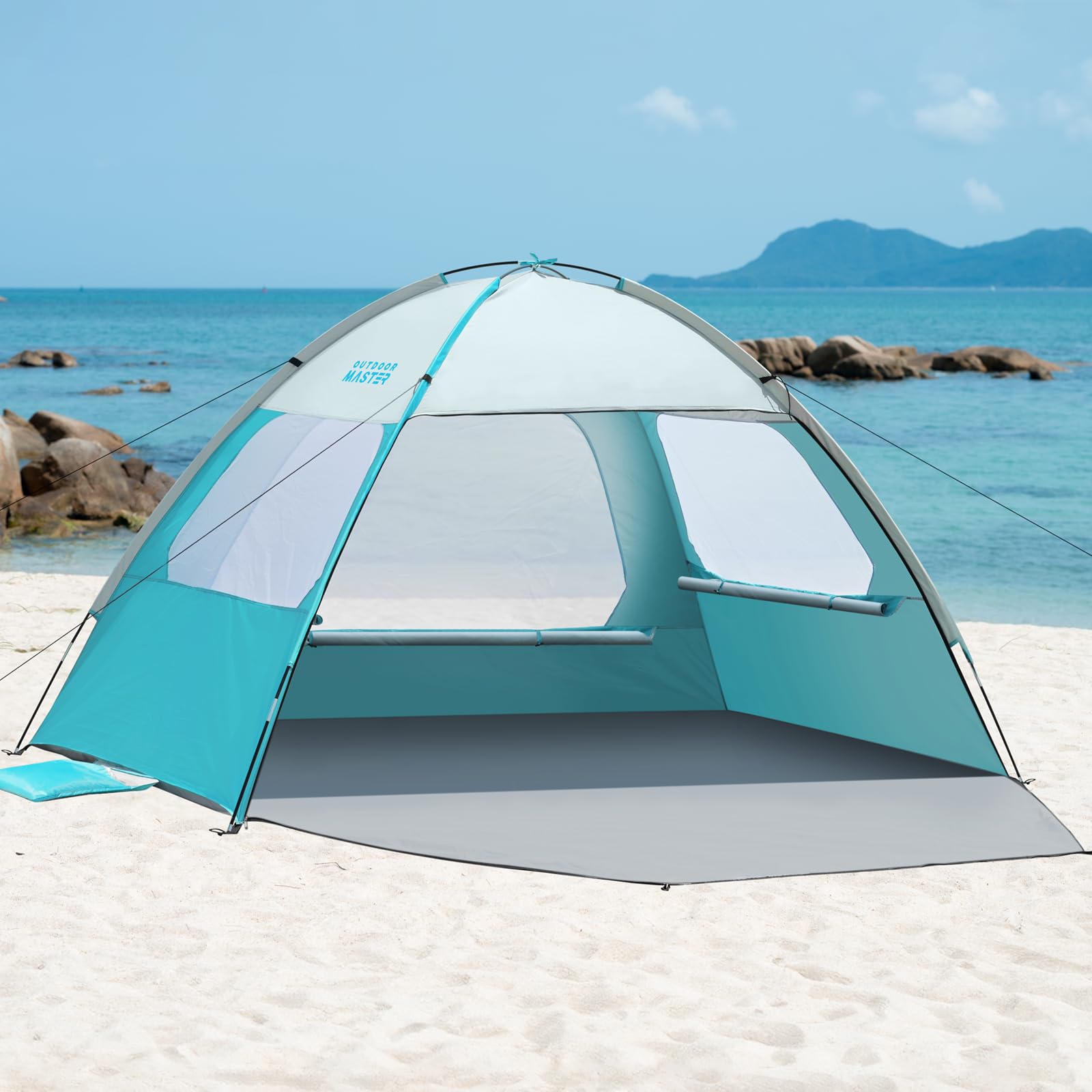
The OutdoorMaster earns its spot with the most shaded floor for the money on this list. It opens to 102.4″L x 65″W x 60″H — that is 10% longer than the Gorich — and gives you 46.25 square feet of covered floor, enough to seat 4-5 people in chairs instead of wedging everyone against the walls. The frame is an 8.5mm fiberglass pole set (fiberglass is a rust-proof pole material), thicker than the 8mm runs on cheaper tents, so it holds up season after season without rusting. Buyers report the setup is what wins them over most.
Sun coverage is UPF 50+, which the listing describes as blocking 98% of UV rays, and three mesh windows keep the air moving so the inside stays livable on a hot day. Setup is the thing everyone talks about — this is what wins people over most, since it goes up in minutes and packs back into the carry bag with room to spare. It is also genuinely light at 4.8 lb, so it drops into a beach bag or the trunk without a second thought.
The honest catch is the poles and the wind. The recurring gripe is that solo setup on a breezy day is a two-person job — you thread the poles, and the fabric catches before you are done. Tension it down with the stakes and weight the corners thoroughly, and it holds; skip that step and it behaves like a kite. There is also a divider between people who find it sturdy and people who do not, so treat the poles gently and it will treat you well. At 4.4 stars, the crowd that owns it is mostly delighted — a handful wanted a gentler solo setup.
What earns its keep
- 46.25 sq ft of floor and 60″ of headroom — room for 4-5 people with chairs
- 8.5mm fiberglass frame that stays rust-free and holds its shape
- UPF 50+ fabric with three mesh windows for airflow
- Just 4.8 lb, packs into the included carry bag
Where it asks for help
- Solo setup in wind is genuinely hard — bring a second pair of hands
- Pole threading takes patience the first few trips
- Sand clings to the floor and it is a tight squeeze back into the bag
Reach for this if: you want the largest shaded floor for the money and usually have a helper to set it up.
Look elsewhere if: you set up alone in a stiff breeze and need a frame that springs open in seconds.
2. OAOA Beach Tent Sun Shelter with 114 x 82″ Extended Mat
A tent plus a picnic mat in one bag, so the kids get their own sand-free zone out front.
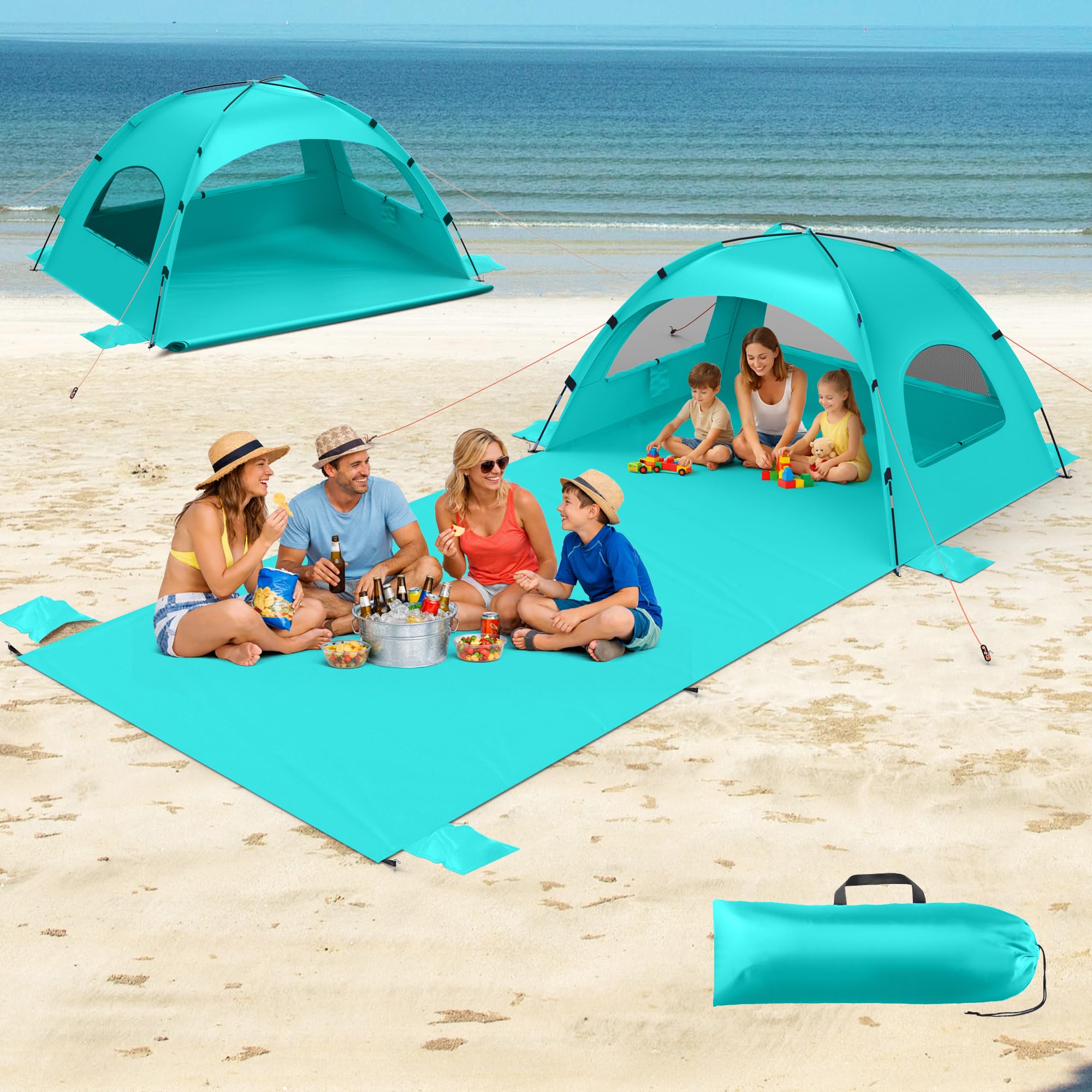
The OAOA’s standout is its mat. Most beach tents give you a shell and nothing else; this one unrolls an 82″ x 114″ waterproof floor out the front door, so you get a tent to sit under plus a separate apron for blankets, snacks, or a toddler who refuses to stay inside. Inside, the room measures 86.6″ x 59.6″, and the whole thing is lined in 210D Oxford cloth (a tough, tightly woven fabric) with a dual sun-and-water coating. It also beats the OutdoorMaster on usable ground — the extended mat opens up a wider footprint than the OutdoorMaster’s plain floor does. If you want a tent plus a sand-free picnic zone, this is the one; if you only need shade and no apron, the OutdoorMaster covers more floor for less.
Wind handling is where the numbers do the talking. The fiberglass supports are 149.6″ long and 8 mm thick, and they come bundled with 4 sandbags, 12 stakes, and 4 guy lines — that is the most complete anchor set on this list. Owners put it up solo in about five minutes and report folding it back down just as fast. One buyer, testing it on a gusty day, put it up in about five minutes and “withstood 20-25 mph winds with no issues!”
The trade-offs are fair ones. Some owners find the polyester warms up under direct sun, so ventilate it with the mesh windows open and it stays comfortable. A few mention the rear patio section soaks up sand because it lacks side walls — the nature of an open apron. And it is not the lightest; at 5.17 lb, it is 14% heavier than the Gorich. Set expectations there and the roominess wins you over.
The mat makes it: the 82″ x 114″ extended floor is what owners praise most — it turns a small tent into an all-day base camp with a place for gear that never touches the sand.
Keep an eye on: that open front apron collects wind-blown sand, so shake it out before you fold.
Who it is for: groups and families who want a tent and a picnic pad from one bag, and who don’t mind anchoring it properly.
Who might prefer another: if every ounce counts on the walk to the sand, the Gorich and OutdoorMaster both carry lighter.
3. Gorich Beach Tent Sun Shelter with UPF50+
Two zippered doors that drop into extra floor, for a couple who wants a cross-breeze and a private changing room.
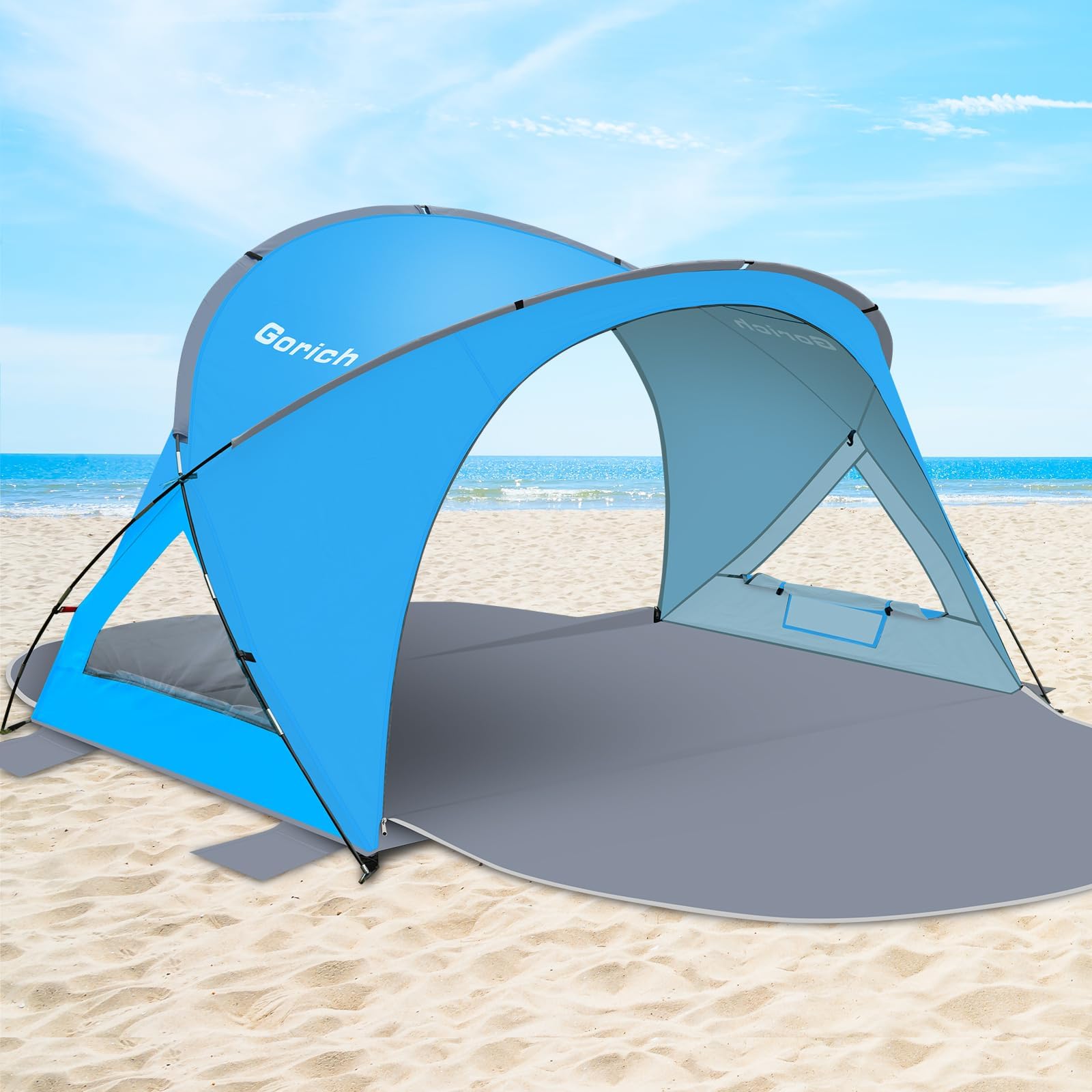
Gorich takes a different shape than the tents above. The square-top cut packs 30% more usable internal space than a traditional dome, per the maker, and the two pull-down doors each fold out into their own sand-free extension floor. Zip them shut and you have a fully enclosed changing room; open the rear window and the whole tent turns into a breezeway. For two adults who want airflow and a bit of privacy on a hot day, that is a smarter layout than a single big shell.
Sun coverage is UPF50+ through a silver-coated fabric, and the UV cut is listed as at least 98%. At 5.9 lb with a folded size of 16.9″ x 5.9″ x 5.9″ — roughly the length of a keyboard — it drops into a suitcase without drama. The frame is 8mm thickened fiberglass with 4 sandbags, 8 stakes, and 4 wind ropes; the maker rates it for Beaufort 3-4 wind. And it holds on price: the entire rig costs roughly the same as the OAOA above, but you are trading the giant front mat for those two doors.
Set your expectations on assembly, because the honest answer is mixed. Owners who follow the directions once — folding it flat at home first, then threading the poles on the beach — get it up quickly. Owners who thread it cold, especially in wind, find the poles bow and the sleeves tight. That mirrors the rating: this one sits at 4.0 stars, the only sub-4.1 score on the list, and durability gets the most pushback. Treat the poles like glass, stake the corners before you tension anything, and it rewards you. Expect it to be fussier than the pop-ups, and you’ll be happy.
What the dual doors buy you: a full cross-draft on a still day, and a private changing room the second you zip up.
The real caveat: threading 8mm poles through tight sleeves is the job people underestimate — do a practice run in the yard first.
Consider it if: you’re a couple or small family who’d rather have airflow and a door than extra floor.
Better skip it if: you want zero-assembly setup or you’re not willing to learn the pole threading first.
4. Elegear CumbreX™ Beach Tent Sun Shelter

A tent that flips open into a canopy shelter, so it grows from a two-person shade to a full family hub.
The Elegear’s pitch is flexibility — a built-in canopy you can open or retract depending on how many people showed up, with the maker claims up to twice the space of a traditional beach tent. Snap the canopy on for a full family setup and retract it back to a regular dome for you and one other person. It carries an award nod — a NY Product Design Awards Silver and a MUSE Design Awards Silver — but the award you actually feel is that size, which is what owners rave about above everything else. Pick this if your group size changes trip to trip; pass on it if you want one fixed shape and nothing to adjust.
Sun protection runs UPF 50+ through a double-layer silver-coated, waterproof PU2000 polyester shell, and the listing claims 99% UV blocking and a 9°F interior temp drop. The frame is thickened 8.5mm fiberglass — heavier than the standard 6.0mm — and it comes with sandbags, stakes, and ropes. Setup here is the other big win; owners describe it as easy in minutes and staying secure in an ocean breeze. The 6 lb carry weight is mid-pack, and the pack-down is compact enough for a car trunk.
Two things to know before you commit. First, durability is the mixed note — some owners mention it holding solid in light wind, others find it doesn’t take a stiff blow, so bury the sandbags deep on a windy day. Second, the grommets are the part to watch: a few owners had them give out after the canopy strained in wind, so don’t leave the open canopy up unattended. Pair those cautions with a straightforward setup and this becomes a very livable family tent.
Its defining feature: the snap-on canopy doubles the shade and reconnects in seconds, so the tent adapts to your group size instead of the other way around.
Where the work is: check the grommets and sandbag deep on breezy afternoons — that is the part that wears first.
Best matched to: families who want one tent that scales from a couple to a crowd without hauling two shelters.
Think twice if: you leave a tent planted all day in stiff wind and want it to need zero babysitting.
5. Elegear Beach Tent with 360° Removable Canopy 4-6 Person

The tent that springs open in a second and then hands you a removable canopy the rest of the afternoon.
Two tents on this list come from Elegear, and this is the faster, larger, more expensive one — a 4-6 person pop-up with a patented spring-loaded frame the maker rates setup and takedown at one second. The removable 360° canopy is the headline: leave it on for doubled shaded space and doubled ventilation, pull it off and the tent shrinks back to a regular dome for a couple. It is the most flexible frame-and-canopy combination in this group, and quality is what owners praise most across the board.
Fabric is the same 190T double-layer silver-coated, waterproof PU2000 polyester as the other Elegear — UPF 50+ with a claimed 9°F interior temp drop. The frame gets the thickened 8.5mm fiberglass treatment, and the anchor kit is the fullest here: 5 sandbags, 10 stakes, and 6 ropes. Interior layout adds three storage pockets, three closable windows, and a roof hook for a hanging light. Owners describe it as spacious enough for a couple plus kids and easy for one person to set up solo, even with a baby in tow.
The friction is in the extras. Owners like the shade, but the front canopy poles are thin and can struggle in a real ocean breeze — the side sandbags do most of the heavy lifting. Several also report it running hot inside even with the windows open and reach for a battery fan on the roof hook. Fold-back is trickier than the spring-open. And durability is a mixed note, with a minority seeing the fabric strain after a season — treat the pop-up frame gently and this holds up.
Why it lands up here: one-second setup and a detachable canopy give you a couple’s tent and a family tent in one bag, and owners consistently call the build quality excellent at this price.
Where to prep: add sand weight to the canopy poles on a windy day, and pack a fan for the still afternoons.
Pick this one when: setup speed and a growth-from-two-to-six canopy matter more than anything else in the bag.
Less ideal if: you want a tent that runs noticeably cooler without adding a fan.
6. Old Bahama Bay Pop Up Beach Tent

A pop-up that swallows a family of five in shade and pops back into its bag without a wrestling match.
If you want the no-assembly convenience of a pop-up and the room of a full tent, this is the one. It is a spring-frame design that sets up in seconds and folds down in under a minute, and it opens into 81″L x 54.5″W x 62″H. Reviewers describe it as spacious enough for up to five people comfortably — one buyer fits two beach chairs, a cooler, and bags with ample room to spare, with mesh on all four sides for airflow and visibility. Sand shakes off the fabric easily, which matters more than people expect.
The shell is a silver-coated polyester that the maker lists at UPF 50+, reflecting and absorbing sunlight and cutting up to 98% of UV rays. A four-sided ventilation structure with 3 large mesh windows keeps the air moving, and stakes and sand bags are included so you can pin it down. What owners rave about most is the speed — the pop-and-fold takes under a minute for most, and it is light enough at 8.2 lb for one person to carry solo with two kids in tow. This is the fastest tent on the list to get standing.
The one honest limitation sits in strong wind. In calm and normal conditions it is easy; in a real blow, one person setting it up can struggle as the frame catches air, and the included sandbags are on the light side for anchoring. Add heavier weights or bury the corners, and it holds. This is a pop-up you buy for convenience first, so plan your wind kit accordingly and you will be delighted.
The case for it
- Springs open in seconds and folds down in under a minute — the fastest here
- Roomy 81″ x 54.5″ footprint for 3-4 people plus gear
- UPF 50+ silver-coated shell cutting up to 98% of UV
- Mesh on all sides for airflow, sand shakes off easily
Worth knowing
- At 8.2 lb it is the heaviest of the pop-up group
- Included sandbags want help against a strong beach wind
- Setting up solo in wind takes two hands and patience
Go here for: true pop-up convenience and a shell that seats a family of four without a pole in sight.
Consider a pole tent instead if: you want the lightest rig for a long walk or a freestanding frame you can adjust in any wind.
7. Rhino Valley 10 x 10 FT Beach Tent

A full canopy pavilion that shades 100 square feet and anchors with eight sandbags and four aluminum poles.
This is a different animal from the dome tents: it is a flat-topped canopy, 10 x 10 ft of shade on four thickened aluminum poles, standing 6.5 ft high so you can actually move around underneath. The Lycra fabric is triple-stitched for tensile strength and machine-washable, and the maker builds it around wind with 8 sandbags, 4 poles, and 4 windproof ropes. If you host a big beach crew and want open shade instead of a closed shell, this is the shape you want.
On a crowded summer weekend, 100 square feet of shade comfortably covers 4-8 people plus chairs, towels, and a cooler. Setup is straightforward once you have the rhythm: spread it, fill the sandbags, add the poles, and the included sand shovel saves your hands. One owner put it up with three people in about five minutes and solo in under fifteen. Owners describe it as a gazebo replacement and love that it folds into a surprisingly small carry bag. Sun protection is UPF 50+, blocking harmful UV so an all-day sit stays comfortable.
Two things to flag. The listed package includes four poles and it shades a large area, so on a packed or windy beach the footprint can be too much shade to place, and it needs its full anchor kit to hold. And it sits a bit lower than the product photos suggest — the maker lists 6.5 ft of height, and one 6-foot owner could not stand fully upright, so plan on sitting or ducking. Humble expectations on standing room keep this a winner.
The shade is the story: a 10 x 10 canopy that shelters a whole crew, and the value is that it does the job of a much heavier gazebo.
Set realistic headroom: at 6.5 ft this is a sit-under canopy, not a stand-up tent, so mind the overhead clearance.
The right call for: big family spreads and group trips where open, generous shade beats a closed tent.
Probably not for you if: you set up on a crowded beach and can’t spare a large 10 x 10 footprint.
8. Oileus XX-Large 5-6 Person Waterproof Pop-Up Beach Tent

An instant pop-up with an awning out front and a floor size ready for two adults plus kids.
The Oileus suits a quick beach trip with three features: an instant spring-open frame, a roomy 98.4″ L x 55″ D x 58″ H interior, and an awning that projects extra shade out over the front mat. The maker lists it for up to 4 adults with 2 kids, so it is one of the larger pop-ups here. The 210T polyester shell is PU-coated (a waterproof polyurethane layer) and rated to block 99% of harmful UV, so you get real sun protection on a long afternoon. The floor is 210D PE for durability underfoot, and the frame is 9mm fiberglass — thicker poles than most pop-ups use.
Setup is the star. Customers note it goes up and folds back in under 30 seconds with no strength needed — some say under two minutes for the whole routine — and it packs down to 35″ x 5.5″, light enough at 5 lb to drop in a beach cart or trunk. The package is generous: 6 sand pockets, 10 steel stakes, and 4 guylines for anchoring, plus an internal pocket and a hook for a speaker or fan. Owners consistently call the speed a standout. If you want the fastest pitch here, this is it; if you need the most floor for a big group, the OutdoorMaster’s 46.25 square feet beats it.
Be honest about the size, because it runs small. The XXL label is optimistic — owners who bought it for a 5-6 person group find it comfortably fits a family of three, so buy a tier up if you plan to seat everyone. Durability is the other mixed note; a minority had the material start to break after a few uses, though many say it holds up in heavy wind. Treat the fabric kindly, store it dry, and it serves you well. And the light weight is the payoff — nobody complains about carrying 5 lb to the water.
Why owners gush: the instant pop-up and fold-down take seconds, and the 5 lb pack is light enough to carry one-handed with a kid on your hip.
Size it up front: the XXL tag covers 4 adults plus 2 kids on paper, but a 5-6 person group will want the next size up to avoid cramping.
Suits you if: you want instant shade with an awning and a pack light enough for a solo parent to handle.
Size up if: your group is more than two adults with children, or you want to seat everyone with chairs.
9. COZEER Beach Tent Sun Shelter 10x10FT
A triangular-braced canopy built around wind, with eight sandbags and a 25 mph wind rating.
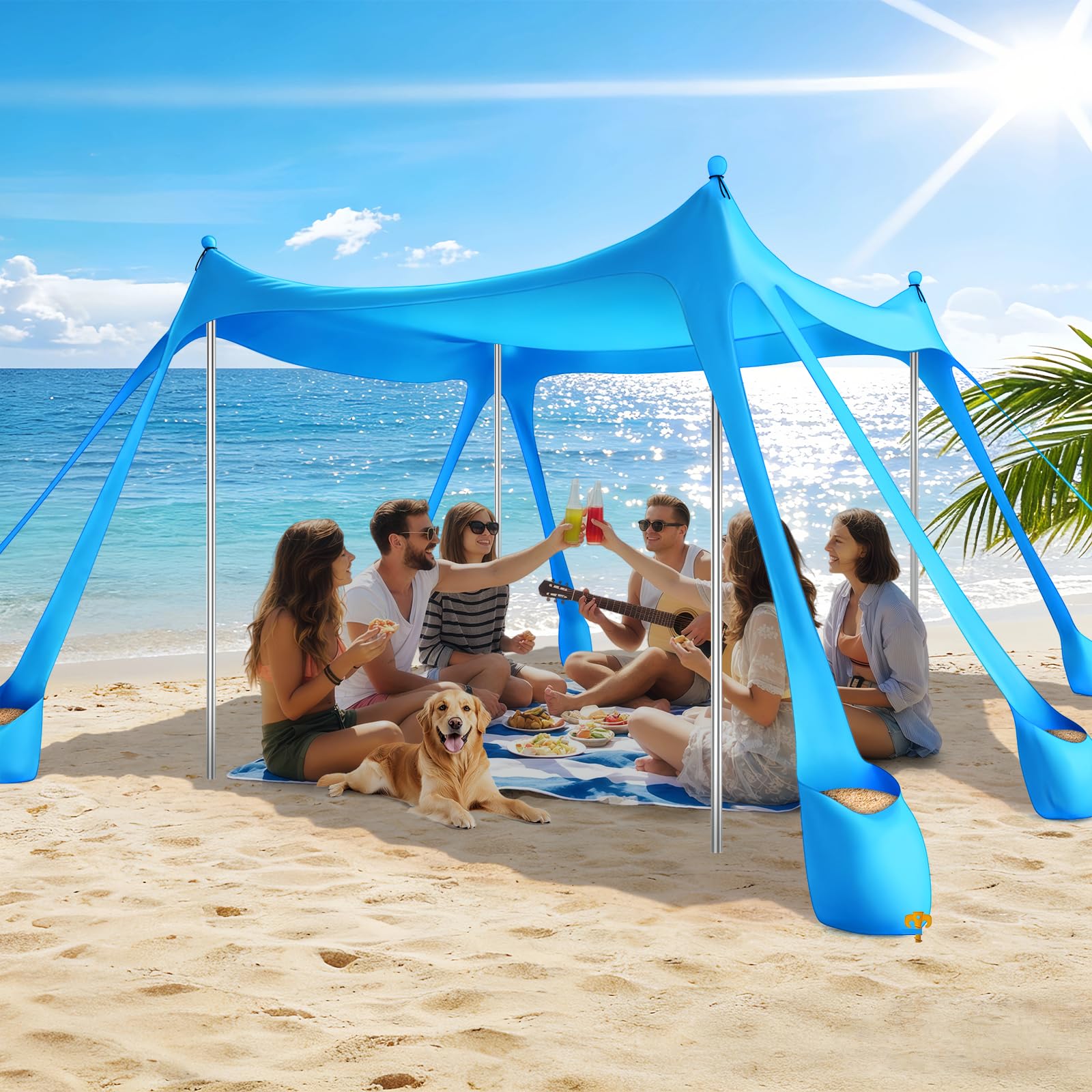
Where the domes and pop-ups are shaped for shade, this COZEER is shaped for wind. It uses a triangular windproof structure with 8 sandbags, 4 aluminum poles, 8 sand stakes, and 8 grass stakes — and the maker rates it to 25 mph winds. That is the most wind-specific spec on this list, and it addresses the exact problem with canopy-style tents on an open beach. The frame stands 6.6 ft tall with poles secured by elastic cords so they don’t shift as you tension it.
Shade is UPF 50+, and the canopy fabric is Lycra with 12% spandex for stretch and tensile strength — it blocks 98% of rays and resists sudden rain, with four-sided ventilation so you don’t bake underneath. It opens to a full 10 x 10 ft footprint that comfortably shades up to 8 people with chairs and gear, which makes it the largest-capacity option here alongside the Rhino Valley. Setup is a single-person job: unfold, secure poles, fill sandbags, insert anchors, done. On grass you swap the sand stakes for the grass stakes — a thoughtful touch if your “beach” day is actually a park day.
The catch is rain and other canopies’ least favorite condition. Owners note it is a sun shade, not a rain shelter — the fabric sags and lets drizzle through rather than beading off, so check the forecast before you commit to an all-day sit. It handles light breeze beautifully; in a hard blow, the lighter poles can give and the crew may need heavier-duty footing. Pack it as a sun-first shelter, know your day’s weather, and the wind rating earns its keep.
Built for the breeze: the triangular frame and full sandbag kit give it the strongest wind rating on the list, so it plants and stays planted on an exposed beach.
Read it as a sun shade: rain passes through the Lycra rather than rolling off, so plan around the forecast.
The one for: windy, exposed beaches where a lighter dome would take off — the 25 mph rating is the whole point.
Keep looking if: you need rain coverage or a footprint that fits a crowded stretch of sand.
Understanding the Specs
UPF Rating
UPF stands for Ultraviolet Protection Factor — it is a number that tells you how much UV a fabric keeps off you. UPF 50+ is the highest rating there is, and the tents here describe it as blocking around 98% of UV rays or more. A high UPF matters most when you plan to sit under the shade for a whole afternoon, because sunburn sneaks up on a beach day. Pair a high rating with mesh windows and openable doors: the fabric blocks the sun, but the airflow is what keeps the inside from heating up so you actually stay comfortable under it.
Frame and Poles
The frame is the load-bearing skeleton, and it is where beach tents differ most. Pop-up frames spring open from a coiled hoop, which is why they set up in seconds but can feel less rigid in wind. Pole-and-sleeve frames use fiberglass rods you thread through fabric channels; the poles here run about 8mm to 9mm thick, and fiberglass is chosen because it flexes without rusting. The thicker the pole, generally the more resistance to bend. Whichever you pick, the frame only holds if the anchor system backs it up — the poles set the shape, but the sandbags and stakes keep it there.
Anchor System
A beach tent lives or dies by how it grabs the sand. Three tools do that work: sandbags you fill on site, stakes and anchors, and guy lines that let you tension the frame down. The tents here range from 4 to 10 sandbags and from a few stakes up to 8 sand stakes plus 8 grass stakes. Bury the sandbags rather than leaving them on the surface — a buried bag grips far better than a weighted one lying loose. That single habit is the biggest difference between a tent that shames the wind and one that tumbles down the beach.
Floor Area and Headroom
Floor area is measured in square feet when it is given, and it is the real test of capacity — a “6 person” rating usually assumes seated bodies with no chairs or coolers. If you plan to keep beach chairs inside, size up one tier. Headroom matters too: a 6.5 ft canopy lets most adults move around underneath, while a lower canopy is a sit-under shelter. An extended front mat adds floor without adding to the shaded footprint, giving you a sand-free zone for shoes and toys outside the main tent — useful, since sand finds its way into every sealed floor anyway.
FAQ
What does UPF 50+ actually mean on a beach tent?
How long does it take to set up a beach tent by yourself?
Will a beach tent stay up in wind?
Is a pop-up tent better than a pole beach tent?
How many people does a beach tent really hold?
Does a beach tent keep rain out?
Can one person set up a beach tent alone on the sand?
How do I stop sand getting inside a beach tent?
Should I buy a tent or a beach umbrella for shade?
How do I pack my beach tent back into its bag?
Final Thoughts: The Verdict
For most beach days, the camping tent for beach winner is the OutdoorMaster Beach Tent because it shades the most floor for the money — 46.25 square feet, 60″ of headroom, and an 8.5mm fiberglass frame — and it wins over owners most for its easy setup. If what you actually want is a tent plus a sand-free picnic mat, grab the OAOA with the 114 x 82″ extended mat, since that front apron gives the kids their own zone. And for a breezy, open coastline where standard domes get up and walk, the COZEER 10x10FT is the one to reach for — its triangular frame is the only one here rated to 25 mph. And if pure setup speed is your priority, the spring-open Old Bahama Bay takes the crown.
One honest nudge: if you spot a beach tent with a thicker pole set — like the 8.5mm fiberglass the OutdoorMaster and both Elegears use — it usually tracks with a sturdier frame than the 6.0mm standard models, and it is the kind of detail worth paying a little more for. Whichever you choose, bury the sandbags on day one and you will spend the afternoon in shade instead of chasing your tent down the beach.
How We Picked
We do not accept paid placement. Every pick is matched to a real buyer and a real use-case; we do not hands-on test units.
Sources & Methodology
Specifications: manufacturer listings and product documentation. Review insights: verified customer reviews, as of September 2026. Pricing: not shown on this page (it changes often); check the current price via the retailer link.
As an Amazon Associate, Gadgets Feed earns from qualifying purchases. This does not affect which products we feature.