
Living with a herniated disc means every twist, bend, or lift is a gamble with searing nerve pain. The right brace doesn’t just squeeze your waist — it offloads pressure from the affected vertebrae, stabilizes the lumbar spine, and gives your core muscles the mechanical advantage they need to prevent spasms. Without that targeted support, even simple tasks like tying your shoes or sitting through a meeting can trigger a flare-up that sets recovery back days.
I’m Min — the co-founder and writer behind Gadgets Feed. I’ve analyzed dozens of back braces across multiple price tiers for this guide, focusing on the medical-grade features that actually matter for herniated disc sufferers: rigid vs. flexible stays, pulley tension systems, inflatable lumbar pads, and the ability to immobilize the L4-S1 region where disc herniations most frequently occur.
This guide cuts through the marketing noise to find the back brace for herniated disc that delivers real, measurable decompression and support for your specific condition.
How To Choose The Best Back Brace For Herniated Disc
Selecting a brace for a herniated disc isn’t about finding the most comfortable belt — it’s about matching the brace’s mechanical support to the specific level and severity of your disc injury. Buyers often over-prioritize breathability or slimness while neglecting the structural rigidity required to prevent painful micro-movements at the injured segment.
Rigid Stays vs. Flexible Support
For a diagnosed herniated disc, especially during the acute inflammatory phase, rigid steel stays are non-negotiable. They lock the lumbar spine into a neutral position and prevent flexion, extension, and rotation that can aggravate the protruding nucleus pulposus. Flexible spring strips or foam panels are better suited for chronic mild ache or postural correction — they won’t provide the immobilization needed when a disc is actively pressing on a nerve root.
Compression Tensioning: Pulley vs. Velcro
Standard Velcro straps can loosen over a few hours of wear, especially during sitting or bending. A pulley system — using aircraft-grade cable routed through guides — allows you to ratchet compression to a consistent, repeatable tension. This is critical for herniated disc patients because uneven pressure distribution can shift the load onto the painful side. Pulley braces also let you release tension without removing the brace, which helps during sitting when intradiscal pressure is highest.
LSO Design vs. Standard Belts
Lumbosacral orthosis (LSO) braces extend coverage from the mid-back (L1) down to the sacrum (S1), providing superior stabilization across the entire lumbar curve. Standard back belts only wrap the lower abdomen and lumbar area, missing the sacroiliac joint involvement that often accompanies lower disc herniations. If your doctor has prescribed an LSO, don’t substitute it with a generic support belt — the biomechanical support profiles are fundamentally different.
Adjustable Lumbar Pads for Targeted Decompression
An inflatable or adjustable arch pad allows you to increase lordotic support — the inward curve of the lower spine. For herniated discs at L4-L5 or L5-S1, increasing this curve can open the posterior disc space slightly, reducing pressure on the herniated fragment against the nerve. Fixed foam pads may not provide enough lift or may push in the wrong direction depending on your specific disc level involvement.
Quick Comparison
On smaller screens, swipe sideways to see the full table.
| Model | Category | Best For | Key Spec | Amazon |
|---|---|---|---|---|
| BaxMAX Adjustable Back Brace | Premium | Active users needing 5X pulley compression | 5-to-1 pulley system, 5 oz nylon/kevlar | Amazon |
| LSO Back Brace with Decompression Plate | Premium | Maximum immobilization for severe herniations | Bionic decompression plate, dual pulley | Amazon |
| NEENCA Lower Back Brace | Mid-Range | Slim profile medical-grade daily wear | Medical-grade polyester/spandex, multi-point support | Amazon |
| DARLIS Back Brace with Inflatable Pad | Mid-Range | Customizable decompression via inflatable lumbar pad | 6 rigid steel stays + inflatable pad | Amazon |
| Slim & Narrow Back Brace | Mid-Range | Discreet support for desk workers | L4-S1 targeted compression, 4-inch front panel | Amazon |
| TEKOMVO Work Back Brace | Entry-Level | Heavy lifting and industrial use | 5 flexible support bars, shoulder straps | Amazon |
| Bracepost 360° Back Brace | Entry-Level | Hot/cold therapy integration with support | 26° bionic curvature, 3D massage pad | Amazon |
In‑Depth Reviews
1. BaxMAX Adjustable Back Brace
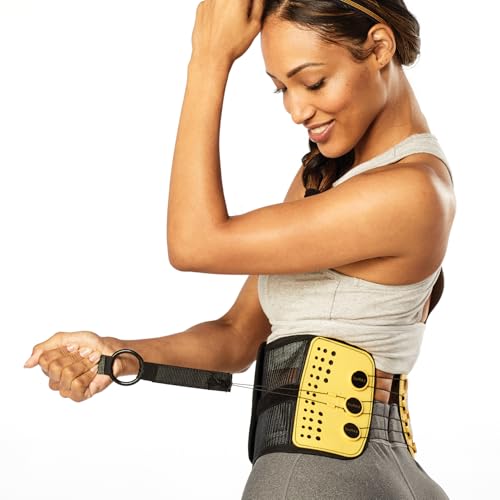
The BaxMAX redefines what a herniated disc brace can deliver with its patented 5-to-1 pulley system — a single pull generates five times the compression of standard Velcro straps, giving you precise, repeatable tension that stays locked during movement. The body is constructed from a lightweight nylon/kevlar blend mesh weighing only 5 ounces, making it one of the lightest serious support braces on the market. Chiropractor-recommended and used in over 3,000 clinics for 15 years, this brace is trusted specifically for acute lumbar disc herniation, bulging discs, and sciatica cases.
The three-way wearing positions let you adjust compression levels throughout the day without removing the brace — critical for herniated disc patients who need more support during standing or walking and less during seated rest. The Kevlar-reinforced pulley cable resists fraying even under daily high-tension use, while the breathable mesh prevents the sweat buildup that plagues neoprene braces. Users with L4/L5 herniations report immediate focused lumbar compression that offloads the affected disc without constricting the abdomen or chest.
Compatibility with optional hot/cold therapy packs adds versatility for managing inflammation alongside mechanical support. The hook-and-loop closure and pulley system work in concert to distribute compression evenly across the lumbar spine rather than pinching at isolated points. For active individuals who refuse to let a herniated disc sideline them, the BaxMAX delivers a level of adjustability and targeted stabilization that cheaper braces simply cannot replicate.
Why it’s great
- Patented 5-to-1 pulley delivers superior, consistent compression for herniated disc stabilization
- Ultra-lightweight 5-ounce construction allows all-day wear without fatigue
- Three-way wear positions enable tension adjustment for sitting, standing, or movement
Good to know
- Material may roll up slightly at edges during prolonged sitting
- Best suited for active use rather than stationary desk work
2. LSO Back Brace with Maximum Decompression Plate

This is not a general support belt — it’s a lumbosacral orthosis (LSO) with a bionic decompression plate engineered to stabilize the L1 through S1 vertebrae. The rigid plastic plate combined with an adjustable arch that reaches 26 degrees of bionic lumbar extension provides the closest thing to a clinical traction unit you can wear throughout your day. The dual pulley system uses finger-tab pulls that seniors or those with grip weakness from nerve root irritation can operate without strain.
The three-stage arch adjustment lets you customize support: maximum arch for active lumbar correction and decompression before or after activity, a moderate arch for protection during daily tasks, and the option to remove the arch entirely for lounging or sleep. An additional abdominal extension piece with a removable plastic panel provides supplementary support for postpartum lumbar pain or abdominal obesity — a thoughtful inclusion for patients whose disc issues are compounded by core weakness. Users with herniated discs at L4-L5 and L5-S1 report 80% immobilization of lower back movement, allowing functional activity that would otherwise be impossible during flare-ups.
The sizing runs from S/M (belly 23.5″-33.75″) up to 2XL/3XL, and the boxy design accommodates larger torsos better than tapered braces. While it won’t disappear under tight clothing, the trade-off is uncompromising structural support. Patients coming off post-surgical braces have confirmed this unit replicates the function of hospital-issued orthoses at a fraction of the cost. For severe herniations requiring maximum stabilization, this is the brace that delivers.
Why it’s great
- Bionic decompression plate provides targeted L1-S1 stabilization for severe disc injuries
- Adjustable arch (up to 26 degrees) allows three levels of lumbar extension
- Dual pulley system with finger tabs is accessible for those with limited grip strength
Good to know
- Bulky design is not discreet under fitted clothing
- Abdominal plate may feel rigid for some users during prolonged wear
3. NEENCA Lower Back Brace

The NEENCA strikes a rare balance between medical-grade construction and a low-profile silhouette that fits discreetly under clothing. Crafted from medical-grade polyester and spandex, this brace uses multi-point support engineering to distribute pressure across the lumbar spine rather than concentrating it at a single point — reducing the risk of pressure sores during extended wear. The dual elastic Velcro straps allow custom tensioning for herniated disc, sciatica, and spinal stenosis sufferers without the bulk of a full LSO.
Breathable mesh fabric prevents overheating even during warm-weather wear or physical activity, addressing a common complaint among back brace users. The slim 9.5-inch profile sits comfortably at the waist without riding up into the ribs or rolling down over the hips — a fit issue that plagues wider designs on shorter torsos. Patients with L5-S1 herniations have reported that the plastic curvature support prevents unwanted spine shifting during sleep, while the adjustable tension tabs let them increase support when standing and decrease it for seated rest.
Available in five sizes from Small to XX-Large, the NEENCA covers waists from 25.9 to 65 inches, making it one of the more inclusive mid-range options. The hook-and-loop closure maintains grip even after repeated adjustments, and the slim design means you can wear it under a shirt without announcing your condition to colleagues. For daily wearers who need consistent support without the visual and physical footprint of a medical orthosis, the NEENCA delivers reliable performance.
Why it’s great
- Medical-grade construction with multi-point support for even pressure distribution
- Slim, breathable design fits discreetly under daily clothing
- Plastic curvature support prevents spine shifting during rest and sleep
Good to know
- Less rigid than steel-stay braces for acute-phase herniations
- Inner support may feel pronounced during prolonged driving
4. DARLIS Back Brace with Inflatable Lumbar Pad
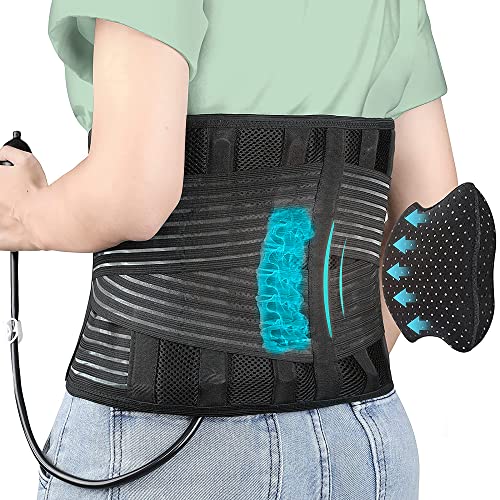
The DARLIS is built around a unique proposition for herniated disc sufferers: six rigid steel stays for structural immobilization combined with an adjustable inflatable lumbar pad that lets you dial in the exact degree of lordotic support. This dual-system approach means you can increase the arch in your lower back during acute episodes to open the posterior disc space, then deflate the pad for a neutral position during recovery or sleep. The six stays are arranged to lock the spine in a safe position while two flexible spring strips allow controlled movement during bending and twisting.
The air mesh and 80% soft nylon fabric prioritize breathability, while silicone anti-slip bands on each side prevent the belt from migrating up or down during activity — a common frustration with heavier braces. At 0.67 kilograms, it has a substantial feel that reassures users of its structural integrity without being unbearably heavy. Patients with pre-surgery herniated discs have reported this brace significantly reduces pain enough to continue physical therapy and reduce reliance on painkillers, though it does not eliminate pain entirely — no external brace can do that.
Sizing runs from S/M up to 4XL/5XL, and the hook-and-loop closure provides a wide adjustment range. The inflatable pump mechanism is located at the back, which can be difficult for users with limited shoulder mobility to reach independently — a design consideration to weigh if your herniation affects your upper body range of motion. For buyers who want active control over their lumbar curve throughout the day, the DARLIS offers an unmatched level of adjustability in the mid-range tier.
Why it’s great
- Six rigid steel stays provide robust immobilization for acute herniated disc episodes
- Inflatable lumbar pad enables adjustable lordotic support throughout the day
- Silicone anti-slip bands prevent brace migration during movement
Good to know
- Inflatable pump hose is positioned at the back, hard to reach for some users
- Heavier construction than slim-profile alternatives
5. Slim & Narrow Back Brace for Lower Back Pain

Most back braces treat the entire lumbar spine uniformly, but this slim design specifically targets the L4 to S1 region — the exact segment where the majority of herniated discs occur. The 4-inch anterior panel and 5-inch posterior panel with soft-edge construction won’t dig into your hip bones or ribs during seated work, making this the most ergonomic option for desk-bound herniated disc sufferers. The pulley adjustment system lets you fine-tune compression instantly without fumbling with bulky straps.
The breathable mesh inner layer with perforated holes actively wicks moisture away, addressing the “sticky back” problem that makes many braces unbearable during summer months or long office hours. Despite its lightweight appearance, integrated support stays and high-tension elastic compression straps deliver serious support — enough that users report significant relief from both lower back pain and associated hip bursa discomfort. The slim profile means it disappears completely under dress shirts or polo shirts, allowing you to wear it through the workday without drawing attention to your condition.
Available in XS (26-31.5″), S/M (32-42″), and L/XL (42-53″), the size range is more limited than some competitors, so accurate waist measurement is critical. The lack of rigid steel stays means it won’t provide the same level of immobilization as a full LSO for severe herniations, but for managing chronic disc pain during daily activities, the balance of targeted support and wearability is excellent. For office workers who need to maintain mobility while protecting their disc, this is the most practical option.
Why it’s great
- Anatomically contoured to focus support on the L4-S1 region where disc herniations typically occur
- Ultra-slim profile fits discreetly under work attire
- Pulley adjustment system enables precise, instant compression changes
Good to know
- Lacks rigid steel stays for severe acute-phase immobilization
- Size range is limited compared to competitors
6. TEKOMVO Work Back Brace

Built for the demands of heavy lifting and repetitive physical labor, the TEKOMVO Work Back Brace integrates five flexible support bars with an oblique arc design that conforms to the natural curve of the lower spine. The dual-layer construction — a soft breathable inner layer for comfort and an adjustable outer compression layer — provides graduated support that protects the lumbar discs during lifting without restricting range of motion. Removable suspenders prevent the brace from sliding down during overhead work or bending tasks.
This brace is less about immobilizing a herniated disc during recovery and more about preventing further injury during high-load activities. The two adjustable elastic bands distribute pressure across the lumbar muscles and spine, reducing strain on the discs and nerve roots. Users working in construction, warehousing, or manufacturing report that the breathable fabric keeps them cool during full-shift wear, and the machine-washable care instructions make maintenance straightforward for daily use.
Sizing spans from S (25-30″) to a massive 6XL (65-76″), accommodating virtually any body type. The absence of rigid steel stays means it won’t provide the same level of spinal locking as premium braces, but for entry-level buyers who need a durable work brace to protect a known disc issue during physical jobs, the TEKOMVO delivers reliable support at a budget-conscious price point. Users with moderate herniations who are medically cleared for work will find this brace helps maintain proper lifting mechanics throughout the day.
Why it’s great
- Five oblique-arc support bars distribute lifting stress across the lumbar spine
- Removable suspenders prevent slipping during dynamic work movements
- Machine washable for easy maintenance during daily industrial use
Good to know
- Flexible bars provide less immobilization than steel-stay braces for acute herniations
- Bulky design may be uncomfortable for seated or sedentary use
7. Bracepost Back Brace with Hot/Cold Compress

The Bracepost stands out in the entry-level segment by combining structural support with active therapy features — a reusable medical-grade hot/cold pack fits into a dedicated pocket on the inner brace, allowing you to apply temperature therapy directly to the painful disc area without removing the brace. The 26-degree bionic curvature support is molded to complement the natural lordotic curve of the spine, helping maintain improved posture while providing substantial lumbar support during daily activities at home, work, or during light exercise.
An included removable 3D massage pad provides gentle acupressure to the lower back region, potentially helping to reduce muscle tension and promote circulation around the affected disc. The 360-degree ergonomic support system uses upper and lower adjustable compression straps plus four supplementary straps for enhanced stability and reduced shifting during movement. The high-stretch 3D knit fabric conforms to your body shape and allows discreet wear under loose clothing, making it suitable for office environments where a medical-looking brace would be conspicuous.
Available in five sizes based on precise waist measurements, the aluminum-stayed construction provides more structure than foam-only braces at this price point. Users report immediate pain relief for conditions including herniated discs, sciatica, and scoliosis, with many noting significant improvement from the first day of wear. The integration of hot/cold therapy directly into the support system makes this brace uniquely suited for the inflammatory phase of a disc injury, where reducing swelling around the nerve root is as important as mechanical stabilization.
Why it’s great
- Integrated hot/cold therapy pack provides temperature treatment alongside mechanical support
- 26-degree bionic curvature complements natural spinal lordosis
- Removable 3D massage pad aids muscle tension relief and circulation
Good to know
- Stated waist measurements may run slightly smaller than indicated on the belt itself
- Aluminum stays are lighter but less rigid than steel alternatives
FAQ
Can a back brace actually heal a herniated disc?
Should I wear my back brace while sleeping?
How tight should my back brace be for a herniated disc?
How do I know if I need an LSO brace vs. a standard back belt?
Can I wear a back brace while driving with a herniated disc?
Final Thoughts: The Verdict
For most users, the back brace for herniated disc winner is the BaxMAX Adjustable Back Brace because its 5-to-1 pulley system delivers repeatable, targeted compression that active herniated disc patients can adjust throughout the day without removing the brace. If you need maximum structural immobilization for a severe herniation, grab the LSO Back Brace with Decompression Plate. And for discreet daily wear that disappears under office clothes while still supporting the L4-S1 region, nothing beats the Slim & Narrow Back Brace.