
An Alaska cruise is a sensory overload of glaciers, whales, bears, and bald eagles — moments that appear suddenly and vanish just as fast. The wrong binoculars, with fogged lenses or shaky hands, turn those once-in-a-lifetime sightings into blurry regrets. The right pair makes the 17th deck the best seat in the house.
I’m Min — the co-founder and writer behind Gadgets Feed. I’ve spent countless hours analyzing lens coatings, exit-pupil formulas, and waterproofing standards to separate real marine-ready optics from marketing that would sink on day one. This guide is built from deep spec research, not guesses.
Whether you need steady 10x magnification for spotting a humpback breach or a compact 8×25 for quick drawer access, the right binoculars for alaska cruise must balance optical clarity, weather sealing, and portability to handle the unique demands of being on the water.
How To Choose The Best Binoculars For Alaska Cruise
Choosing binoculars for an Alaska cruise means optimizing for a unique set of conditions: saltwater mist, low light at dawn and dusk, and the constant motion of the ship. You need a pair that balances magnification against stability, brightness against weight, and durability against portability. Forget what works for a sunny birdwatching walk — this is a different game.
Magnification vs. Stability: The 10x Ceiling
On a moving ship, your body becomes the tripod. Hand shake is amplified by magnification, so 12x or higher often produces a bouncy, frustrating view that blurs the very details you’re trying to catch. An 8x or 10x binocular offers the sweet spot: enough reach to see a bear on the shoreline without turning a whale’s spout into a blur. The lower magnification also gives you a wider field of view, making it easier to find your target when the ship is swaying.
Waterproofing and Fogproofing: Non-Negotiable Marine Specs
Alaska’s weather changes every ten minutes. A drizzle will turn into a downpour, and your cabin-to-deck temperature swing will fog any standard optic. Look for nitrogen-purging and O-ring seals that make the binocular truly waterproof, not just splash-resistant. An IPX7 rating or better is what separates binoculars that survive the trip from those that become expensive souvenirs after the first squall. This is the single most important spec for a cruise context.
Light Transmission for Twilight Hours
The best wildlife action in Alaska happens during the golden hours of dawn and dusk, when light levels drop sharply. A large objective lens (42mm or 50mm) combined with High Definition (ED) glass and top-tier anti-reflective coatings dictates how bright and clear the image will be when the sun is low. Don’t just look at magnification — the exit-pupil number (objective diameter divided by magnification) tells you how bright the image will be. Anything below a 4mm exit pupil will struggle in dim light, making a 10×42 a smarter choice than a 10×25 for early-morning glacier viewing.
Quick Comparison
On smaller screens, swipe sideways to see the full table.
| Model | Category | Best For | Key Spec | Amazon |
|---|---|---|---|---|
| Nikon MONARCH M7 10×42 | Premium | Maximum clarity on the water | ED glass, 362ft FOV | Amazon |
| ZEISS Terra ED 10×42 | Premium | Premium glass on a budget | 88% light transmission | Amazon |
| Nikon Monarch 7 8×42 | Premium | Widest field of view | FOV 420ft, ED glass | Amazon |
| Leupold BX-4 Pro Guide 12×50 | Premium | Extreme long-range detail | 12×50, Guard-ion coating | Amazon |
| Steiner Marine 7×50 | Mid-Range | Rough-weather workhorse | Float glass prisms | Amazon |
| Bushnell H2O Xtreme 10×42 | Budget | Best value waterproof optic | IPX7, Fully Multi-Coated | Amazon |
| ZEISS Terra ED Pocket 8×25 | Compact | Ultra-portable backup | LotuTec coating | Amazon |
In‑Depth Reviews
1. Nikon MONARCH M7 10×42 Binocular
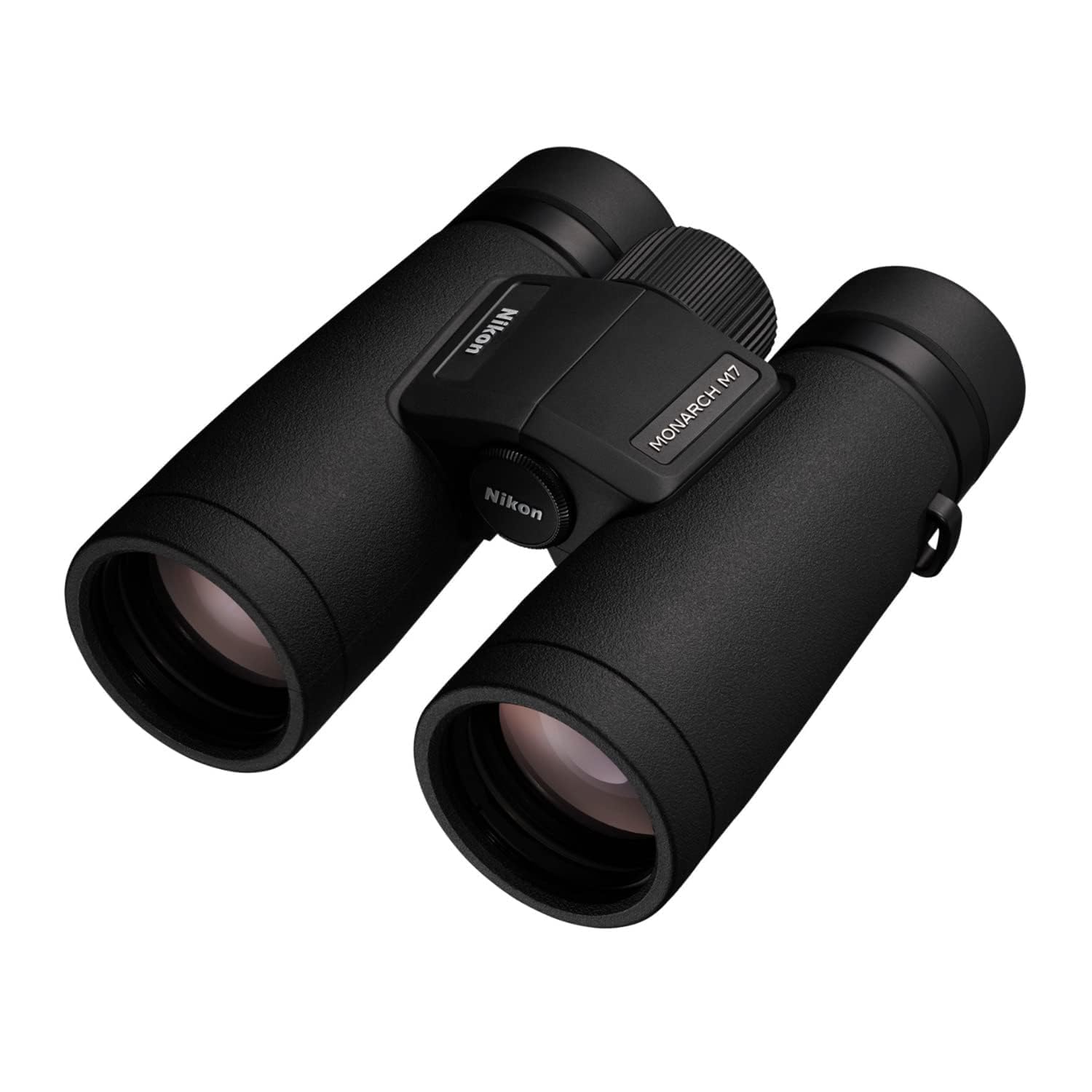
The Nikon MONARCH M7 10×42 sets the benchmark for binoculars on an Alaska cruise. Its ED glass and dielectric-coated prisms deliver exceptional edge-to-edge sharpness, with a 362-foot field of view at 1,000 yards that lets you track a breaching whale without losing the horizon. The 4.2mm exit pupil ensures the image stays bright even during Alaska’s dim early-morning sail-ins to Glacier Bay.
The oil- and water-repellent coating on the lenses is a practical lifesaver for the spray-laden deck environment — one quick wipe clears salt residue without smearing. At 1.4 pounds, the rubber-armored chassis is light enough to hang from your neck during a six-hour scenic cruise without fatigue, and the twist-up eyecups work perfectly with sunglasses. The smooth center-focus knob maintains tension over time, which is critical when you need to rapidly refocus between a distant eagle and a nearby sea otter.
Nitrogen-filled and O-ring sealed, the M7 is fully waterproof and fogproof against the temperature swings from the heated cabin to the freezing deck. Some users note slight chromatic aberration in extreme high-contrast conditions like a white glacier against a blue sky, but adjusting the angle of view eliminates it. This is the pair that makes every Alaska moment feel magnified without making you feel unsteady.
Why it’s great
- ED glass and dielectric prism coatings produce stunning clarity and color accuracy
- Oil-repellent lens coating handles rain and salt spray effortlessly
- Lightweight build with excellent ergonomics for extended viewing
Good to know
- Some chromatic aberration visible on extreme bright-edge scenes
- Premium price point requires a serious commitment
2. ZEISS Terra ED 10×42 Binocular

The ZEISS Terra ED 10×42 brings legendary German optical engineering into a mid-range price bracket that competes head-to-head with the best. The Schmidt-Pechan ED glass achieves 88% light transmission, making it one of the brightest options in its class for low-light scenarios — think spotting a brown bear along a forested shoreline at dusk. The hydrophobic multi-coating sheds water instantly, keeping your view clear in the constant drizzle of an Inside Passage transit.
The large, fast-focus wheel is positioned so your index finger naturally finds it, which is crucial when you’re fumbling with cold hands or gloves. The fiberglass-reinforced polycarbonate housing is tough yet surprisingly light, allowing you to stow it in a daypack for shore excursions without adding noticeable weight. With 18mm of eye relief, glasses wearers get the full field of view without vignetting — a common complaint on cheaper models that ruins the immersion.
Some users mention the tripod mount compatibility, which is a bonus if you plan to set up a photo pod on the deck, though most cruise binocular use is handheld. The ZEISS name brings a confidence in collimation and build that many cheaper brands lack. For the buyer who wants premium glass without the premium price of a flagship Swarovski, the Terra ED is the sweet spot for cruise life.
Why it’s great
- 88% light transmission with ED glass delivers exceptional low-light performance
- Fast-focus wheel is intuitive and responsive even with cold hands
- Hydrophobic coating handles rain and salt spray better than most
Good to know
- Made in China despite German brand premium
- Some users report a slightly stiff diopter ring initially
3. Nikon Monarch 7 8×42 Binocular

The Nikon Monarch 7 8×42 delivers the widest field of view in this comparison at 420 feet per 1,000 yards — a massive visible sweep that makes finding distant objects on a moving ship far easier. This is a critical advantage when scanning for spouting whales or Dall’s sheep on a mountainside; the 8x magnification is steady enough for handheld use, while the 5.25mm exit pupil provides maximum brightness for twilight conditions. The Extra-low Dispersion (ED) glass reduces color fringing, so the edge of a glacier appears crisp rather than ringed in purple.
The rubber-armored coating provides a non-slip grip even in wet conditions, and the closed-bridge design protects the focus mechanism. The 8x magnification is particularly forgiving of ship motion — you’ll find it easier to hold a steady image than with any 10x or 12x pair, making it the clear choice for anyone prone to queasiness on deck. It weighs just over a pound, manageable for full-day use.
Several owners report a “rolling ball effect” during rapid panning, a known peculiarity of the Monarch 7’s wide-angle design that some find disorienting. It’s not universal, but it’s worth testing. The eye relief is generous at 17.1mm for eyeglass users, though the included case feels cheap for this price tier. Still, for sheer immersive viewing on a glacier cruise, the Monarch 7 is unmatched.
Why it’s great
- Widest FOV (420ft) makes target acquisition fast and natural
- 5.25mm exit pupil is excellent for dawn/dusk viewing
- 8x magnification is the most stable option for shipboard use
Good to know
- Some users experience a rolling ball effect during quick panning
- Included case and neck strap quality feel below premium standards
4. Leupold BX-4 Pro Guide HD 12×50 Binocular

The Leupold BX-4 Pro Guide HD 12×50 is the binocular for the dedicated naturalist who demands extreme reach. The 12x magnification and 50mm objective combine to deliver a 65.2-degree apparent field of view, bringing distant tidewater glaciers and mountain goats into intimate detail. The Guard-ion lens coating repels water, dirt, and fingerprints aggressively, which is invaluable on a deck where salt spray and sunscreen-covered hands are the norm.
Made in Japan and backed by Leupold’s legendary lifetime warranty, the open-bridge dual-hinge design keeps the 1.8-pound weight well-balanced, though the higher magnification demands a steadier hand or a deck railing for support. At 12x, any ship roll is amplified, so this is best used when you have a stable surface or a monopod. The 4.17mm exit pupil provides adequate brightness for daytime and twilight, but low-light performance won’t match a 10×50 or 7×50 with a larger exit pupil.
The BX-4 Pro delivers exceptional resolution at distances beyond 400 yards, where other binoculars blur into indistinct shapes. The focus knob is precise with zero backlash, critical for dialing in on a distant bear that’s moving along the shoreline. If you’re the type who wants to see individual rivets on a passing fishing boat or read the species tag on a distant eagle, this is the tool. Just be prepared to brace it.
Why it’s great
- 12×50 magnification resolves extraordinary detail at extreme distances
- Guard-ion coating is the best water/fingerprint repellent available
- Lifetime warranty from a legendary American brand
Good to know
- 12x magnification requires bracing against ship motion
- Heavier at 1.8 lbs, tiring for extended handheld use
5. Steiner Marine 7×50 Binocular

The Steiner Marine 7×50 is purpose-built for the marine environment, with German engineering focused entirely on survival and low-light performance. The 7×50 formula yields a massive 7.14mm exit pupil — the brightest image in this guide, making it the undisputed king for dawn, dusk, and foggy Alaskan mornings. The Sports Auto Focus system, once set, keeps everything sharp from 20 yards to infinity without any manual focus adjustment — a massive convenience when you spot a pod of orcas while also holding your coffee.
The floating prism system absorbs severe shock, a real consideration when you’re bouncing through wake chop on a small excursion boat. The rubber-armored body is designed to shrug off saltwater exposure and drops on a wet deck. At 7x magnification, the image is practically rock-steady even on a moving vessel, eliminating the shake that ruins higher-power views. The trade-off is that 7x won’t bring in a distant mountain goat as close as a 10x will, but for marine and coastal wildlife, the field of view and stability are superior.
The Steiner is heavy — the price you pay for the large 50mm objectives and rugged construction. The individual focus design (each eyepiece adjusts separately) takes getting used to and is not ideal for rapid refocusing between different distances. The included strap is thin, and many users replace it for comfort. This is not a compact travel optic; it’s a dedicated marine tool that will outlast every other piece of gear on your trip.
Why it’s great
- 7.14mm exit pupil provides unmatched low-light brightness
- Auto-focus system eliminates the need for constant refocusing
- Floating prism and rubber armor survive brutal marine conditions
Good to know
- Heavy and bulky for carrying on shore excursions
- Individual focus is slower to adjust between near and far targets
6. Bushnell H2O Xtreme 10×42 Binocular

The Bushnell H2O Xtreme 10×42 is the budget champion that outperforms its price tag. Fully multi-coated optics and BaK-4 prisms deliver a surprisingly bright and clear image, with the 10×42 format providing a solid balance of reach and brightness for shipboard use. The IPX7 waterproof rating means it can be submerged up to one meter for 30 minutes — far beyond what you’ll need for a rain squall, but confidence-inspiring for the spray-prone deck.
The rubberized, O-ring sealed design is rugged and offers a non-slip grip even with wet hands. At 25 ounces, it’s heavier than the premium Nikons but still manageable for a full day of hanging from a neck strap. The center-focus mechanism is smooth and precise, with a diopter ring that holds position once set. The 17mm eye relief works well with glasses, and the twist-up eyecups lock firmly.
The downside is the lack of a tripod adapter socket — a notable omission if you want to mount them for extended glacier watching. The field of view is narrower than the Monarch series at 357 feet per 1,000 yards, but it’s still functional for most wildlife spotting. A few users note that the neck strap is uncomfortable, but that’s an easy swap. For the price, this is the most capable waterproof cruiser you can buy without breaking the bank.
Why it’s great
- IPX7 waterproof rating provides total confidence in wet marine conditions
- Fully multi-coated BaK-4 prisms deliver bright, sharp images for the price
- Rugged rubber build withstands hard use and drops
Good to know
- No tripod adapter socket for stable long-term viewing
- Heavier and less refined optics than premium-tier models
7. ZEISS Terra ED Pocket 8×25 Binocular

The ZEISS Terra ED Pocket 8×25 is the binocular you slip into a jacket pocket before leaving the cabin, always ready when a surprise whale breaches while you’re heading to the buffet. At just over 10 ounces, you’ll forget it’s there until you need it. The 8×25 format sacrifices brightness (3.1mm exit pupil) for portability, but the SCHOTT ED glass with LotuTec coating ensures that what you do see is sharp, high-contrast, and free from chromatic aberration.
The magnesium housing is waterproof and fiberglass-reinforced, so it’s far tougher than its compact size suggests. The ZEISS T* coating ensures brilliant images in adverse light, performing better than its objective size would suggest. The fast-focus wheel is large and intuitive, a rarity in pocket bins. The 16mm eye relief is barely adequate for glasses but works with contact lenses or bare eyes. The waterproofing and LotuTec coating make it fully functional in Alaska’s variable weather, unlike most pocket binoculars that fog up immediately.
The 8×25 is not for low-light dawn viewing — the 3.25mm exit pupil simply doesn’t gather enough light for Alaska’s dimmer hours. But for daytime viewing of glaciers, eagles, and harbor seals, it’s more than capable. The lack of lens caps is a strange omission for a ZEISS product, though the case offers decent protection. This is the ultimate backup pair that will always be with you, ensuring you never miss a sudden sighting.
Why it’s great
- Ultra-compact and lightweight at just over 10oz
- ZEISS ED glass and LotuTec coating provide premium image quality
- Waterproof magnesium housing is surprisingly rugged
Good to know
- 3.1mm exit pupil struggles in low-light dawn/dusk conditions
- Not suitable for long-range mountain or shoreline scanning
FAQ
Is 12x magnification too much for an Alaska cruise?
What does IPX7 waterproof rating mean for binoculars?
Final Thoughts: The Verdict
For most users, the binoculars for alaska cruise winner is the Nikon MONARCH M7 10×42 because it offers the best all-around balance of optical clarity, weatherproofing, and ergonomic design for the shipboard environment. If you want the absolute widest field of view for easy scanning, grab the Nikon Monarch 7 8×42. And for the budget-conscious cruiser who needs genuine IPX7 waterproofing without compromise, nothing beats the Bushnell H2O Xtreme 10×42.