
Our readers keep the lights on and my morning glass full of iced black tea. As an Amazon Associate, I earn from qualifying purchases.
Specs are compiled from manufacturer listings and verified buyer reviews and can change over time — please confirm the key details on the product page before buying.
Your sled fired on the first button in October. Now it’s minus twenty, the engine is stiff, and that same battery is grunting like it’s lifting something it can’t. That gap — warm-weather confidence versus a real cold snap — is what decides whether a snowmobile battery is worth owning. Here’s what actually separates a battery that survives February from one that quietly quits, so you can pick the right one the first time.
I’m Min — the founder and writer behind Gadgets Feed. This guide is built by comparing the manufacturers’ published specifications and the patterns across verified customer reviews, so you get each pick’s real strengths and trade-offs instead of marketing spin.
Three numbers decide whether a battery drops straight into your machine and spins it over: cold cranking amps (CCA — the burst of power that turns a frozen engine), amp-hour capacity (Ah — how much charge it stores), and terminal layout (which side the positive and negative posts sit on). Below are the picks that hold up in freezing garages and on trailers overnight, from a mild trail machine to a big-bore four-stroke that demands serious punch — a shortlist of the very battery for snowmobile choices you can trust.
Our Picks at a Glance

How To Choose The Best Battery For Snowmobile
A snowmobile battery has one job that a motorcycle battery never faces: it has to work on the coldest morning of the year, after sitting in an unheated trailer, in a machine whose oil has turned to syrup. Everything that matters flows from that single reality.
CCA Is The Number That Saves Your Morning
CCA stands for cold cranking amps — the burst of current a battery can deliver for thirty seconds at a set cold temperature. A 400 CCA battery can shove far harder against a frozen engine than a 240 CCA one. If you ride a big-bore two-stroke or a heavy four-stroke, the higher number is the one that turns a frustrating morning into a one-button start.
Amp-Hours And Why They Play Second Fiddle
Amp-hours (Ah) measure how much total energy the battery stores — think of it as tank size, while CCA is how fast the fuel pours out. On a snowmobile, most of the battery’s energy goes to the starter motor, so a 20Ah or 30Ah unit that can’t crank is useless. Match the Ah to your original battery’s code, then prioritise CCA.
Terminal Layout Has To Match Your Machine
Most of these batteries run left-negative, right-positive, which is what the majority of sleds expect. If your cables won’t reach because the posts are flipped, the battery is the wrong one regardless of specs. Measure your old battery and compare dimensions, pole positions and terminal type before ordering.
AGM Versus Old-Style Wet Cells
AGM — Absorbent Glass Mat — holds the electrolyte in glass-fibre mats instead of free liquid acid. That’s why these are sealed, leakproof and can be mounted in any orientation. On a sled that tips, rolls and vibrates hard, a sealed AGM is the sensible default.
Size And Weight Still Count
These batteries range from around 9.5 pounds up to 18 pounds, and a snowmobile battery box is not generous. A heavier battery adds ballast you don’t need, but it usually carries more lead and more capacity. Measure first, then decide whether the extra mass is worth it.
Quick Comparison
| Model | Best For | Capacity | Cold Cranking Amps | Weight | Amazon |
|---|---|---|---|---|---|
| Deka Power Sports ETX20L★ Best Overall | Big-bore sleds that need serious punch | 18 Ah | 310 CCA | — | Amazon |
| Weize YTX20L-BSBudget Champion | Budget-minded riders who swap batteries often | 18 Ah | 300 CCA | 12.8 lb | Amazon |
| Daakmax YTX20L-BS | Cold-weather starting and fitment flexibility | 20 Ah | 270 CCA | 12.9 lb | Amazon |
| ExpertPower YTX20L-BS | Sleds, ATVs and UTVs on one sealed unit | 20 Ah | 275 CCA | 13.2 lb | Amazon |
| UPLUS EB20H-3 | Warmer-climate riders and gravel-trail use | 18 Ah | 310 CCA | 9.5 lb | Amazon |
| CB CHROMEBATTERY YB16CL-B | Jet skis, touring bikes and older sleds | 19 Ah | 240 CCA | 13.8 lb | Amazon |
| UPLUS YTX30L-BS | Big-displacement sleds and loaded accessories | 30 Ah | 400 CCA | 18 lb | Amazon |
In-Depth Reviews
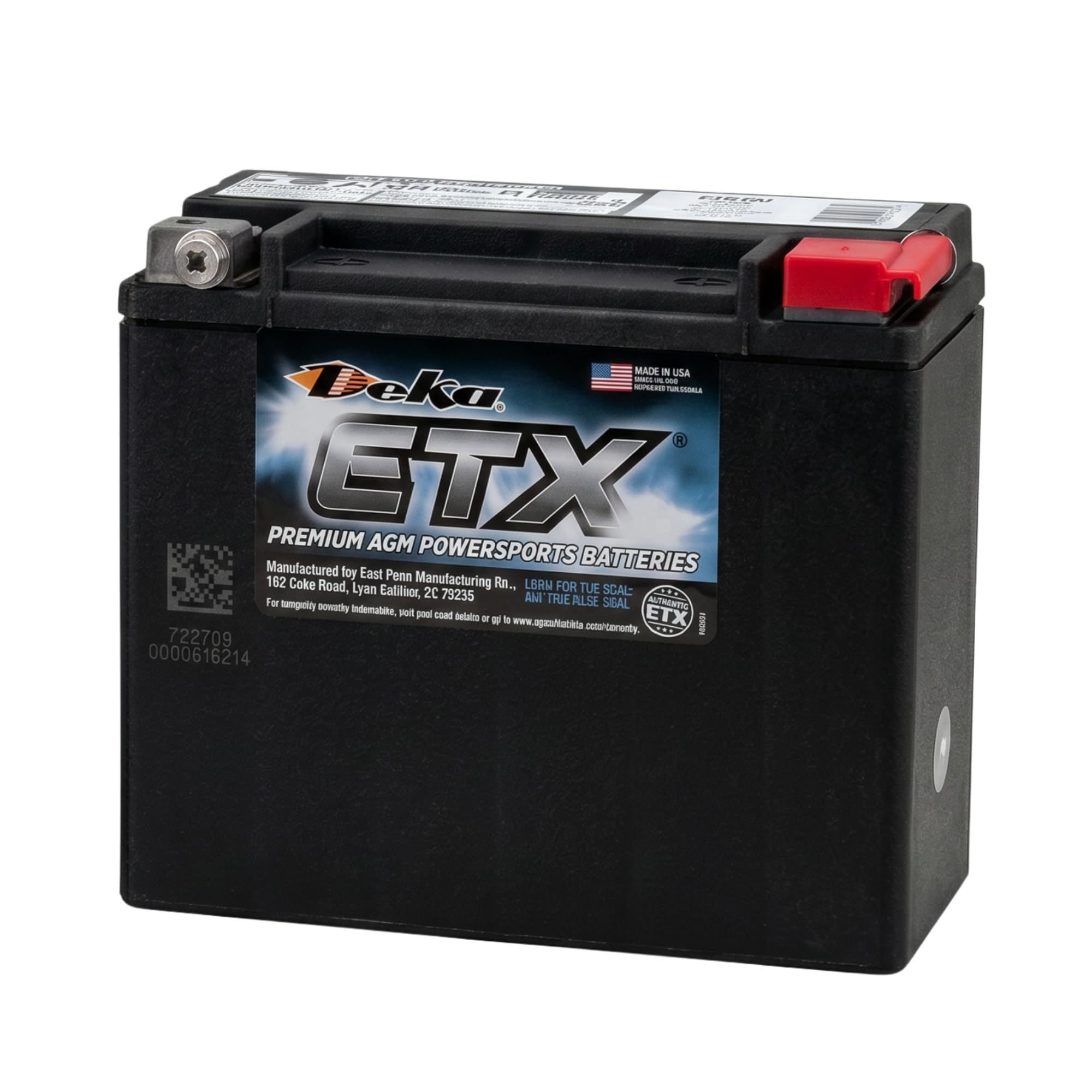
1. Deka Power Sports ETX20L Battery
Our pick — over 4★ from 850+ verified ratings; the strongest balance of quality and price.
The genuinely OEM-built battery that clone makers are all copying.
Deka’s ETX20L is the strongest all-round pick here, and the reason is unglamorous — it is the actual East Penn OEM battery that several manufacturers install at the factory. You get 12 volts, 18 amp-hours of stored capacity and 310 cold cranking amps of starting muscle. That 310 CCA figure is what turns a frozen, stiff engine over without that long, ugly cranking sound. It also arrives fully charged and ready to bolt in.
Where this battery pulls away from the budget options is physical build. It is sealed, maintenance-free and leakproof, so nothing spills when the machine tips. It carries six cells in a case measuring just over three inches deep, and the SAE terminal layout — left negative, right positive — is what most sleds expect. Compare that with the cheaper UPLUS EB20H-3, which runs the same 310 CCA but where buyers report the soft lead terminals can deform and loosen over time. On a machine that shakes hard on trail chop, that terminal material difference is the whole ballgame.
The honest catch is service life. Most owners are delighted, and the quality and performance feedback on this battery is overwhelmingly strong, but the reviews split on how long it lasts — some owners get years, and a small number report it quitting inside twelve months despite using a tender (a trickle charger that keeps the battery topped up). One long-term review on the page reads: “Battery died Feb 2024 after June 2023 purchase despite Battery Tender and indoor storage.” Treat that as the outlier, not the rule, and register the warranty the day it arrives. Fits and replaces YTX20L-BS, YTX20HL-BS, YB18L-A and 65989-97A.
Where it earns its place up top
- 310 CCA of cold-start punch — the joint-highest here alongside the UPLUS EB20H-3
- Genuine East Penn OEM build, not a copy — the quality feedback is by far the strongest of any pick on this list
- Arrives fully charged with SAE terminals, so most sleds are a straight bolt-in
- Sealed and leakproof, safe to mount in any orientation on a machine that rolls
The honest wrinkle
- Battery life is the one split topic — a minority report short service, so use a tender
- Third-party sellers mean warranty contact can take a few attempts
Buy this if: you want the safest possible bet — a factory-grade battery at 310 CCA that most snowmobiles will accept without a single modification.
Think twice if: your sled’s battery box demands the shallowest possible case or you need the lightest option on the list.
2. Weize YTX20L-BS High Performance Power Sports Battery
The one you buy when you’d rather replace twice than overpay once.
Weize’s YTX20L-BS is the value play, and it does not pretend otherwise. It runs 12 volts, 18Ah of capacity and 300 CCA — so it gives up very little cranking power against the Deka’s 310, in exchange for a much friendlier entry point. It weighs 12.8 pounds, which is a touch lighter than the Daakmax at 12.9 pounds and the ExpertPower at 13.2 pounds. Terminal layout is left-negative, right-positive, the standard that fits the widest spread of sleds and bikes.
What wins people over here is pure economics. The battery arrives at roughly 12.6 volts and full charge, bolts in with no modification on machines that take the 20L-BS footprint, and cranks hard from the first press. Owners are clear-eyed about the trade — this is a battery you buy knowing you’ll probably replace it on a two-year cycle. The maker even recommends replacing it every two years to avoid a no-start.
The recurring gripe in the reviews is lifespan, and it is worth hearing straight. Owners mention solid service, then a sudden death with no warning — often sitting at around 10 volts one morning instead of cranking. Here is how one buyer put it: “2-year update: Battery died suddenly at ~10V, no warning; lasted 2 years despite tender use, high vibration, 15.5V regulator, and one full discharge.” At this price, a 300 CCA unit is a consumable, not a lifetime buy. If you ride hard and want to re-buy every couple of seasons without wincing, this is exactly the right call.
The value math: you are getting 300 CCA and 18Ah for the kind of money that makes a dealer quote look absurd. It replaces the 20L-BS, ETX20L, CYTX20L-BS and GTX20L-BS codes, so if your sled’s original battery carries any of those numbers, this drops in.
What to plan for: treat two seasons as the realistic horizon and keep it on a maintainer through the off months. Buyers who expected five years from a value battery are the ones leaving the unhappy reviews — and the maker’s own two-year replacement guidance backs that up.
Reach for this if: you want maximum cranking power per dollar and you’re comfortable treating a battery as a seasonal consumable.
Look elsewhere if: you want to install once and forget it for half a decade.
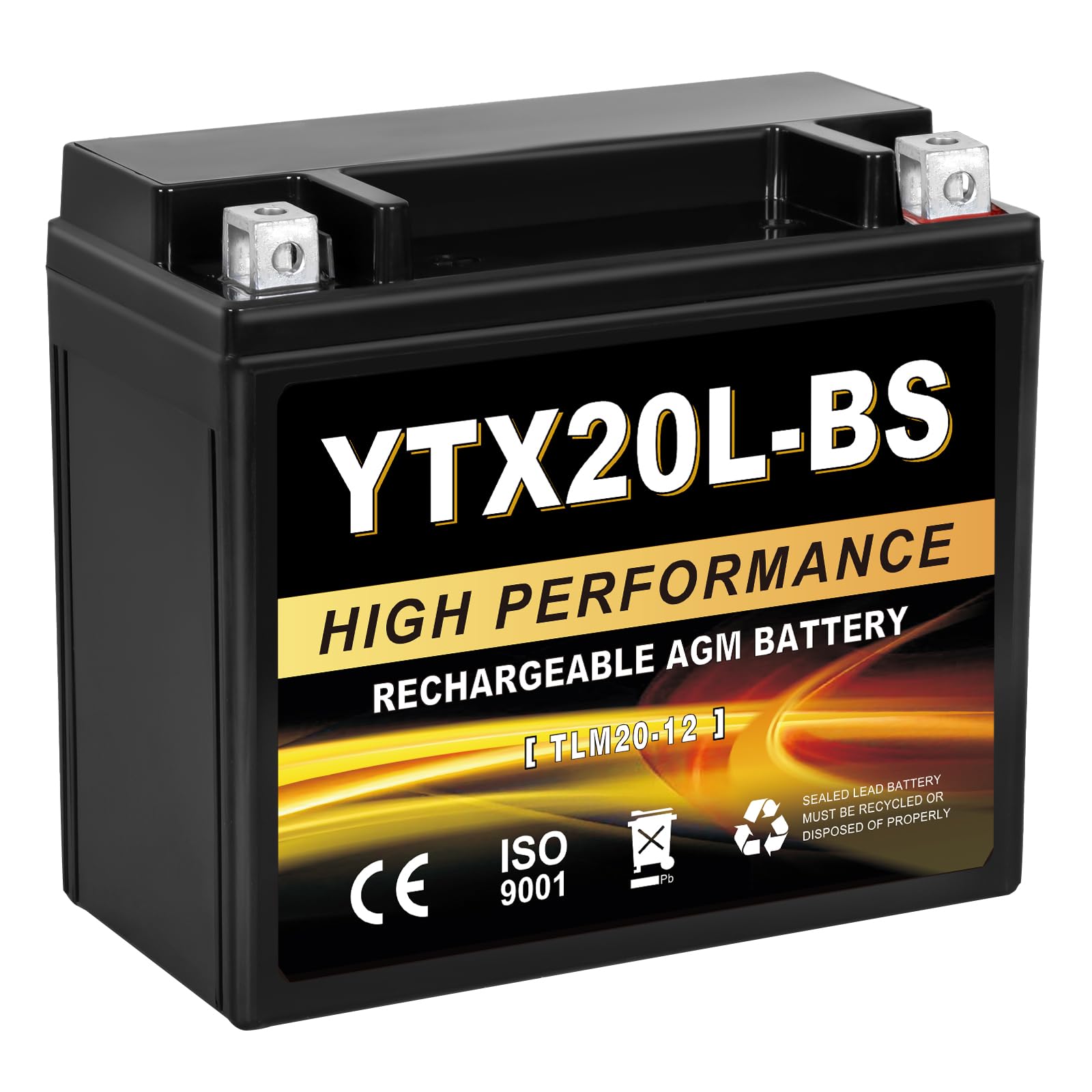
3. Daakmax YTX20L-BS 12V 20Ah AGM Sealed Battery
More stored energy than its rivals, built with cold mornings in mind.
Daakmax’s angle is capacity. This battery holds 20 amp-hours against the 18Ah that the Deka and Weize units carry — a meaningful bump if you’re running grip warmers, a heated visor or auxiliary lights off the same battery. It’s rated at 270 CCA, lower than the Deka’s 310, so it trades a little burst power for a bigger energy tank. If your sled is a mild-mannered trail machine rather than a big-bore monster, 270 CCA is plenty and the extra amp-hours are genuinely useful.
The build story is sealed AGM (absorbed glass mat — a spill-proof design that holds the electrolyte in glass mats), with a stated resistance to shock, vibration and both hot and cold temperatures, plus ISO9001, CE and UL certifications listed on the product page. It ships with left-negative, right-positive terminals and measures the same footprint as the other 20L-BS units here. Customers note it arriving fully charged in the mid-to-high 12-volt range, so it goes in and cranks right away. It also matches the 20Ah capacity of the ExpertPower unit exactly — the split between those two depends on brand trust and terminal hardware, not raw numbers.
The place this one frustrates people is the terminal hardware. The square nuts and bolts can be genuinely awkward to seat in a tight, cold battery box, and a few owners have had to reach for a pick tool or longer screws to get everything lined up. It’s a fit-and-fiddle issue rather than a reliability one, and it’s the kind of thing that stops mattering the moment the cables are tight. Backed by a one-year warranty.
For the accessory-heavy sled: the 20Ah capacity is the draw.
Know going in: the terminal bolts take patience. Have a small pick or needle-nose pliers on the bench before you start, and the install goes from annoying to quick.
Pick it when: your sled runs accessories and you’d rather have 20Ah of reserve than the highest possible CCA number.
Leave it if: you want zero fuss during installation — the terminal hardware asks for a little extra patience.
4. ExpertPower YTX20L-BS 12V 20Ah Battery OEM Replacement SLA AGM

One sealed battery that covers the sled, the quad and the UTV in the shed.
If you own more than one powersports machine, ExpertPower’s pitch makes a lot of sense. This is a 12-volt, 20Ah sealed AGM battery rated at 275 cold cranking amps, and it fits anything originally specced for the YTX20L-BS, EBX20L-BS, ETX20L, PTX20L-BS or GTX20L-BS codes. That’s sleds, ATVs, UTVs and WaveRunners off one part number. It comes pre-charged with clearly marked polarity and standard terminal configuration, so the swap is about as painless as a battery install gets.
The construction is aimed squarely at vibration. A rugged ABS case with nut-and-bolt terminals is built to take shock and rough terrain without the posts working loose — the kind of abuse a sled’s tunnel dishes out constantly. It also shares the 20Ah capacity with the Daakmax above, so if you’re weighing those two, the difference isn’t energy storage. It’s the hardware and the brand’s track record on fitment.
Fitment is where ExpertPower genuinely shines for a lot of buyers, and it’s the aspect owners praise most after value. Owners are putting it in everything from a 2007 Polaris Sportsman to a 2003 Harley Fatboy, reporting it arrives sealed, fully charged and cranking better than the tired factory battery it replaced. The honest wrinkle is the included hardware: some units arrive without the attaching bolts and nuts, and a couple of owners found the terminal gap awkward to bridge. It’s a small, fixable annoyance — not a reason to walk away from an otherwise dependable battery with a one-year warranty.
Why it’s the fleet pick: a single part number that covers your sled, your quad and your UTV means one spare on the shelf instead of three. For a household with multiple machines, that convenience is worth as much as any spec.
The one thing to check: confirm your box includes the mounting bolts before you plan the install, and have a set of spares on hand just in case. Otherwise this is a bolt-in job.
Best matched to: owners of several powersports machines who want one battery code to cover them all.
Less ideal if: you want the highest CCA available — at 275 it sits below the Deka and UPLUS EB20H-3.
5. UPLUS EB20H-3 YTX20HL-BS Snowmobile & UTV Battery

Featherweight cranking muscle — 310 CCA in a case that barely registers on the scale.
Here’s the standout number: this battery delivers 310 cold cranking amps while weighing just 9.5 pounds. That is dramatically lighter than the 13.2-pound ExpertPower and the 12.8-pound Weize sitting above it. For a sled where every pound matters, or for anyone who’s tired of wrestling a heavy brick into a tight battery box, that weight difference is the reason to care about this one. It runs 12 volts, 18Ah of capacity and the standard left-negative, right-positive terminal layout.
The materials story is also specific rather than generic. UPLUS builds the case from PP (polypropylene, a plastic that resists heat better than the ABS many rivals use), which means less deformation in a hot engine bay. UPLUS claims over five years of usable life from a corrosion-resistant internal structure and backs it with a 15-month warranty serviced from a US office. Those are manufacturer claims, not test results — but the supporting detail is more than most budget brands offer.
The important honest note concerns the terminals. This battery’s overall quality feedback is genuinely mixed, and the negative side clusters around two things: service life being shorter than hoped, and, more specifically, soft lead terminals that can deform under normal tightening torque and loosen repeatedly. One owner found the terminals wouldn’t stay secure and reported no response from the seller after several attempts. That’s a real concern on a high-vibration snowmobile, so if you go this route, torque the terminals gently and re-check them after the first few rides.
What it gets right
- 310 CCA in a 9.5-pound case — the lightest battery here by a wide margin
- PP case material resists heat better than ABS, per the maker’s spec
- 15-month warranty with US-based support and warehouses
- Arrives fully charged, fits the YTX20HL-BS and YTX20L-BS codes
What to watch
- Terminal design draws criticism — soft lead can deform and loosen
- Quality feedback is split, with lifespan the most common complaint
- Fewer reviewers point out long-term satisfaction than on the top picks
Choose it for: weight savings and a strong CCA number, especially on a machine where the battery box is awkward to reach.
Second-guess it if: you want bulletproof terminals and consistent multi-season reliability — go with the Deka instead.
6. CB CHROMEBATTERY YB16CL-B 12V 240 CCA AGM Battery

Built for the shed with a jet ski at one end and a sled at the other.
Chrome Battery’s YB16CL-B is a different animal from the 20L-BS family above — it’s a 12-volt, 19Ah sealed AGM rated at 240 cold cranking amps, aimed at jet skis, touring bikes, cruisers, ATVs and snowmobiles. The 240 CCA figure is the lowest here, so this is a battery for mild-to-moderate machines rather than a big-bore two-stroke that needs a hard shove. It fits the YB16CL-BS code and lists compatibility with Honda Gold Wing GL1200, Yamaha V-Max 1200, Kawasaki Voyager XII, Suzuki Cavalcade and Polaris Trail Boss.
what separates it is the warranty and the build standards behind it. Chrome Battery backs this with an 18-month warranty and a 60-day refund policy, and states the battery is engineered to Japanese QC standards and UL-certified. Those are the manufacturer’s claims, but they’re backed by a longer stated warranty than the 12-month and 15-month coverage elsewhere on this list. It ships fully charged and ready to connect, with T3 nut-and-bolt terminals.
Lifespan is the honest sticking point. This battery’s service-life feedback runs negative overall, and the complaints aren’t all the same story — some shoppers say a battery that quit within a few weeks, while others get years of faithful service. One buyer summed up the good case plainly: “Lasted 3 years and still going, just keep in mind you need to take inside during the winter and trickle charge every 2-3 months.” Tender it, store it warm, and you’re in the happy group. The terminal nuts are small and easily lost, so keep a spare on the bench.
Why the warranty matters here: an 18-month term with a 60-day refund window is the most generous coverage on this list. If you’re rolling the dice on a multi-sport battery, that safety net is the feature worth paying attention to.
Storage is the tell: the owners who lose a season are the ones who leave it in the cold. Bring it indoors and trickle-charge through the off months, and this battery behaves completely differently.
Suits you if: you need one battery for a jet ski, an ATV and a light sled, and you want the longest stated warranty of the group.
Skip if: your snowmobile needs serious cold-cranking muscle — at 240 CCA this is the mildest battery here.
7. UPLUS YTX30L-BS Motorcycle & Snowmobile Battery, 12V 30AH 400CCA

The heavyweight — 400 CCA and 30Ah for sleds that ask for everything.
Nobody else on this list comes close to 400 cold cranking amps. That number — paired with 30 amp-hours of capacity — makes the UPLUS YTX30L-BS the pick for big-displacement sleds, machines running heavy electrical loads, or anyone who has ever stood in the cold listening to a starter grind. Compare it with the 240 CCA Chrome Battery above and the gap in raw starting force is enormous. It’s a 12-volt sealed lead-acid gel battery, maintenance-free with no spills, no leaks and no water to check, in a case measuring about 6.5 by 5 by 6.8 inches.
The capacity is the other headline. At 30Ah it carries half again the stored energy of the 20Ah units — useful if you’re running a winch, big lights or a plow setup that leans on the battery harder than a stock sled would. UPLUS claims over five years of usable life and states the battery uses 99.99% pure primary lead, which the maker says charges better than recycled lead. Those are manufacturer claims rather than independent test results, but the construction detail is specific enough to be worth noting.
The unavoidable trade-off is weight. At 18 pounds this is the heaviest battery here — noticeably heavier than the 9.5-pound UPLUS EB20H-3, and the kind of mass you’ll feel when you’re lying on your back under a sled trying to seat it. Owners describe it as a solid, economical solution that fires up and holds charge well, with typical service running several seasons. It comes with a 15-month warranty and a fixed US office in California for after-sales support. If your sled can handle the extra weight and genuinely needs the cranking power, this is the one to buy.
The case for it
- 400 CCA — the highest cold-cranking figure on this list by a clear margin
- 30Ah of capacity, half again as much stored energy as the 20Ah units
- Sealed gel design, maintenance-free with no water checks
- 15-month warranty with US-based after-sales support
The trade you’re making
- 18 pounds — the heaviest battery here, and awkward to install solo
- The extra size may not fit every snowmobile battery box — measure first
- More battery than a mild trail machine actually needs
Made for: big-bore sleds, plow rigs and machines with heavy electrical loads that demand maximum cranking force.
Overkill if: you ride a modest trail sled — the 400 CCA and 18 pounds are more than your machine will ever call on.
Understanding the Specs
Cold Cranking Amps (CCA)
CCA is the burst of current a battery can deliver for thirty seconds at a set cold temperature — effectively, how hard it can shove a frozen engine into life. On a snowmobile this is the single most important number, because cold thickens oil and stiffens every moving part. The range across these picks runs from 240 CCA up to 400 CCA. If your sled has a large-displacement engine or you ride in deep cold, push toward the top of that range.
Amp-Hour Capacity (Ah)
Amp-hours describe how much total energy the battery stores — think tank size rather than pour rate. The batteries here range from 18Ah up to 30Ah. A bigger tank helps if you run extras like grip warmers or lights, but it doesn’t help you start a stubborn engine if the CCA is low. Match the Ah to your original battery, then let CCA decide the winner.
AGM Construction
AGM stands for Absorbent Glass Mat, a design that holds the battery’s acid inside glass-fibre mats instead of as free liquid. The practical upshot is a sealed, leakproof unit that can be mounted in any orientation without spilling. On a machine that tips, rolls and vibrates hard, that’s why every battery on this list uses AGM rather than an old-style wet cell.
Terminal Layout And Fit
Terminal layout means which side the positive and negative posts sit on — most of these batteries run left-negative, right-positive, which is the standard most sleds expect. Get it backwards and your cables won’t reach. Similarly, dimensions and terminal type (SAE or T3, for example) have to line up or the battery physically won’t seat. Measure your old battery before ordering.
FAQ
What CCA do I need for a snowmobile battery?
Will a YTX20L-BS battery fit my snowmobile?
Do I need a trickle charger for a snowmobile battery in summer?
Is an AGM battery better than a regular wet cell for a snowmobile?
How long should a snowmobile battery last?
What does maintenance-free actually mean on these batteries?
Can I use a motorcycle battery in a snowmobile?
Why does my sled battery die suddenly with no warning?
Do snowmobile batteries come charged and ready to install?
Should I buy the highest CCA battery I can find?
Final Thoughts: The Verdict
For most riders, the battery for snowmobile winner is the Deka Power Sports ETX20L because it’s the genuine OEM build — 310 CCA, 18Ah, factory-grade construction, and the strongest quality feedback of any battery here. If you ride a big-bore sled or run a plow, grab the UPLUS YTX30L-BS with its 400 CCA and 30Ah of stored power. Whichever you pick, put it on a tender before the season ends; that single habit is the difference between a battery that starts first try in February and one that lets you down.
How We Picked
We do not accept paid placement. Every pick is matched to a real buyer and a real use-case; we do not hands-on test units.
Sources & Methodology
Specifications: manufacturer listings and product documentation. Review insights: verified customer reviews, as of September 2026. Pricing: not shown on this page (it changes often); check the current price via the retailer link.
As an Amazon Associate, Gadgets Feed earns from qualifying purchases. This does not affect which products we feature.