
Our readers keep the lights on and my morning glass full of iced black tea. As an Amazon Associate, I earn from qualifying purchases.
Specs are compiled from manufacturer listings and verified buyer reviews and can change over time — please confirm the key details on the product page before buying.
You need one box that turns the AC power from your wall socket into the low-voltage DC your device actually wants. Match the voltage and amperage and the device runs for years; mismatch them and you can fry it. This guide ranks seven adapters across the three specs that decide everything: output voltage, maximum current, and the physical tip that has to physically fit your device’s barrel port.
I’m Min — the founder and writer behind Gadgets Feed. This guide is built by comparing the manufacturers’ published specifications and the patterns across verified customer reviews, so you get each pick’s real strengths and trade-offs instead of marketing spin.
The main things to weigh are output voltage, amperage, and tip fit. Make sure to match the jack. Our guide to the alternating current adapter breaks down each pick so you can match watts, volts, and tips fast.
Our Picks at a Glance

How To Choose The Best Alternating Current Adapter
An AC adapter takes the alternating current from your home’s wall socket and converts it to the direct current that small electronics actually run on. The single most important thing you’ll do is read the label on the old adapter you’re replacing. It will tell you three things: the output voltage, the output amperage, and the size of the barrel tip. Everything you choose from here should match or respect those numbers.
Match voltage first, then amperage
Voltage has to match. If your device says 12V, you want a 12V output, not a 9V or a 24V one. Amperage has to meet or exceed the requirement. If the original adapter was 1.5A, a 2A or 3A replacement will work fine because the device only draws what it needs. A fixed 12V adapter with 2A output will happily run a 12V 1A device because the current is pulled, not pushed. This is why a fixed-voltage supply is honest insurance — nothing to knock out of adjustment.
Barrel-tip size and polarity
The barrel tip has two numbers: the outer diameter and the inner diameter, usually written like 5.5×2.1mm. If the tip does not physically click into your device’s port, the adapter is useless no matter how good the electronics are. Polarity matters just as much. Most devices use center-positive, where the inner pin is positive, but some vintage gear and effect pedals use center-negative. A reversible-tip system or a polarity-reverse cable lets you flip that without cutting and re-soldering wires. If your device is center-negative and the adapter is fixed center-positive, you cannot make it work without extra hardware.
Adjustable vs fixed output
Adjustable adapters let you dial the voltage anywhere between a low and high limit, which is ideal if you’re powering several different devices or a repair bench. The trade-off is that a dial can be bumped. Fixed adapters lock in a single voltage and remove that risk entirely. If you’re replacing one failed power brick, a fixed voltage is simpler and safer. If you power several devices at different voltages, one adjustable unit replaces a drawer of fixed bricks.
Quick Comparison
| Model | Best For | Output Voltage | Max Amperage | Tip Type | Amazon |
|---|---|---|---|---|---|
| VoolexGo 180W AC to DC Converter★ Best Overall | High-power car accessories indoors | DC 12V fixed | 15A | Cigarette lighter socket | Amazon |
| Minidodoca 72W Adjustable SupplyBest Adjustability | Mixed-voltage bench work | 3V–24V adjustable | 3A | 16 plug tips incl. barrel, USB-C, Micro-USB | Amazon |
| SoulBay 30W Reverse Polarity Adapter | Vintage gear and center-negative devices | 3V–12V adjustable | 2A | 9 reversible barrel tips | Amazon |
| SHNITPWR 48W Universal Adapter | DIY projects and 19.5V replacements | 3V–24V adjustable | 2A | 14 tips incl. Type-C, Micro-B, terminal | Amazon |
| ALITOVE 24V 3A 72W Power Supply | LED strips, CCTV, and 24V fixed loads | DC 24V fixed | 3A | 5.5×2.1mm barrel jack with female connector | Amazon |
| Wefomey Universal 72W Variable Supply | Bench testing with multiple device tips | 3V–24V adjustable | 3A | 14 tips incl. Type-C, Micro-USB, alligator clip | Amazon |
| Wefomey 12V 2A 24W 5-Pack | Running several 12V devices at once | DC 12V fixed | 2A | 5.5mm x 2.1mm DC barrel | Amazon |
In‑Depth Reviews
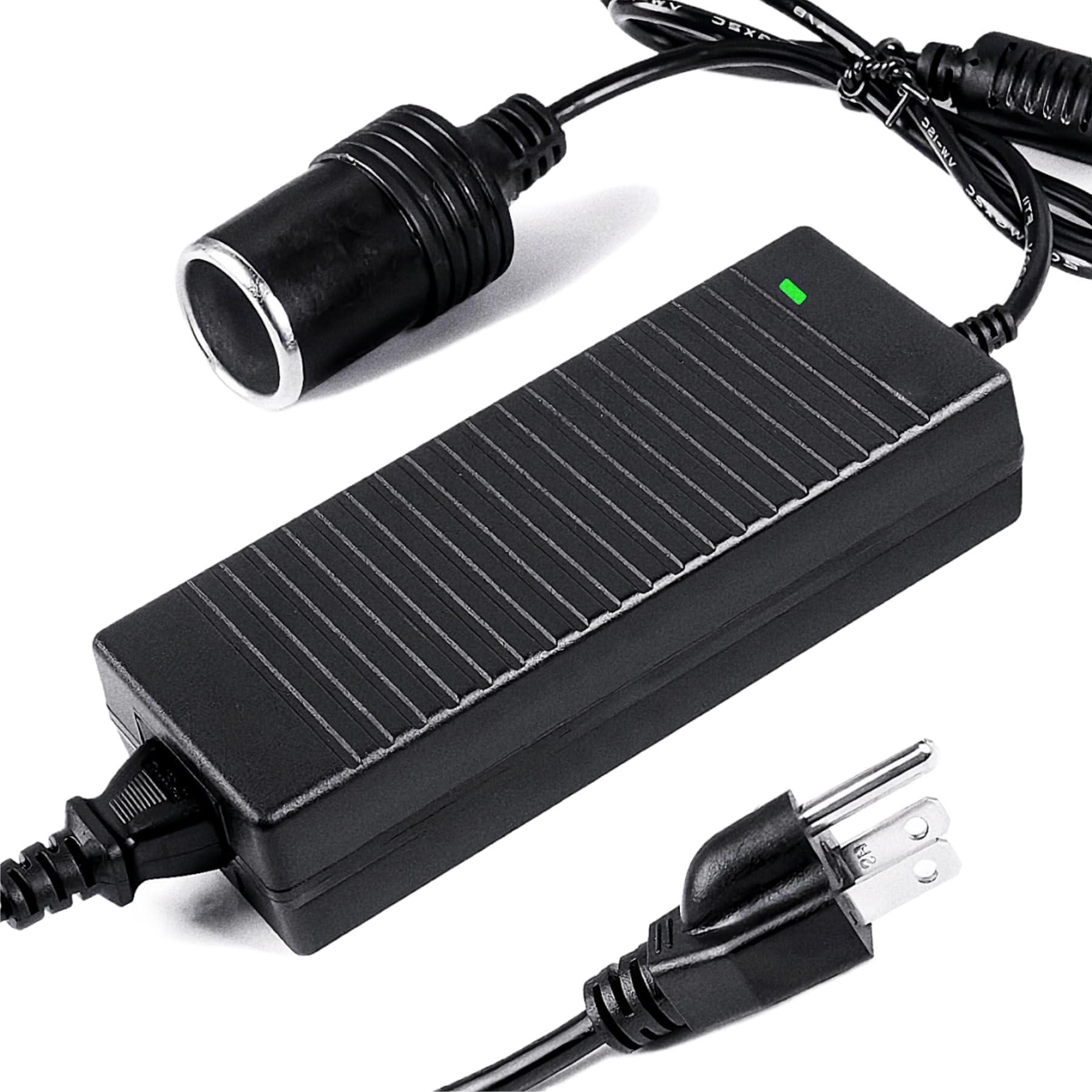
1. VoolexGo 180W AC to DC Converter, 110V-240V to 12V/15A, Cigarette Lighter Socket
Our pick — over 4.5★ from 250+ verified ratings; the strongest balance of quality and price.
The one that turns a wall outlet into a 12V/15A car socket for a tire inflator or cooler.
If your car-powered gadget has a cigarette-lighter plug and you’re tired of running an extension cord out to the driveway, this is your pick. It takes the 110V-240V AC from a home wall outlet and outputs DC 12V at up to 15 amps — enough for demanding loads like a car air compressor, a cooler/warmer, or a car massage cushion. The power cord runs a long 7.2 feet, which gives you real freedom in where you place the device. There is no setup: plug the 3-pin plug into the wall, then plug your car device into the female cigarette lighter connector on the other end.
The nameplate rating is 180 watts, and the manufacturer notes you should plan to keep the load at or under 144 watts — roughly 80% of full load — so the unit runs cool and lasts. That ceiling is important to understand before you plug in a demanding device. On protection, the unit carries CE, FCC, and RoHS certifications and includes built-in protection against overcharging, short circuits, overpowering, overcurrent, overheating, over-discharge, and overvoltage. That list of safety cutoffs is what separates a serious unit from a bare-bones brick.
The most-discussed honest subject among owners is reliability — a small number of them report the unit stopped working after some time. The reviewer reviews that do land positive describe it working exactly as expected, with a specific test on a car pump for a camping air mattress. Realistic reading: this unit handles high-power devices well, but like any high-wattage power supply, it should not be run at the edge of its ceiling for long stretches. One buyer flagged it as large and not suited to backpacking, which is fair — a 180-watt transformer has to have real internal mass. For home or garage use where it stays put on a bench, size is not a problem. It is the highest-rated pick here and the one high-power buyers should reach for first.
What Lands The Power Job
- Outputs DC 12V at up to 15 amps through a real cigarette-lighter socket, matching car accessories directly
- 7.2-foot power cord gives you real placement freedom from the wall outlet
- Holds CE, FCC, and RoHS marks plus seven named internal protection cutoffs
Where It Presses Limits
- Manufacturer recommends keeping the actual load under 144W — real headroom before hitting the 180W ceiling
- Substantial size — the transformer block is not backpack-friendly
- A small number of buyers report reliability issues after extended use; not built for continuous max loads
Reach for this if: you need to run a car-plug device — an inflator, a cooler, a massage pad — from a standard household wall outlet indoors.
Look elsewhere if: your device draws a USB-C connection or needs an adjustable voltage below 12V; this is a fixed 12V output built around the cigarette-lighter form factor.
2. Minidodoca 72W Power Supply Adjustable 3V ~ 24V with LED Display and 16 Tips
Sixteen different tips and an adjustable dial — one box for a whole shelf of odd-voltage devices.
What wins people over here is outright functionality. The review pages are dominated by buyers who needed something that just works — WiFi routers, CCTV interfaces, LED strips, Bluetooth speakers, sound bars, digital pianos. That is what the 3V-to-24V adjustable range and the 72W, 3A max output are for: one box replaces a drawer of dead proprietary adapters. The unit includes 16 tips covering a lot of ground, from standard 5.5×2.5mm and 5.5×2.1mm barrel connectors to Micro-USB, Type-C, and an alligator-clip lead for soldering to bare wire. There is a 3,000mA maximum rating, and the LED readout shows the actual output voltage in real time.
It has a rotatable knob that reaches 13V-14V at 50% of its rotation. The unit carries over-voltage, over-current, over-temperature, and short-circuit cutoffs.
Owners say the voltage knob is very sensitive, so you can easily overshoot your target. One review warns: “If you pick one of these up, be careful when adjusting the voltage, easy to overshoot your desired voltage!” A few buyers also note the display reads slightly high, and the knob has no locking mechanism. That makes it a good bench tool, but not the right pick for anything you want to leave powered unattended. On the plus side, one buyer used it to power a Meade DS-2000 telescope at 12VDC (12 volts direct current) and reported rock-steady voltage for over 40 minutes, with accurate tracking for over 30 — real proof it holds steady when you leave the dial alone.
Where it shines: an enormous tip and adapter collection attached to a genuinely adjustable 3V–24V supply, all in one box you can leave on a workbench.
The honest trade-off: the voltage knob is feather-light. Owners who need rock-solid locked voltage for permanent installs should look at a fixed voltage supply instead.
Bench and repair buyers: this is the one to own if you routinely swap between devices that need different voltages and connections.
Set-and-forget installers: skip the sensitive dial and go fixed voltage — the knob is too easy to nudge for something wall-mounted and forgotten.
3. SoulBay Reverse Polarity 30W Universal AC DC Adapter 3V-12V 2A with 9 Tips

Flip the tip to switch center-positive to center-negative — the polarity vintage handhelds and pedals need.
Most adapters lock in one polarity. If your device wants center-negative and the adapter is center-positive, you’re stuck. This SoulBay owns dual polarity — you unplug the tip, turn it around, and plug it back in. That is the whole feature, and for the right buyer it is everything. It adjusts from 3V to 12V and outputs up to 2 amps at 30W maximum. The package includes 9 changeable adapter tips, each marked with its dimension, plus a small key. Center-positive is set by default; flip the tip for center-negative.
For scale: this 30W (watt) unit runs at roughly one-sixth the power of the VoolexGo 180W converter above, but it targets a completely different job. The 180W handles a car compressor at 15A (amps); the SoulBay handles a vintage palmtop at a fraction of an amp. Polarity (which pin carries positive and which carries negative) is the defining spec here, and that is exactly what earns its strongest mentions. The buyer who powered an old WD hard drive had that problem solved by the tip assortment — they worried about the physical fit, and it worked. A vintage handheld games collector confirmed the whole system is easy: “it is very easy to switch polarity by just unplugging them and turning them around and plugging them back in.” That is not marketing — it is the entire mechanism described by someone using it on real hardware.
The honest limit is on the fine print. SoulBay itself notes the adapter is not compatible with sensitive electronics like AM/FM radios — the switching circuitry can introduce interference into a radio’s tuner. And one buyer doing electronics-signal work returned it because the noise floor was too high. If your device is analog audio or RF-sensitive, this is not the pick. But for vintage computers, palmtops, model railroad buildings, effect pedals, and general household 3V–12V gear, this is the most practical center-negative-capable adapter in the group. Physical fit is the last thing to watch — one buyer’s device needed a size none of the 9 tips provided, so measure the barrel you need before you buy.
Why Polarity Buyers Pick It
- Reversible tip design gives center-positive or center-negative without extra hardware
- 9 tips with clear size markings remove the guesswork for common barrel sizes
- Easy, no-tool polarity switching confirmed by owners running vintage handhelds and palmtops
What It Cannot Do
- Manufacturer states it is not compatible with AM/FM radios and other sensitive electronics
- 2A, 30W ceiling — will not power high-current devices like the 180W converter above does
- Fixed 9-tip set; unusual barrel sizes may not have an exact match
Best for the collector: old palmtops, handheld game systems, model railroad gear, and any vintage device wired center-negative.
Not for audio or RF: the switching supply introduces noise that AM/FM radios and similar sensitive gear cannot tolerate.
4. SHNITPWR Universal AC to DC Adapter 3V ~ 24V 2A 48W with 14 Tips

Fourteen tips, a 7.3-foot cord, and one very specific claim: it kept a 19.5V POE switch running.
The Versatility here is the story. Buyer reviews consistently cite compatibility as the reason this one earns its spot — it replaces a dead power supply on devices the manufacturer stopped making, from 19.5V POE switches to LED strips, essential-oil diffusers, and DC motors. The adjustable range is 3V to 24V, the maximum output is 2A at 48W, and the unit ships with 14 tips plus a polarity converter cable. Two features make it stand out from the pack: an on/off switch built into the adapter, and mounting flanges on the back so you can screw it onto a surface. The 7.3-foot cord is among the longest in this lineup.
The genuine success stories are specific. A buyer used the adjustable voltage to dial in a replacement for a 19.5V POE (Power over Ethernet, which sends power and data over one cable) switch running security cameras, and noted it was cheaper and easier than sourcing a new POE switch. Another buyer at 12V/3.4A pushed past the 2A rating and reported the voltage dropped to 6.5V, then recovered normally — solid behavior that shows the current-limiting protection is real, and a good reminder not to run it near its rating ceiling.
The most-discussed complaint is voltage control at low outputs. Owners mention the readout is slightly inaccurate, that the voltage drops under load (which is normal for a small supply), and that the dial has no lock — so it can be bumped. The SHNITPWR comes in at 2A/48W, whereas the Minidodoca above delivers 3A/72W for a similar purpose; if you need real reserve on a device that wants 2-3A, the Minidodoca gives more headroom. But for the classic use case — swapping out a discontinued brick for something with adjustable voltage and a lot of physical connections — the SHNITPWR is one of the few that will accept Type-C, Micro-B, and bare wires all in one box. As one buyer put it, “just be mindful for your applications the polarity of the tip.”
What separates it: mounting flanges, an on/off switch, and a wider tip inventory than almost anything else in this tier — plus a 7.3-foot cord that reaches places shorter units cannot.
Where it asks for care: 2A/48W is a lower ceiling than the Minidodoca above. Plan your device’s actual draw honestly before buying, and check output with a multimeter if precision matters to you.
Best for the DIY bench: any project where you need polarity reversal, mounting points, and a wide tip selection without overshooting your budget.
Skip the dial if: you want locked voltage for a permanent install — the free-spinning knob is easy to brush and change.
5. ALITOVE 24V 3A 72W AC to DC Adapter Power Supply Converter

A fixed 24V/3A brick with no dial to bump — for LED strips and CCTV cameras that specify 24V DC.
Buyers cite durability and consistency, with one owner running ten units for museum sound modules without a dud. The output is DC 24V at 3 amps and 72 watts, from an input range of 100V-240V at 50/60Hz. The DC jack is a standard 5.5mm x 2.1mm barrel, and the unit ships with a female DC connector so you can attach bare wires without soldering. There is no dial, no voltage display, and no reversible tips to fiddle with — just a clean 24V output every time. Safety is handled with automatic overload, over-voltage, thermal, and short-circuit protection.
The application list is LED strip lighting, CCTV (closed-circuit television) cameras, wireless routers, switches, and audio gear, and it does that well enough that one buyer swapped it in as a replacement for a failed power supply on a water softener and described it as more sturdy than the original. Another buyer used it to power a ring light that had been sitting unused. That range — from fixed home gear to lighting to camera systems — is what a stable fixed-voltage supply is designed for.
The honest caveat: durability is where owner experience splits. Some units last about a year, and a small number of customers note early failure — this is expected in a plastic-enclosed 24V supply, but note if you plan to leave it running continuously. There is also a reported sparking issue on a small number of units, and the included 18AWG wire-terminal adapter gets dinged for poor screw grip and easy-to-strip plastic housings. The adapter itself is the good part; the extra terminal piece is the weak link. If you need to attach bare wires, budget for a small prewired female socket pigtail rather than fight the included terminal. For everything else — LED strips, cameras, replacing an old fixed 24V brick — it does exactly what it says.
Why The Fixed-Voltage Crowd Likes It
- Rock-solid fixed 24V output at up to 3A — no dial to knock or display to misread
- Includes a free female DC connector so you can wire bare loads without soldering
- Full safety suite: overload, over-voltage, thermal, and short-circuit protection
Where The Trade-offs Sit
- Some units fail early — expected in plastic 24V supplies, but real
- 18AWG wire-terminal adapter has poor screw grip and strips plastic easily — plan for a prewired socket instead
- Fixed 24V output only — no adjustability, so it is useless if your device needs another voltage
Straight answer for LED strip and CCTV owners: buy this if your device clearly says “24V DC” and you want a set-and-forget brick.
Hands-off if: you also run 12V or 19.5V devices; without an adjustable dial you would need a second adapter.
6. Wefomey Universal Power Supply Variable 3V~24V 3A 72W Multi Voltage Adapter

The kit that feeds four cameras from one 3V-24V supply, with a 4-way splitter cable in the box.
What sets this Wefomey apart is the accessory list, not the adapter body. The basket includes 14 tips (covering 6.5×4.4mm+Pin down to 2.5×0.7mm plus Micro-USB, Type-C, and a DC terminal connector), a reverse-polarity converter, an alligator-clip cable, and — the actual differentiator — a 4-way power splitter cable. That splitter lets you run two or more cameras or LED strip sections from one central adapter without adding outlets. The output range runs 3V to 24V at up to 3A and 72W maximum, with an LCD display showing real-time voltage. Alligator clips on the included lead let you attach to bare wires or a breadboard.
Versatility is what the review pages talk about most, and it shows up in real use: everything from old hard drives to unusual DC (direct current) devices gets covered by the tip assortment, and buyers describe the supply as steady enough for sensitive analog gear. Two honest calibration points landed in the reviews: one buyer’s display read roughly 0.1V high, and another noted that the 24AWG (a wire thickness gauge) cable drops about 0.57V at full 3A draw, so a 5V setting sags to around 4.54V under a 2A load. That is normal behavior for thin cables at load, but it means you should confirm with a multimeter if your device is voltage-sensitive.
Comparing to the Minidodoca above, the Wefomey wins on the splitter and the alligator-clip lead; the Minidodoca wins on the 4-inch-longer power cord and a slightly simpler tip set. Both top out at 3A/72W. The trade-offs to know: the voltage knob is very sensitive, the display is slightly off, and the supply gets warm above 1A at 5V or higher. Hardly disqualifying for a bench supply, but the fine print worth reading. If your job is powering several low-current devices from one outlet, the bundled splitter makes this the more efficient pick. If your job is one device with sensitive voltage needs, buy the wrong one and you will wish you’d grabbed a fixed-voltage brick.
The bundled-splitter edge: powering a cluster of low-current devices from one adapter without buying extra hardware is the whole reason this earns its place.
Best for multi-device bench work: if you are feeding two or more cameras, LED sections, or small DC components from one box, this is the most efficient pick.
Look at the Minidodoca instead if: you want a simpler kit and a longer cord — the Wefomey’s warmth above 1A at 5V matters more for continuous load.
7. Wefomey UL Listed 12V 2A 24W AC DC Power Supply Adapter, 5 Pack
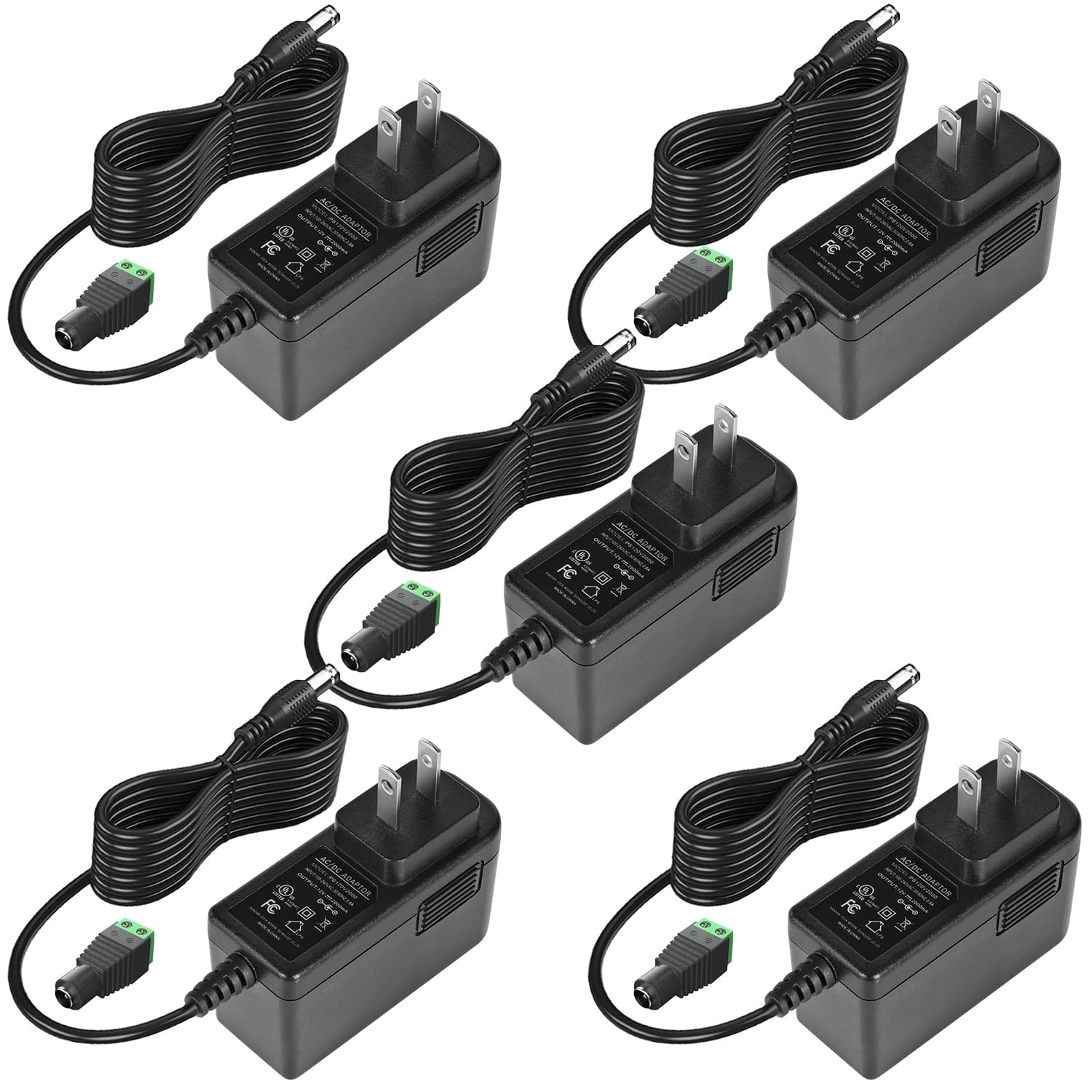
Five UL-listed 12V/2A bricks, each with a 5.5/2.1mm barrel connector — one per 12V device.
If you run a wall of 12V gear — under-cabinet lights, small cameras, sound modules — this is the smartest buy in the group. You get five separate 12V 2A power bricks, each rated for 24W and each paired with a 5.5/2.1mm DC female barrel connector. The output is a fixed, regulated DC 12V, max 2A, with 18AWG wire, IP30 indoor rating, and a 5-foot power cord. Polarity is inner-positive, outer-negative — standard for most household 12V devices. Where this separates from the bare-brick competitors is safety paperwork: it is tested and certified by UL and carries UL FCC safety certificates. Nothing else in this list carries a UL mark.
What reviewers point out lands on the same two notes: quality and value. One owner used the pack for sound modules in a museum and reported no duds across a batch of ten. Another runs them under cabinet lights and describes them as never failing. That consistency across multiple units is exactly the reason a 5-pack makes sense — you get redundancy built in. If one 12V adapter dies, you have four more on the shelf. No sizing, no dial, no fiddling, no reverse polarity to check — plug in and go.
The honest limit is flexibility. It is one fixed voltage and one fixed polarity. If your device is 5V, 9V, or 24V, this pack does nothing for you. It is also 2A max per unit, which is a lower per-brick ceiling than the adjustable Wefomey above — expect to run one device per brick rather than splitting. And the 5-foot cord is shorter than several other options here. But for the classic multi-device 12V scenario — under-cabinet lighting, several small cameras, a row of audio gear — the math lands solidly on your side versus buying single adapters one at a time.
Why The Multi-Device Buyer Picks It
- Five separate UL-listed 12V 2A power bricks, each with a 5.5/2.1mm female barrel connector included
- UL and UL FCC safety certificates — rare in this tier of budget adapters
- Consistent build quality across units means a clean replacement when a single adapter fails
What It Does Not Do
- Fixed 12V output only — no adjustability, no alternative voltages
- 2A per brick means no headroom for high-draw devices
- 5-foot power cord is shorter than several other picks here
Best for stockpiling: households or installs with several fixed 12V devices that want UL-marked power on every wall drop.
Skip if: any of your gear needs a voltage other than a clean, regulated 12V — this pack cannot dial up or down.
Understanding the Specs
What “Output Voltage” Really Tells You
Output voltage is the DC (direct current) voltage the adapter sends into your device. Most small home electronics run on 5V, 9V, 12V, 19V, or 24V. Sending the wrong voltage — even slightly too high — can permanently damage a device. Fixed adapters lock in one voltage and remove that risk entirely. Adjustable adapters let you dial the voltage range, which is useful when you own devices with different requirements, but they require you to set the dial correctly and — ideally — verify it with a multimeter before plugging into something costly.
The Amperage Ceiling and Why It Matters
Amperage (measured in amps) is the maximum current the adapter can supply. Your device will only draw the current it actually needs — so a higher-amperage adapter than your device requires is safe, but a lower one is not. If your original brick was 1.5A and you plug in a 2A replacement, nothing breaks. If your original was 3A and you plug in a 2A replacement, the device will pull more than the adapter can give and either shut down or run erratically. Rule: meet or exceed the original amperage; never go under it.
Barrel Tips, Jack Size, and Polarity
The barrel tip is the physical connector that plugs into your device. It is measured as outer diameter by inner diameter — 5.5×2.1mm is the most common size, followed by 5.5×2.5mm. If your device uses one size and your adapter ships the other, it will not fit. Polarity is a separate physical property: whether the center pin is positive or negative. Most household devices use center-positive, but effect pedals and vintage gear often use center-negative. Get polarity wrong and you can damage the device, so check the label on the device or the box.
Safety Marks: UL, CE, FCC, RoHS
These are third-party or regulatory marks. UL and UL FCC listings indicate the product has been tested for electrical safety. CE and RoHS indicate compliance with European safety and environmental rules. They do not change performance, but they do lower the risk profile if you plan to leave the adapter running unattended or powering an expensive device. In the adapters above, the Wefomey 5-pack is the only one that carries UL specifically — an important note if electrical safety is your deciding factor.
FAQ
Will a higher-amperage adapter hurt my device?
Do I need to match the barrel tip exactly?
What happens if I set the wrong polarity?
Can I use one adapter to power multiple cameras or LED strips at once?
Is an adjustable adapter better than a fixed one?
Do I need a UL listed adapter or is CE enough?
Will my electrical device work in another country with an AC adapter?
Can I use an adjustable adapter permanently for a device?
How do I know which barrel tip matches my device?
What is the maximum wattage these adapters can safely handle?
Final Thoughts: The Verdict
For most buyers, the alternating current adapter that fits the widest range of jobs is the VoolexGo 180W AC to DC Converter because it handles the highest-power load in the group, holds the highest rating, and drops into place with a cigarette-lighter socket that requires no wiring at all. If your gear runs different voltages and you want one box for a repair shelf, reach for the Minidodoca 72W Adjustable Supply — its 16-tip kit and 3A ceiling handle more devices than anything else here. And for anyone powering a handful of fixed 12V devices — under-cabinet lights, small cameras, audio gear — the Wefomey 12V 2A 5-Pack is the value call, because UL-listed power on every wall drop is worth the small extra outlay.
How We Picked
We do not accept paid placement. Every pick is matched to a real buyer and a real use-case; we do not hands-on test units.
Sources & Methodology
Specifications: manufacturer listings and product documentation. Review insights: verified customer reviews, as of September 2026. Pricing: not shown on this page (it changes often); check the current price via the retailer link.
As an Amazon Associate, Gadgets Feed earns from qualifying purchases. This does not affect which products we feature.