
Our readers keep the lights on and my morning glass full of iced black tea. As an Amazon Associate, I earn from qualifying purchases.
Specs are compiled from manufacturer listings and verified buyer reviews and can change over time — please confirm the key details on the product page before buying.
If you are shopping for a 1/10 scale RC buggy, the first decision is kit or ready-to-run, because it sets how much of your time goes to building versus driving. Then it depends on what actually survives a day of bashing: a brushless motor, oil-filled shocks, and a chassis that does not bend on the first curb strike. This guide runs through nine buggies that real owners actually keep running, from build-it-yourself Tamiya kits to ready-to-run brushless machines that hit serious top speeds, so you can match the buggy to your terrain and driving style.
I’m Min — the founder and writer behind Gadgets Feed. This guide is built by comparing the manufacturers’ published specifications and the patterns across verified customer reviews, so you get each pick’s real strengths and trade-offs instead of marketing spin.
You will see which shells crack under abuse, which motors need upgrading from the start, and which buggies happily run stock for years. By the end you will know which 1/10 Scale RC Buggy fits your terrain, your skill level, and how much wrenching you want.
Our Picks at a Glance


How To Choose The Best 1/10 Scale RC Buggy
A 1/10 scale RC buggy is not one product — it is a category split between kits you build and ready-to-run machines you charge and drive. Settle that split first and the rest of the spec sheet reads clearly.
Kit Or Ready-To-Run: The First Fork In The Road
A kit arrives as a box of parts with no motor, no ESC, and no battery unless the listing says otherwise — you assemble it yourself, which teaches you the whole machine and makes repairs obvious later. Tamiya kits like the Hotshot II and Neo Scorcher fall here: you supply the motor and speed control, though some releases include them. A ready-to-run (RTR) buggy like the GoolRC or CROBOLL arrives fully assembled with electronics installed, so you are driving within minutes of unboxing. Kits suit tinkerers and nostalgia buyers; RTR suits anyone who wants to drive today.
Brushed Versus Brushless — What Actually Changes
A brushed motor uses carbon brushes that wear down over time and generally caps your speed. A brushless motor has no brushes, so it runs cooler, lasts longer, and delivers more punch per unit of heat — which is why the fast buggies here run brushless. The trade-off is cost and the need for a compatible ESC. A brushed setup is cheaper to start with and perfectly fine for tight backyard tracks, while a brushless buggy leaves room to grow.
Chassis Materials And Why They Matter
An aluminum alloy chassis with metal shock towers takes hits without bending; a plastic-only chassis is lighter and cheaper but cracks more easily under abuse. Oil-filled shock absorbers (sealed cylinders that use hydraulic oil to damp the springs) let a buggy land a jump instead of bouncing. Look for double A-arm suspension and sealed differentials if you plan to run on loose dirt rather than pavement.
The Specs Buyers Obsess Over
Motor KV rating, ESC amperage, battery voltage, servo torque, and control range are the numbers that separate a serious buggy from a toy. Higher KV means more RPM per volt; higher ESC amperage means it can feed a bigger motor without overheating. Battery voltage and capacity determine both speed and runtime. Servo torque — measured in kilograms — decides whether the steering holds up in grass and gravel.
Quick Comparison
| Model | Best For | Drive / Motor | Top Speed | Build Type | Amazon |
|---|---|---|---|---|---|
| TAMIYA 1/10 RC Hotshot II Blockhead Motors★ Best Overall | Nostalgic builders | 4WD double wishbone / brushed kit motor | — | Kit (body pre-painted) | Amazon |
| Tamiya 58568 1/10 Neo Scorcher TT02BBest Value Kit | First-time kit builders | 4WD shaft drive / brushed-capable TT-02B | — | Kit | Amazon |
| GoolRC WLtoys 104001Budget Champion | Affordable starter 4WD | 4WD / 550 brushed | 45 km/h | Ready-to-run | Amazon |
| CROBOLL 1/10 Brushless 4X4 | Jump take-off and all-round bashing | 4×4 / 2852-3100KV brushless, 45A ESC | 40+ mph | Ready-to-run | Amazon |
| 1/10 Nitro RC Car B9996 | Nitro hobbyists | 4WD shaft drive / 18CXP pull start | 90 km/h (maker claim) | Ready-to-run | Amazon |
| RLAARLO 1/10 Brushless 4×4 Buggy | High-speed bashing | 4WD / 3650-2650KV brushless, 60A ESC | 50 mph (maker claim) | Ready-to-run | Amazon |
| JLBRACINGRC 21101 Fast Buggy | Top speed and big jumps | 4WD / 3670-2500KV brushless, 120A ESC | 80 km/h | Ready-to-run | Amazon |
| Kyosho Optima Vintage Series | Vintage restoration and shelf builds | 4WD / chain or belt drivetrain kit | — | Kit | Amazon |
| Kyosho 30616B Turbo Scorpion | Vintage racing revival | 2WD buggy / pre-assembled gearbox kit | — | Kit | Amazon |
In‑Depth Reviews
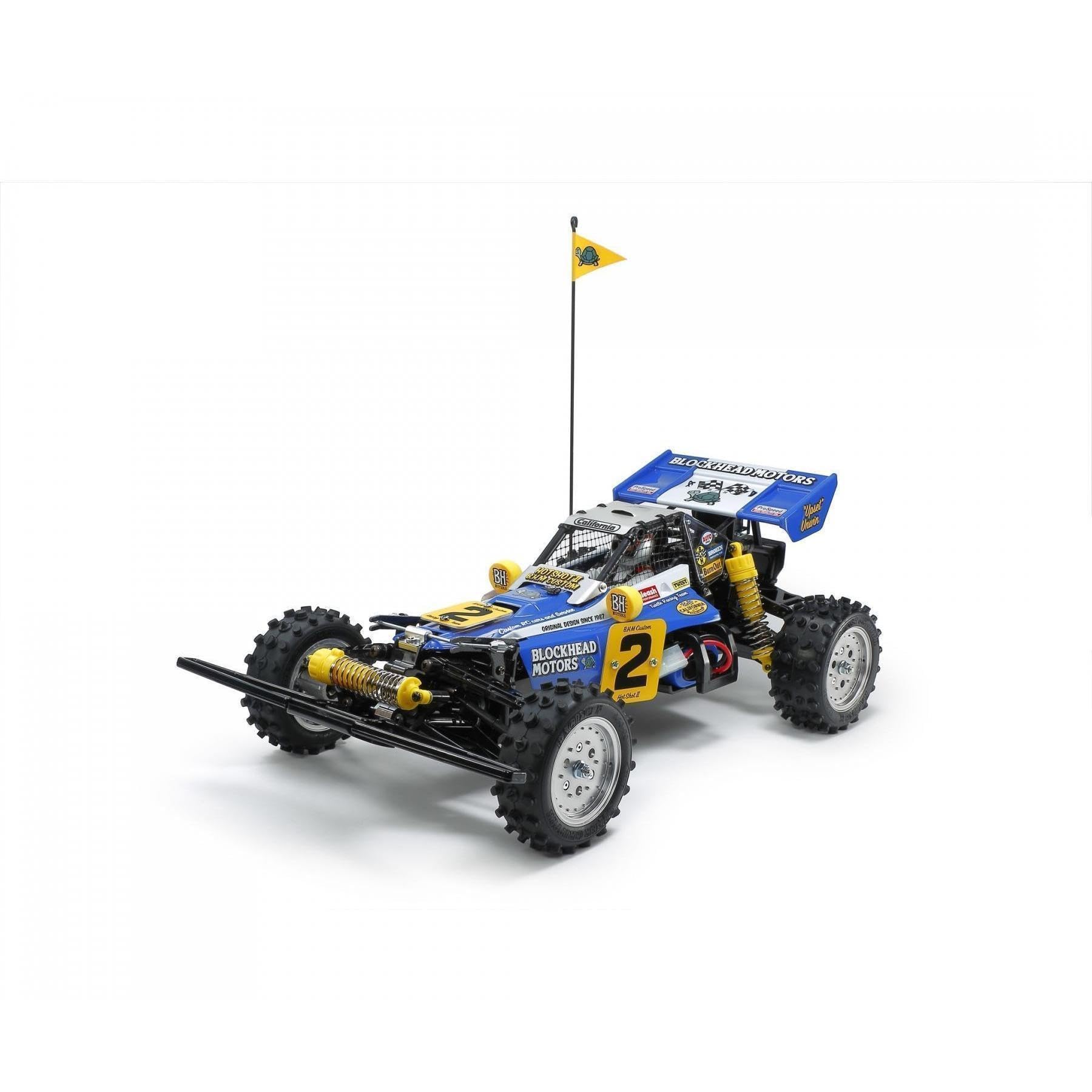
1. TAMIYA 1/10 RC Hotshot II Blockhead Motors TAM58710A
Our pick — over 4.5★ from 90+ verified ratings; the strongest balance of quality and price.
A build-it-yourself 80s legend with the body already painted, so you skip the masking tape.
The Hotshot II here is a kit you assemble yourself, and the body arrives pre-cut and pre-painted in Brilliant Blue with stickers designed by Jun Watanabe — so the fiddly roll cage sits higher than the original, and the uprights and wheels carry a matte metal plating. It is built around a 4-wheel double-wishbone suspension, which means each wheel reacts to a bump independently rather than rocking the whole chassis, and it takes a 2-3S LiPo battery or an equivalent 7.2V NiMH pack. The whole car measures 15.35 x 9.25 x 5.91 inches and weighs 16 ounces, light enough to carry in one hand to the park.
Against the Neo Scorcher further down this list, the Tamiya is the one for buyers who want the 80s re-release experience rather than a rugged basher. As owners put it: “Fun to build reasonable price.Comes with motor and ESC. The body is painted and cut out.” That review captures the appeal exactly — a real rolling chassis at a fair cost, with the paintwork already handled. Nostalgia runs through every review, and one 53-year-old owner notes he bought his first Tamiya back in 1985 and bought two more Tamiya kits alongside two Kyosho kits, which tells you how well these kits hold up over a lifetime of collecting.
What wins the most praise here is the driving experience combined with the build itself — the buggy handles well and is honestly fun to run, and the kit accepts a bigger motor and pinion with sealed bearings if you want more speed. That flexibility is the whole point: like the Neo Scorcher on paper, the Hotshot II starts mild but the chassis rewards upgrades.
What owners keep coming back to
- Body arrives painted and cut, saving a messy paint job
- Comes with motor and ESC, so it runs soon after building
- 4-wheel double wishbone suspension handles mixed terrain
Worth knowing before you buy
- You have to change the battery plug to match your charger setup
- Electronics access is tight inside the sealed chassis
- Not a track racer — maintenance-heavy if you push it hard
Reach for this if: you want the original 80s re-release experience with the paintwork already done.
Look elsewhere if: you want a turnkey racer that never needs the body off — the Hotshot II is a light-use, display-and-backyard machine, not a competition basher.
2. Tamiya 58568 1/10 Neo Scorcher TT02B
The Tamiya kit that gets beginners building — and the aftermarket parts are everywhere.
If you have never built a Tamiya before and want the easiest entry into the hobby, this is it. The Neo Scorcher runs on the TT-02B chassis, a shaft-driven 4WD setup that takes a 7.2V NiMH battery at 2400mAh with a 6C charge rate, and it weighs 4 pounds. Where the Hotshot II above measures 15.35 x 9.25 x 5.91 inches, this one stretches to 6 x 9.13 x 19.13 inches — a substantially longer footprint, which changes how it carries over uneven ground. Assembly is the star: buyers describe a nicely engineered kit that goes together easily, and the plastic and rubber parts get called out for quality, which matters because the TT-02B is a platform you will keep upgrading rather than replace.
Parts availability is the real reason to pick this over an RTR. As one buyer put it: “Easy to assemble and there are many aftermarket parts for this 1/10 scale RC car.” That single line tells you everything a hobbyist needs — you can hop it up incrementally without hunting for odd parts, and the community knows the TT-02B inside out. The stock motor is fine for tight, small tracks, so you do not need to spend more right away; if you want world-class performance later, the hop-up options are already mapped out.
The honest catch: this is not a forgiving first build for everyone. It ships without an aluminum motor mount, so the plastic one can crack under a torquey motor unless you upgrade, and the plastic drivetrain will not survive a wild brushless setup without proper greasing. Dampers come with stock oil, and owners who race recommend a thicker weight. Fine-tune it before you thrash it and it rewards you for years; treat it as a bolt-together toy and it can feel clunky.
The upgrade path: Because the TT-02B is so heavily supported, this is the kit to buy if you enjoy adding aluminum suspension arms and better shocks over time rather than buying a finished car.
Go with this one if: you want a proven, endlessly upgradeable Tamiya kit at an entry-friendly price.
skip it if: you want a buggy that runs great straight from the box with zero tuning.
3. GoolRC WLtoys 104001 RC Car, 1:10 Scale 2.4GHz 4WD Buggy
A metal-heavy 4WD starter buggy that punches well above its low entry cost.
For anyone who wants a running 4WD buggy without spending hobby-grade money, the WLtoys 104001 puts genuine aluminum and metal parts on the table. Its 550 brushed motor converts power into a top speed of 45km/h, and the 4WD setup provides strong torque to clear jumps and rough corners. The 2.4GHz radio lets several people drive on the same track at once without interference, with a control range up to 100 meters. Hardware oil-pressure shock absorbers and all-terrain tires round out the equation. Materials include aluminum, metal, plastic, and zinc, and it weighs 2.88 kg.
Owners rave about the component quality most — the chassis, arms, shock mounts, and axles all come in aluminum where many budget buggies use plastic. Handling gets praised too: it corners well and offers decent speed for beginners and kids. One buyer describes being genuinely surprised by what the buggy delivers for its price, calling the part quality extensive, and notes the only planned upgrade was a brushless motor. The same buyer sums it up: for the money, it exceeds expectations.
Be realistic about durability, though. The speed and ruggedness get mixed reactions, and some buyers report reliability issues with the motor and drivetrain — a driveshaft arriving noisy and a return-and-refund is a genuine possibility. from the start the buggy can be sluggish until you grease the diffs and set it up properly, and a serious upgrade path involves a stronger carbon chassis because the thin stock one flexes. Treat it as a learning platform you tune and upgrade, not a plug-and-play racer.
Where it wins
- Metal and aluminum parts where budget rivals use plastic
- 4WD torque and all-terrain tires handle dirt and meadow well
- 2.4GHz control runs up to 100 meters with anti-jamming for group racing
The trade-offs
- Speed claims are ambitious — the 550 motor does not always hit 45km/h
- Durability and reliability are the recurring gripe; parts can fail early
- Slow from the start; needs setup and an eventual chassis upgrade to shine
Best for: budget-minded buyers who want 4WD and metal parts and are happy to tune and upgrade over time.
Think twice if: you want reliable out-of-the-box performance at home in your yard and do not enjoy wrenching.
4. CROBOLL 1/10 Brushless RC Cars, 40+ mph Max, 4X4 RTR Off-Road Buggy
The buggy that ships with a waterproof brushless motor and a full tool kit for serious bashing.
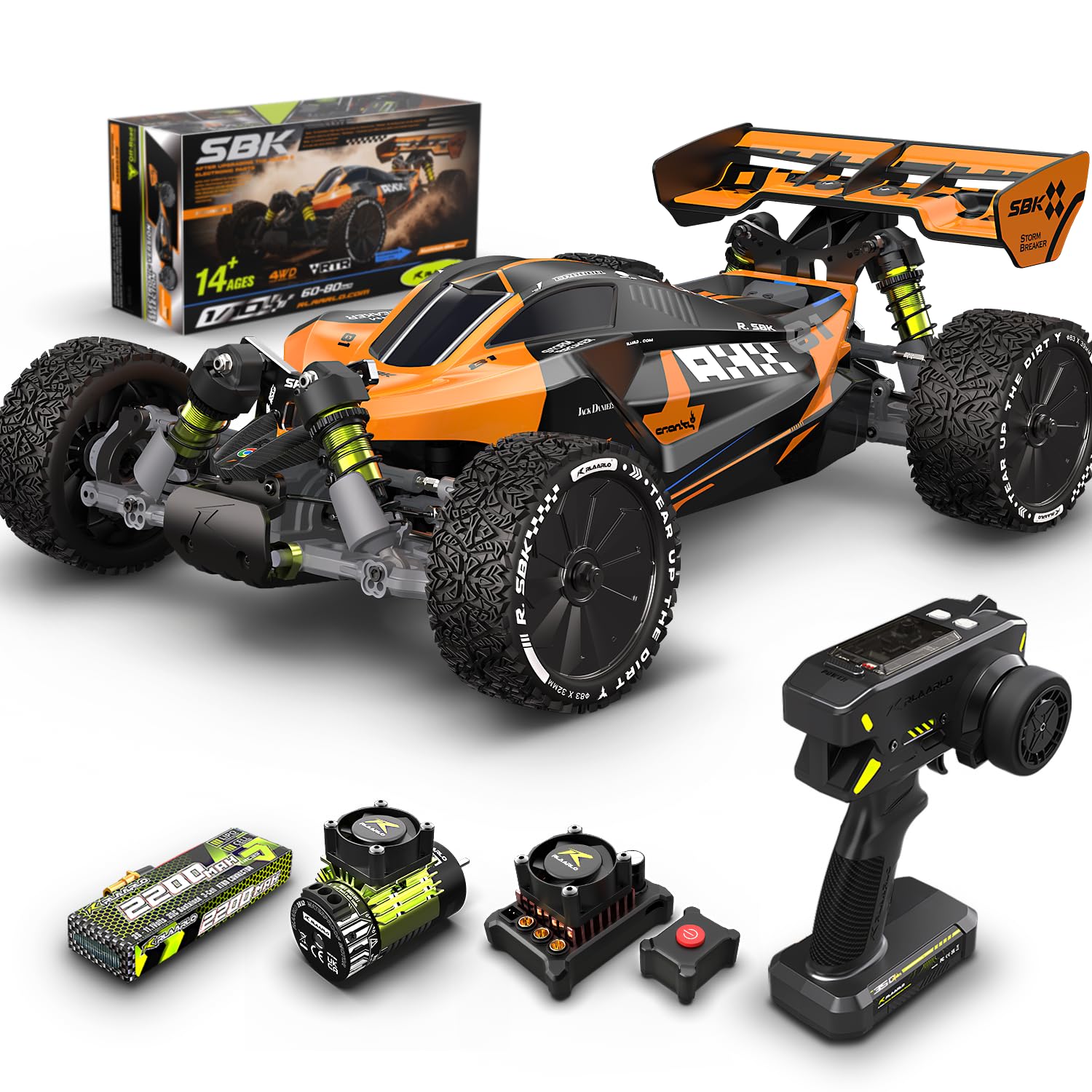
The CROBOLL arrives as a complete ready-to-run machine, and the heart of it is a 2852-3100KV brushless motor paired with a 45A ESC — both with cooling fans and a metal heatsink to shed heat on long runs. A waterproof design means puddles and damp grass are not a death sentence. It is a 4×4 setup with a central differential and triangular transmission structure, which keeps power distributed and the chassis from bending out of shape on impact. Metal oil-filled shock absorbers soften landings, and the aggressive all-terrain tires keep it planted at speed.
The construction is unusually serious for the price bracket. The shock towers are 7075-T6 aluminum alloy at 4mm, the chassis is 2.5mm aluminum, and the drivetrain uses carbon steel CVD, dog bone, and drive shaft parts — the kind of hardware that shrugs off hard landings. The radio side is equally generous: a 6-channel receiver with a 2.4GHz transmitter gives a control range up to 350 meters, and speed and steering limiting at 25%, 50%, 75%, and 100% lets new drivers learn without the car becoming a missile. A 16T and 19T motor gear pair lets you tune the top speed, and the package includes a telemetry wire that displays real-time battery voltage on the transmitter, plus a spare front bumper and a larger battery tray.
The honest limits are weight and stock speed. Owners note the car is heavy enough to flip on rough, uneven terrain, and that the out-of-the-box setup is not as fast as the “40+ mph” headline — some measure it closer to 28mph until you change gearing, and one reviewer noted it takes optional gears or a beefier battery to open up the real top end. Hinge pins and small bolts can be brittle if you land hard, so ordering a set of M3 hex bolts before your first session is sensible advice. Given the build quality and the number of buyers who call it better than builds costing far more, that is a fair trade.
Why it earned this spot: Multiple buyers compare it favorably to builds costing vastly more, and the 7075-T6 shock towers and carbon steel drivetrain are genuine durability hardware, not marketing language.
Pick this if: you want a ready-to-run brushless buggy with real premium hardware and room to grow.
Consider others if: you want maximum stock speed straight from the box or plan to run on very rough, root-filled terrain where its weight can roll it.
5. 1/10 Nitro RC Car for Adult B9996 Two Speed 4WD Off-Road Buggy

A pull-start nitro buggy with a two-speed gearbox and a 75cc fuel tank.
This is the odd one out on the list: no battery pack, no brushless motor, just a two-speed nitro monster built for the smell of fuel and the scream of a small engine. It arrives 100% assembled and ready to run, and its power comes from a strong 18CXP pull-start nitro engine — gas powered, so you fill the 75cc leak-proof fuel tank and fire it up. That 75cc tank with an overflow pipe and spring-loaded fill cover is the spec that matters most here, because fuel capacity directly sets your runtime. The whole assembly measures 15.76 x 9.85 x 6.5 inches.
The mechanical hardware is where a nitro buggy earns its keep, and this one is fully loaded: a two-speed automatic transmission for acceleration, front and rear leak-proof differentials with metal bevel gears, a 2.5mm 6061/T6 anodized aluminum chassis, and a lightweight aluminum flywheel at 13.8g that quickens engine response. It has four adjustable oil-filled aluminum-capped shocks, a high-flow dual-element air filter, and a powerful disk brake system with replaceable pads. Enthusiasts who want the traditional RC hobby experience of tuning a real engine will appreciate this.
Fair warning: nitro buggies demand mechanical expertise, and this one is no exception. The pull-start mechanism is the most-discussed failure point — users report it breaking, and the fix is usually to buy an electric starter and a drill start rather than a replacement pull cord. Transmission and one-way bearing wear, a slower-than-advertised top speed, and a manual that shows the wrong engine configuration are all reported. If you enjoy tuning and troubleshooting, that is part of the deal; if you want to charge and drive, go brushless.
Why nitro buyers like it
- Two-speed transmission gives strong acceleration and a high top end
- Full metal differential gears and anodized aluminum chassis
- 75cc leak-proof tank and adjustable oil shocks for real tuning
Be ready for
- Pull-start system breaks — budget for a drill starter from the start
- Transmission and bearing wear; high-maintenance ownership
- Top speed runs below the advertised figure in real-world use
The right call for: hobbyists who enjoy tuning a real nitro engine and do not mind the maintenance that comes with fuel-powered RC.
Do not buy it if: you want simple charge-and-drive ownership — brushless electrics suit that far better.
6. RLAARLO 1/10 Brushless RC Cars, 4×4 Buggy, 50+ MPH, Carbon Fiber
A carbon-reinforced buggy with a 350-meter radio range and a 20kg steering servo.
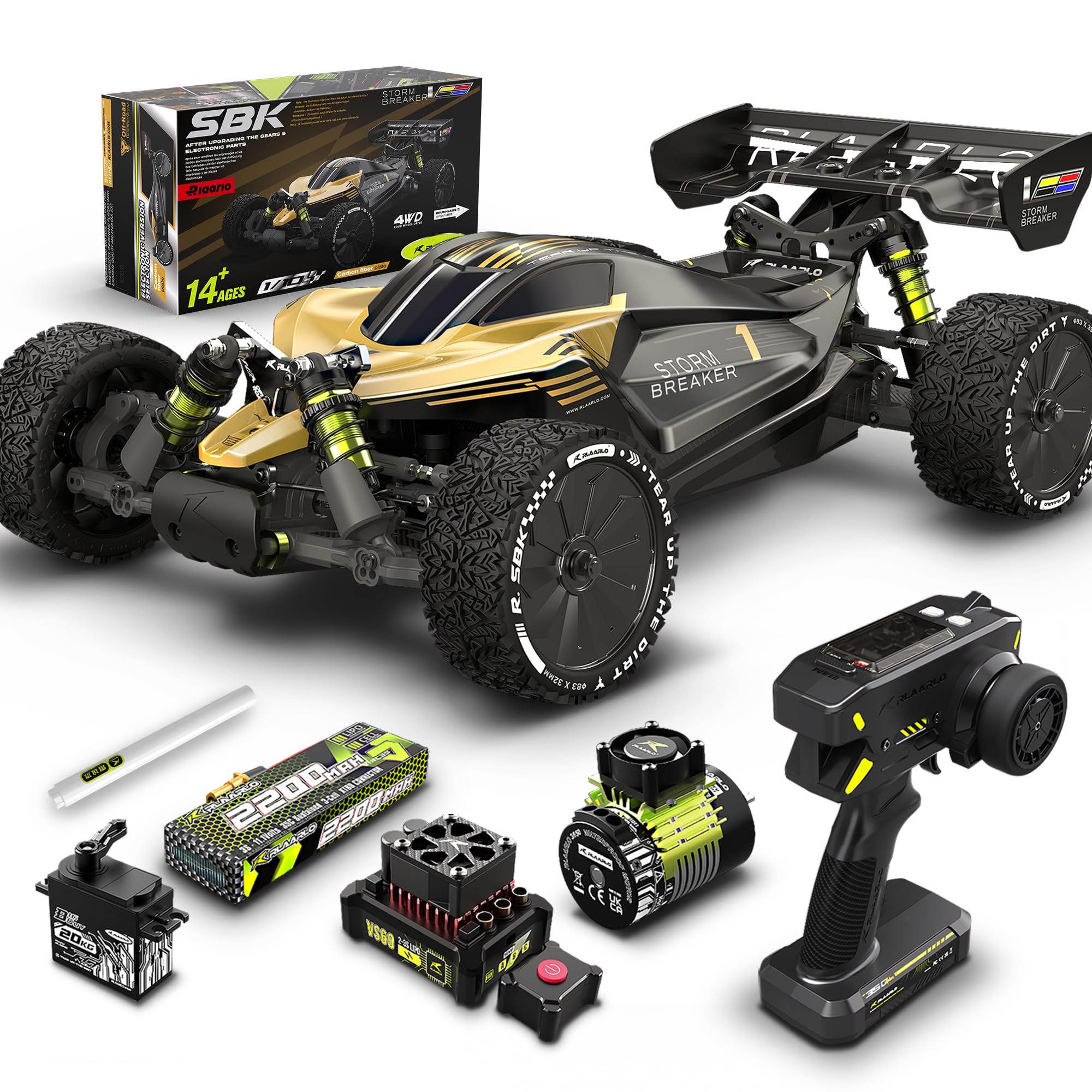
The RLAARLO is built around a 3650-2650KV brushless motor with an integrated cooling heat sink, paired with a 60A ESC and a 3S 2200mAh Li-Po battery for speeds up to 50 MPH under recommended conditions. The 3S-compatible platform leaves headroom for future upgrades. It carries a 2.5mm aluminum alloy chassis and 4mm 7075 aluminum shock towers, metal oil-filled shocks, and reinforced double A-arm suspension. Front and rear anti-roll bars cut body roll in turns, and adjustable ground clearance lets you dial the buggy in for different surfaces.
Steering and control hardware run deep for the class: a 20KG high-torque servo, sealed front and rear differentials, and a 6-channel radio with a control range up to 350 meters for stable signal transmission. The drivetrain uses hardened steel gears and carbon steel drive shafts inside a 1.2mm polycarbonate body shell — a full carbon fiber and metal build. That the anti-roll bars and adjustable ride height are included is unusual at this level, and it is exactly the configuration serious bash-session drivers want.
Two honest points. First, the 50 MPH figure is a recommended-conditions number, not a from-the-box guarantee — owners mention hitting around 40mph with a larger battery and clocking about 44mph on radar, with 50mph reachable only after upgrades. The buggy is stable and planted for beginners, handles pavement, dirt, and low grass, and one owner even fitted bigger 110mm offroad tires to grip through tall grass. Second, ground clearance is low: it can hang up on gravel, driveway lips, and sidewalk cracks, and clipping a wheel on an obstacle will break the steering or suspension links. Parts are cheap but ship slowly from overseas, so plan your spares order ahead.
What everyone raves about: the build and the handling — owners repeatedly describe it as stable, planted, and better than the well-known alternatives, with excellent warranty and after-sale service behind it.
Get this if: you want genuine carbon fiber and 7075 aluminum hardware, a long-range radio, and easy adjustment for multiple surfaces.
Steer clear if: you drive mostly over gravel and cracked concrete — its low ground clearance prefers pavement, dirt, and short grass.
7. JLBRACINGRC 1/10 80+ KPH Brushless Fast RC Buggy, 120A ESC, 4WD
A 120A ESC and a 3670 motor make this the top-speed machine of the group.
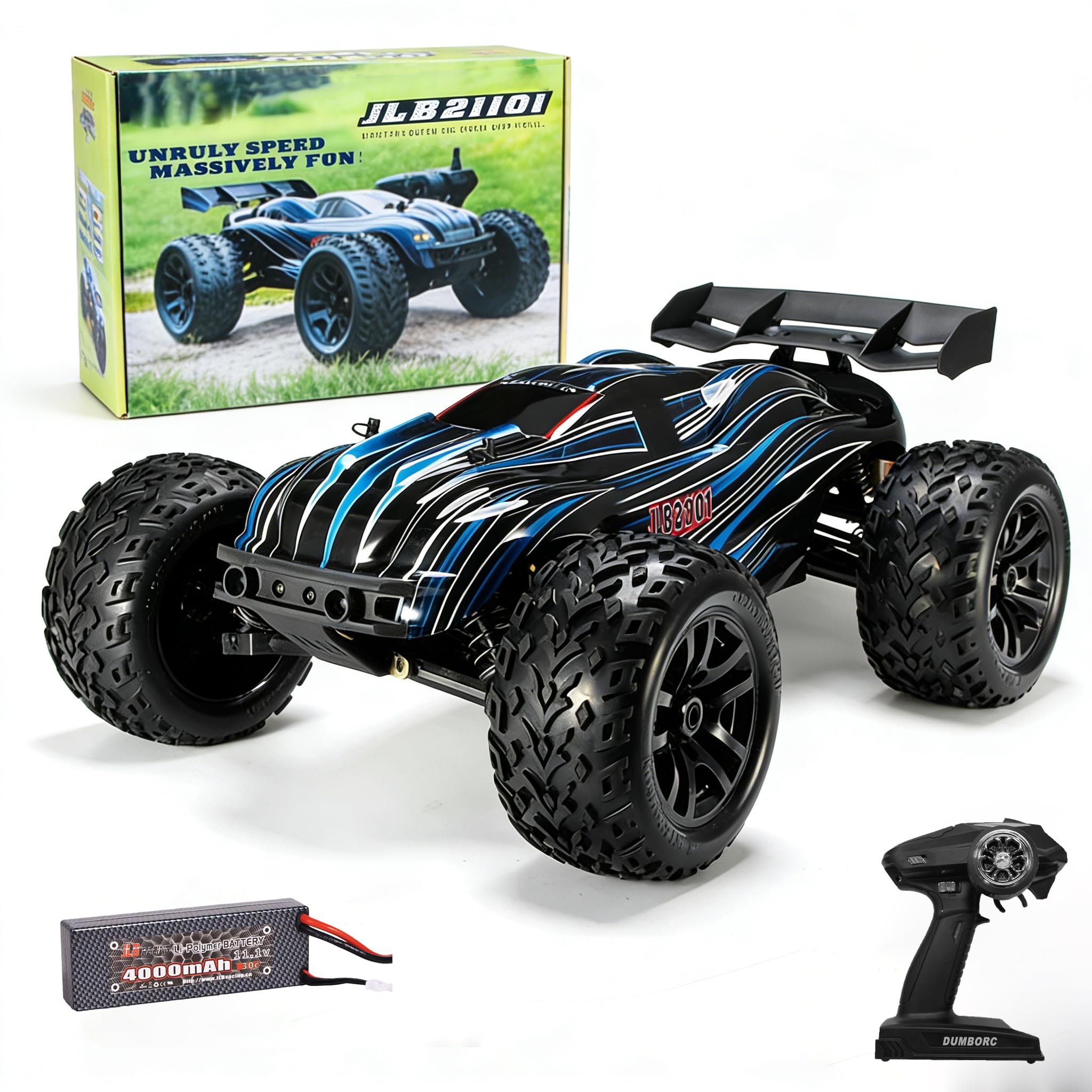
Numbers are the story here. A 3670 2500KV brushless motor, a waterproof 120A ESC, an 11.1V 4000mAh 30C lithium battery pack, and a 21KG metal gear steering servo make the JLB 21101 a genuinely serious machine. The four-wheel drivetrain delivers a top speed of 80km/h, and fully independent suspension with 8 coil springs soaks up bumps across uneven terrain. It sells as a 1/10 stadium truck with a hybrid plastic-and-aluminum chassis, bright LEDs visible from over 200 meters, and a 150-meter radio range.
What people enjoy most is how it drives. It does not get stuck on rocks, stays fun over mixed terrain, and suits everyone from teens up — buyers describe it as durable enough that it will not be outgrown quickly, with a build quality that holds up. The car performs well day and night, and the price is called excellent relative to the hardware on board. If your priority is raw speed with the hardware to feed it, this is arguably the value leader of the whole list.
Two things to plan for. The chassis has a hybrid plastic-and-aluminum construction — the front and rear ends are metal, but the main frame is plastic, so a buyer hoping for a full alloy chassis may be surprised. And the car is very light on the front end: it flips backward when you apply hard throttle, so you need to modulate the trigger or add weight to keep the wheels planted. Sizing is also inconsistent across buyers — some report it feels closer to 1/8 scale than true 1/10. That is characteristic of the budget-fun end of this category, and it underlines that this buggy rewards a careful hand on the throttle.
Best fit for: speed-seekers who want the highest advertised top figure and the electronics to back it up.
Reconsider if: you need a full metal chassis or expect the car to stay flat under full throttle — the body flips backward and the main frame is plastic.
8. Kyosho Optima Vintage Series Off-Road Buggy Vehicle (1/10 Scale)

A 1980s racing icon reissued with thicker aluminum and a choice of chain or belt drive.
This is not a buggy you buy to bash in the dirt — it is a piece of RC history you bring back to life. The Optima Vintage Series keeps the classic layout but upgrades it: the chassis plates and main chassis bars are slightly thicker 6061T6 aluminum for improved durability as well as the iconic styling. Crucially, the kit includes both chain and belt drive trains, so you can pick the drivetrain that suits the motor you plan to run — belt for smooth power delivery, chain for old-school character. That flexibility is the whole point of a proper vintage build.
The mechanical detail shows in the parts list. Gears are 48 pitch with sintered alloy and high-impact nylon construction and a newly added slipper clutch to handle modern power levels. The shocks are a new 10mm diameter aluminum cylinder with a stainless steel shaft for improved damping, and every piece of hardware is hex. At 2.35 kg it feels substantial in hand, and it runs a Nickel-Metal Hydride battery. The kit also includes a clear polycarbonate body, decal sheet, grease, shock oil, threadlock glue, and a cross wrench.
Owners who grew up with these cars are the ones who appreciate it most — the Optima is the buggy that brings back the feeling of building your first RC kit in the 80s. What comes through is the quality of the build and the pure joy of assembly: buyers describe a great kit with top-of-the-line construction, and note it drives nicely, does not flip over easily, and even pops wheelies. It comes with a clear body you paint yourself, so plan on buying paint and a motor and ESC separately. If you want to run a buggy today with zero extra purchases, keep looking; if you want to build a legend, this is the one.
Who it is made for: collectors and nostalgia builders who find as much satisfaction in the assembly as in the driving.
The one for you if: you want a genuine reissued racing legend you build and paint yourself, with the option of chain or belt drive.
Not the one for you if: you need a buggy that runs in this decade from the start — this is a kit with no motor, ESC, or battery included.
9. Kyosho 30616B Turbo Scorpion 1/10 Electric Buggy Kit

A vintage Scorpion reissued for modern speed, with the gearbox already built.
The Turbo Scorpion is the modernized version of Kyosho’s classic off-road racer, updated to meet the demands of today’s off-road racing scene. It is a build-it-yourself kit but not a total from-scratch affair — the gearbox comes pre-assembled, saving the trickiest assembly step. It keeps the racy-style mini bumper of the original, the rear section is reinforced with a rear sus post L and strengthened by an added flange, and the body finish comes from die-cut decals that stretch for easy application. The accurate recreation of the original loop-mount light buckets even lets you bolt on optional LED lights, weighing 4 pounds. It runs on a 7.4V 2S LiPo battery at 3300mAh with a 30C discharge rate.
The build quality and the instructions are what get highlighted. Owners describe a kit that assembles in a handful of hours, with an aluminum chassis and steering components described as solid, and instructions that are easy to follow. When assembled and equipped with a 60A brushless system it is very quick, and it survives flips and tumbles without breaking. The die-cut decals take a bit of care to apply — that part is a genuine test of fine-motor skills just like the original but you do not need to be a professional.
The honest catch is completeness. Some kits have arrived with a small plastic parts pack missing — typically the differential cover or spoiler — which can hold up your first test drive until replacements show up. The seller has been quick to ship missing parts when that happens, so it is a hassle rather than a dead end, but it is worth setting expectations. If your priority is a flawless, ready-to-race box, know that small gaps are possible; if you love the build and the vintage machine itself, the Turbo Scorpion delivers on that beautifully.
What makes it shine
- Pre-assembled gearbox saves the hardest assembly step
- Solid aluminum chassis and steering components
- Very fast with a 60A brushless setup and surprisingly resilient to flips
Before you commit
- Occasional kits arrive short a small plastic parts pack
- Dies-cut decals demand patience to apply
- No motor, ESC, or battery included — budget for those separately
The best choice if: you love Kyosho’s vintage design and want a modernized racer that is still satisfying to build.
Look elsewhere if: a missing small part in the box would ruin your day — check the contents before the build begins.
Understanding the Specs
Motor KV And Brushed Versus Brushless
KV measures how many RPM a motor spins per volt of power — a higher number means more top-end speed, and a lower number means more torque for climbing and acceleration. Brushed motors use carbon brushes that wear and limit speed; brushless motors run cooler, last longer, and deliver more punch for the same heat, which is why every high-speed buggy here runs brushless. If you are just starting, a brushed setup is cheaper and simpler; if you want to grow into the hobby without replacing the motor, go brushless from the start.
ESC Amperage And Battery Voltage
The ESC (electronic speed control) is the part that regulates how much current flows from the battery to the motor, and its amp rating must be high enough to feed the motor without overheating. A 120A ESC can handle a bigger motor than a 45A one. Battery voltage sets the ceiling: a 2S pack gives less power than a 3S, and some buggies let you step up as you gain experience. Always match battery voltage and ESC amperage to the manufacturer’s recommendation, or you risk frying the electronics.
Shocks, Chassis, And Ground Clearance
Oil-filled shock absorbers use hydraulic oil in a sealed cylinder to slow the spring’s bounce, so the buggy lands a jump smoothly instead of bucking. An aluminum alloy chassis with metal shock towers bends less under impact than plastic, and sealed differentials stop dirt getting into the gears. Ground clearance is easy to overlook but matters most: a low buggy will hang up on gravel and driveway lips, while a higher one floats over rough ground — match it to where you actually drive.
Scale, Control Range, And Servo Torque
Scale is a size class: 1/10 buggies occupy the mainstream hobby tier, with plenty of shared racing parts. Control range is the distance your radio keeps a solid signal — anywhere from around 100 meters to 350 meters depending on the model — so if you race on a big field, pick a longer range. Servo torque, measured in kilograms, decides how strongly the steering resists the kickback from grass and gravel; a higher-rated KG servo keeps the wheels pointing where you want them under grip.
FAQ
Are all 1/10 scale RC buggies the same size?
Do I need to buy a motor and battery separately for a kit?
What is the difference between brushed and brushless in a 1/10 buggy?
Is a nitro buggyharder to maintain than an electric buggy?
How fast do these 1/10 buggies actually go?
What terrain can a 1/10 scale RC buggy handle?
How long does the battery last on a 1/10 buggy?
Do I need to upgrade parts straight from the start?
Can a beginner handle a fast 1/10 buggy?
Are replacement parts easy to find for these buggies?
Final Thoughts: The Verdict
For the majority of shoppers, the 1/10 scale rc buggy winner is the TAMIYA 1/10 RC Hotshot II Blockhead Motors because it pairs a genuine 4-wheel double-wishbone suspension with a body that arrives already painted and cut — among the most complete kit experiences you can buy, back by a crowd of owners who grew up on these kits and keep buying more. If you want raw ready-to-run speed with premium hardware, grab the RLAARLO 1/10 Brushless Buggy. And if you want the highest-speed machine on the list, the JLBRACINGRC 21101 is the one to reach for. Whichever you pick, matching the buggy to where you actually drive — pavement, dirt, or mixed grass — matters more than chasing the biggest top-speed figure, and the range of options here means it is worth taking the time to match your drive style, build patience, and terrain before you decide.
How We Picked
We do not accept paid placement. Every pick is matched to a real buyer and a real use-case; we do not hands-on test units.
Sources & Methodology
Specifications: manufacturer listings and product documentation. Review insights: verified customer reviews, as of September 2026. Pricing: not shown on this page (it changes often); check the current price via the retailer link.
As an Amazon Associate, Gadgets Feed earns from qualifying purchases. This does not affect which products we feature.