
Our readers keep the lights on and my morning glass full of iced black tea. As an Amazon Associate, I earn from qualifying purchases.
Specs are compiled from manufacturer listings and verified buyer reviews and can change over time — please confirm the key details on the product page before buying.
You can revive a dead device with a 3.7V lithium battery, but the plug and the size matter more than the power. Almost every 3.7V cell here holds the same nominal voltage (the average voltage it runs at), so your success depends on three things: does the plug match your board, does the size drop into the compartment, and does the polarity line up. Get those three right and your device runs again. Get them wrong and you can melt the board.
I’m Min — the founder and writer behind Gadgets Feed. This guide is built by comparing the manufacturers’ published specifications and the patterns across verified customer reviews, so you get each pick’s real strengths and trade-offs instead of marketing spin.
Below are nine real 3.7V cells sorted by what they are actually good at. They range from a two-pack that doubles runtime in kids’ RC trucks to a 5000mAh pack that sits for six weeks without losing charge. That way you can pick the one that fits your build and walk away with the right 3.7v lithium battery in your hand.
Our Picks at a Glance

How To Choose The Best 3.7V Lithium Battery
A 3.7V lithium cell is a small, sealed package with two wires and a plug on the end of it. It is not universal, and the fastest way to waste your money is to buy on capacity alone. Here are the four things that actually decide whether your project works.
Match the connector before anything else
The plug is the deal-breaker. A PH2.0 connector is a tiny two-pin plug with a 2.0mm pin pitch (the gap between the pins), and it will not seat in a board built for a 1.0mm JST plug. The Blomiky two-pack uses an SM-2P plug that is a different shape again. Measure the pitch on your old battery with calipers, or count the pins and eyeball the gap, before you buy. A plug that is close but not exact will either not click in or will force you to rewire the whole thing.
Know your capacity in mAh
The mAh figure tells you how long the cell will run your device. A 1000mAh cell runs a 1-amp load for about an hour, and a 5000mAh cell runs the same load for about five hours. For a small Bluetooth headset or a garage door keypad, 1000mAh to 1250mAh is plenty. For a dash cam or a device you leave running all day, aim higher and check that the bigger cell still fits the bay.
Check polarity and protection
On nearly every one of these cells, red is positive and black is negative, but the wires on the plug end are not always wired the way your board expects. Reversed polarity can short the board instantly. If your device relies on the cell for safety, look for a built-in PCM protection board (a small circuit that cuts power if the cell is overcharged, over-discharged, or short-circuited). skip it if you are building a high-drain RC car that needs raw current.
Quick Comparison
| Model | Best For | Capacity | Connector | Cell Type | Amazon |
|---|---|---|---|---|---|
| Blomiky 3.7V 1000mAh 2 Pack with SM-2P Plug★ Best Overall | RC trucks and kids’ jeeps | 1000 mAh (max 1200 mAh) | SM-2P | Lithium Ion | Amazon |
| 3.7V 5000mAh 115659 Lipo Pack with JST PH2.0mmBiggest Capacity | Dash cams and long-standby electronics | 5000 mAh | JST PH2.0mm | Lithium Polymer | Amazon |
| DC 3.7V 1250mAh 603450 with 2-Wire LeadBest For Repairs | Wire-in replacements for headsets | 1250 mAh | 2-pin JST (2.0mm pitch) | Lithium Polymer | Amazon |
| EEMB 3.7V 103454 2000mAh with JST 2.0mm | Compact electronics and sensor nodes | 2000 mAh | JST 2.0mm | Lithium Ion | Amazon |
| 3.7V 3000mAh 103665 with USB Charger Cable | Meshtastic and development boards | 3000 mAh | PH2.0 with USB cable | Lithium Polymer | Amazon |
| DC 3.7V 1100mAh 102050 with 2-Wire Lead | Helmet intercoms and MP3 players | 1100 mAh | 2-pin JST (1.0mm pitch) | Lithium Polymer | Amazon |
| EEMB 3.7V 103395 3700mAh with JST 2.0mm | Portable lights and GPS units | 3700 mAh | JST-PHR 2.0mm | Lithium Polymer | Amazon |
| 2Pcs 3.7V 2000mAh Pack with PH2.0 Connector | ESP32 and IoT prototyping | 2000 mAh | Micro PH2.0 | Lithium Ion | Amazon |
| MakerHawk 4 Pack 3.7V 1000mAh 1S 102050 | Bulk battery replacements | 1000 mAh | Micro JST 2.0 | Lithium Polymer | Amazon |
In‑Depth Reviews
1. Blomiky 3.7V 1000mAh 2 Pack Lithium-ion Rechargeable Battery with SM-2P Plug and USB Cable
Our pick — over 4.5★ from 250+ verified ratings; the strongest balance of quality and price.
Two cells and two USB charging cables that turn a sluggish RC toy back into the fast one.
This is the pick for the parent fixing a kids’ RC jeep or the hobbyist upgrading a car from a single cell to a double. Each battery is rated 3.7 volts at 1000mAh (max up to 1200mAh), and the cell measures 52.5 x 28.5 x 14.6mm, so it drops into most stock toy compartments. The battery weighs just 38g. That combination matters because the whole two-pack, plugs and cables included, adds almost nothing to a lightweight chassis.
What wins people over is the quality of the cells themselves, paired with runtime that beats the stock batteries these replace. The upgrade story is the real draw: going from one 3.7V cell to two in the same car nearly doubles drive time, with two packs giving roughly 30 minutes of combined run time in one owner’s build. Two USB cables are in the box, and both were reported working straight out of the packaging where a cable from another seller was not. There is an 8.5A over-current protection circuit on each cell, so a hard stall does not cook the battery.
The honest catch is the plug. This is an SM-2P black two-prong connector with a 0.22 x 0.2-inch plug face, and it will not fit every RC toy on the shelf — some take a different plug entirely. The fit reads mixed in reviews for exactly that reason. Measure your toy’s plug and the battery bay before ordering, and this becomes a non-issue. The USB cable charges via a solid red light that flips to green when full, so you always know where you stand.
What earns the top spot
- Two batteries plus two USB cables — everything you need to get running
- 1000mAh capacity, up to 1200mAh max, doubles runtime in many single-cell toys
- 8.5A over-current protection circuit built into each cell
- Only 38g per battery and 2.07 x 1.12 x 0.57 inches — fits tight toy bays
Where it asks something of you
- SM-2P plug will not fit every RC device — check your connector first
- Some buyers found the fit did not match their specific toy from the start
Reach for this if: you are powering or upgrading an RC truck, car, or boat with an SM-2P plug and want the backup cell included.
Look elsewhere if: your device uses a PH2.0 or JST-style plug — the SM-2P here will not seat and you would need to rewire.
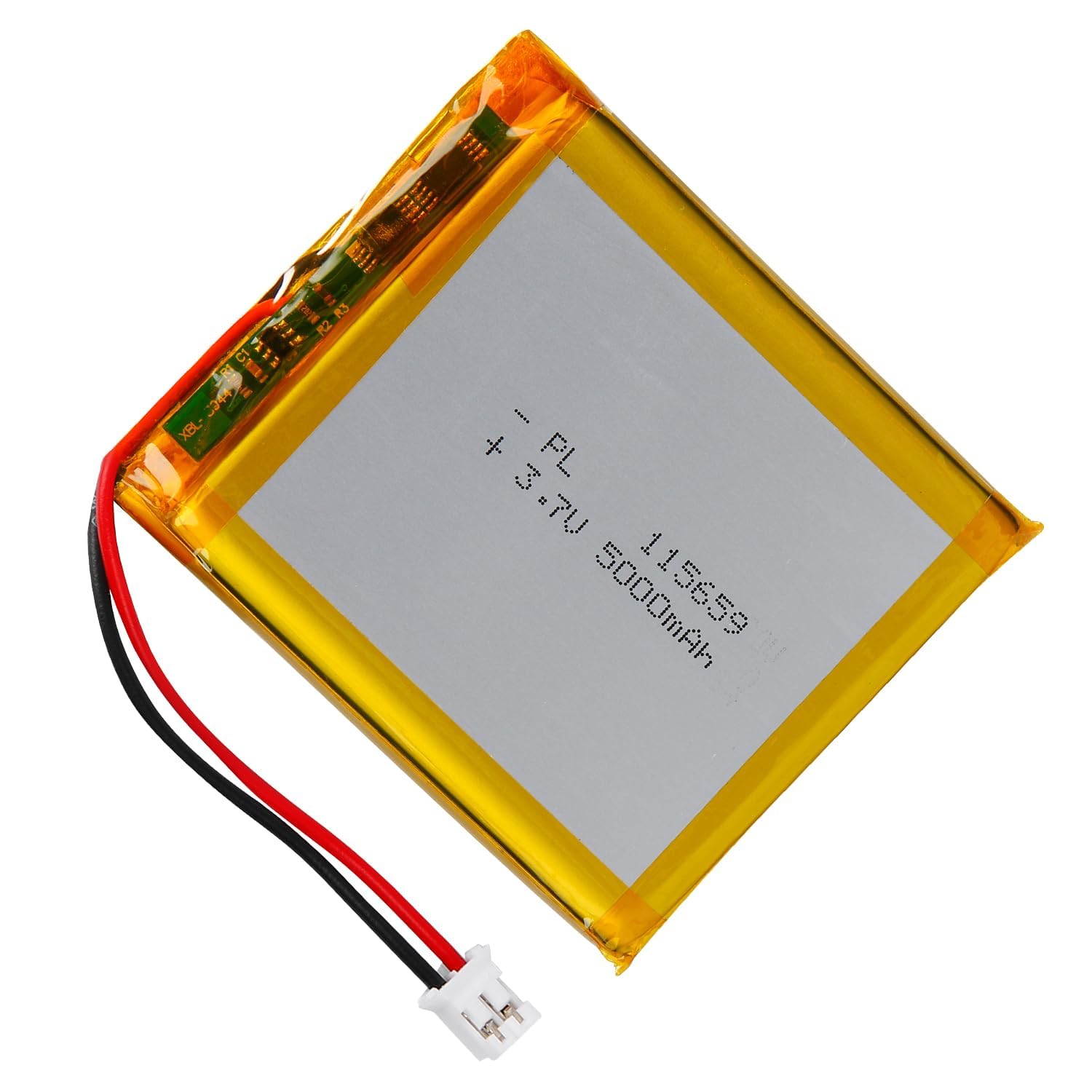
2. 3.7V 5000mAh 115659 Lipo Battery Pack with JST PH2.0mm Connector
The one that sits on the shelf for six weeks and barely loses a drop of charge.
If you are building a dash cam, a dash-mounted E-Ink display, or anything that sits idle for weeks between uses, self-discharge is what kills you. This 5000mAh cell arrived at 4.1V and still read 3.97V after six weeks of sitting around waiting for a project to finish. That low self-discharge rate is the whole point of this pack. It also holds five times the capacity of the Blomiky cells above — 5000 mAh against 1000 mAh — so it runs a dash cam or idle sensor node for days instead of hours.
It has a built-in PCM protection circuit module that guards against over-charge, over-discharge, short circuit, and over-current, which is exactly what sensitive electronics want. The listed applications are wide: Bluetooth speakers, wireless headphones, GPS units, smart watches, baby monitors, digital cameras, portable POS systems, dash cams, VR glasses, and pet trackers. One thing to know about the size — the cell measures 10 x 54 x 60mm and weighs 61g, which is on the large side for a 3D-printed enclosure.
The catch here is the connector and the polarity, both of which have bitten buyers. The plug is a JST PH2.0mm two-pin with a 2.0mm pitch, and at least one owner had to swap the wire polarity because it came backwards for their build. This is a low-current cell — it is not for drones, RC cars, or power tools, and forcing it there will damage either the battery or the device. Check the plug pitch and the polarity before you plug anything in.
Real-world staying power: the standout fact is the low self-discharge — a 4.1V arrival still reading 3.97V six weeks later without a charger touching it.
What it is not for: high-drain toys and models. The PCM protection is a feature for sensitive electronics, but it caps the current draw well below what an RC car needs.
Fits best: long-standby electronics and custom projects where you want capacity without worrying about charge loss between uses.
Think twice if: your build needs high current — this is a low-to-moderate current cell with a safety cutoff, not a power cell.
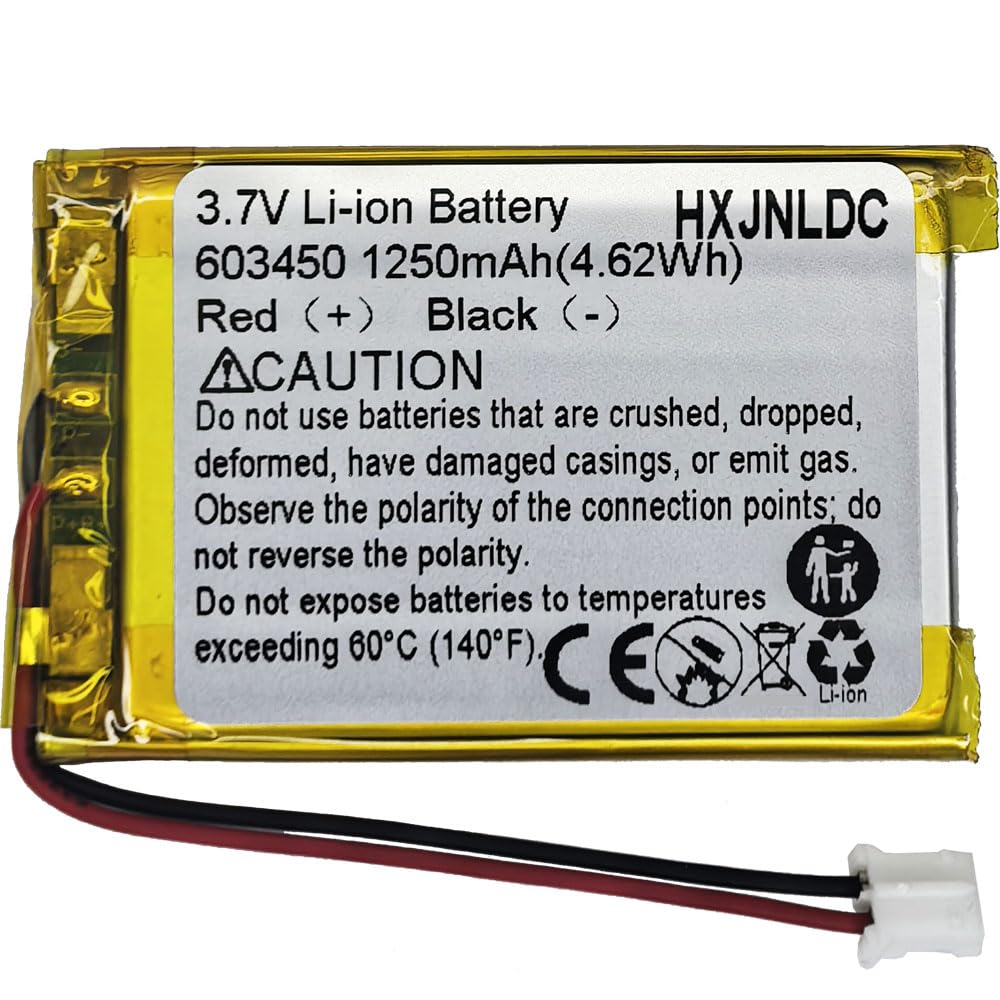
3. DC 3.7V 1250mAh 603450 Rechargeable Lithium Polymer Battery for Built-in 2-Wire Replacement
A wire-in cell that brings dead headsets and speakers back to life for the cost of a coffee.
When an old headset or speaker stops holding charge, you rarely need a new device — you need a fresh cell in the same slot. This 1250mAh battery is 3.7V nominal (4.2V full charge), at 4.62Wh and a maximum current of 1.2A, and it is built for replacing built-in 3.7-5V batteries with two wires. It measures 6 x 34 x 51mm and weighs 25g, so it slips into the same compartment the old cell came out of. At 25g it also stays lighter and smaller than the 38g Blomiky cells above, which makes it the easier swap for a headset compartment with almost no spare room.
Owners have installed this in a Sony PS3 CECHYA-0080 headset after a proper capacity check — the cell tested 1262mAh on a Vapcell S4 Plus charger, which is a real, measured result, not a label. It has also revived a Jensen Bluetooth speaker that had dropped to a few minutes of playtime, and a PS4 Gold headset used for evening gaming on PC and PS5. The replacement cell is paired with a Japanese Seiko IC protection board, a high-temperature silicone cable, and a genuine JST Pitch 2.0mm 2-pin connector. The takeaway is that two wires and a matching connector get you back in business.
Polarity is the one thing that catches buyers. This is a two-wire lead, not a pre-wired plug, so if your device’s connector is inverted or missing a plug, you cut and solder the same-color wires and use the included heat-shrink tubing to cover the join. It is not a universal drop-in — but if you can handle a soldering iron, it is among the most useful cells here. A full charge lasts days in a headset, and the biggest gain goes to owners replacing a lower-capacity OEM cell (the original battery that came with the device).
Why repairers keep this on hand
- 1250mAh capacity at 3.7V nominal, tested at 1262mAh on a Vapcell S4 Plus in one owner’s check
- Fits a Sony PS3 CECHYA-0080 headset and similar 2-wire devices
- Included heat-shrink tubing makes splicing to an old plug tidy and safe
- Weighs just 25g and measures 6 x 34 x 51mm for tight compartments
The trade-off to plan for
- Polarity may need reversing — check red/black wiring before you connect
- No plug included in some cases, so be ready to cut and solder
Best match: anyone reviving a dead headset, speaker, or small 3.7-5V device and comfortable doing a two-wire repair.
Not for you if: you want a plug-and-play cell — this is designed to be spliced, not simply clicked into a socket.
4. EEMB 3.7V 103454 2000mAh Lipo Battery Rechargeable JST 2.0mm 1-Pack

The project battery that has survived years in the field without complaint.
This 2000mAh LiPo is rated at 3.7V, min 1900mAh, 40g, and it claims 500+ cycles with no leaking and low internal resistance. It carries UL, IEC62133-2 certification, and UN38.3 compliance for air and sea shipping, which matters if you are shipping a product you built. That no-leak, low-resistance profile is what makes it the common pick for commercial builds. It also weighs 40g against the 25g of the DC 603450 above — the extra 750mAh costs you 15g, which matters in a handheld device but not in a stationary one.
Buyers report this cell running better than expected in a range of compact electronics — Bluetooth speakers, dash cams, keyboards, mice, Wi-Fi smart home gear, GPS units, e-books, and IoT devices. A direct fit into an Inkbird iBBQ-4T thermometer pops up as a clean replacement, and one buyer revived a Potensic P5 drone by desoldering swollen cells and dropping these in. The one that has run for two years and counting is the quiet proof of durability. The typical use is exactly what this cell is built for: steady, moderate-current, everyday electronics.
You do need to check four things before you buy: size 34.5×56×10.3mm, connector model, connector pin size, and the +/- polarity alignment. Polarity is the recurring issue — some units arrive with the red and black wires reversed, and reversed polarity equals an instant short circuit. If you are comfortable reading the wires and matching them to your board, this is one of the best-supported cells in the category, backed by a wide UL listing. For high-current or high-heat builds, look elsewhere.
The certification edge: UL, IEC62133-2, and UN38.3 compliance is rare at this size and makes it the safer pick for builds you plan to ship or sell.
The proof in long service
- 2000mAh, 3.7V, 40g, 500+ cycle life
- Recorded working from 2024 through 2026 in a buyer’s long-term test
- Standard fit for the Inkbird iBBQ-4T and many compact electronics
Read the polarity first
- Reversed wires on some units — confirm polarity before you connect
- Fit is mixed across devices, so verify the 34.5×56×10.3mm size
- Not suited to high-current builds like drones or power tools
Pick this when: you want a certified, cycle-tested cell for a moderate-current device you will rely on long term.
Walk away if: you cannot verify the connector and polarity on your board — the wrong hookup on this one shorts the device.
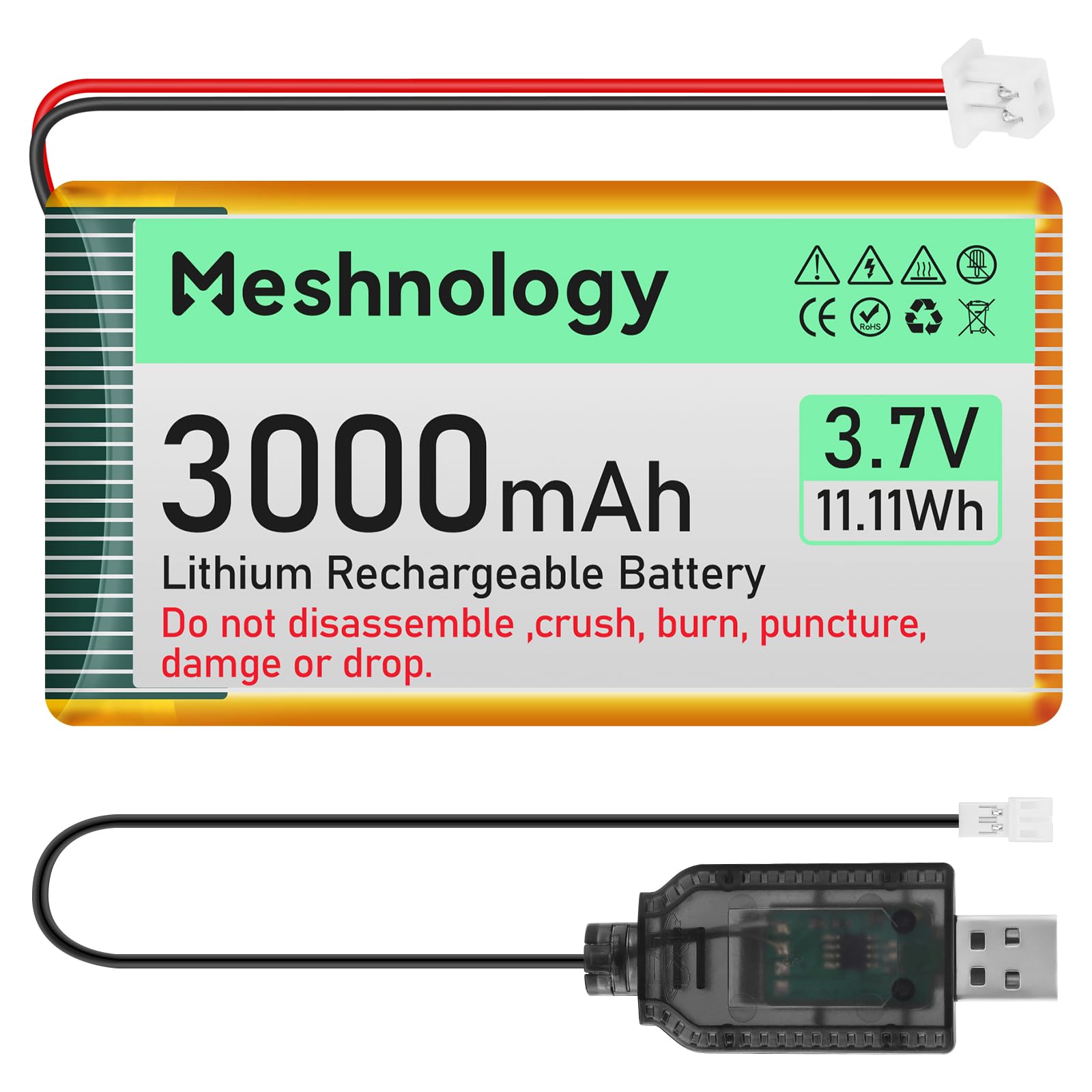
5. 3.7V Lipo Battery 3000mAh 103665 with USB Charger Cable and PH2.0 Connector
The 3000mAh cell built for Meshtastic nodes and development boards that need to run untethered.
Meshtastic builders and RAK19007 + RAK4631 users have a lot of battery options that technically work but do not have the protection they want. This 3000mAh cell has a PH2.0 connector and carries UN38.3 and CE certifications, and the package includes a USB charging cable with anti-short-circuit reverse-polarity protection plus LED status light. That combination — protected charging cable plus protected cell — is what makes it the pick for a node you leave running in the field. The 3000mAh capacity sits between the 2000mAh EEMB above and the 5000mAh pack, so it splits the difference on runtime and size.
Owners put this cell on real workloads. One report has it powering a custom CPU board drawing 450mA for 4 hours and 20 minutes. Another uses a set of them in Meshtastic devices with no issues at all. The battery weighs 58g, which is on the heavier side for the size but comes with the capacity premium. The build quality and out-of-the-box reliability show up consistently, and the whole reason builders keep coming back is that it just works when wired correctly.
There is one important caveat: polarity and wiring tripping up first-timers. At least one multi-cell order showed decimal-mV readings and boards not powering up until the owner confirmed it was a wiring error, not a bad cell. The USB charging cable’s built-in protection and LED status light help you catch a wiring problem early. If your board is PH2.0 and you respect the polarity, this is a solid fit for battery-powered DIY electronics.
Standout spec: the included USB cable is the difference-maker — reverse-polarity protection and an LED status light on the charging cable alone is rare in this category.
Real workload numbers: a 450mA draw sustained for 4 hours and 20 minutes is real-world proof that the 3000mAh rating holds up under a normal device load.
Go here for: Meshtastic nodes, development boards, and DIY projects where you want protected charging built into the cable.
Skip it for: high-drain RC or power-tool use — this is a low-current cell, and the PH2.0 plug only fits compatible PH2.0 sockets.
6. DC 3.7V 1100mAh 102050 Rechargeable Lithium Polymer Battery for DIY 3.7-5V Replacement

An 18g cell for builds where every gram of weight shows up in your hand.
Small electronics do not need a big battery, and this one proves it. The 1100mAh cell is 3.7V nominal, 4.2V full charge, at 4.07Wh and 1.1A max current, and its 51 x 20 x 10mm body weighs just 18g. It uses a JST Pitch 1.0mm 2-wire connector — note the 1.0mm pitch, which is finer than the 2.0mm connectors on most of the cells here. If your board takes JST 1.0, this is the one, and the smaller pitch is what enables the lighter weight. That matters in helmet intercoms and MP3 players where a few grams on your head or in your pocket is noticeable.
The real-world uses line up perfectly. A motorcyclist swapped this into a Bluetooth helmet intercom — about ten minutes of soldering, the included heat-shrink tubing over the joins, a charge to 100%, and it fit despite being slightly larger than the original. A hobbyist ran it against a 30mm x 40mm heater film drawing roughly 160mA and got through a couple of hours without a problem. It has a Japanese Seiko IC protection board and high-temperature silicone cable, and the same heat-shrink replacement offer as the other cells in this family.
The complaint that surfaces is charge retention — a couple of owners say it does not hold long, and one connector arrived wrong for the buyer’s project. That second issue is not unique to this cell; it is the universal 3.7V buyer trap. If you verify your pitch and draw and use it in a low-current device, you get a tiny, light, reliable cell for a DIY replacement. If you need all-day runtime from a single charge, size up instead.
Sizing balance: at 18g and using a JST 1.0mm pitch connector (a tiny plug with 1.0mm between pins), this is the pick when your project device has almost no room to spare.
One downside to know: reported charge retention is modest, so it fits low-draw devices rather than anything that needs to run for a full day.
Best for: helmet intercoms, MP3 players, and tight-space DIY builds that need a small, light cell with a JST 1.0mm plug.
Choose bigger if: you need all-day runtime — the 1100mAh here is best suited to short-burst, low-current devices.
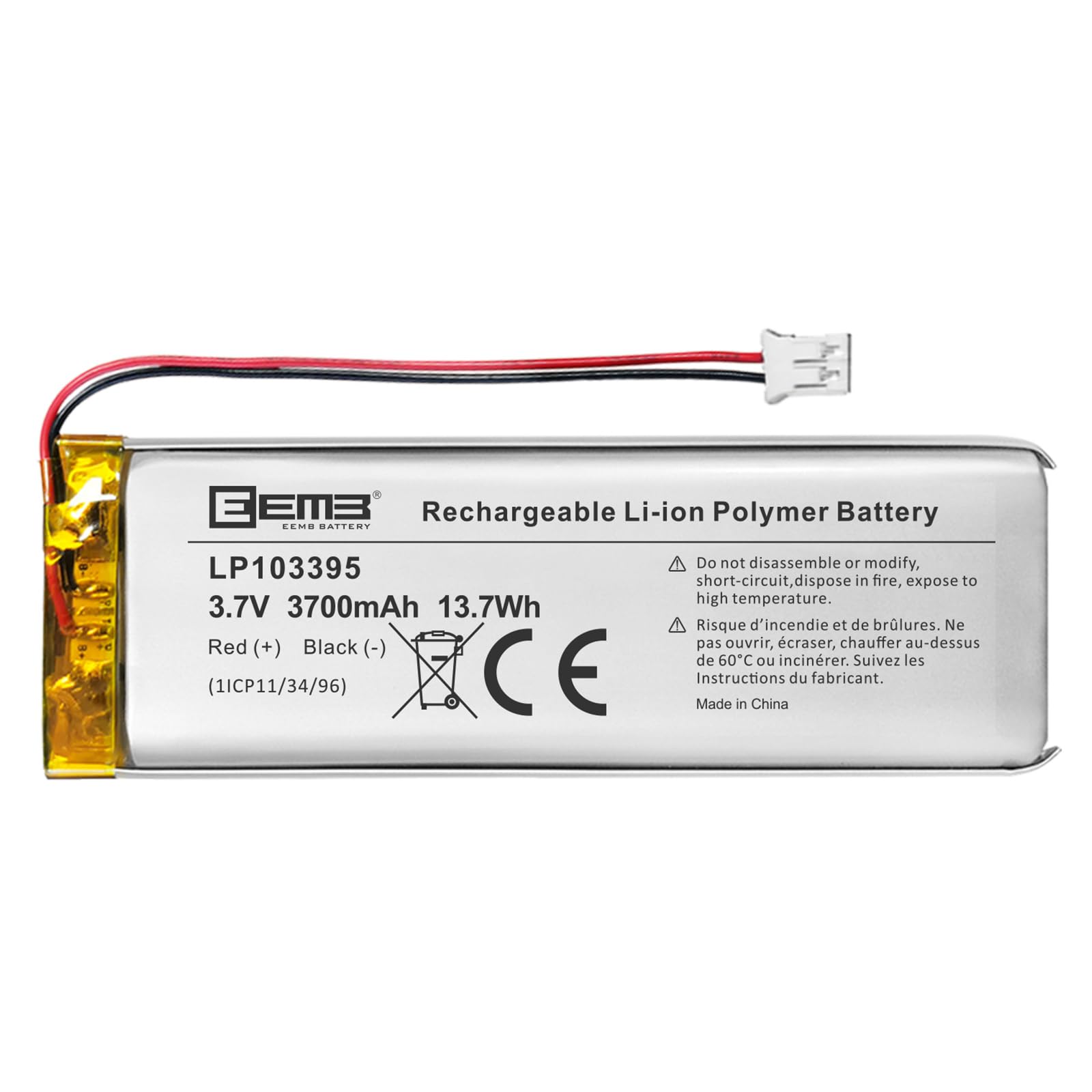
7. EEMB 3.7V 103395 3700mAh Lipo Battery Rechargeable JST 2.0mm, 1-Pack
A compact 3700mAh cell that keeps LEDs and GPS rigs running all day.
If your project needs to run for a full workday off one charge and you do not have room for a brick, this is the size to reach for. The 3700mAh LiPo is 3.7V with a min 3500mAh rating, 74g, 500+ cycle life (the number of full charges and discharges it can take), and it uses a JST-PHR connector with a 2.0mm pitch (2.0mm between pins). It measures 33.5 x 96 x 10.3mm. That 74g battery weight is nearly triple the 25g of the DC 603450 above, so the extra runtime comes with a real weight cost — fine for a lamp you set down, more noticeable in a device you wear. It is certified UL, IEC62133-2, and UN38.3 compliant (safety and transport standards).
Owners use it for exactly the applications this cell is designed for. One build powers LEDs through a buck converter — the higher capacity versus a single-cell LiPo means longer sessions between charges, and removing the Molex connector and soldering on Deans leads was straightforward. Another runs it with a U-Blox C099-F9P GNSS RTK unit, where it lasted through half a day of work without running out. The built-in low-voltage cutoff is a real safety benefit in a compact cell. Runtime, not peak power, is the story.
The catch to plan for is polarity. The wires on the battery often arrive reversed relative to the plug on the device, and one owner reported needing to unlatch the sockets with a mini screwdriver to swap them. If you are familiar with JST connectors, that is a five-minute job. If you are not, it is worth watching the JST latch tab video before you start. Verify size, connector model, and polarity alignment, and this becomes a reliable long-runtime cell.
Why it is the runtime pick
- 3700mAh at 3.7V, typical rating with a 3500mAh minimum
- Lasts all day in a U-Blox C099-F9P GNSS RTK build without running out
- Built-in low-voltage cutoff and UL, IEC62133-2, UN38.3 certification
- 500+ cycle life with low internal resistance and no leaking
The trade-offs
- Wires can arrive reversed — reversing them is easy for a JST-savvy buyer, fiddly otherwise
- 74g and 33.5 x 96 x 10.3mm may be larger than some bay openings
Get this for: portable lights, GPS units, and projects where a full day of runtime from a compact cell is the whole goal.
Consider twice for: anything weight-sensitive — at 74g this is one of the heavier cells here, and reversed polarity is a common reason for returns.
8. 2Pcs 3.7V Lipo Battery 2000mAh Pack with PH 2.0mm Connector for Arduino and ESP32
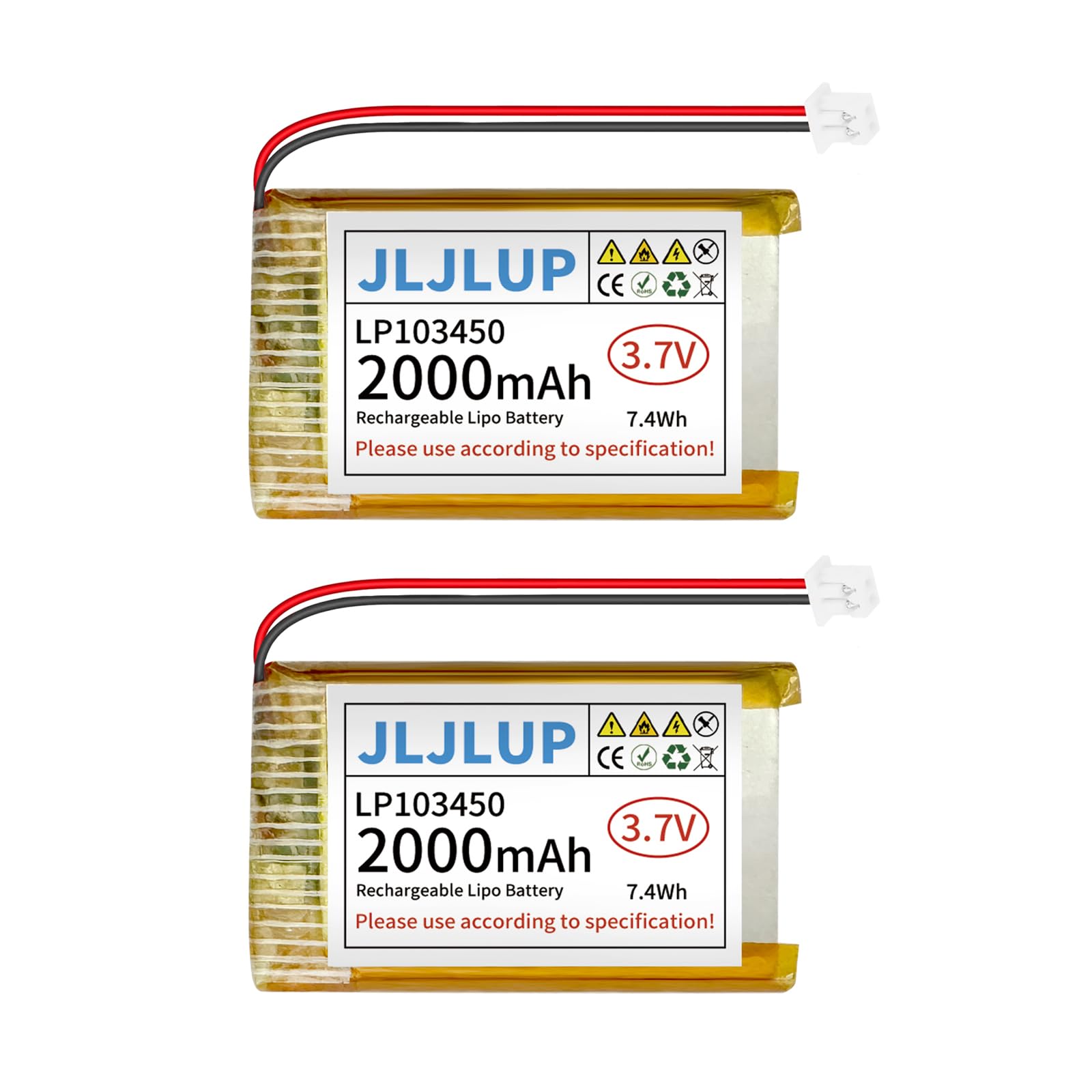
Two 2000mAh cells in one box — one to build with and one to keep charged.
Prototyping is a two-battery game. You want one on the board and one on the desk, and that is exactly what this pack gives you. Each 3.7V cell is rated at 2000mAh with a 1C discharge rate (it can safely output its full capacity in one hour), weighs 34g, and measures 34 x 10 x 52mm. The plug is a Micro PH2.0 connector on a wire of about 70mm. A matching pair beats chasing a single cell. The 2000mAh capacity matches the EEMB 103454 above, so you are choosing between two unprotected cells or one UL-certified single.
These are aimed straight at ESP32 and IoT builds (small internet-connected devices). Owners say the cells manage charging and discharging well and run long enough for real projects — one report has them powering a RAKWireless WisBlock both mini and normal, about 30 units left outside in freezing weather for several weeks with no failures. The built-in protection board shields against overcharge, over-discharge, overcurrent, overheating, and short circuits.
There are two things to know. The first is polarity — the connector has been reported as reverse-polarity for RAKWireless WisBlock boards, and plugging it in as-is can fry transistors, so rewire before you connect. The second is protection: one owner reported the protection circuit did not stop a buck-boost converter from draining the cell from 3V to 0V overnight. For most builds with a good charging setup, though, these cells deliver. This is also a 1.5A-max cell, so it is not for unmanned vehicles or model aircraft.
Two is the feature: getting a spare 2000mAh cell in the box is the practical win for anyone who cycles builds — no waiting to recharge between prototypes.
Before you plug in: know that the connector polarity can be reversed for some boards, so check and rewire first if you are building on a RAKWireless WisBlock.
Grab this for: ESP32 and Arduino projects where you want two 2000mAh cells and a PH2.0 plug to match your board.
Look elsewhere if: your board uses a different connector pitch, or you need more than 1.5A of current draw — this is not a power-sports cell.
9. MakerHawk 4 Pack 3.7V 1000mAh LiPo Battery Rechargeable 1S 102050 with Micro JST 2.0 Connector
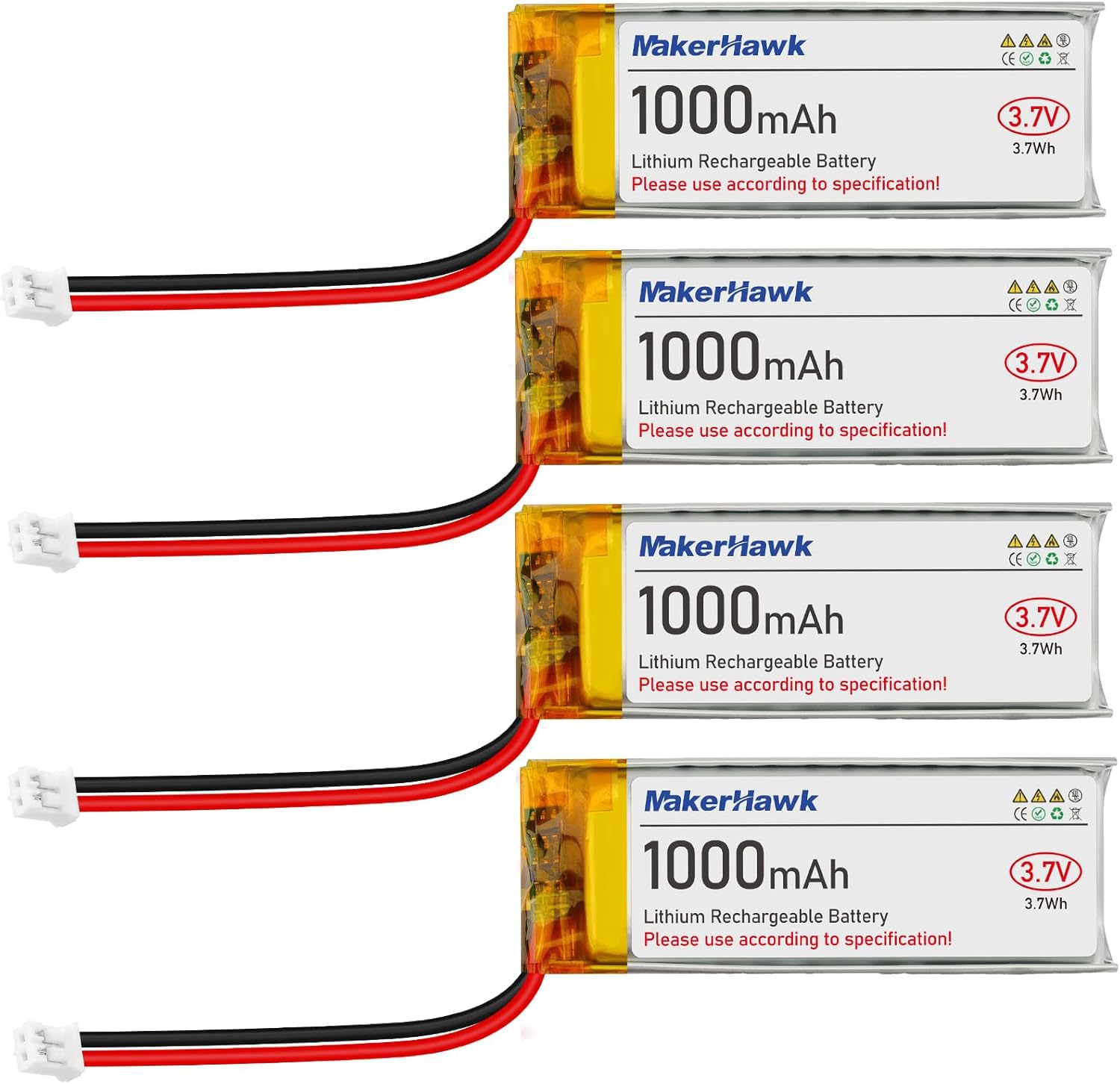
Four 1000mAh cells in one box for the tinkerer who always needs a spare.
Some people replace one battery at a time. Others want a small stockpile on the shelf, and this is the pack for them. It gives you four rechargeable 1000mAh cells at 3.7V, each with a micro JST 2.0 connector and a lead wire length of 50±3mm. A built-in protection circuit module guards against overcharging, overcurrent, over-discharge, short circuits, and overheating. The four-cell count means you are never held up waiting for a single battery to arrive. Each cell is on the small side, which suits the headset, toy, and tracker replacements it is designed for.
What owners value most is reliability — the cells work and keep working. One owner runs them with Xiao mini boards with no fuss. Others have used them across sound cards, toys, headsets, Bluetooth speakers, VR headsets, pet trackers, and visual doorbells. The recurring note is a familiar one for this category: the wires sometimes need swapping to match a device’s connector, and after the swap the cells work as they should. That is a small job with a soldering iron, and it is the reason a four-pack is smart — you can afford a spare while you get one right.
The one gripe worth flagging is the micro JST 2.0 connector size and the wire-swap need. If your device takes a different pitch, these will not seat as-is and you will be splicing. For the DIY replacement crowd, though, four reliable cells for one buy is hard to argue with. If you are replacing an OEM battery in a small device, measure the old connector first and confirm the pitch before you commit.
Why four at once: the value here is the spare count — four 1000mAh cells means replacements on hand for whatever small gadget dies next.
The strongest part
- Four 1000mAh cells in one purchase
- Micro JST 2.0 plug and 50±3mm lead wire
- Built-in PCM protection against overcharge, over-discharge, overcurrent, short circuits, and overheating
Prepare for
- Wires may need swapping to match your device’s connector
- Micro JST 2.0 pitch will not fit JST 1.0 or SM-2P sockets without rewiring
Order this if: you tinker often, want a stockpile of small 1000mAh cells, and are comfortable doing a wire swap when a connector does not match.
Buy a single instead if: you only need one cell for a known-compatible device — the four-pack value is wasted if the connector pitch does not fit your build.
Understanding the Specs
Capacity and voltage
Every battery here is rated 3.7V nominal, which is the average voltage during normal discharge. Capacity is measured in mAh (milliamp-hours), and it tells you how long the cell runs your device at a given draw. A 1000mAh cell gives roughly one hour at a 1-amp load, and a 5000mAh cell gives roughly five hours at the same draw. Match capacity to your device’s current draw, not just to the biggest number, because a bigger cell is also physically larger and heavier and may not fit your device bay.
Connectors and polarity
Connector type is the first thing that determines whether a cell works for you. Common types include JST PH2.0 (2.0mm pitch), JST 1.0 (1.0mm pitch), JST-PHR, SM-2P, and PH2.0. They are not interchangeable even though they look similar. Polarity — which wire is positive (red) and which is negative (black) — must match your device’s plug. On several cells here the wires have arrived reversed, and reversing polarity can short-circuit the device instantly. Always check the wires against your board before connecting.
Protection circuits (PCM and PCM boards)
APCM (Protection Circuit Module) is a small board built into the cell that cuts power if the battery is overcharged, over-discharged, over-currented, or short-circuited. It also helps prevent overheating. This is what protects sensitive electronics, and it is why cells with a PCM are the right choice for devices like dash cams, headsets, and Meshtastic nodes. High-drain devices like RC cars and power tools usually want a cell without a current-limiting PCM so they can draw full power on demand.
Physical size and weight
Every cell has a model number that encodes its dimensions, and the numbers matter more than the model name. A 103450 is roughly 10mm thick, 34mm wide, and 50mm long, and the size determines what compartment it slides into. Weight matters in wearable or handheld devices — a 18g cell feels very different on a helmet intercom than a 74g one. Always measure your old battery and your device bay before ordering, since a cell that is “close” will usually not fit.
FAQ
Can I use any 3.7V lithium battery to replace my old one?
What does mAh mean on a 3.7V lithium battery?
What is a PCM protection board and do I need one?
How do I check the polarity on a 3.7V battery before connecting it?
What is the difference between a lithium-ion and a lithium polymer 3.7V battery?
Will a 2000mAh battery last twice as long as a 1000mAh battery?
Can I use a 3.7V lithium battery to replace a 3.6V or 5V built-in battery?
How should I store a 3.7V lithium battery for a long time?
Are 3.7V lithium batteries safe in RC cars and toys?
What size battery model number should I look for?
Final Thoughts: The Verdict
For most people fixing an RC toy or upgrading a kids’ vehicle, the Blomiky 3.7V 1000mAh 2 Pack is the right call — the two batteries, two cables, and 8.5A over-current protection cover the job with a spare cell left over. If you have a project that needs to sit for weeks without losing charge, grab the 5000mAh 115659 Lipo Pack — the low self-discharge alone is the reason to pick it. And if you are reviving a dead headset or speaker, the DC 3.7V 1250mAh 603450 has the wire-in design and included heat-shrink tubing that turns a two-minute solder job into a working device again. Whichever you choose, verify the connector, size, and polarity first — that one habit saves more frustration than any spec on the label.
How We Picked
We do not accept paid placement. Every pick is matched to a real buyer and a real use-case; we do not hands-on test units.
Sources & Methodology
Specifications: manufacturer listings and product documentation. Review insights: verified customer reviews, as of September 2026. Pricing: not shown on this page (it changes often); check the current price via the retailer link.
As an Amazon Associate, Gadgets Feed earns from qualifying purchases. This does not affect which products we feature.