
Our readers keep the lights on and my morning glass full of iced black tea. As an Amazon Associate, I earn from qualifying purchases.
Specs are compiled from manufacturer listings and verified buyer reviews and can change over time — please confirm the key details on the product page before buying.
If you are shopping for a 1200-watt countertop microwave, the single most useful thing to know is that wattage alone will not tell you which one heats evenly — the ones that avoid cold spots use inverter power, while the cheaper ones cycle the magnetron on and off. A slightly stronger standard unit that fits the same counter slot does the same job, and we flag the real wattage on every pick so nothing is misleading.
I’m Min — the founder and writer behind Gadgets Feed. This guide is built by comparing the manufacturers’ published specifications and the patterns across verified customer reviews, so you get each pick’s real strengths and trade-offs instead of marketing spin.
Below you will find the specs that decide how a microwave actually performs in a real kitchen — capacity, turntable diameter, inverter versus cycling power, sensor cooking, and the clearance your counter needs. Whether you are replacing a dead unit or sizing up for a family, here is how to choose the 1200 watt countertop microwave.
Our Picks at a Glance
How To Choose The Best 1200 Watt Countertop Microwave
A 1200-watt countertop microwave sounds like a single fixed thing, but the wattage is only the headline number. The two specs that change your daily experience are how the power is delivered and how much interior space you get for the size of the box on your counter.
Inverter vs. non-inverter power
An inverter microwave (one that feeds a steady stream of power instead of switching the magnetron fully on and off) heats edges to center more evenly, especially at lower power settings. A non-inverter unit cycles between full blast and nothing, which is why a low-power setting can still overheat the edges of a dish. If you defrost meat or melt chocolate, inverter delivery is the difference between even and patchy.
Capacity and turntable diameter
Interior volume is measured in cubic feet, and it tells you how much food fits at once. The turntable diameter is the number to check if you want to warm a full casserole or a large plate — a wider tray means less rotating and repositioning. A 2.2 cubic-foot unit with a 16.5-inch turntable handles big family dishes; a 1.2 cubic-foot unit is better for a small counter and single servings.
Sensor cooking and preset menus
Sensor cooking uses a humidity sensor inside the cavity to judge when food is done and shut the unit off. It works well for popcorn, potatoes, and reheating a plate, but reviewers often find manual timing more predictable for covered or uneven dishes. Preset menus (popcorn, pizza, potato) are shortcuts, not requirements — the manual controls still work fine.
Clearance, child lock, and controls
Countertop microwaves need airflow, so factor in the manufacturer’s clearance recommendation — GE, for example, asks for 3 inches on each side and above plus 1 inch at the rear. A child lock (a button combination that disables the keypad) is now standard on most U.S. countertop microwaves, and it can be disabled when you do not need it.
Quick Comparison
| Model | Best For | Capacity | Rated Wattage | Heating Method | Amazon |
|---|---|---|---|---|---|
| Sharp SMC2266KS★ Best Overall | Family cooking, large dishes, quiet operation | 2.2 cu. ft. | 1200W | Inverter | Amazon |
| FRIGIDAIRE 2.2 Cu. Ft.Best Value | Value buyers wanting family capacity | 2.1 cu. ft. | 1200W | Microwave radiation | Amazon |
| GE 1200 Watt 2.0 Cu. Ft.Most Popular | Everyday family reheating and one-touch cooking | 2.0 cu. ft. | 1200W | Electric (cycling) | Amazon |
| TOSHIBA ML-EM45PIT(SS) | Compact counters, mid-size families | 1.6 cu. ft. | 1250W | Inverter | Amazon |
| TOSHIBA 2.2 Cu.Ft Inverter | Large-family cooking on a mid-range budget | 2.2 cu. ft. | 1200W | Inverter | Amazon |
| LG 1.5 cu. ft. | Small kitchens wanting easy-clean interiors | 1.5 cu. ft. | 1200W | Smart Inverter | Amazon |
| Panasonic NN-SN65KB | Small footprint with serious heating power | 1.2 cu. ft. | 1200W | Inverter | Amazon |
| LG 2.0 cu. ft. | Large-dish reheating with a gentle chime | 2.0 cu. ft. | 1200W | Smart Inverter | Amazon |
| Panasonic NN-SN686S | Long-term reliability with a slim footprint | 1.2 cu. ft. | 1200W | Inverter | Amazon |
| Sharp SMC2266HS | Large-capacity stainless on a short list | 2.2 cu. ft. | 1200W | Inverter | Amazon |
In‑Depth Reviews
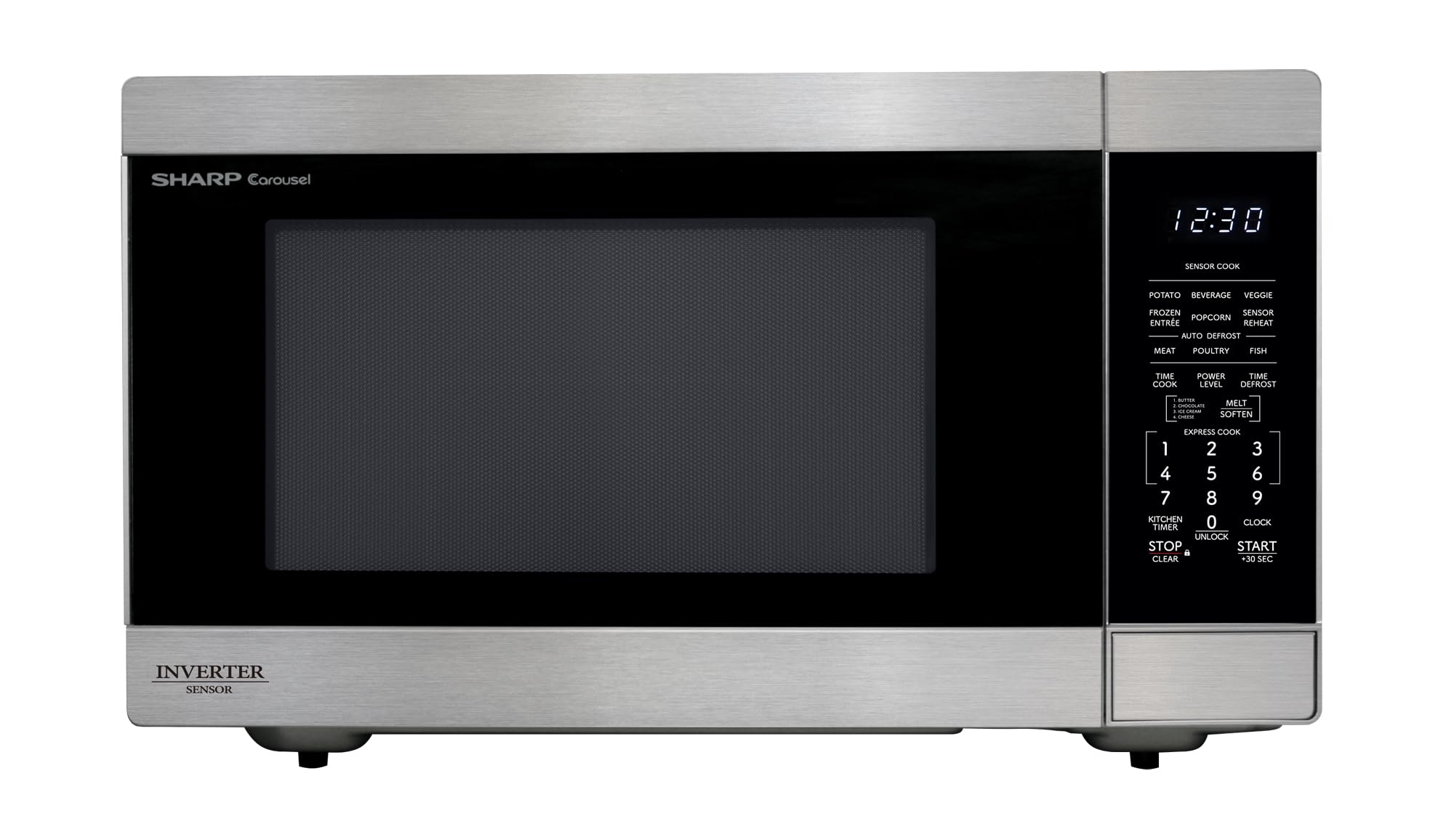
1. Sharp SMC2266KS 2.2 cu. ft. 1200W Stainless Steel Countertop Microwave
Our pick — 4.5★ from 350+ verified ratings; the strongest balance of quality and price.
The 2.2-cubic-foot workhorse that heats two frozen dinners at once without rattling your cabinets
The Sharp SMC2266KS is the pick that earns its spot by capacity alone. At 2.2 cubic feet, it is the largest interior in this whole roundup — and the number matters because it is what lets you warm a big casserole or feed four people without cooking in shifts. Sharp’s own marketing calls it family-sized, and the internal volume backs that description with plenty of usable room, not just a bigger box with a shrunken cavity wall.
Inverter cooking technology is the second pillar here. Instead of switching the magnetron fully on and off, this unit feeds a steady stream of power, so a low-power defrost does not overheat the edges while the center stays frozen. The 2.2-cubic-foot interior is paired with a 16.5-inch carousel turntable, and owners who have run 3-quart casseroles and vintage Corningware report both fit easily. There are 10 power levels with 2-stage cooking, a +30-seconds key for instant start, senior-friendly “Melt/Soften” and Sensor Cook, plus Auto Cook for common meals and Weight/Time Defrost for thawing.
The thing everyone raves about here is how quiet the unit stays while it runs — owners repeatedly describe it as almost inaudible in a normal kitchen, which matters when the microwave sits near a home office or open-plan living room. The recurring gripes are more about ergonomics than function: the white LED panel is small, the interior lighting is dim compared to the old incandescent glow, and the beeps are softer than some users prefer. On dimensions, it is the widest stainless steel microwave of the bunch here — 19.6 inches deep by 24.4 inches wide by 13.6 inches tall — so measure your counter and overhead cabinet clearance before hitting add to cart.
What earns it first place
- Largest capacity here at 2.2 cubic feet, with a 16.5-inch carousel turntable
- Inverter cooking for even heat at any power level
- Quiet operation is the most-praised trait after build quality
- 10 power levels, 2-stage cooking, and a dedicated +30-seconds key
- Sensor Cook, Melt/Soften, and Auto Cook cover most everyday meals
Worth knowing before you buy
- Widest footprint here at 24.4 inches — measure your counter first
- Small, hard-to-read control panel with dim interior lighting
- Softer beeps than some older microwaves, so you might miss the signal
The short version: Buy this if you cook for a family, warm large plates, or want inverter power behind a 2.2-cubic-foot interior — it earns the top spot here on capacity, inverter power, and quiet operation.
Look elsewhere if: your counter is under about 25 inches wide or you need a bright, tactile control panel; the smaller LG or Panasonic picks will fit the same meals into a tighter footprint.
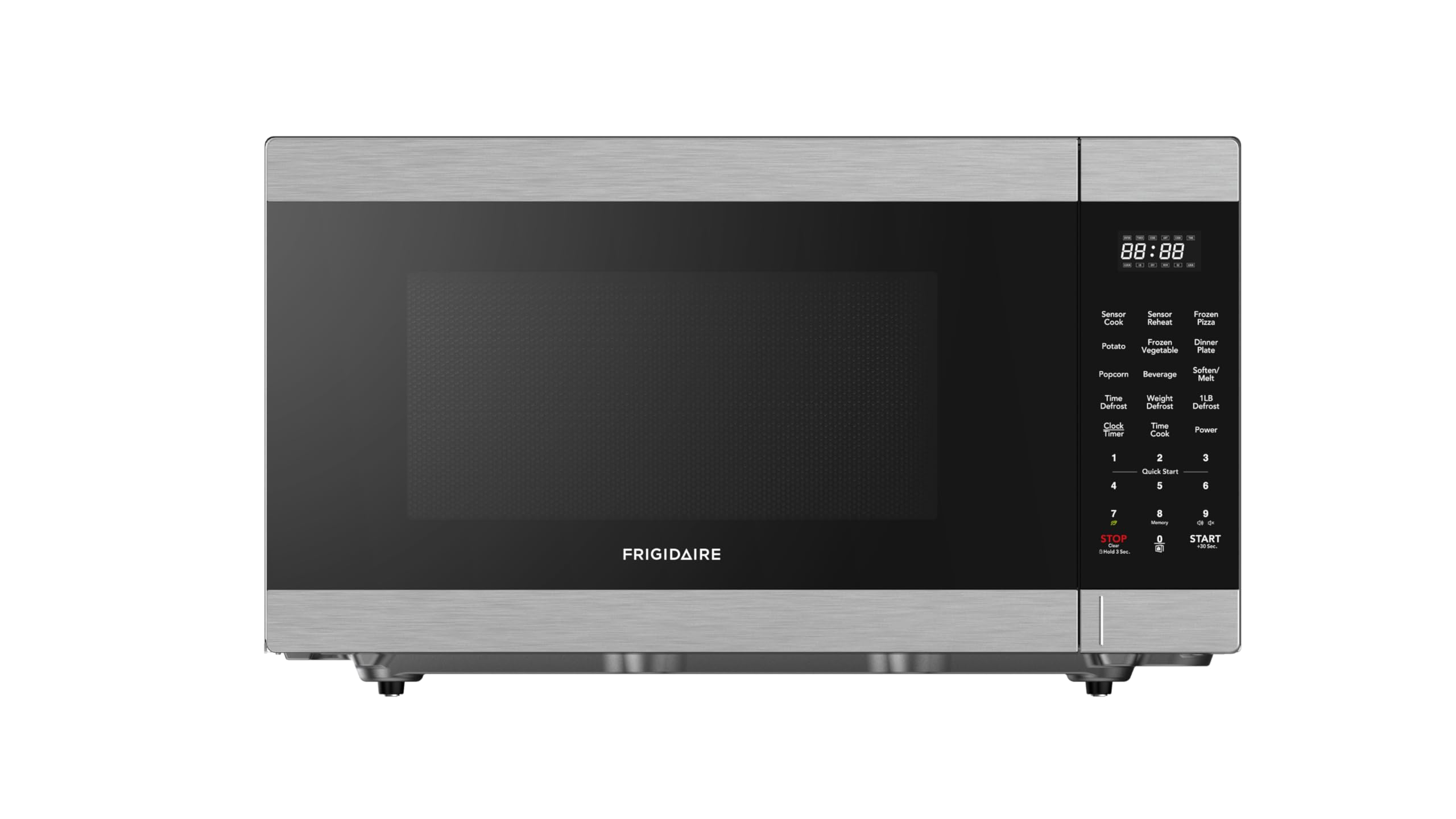
2. FRIGIDAIRE 2.2 Cu. Ft. Stainless Steel Microwave Oven, Multi Function, 1,200 Watts
The value pick that bakes a tray of potatoes in one shot, then makes you learn its door-lock ritual
Frigidaire aims this unit at anyone who wants family-scale interior without paying the family-scale premium. Its advertised 2.2-cubic-foot capacity and the listed interior of 2.1 cubic feet are close enough that the difference never shows up in daily use — either way, you are getting a large-capacity oven. Six pre-programmed options cover popcorn, pizza, French fries, wings, and nuggets, while Auto Defrost, reheat, and a set of power levels handle the rest. A built-in child safety lock and a removable glass turntable round out the feature list.
The standout reviewer story here is potato night. Multiple buyers describe loading six potatoes, pressing the Potato button, and finding them perfectly cooked when the timer finished — that is the kind of set-and-forget confidence the presets are supposed to deliver. Owners also flag that the cabinet runs a touch warmer and louder than a premium inverter unit, and the door-lock system is a common source of early confusion because the child lock has to be released before you can change settings. The manual does not spell that out, so expect a little learning curve on the first day.
Where this really stands apart is the size you get relative to what you spend. It is one of the largest interiors on this list for a mid-tier number, and the stainless and black exterior with a curved handle looks like a more expensive appliance than it is. The trade-off is that the underlying build is a step below the Sharp or Panasonic picks — a few owners have reported dents on arrival and one long-term reviewer described sporadic shorting after several months. That is a small minority of a 250-rating pool, and returns are easy, but for durability over value the Panasonic NN-SN686S is the safer long game.
The honest read: You are paying for capacity and preset convenience, and in that lane the Frigidaire delivers. The interior finish is white and easy to wipe clean, the turntable lifts out for dishwasher duty, and the 1200 watts heat food evenly when you set the time yourself.
The catch: The door-lock release sequence has to be learned, the housing is thinner than the premium picks, and the case is prone to cosmetic damage in transit. Treat it as a real workhorse you will use daily rather than an heirloom appliance.
Reach for this if: you want the biggest interior you can get without stepping into premium territory, and you bake potatoes or reheat plate after plate for a busy household.
Look elsewhere if: you want years of trouble-free service and a construction quality you can feel; the Sharp SMC2266KS above holds a stronger long-term reputation for a modest step up.
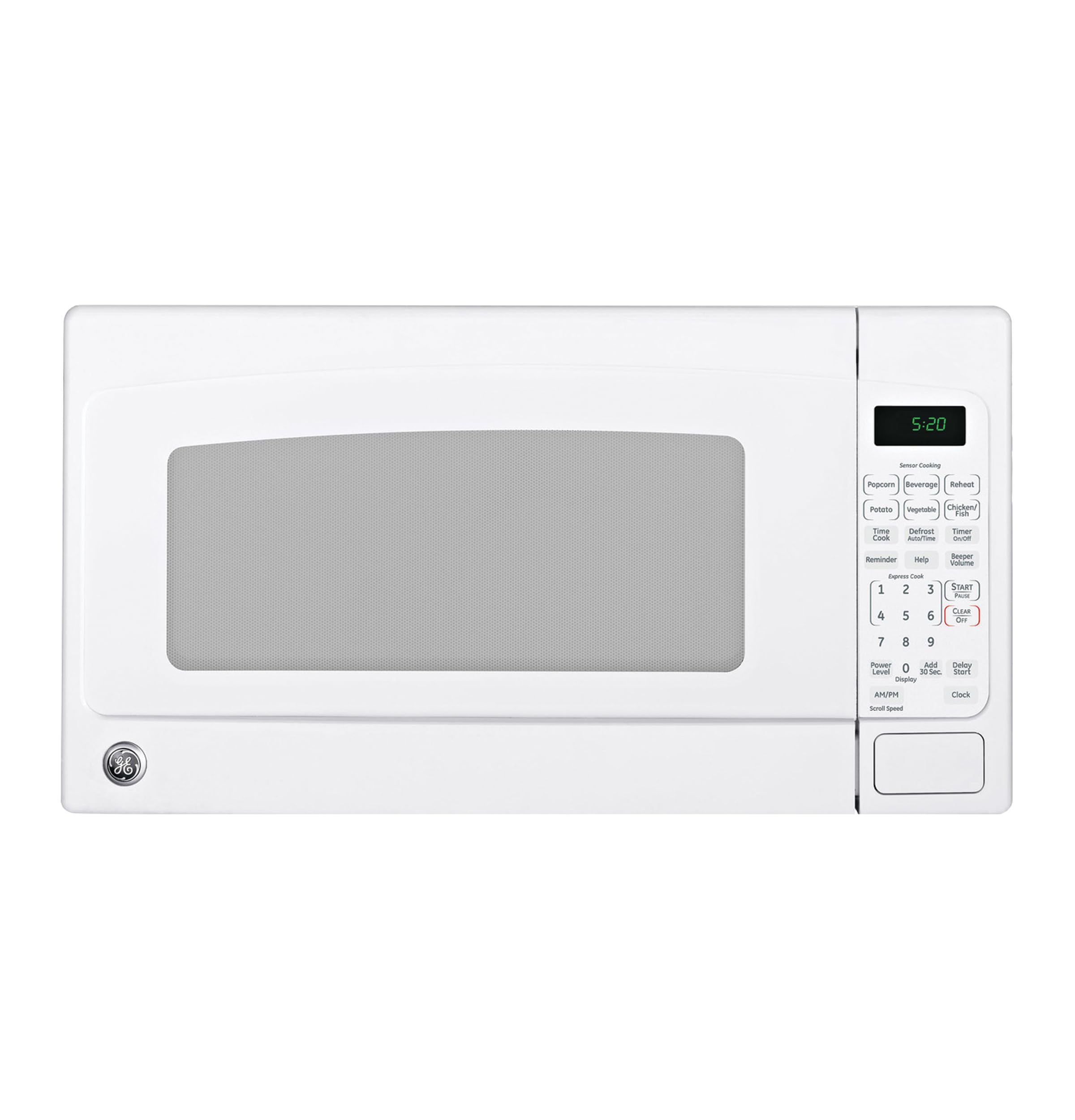
3. GE Countertop Microwave Oven, 1200 Watt, 2.0 Cu. Ft., White
The every-kitchen pick with sensor cooking that judges moisture so you can stop guessing at times
GE’s 2.0-cubic-foot, 1200-watt countertop unit is the definition of dependable middle-of-the-road cooking. It is not a showpiece and it does not claim to be — instead it packs the buttons and presets a family actually touches every day and leans on GE’s long appliance pedigree to reassure buyers. Eight convenience cook settings plus one-touch express cooking cover most of what you will ever do with it, and the electronic keypad gives you manual control when the presets do not fit the dish in front of you.
Sensor Cooking is the marquee feature. A sensor inside the cavity monitors moisture as food cooks and adjusts the time automatically, which is exactly the sort of hands-off help you want when reheating a plate or steaming frozen vegetables. Owners who run the frozen-veggie cycle regularly describe it as working perfectly with two presses of the vegetable button — no extra math, no burned edges. Manual and auto defrost modes are also included, with separate time-and-power presets for thawing evenly.
Size is where the GE surprises people. The 2.0-cubic-foot interior handles a 9×13 glass pan without the door refusing to shut, and buyers consistently call it the “just right” volume for a four-person household. The white finish won’t disappear into a stainless kitchen, but buyers who wanted a matching white suite say it complements their other appliances. The recurring complaint is that the unit is a bit noisier than expected — the fan and the magnetron are audible in an open-plan space. Child lock is included and easy to disengage, and GE specifies 3 inches of clearance on the sides and top plus 1 inch at the rear for correct airflow, so leave the shelf breathing room.
Why it works: Sensor cooking takes the guesswork out of reheating, the 2.0-cubic-foot interior swallows standard bakeware, and the one-touch keys keep daily use fast. It is the model most households can hand to a houseguest and let them work it out.
The trade-off: Noise is the one thing buyers consistently flag, and the unit runs on standard cycling power rather than inverter delivery, so low-power defrosts will alternate between full and off rather than settle into a steady output.
Pick this one when: you want a well-known brand, sensor cooking you can trust, and a true 2.0-cubic-foot interior that hides a standard 9×13 pan.
skip it if: your counter sits in a quiet room — the fan is one of the loudest on this list — or if you defrost at low power often and want inverter smoothness instead.
4. TOSHIBA ML-EM45PIT(SS) Countertop Microwave Oven with Inverter Technology

Inverter cooking squeezed into a lighter cabinet with a 13.6-inch tray that still takes a whole 12-inch pizza
If counter space is your limiting factor, the Toshiba ML-EM45PIT(SS) is the one to study. At 1.6 cubic feet with a 13.6-inch removable turntable, it is a step down from the giant 2.2-cubic-foot units on this list, but the interior is not where the savings go — the footprint shrinks while the tray still handles a full 12-inch pizza. That tray size is the real buyer decision: if you cook frozen pizza, large casseroles, or full meals on big plates, this is the smallest interior that will do it without rotating the dish.
Origin Inverter Technology keeps the power output steady, which owners describe as fast and even cooking with perfect defrosting and no cold spots. Steady power in a 1.6-cubic-foot cabinet is what keeps defrosting even. Six smart sensor auto menus cover pizza, potato, vegetables, and the rest, while the Quick Start button jumps you straight to 1 to 3 minutes at full power — handy when the food is already on the plate and you just want it hot. There is a Sound On/Off function that silences the buzzer with a long-press of the number 8 key, plus an Eco mode and a child safety lock for households with kids.
Where the Toshiba asks for patience is the control panel. Owners consistently flag that the keypad is small, not backlit, and pressed under a low-contrast overlay that becomes hard to read in low light. It also arrives with a protective film over the keypad that has to be peeled off, and a couple of buyers report needing a firmer press than a touchscreen. On the durability side, a small minority of ratings describe units dying within a couple of years — that is an outlier on a large review pool rather than a pattern — and the inverter design does run lighter than a comparable non-inverter unit, so movement on the counter is possible if it is not set against a stable surface.
What buyers keep coming back to: the combination of inverter heating and a compact cabinet that fits a real 12-inch pizza tray. Few microwaves under 2.0 cubic feet pair inverter heating with a 13.6-inch tray.
The recurring gripe: the non-backlit keypad and slightly faint labeling. Learning the buttons takes a week; after that it fades into muscle memory.
Best fit for: apartment or condo kitchens where counter space is tight, but you still want inverter cooking and a tray that takes a full frozen pizza.
Consider moving up if: you need to warm multiple large plates at once or you prefer a bright, backlit control panel — the Sharp or Panasonic picks above deliver those.
5. TOSHIBA Countertop Microwave Oven with Inverter, 2.2 Cu.Ft, 1200W

A family-scale 2.2-cubic-foot inverter microwave with ten power levels and a two-step child lock
Toshiba’s big 2.2-cubic-foot countertop model checks the specs most families care about. Inverter technology flows a steady stream of power, a humidity sensor inside the cavity adjusts power and time on six automatic sensor cook and auto menus, and there are 10 power levels from defrosting up through boiling. The 16.5-inch glass turntable matches the Sharp and Frigidaire footprints, so big casseroles, sheet-pan suppers, and family pizza nights all fit. The trade-off versus the Sharp is the child lock: Toshiba uses a two-step release that some owners describe as a nuisance to engage and disengage, whereas the Sharp unit is more forgiving.
The output spec is 1200 watts with an input rating of 1350 watts — note because that is the load your circuit actually sees, and it lines up with what other mid-tier 1200-watt class microwaves pull. External dimensions are 24.4 by 19.5 by 13.6 inches (W x D x H), so it wants a wider counter ledge. The stainless interior wipes clean easily, and the appearance is a strong point for buyers — it looks like a mid-premium appliance from the front.
Where Toshiba gives ground is durability. A small cluster of negative reviews describe units failing in a matter of months, though Toshiba customer service has been proactive about sending replacements in the cases where buyers escalated. Weigh that against the volume of praise for performance and quiet operation, and the picture is a solid performer with a quality-control tail that mostly resolves under warranty. If you buy this, keep the box and the receipt — Toshiba’s replacement policy depends on the warranty registration being easy to process.
What stands out: the 2.2-cubic-foot interior with a 16.5-inch tray, six sensor menus, and quiet operation — a familiar combination that lands in the balance for busy kitchens.
The honest caution: the two-step child lock takes more presses than most, and the reliability record is more uneven than the Sharp or Panasonic picks above. Buy for the capacity and the price tier, not for a spotless long-term record.
The right call for: large households that want a 16.5-inch turntable at a mid-tier price and are patient with a two-step child-lock routine.
Think twice if: you rely heavily on the warranty — Toshiba’s process has worked for many buyers but has also required the box and receipts to be kept on hand.
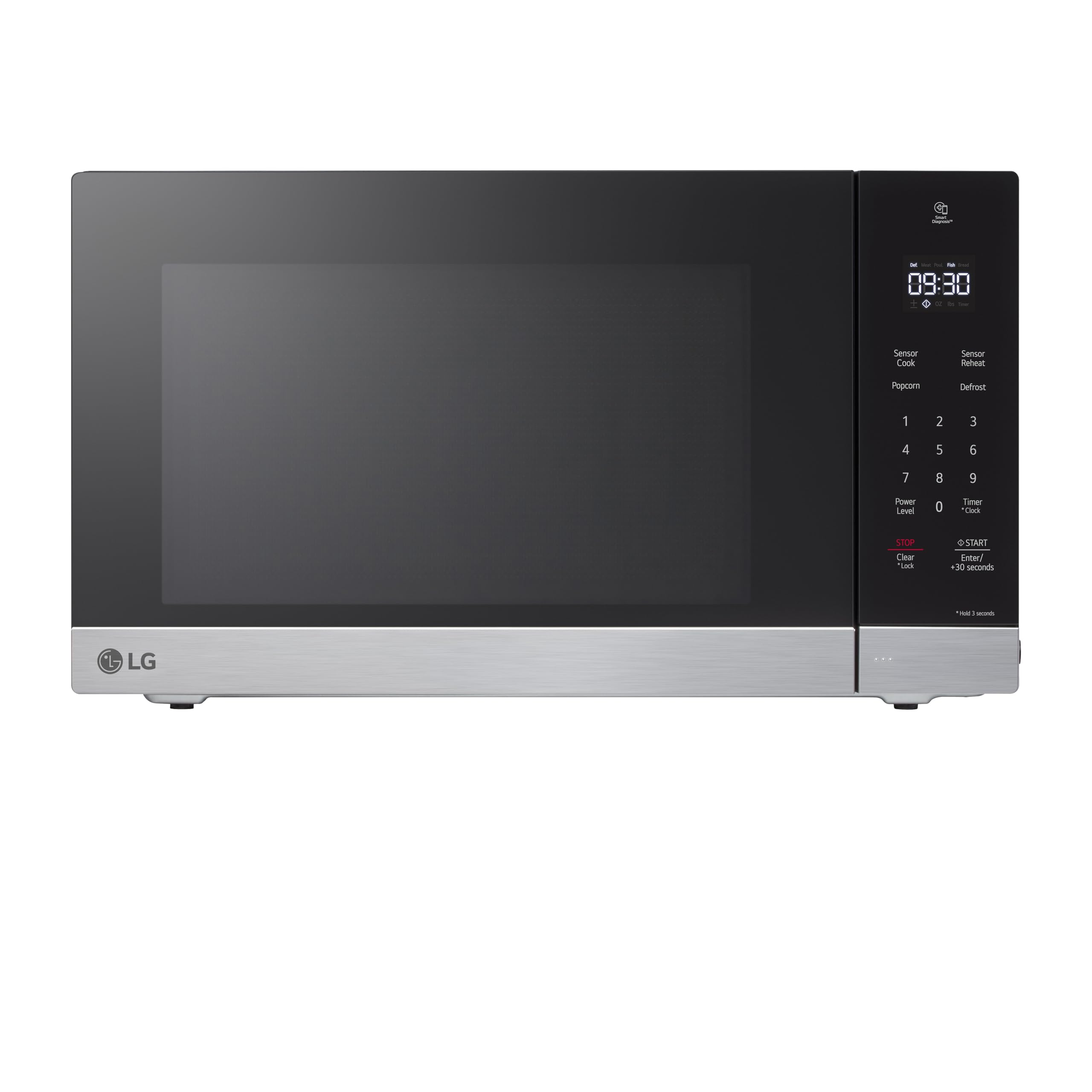
6. LG Countertop Microwave, 1.5 cu. ft., Stainless Steel, Smart Inverter, 1200 Watts
A friendly, small-footprint inverter microwave with a chime you will not want to mute
LG’s 1.5-cubic-foot NeoChef is the friendliest unit on this list to actually live with, and that is what earns it the mid-list spot. Smart Inverter technology steadies the cooking power, so a low-power melt does not alternate between full blast and nothing. Seven sensor cook options cover Bacon, Fresh Vegetable, Frozen Entrée, Frozen Vegetable, Oatmeal, Potato, and Rice — enough coverage that you can put almost any everyday food in and walk away. The interior is EasyClean, the SmoothTouch glass control panel wipes off without effort, and the 14.2-inch turntable is generous for the cabinet size.
The personality of this thing is the chime. Owners rave about the gentle LG melody at the end of the cycle versus the harsh beep of most microwaves — it is audible to older family members without being jarring. The beeps when a key is pressed are similarly discreet, and a reminder beep chimes if you forget to open the door. On the noise front, owners describe it as a reasonably quiet appliance for the class. Two months of use on a typical unit leaves the interior still clean because the matte gray finish hides splatters well, while still being easy to wipe down.
The negatives here sit in the “quirks” column rather than the “problems” column. The non-backlit keypad is hard to read in a dark kitchen, one buyer reports the black exterior shows dust quickly, and the door mechanism is left-hand dominant — right-handed users find it natural, left-handed users less so. The most common friction points are the lack of common food presets and the slightly fragile turntable ring that needs care when lifting dishes. A few units have arrived non-functional — that is a rare tail on a compact review pool — and LG’s returns flow handles it cleanly. Overall this is a low-friction appliance rather than a feature monster.
What owners love: the soft chime, the quiet run, the quick even heating, and the clean matte interior. The personality of the appliance is the reason it keeps showing up in recommendations.
The catch: you trade fancy presets for simplicity here — no one-touch popcorn, no pizza preset — so you will rely on manual time and power for most foods.
Best for: smaller kitchens and anyone who wants a quiet, easy-to-clean 1200-watt inverter microwave that does not need its buttons memorized.
Not the pick for: preset-driven cooks who want a one-touch popcorn button or a backlit panel — the Sharp or GE will feel more familiar.
7. Panasonic NN-SN65KB Microwave Oven with Inverter Technology 1200W, 1.2 cu.ft.
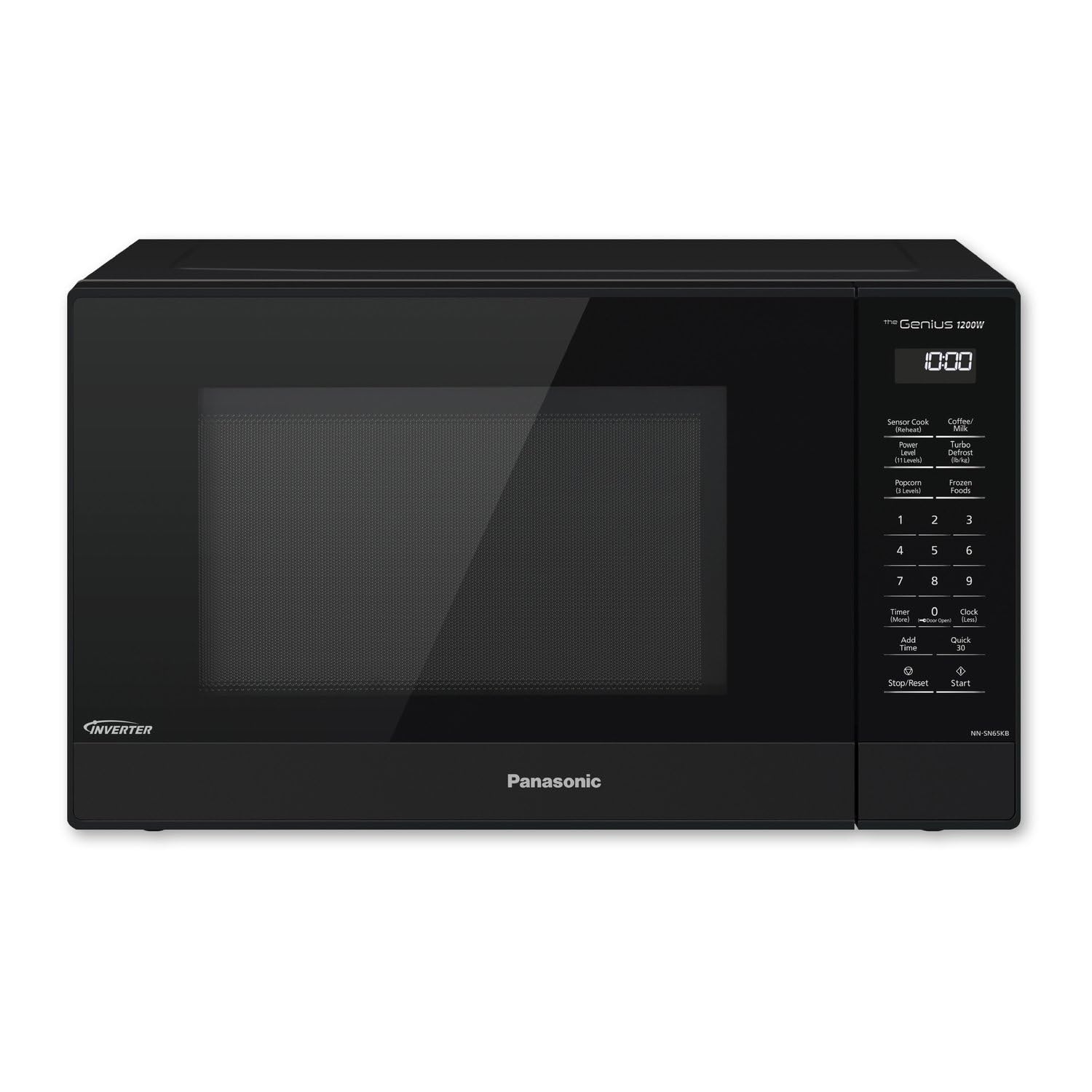
The black-cabinet Panasonic that punches above its 1.2-cubic-foot size on raw heating power
Panasonic’s smaller NN-SN65KB is the inverter microwave for tight kitchens that still need serious output. The 1.2-cubic-foot interior is compact, but the 13.4-inch turntable is the biggest you can fit within that frame, and Panasonic’s own marketing calls out the “small external footprint” as the trade for keeping counter space. Where this model earns its spot is in heating capability — Panasonic’s Inverter Technology streams power continuously so food heats edges to center, and the Genius Sensor uses 10 cooking presets plus sensor reheat to judge when leftovers are done. Inverter Turbo Defrost, 15 auto cook options, and a Keep Warm setting round the feature list.
Owners describe the heating as powerful and targeted, particularly for water, soups, and coffee — the kind of everyday jobs where a slower microwave would drag. The unit barely produces condensation, even after long runs like melting chocolate, because most of the steam vents instead of pooling on the turntable. A bright cooking light lets you watch what is happening without opening the door. The push-button door is quiet, and disabling the beep is a one-time toggle that Panasonic owners tend to do on day one.
The honest downsides come in clusters. The keypad section is small and demands firm, centered presses — a recurring annoyance rather than a defect. The auto child lock comes enabled and has to be disabled after every power outage, so this is worth learning once. The unit is also unusually lightweight for its class, which means it can slide backward when you push the door or buttons; buyers typically park a couple of felt pads or spacers behind it as a fix. A handful of long-term ratings describe panel peeling over time, so give it a soft cloth rather than a rough sponge on the front control strip.
Why the crowd likes it: heating performance is the recurring praise — 1200 watts that still feels strong in a small box, with sensor reheat that nails leftovers and coffee reheats without overshooting.
Where it falls short: the keypad wants a firm target, the automatic child lock reloads after outages, and the light weight means the cabinet can slide under pressure. None of these is a functional failure — they are daily-use quirks.
Pick this for: small kitchens, apartments, and single-cook households that want compact footprint, inverter power, and strong 1200-watt output for quick reheating.
Consider the larger Sharp instead if: you need to warm multiple big plates at once, want a bigger 16.5-inch tray, or want a control panel that does not demand centered presses.
8. LG Countertop Microwave, 2.0 cu. ft., Stainless Steel, Smart Inverter, 1200 Watts

A large 2.0-cubic-foot LG with stainless innards, Smart Inverter power, and a calmer chime
LG’s larger 2.0-cubic-foot NeoChef takes what works in the smaller version and hands it a bigger cavity. The stainless-steel interior is a meaningful step up from the plastic or coated cavities on some rivals because it is easier to wipe and does not pick up discolor over time. Smart Inverter holds cooking power steady so defrosting works evenly. Ten adjustable power levels sit alongside seven sensor cook options (Bacon, Fresh Vegetable, Frozen Entrée, Frozen Vegetable, Oatmeal, Potato, Rice) plus Ez On, child lock, and LED interior lighting. The SmoothTouch glass panel clears with a damp cloth, and the EasyClean interior resists staining.
Owners describe the cavity as huge — a full-size casserole fits with room to spare, which is the advantage of jumping to 2.0 cubic feet. The chimes are gentler than most competitors, the turntable is more stable than the Panasonic equivalent according to one side-by-side buyer, and the door mechanism has a mechanical override for the child lock so you can open it after a power outage. The end-of-cycle signal, however, is on the quiet side; a few buyers find they miss the signal when they are in another room.
The two recurring friction points are the punched screen control buttons and the absence of a one-touch minute start — you have to type the exact cook time and press start. Screens that demand firm presses are a running theme in the user reviews, and the lack of a quick “+1 minute” shortcut feels antiquated compared to some competitors. A handful of units have also arrived dead or died young, which is an unusual failure rate for the brand but not unique to this model. All told, this is a premium-capacity workhorse with a couple of operational quirks that take a week to get used to.
What earns the spot: 2.0-cubic-foot stainless interior, Smart Inverter output, seven sensor menus, and a pleasant end-of-cycle chime. That is a strong feature set for family-scale reheating.
The quirks: hard-to-press buttons, no one-touch minute shortcut, and a signal that some find too soft. None of these blocks daily cooking, but they are worth a test drive in-store if you can.
Reach for this when: you want a large stainless cavity that stays easy to clean, inverter cooking power, and sensor menus for common foods.
pass on it if: you want a quick-minute key or a touchscreen-style panel — the GE one-touch controls will feel more direct.
9. Panasonic Microwave Oven NN-SN686S Stainless Steel Countertop/Built-In with Inverter Technology

The slim stainless workhorse that has been quietly winning kitchens for years on inverter reliability
The Panasonic NN-SN686S is the pick that shows up again and again in long-term ownership stories — owners mention units still running after 15 years, replacements bought for second homes, and gifted units going strong five years later. That reputation rests on the same technology as its siblings: 1200 watts of Inverter power that streams steadily instead of switching on and off, so reheating is consistent and defrosting does not leave hot edges with a frozen center. The 1.2-cubic-foot interior is compact, but Panasonic engineers the shell to keep the external footprint small and heft the interior generous enough for full plates, casseroles, and a whole head of broccoli.
The Genius Sensor adds 14 preset menus plus sensor reheat and sensor cook, and Inverter Turbo Defrost speeds thawing noticeably compared to a conventional defrost mode. The 13.4-inch turntable is the same as the smaller NN-SN65KB above. Power draw is 1480 watts input against the 1200-watt output rating — the same class as the Toshiba 2.2-cubic-foot model on this list — so a standard kitchen circuit handles it without trouble. A Keep Warm mode holds soups, gravies, and desserts hot until dinner is ready, and a quick-minute timer gives you spot timing without setup.
The complaints here are practical, not functional. The command panel is dim and low-contrast, which some buyers find hard to read in a bright kitchen. The automatic child lock comes enabled by default and has to be pressed through to release the door — the magic sequence takes some owners a day or two to internalize. Steam sensor reheats on covered foods can underheat because moisture never reaches the sensor, so most owners learn to leave the cover off or use manual timing. A minority of ratings report failures within the first few years, which is worth acknowledging even on a strong reliability record, and buying an extended warranty is a common choice in that pattern.
Why it stays at the top of the class: inverter performance that preserves texture (bread thaws soft, coffee is hot in a minute), a compact cabinet that fits a normal shelf, and stainless-steel looks that hold up.
The honest friction: the dim panel, the automatic child lock, and the sensor’s preference for uncovered food. Learn the child-lock sequence and uncover plates before using the sensor, and this runs like clockwork.
The right pick for: anyone who wants inverter reliability, a compact footprint that fits a small shelf, and a microwave that has proven itself across many long-term owners.
Consider the LG 2.0-cubic-foot instead if: you want a larger stainless cavity and sensor cooking you can trust with the cover on.
10. Sharp 2.2-Cu. Ft. Countertop Microwave Oven, Stainless Steel (SMC2266HS)
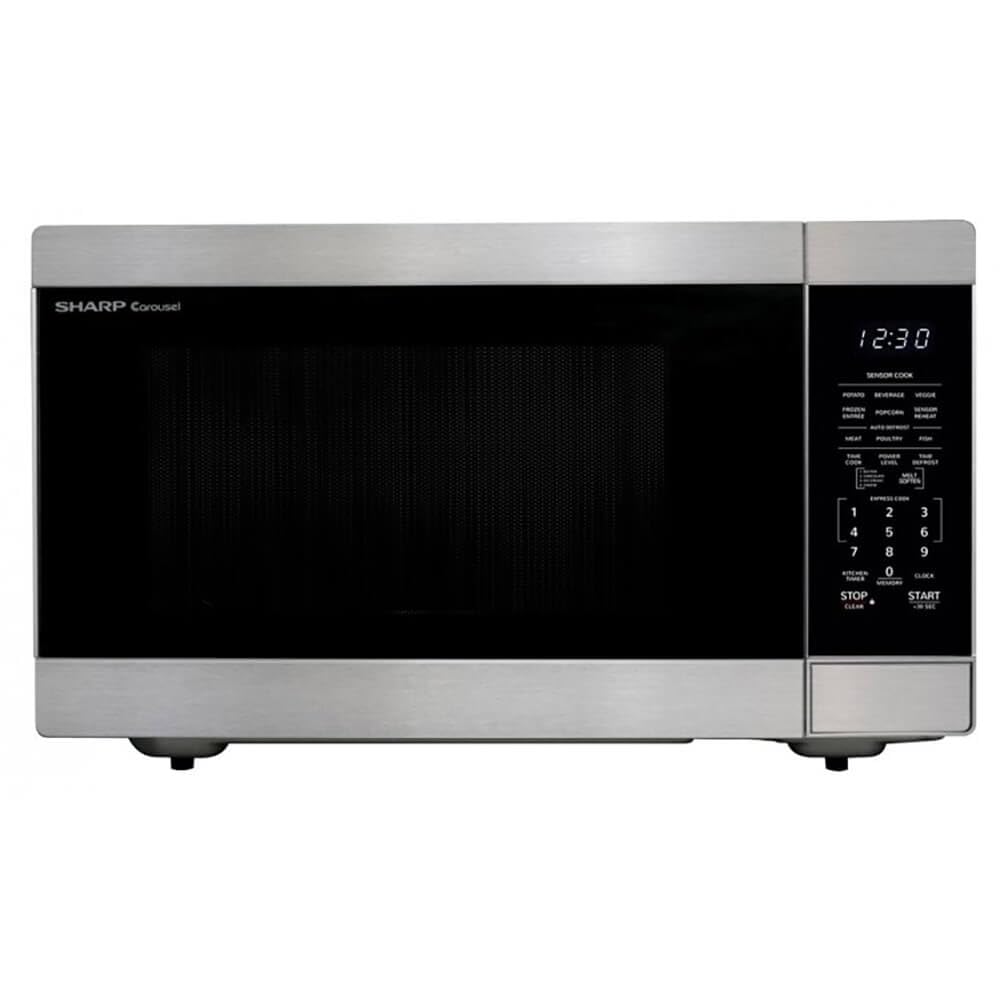
The same 2.2-cubic-foot Sharp family kitchen but wearing the stainless finish buyers ask for
The Sharp SMC2266HS is essentially the same family-kitchen concept as the SMC2266KS that tops this list, in a stainless exterior and with the newer SMC2266KS control package. It carries the same 2.2-cubic-foot interior, the same 1200 watts of output, an inverter heating method, and Auto Defrost. If you want the biggest interior Sharp makes and you like the stainless look, this is the direct alternative. Sensor Cook, Convection, Grill, and Auto Defrost round out the cooking programs, and the child lock comes in the box.
Where this model stands out is the buyer voice. Owners come away impressed with the power and the quiet run, and a couple of testimonials are unusually warm-welcoming — one buyer replaced a Quasar unit that had served for over 60 years, another simply says the microwave is “awesome.” That is the picture you hope for from a large Sharp: a solid appliance that does its job quietly and lasts. Cooking is described as faster and easier than the unit it replaces, and the 2.2-cubic-foot cavity is a clear advantage over any 1.5 or 2.0-cubic-foot alternative.
The one recurring niggle is that the front bottom trim strip can work loose and fall off over time. A few owners have tried gluing it back on andreport the piece has a habit of coming unstuck. It is cosmetic, not functional, and Sharp’s stainless front is otherwise easy to wipe clean. Beyond that one issue, the buyer feedback on this model is almost entirely positive — the appliance runs quietly, heats food and liquids quickly, and the ergonomic layout of the 2.2-cubic-foot cavity makes it a natural fit for families that cook a lot. If you have the counter width and want the same family-scale interior as the sibling SMC2266KS, this stainless variant is the one to shop.
The appeal: same 2.2-cubic-foot interior and 1200 watts as the top-pick Sharp, but finished in stainless to match most modern kitchens. Quiet enough that owners notice, powerful enough that liquids and plates heat fast.
The one recurring niggle: the trim strip on the front bottom edge can come loose over time. It is cosmetic and easily glued back — the underlying cabinet and controls are unaffected.
Worth grabbing if: you want the largest Sharp cavity with a stainless finish and you value quiet operation on a family-scale appliance. It is the top pick’s twinned, stainless-clad sibling.
Worth checking the dimensions first if: your counter is narrow — it shares the same wide footprint as the SMC2266KS, so measure before you buy.
Understanding the Specs
Rated Wattage vs. What You Actually Need
Wattage tells you how fast the microwave can heat food, and 1200W sits in the balance where a plate of leftovers is hot in a minute or two and a full family dinner does not need to be run in shifts. Anything below 1000W starts to slow down noticeably on dense dishes like casseroles, and above 1300W the extra speed rarely pays off in a standard home kitchen. Match the watt rating to what you cook — daily family meals want the 1200-watt class, while a single-serve household can get by fine with a slightly lower rating in the same physical size.
Inverter vs. Cycling Power
An inverter microwave holds steady power output at any level, so a 30% defrost setting actually delivers 30% power instead of pulsing between full blast and off. Older-style cycling microwaves (the ones that simply switch the magnetron on and off) still heat food, but the pulses can cook the edges of a dish while the center is still cold. This matters most when you defrost meat, melt butter or chocolate, or keep something warm — the inverter units do those jobs evenly without the stop-start effect.
Cubic-Foot Capacity vs. Turntable Diameter
Cubic feet describe the total interior volume, but the turntable diameter is what actually limits the dish you can put inside. A 2.2-cubic-foot unit with a 16.5-inch tray handles big casseroles and family platters, while a 1.2-cubic-foot cabinet with a 13.4-inch tray is best for single plates and small bowls. If you regularly warm large dishes, prioritize the turntable size — a wider tray means less rotating and repositioning mid-cook.
Sensor Cooking and Auto Menus
Sensor cooking uses a humidity sensor inside the cavity to detect steam and shut the microwave off when food is done. It works beautifully for popcorn, potatoes, and reheating a plate of food, but it is less reliable on covered dishes because the steam never reaches the sensor. Preset menus (popcorn, pizza, potato, frozen vegetable) are shortcuts that save you from entering a time — they do not change how the microwave works, and the manual time-and-power controls are always available when you want more control.
FAQ
Does a 1200 watt microwave really heat faster than a 1000 watt one?
What does inverter technology actually do in a microwave?
How much counter space do I need for a 2.2 cubic foot microwave?
Is sensor cooking worth paying extra for?
Do all countertop microwaves need a child lock?
Will a 1200 watt microwave fit a standard 20-amp kitchen circuit?
What is the difference between inverter microwaves and regular ones?
How long should a 1200 watt countertop microwave last?
Can a countertop microwave be built into a cabinet?
Why does my microwave get louder when it runs?
Final Thoughts: The Verdict
For most kitchens, the 1200 watt countertop microwave worth bringing home first is the Sharp SMC2266KS — its 2.2-cubic-foot interior, 16.5-inch carousel turntable, and inverter cooking combine to make it the best all-around pick for family-scale reheating, and it has built a strong reputation for quiet, even performance. If counter space is tight and you want the same inverter power in a compact cabinet, the Panasonic NN-SN686S is the enduring choice — its long-term owner record and compact 1.2-cubic-foot footprint make it the reliability play. For smaller kitchens that care most about simplicity, the LG 1.5 cu. ft. NeoChef earns its spot on easy-clean stainless interiors and that calming end-of-cycle chime. And if you want the same family-scale interior as the top pick in a stainless finish, the Sharp SMC2266HS delivers it without a redesign. Match the pick to your counter size, your cooking volume, and whether you defrost often — those three questions answer this whole category.
How We Picked
We do not accept paid placement. Every pick is matched to a real buyer and a real use-case; we do not hands-on test units.
Sources & Methodology
Specifications: manufacturer listings and product documentation. Review insights: verified customer reviews, as of September 2026. Pricing: not shown on this page (it changes often); check the current price via the retailer link.
As an Amazon Associate, Gadgets Feed earns from qualifying purchases. This does not affect which products we feature.