
Our readers keep the lights on and my morning glass full of iced black tea. As an Amazon Associate, I earn from qualifying purchases.
Specs are compiled from manufacturer listings and verified buyer reviews and can change over time — please confirm the key details on the product page before buying.
When the grid drops, you want your fridge, router, and phone charger to keep running without dragging a gas generator onto the porch. This list covers battery solar backup units that recharge from the sun and hold enough stored power to ride out an outage or a weekend off-grid. Every pick here accepts solar panel input, so you charge it from a wall outlet, a car, or free sunlight.
I’m Min — the founder and writer behind Gadgets Feed. This guide is built by comparing the manufacturers’ published specifications and the patterns across verified customer reviews, so you get each pick’s real strengths and trade-offs instead of marketing spin.
This list uses flexible, human-like matching for solar rechargeable units — the requirement being that every pick must accept solar panel charging input — so not every choice is the exact number you typed into the search bar. The nearest same-type size or watt output serves the same purpose, and we tell you that upfront so you are never misled. Read on to see which battery solar backup fits how you live.
Our Picks at a Glance

How To Choose The Best Battery Solar Backup
The number that actually decides whether a battery solar backup works for you is watt-hours — the total energy it can hold — not the peak watts on the label. A unit rated 1024Wh stores about one kilowatt-hour of usable energy, while a 3600Wh model holds roughly three and a half times that. Peak watts only tell you what it can run for a few seconds; watt-hours tell you how long it runs.
Match capacity to what you need to keep alive
A fridge and a router draw light, steady power, so even a mid-size solar generator keeps them alive for a day or more. A window air conditioner or a hair dryer pulls heavy current, so you need both higher capacity and higher continuous output. Add up the watts of everything you want running at once, then compare that total against each unit’s rated continuous AC output.
Check the solar input before you buy panels
Every unit here accepts solar, but the ceiling on input voltage and amperage varies. Push past that ceiling and you can damage the charge controller. If you already own panels, check their open-circuit voltage against the station’s limit first — it is the single fastest way to avoid a frustrating return.
Quick Comparison
| Model | Best For | Capacity | Continuous AC Output | Battery Chemistry | Amazon |
|---|---|---|---|---|---|
| BLUETTI Elite 200 V2★ Best Overall | Whole-home outage anchor | 2073.6Wh | 2600W | LiFePO4 | Amazon |
| BLUETTI Elite 100 V2Best for Travel | Portable camping power | 1024Wh | 1800W | LiFePO4 | Amazon |
| Anker SOLIX C2000 Gen 2Fastest Recharge | RV and camper power | 2,048Wh | 2,400W | LiFePO4 | Amazon |
| BLUETTI Elite 300 | RV shore power and home backup | 3014Wh | 2400W | LiFePO4 | Amazon |
| EF ECOFLOW DELTA 3 Max | Fast-recharge home backup | 2048Wh | 2400W | LFP | Amazon |
| AFERIY 3840Wh | Expandable off-grid system | 3840Wh | 3600W | LiFePO4 | Amazon |
| Jackery Explorer 2000 v2 | Camping and small business | 2042Wh | 2200W | LiFePO4 | Amazon |
| EF ECOFLOW DELTA Pro | Expandable whole-home backup | 3600Wh | 3600W | LFP | Amazon |
| Jackery HomePower 3000 | Essential home circuits | 3072Wh | 3600W | LiFePO4 | Amazon |
| PECRON F5000LFP | 120V/240V whole-home and RV | 5120Wh | 7200W | LiFePO4 | Amazon |
| Anker SOLIX F3800 | EV charging and appliances | 3,840Wh | 6,000W | LFP | Amazon |
In‑Depth Reviews
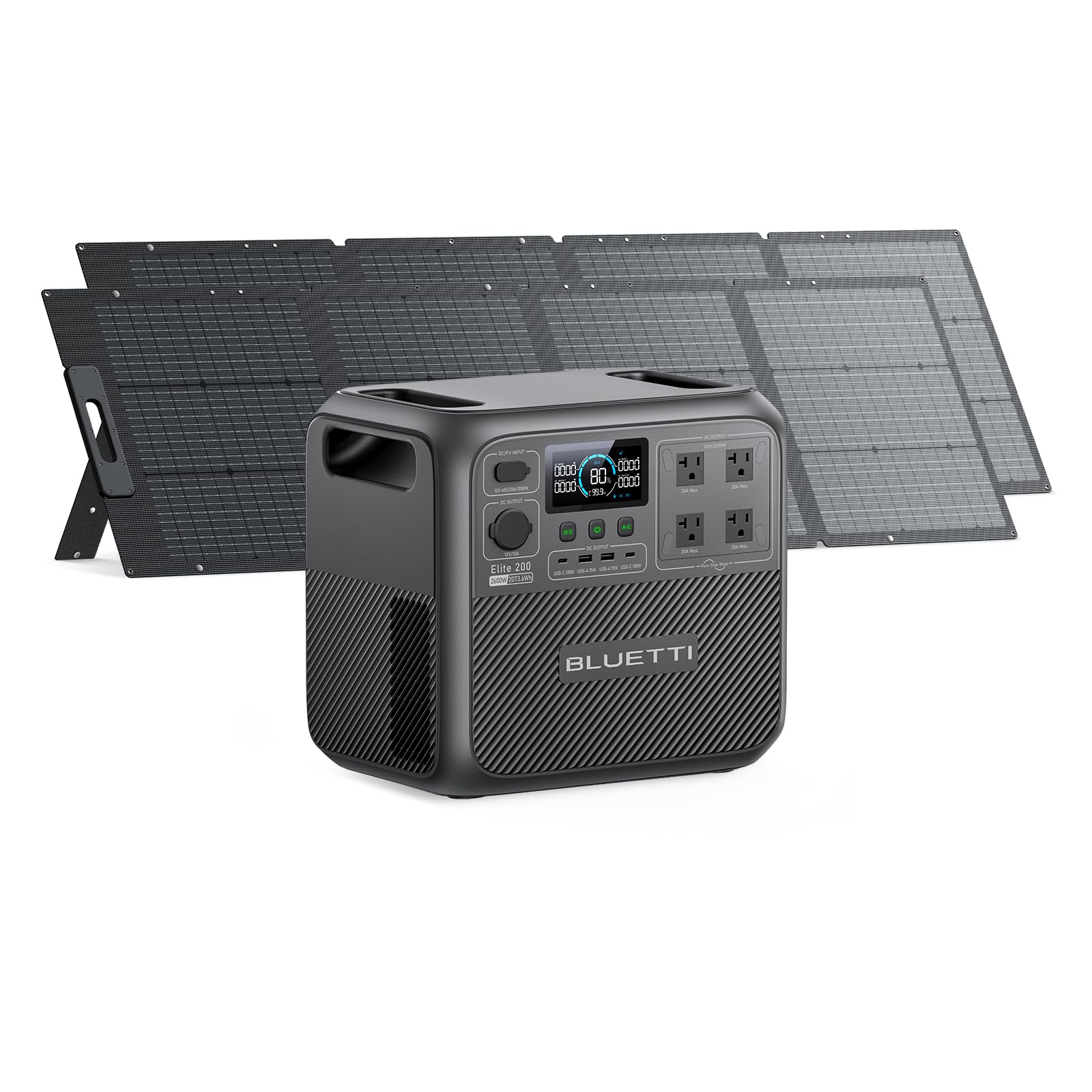
1. BLUETTI Elite 200 V2 Solar Generator & 2x200W Solar Panel Included
Our pick — over 4.5★ from 900+ verified ratings; the strongest balance of quality and price.
The two-kilowatt-hour anchor that runs the whole kitchen and still charges in about an hour.
If one unit has to carry your whole home through an outage, this is the one to pick. It stores 2073.6Wh in a LiFePO4 battery (a lithium chemistry that resists heat and lasts far longer than the older lithium-ion type), so your fridge, freezer, and microwave keep running. It delivers 2600W of continuous AC power, plus a 3900W power-lifting mode for the sharp startup spikes a fridge or coffee maker throws off. It ships as a kit with two 200W solar panels that recharge it fully in 5.5 hours, so you can genuinely go off the cord.
That capacity is what separates it from the smaller picks below. The payoff is a unit that runs an induction cooktop, air fryer, microwave, fridge, and freezer, often at the same time. Buyers report it handled exactly that spread of heavy appliances across camping, tailgating, and multi-day blackouts.
Durability is the headline number: over 6,000 charge cycles and a rated 17-year lifespan. Fast charging is a real strength too — 0–80% in about 50 minutes on dual AC and DC input, or a full charge in 2.4 hours from 1000W of solar. The catch worth knowing: solar input is capped at 60V and 1000W, and a few owners hit a battery-calibration quirk that needs a full charge-and-drain reset cycle to clear. The app and some settings also sit behind an account login.
Where it earns its keep
- 2073.6Wh runs heavy kitchen appliances, not just phones and laptops
- 2600W continuous with 3900W lifting mode for startup surges
- 10W standby draw — three times lower than similar stations, per the maker
- 17-year rated lifespan and 6,000+ cycles on automotive-grade LiFePO4
What to plan around
- 53.4 pounds — a two-hand carry, not a one-hander
- Solar input capped at 60V/1000W, so oversized panels are wasted
- App configuration wants an account login
Reach for this if: you want one unit to run fridge, freezer, and small kitchen appliances through a multi-day outage or a full off-grid week.
Look elsewhere if: you need to carry it up stairs often or want to expand capacity later — this one is fixed at 2073.6Wh.
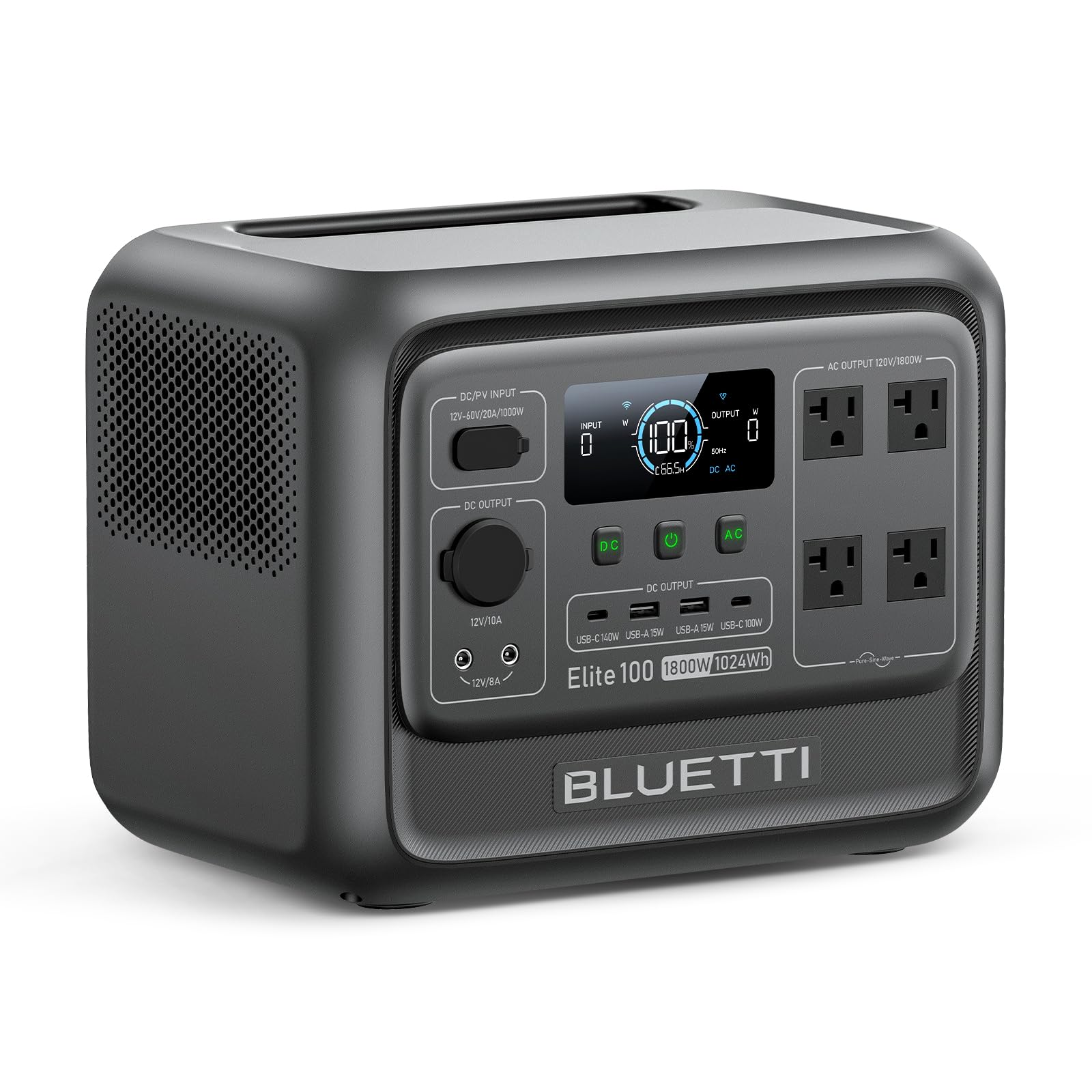
2. BLUETTI Elite 100 V2 Portable Power Station for Camping
Twenty-five pounds of camping power that refills from the wall in about seventy minutes.
If you camp, tailgate, or live in an apartment and want backup you can actually lift, this is the balance. The 1024Wh LiFePO4 battery and 1800W AC output run up to 90% of everyday appliances, with 3600W of surge to kick-start motors. What sells people on it is the recharge speed — a full charge in about 70 minutes on 1200W TurboBoost AC charging, or up to 1000W of solar input, which the maker calls the fastest solar charge for a one-kilowatt-hour station.
It also stays quiet. Silent mode runs at 30dB — about the level of a soft whisper — which is half as loud as other 1kWh stations, so it will not wreck a night in a tent or a bedroom. The UPS switchover happens in 10ms, keeping a router or PC alive through a blink in the grid. At 25 pounds with a hidden handle it is light enough for seniors to move one-handed, and it goes 35% smaller and 30% lighter than comparable units.
The honest limitation is capacity: 1024Wh is half of what the Elite 200 V2 above holds, so it is a short-outage and outdoor unit, not a whole-home anchor. Durability also comes up mixed in owner feedback, and at least one unit dead-on-arrival story exists, though the maker’s service resolved issues for most. Treat it as your camping and short-blackout companion, not your storm-season fortress.
The real-world rundown: it powers a fridge for up to 48 hours during an outage and still fits under a counter or in a car trunk. Astrophotographers push a telescope mount, two cameras, a mini PC, tablet, and phone for about eight hours off one charge.
The trade-off: heavy charging loads can spin the fans audibly, and the 1024Wh ceiling means big appliances drain it fast.
Best matched to: campers and travelers who want genuine portability, fast top-ups, and near-silent operation.
Not the one for: running an air conditioner or a whole fridge wall for days — step up in capacity for that.
3. Anker SOLIX C2000 Gen 2 Portable Power Station
A two-kilowatt-hour station that refills in under an hour and slides under a counter.
The C2000 Gen 2 is built around one number: 58 minutes to a full charge on AC and solar together. That speed turns “I forgot to charge it” into a non-issue before a storm. It holds 2,048Wh in a LiFePO4 battery, outputs 2,400W continuous with a 4,000W peak, and can run a dual-door fridge for up to 32 hours — or up to 64 hours if you add its expansion battery to reach 4kWh.
What wins people over is how little it wastes at idle. Standby draw is just 9W, so the battery is still mostly full a day later. It is also genuinely portable for its class: 41.7 pounds and 25% lighter, 29% smaller than similar units, with a slim profile that tucks under counters or a TV stand. RV owners pull 10%+ of charge back per day from a single 200W panel while boondocking, and it runs a 13,500 BTU air conditioner for about 90 minutes.
One quirk to know: when you feed it from 120V AC input, the output is limited to 1,800W rather than the full 2,400W — that is an input constraint, not a defect, but it matters if you plan to run heavy loads while recharging. Owners mention mixed feelings on weight, and the display’s runtime estimates drift with cycling appliances like fridges.
What stands out
- 100% recharge in 58 minutes on AC plus solar
- 9W standby draw keeps stored power where it belongs
- 25% lighter and 29% smaller than typical 2kWh stations
- 800W alternator charging tops it up from your car in 3 hours
Worth knowing first
- AC input caps output at 1,800W instead of 2,400W
- 41.7 pounds — light for the class, still a two-hand lift for many
- App runtime estimates can be off for cycling loads
Pick this one when: fast turnaround and a low profile matter more than maximum capacity — RV weekends, apartment blackouts, storm prep in a hurry.
Skip it when: you want 3kWh+ from the start or need top output while plugged into a standard wall outlet.
4. BLUETTI Elite 300 Portable Power Station for RV & Home Backup

A three-kilowatt-hour station with a real RV outlet, sized to fit where bigger boxes cannot.
RV owners get the feature most stations skimp on: a TT-30 RV outlet plus a high-current 12V/30A DC output for running RV fridges, water pumps, and diesel heaters directly. Frost & Sullivan recognized the Elite 300 as the world’s smallest 3kWh portable power station, packing 3014Wh into a shell nearly 59% smaller than traditional large stations. Output runs 2400W continuous with a 4800W surge to start resistive loads like kettles.
For home use, the 10ms UPS switchover keeps computers and routers alive during an outage, and the 3014Wh capacity runs a 12,000 BTU air conditioner all night in owner testing. It recharges from AC to 80% in as fast as 78 minutes, and the 6,000+ cycle LiFePO4 battery is built for years of daily service. One owner measured 77.2% round-trip efficiency — 1.05kWh out for 1.36kWh in — which is honest depreciation you should expect from any LFP station.
Here is the limit to plan around: solar input tops out at 60V/20A, and pushing past that open-circuit voltage can damage the MPPT charge controller (the part that matches panel voltage to battery voltage) and void the warranty. There is also no battery expansion path, so 3014Wh is your ceiling. A soft-start ramp occasionally struggles with a high-draw compressor like a dehumidifier.
Editor’s read: performance is the trait buyers lean on most here, with battery life close behind — it happily powers a fridge, fans, and phones all day and shrank to the size of two ammo cans. Build quality, the clear color display, and the UPS all test clean.
The honest catch: you cannot grow the capacity later, and solar charging is capped lower than some rivals.
Ideal for: RV and camper van owners who want a native TT-30 outlet and 12V/30A DC in a compact shell.
Think twice if: you plan to expand capacity later or already own high-voltage solar panels.
5. EF ECOFLOW DELTA 3 Max Portable Power Station

X-Boost turns a 2400W station into one that runs almost anything you plug in.
The DELTA 3 Max leans on convenience. It holds 2048Wh in a LiFePO4 (LFP) battery and outputs 2400W continuous, but its X-Boost mode pushes that to 3400W so it can run appliances rated above its base output without tripping. Like the Anker C2000 above, it wants to be ready fast — 0–80% in just over an hour through EcoFlow’s X-Stream charging.
What repeatedly stands out to owners is the value and the speed of top-ups together. The LFP battery is rated for 10 years of daily use and carries a 5-year warranty. A TV will run for about 12 hours on a charge, and it handles outages, camping, and road trips without complaint.
The fine print involves cables and setup. A plain XT60 solar cable limits charging to 12V/8A, while the XT60i cable open up higher current — so the cable you use changes your recharge speed. Some settings live in the app and mirror that quirk from the C2000; you will want the app configured before heading off-grid. Charging capability comes up mixed in owner notes, and the unit is heavy despite its portability claims.
Quick take: the combination of 3400W X-Boost output, fast charging, and a clear display is what buyers value most, with charging speed a close second. It is portable for its class and solidly built.
Know before you buy: bring the right cable, and set the app up on Wi-Fi before you leave home.
Choose it if: you want flexible output that handles appliances above the rated wattage and lightning-fast recharges, indoors or out.
Pass if: you prefer every setting to live on physical buttons rather than in an app.
6. AFERIY 3840Wh Portable Power Station, Expandable Solar Generator

Start at 3.8kWh and grow the system all the way to 11.5kWh with add-on packs.
If you want room to grow, this is the pick. The AFERIY starts with 3840Wh of LiFePO4 storage and 3600W continuous output, then lets you stack expansion batteries up to 11.5kWh — enough to scale from a weekend cabin to a serious home backup over time. It recharges four ways (AC wall, solar, car, or AC plus solar) with adjustable speed settings, and can reach a full charge in as little as 1.5 hours.
Its UPS bridges grid gaps in under 10ms, keeping computers and security cameras running through a storm. Runtime for common household essentials lands around 17 hours, and a refrigerator runs 1–2 days depending on the model. There are 15 output ports in all, including USB-C PD 3.0, DC5521, XT60, and a 12V car socket, and a pull handle helps move the 80.46-pound shell.
Owners point to performance and value most — it is a lot of stored watt-hours for the tier, and off-grid RV users run a whole rig minus the air conditioners off it while recharging fast from large solar arrays. The honest trade-offs: charging speed and noise both come up mixed in feedback, with some units charging fully in under 90 minutes and others arriving unable to charge at all, and it weighs 104.7 pounds. It is UL Listed with a 7-year support period.
Why it made the list
- 3840Wh expandable to 11.5kWh for long-term growth
- 4 recharge methods with a 1.5-hour fast-charge ceiling
- 15 ports cover AC, USB-C PD 3.0, XT60, and 12V car
- UL Listed with a 7-year support period
Room to weigh
- 104.7 pounds — moving it is a two-person job
- Charging speed and noise both come up mixed in owner feedback
- The app lacks a separate solar/AC input display
Right for: off-grid and home-backup buyers who want to start modest and add batteries as needs and budget grow.
Wrong for: anyone who needs to relocate it often or wants a lighter single-box solution.
7. Jackery Explorer 2000 v2 and 2x200W Solar Panels

The two-kilowatt-hour kit that stays light enough to lift and quiet enough to sleep beside.
Jackery’s selling point here is portability in a two-kilowatt-hour package. At 39.5 pounds, it is 41% lighter and 34% smaller than conventional 2kWh LiFePO4 stations, thanks to CTB (Cell-to-Body) construction borrowed from electric vehicles. It holds 2042Wh and outputs 2200W across three AC ports, plus a USB-C PD 100W port that fast-charges laptops and tablets without an adapter.
Recharging is quick and flexible: 80% in 66 minutes on AC, a full charge in 102 minutes with app-activated Emergency Super Charging, or about 6 hours from the included 400W of solar. Silent Charging mode tops it up in 5 hours at just 30dB, so it can run in a bedroom overnight. The UPS switchover comes in at 20ms and is UL1778 certified.
Two things to weigh. The 20ms transfer is slower than the sub-10ms units on this list, so it is fine for fridges and routers but not the fastest gap-cover for delicate electronics. And the included solar panels draw a fair complaint — they work well in full sun but feel flimsy, and they can yellow the grass beneath them after a couple hours. The 10-year LiFePO4 lifespan and clean, fume-free operation still make it a strong indoor-friendly alternative to a gas generator.
Where it shines: charging speed is the trait owners praise most, with value close behind — a 29% to 100% top-up lands in about 1 hour 40 minutes, and it runs Starlink around the clock for some users.
Worth a careful look: panel durability and the slower 20ms UPS flip are the compromises.
Great fit for: campers and small-business users who prize weight savings and near-silent indoors operation.
Look on if: you need sub-10ms UPS speed or heavy-duty solar panels built to the same standard as the station.
8. EF ECOFLOW Portable Power Station 3600Wh DELTA Pro

A 3.6kWh base that scales to 25kWh and can top up an EV in a pinch.
For buyers thinking years ahead, the DELTA Pro is the growth platform. It starts at 3600Wh and 3600W AC output, then expands from 3.6kWh up to 25kWh with extra batteries or smart generators. Its X-Boost pushes a single unit to 4500W, and you can link two units for 7200W — enough to sweep through heavy-duty devices at home or on a job site. There are 15 output methods, including two 100W USB-C ports, five AC outlets, and an Anderson port.
X-Stream charging refills it in 1.8 hours from 240V outlets and 2.7 hours from a standard 1800W wall outlet, or 2.8 hours from four 400W solar panels. Its solar conversion efficiency reaches up to 23%, which is why the solar recharge keeps pace with wall charging. One owner runs a heat press at vendor markets with zero voltage drops, and mobile businesses lean on exactly that kind of steady, quiet output.
Watch two figures. Solar input is limited to 15A, which caps how fast panels can feed it, and at 99 pounds it is a permanent fixture rather than a grab-and-go. Weight is the one trait that reads negative in owner feedback, while performance leads the positives. Battery replacement is also part of the long-term picture if you plan to keep one running for years.
The pitch, plainly: it is a base station you build on. Performance and reliability are the two things owners count on most, and the 15-day stored-charge window suits long-term backup.
The offset: 99 pounds locks it in place, and the 15A solar ceiling limits how fast panels recharge it.
Best if: you want a home-backup foundation that can grow past 20kWh over time without replacing the whole system.
Not if: you need to move it often — this one stays put.
9. Jackery HomePower 3000 and 2x200W Solar Panels

A 3kWh home-backup unit that packs 47% smaller than the box it replaced.
Built for home essentials, the HomePower 3000 delivers 3600W continuous with a 7200W surge off 3072Wh of LiFePO4. It runs a household for up to 15 hours on the essentials — fridge, fan, router, lights — and keeps a refrigerator going for 1 to 2 days. It is the first 3kWh station with CTB (Cell-to-Body) construction, which makes it 47% smaller and 43% lighter than comparable models. There is a built-in TT-30 RV port for plug-and-play camper power too.
Recharging is flexible and quick: a full top-up in 1.7 hours on hybrid AC and DC, or 2.2 hours on AC alone. With the included 2x200W panels, it charges to 80% in 9 hours — slower solar than some rivals, but a real option for quiet, generator-free recharging during a long outage. The UPS switches in ≤20ms and is UL certified, fast enough to keep security cameras and routers alive. ChargeShield 2.0 and the LiFePO4 cells are rated for 4,000 cycles while retaining 70% capacity.
The trade-offs are weight and a couple of service missteps. At 59.5 pounds it is manageable but not light, and owner reports describe the unit occasionally shutting off unexpectedly or a flashing light with no clear meaning. Charging speed also comes up mixed, with a few units reportedly not charging at all. The 9-hour solar recharge window is slow if you are counting on panels alone.
Strengths that hold up
- 3072Wh runs essentials up to 15 hours, fridge 1–2 days
- 47% smaller and 43% lighter than comparable 3kWh models
- ≤20ms UL-certified UPS with dual 100W PD ports and a TT-30 RV outlet
- 4,000-cycle LiFePO4 retains 70% capacity
Caveats to size up
- Solar recharge to 80% takes 9 hours on the included panels
- 59.5 pounds — heavy for casual moving
- Charging speed reads mixed in owner feedback
Suits: homeowners who want one station for essential circuits, a native RV outlet, and a compact footprint on a shelf.
Look past if: you need solar to replenish fast or want a no-expansion-needed system — this one has a fixed 3072Wh.
10. PECRON F5000LFP Power Station, 5120Wh, 7200W AC Output

A 5kWh powerhouse that runs both 120V and 240V loads — and expands to 35.8kWh.
This is the whole-home tier. The F5000LFP delivers 7200W output with dual voltage (120V/240V) off a 5120Wh LiFePO4 battery, enough to carry a household’s essential power for up to 3 days. Pair it with its expansion batteries and it scales up to 35.8kWh, handling dryers, heaters, water pumps, and other heavy equipment. Three recharge paths — AC, solar, and generator — can be freely combined, and solar input tops out at 6400W across two ports.
Its UPS is the standout spec for critical gear: two 20A and one 30A 0ms online UPS outlets keep WiFi, aquariums, CPAP machines, and computers online with zero gap. The 12~40V adjustable 5525 port and XT60 port let you dial voltage and current to match different devices, and there are 12 outputs in all. A detachable cart makes the 123.9-pound shell manageable, and it runs as quietly as 30dB, with a battery heating function for cold-weather operation.
The honest picture involves reliability variance and support gaps. Battery life sits highest in owner mentions as a mixed point, and a few buyers hit real problems — one unit sparked at the solar controller from over-voltage input, another suffered an inverter failure that support could not resolve by software. Customer support draws slow-response complaints, including a phone line out of service. At this tier, buy with the after-sales path in mind and keep solar input well under the voltage limit.
Owners’ verdict, mostly: functionality is what buyers value most, with value for money a close second — it is a lot of inverter and stored energy for the tier, and heavy appliances like washers and dryers run from it.
Be realistic about: mixed battery-life feedback, slow support, and the need to respect the solar voltage ceiling.
For you if: you need 240V appliances, dual-voltage output, and a path to 35.8kWh for serious home backup.
Think twice if: you want smooth, fast customer service or refuse to nurse solar input limits.
11. Anker SOLIX F3800 Portable Power Station, 3,840Wh

A 6,000W station that charges your EV and runs your dryer off one box.
The F3800 is the most appliance-capable pick on this list. It puts out 6,000W AC at 120V/240V off 3,840Wh of EV-class LFP cells, so it runs a dryer without hesitation. It can charge your EV directly at 6,000W through its NEMA 14-50 port — and power your RV through the NEMA 14-50 or L14-30 ports. Add battery packs to grow capacity to 26.9kWh, or add a second F3800 and 12 batteries to push toward enough for two weeks of backup.
Anker InfiniPower gives the LFP cells a 10-year lifespan backed by a 5-year warranty, with a smart temperature system that keeps them cool under load. One owner paired it with a 400W panel and gets about 3 days of backup with two expansion batteries, and set it up in minutes before a Connecticut outage. The Anker app connects by Wi-Fi or Bluetooth to monitor inputs and control how power is used.
Two things cost you real-world performance. Firmware must be updated to allow simultaneous AC and DC charging, and below 50°F the BMS (the battery management system that guards against over-charge) limits charging to about 710W DC and 685W AC. Hitting the full 2,400W solar ceiling is also hard in practice. Charging speed and battery life both come up mixed in owner feedback, with a few units draining in a few hours under heavy load, and at 132.3 pounds it is a fixed installation. The portable foldable panels are the weak link — they can de-laminate above 80–90°F, so rigid panels serve this system better.
What it does best
- 6,000W AC at 120V/240V runs dryers and heavy appliances
- Charges an EV at 6,000W through the NEMA 14-50 port
- 3,840Wh expandable to 26.9kWh, or two weeks of backup with a second unit
- 10-year LFP lifespan and a 5-year warranty
Watch-outs
- 132.3 pounds — this one gets installed, not carried
- Cold-weather BMS limits charging below 50°F
- Portable panels can de-laminate in high heat; rigid panels work better
The one to buy when: you want maximum appliance reach — dryer, RV, and even EV charging — from a single station with a decade-long lifespan.
Not for: anyone who needs to move the thing or expects full solar charging in cold weather.
Understanding the Specs
Watt-Hours (Wh) — How Long You Can Run
Watt-hours measure stored energy, the amount of runtime before you need to recharge. A 1024Wh unit holds roughly one kilowatt-hour of usable power; a 5120Wh unit holds about five. In plain terms, bigger watt-hours means your fridge, router, and lights stay alive longer during an outage. Match it to how many hours you want to stay powered, not to how big the number sounds.
UPS Transfer Time — The Outage Safety Net
UPS (uninterruptible power supply) mode means the station automatically switches from wall power to battery when the grid drops. The number in milliseconds tells you how big that gap is. A 10ms switchover is fast enough to keep a router or PC running without a restart. Faster is better for delicate electronics, but nearly any UPS mode here beats a generator that needs a manual start.
LiFePO4 vs LFP — The Battery Chemistry
LiFePO4 and LFP name the same lithium iron phosphate chemistry, a safer and longer-lived battery type than older lithium-ion. It resists heat better and holds up across thousands of charge cycles, which is why rated lifespans reach 10 to 17 years. It is the reason these stations can sit in a garage or camper for a decade and still hold charge.
Solar Input Limits — The Charging Ceiling
Every station here accepts solar, but each sets a maximum input voltage and wattage. A 60V ceiling rejects standard higher-voltage panels, and exceeding the open-circuit voltage can damage the charge controller. Check your panels’ specs against the station’s limit before you buy — it is the fastest way to avoid a return.
FAQ
How many watt-hours do I need to run my fridge in an outage?
Do these stations really run a window air conditioner?
What does UPS transfer time mean for my router and computer?
How fast can these units fully recharge from a wall outlet?
Can I charge a battery solar backup from car and solar at the same time?
How many solar panels do I need to recharge these generators?
Do these battery solar backups work as a permanent home backup?
How long do the LiFePO4 batteries last before replacement?
Are these units safe to run indoors instead of a gas generator?
Can I add batteries later to increase capacity?
Final Thoughts: The Verdict
For most homes, the battery solar backup winner is the BLUETTI Elite 200 V2 because it pairs 2073.6Wh of LiFePO4 storage with 2600W of continuous output, a 17-year rated lifespan, and roughly-double-the-capacity headroom over the smaller Elite 100 V2. It runs the appliances that actually matter in a blackout — fridge, freezer, microwave, coffee maker — and tops up in about an hour. If you want a portable unit you can lift one-handed, grab the BLUETTI Elite 100 V2. And for a whole-home system you can grow for years, the EF ECOFLOW DELTA Pro is the one to reach for. Buy the unit that matches your real load and solar setup, and you will ride out the next outage without ever touching a gas can.
How We Picked
We do not accept paid placement. Every pick is matched to a real buyer and a real use-case; we do not hands-on test units.
Sources & Methodology
Specifications: manufacturer listings and product documentation. Review insights: verified customer reviews, as of September 2026. Pricing: not shown on this page (it changes often); check the current price via the retailer link.
As an Amazon Associate, Gadgets Feed earns from qualifying purchases. This does not affect which products we feature.