
Our readers keep the lights on and my morning glass full of iced black tea. As an Amazon Associate, I earn from qualifying purchases.
Specs are compiled from manufacturer listings and verified buyer reviews and can change over time — please confirm the key details on the product page before buying.
If you want one camera that handles portraits, travel, video and low light without forcing you to buy three bodies, the answer is to match the sensor size to your real shooting habits first. Full-frame wins indoors and at dusk; a compact 30x zoom wins at a concert or on a hike. This guide sorts eleven real options by what they actually do well, so you can pick the one that fits your hands and your weekends.
I’m Min — the founder and writer behind Gadgets Feed. This guide is built by comparing the manufacturers’ published specifications and the patterns across verified customer reviews, so you get each pick’s real strengths and trade-offs instead of marketing spin.
A camera you actually carry beats a better one that stays in the closet, so this breakdown covers both full-frame bodies and pocketable travel zooms. Everything below is sorted by how it fits real use, not by price tag, so you can find the right tool for all around camera duty.
Our Picks at a Glance


How To Choose The Best All Around Camera
An all-around camera is a compromise machine, and the smart move is deciding which compromise you can live with before you compare a single spec. Three things separate a camera you love from one you resell in six months: the sensor, the autofocus system, and whether the body is small enough that you actually bring it.
Sensor Size Sets Your Ceiling
A full-frame sensor is a chip the size of a frame of 35mm film, and it gathers more light than a smaller APS-C or Micro Four Thirds chip. More light means cleaner pictures in a dim restaurant and smoother background blur behind a portrait. The trade-off is size and weight: a full-frame body plus a lens takes real room in a bag. Compact travel cameras use much smaller sensors, which is exactly why they fit in a jacket pocket but struggle after sunset.
Autofocus Points Are Not All Equal
Autofocus points are the zones the camera checks to lock onto your subject. More points generally mean smoother tracking of a moving kid or a dog. Just as important is subject detection — the camera recognizing a face, an eye, an animal or a vehicle on its own. A camera with fewer points but smarter detection can beat one with a bigger number and dumber logic, so read what owners say about real tracking, not just the spec sheet.
Video Limits And Heat
If you shoot long interviews or events, recording time matters more than resolution. Some bodies cap 4K clips and shut down when the sensor gets hot, while others use active cooling to keep rolling. Check whether the camera has a recording time limit, whether it overheats, and how long the battery lasts — a body that dies mid-ceremony is worse than one with a slightly softer image.
Quick Comparison
| Model | Best For | Sensor | Autofocus Points | Bit Depth | Amazon |
|---|---|---|---|---|---|
| Sony Cinema Line FX30★ Best Overall | Cinematic video on a budget | 20.1 MP Super 35mm | 495 | 14 Bit | Amazon |
| Nikon Z 6IIPremium Pick | Hybrid stills and video | 24.5MP BSI full-frame | 273 | 14 Bit | Amazon |
| Sony Alpha 7 IVMost Versatile | All-round full-frame hybrid | 33MP full-frame | 693 | 14 Bit | Amazon |
| Panasonic LUMIX TZ/ZS99 (Black) | Travel and concerts | 20MP compact | 19 | 10 Bit | Amazon |
| LUMIX ZS99 (Silver) | Pocket zoom on a budget | Compact | 121 | 12 Bit | Amazon |
| OM SYSTEM OM-5 Mark II | Outdoor travel | Micro Four Thirds | 121 | 12 Bit | Amazon |
| Canon EOS R8 | First full-frame body | 24.2 MP full-frame | 1,053 AF zones | 10 Bit | Amazon |
| Nikon Z50 II (two lenses) | Beginners stepping up | 20.9MP APS-C | 231 | 14 Bit | Amazon |
| Canon EOS R7 | Wildlife and birding | 32.5 MP APS-C | 651 | 10 Bit | Amazon |
| Fujifilm X100VI | Street and everyday carry | 40.2 MP APS-C | 425 | 14 Bit | Amazon |
| LUMIX S5II | Pro hybrid video work | 24.2 MP full-frame | 779 | 10 Bit | Amazon |
In‑Depth Reviews
1. SONY Cinema Line FX30 Super 35 Camera, Gray
Our pick — over 4.5★ from 500+ verified ratings; the strongest balance of quality and price.
The cinema body that treats video creators like professionals, not hobbyists with a phone.
If your all-around work leans heavily toward interviews, podcasts or events, this is the pick that pulls ahead of everything else here. The 20.1 MP Exmor R Super 35mm image sensor (a chip sized between APS-C and full-frame) gives you wide dynamic range — meaning it holds detail in both the bright window and the dim corner of the same shot. S-Cinetone hands you a finished cinematic look straight out of the camera, so you can upload without color grading. And with 495 autofocus points, it locks on to faces and eyes with a precision that the compact Panasonic TZ99, at 19 points, simply cannot match.
The FX30 is built for long recording sessions rather than quick snapshots. Its active cooling keeps it from overheating during hour-long 4K runs, dual CFexpress Type A and SD card slots give you instant backup, and user LUTs (custom color presets you load into the camera) apply to the LCD and HDMI output and get embedded in your clips. A 14 Bit bit depth and 14+ stop range deliver wide latitude for low-noise images. Special effects like S-Log3, Cine EI and shutter-angle control round out a kit that owners describe as the most versatile they have used.
The crowd favorite here sits at 4.8 stars across hundreds of satisfied owners, and the consensus is loud about quality and image quality above all. What wins people over is the autofocus and speed. As owners put it: “Autofocus fantastic, IBIS, phenomenal speed, non-clunky fast menus.” The honest catch is battery life: intense shooters clock roughly 1–2 hours per podcast and carry a spare battery pack to top up while rolling. It also uses an interchangeable Sony E/FE mount, so you budget for a lens separately — plan for that before you commit.
Where It Earns Its Keep
- 495 autofocus points with phase and contrast detection for rock-solid subject lock
- Dual Base ISO and 14+ stops of dynamic range for clean low-light footage
- Active cooling means no overheating on long 4K recordings
- Dual card slots and 14 Bit recording for professional backup and grading room
What To Plan Around
- Weak battery life — real-world shooters report 1–2 hours per session
- Interchangeable Sony E/FE mount means the lens is a separate purchase
- Super 35mm sensor isn’t full-frame, so you lose some wide-angle reach
Reach for this if: you create high-volume video content — podcasts, courses, client shoots — and want pro-grade results without a studio budget.
Look elsewhere if: you want a camera you can slip into a coat pocket, or you need a full-frame sensor for maximum wide-angle and shallow depth of field.
2. Nikon Z 6II | Versatile Full-Frame Mirrorless Stills/Video Hybrid Camera | Nikon USA Model
A do-everything full-frame hybrid that takes whatever lens you already own.
Start with the number that matters here: 273 autofocus points. The 24.5MP BSI (back-side illuminated) full-frame sensor excels in low light, and it shoots at 14 FPS for fast action. Dual EXPEED processors keep a deep buffer so burst shooting doesn’t stall on you.
Where this camera quietly wins is the mount. It accepts the growing line of NIKKOR Z lenses and, with an FTZ adapter, roughly 360 F-mount NIKKOR lenses — so photographers with a shelf of older glass are not starting from zero. You get two card slots (CFexpress/XQD plus UHS-II SD) for instant backup, a weather-sealed body, USB-C constant power for livestreams and timelapses, and a 14 Bit bit depth for flexible editing. The full pixel readout delivers clean 4K UHD video at 60p. The thing everyone raves about is the sharpness of both stills and video, and buyers describe it as a worthy upgrade over the original Z 6.
The trade-offs are small but real. The screen doesn’t flip forward for self-filming — you’ll rotate it or use an app instead. Focus tracking can lose a subject in tricky situations, and one owner raised long-term concerns about Nikon’s lens roadmap. Otherwise, this is a genuine stills-and-video workhorse that covers portraits, events and travel without complaint.
The adapter advantage: accepting roughly 360 F-mount lenses with an FTZ adapter makes this the smoothest landing spot for anyone with a drawer of older Nikon glass.
Pick it for: photographers who want one full-frame body for both stills and video and value backwards lens compatibility.
Don’t count on: a forward-flipping screen for easy self-recording or vlog-style shooting.
3. Sony Alpha 7 IV Full-frame Mirrorless Interchangeable Lens Camera
The full-frame balanced act: enough resolution for pro cropping, enough speed for live subjects.
If you have to name one body that does everything well, 33 megapixels is the reason this one’s name keeps coming up. That 33MP full-frame Exmor R back-illuminated sensor captures huge detail, so you can crop into a shot and still print it large. Its 693 autofocus points (a mix of contrast and phase detection) with real-time Eye AF for people and animals make sharp framing almost automatic. Video shooters get 4K 60p at 10-bit 4:2:2 with full pixel readout, plus 7K oversampling for cleaner 4K 30p footage. And a 14 Bit bit depth gives stills editors plenty of room to pull shadow detail.
Owners consistently single out image quality and customization as the highlights, and this is clearly a camera people grow with rather than outgrow — the menu system and depth of flexibility reward the time you put into learning it. It carries dual card slots (CFexpress Type A, SDHC, SDXC), a fully articulating screen, and strong low-light performance with high-ISO noise reduction. The catch is the learning curve: this is not a point-and-shoot, and beginners should expect a few weeks of study. Overheating shows up as a recurring gripe, and battery life, while sufficient for a typical shoot, can run short on long days.
The Strong Hand
- 33MP full-frame sensor with 7K oversampling for detailed 4K 30p
- 693 AF points and real-time Eye AF for people and animals
- Dual card slots plus fully articulating screen
- 14 Bit depth for editing flexibility and clean low-light results
The Real Caveats
- Overheating is a recurring theme among long-session shooters
- Steep learning curve makes it a poor first camera for total beginners
- Requires Sony E-mount lenses, sold separately
Best for: enthusiasts and working shooters who want one full-frame body that handles stills and video at a high level.
Skip if: you want a straightforward point-and-shoot experience or need unlimited long-take recording without heat concerns.
4. Canon EOS R7 Mirrorless Camera (Body Only)

For anyone who shoots wildlife, birds or sports, reach matters more than sensor size.
This is the crop-sensor specialist. The 32.5-megapixel APS-C CMOS sensor gives you telephoto reach without buying a gigantic lens, and Dual Pixel CMOS AF covers up to 651 AF zones across roughly 100% of the frame, so a bird crossing the viewfinder stays locked. Burst shooting is genuinely fast: 15 fps with the mechanical shutter and 30 fps with the electronic shutter, plus RAW Burst Mode with a 1/2-second pre-shoot that starts capturing before you press the button. A 5-Axis In-body Image Stabilization (IBIS) system steadies handheld shots in dim light, and an included spare LP-E6NH battery lets you keep going past the 30-minute video mark.
The R7 has an interchangeable Canon RF mount, dual UHS-II card slots, and a comfortable grip that photographers switching from the Rebel series find instantly familiar. The verdict from the field is that quality and image quality carry the day, with the fast frame rate and compact, lightweight body singled out as practical wins for travel. Autofocus feedback is mixed — mostly praised, though low-light focus trips some users. One caution worth knowing: a third-party Sigma 150-600mm lens worked but showed focus quirks that likely wouldn’t appear with native Canon glass.
Fast on the draw: at up to 30 fps electronic and 15 fps mechanical, this camera is built to catch a bird mid-flap or a sprinter mid-stride.
It’s the one for: wildlife, birding and sports shooters who want extra reach and lightning-fast bursts in a compact body.
Think twice if: you already own third-party telephoto glass, since native RF lenses give the most consistent autofocus behavior.
5. Canon EOS R8 Mirrorless Camera (Body Only)

The budget door into full-frame: R6 II internals at a lighter, smaller footprint.
Full-frame image quality in a compact body is exactly what you get here. The 24.2-megapixel CMOS sensor and DIGIC X image processor (Canon’s image-processing engine) deliver true-to-life color, wide dynamic range and strong low-light results. Then there is the autofocus: Dual Pixel CMOS AF II covering up to 100% x 100% of the frame with 1,053 AF zones and automatic subject detection for people, animals, vehicles, aircraft and trains. For a body this approachable, that coverage is exceptional. Video is uncropped 4K at up to 60 fps oversampled from 6K, with Full HD up to 180 fps for slow motion.
Photographers making the jump to full-frame rate this highly, and versatility plus the overall quality of the results keep it in the conversation. The 0.39-inch 2.36 million dot OLED electronic viewfinder (the tiny screen you look through) refreshes up to 120 fps for a smooth live view. Video buffers up to 2 hours and it can work as a webcam over USB. The main honest caveats: no IBIS — you lean on stabilized lenses for handheld video — plus a single card slot and the smaller LP-E17 battery. In warm weather, extended 4K shooting can trigger an overheating warning.
For most people shopping a first full-frame camera, this is the one that makes the most sense. It strips down the R6 II formula without gutting the parts that matter: sensor, autofocus and video all carry over. If you need dual slots or stabilization built into the body, that is the reason to spend more elsewhere.
The smart first step: buyers moving up to full-frame who want R6 II-level sensor, autofocus and video without the pro price.
The honest limit: no in-body stabilization, so handheld video relies on Optical IS lenses.
6. LUMIX S5II Full Frame Mirrorless Hybrid Camera for Photography & 6K Video

Unlimited recording and 779 autofocus points: a hybrid built so the heat never stops you.
The reason video professionals pick this up is simple — it records without a time limit. A heat dispersion mechanism combining a small fan and a high-efficiency heat sink lets it keep rolling indefinitely while staying compact, so a long interview or ceremony never gets cut short. The 24.2-MP full-frame 35mm CMOS sensor delivers native resolution, and phase hybrid autofocus with 779 AF points tracks a subject through bad lighting and crowded scenes. There is also a 20-60mm kit lens in the box, a 14+ stop V-Log mode and REAL TIME LUT for in-camera color grading.
The active image stabilization (a hybrid system that smooths walking shots) is one of the features buyers mention most, alongside the camera quality itself. It is comfortable in the hand, with an intuitive button layout, dual SD card slots and Leica L-mount lens compatibility. Owners find it works equally well for stills and video, and the learning curve is gentle enough for a first camera — though one quirk worth noting: some settings configurations won’t save and need to be reloaded each time you power on.
Made to keep rolling: the fan-and-heat-sink design means unlimited recording in a body small enough to still be inconspicuous on a gimbal or a tripod.
Suits: creators who need long-form, unlimited video plus reliable autofocus in one hybrid body.
Be aware: some settings don’t persist between power cycles, so you’ll reload your configuration at the start of each session.
7. Nikon Z50 II with Two Lenses | Compact mirrorless Stills/Video Camera with Easy Color presets and Wireless Photo Sharing | USA Model

Two lenses in the box and 31 color presets: a beginner’s shortcut out of phone photography.
The 20.9-megapixel DX-format (APS-C) sensor is several times larger than the chip in a typical smartphone, which is the whole point — more light captured, more background blur, cleaner detail from dawn to dusk. Two NIKKOR Z DX lenses come included: a 16-50mm f/3.5-6.3 VR and a 50-250mm f/4.5-6.3 VR, both with image stabilization. That covers everything from a landscape to a distant stage without buying a second lens. And when you want a look you can’t get by default, 31 built-in Picture Control presets let you change your aesthetic at the press of a button.
Autofocus detection works across nine distinct subjects — people, dogs, cats, birds, vehicles and more, with dedicated bird and airplane modes. Video shoots 4K UHD at 60p with in-camera 120p slow motion in Full HD, built-in electronic VR and a product review mode for creators filming items. There is a built-in flash for night portraits, plus wireless photo sharing to your phone through the free Nikon SnapBridge app. Buyers describe it as lightweight and easy to carry, with sharp kit lenses and fast autofocus.
The one honest note is durability: while most reports are glowing, a few users have flagged the autofocus stopping after a period of use. Focus on what matters — you are getting two stabilized lenses and a serious step up from any phone camera in a package that fits in a small bag. It is the most forgiving entry point on this list for someone ready to learn.
The Beginner Advantage
- Two stabilized NIKKOR Z DX lenses included — 16-50mm and 50-250mm
- 31 built-in Picture Control presets to change your look instantly
- Autofocus tracks nine subject types, including birds and airplanes
- 4K UHD/60p video with in-camera 120p Full HD slow motion
What To Keep In Mind
- APS-C sensor is smaller than full-frame, so less low-light headroom
- A handful of users report autofocus ceasing after weeks of use — check your unit early
- Not a replacement for the speed and reach of a dedicated sports or wildlife body
Ideal for: first-time camera buyers who want a complete kit — two lenses and creative presets — in a lightweight body.
Consider stepping up if: your priority is full-frame low-light punch or professional-grade action autofocus.
8. Fujifilm X100VI 40.2 MP Mirrorless Camera with Fixed 23mmF2 Lens
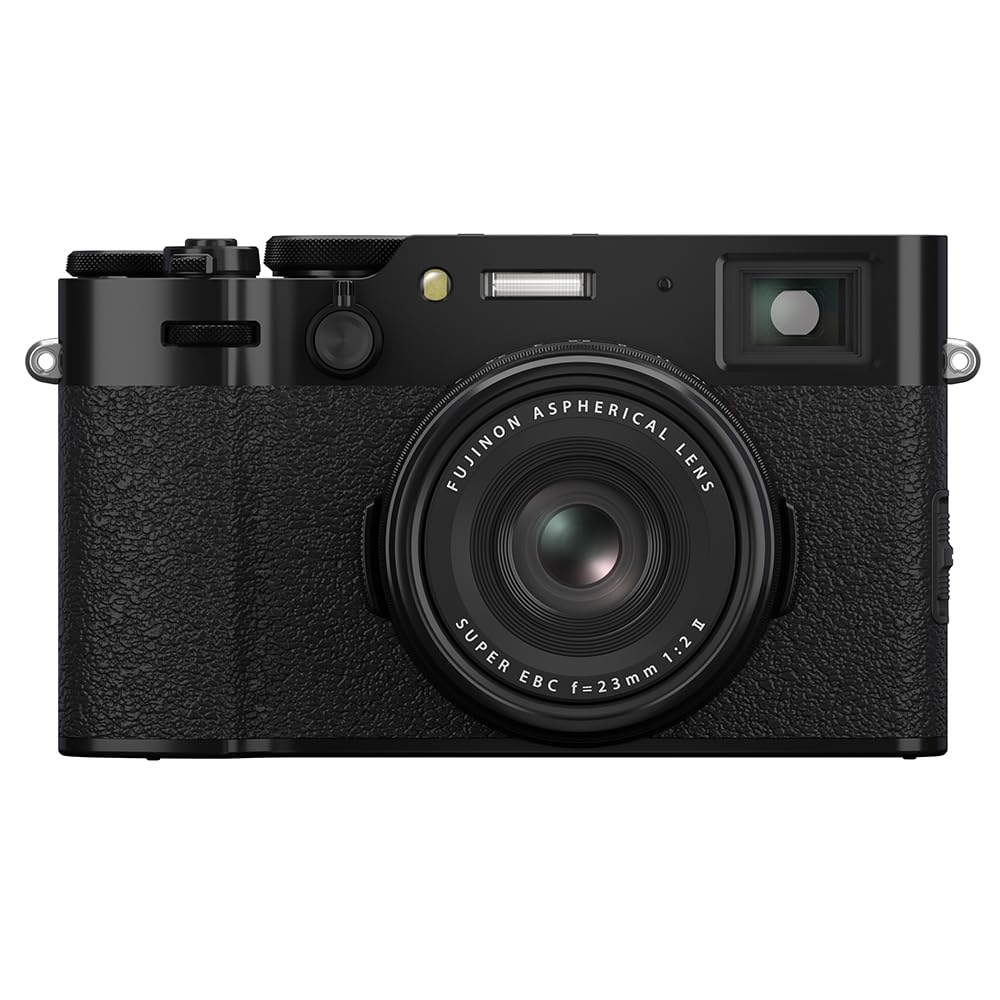
A fixed 23mmF2 lens and 40.2 megapixels — the everyday carry that turns heads and keeps them.
Some cameras are about specs; this one is about the walk. The fixed 23mmF2 lens pairs with a 40.2-megapixel X-Trans CMOS 5 HR sensor built to boost resolution without compromising signal-to-noise ratio, and the two are matched for edge-to-edge sharpness across the frame. A five-axis in-body stabilization system offers up to 6.0 stops of compensation — meaning you can capture sharp images and steady video in far dimmer light than you could handhold without it. A hybrid viewfinder lets you switch between an electronic view (what the sensor sees) and an optical one (which also shows what’s outside the frame), and there are 20 film simulations for an instant Fuji look.
The body is genuinely small, with a two-way tilting 1.62 million dot LCD that stores flat against the back. Owners photograph landscapes, street scenes and journalistic work with it, and the size makes it a natural travel companion. Semi-professional users note a learning curve if you’re used to a different brand’s menu system, and a minor complaint surfaced about the manual focus on one unit. Availability can push the asking price up when demand spikes, so grabbing the whole-black version you ordered matters — one buyer received the black-and-silver variant instead.
The one-lens philosophy: committing to a fixed 23mmF2 means fewer decisions and faster shooting — the classic street photography stance.
Great for: street, travel and documentary shooters who want a high-resolution APS-C body that fits in a coat pocket and looks the part.
Look elsewhere if: you need interchangeable lenses, telephoto reach or the price to stay low during demand peaks.
9. OM SYSTEM OM-5 Mark II Body Silver Compact Light Weight Weather Sealed 4K Video Camera Best for Outdoor Travel
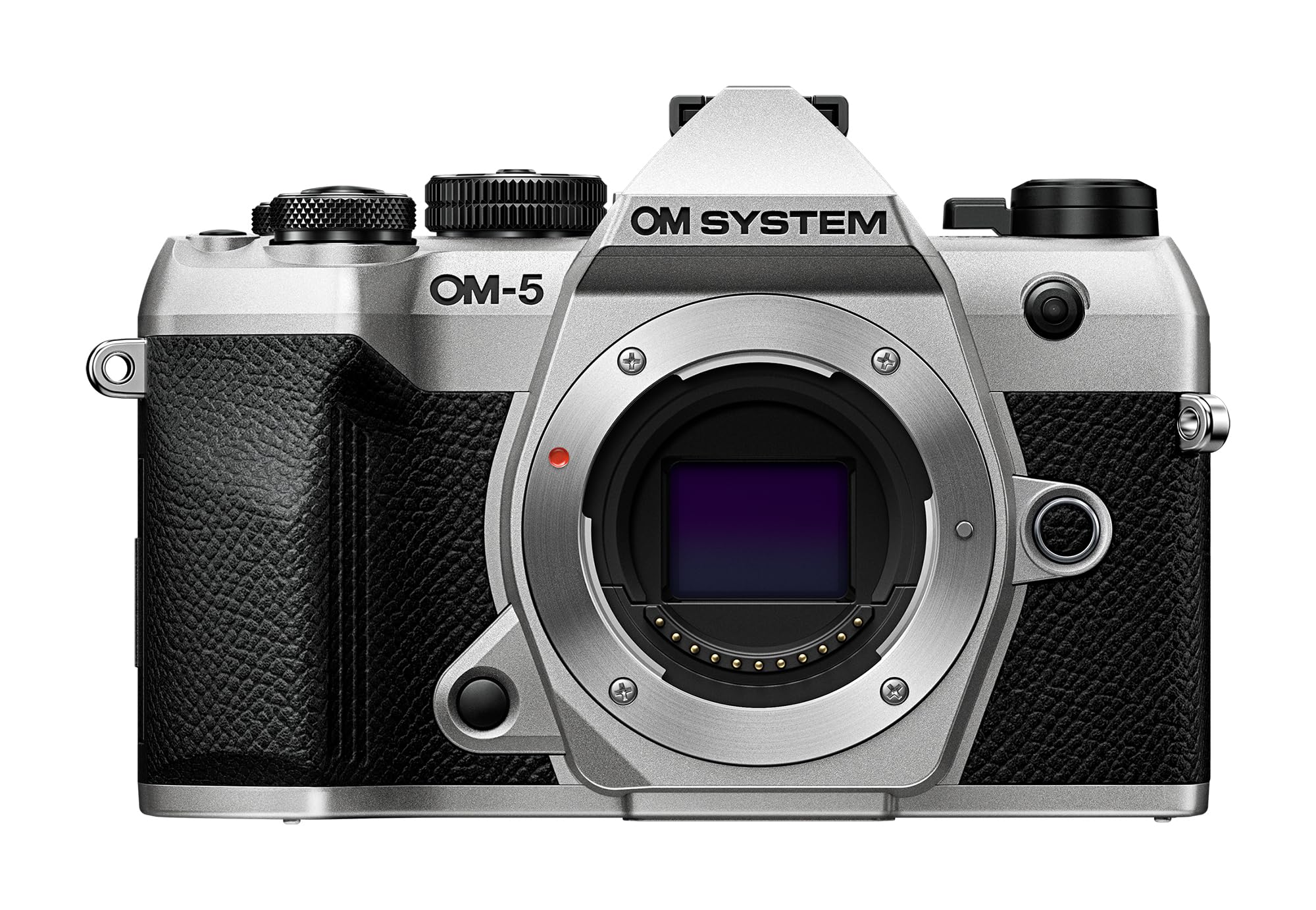
Weather-sealed and light enough to live in a daypack, built for the trail rather than the studio.
If your shooting happens outdoors in uncertain weather, this is the pick to beat. The compact Micro Four Thirds body is weather sealed, runs on a light battery, and uses Micro Four Thirds mount glass — one of the widest lens ecosystems around, and generally lighter on the wallet than full-frame. The 121 autofocus points use both contrast and phase detection for reliable subject acquisition, and continuous shooting reaches 30 frames per second. Unlimited 4K video recording keeps rolling without a clip-length cap, and a dedicated computational photography button puts features like those inspired by nature’s wonders one press away.
Feedback from photographers who have used this line for years is that it is the refined version of what came before: simpler menus, improved stabilization, a better grip, and the new CP button. A professional shooter called it exactly the right tool — small, solid and light enough to carry all day. The 12 Bit image pipeline delivers solid dynamic range for its class.
Two things to know before you buy. Battery life runs to around 300 shots, which is fine for a hike but worth a spare for an all-day trip. And the line has a vocal critic who disputes the image quality and price positioning — a minority view against a strong overall reception, but worth reading reviews from your own genre before committing. Cost-conscious outdoor shooters will find the smaller-sensor sizing hard to argue with.
The travel fit: hikers, backpackers and rain-or-shine shooters who want weather sealing and 4K video in a light Micro Four Thirds body.
Skip if: you need full-frame low-light headroom or you expect a long single-charge battery for continuous all-day shooting.
10. LUMIX ZS99 Point & Shoot Digital Camera for Photography 30x Zoom 4K Video

A pocket zoom that shines in daylight and slips into your jacket.
For a ninth of the focal versatility of a full-frame kit, this camera gives you a 24-720mm LEICA lens with 30x optical zoom in a body small enough to forget you’re carrying it. The 121 autofocus points use hybrid detection for responsive focus, and 12 Bit depth gives the files more editing room than the TZ99’s 10 Bit pipeline. Video handles 4K at 30p, 4K PHOTO bursts at 30fps and HD slow motion at 120fps. A 1,840k-dot tiltable touchscreen lets you frame from any angle, and built-in Bluetooth v5.0 plus a dedicated Send Image button move photos to your phone through the Panasonic Image App. Universal USB Type-C charging keeps the battery topped up with the same cable as your laptop.
The zoom carries the day here — that’s what owners talk about most, alongside the camera’s overall quality. It’s the kind of body that gets taken to concerts and on motorcycle trips because it offers reach a phone cannot. The honest caveats: it lacks an electronic viewfinder, so framing in bright light is tricky, and image quality is good rather than spectacular. The separate Panasonic TZ/ZS99 Black model is the sibling pick — same 30x zoom philosophy, smaller 19-point autofocus system and a 10 Bit pipeline, which makes this Silver body the slightly sharper tool for RAW editing.
Zoom is the feature: 30x optical gets you close to a stage or a distant peak without carrying a bag of lenses.
Grab this for: casual shooters who want travel zoom, 4K video and pocketable size in one small camera.
skip it if: you shoot mostly after dark or frame in bright sunlight, where a built-in viewfinder matters.
11. Panasonic LUMIX TZ/ZS99 Point and Shoot Camera, Compact Camera for Travel with 30x Zoom (Black)

A 30x Leica zoom in a coat pocket, ideal for the seat that’s nowhere near the stage.
If you want the reach of a big camera without the bulk, the 24-720mm LEICA lens with 30x optical zoom (and up to 60x intelligent zoom) is the reason this camera exists. It captures everything from a wide landscape to a close-up of a performer’s face from the back of the room. Video runs 4K at 30p, 4K PHOTO bursts at 30fps and HD slow motion at 120fps. A 1,840k-dot tiltable touchscreen lets you angle the frame overhead in a crowd, and universal USB Type-C charging means you top up with the same cable you carry for everything else. Bluetooth v5.0 plus a dedicated Send Image button push files straight to your phone through the Panasonic Image App.
People praise the zoom and the functionality most, and for a camera this small, the feature set covers a lot of ground. It accepts full manual exposure modes, offers RAW capture and a deep menu for anyone who wants to tweak. The 10 Bit depth gets you solid edits without a fuss. Where the sibling Silver LUMIX ZS99 body has 121 autofocus points, this Black model carries 19 — fewer tracking points, so it leans on your technique, not the camera’s.
On the honest caveats: the user interface draws mixed reactions — some find it intuitive, some find it clumsy — and image quality is good in daylight but softer in low light. It’s a bit heavy for a “pocket” camera, so plan on a jacket or a bag loop rather than a shirt pocket. Buyers report a lightweight 20-megapixel sensor with RAW files that hold detail up to ISO 1600, which is exactly the flexibility a casual travel shooter wants.
Perfect for: concert-goers, travelers and casual shooters who want serious zoom in a small package with easy phone sharing.
Don’t expect: the low-light performance of a full-frame body or an entirely intuitive menu system.
Understanding the Specs
Sensor And Megapixels
Megapixels are the dots of detail the sensor captures — 33MP lets you crop harder and print larger than a 20MP chip. But more important than the number is the physical size of the sensor: a full-frame chip gathers far more light than a compact one, which is why a low-megapixel full-frame body often beats a high-megapixel pocket camera after dark. Match sensor size to where you actually shoot, not to the biggest number on the box.
Autofocus Points And Detection
Autofocus points are the zones the camera checks for focus, and more of them generally mean smoother tracking. What matters just as much is subject detection — whether the camera recognizes a face, an eye, an animal or a vehicle on its own. A body with fewer points but smarter detection can outperform one with a bigger number, so weigh how each camera handles the subjects you actually shoot.
Bit Depth And Video Latitude
Bit depth describes how finely the camera records color — 10 Bit gives you more gradations than 8 Bit, and 14 Bit stills files give you far more room to brighten shadows or recover highlights during editing. If you shoot video and plan to colour grade, a higher bit depth and features like log recording give you more freedom to push the footage without it falling apart.
In-Body Stabilization
In-body image stabilization uses a sensor that shifts to cancel hand shake, letting you hand-hold slower shutter speeds or video without a gimbal. Bodies with strong IBIS are far easier to shoot handheld, especially in low light or at the long end of a zoom. Cameras without it rely on stabilized lenses or a tripod, so check whether the body compensates before you commit.
FAQ
What sensor size is best for an all-around camera?
How many autofocus points do I really need?
Is a full-frame camera worth it for a beginner?
Can a compact travel camera really replace a phone?
Do I need in-body image stabilization for video?
Which camera is best for long video recordings without overheating?
Should I choose a fixed lens or an interchangeable lens camera?
How does bit depth affect video quality?
What does a weather-sealed camera body actually protect against?
Final Thoughts: The Verdict
For most people hunting for the right all around camera, the SONY Cinema Line FX30 is the standout — 495 autofocus points, S-Cinetone color straight out of the camera, and active cooling that keeps long 4K recordings running. If you want a full-frame hybrid that takes your existing Nikon glass, reach for the Nikon Z 6II. And if you want pro-level stills and video in one body without the flagship budget, the Sony Alpha 7 IV is the one to grab. Any of the eleven here will serve you well — the right one depends on whether you shoot in a studio, on a trail, or from the back row of a concert hall.
How We Picked
We do not accept paid placement. Every pick is matched to a real buyer and a real use-case; we do not hands-on test units.
Sources & Methodology
Specifications: manufacturer listings and product documentation. Review insights: verified customer reviews, as of September 2026. Pricing: not shown on this page (it changes often); check the current price via the retailer link.
As an Amazon Associate, Gadgets Feed earns from qualifying purchases. This does not affect which products we feature.