
Stepping up to an 11.2 receiver is the moment your home theater stops being a hobby and becomes a destination. You are no longer building a sound system around a living room compromise — you are wiring a dedicated space where the ceiling has speakers, the subs are matched, and every seat in the house hears the same thunder. The jump from a 7-channel unit to an 11-channel processor changes how you watch movies, because now the overhead layer exists as a true, discrete object-based dome instead of a simulated afterthought.
I’m Min — the co-founder and writer behind Gadgets Feed. I have spent hundreds of hours cross-referencing HDMI 2.1 compliance, DAC architectures, room-correction ecosystems, and real-world power measurements to separate the flagship contenders from the marketing spec sheets.
Whether you are building a dedicated theater room or future-proofing a media space, finding the best 11.2 receiver means balancing channel count with amplifier headroom and room-calibration depth.
How To Choose The Best 11.2 Receiver
An 11.2 receiver is the nerve center of a serious home theater. Before you sort by channel count or wattage, understand what separates a genuine 11-channel amplifier from a processor that requires external amps to reach its full potential.
Channel Configuration vs. Amplification
Not every 11.2-rated unit amplifies all 11 channels internally. Some receivers process 11 channels but only amplify 9 — the remaining two channels require an external stereo amplifier via pre-outs. Check the fine print: if you want a true one-box 7.2.4 setup, you need eleven channels of onboard amplification.
Room Correction Ecosystem
The biggest differentiator at this tier is the room-correction suite. Dirac Live Full Bandwidth offers the most precise phase and impulse correction, especially when paired with Dirac Live Bass Control. Audyssey MultEQ XT32 is effective but less flexible above the Schroeder frequency. YPAO R.S.C. with 3D is Yamaha’s strong suit for multi-point measurements. Your room, your subs, and your budget should dictate which ecosystem you buy into.
HDMI 2.1 Throughput and Gaming Features
All 11.2 receivers shipping now should support 40 Gbps HDMI 2.1 on every input. Verify 4K/120Hz and 8K/60Hz passthrough, plus Variable Refresh Rate (VRR), Auto Low Latency Mode (ALLM), and Quick Frame Transport (QFT). Some earlier 2020-2021 units had HDMI chipset issues — ensure the model you choose has a clean bill of health on third-party retests.
Quick Comparison
On smaller screens, swipe sideways to see the full table.
| Model | Category | Best For | Key Spec | Amazon |
|---|---|---|---|---|
| Onkyo TX-RZ70 | Premium | Best Overall Value | 140W/ch, Dirac Live, ESS Sabre DAC | Amazon |
| Yamaha RX-A8A | Premium | Surround:AI Processing | 11.2-ch, 150W/ch, Auro-3D, XLR | Amazon |
| Marantz SR8015 | Premium | High-Current Class AB | 140W x 11, Audyssey XT32, HEOS | Amazon |
| Sony STRAZ5000ES | Premium | 360 Spatial Sound Mapping | 130W/ch, DCAC IX, Chromecast | Amazon |
| Yamaha RX-A6A | Premium | 9.2-ch with 11.2 Processing | 150W/ch, YPAO R.S.C., MusicCast | Amazon |
| Marantz AV7706 | Premium | Preamp/Processor Only | 11.2-ch preamp, Audyssey XT32, XLR | Amazon |
| Sony STR-AN1000 | Mid-Range | Best Value for 7.2 Setup | 165W/ch (6 ohm), DCAC IX, 8K | Amazon |
| Denon AVR-S970H | Mid-Range | Best for Music + Movies | 90W x 7, Audyssey, Phono Input | Amazon |
| Denon AVR-S770H | Mid-Range | Best for 4K/120 Gaming | 75W x 7, HEOS, Dolby Atmos | Amazon |
| Onkyo TX-NR6100 | Mid-Range | Best THX Entry | 210W/ch (6 ohm), THX Select, 5.2.2 | Amazon |
| OSD Nero XMAX11 | Power Amp | External Amplification | 3x310W + 8x135W, Class AB, XLR | Amazon |
In‑Depth Reviews
1. Onkyo TX-RZ70 11.2-Channel AV Receiver
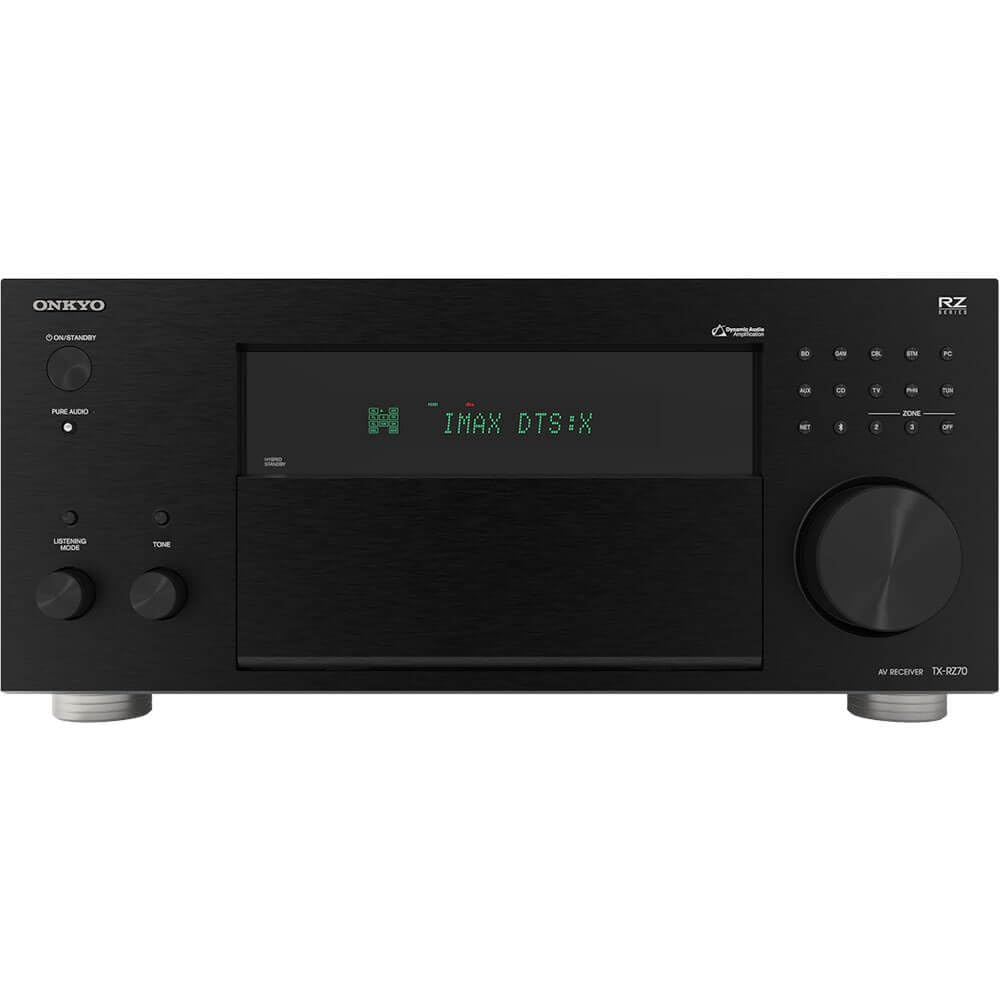
The Onkyo TX-RZ70 delivers 140 watts per channel across all 11 channels from a discrete amplifier section, backed by ESS Sabre DACs that resolve fine micro-detail typical of high-end separates. Out of the box, it includes Dirac Live Full Bandwidth room correction, which is a genuine value that most competitors force you to buy as an add-on. The THX Select certification ensures the preamp-output noise floor stays clean even when driving high-sensitivity reference speakers.
HDMI 2.1 implementation is full-bandwidth 40 Gbps across all inputs, supporting 4K/120Hz and 8K/60Hz without the handshake bugs that plagued earlier Onkyo HDMI boards. Roon Ready certification and dual 12-volt triggers make it a seamless fit for multi-room audio systems. Third-party power bench tests show the unit actually exceeds its 140W rating, delivering around 170W per channel into 8 ohms before clipping.
Klipsch Optimize mode auto-sets crossover values for Klipsch Reference speakers, which streamlines integration if you are using that brand. The physical footprint is substantial at 57.8 pounds and over 22 inches deep, so verify your rack depth before purchasing. The supplied remote feels denser than previous Onkyo wands but still lacks backlighting.
Why it’s great
- Dirac Live Full Bandwidth included, saving + over competitors
- ESS Sabre 32-bit DAC array for high-resolution stereo playback
- True 11-channel amplification at 140W per channel
Good to know
- Extremely large chassis — verify cabinet depth before buying
- Zone2 volume control lacks a numerical on-screen display
- Remote control has no backlighting
2. Yamaha RX-A8A AVENTAGE 11.2-Channel AV Receiver

The Yamaha RX-A8A is a genuine 11.2-channel beast with 150 watts per channel and the full AVENTAGE treatment: an anti-resonance bottom plate, high-quality ESS DACs, and XLR balanced pre-outs. Unlike the RX-A6A which only processes 11 channels but amplifies 9, the A8A amplifies all 11 channels internally, making it a true one-box 7.2.4 solution. Surround:AI uses machine learning to analyze real-time audio scenes and adjust the surround balance — dialogue clarity improves, and action sequences gain weight without manual tweaking.
HDMI 2.1 runs at 40 Gbps across all inputs, with VRR and ALLM support for console gaming. YPAO R.S.C. with 3D and multipoint measurement offers precise EQ tailoring, though some users report it works best when you use a tripod instead of the included cardboard mic stand. The unit also supports Auro-3D upmixing, giving you access to an alternative immersive format that not every 11.2 receiver offers.
MusicCast multi-room integration is solid for streaming, but the app interface has drawn complaints for its unintuitive layout compared to HEOS or AirPlay 2 alone. Reports of HDCP handshake issues after firmware updates exist, though Yamaha has addressed most of these with patches. At 53.85 pounds, this receiver demands a sturdy shelf.
Why it’s great
- Surround:AI analyzes and optimizes sound in real-time per scene
- Full 11-channel amplification with XLR balanced pre-outs
- Supports Dolby Atmos, DTS:X, and Auro-3D
Good to know
- MusicCast app interface is less intuitive than competitors
- Yamaha ended Alexa/Google voice support via firmware, angering some owners
- Chassis is heavy and deep — measure your rack
3. Marantz SR8015 11.2-Channel AV Receiver

The Marantz SR8015 packs 140 watts per channel into all 11 channels using a high-current discrete amplifier layout designed for low-impedance speaker loads. The Audyssey MultEQ XT32 room correction suite includes Sub EQ HT for dual-subwoofer integration and LFC (Low Frequency Containment) to manage bass bleed into other rooms. Owners consistently report that the SR8015 runs cooler than similarly spec’d Denon and Onkyo units due to its oversized heatsinks and toroidal transformer.
HEOS built-in handles multi-room streaming across Denon and Marantz products, with support for Tidal, Spotify Connect, and AirPlay 2. HDMI 2.1 supports 8K/60Hz and 4K/120Hz with the full gaming feature set. The unit also features bi-amping capability for front left and right channels, though note that bi-amping uses two of the surround channels, reducing your effective channel count if you are building a 7.2.4 system.
Critics point out the remote control feels cheap for a flagship that originally launched near — the plastic wand has limited backlighting and button travel. The GUI is functional but dated compared to Sony’s graphical UI. This is a 2020 flagship that remains competitive because its amplifier section genuinely delivers reference-grade current delivery to each channel.
Why it’s great
- High-current discrete amplifier drives 4-ohm loads with authority
- Audyssey MultEQ XT32 with Sub EQ HT for dual subwoofer integration
- HEOS multi-room streaming with broad music service support
Good to know
- Remote control feels cheap and unresponsive
- Bi-amping reduces effective channel count for surround
- No XLR balanced outputs despite premium price point
4. Sony STRAZ5000ES Premium ES 11.2 CH A/V Receiver

Sony’s ES series brings 360 Spatial Sound Mapping to the 11.2 category, creating phantom height and surround speakers that fill gaps in imperfect room geometry. Rated at 130 watts per channel into 8 ohms, the STRAZ5000ES uses Digital Cinema Auto Calibration IX to measure speaker distance, angle, and height, then applies phase matching that creates a soundstage wider than the physical speaker placement. Multiple owners report that a 5.1.2 setup with Dolby Atmos enabled speakers sounds convincingly like true 7.1.4.
HDMI 2.1 support across seven inputs includes 8K/60Hz and 4K/120Hz passthrough. The unit runs Chromecast built-in, Apple AirPlay 2, and Spotify Connect natively. The Works with Sonos certification allows integration into an existing Sonos ecosystem using a Sonos Port. The front-panel cover plate creates a clean, professional look when the display is not needed, and the backlit remote is a welcome upgrade from Sony’s previous plastic remotes.
The unit runs very hot in operation — owners strongly recommend an AC Infinity Aircom T10 top fan to maintain thermal stability. The auto-calibration systems sometimes mis-set speaker distances and subwoofer crossovers, requiring manual verification. This receiver does not support HDR10+, QMS, or QFT, which may matter for future proofing.
Why it’s great
- 360 Spatial Sound Mapping creates phantom height channels effectively
- DCAC IX calibration with phase matching for wider soundstage
- Clean front-panel cover plate with backlit remote
Good to know
- Runs very hot — active cooling is recommended
- Auto-calibration often needs manual distance correction
- No HDR10+ or QFT support
5. Yamaha RX-A6A AVENTAGE 9.2-Channel AV Receiver

The Yamaha RX-A6A processes up to 11.2 channels but internally amplifies only 9 channels at 150 watts each. This means achieving a true 7.2.4 setup requires adding a two-channel external amplifier for the rear height channels via the pre-outs. The upside is access to the full AVENTAGE platform: Surround:AI, YPAO R.S.C. with 3D multipoint measurement, and Auro-3D decoding.
HDMI connectivity includes 7 inputs and 3 outputs, all running 40 Gbps HDMI 2.1 with 8K/60Hz and 4K/120Hz passthrough. ALLM and VRR support covers next-gen gaming. MusicCast handles multi-room streaming across 20+ zones, though the app’s interface has been criticized for being less refined than HEOS. Owners praise the DSP modes for music, which add spatial effects without distorting the original mix.
The RX-A6A lacks a front-panel display and browser-based management, forcing reliance on the smartphone app for deeper settings. Some units shipped with HDCP handshake issues that required firmware updates to resolve. For buyers who plan to operate in a 5.1.2 or 5.2.2 configuration, the internal 9 channels are sufficient — the 11.2 processing headroom offers future upgrade flexibility without buying a new receiver.
Why it’s great
- 11.2 channel processing with future upgrade path to 7.2.4
- Surround:AI real-time optimization and Auro-3D support
- All HDMI inputs support 40 Gbps 8K/4K120
Good to know
- Only amplifies 9 channels internally — external amp required for 11
- No front-panel display or browser-based management
- MusicCast app interface lags behind HEOS and AirPlay
6. Marantz AV7706 11.2Ch 8K AV Surround Pre-Amplifier

The Marantz AV7706 is a pure preamp/processor with zero internal amplification — it is designed for buyers who already own or plan to purchase separate power amplifiers. This removes the heat and power supply compromises inherent in AVR designs, allowing the processor to focus entirely on DAC performance and room correction. The unit features Audyssey MultEQ XT32 with the full Platinum suite including Sub EQ HT and LFC.
HDMI 2.1 inputs support 8K/60Hz and 4K/120Hz with HDR10+, Dolby Vision, HLG, and Dynamic HDR passthrough. eARC handles lossless audio return from your TV. XLR balanced outputs are included for the main left/right channels, offering clean signal transmission over long cable runs to external amplifiers. The HEOS ecosystem enables multi-room streaming across Marantz and Denon components.
The AV7706 delivers noticeably improved picture clarity over its predecessor, the AV7704, according to owners who upgraded. Audyssey calibration via the app provides detailed control over target curves and frequency-dependent compression. The unit is large and requires careful ventilation, but since it generates less heat than AVRs, it can live in tighter cabinets. No printed manual is included, which frustrates some owners who prefer physical documentation.
Why it’s great
- Pure preamp/processor design eliminates amplifier heat and compromises
- Full Audyssey MultEQ XT32 Platinum suite with Sub EQ HT
- XLR balanced outputs for clean long-distance signal transmission
Good to know
- Requires separate power amplifiers — not a one-box solution
- No printed manual included
- Marantz Smart Select features are locked to input sets, not programmable per source
7. Sony STR-AN1000 7.2 CH Surround Sound 8K A/V Receiver

The Sony STR-AN1000 is the most affordable entry point into Sony’s 2023-2024 platform that supports 8K/4K120 and DCAC IX calibration. At 7.2 channels with 165 watts per channel into 6 ohms, it is not an 11.2 receiver itself, but it feeds into the same 360 Spatial Sound Mapping ecosystem as the flagship ES models. This makes it a strong candidate for buyers building a 5.1.2 or 7.1 system who want Sony’s immersive audio algorithm without the flagship price.
DCAC IX calibrates speaker distance, angle, and height to create a coherent sound bubble. The Works with Sonos integration allows the STR-AN1000 to join an existing Sonos network as a grouped zone. Chromecast built-in, AirPlay 2, and Spotify Connect cover streaming, while Google Assistant enables hands-free control. Six HDMI inputs (two 8K-capable) and two outputs support eARC.
A known quirk: the STR-AN1000 does not pass Dolby Vision from an Apple TV 4K through the receiver — instead, the Apple TV must connect directly to the TV, using eARC to return audio. The front display is small and hard to read from a seating position. The unit lacks a phono input, so vinyl listeners need an external preamp. For the price, the core sound quality and calibration technology are genuinely impressive.
Why it’s great
- 360 Spatial Sound Mapping and DCAC IX calibration at a mid-range price
- Works with Sonos for ecosystem integration
- 8K/4K120 HDMI 2.1 with eARC and Chromecast built-in
Good to know
- Dolby Vision passthrough does not work with Apple TV 4K
- Small, hard-to-read front display
- No phono input for turntable users
8. Denon AVR-S970H 8K Ultra HD 7.2 Channel AV Receiver

The Denon AVR-S970H delivers 90 watts per channel across 7 channels, making it a strong choice for music-focused listeners who want a phono input for turntable integration. The unit supports 8K/60Hz and 4K/120Hz passthrough with VRR, ALLM, QFT for gaming. HEOS multi-room streaming provides access to Tidal, Spotify, and Amazon Music HD. Audyssey MultEQ handles room calibration for the main listening position.
Powered Zone 2 uses the rear surround speaker connections, which means running a 5.1 main zone plus a stereo Zone 2 drops the surround system to 5.1. The onboard phono stage eliminates the need for an external preamp for most moving-magnet turntables. Owners report the receiver runs cooler than comparable Onkyo units, measuring around 80°F during normal operation versus 90-92°F.
The remote lacks a programmable TV power button, which means you may need two remotes unless you use HDMI-CEC. FM tuner preset programming is cumbersome, with many stations pre-loaded above 92.1 MHz. The onscreen setup is intuitive with video guides and smartphone app support. For a music-first theater where vinyl is part of the mix, this is the best-priced entry point for 8K readiness.
Why it’s great
- Built-in phono stage for turntable integration without extra gear
- HEOS multi-room streaming with broad service support
- Runs cooler than many competitors at similar power levels
Good to know
- Powered Zone 2 reduces main zone to 5 channels
- Remote lacks programmable TV button
- FM tuner preset interface is clumsy
9. Denon AVR-S770H 7.2 Ch Home Theater Receiver

The Denon AVR-S770H is the most affordable Denon receiver to support 4K/120Hz and 8K/60Hz passthrough with VRR, ALLM, and QFT — the full HDMI 2.1 gaming suite. At 75 watts per channel across 7 channels, it is not a high-current monster, but it comfortably drives a 5.1.2 Atmos setup for gaming. The HEOS platform integrates with Alexa for hands-free volume and input switching.
Dolby Height Virtualization and DTS Virtual:X can simulate overhead sound without physical height speakers, which is useful for rooms where ceiling installation is impractical. Owners report excellent integration with PS5 and Xbox Series X, with no handshake issues or frame-sync problems. The onscreen setup assistant walks through each connection step, making this one of the easiest receivers to deploy for first-time AVR buyers.
Some firmware versions have experienced random volume drops to zero and startup picture loss requiring power cycling. The advanced menu system is deep and not particularly intuitive, requiring time to master. For a pure gaming-focused 7.2 system on a budget, the HDMI 2.1 reliability here beats similarly priced alternatives from other brands.
Why it’s great
- Full HDMI 2.1 gaming feature set at a budget-friendly price point
- Dolby Height Virtualization creates phantom overhead channels
- Straightforward onscreen setup assistant for beginners
Good to know
- Some units experience volume drop and startup picture issues
- Advanced menu is deep and unintuitive
- Limited to 75W per channel — not for power-hungry speakers
10. Onkyo TX-NR6100 7.2 Channel THX Certified AV Receiver
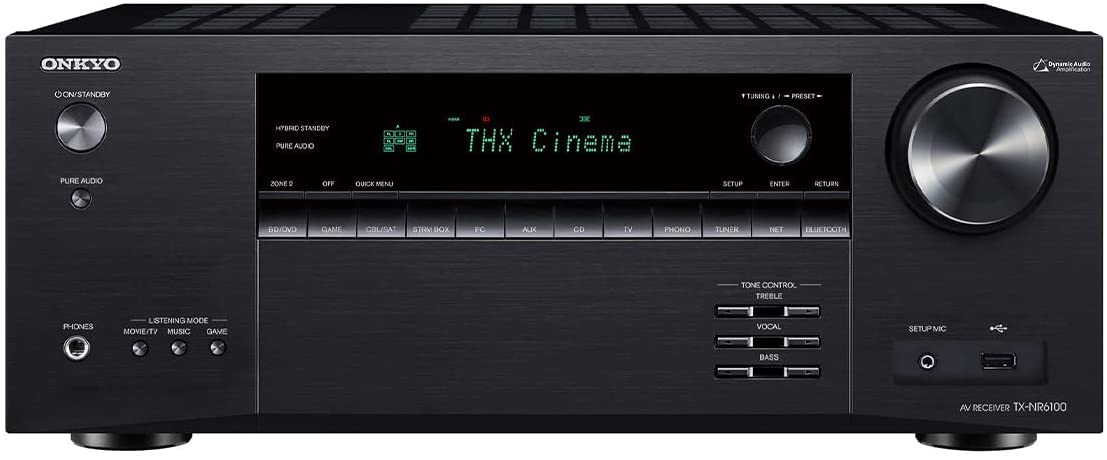
The Onkyo TX-NR6100 brings THX Select certification and 210 watts per channel into 6 ohms to the entry-level 7.2 category. This means it meets THX’s reference-level requirements for speaker impedance matching and noise floor in a medium-sized room. It supports 5.2.2 Dolby Atmos and DTS:X playback with three HDMI 2.1 inputs running 8K/60Hz at 40 Gbps.
Discrete Zone 2 audio and video allows independent content playback in a second room. Owners running Klipsch systems report the 6100 drives a 5.1 setup with authority, and the THX/IMAX Enhanced modes produce clear channel definition with crisp HDR passthrough. The unit is fully compatible with PS5 and Xbox Series X at 4K/120Hz.
Bi-amping the front channels consumes two surround channels, reducing the system to 5.1. Some HDMI 2.1 boards from the initial production run had a known processor issue causing long input delays and video flickering — later firmware updates addressed most of these, but some units still exhibit problems. The remote lacks backlighting, and only three of the six HDMI inputs support the full 40 Gbps bandwidth.
Why it’s great
- THX Select certification guarantees reference-grade noise and impedance handling
- Three 40 Gbps HDMI 2.1 inputs for gaming at 4K/120Hz
- Discrete Zone 2 with independent audio and video source
Good to know
- Some HDMI 2.1 processor issues reported in early production units
- Only 3 of 6 HDMI inputs are full 40 Gbps
- Bi-amping reduces surround system to 5.1 channels
11. OSD Audio Nero XMAX11 Class A/B 11-Ch Home Theater Amplifier

The OSD Audio Nero XMAX11 is not an AVR — it is a dedicated 11-channel power amplifier designed to partner with a separate processor. It delivers 3 channels at 310 watts and 8 channels at 135 watts into 4 ohms, all channels driven simultaneously, with less than 1% THD. The power plant uses dual 2.3KVA toroidal transformers and a capacitor bank of 3 x 4000µF plus 8 x 2000µF for instantaneous current delivery.
Class A/B topology ensures linear, low-distortion performance across the entire 5Hz to 50kHz frequency range, making it suitable for both subsonic tactile bass and high-frequency air. XLR and RCA inputs are available for each channel, giving flexibility to connect with any processor. The amplifier runs surprisingly cool due to its generous heatsinking, and the build quality is tank-like at well over 60 pounds.
This amplifier delivers the power reserve that no AVR’s internal amps can match — if you want reference-level output with dynamic headroom for demanding speaker loads, the XMAX11 is the muscle your 11.2 processor needs. The 5-year warranty provides long-term peace of mind. Note that the amplifier does not handle any processing, HDMI switching, or streaming — it is purely a power delivery machine.
Why it’s great
- Massive power delivery: 310W to LCR channels, 135W to surrounds/height
- Class A/B topology with dual toroidal transformers for clean current
- XLR and RCA inputs per channel for flexible system integration
Good to know
- No processing or streaming — requires a separate preamp/processor
- Very heavy (over 60 pounds) — two-person installation recommended
- High price point justified primarily for reference-level dynamics
FAQ
Do I need 11 channels or is 7 enough for a dedicated theater room?
What is the difference between processing 11 channels and amplifying 11 channels?
Will an 11.2 receiver improve sound quality with a 5.1 speaker setup?
Which room correction system handles dual subwoofers best?
Final Thoughts: The Verdict
For most buyers looking for the best 11.2 receiver, the clear winner is the Onkyo TX-RZ70 because it combines Dirac Live Full Bandwidth, ESS Sabre DACs, and full 11-channel amplification at a price point that undercuts competitors while exceeding them in measured power output. If Surround:AI real-time scene analysis and Auro-3D support matter most, grab the Yamaha RX-A8A. And for a pure separates system where ultimate power delivery is the goal, nothing beats the OSD Audio Nero XMAX11 paired with your processor of choice.