
Our readers keep the lights on and my morning glass full of iced black tea. As an Amazon Associate, I earn from qualifying purchases.
Specs are compiled from manufacturer listings and verified buyer reviews and can change over time — please confirm the key details on the product page before buying.
If you are running cable outdoors, underground, or out to a hot tub or EV charger, the part that decides whether the job survives is the 1 1/2 PVC conduit you bury it in. Get the size right and the wire slides in, the fittings seal, and the run sits there quietly for years. Get it wrong and you are fighting a coil that will not straighten while water finds the one gap you missed.
I’m Min — the founder and writer behind Gadgets Feed. This guide is built by comparing the manufacturers’ published specifications and the patterns across verified customer reviews, so you get each pick’s real strengths and trade-offs instead of marketing spin.
Every option below is a real 1-1/2 inch trade size flexible non-metallic liquid-tight conduit. Each one is judged on what matters at the trench: wall thickness you can measure, outside diameter that must match your fittings, and whether owners actually got the wire through. That is what separates a smooth install from a weekend of swearing at 1 1/2 pvc conduit.
Our Picks at a Glance


How To Choose The Best 1 1/2 PVC Conduit
Three numbers decide whether your install goes smoothly: the trade size, the actual outside diameter, and the wall thickness. Everything else is fittings and convenience.
Trade size is not the diameter you will measure
Trade size is a naming standard, not a tape-measure reading. A 1-1/2 inch conduit measures roughly 1.87 to 1.88 inches across the outside of the tube. If you order fittings expecting a true 1.5 inch tube, nothing will seat.
Wall thickness matters just as much. A nominal wall thickness of 0.099 inches is a thinner tube than one at 0.315 inches. The thin one bends more easily but crushes more easily too.
How the inside of the tube decides your afternoon
A smooth virgin PVC interior with no burrs lets wire slide through without snagging. A sticky or inconsistent interior means you are buying wire lube and a fish tape before you have pulled the first foot.
This is the single most common frustration in these reviews, so treat it as the deciding factor between two otherwise similar rolls.
25 feet or 50 feet
Short runs — an AC disconnect, a mini-split, a single outdoor outlet — rarely need more than 25 feet. Longer runs to a subpanel, a camper pedestal, or a gate opener usually want the 50 foot roll so you are not splicing mid-trench.
Kitted versions bundle straight and 90-degree fittings, which saves a second trip to the hardware store. Buy the length your run actually needs and check whether fittings are included before you add them to the cart separately.
Quick Comparison
| Model | Best For | Length | Outside Diameter | Wall Thickness | Amazon |
|---|---|---|---|---|---|
| Sealproof Type B (1-1/2″ x 50 FT)★ Best Overall | Long buried runs | 50 feet | 1.5 inches | 0.099 inches | Amazon |
| DWALE Liquid-Tight KitMost Complete Kit | Mini-split and AC hookups | 25 feet | 1.87 inches | 2.5 millimeters | Amazon |
| AISIMEE Liquid Tight 1-1/2″ | EV charger wiring | 25 feet | 1.87 inches | — | Amazon |
| Elecoman 1-1/2″ Kit | Residential or commercial jobs | 25 feet | 1.87 inches | 0.31 inches | Amazon |
| Sealproof 1-1/2″ Kit | First-time buyers wanting a USA-made kit | 25 feet | 1.88 inches | 0.315 inches | Amazon |
| Feotech 1 1/2″ 50 FT | Garage and outdoor reels | 50 feet | 1.5 inches | — | Amazon |
| Wocloer 1-1/2″ 50 FT Kit | Generator and camper feeds | 50 feet | 1.5 inches | — | Amazon |
In‑Depth Reviews
1. Sealproof Flexible Non-Metallic Liquid-Tight Electrical Conduit Type B, UL Listed (1-1/2 Inch x 50 FT)
Our pick — over 4.5★ from 950+ verified ratings; the strongest balance of quality and price.
A 50-foot certified roll built for trenches, hot tubs, and anything else you bury.
This is the roll for anyone running wire somewhere it will stay for a decade — underground, under a slab edge, or straight into an outdoor panel. You get 50 feet of 1-1/2 inch trade size flexible non-metallic tubing that resists corrosion, abrasion, oil, water, acid, and metal shavings, and it is rated for direct burial and sunlight exposure. That combination is exactly what makes it the pick that holds up where cheap conduit fails.
Two certifications do the heavy lifting here. It is UL Listed under file E-129973, with a UL rating of 80°C dry, 60°C wet, and 70°C oil resistant. It is also CSA Certified (Canadian Standards Association) under file LL-84705, rated -18°C to 75°C. In plain terms: run it through a hot attic, a wet trench, or a cold snap, and the tubing is certified to keep its shape and its seal.
Where it beats the DWALE kit above is length. At 50 feet it is not a short-run product, and it double-checks the length the DWALE kit covers twice over. The catch that shows up repeatedly is the pull — a smooth virgin PVC interior is meant to let conductors glide, but owners still find long wire pulls genuinely hard work. The fix is a fish tape and patience, not a different product. People running 10-gauge wire on a long buried run have said so directly: as buyers report, “My needs were 10 gage wire on 75’ run buried 24 inches underground.”
What earns the number-one spot
- 50 feet of continuous 1-1/2 inch conduit in one roll
- UL Listed (E-129973) and CSA Certified (LL-84705)
- Direct burial and sunlight resistant rated
- Roughly half the weight of metallic conduit of the same size
What to plan around
- Long wire pulls are slow going without a fish tape
- No connector fittings in the box — Sealproof straight or right-angle connectors are sold separately
- It is 50 feet, so short jobs leave you with a lot of spare coil
Buy this one if: your run is long, buried, or outdoors, and you want the certification paperwork to match the job.
Look elsewhere if: you only need a short interior connection — you would be paying for 50 feet and fittings you never open.
2. DWALE Liquid-Tight Conduit and Connector Kit, 1-1/2inch 25ft
Everything for a mini-split or AC disconnect lands in one box.
If your job is a single outdoor unit — a mini-split, a condenser, a disconnect box — this is the kit shaped for it. The roll is 25 feet of 1-1/2 inch flexible non-metallic liquid-tight conduit with a 2.5 millimeter nominal wall and a 1.87 inch outside diameter. Toss in four straight and three 90-degree connectors and a single person can finish the hookup in a few minutes.
Like the Sealproof above, it resists corrosion, abrasion, oil, water, acid, and metal shavings, is rated for sunlight and direct burial, and weighs roughly half as much as metallic conduit. What it does not have is Sealproof’s certification listing, and that matters if your inspector wants to see a UL or CSA mark.
The honest trade-offs sit in the fittings and the wire path. The connections are tight enough to survive weather — owners mention they “Survived 10hrs rain post-install with no leaks” — but the interior has a sticky, rubbery feel that grabs cable after the first few feet. So a fish tape (a flexible rod for pulling wire) or wire lube earns its place in the toolbox. The recurring note is that connectors seat perfectly on factory-cut ends and fight you on cut ends; a little warmth and lube smooths that out.
What buyers keep coming back to: the package deal. One box, one order, no hunting for a matching connector while the conduit sits coiled on the porch.
The trade-off to know before you cut: this is the longer roll — the DWALE kit doubles the length of the 25 foot AISIMEE kit below. That means more spare coil if your run is short, and a nastier pull if you let it tangle before you tape the end.
Reach for this if: you want a mini-split or AC job done in one trip with fittings already in the box.
Pass it by if: your inspector needs a stamped UL or CSA listing on the conduit itself.
3. AISIMEE Liquid Tight Conduit 1-1/2inch 25FT with 5 Straight and 3 90-Degree Fittings

The one people keep buying for a charger that lives on the garage wall.
Feed it 6AWG wire (a thick cable for heavy loads) and it holds. That is the practical summary of this 25 foot roll, which carries a 1.87 inch outside diameter and ships with five straight and three 90-degree connectors. Customers note it “fits well on a 6AWG wire that I installed for a EV wall charger” — a real-world size test that matters more than any spec sheet when you are routing heavy charger cable around a corner.
The tube is high-quality virgin PVC with a smooth bore and no sharp edges or burrs, so tight bends do not saw into conductor insulation. It resists corrosion, abrasion, oil, water, acid, and metal shavings, and it is rated for sunlight and direct burial. It is also about half the weight of a metallic conduit of the same size, which makes a two-storey wall run far less miserable.
Where it sits differently from the DWALE kit above: this one is stiffer on purpose. The trade is that it holds shape around a bend instead of flopping, at the cost of needing more muscle to route. That stiffness is the honest limit — people running this at an outdoor kitchen and around an EV charger like it fine, but it is not the tube for a tight, twisty snake through finished walls.
The deciding detail: five straight connectors is more than most of the competing kits ship, so a run with several junction points never leaves you short.
Where it falls short: no UL or CSA listing appears in its published specs, and if your code check hinges on that paperwork, plan accordingly.
Suits you when: you are wiring a wall-mounted EV charger or a single outdoor kitchen appliance and want the fittings to arrive with the tube.
Think twice when: the run snakes through tight interior framing — a stiffer conduit fights those turns.
4. Elecoman 1-1/2 (1.5) 25ft Liquid-Tight Conduit and Connector Kit

The kit that tells you the real measurements before you order, instead of after.
Conduit sizing trips up more first-time buyers than any other detail, and this is the one option that spells it out up front. The listing warns that 1-1/2 inch refers to the U.S. electrical conduit trade size and not the actual outside diameter — the real OD is roughly 1.88 to 1.89 inches, and the real inside diameter is roughly 1.61 inches. Measure once, order once.
The tube itself is a 25 foot roll with a 0.31 inch nominal wall, made from non-metallic PVC with a smooth interior and no burrs, and it ships with five straight and three 90-degree connectors. It resists corrosion, abrasion, oil, water, acid, and metal shavings, and it is rated for sunlight and direct burial.
Where it lines up with the Sealproof 50 footer above is wall thickness — 0.31 inches against 0.099 inches is a meaningfully beefier tube, and owners notice the difference in how much it resists crushing. The cost of that thickness is flexibility, and that is where the gripes land: this conduit is stiff, and cold weather makes it stiffer. Cut ends are also fussier than factory ends when you fit the connectors.
The standout for careful buyers: published real-world dimensions on the product page, so you know what you are drilling for before the box arrives.
The honest catch: connectors over-tighten easily and the tube does not want to straighten out of the coil, so give yourself a warm day or a heat source for the tight bends.
Works best if: you are ordering from a job site or a phone and need to know the true diameter before you commit.
Skip the tight-bend jobs: its stiffness makes it a poor match for snaking through finished walls.
5. Sealproof 1-1/2 Inch Non-metallic Liquid-Tight Conduit and Connector Kit, 25 Foot Made in USA

Domestic-made, certified, and bundled with the fittings you would otherwise chase down.
Buyers who specifically want American-made conduit keep landing here, and it is easy to see why the heavy version of the same brand earns the top pick. This is a 25 foot roll of 1-1/2 inch flexible PVC conduit with a 0.315 inch nominal wall, a 1.88 inch outside diameter, and four straight plus two 90-degree connectors in the box.
The certification is the headline: UL Listed under file E-129973 with an 80°C dry, 60°C wet, and 70°C oil resistant rating, plus CSA Certification under file LL-84705 rated -18°C to 75°C. That is the same paperwork the 50 foot Sealproof above carries, which puts this kit in a different class from the unbranded rolls when an inspector is standing in your yard.
The complaint is the coil. It arrives wound tight, and reviewers point out the conduit holds that memory for a while — going so far as to note that a heat gun will not straighten it out. The wall thickness that makes it crush-resistant is also what makes it stubborn at the bends. Plan for it, and it is a non-issue; fight it with brute force, and it will fight back.
What buyers call out: the material quality. “Thicker than the other ones that I bought from China,” one owner put it, adding that it carried no plastic smell — a small detail that matters when the conduit is going into a living space or a garage you use daily.
Worth knowing: it is a 25 foot kit, so a long underground run needs a splice or a second roll.
The fit here is: American-made, certified, kit-included — the safe pick for an exterior outlet, an RV pedestal, or anything an inspector will look at.
Not the fit if: you need the run in one piece longer than 25 feet.
6. Feotech 1 1/2 Inch Flexible Conduit 50 FT Non Metallic Liquid-Tight Conduit
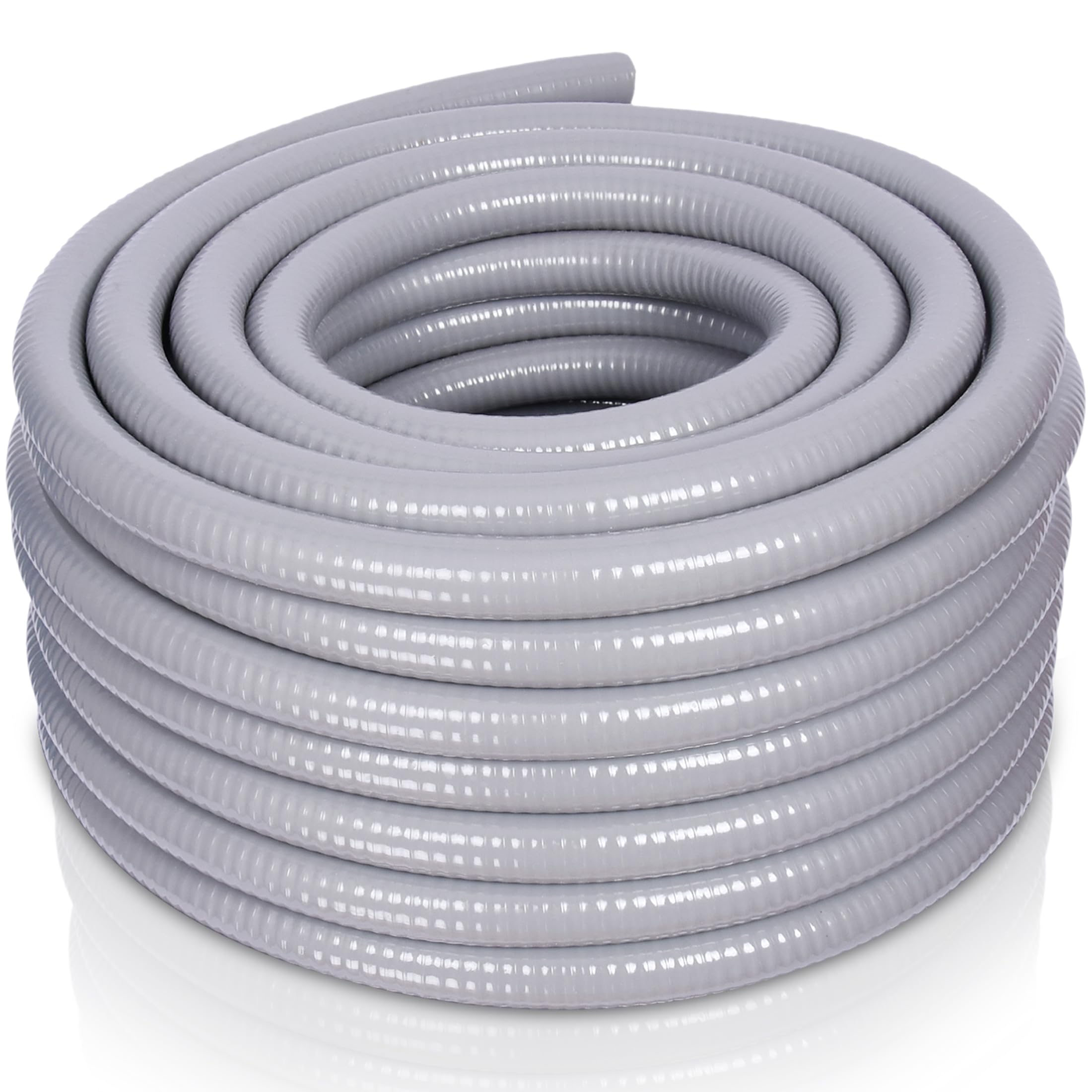
A 50 foot smooth-bore roll for garages, reels, and long outdoor runs.
When the run is long, a smooth interior is what saves your afternoon. This roll is 50 feet of 1-1/2 inch flexible non-metallic liquid-tight conduit at a 1.5 inch outside diameter, made from virgin PVC with a bore that is finished smooth with no sharp edges or burrs. Owners running heavy wire report that it manages bulky bundles that would stall a rougher tube, and the fittings lock down tight for a clean finish.
It resists corrosion, oil, and water, and it stays flexible enough to route around corners, walls, and surfaces without collapsing. It is lightweight for its length, which makes handling a 50 foot coil far less of a wrestling match.
The honest limit is its construction. The published material is listed as metal, and the product is described as light-duty outdoor protection for cabling — in the same territory as the underside of a soffit or a garage fixture, less so for a hard-packed industrial trench.
What people appreciate: genuine one-person installation. No second set of hands, no special tools — cut to length, push onto the ferrule, tighten the sealing nut.
The caveat: the 50 foot length is a commitment, so measure your run before you order.
Pick it for: garage wiring, outdoor fixtures, and long reels where you do not want to splice conduit mid-run.
Sidestep it for: heavy industrial burial where a beefier tube and a certification stamp make more sense.
7. Wocloer 1-1/2 inch 50 Foot Liquid-Tight Conduit Kit
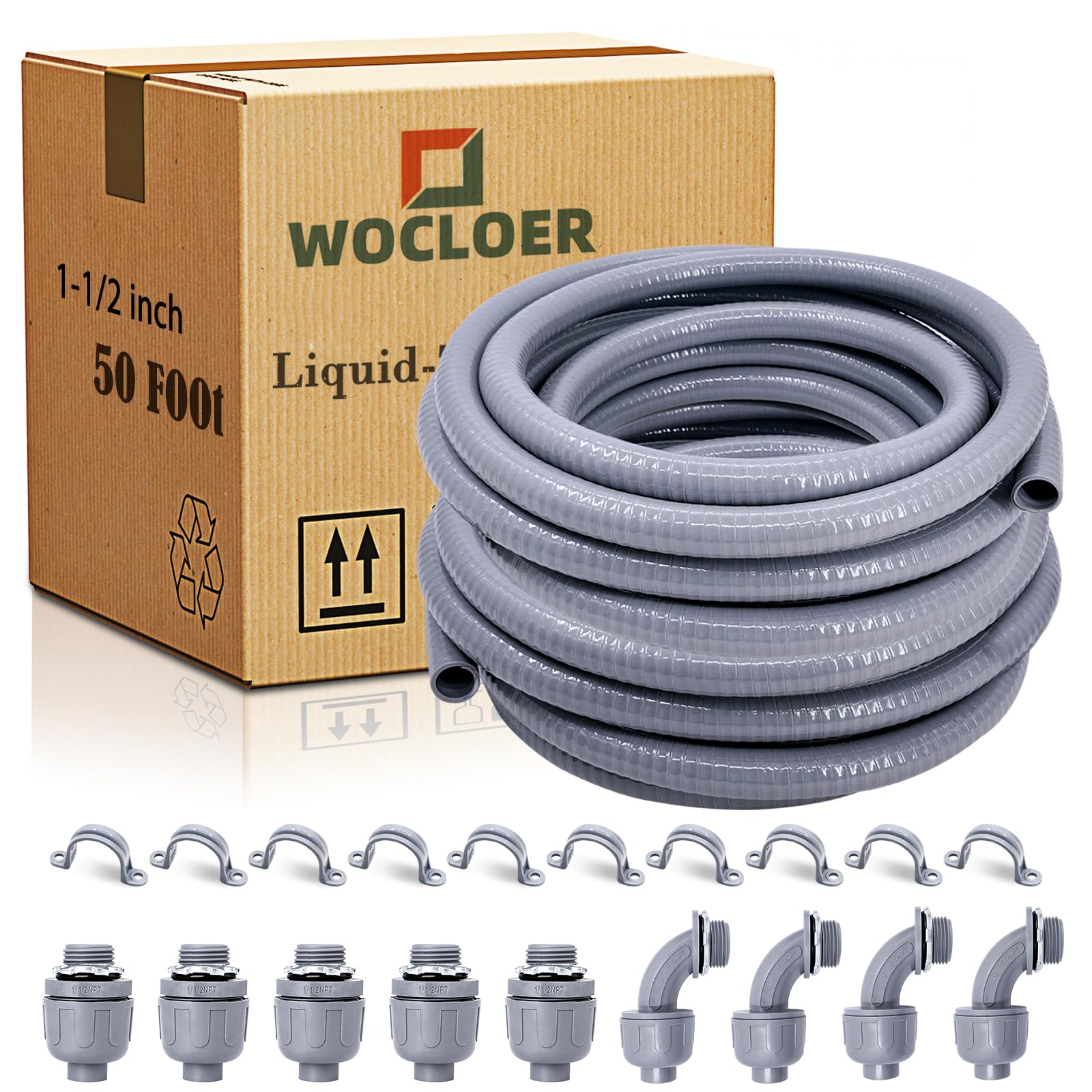
Fifty feet, five straight fittings, four angles, and ten straps in the same box.
Generator feeds, camper power runs, breaker panel connections — these are the jobs where missing a single strap sends you back to the store mid-install. This kit covers the whole set: 50 feet of 1-1/2 inch trade size flexible non-metallic conduit, five straight connectors, four 90-degree connectors, and ten pipe straps. Everything in the box at once.
The tube is high-quality anti-oxidation PVC with corrosion, wear, oil, water, and acid resistance, plus enough tensile and crush strength to handle pulling and squeezing. It cuts to length with a utility knife or PVC cutter, and installation is push-onto-ferrule and tighten — no disassembly, no threading.
What is the catch? The same as most of the 50 foot rolls: length. If your run is short, you are storing a lot of coil, and the fittings kit includes more pieces than a simple run needs. The upside is that the extra connectors are not wasted — they come in handy on the next project.
Where it stands out: the accessories count. Ten straps and a mix of straight and 90-degree connectors is a complete mounting and termination set for a long run.
Where it needs a plan: if you cut the tube for a partial run, save the extra fittings and clamps — this kit covers a longer project than most.
The right call if: your run includes several turns and you want the fasteners included instead of adding them one at a time.
Not for you if: your job is a single short connection — you would open five fittings and use one.
Understanding the Specs
Trade size versus actual diameter
Trade size is a naming convention from the electrical trade, not a measurement you can confirm with a tape. A 1-1/2 inch conduit measures around 1.87 to 1.88 inches across the outside, and the interior is roughly 1.61 inches on the kits that publish it. Order fittings by the actual outside diameter, not the trade size label.
Wall thickness and the flexibility trade
Nominal wall thickness is how thick the PVC skin is. A thinner wall like 0.099 inches bends easily but crushes more easily too. A thicker wall like 0.31 or 0.315 inches resists crushing and holds its shape around a bend, at the cost of needing more force to route through tight turns.
What “liquid-tight” actually seals
A liquid-tight conduit keeps water and oil out where the fittings connect, not just along the tube. That is why the connectors matter as much as the roll, and why owners who report their fittings seal tight also report surviving rainy installs, while looser connections draw complaints.
Certifications and temperature ratings
UL Listed and CSA Certified marks tell you the tubing met a published safety standard. A rating like 80°C dry, 60°C wet, and 70°C oil resistant means the conduit is certified across those conditions. If your installation will be inspected, this mark decides whether the roll is acceptable.
FAQ
Is 1-1/2 inch the actual outside diameter of the conduit?
Can I bury 1-1/2 inch liquid-tight conduit directly underground?
What size wire fits inside 1-1/2 inch flexible conduit?
Why is pulling wire through flexible conduit so hard?
Do I need UL or CSA certification on the conduit?
Can I use 1-1/2 inch conduit for a mini-split air conditioner?
How long does flexible PVC conduit last outdoors?
Can I cut 1-1/2 inch conduit with a utility knife?
What is the difference between a conduit roll and a conduit kit?
Does the wall thickness of the conduit matter for my project?
Final Thoughts: The Verdict
For most jobs, the winner is the Sealproof Type B 1-1/2 inch x 50 FT, because it pairs 50 continuous feet with UL and CSA certification (safety standards) and a direct burial rating — the combination that survives an inspector’s visit and a decade underground. If you want a kit with fittings in the box for a mini-split or AC hookup, grab the DWALE Liquid-Tight Conduit and Connector Kit. And for a wall-mounted EV charger where 6AWG has to make the turn, the AISIMEE Liquid Tight Conduit 1-1/2inch 25FT is the one to reach for.
One last note: check the actual outside diameter on your fittings before you commit, and consider whether a fish tape belongs on the same order — most of these rolls pull easier with one.
How We Picked
We do not accept paid placement. Every pick is matched to a real buyer and a real use-case; we do not hands-on test units.
Sources & Methodology
Specifications: manufacturer listings and product documentation. Review insights: verified customer reviews, as of September 2026. Pricing: not shown on this page (it changes often); check the current price via the retailer link.
As an Amazon Associate, Gadgets Feed earns from qualifying purchases. This does not affect which products we feature.