
The difference between a standard front-facing projector and a 360-degree projector is the difference between watching a movie on a wall and being inside the projection. True 360-degree projectors — or projectors with 360° gimbal stands or 360° projection orientation capability — let you throw an image onto any surface, including the ceiling above your bed or all four walls in a small room, without losing focus or trapezoidal distortion. This is the category for anyone who refuses to let room layout dictate where the screen goes.
I’m Min — the co-founder and writer behind Gadgets Feed. For this guide, I’ve combed through dozens of spec sheets, brightness claims, laser-optical engines, and real user experiences to identify the models that actually deliver on the 360-degree promise without corner-cutting on image quality or connectivity.
Whether you need a flexible living-room setup, a ceiling-mounted bedroom cinema, or a portable home theater that adapts to any space, this analysis of the best 360 degree projector options on Amazon will help you choose the right combination of lumens, resolution, and rotation mechanics.
How To Choose The Best 360 Degree Projector
The term “360-degree projector” is used loosely across the market. It can refer to a projector with a physical gimbal that rotates 360° horizontally, a unit with 360° vertical/horizontal keystone and orientation flexibility (such as portrait mode or ceiling projection), or a dedicated commercial model designed to project onto all walls simultaneously. Understanding which type fits your use case — and how brightness, lens shift, and auto-correction affect that flexibility — is the key to making the right choice.
Gimbal vs. Optical Orientation: The Real Mobility Factor
A projector with a built-in 360° gimbal stand allows you to tilt and pan the chassis freely without needing a separate tripod or mount. Models like the JMGO N1 Ultra and N1S Ultra integrate this directly, so projecting onto the ceiling takes a second of physical adjustment. On the other hand, commercial-grade laser projectors like the ViewSonic LS740HD and LX700-4K offer 360-degree projection capability through software — meaning the unit can be mounted or placed in any orientation (upside-down, sideways, portrait) while the internal fans and cooling system remain fully functional. If you plan to move the projector between rooms frequently, a gimbal design is more convenient. If the projector will stay in one spot but needs to fire at unusual angles, look for “360-degree projection” listed in the specs alongside H/V keystone and 4-corner adjustment.
Brightness Realities for Ceiling and Wall Projection
When projecting onto a ceiling or a wall from an extreme angle, more light is scattered across the surface compared to a direct-on-wall throw. This means that a projector with 500 ANSI lumens might look decent in a dark room but will appear washed out when angled upward or sideways. For a true 360-degree experience that includes ceiling movie nights, aim for at least 1,500 ANSI or ISO lumens. Laser projectors (like the JMGO N1S Ultra at 2,800 ISO lumens or the ViewSonic LS740HD at 5,500 ANSI lumens) handle angled projection much better than budget LED units because laser light sources maintain consistent color and brightness even at maximum throw angles.
Auto Correction Systems: Speed and Accuracy Matter
A 360-degree projector is only useful if the image stays rectangular and focused when you change the angle. The best models use a combination of 3D Time-of-Flight (TOF) sensors and CMOS cameras to detect the surface angle and automatically adjust keystone, focus, and screen fit within seconds. The PUTRIMS P66, for example, uses AI auto-setup with a 360° stand, while the JMGO N1S Ultra employs a sensorless picture correction system that adapts instantly. Avoid projectors that only offer manual keystone if you plan to frequently rotate the unit — stopping to tweak 4-corner settings every time you change the projection direction defeats the purpose of the 360-degree feature.
Quick Comparison
On smaller screens, swipe sideways to see the full table.
| Model | Category | Best For | Key Spec | Amazon |
|---|---|---|---|---|
| JMGO N1S Ultra 4K | Premium Gimbal | Best overall 360° performance | 2800 ISO Lumens, Triple Laser | Amazon |
| JMGO N1 Ultra 4K | Premium Gimbal | Vibrant colors, portable | 1900 ISO Lumens, Dynaudio | Amazon |
| NEBULA X1 | High-End Lifestyle | Surround sound, micro gimbal | 3500 ANSI Lumens, 200W Audio | Amazon |
| AWOL VISION Aetherion Max | Ultra Premium UST | Daytime UST cinema | 3300 ISO Lumens, UST 0.2:1 | Amazon |
| ViewSonic LX700-4K | Commercial/Gaming | Gaming at 240Hz, 360° mount | 3500 ANSI Lumens, 4.2ms | Amazon |
| ViewSonic LS740HD | Commercial/Room | High-brightness auditorium | 5500 ANSI Lumens, Laser | Amazon |
| PUTRIMS P66 | Mid-Range Gimbal | Built-in Google TV, 360° stand | 500 ISO ANSI, 30W HiFi | Amazon |
| AuKing 4K (4000 ANSI) | Mid-Range | TOF autofocus, 360° stand | 4000 ANSI Lumens, Dolby Audio | Amazon |
| HAPPRUN 4K | Mid-Range | Auto obstacle avoidance | 2000 ANSI Lumens, WiFi 6 | Amazon |
| Samsung The Freestyle 2nd Gen | Compact | Smallest portable 360° setup | 230 Lumens, 360° Sound | Amazon |
| ONOAYO ONO5Pro 2.0 | Budget | Entry-level smart projector | 60W Dolby Audio, AI Focus | Amazon |
In‑Depth Reviews
1. JMGO N1S Ultra 4K Triple Laser Projector
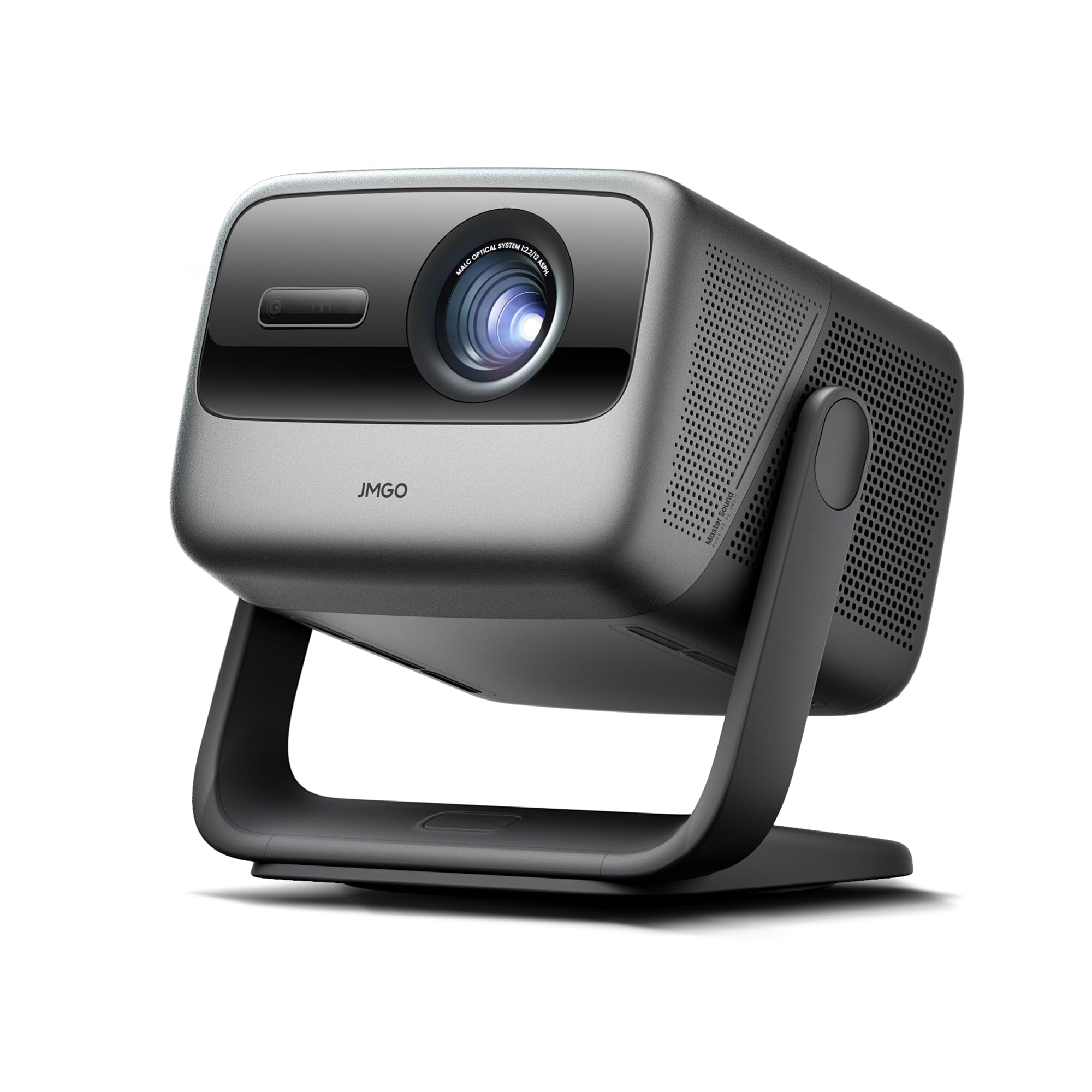
The JMGO N1S Ultra is the most complete 360-degree projector package available today. Its integrated gimbal allows 360° horizontal pan and 135° vertical tilt — enough to project onto a ceiling or a high wall from a coffee table — while the 2,800 ISO lumens triple laser engine delivers bright, accurate HDR10 and Dolby Digital Plus content even in rooms with ambient light. The 4K resolution with 1600:1 FOFO contrast produces deep blacks and vivid colors that rival professional-grade home theater projectors several times the price.
One of the standout features is the sensorless picture correction system. Using a 3D TOF sensor and CMOS camera, the N1S Ultra automatically adjusts keystone, focus, and screen fit in real-time as you rotate the gimbal. This means you can go from floor-level wall projection to ceiling movie mode in seconds without touching a single menu. The built-in Google TV provides access to 10,000+ apps, including Netflix, Prime Video, and Disney+, with Chromecast built-in for casting from any device.
The 20W dual speakers with Dolby Digital Plus offer decent built-in audio, though for a fully cinematic experience, pairing with an external soundbar is recommended. The unit’s packaging doubles as a carrying case, making it genuinely portable for backyard or camping setups. The only minor compromise is a slightly sluggish Google TV UI compared to dedicated streaming boxes, but the image quality and mechanical flexibility more than compensate.
Why it’s great
- Exceptional triple-laser brightness and color accuracy for angled projection
- 360° gimbal with sensorless auto correction makes ceiling projection effortless
- Built-in Google TV with voice control eliminates the need for external streaming devices
Good to know
- User interface can feel sluggish compared to dedicated streaming hardware
- Built-in speakers are decent but benefit from an external sound system
2. JMGO N1 Ultra 4K Triple Laser Projector

The original N1 Ultra set the benchmark for the 360-degree gimbal projector category, and it remains a compelling choice if you can find it at a discount vs. the N1S Ultra. Its 1,900 ISO lumens triple laser engine with 110% BT.2020 gamut coverage delivers rich, lifelike colors that approach OLED-level saturation. The built-in Dynaudio 10W×2 speakers with 45Hz bass are noticeably better than most projector audio systems, providing an immersive soundstage without requiring external speakers.
The mechanical gimbal is identical in design to the newer model, allowing 360° horizontal rotation and 135° vertical tilt with a satisfyingly smooth damped motion. Auto keystone, auto focus, and smart object avoidance all work reliably, and the unit supports Blu-ray 3D and MEMC for smooth motion in high-action content. The Android TV 11.0 interface provides access to Google Play and 5,000+ apps, though Netflix is not pre-installed and requires sideloading or an external streaming stick.
Users consistently praise the N1 Ultra’s sharpness and contrast, with several noting that it rivals much larger and more expensive home theater projectors. The unit is heavier than the N1S Ultra, which affects real portability, but the included EPP carrying bag makes transport manageable. For those who prioritize out-of-the-box audio quality and don’t mind the slightly lower brightness, the N1 Ultra remains a top-tier 360-degree option.
Why it’s great
- Excellent color accuracy and contrast with triple laser optics
- Premium Dynaudio co-created speakers with genuine bass extension
- Smooth 360° gimbal with reliable auto-correction and 3D support
Good to know
- Netflix requires sideloading; not pre-installed on Android TV 11
- Heavier than the N1S Ultra; less ideal for frequent movement
3. NEBULA X1 Triple Laser 4K Projector
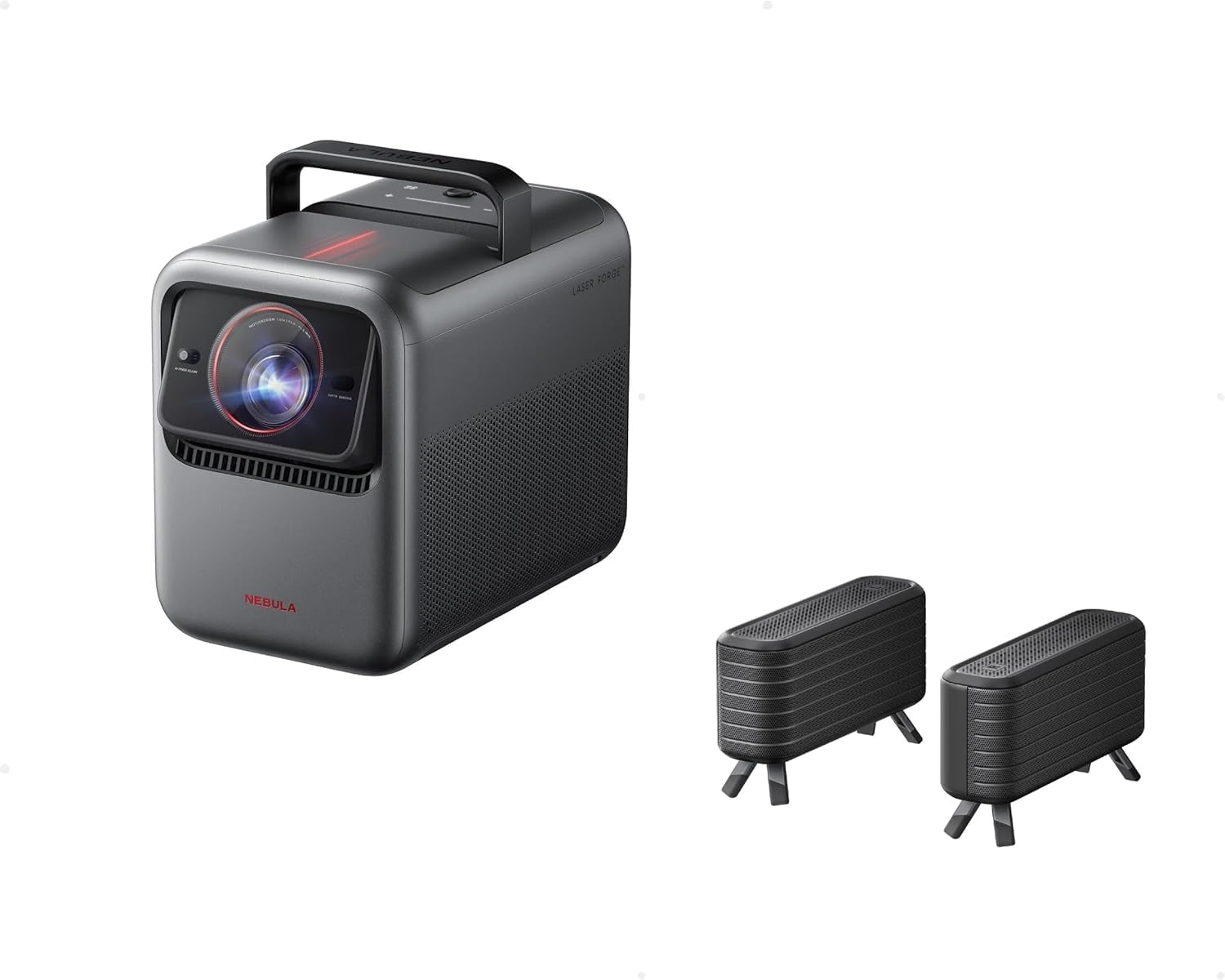
The NEBULA X1 redefines what a 360-degree-capable lifestyle projector can be. Its patented triple-laser optical engine outputs 3,500 ANSI lumens and covers 110% of the Rec. 2020 color space, producing an image that remains vibrant even in a living room with windows open. The 6-blade iris delivers a native contrast ratio of 5,000:1, enhanced by NebulaMaster technology to 56,000:1, providing deep blacks that are rare for a compact laser projector.
Where the X1 truly distinguishes itself is the bundled 200W 4.1.2 surround sound system with two wireless Wi-Fi satellite speakers. The 25ms ultra-low latency wireless link means no audio sync issues, and the 4.1.2 configuration delivers genuine Dolby Atmos immersion. For karaoke nights, a wireless microphone is also supported. The 14-element all-glass lens ensures corner-to-corner sharpness, and the liquid cooling system keeps fan noise below 26 dB, making it one of the quietest high-brightness projectors tested.
The main caveat is that the X1 only accepts 60Hz input, which means no 120Hz or 240Hz gaming mode — a notable limitation for competitive gamers. Additionally, the remote control lacks a dedicated Input Select button, and the auto-backlight on the remote is motion-activated rather than proximity-based, which can be annoying in a dark room. The first production batch also had some quality control inconsistencies. However, for movie and TV enthusiasts who want a complete audio-visual solution in one box with 360-degree mounting flexibility, the X1 is a showstopper.
Why it’s great
- Industry-leading 3500 ANSI lumens with ultra-high 56,000:1 contrast
- Complete 200W 4.1.2 surround sound system included, no extra speakers needed
- Very quiet operation at under 26 dB, ideal for quiet scenes
Good to know
- Limited to 60Hz input; not suitable for high-refresh-rate gaming
- Quality control inconsistencies reported across initial production units
4. AWOL VISION Aetherion Max 4K Projector
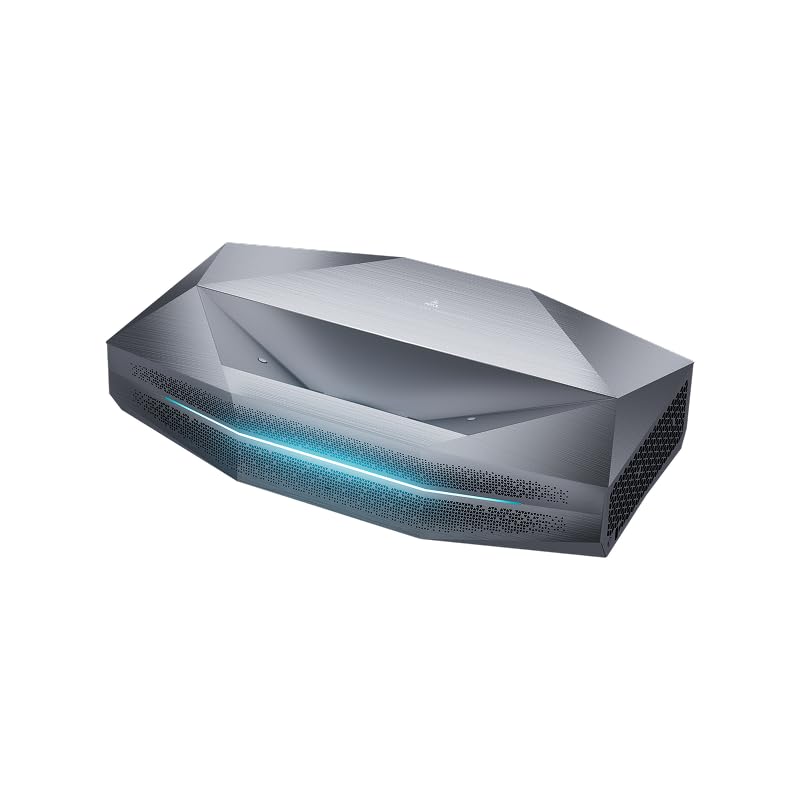
The Aetherion Max is an ultra-short-throw (UST) triple-laser projector designed as a permanent TV replacement. Its 0.2:1 throw ratio means it can sit inches from the wall and produce a 150-inch image, and while it doesn’t have a 360-degree gimbal, its placement flexibility is enormous — you can mount it on a low cabinet and project onto any nearby wall. The 3,300 ISO lumens brightness and 6,000:1 native contrast (up to 60,000:1 viewing contrast via Noirscene System II) deliver a daytime-viewable image that challenges OLED TVs in color saturation and black depth.
The gaming performance is exceptional for a UST projector: 1ms-class input latency at 240Hz, VRR, ALLM, and Dolby Vision Gaming are all supported. The unit includes 3× HDMI 2.1a ports and DisplayPort 1.4a, so you can connect a PS5, Xbox Series X, and gaming PC simultaneously. Anti-RBE technology virtually eliminates rainbow effect artifacts, a common issue with single-chip DLP projectors, making it suitable for sensitive viewers.
The trade-offs are the price and the form factor. At nearly double the cost of the next most expensive option, the Aetherion Max is a serious investment. It is not portable by any definition — it requires a dedicated surface and ideally a compatible ALR screen for best contrast. The built-in speakers are mediocre and require EQ adjustment to sound acceptable. For a dedicated home theater room where you want a living-room-friendly UST with 360-degree orientation mounting options and top-tier gaming specs, the Aetherion Max is the definitive choice.
Why it’s great
- True daytime-viewable brightness with ultra-high contrast
- Industry-leading gaming specs: 1ms latency, 240Hz, VRR, Dolby Vision Gaming
- UST design eliminates ceiling mount, works inches from the wall
Good to know
- Very expensive; nearly double the price of other high-end options
- Built-in speakers are poor; external sound system is required for good audio
5. ViewSonic LX700-4K Laser Projector

The ViewSonic LX700-4K is a 4K laser projector designed for gamers and home theater enthusiasts who need a fixed-installation unit with 360-degree projection capability. It offers 3,500 ANSI lumens, a 3,000,000:1 contrast ratio, and native 4K UHD resolution. The 360-degree orientation feature means it can be mounted on a ceiling, placed upright on a shelf, or even used in portrait mode for video walls — the internal cooling system is designed to work in any orientation without overheating.
For gamers, the LX700-4K is a standout: 240Hz refresh rate at 1080p, 1440p at 120Hz, and an incredibly low 4.2ms input lag. It is officially “Designed for Xbox” certified and supports Dolby Vision as well as HDR10/HLG. The SuperColor technology delivers a wide color gamut, and the 1.36x optical zoom plus H/V keystone with 4-corner adjustment makes installation flexible even in challenging spaces. The auto power on/off feature and Golf Mode (for golf simulator software) add versatility beyond typical home theater use.
The main downsides are the basic built-in speaker (adequate for testing but not for actual viewing) and a known HDMI handshake issue when a receiver is in the chain — some users report HDR flickering through certain AV receivers. The black levels, while good for a laser projector, are not as deep as the best triple-laser options. If you are building a dedicated game room or simulator setup where 360-degree orientation and ultra-low latency matter more than out-of-the-box audio, the LX700-4K is an outstanding choice.
Why it’s great
- Ultra-low 4.2ms input lag and 240Hz for competitive gaming
- 360-degree orientation works in any mount position, including portrait mode
- Certified for Xbox, supports Dolby Vision and HDR10/HLG
Good to know
- Built-in speaker is poor; external audio is required for any serious viewing
- HDMI handshake issues reported with some AV receivers in the chain
6. ViewSonic LS740HD 5500 Lumens Laser Projector
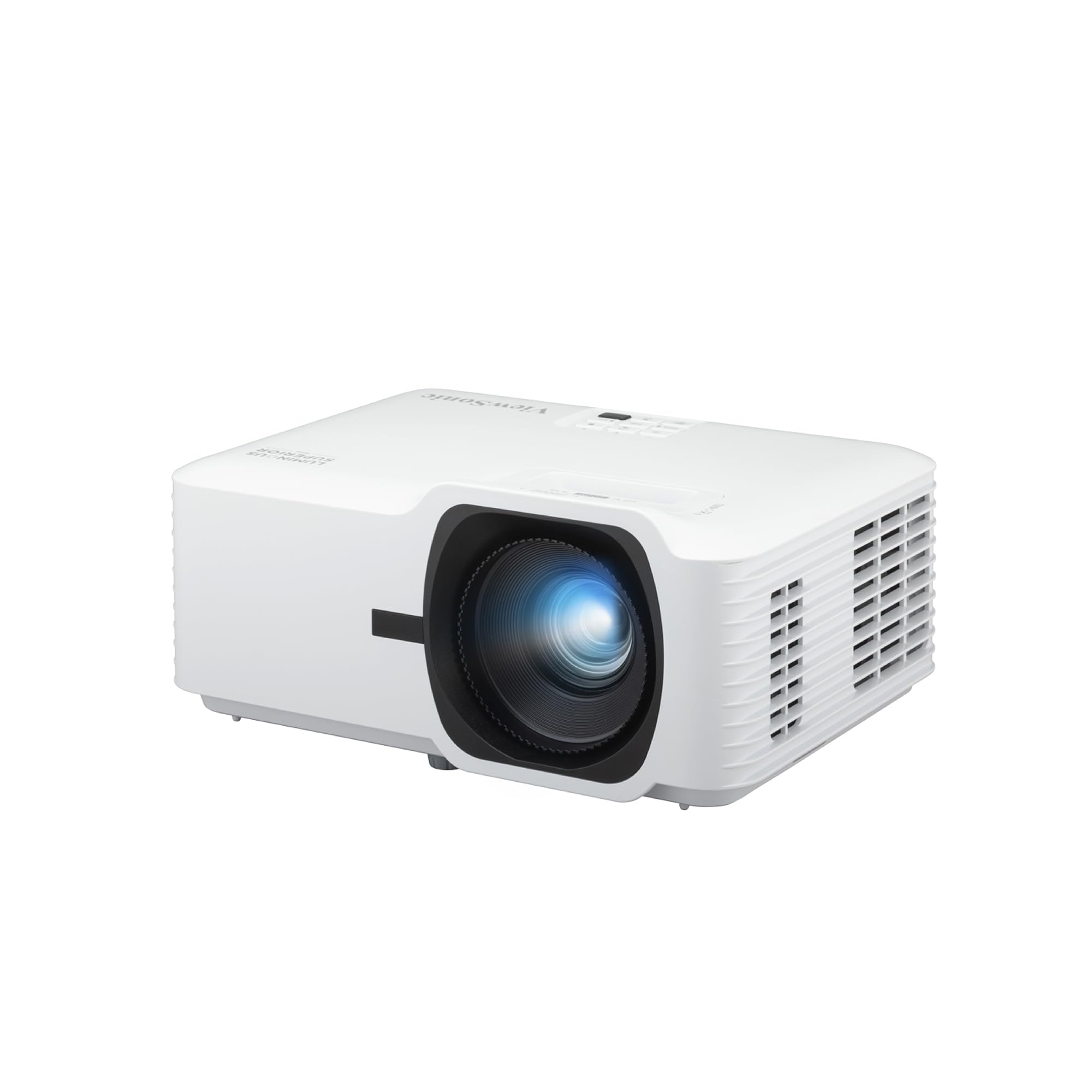
The ViewSonic LS740HD is a commercial-grade FHD laser projector built for environments where brightness and installation flexibility are non-negotiable. At 5,500 ANSI lumens, it is the brightest projector in this lineup by a significant margin — it can easily fill a 200-inch screen in a room with moderate ambient light. The 360-degree projection capability means it can be mounted upside-down, on its side, or at any angle, with the laser light source rated for 30,000 hours of maintenance-free operation.
This projector is ideal for auditoriums, conference rooms, golf simulators, or any fixed installation where image size and throw distance are variable. The 1.3x optical zoom plus digital zoom (0.8x-2.0x) and H/V keystone with 4-corner adjustment make setup straightforward even on irregular surfaces. The “Golf Mode” supports major golf simulator software, and the instant power on/off feature means no cool-down wait time — a significant convenience for commercial use.
The LS740HD is strictly 1080p (not 4K), which may be a dealbreaker for home theater purists. It also lacks built-in smart TV functionality and has no Bluetooth audio output; all connectivity is via HDMI and USB. Some users have reported a random orange flash issue across multiple units, though ViewSonic’s support team is generally responsive in addressing it. For a high-lumen, 360-degree-installable projector used primarily for presentations, simulation, or large-format video, the LS740HD is one of the most cost-effective options at its brightness level.
Why it’s great
- Extremely bright 5500 ANSI lumens suitable for well-lit commercial spaces
- 360-degree orientation and 4-corner adjustment for any mount position
- Long-lasting laser source with 30,000-hour lifespan and instant on/off
Good to know
- Only 1080p resolution; no 4K support
- No smart TV features or Bluetooth audio; basic connectivity only
7. PUTRIMS P66 Smart 4K Projector
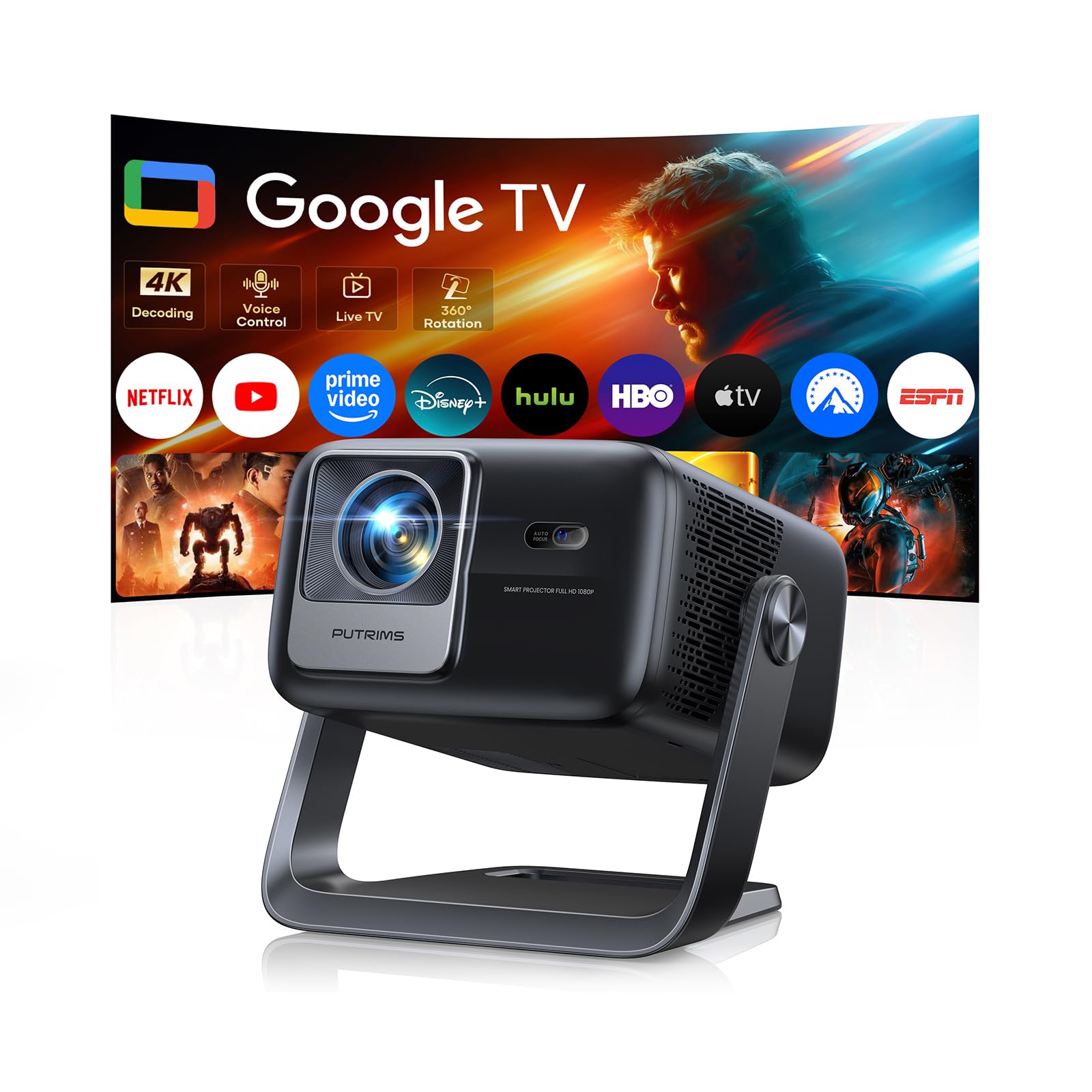
The PUTRIMS P66 is the best mid-range option for anyone who wants a built-in 360° rotatable stand combined with a full smart TV experience. Its integrated gimbal allows you to project onto any wall or ceiling, and the 1.17:1 ultra-short throw ratio means you get a large image from a short distance — perfect for small bedrooms, apartments, or RVs. The native 1080p resolution with 4K decoding and HDR10 support delivers a sharp, vibrant picture, though its 500 ISO-standard ANSI brightness is best suited for dark-room viewing.
The built-in Google TV (with Chromecast) is a major convenience: it provides instant access to 10,000+ apps including Netflix, Prime Video, and Disney+, plus 800+ live TV channels, all controlled by the Google Assistant voice remote. The AI auto-setup system handles auto focus, auto keystone, screen alignment, and obstacle avoidance in seconds. The multi-brightness settings let you adjust from economy to bright mode, and the unit remembers your settings if you keep it in a fixed position — so you can disable auto-correction after the initial adjustment.
The 30W Hi-Fi stereo speakers are significantly better than budget projectors but still lack the bass depth and clarity of dedicated sound systems. Bidirectional Bluetooth 5.3 allows you to connect external speakers or use the projector as a standalone Bluetooth speaker. The P66 also supports WiFi 6 for smooth streaming and has HDMI ARC/CEC ports for easy soundbar integration. If you want the convenience of a 360-degree gimbal and Google TV without spending premium-tier money, the PUTRIMS P66 is the sweet spot.
Why it’s great
- Built-in 360° rotatable stand with ultra-short throw for small spaces
- Full Google TV experience with Chromecast and voice control built-in
- AI auto-setup with auto focus, keystone, obstacle avoidance, and screen fit
Good to know
- 500 ISO ANSI lumens requires a dark room for optimal viewing
- Built-in speakers are decent but lack deep bass
8. AuKing 4K Projector (4000 ANSI)
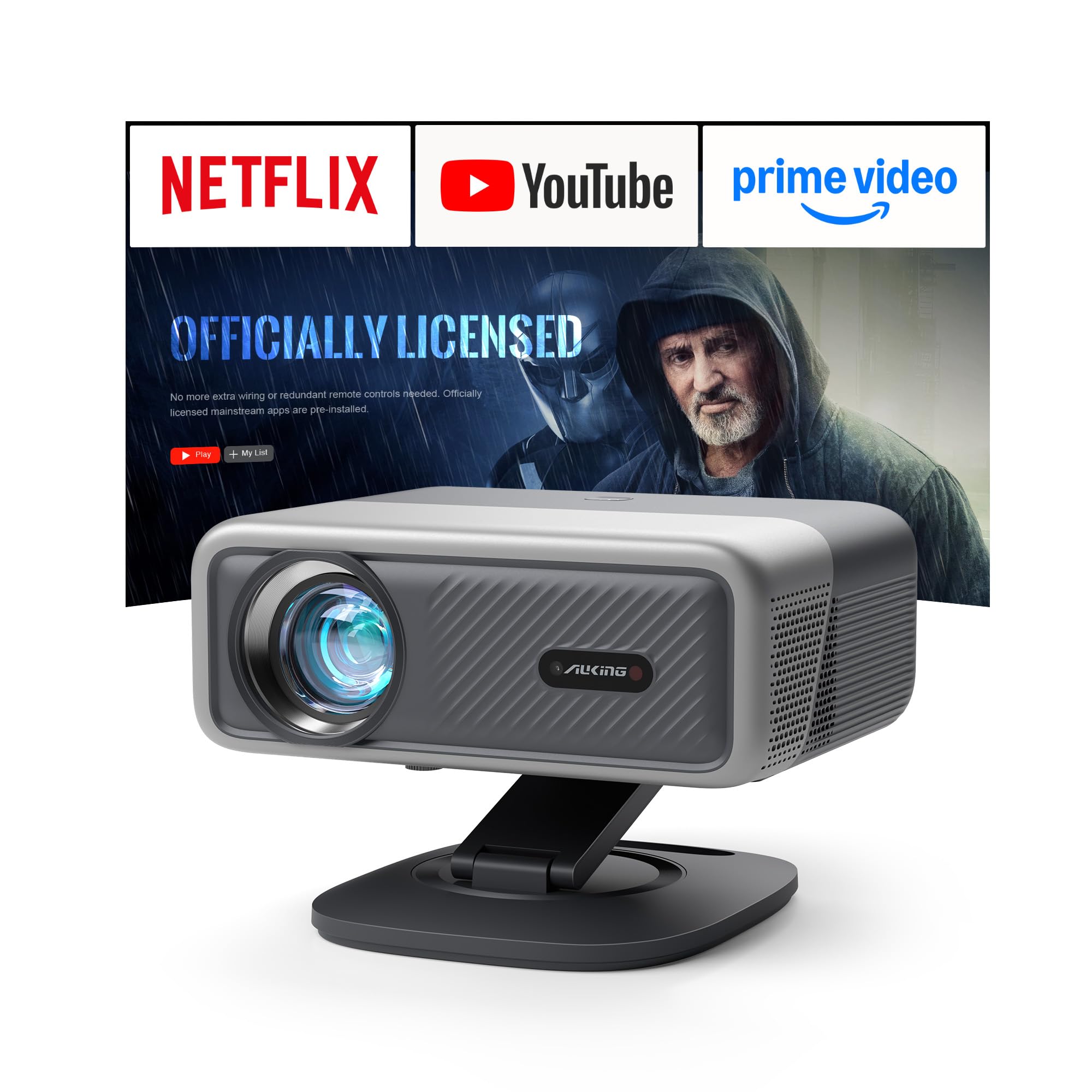
The AuKing 4K projector with 4000 ANSI lumens is a budget-disrupting option that brings surprising brightness and a physical foldable 360° stand to the mid-range space. The claimed 4000 ANSI lumens is extraordinarily high for this price bracket, and while independent measurements suggest real-world output is lower, the unit is genuinely bright enough for daytime living-room use with curtains closed. The HDR10+ and 99.8% wide color gamut produce rich, accurate colors that compete with more expensive projectors.
The foldable, removable stand is a clever design: it offers 360° horizontal rotation and 180° vertical tilt, then collapses flat for storage. This makes it easy to switch between wall, ceiling, and floor projection without tools. The upgraded TOF autofocus system achieves focus in 0.2 seconds, and the auto keystone correction works reliably. The unit runs a Linux-based OS — not Android — which means it boots instantly with no ads or bloatware, but it also means that apps like Netflix and Prime Video are pre-installed rather than being sideloaded, which provides a more stable experience.
The main drawbacks are the fan noise, which is noticeably louder than premium options, and the overall size and weight of the unit — it is larger than most portable projectors. The Linux OS, while fast, offers fewer apps than Google TV. The built-in Dolby Audio speakers are decent for dialogue but lack bass for action movies. For a user who wants a bright, 360-degree-stand-equipped projector with convenient app support and doesn’t mind a bit of fan hum, the AuKing delivers exceptional value.
Why it’s great
- Very high brightness for its price tier, with HDR10+ and wide color gamut
- Foldable 360° stand with TOF laser autofocus in 0.2 seconds
- Pre-installed official apps (Netflix, Prime Video, YouTube) with no sideloading
Good to know
- Fan noise is noticeable and louder than premium models
- Larger and heavier frame reduces true portability
9. HAPPRUN 4K Decoding Projector

The HAPPRUN projector is a well-rounded mid-range option that combines 2,000 ANSI lumens brightness, 4K decoding, and an AI-powered auto adjustment system at an accessible price point. Its 6D auto-keystone and auto focus technology delivers a clear rectangular image within 5 seconds of startup, and the AI auto obstacle avoidance and screen alignment features further reduce setup friction. The 20,000:1 contrast ratio and 95% color gamut produce vivid images with good detail in dark scenes.
Connectivity is comprehensive for this tier: dual HDMI ports, dual USB ports, AV input, 3.5mm headphone jack, and WiFi 6 + Bluetooth 5.2. The WiFi 6 support is notable at this price, enabling stable 4K streaming and wireless screen mirroring. The HAPPRUN supports projection up to 300 inches with a 50% zoom function, giving flexibility in different room sizes. The built-in 8W HiFi speaker is adequate for casual viewing, and the bidirectional Bluetooth 5.2 allows connection to external speakers or using the projector as a standalone Bluetooth speaker.
The auto keystone can be hit-or-miss at extreme angles beyond 15°, and the unit is not bright enough for daytime viewing without dimming the room. The lack of a built-in smart TV OS means you need an external streaming stick for services like Disney+ and Hulu. For a straightforward 360-degree-compatible projector (via its 360° mounting bracket — sold separately) with good brightness and reliable auto features, the HAPPRUN is a safe mid-range pick.
Why it’s great
- 2000 ANSI lumens with 20,000:1 contrast ratio for good image depth
- AI auto obstacle avoidance and screen alignment reduce setup time
- WiFi 6 and dual HDMI/USB ports for flexible connectivity
Good to know
- Auto keystone struggles at extreme angles beyond 15°
- No built-in smart TV OS; an external streaming stick is required for most apps
10. Samsung The Freestyle 2nd Gen

The Samsung Freestyle 2nd Gen is the smallest and most portable projector in this guide, and its 360-degree magic comes from its unique form factor and accompanying 360° sound. It is not a gimbal projector in the traditional sense — instead, its compact cylindrical body fits into a dedicated cradle that allows a full range of tilt, and its 360° sound capability fills the room without requiring physical reorientation of speakers. The image is FHD (1920×1080) with HDR support and a 100,000:1 contrast ratio, delivering a surprisingly sharp and colorful picture for its tiny size.
The Freestyle’s key strength is its portability and ecosystem integration. It runs Samsung’s Tizen smart platform with Gaming Hub, allowing cloud gaming without a console. Voice control via Alexa or Bixby is built-in, and the unit includes adaptive sound and smart calibration for room optimization. However, at only 230 lumens, the Freestyle is severely limited in brightness — it requires a pitch-dark room for a decent image and cannot compete with even entry-level laser projectors in lit environments.
This specific unit is a manufacturer-refurbished 2023 model, which brings a significantly lower price point but also comes with a 90-day warranty rather than the standard one-year. Some users have reported glitchy behavior (YouTube mic icon missing, auto-size/leveling failures) that may be attributed to the refurbished status rather than the base product. If you need the most portable 360-degree-friendly projector for dark-room camping or bedroom ceiling projection and already own Samsung devices, the Freestyle is a unique form factor — but its brightness limitations make it hard to recommend as a primary home theater projector.
Why it’s great
- Extremely compact and portable, fits in a small bag
- 360° sound technology fills the room without directional audio
- Gaming Hub supports cloud gaming without a console
Good to know
- Only 230 lumens — requires pitch-black room for usable image
- Refurbished unit with 90-day warranty; some users report glitchy behavior
11. ONOAYO ONO5Pro 2.0 Smart Projector
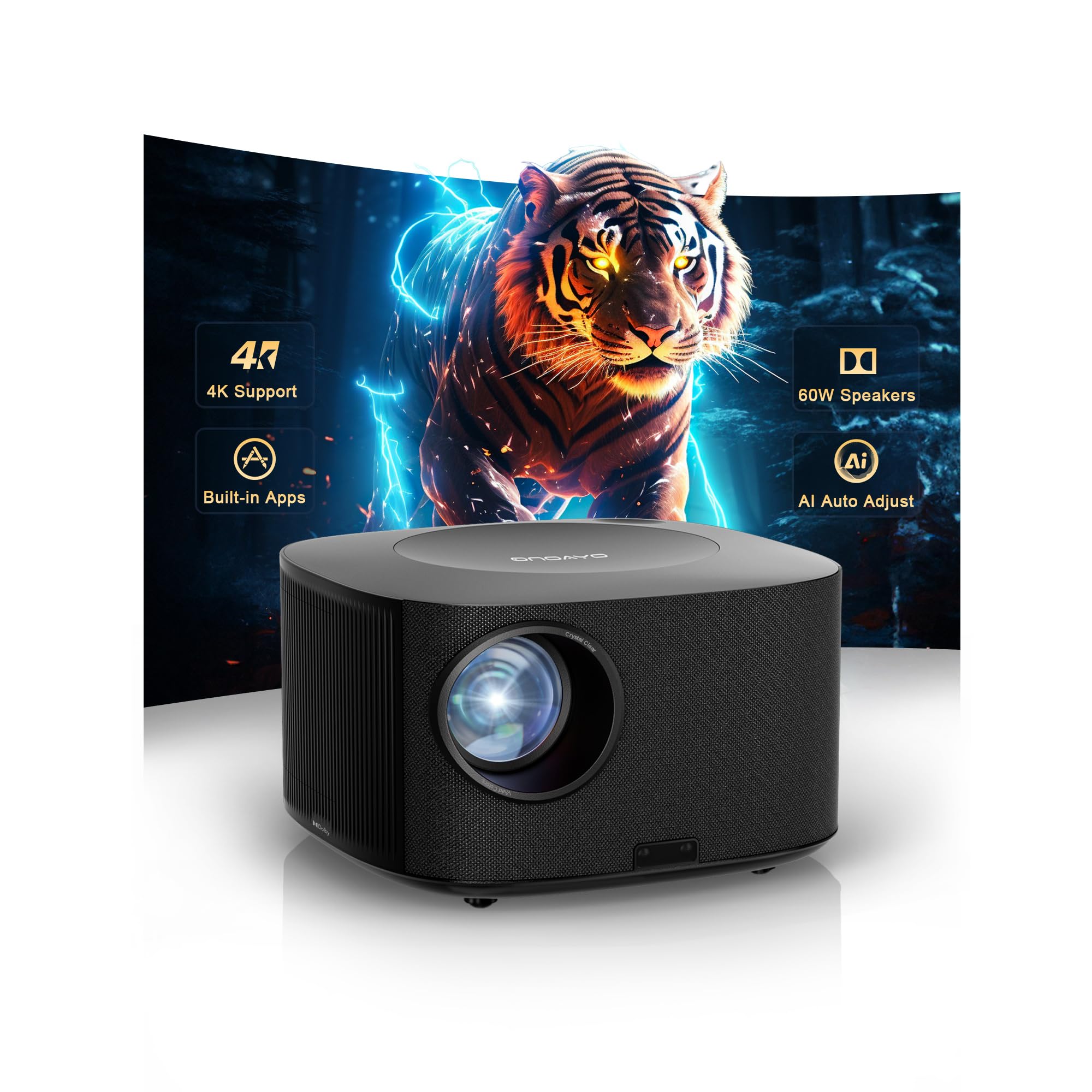
The ONOAYO ONO5Pro 2.0 is the budget-friendly entry point into the 360-degree projector world. While it does not have a built-in physical gimbal, it supports 360-degree mounting orientation and its VisionlQ AI auto calibration system (auto focus, keystone, obstacle avoidance, and screen fit) makes it easy to set up at any angle. The standout feature is the dual 60W Dolby Audio speakers — tuned by Hollywood audio engineers over 800+ hours — which provide loud, clear sound that covers up to 540 sq. ft. without needing external speakers.
The ONO5Pro 2.0 features a 3,500 brightness level (note: this is the manufacturer’s proprietary unit, not ANSI lumens) and supports 4K decoding from a native 1080P display. The Smart TV OS 2.0 provides access to YouTube, Prime Video, and Disney+ with a claimed 1,500+ live TV channels. The unit also includes WiFi 6, Bluetooth 5.2, and a dedicated game mode with 18ms input latency, making it suitable for casual PS5/Xbox gaming. The sealed optical engine is designed to prevent dust ingress and prolong the unit’s lifespan.
The brightness claim is not ANSI-standard, so real-world brightness is significantly lower than the 3,500 number suggests — this unit requires a dark room for best results. The auto focus and keystone work well in most conditions, but the LCD display technology means contrast is limited compared to DLP or laser projectors. The ONO5Pro 2.0 is best viewed as the ultimate budget entry point: it gives you a taste of 360-degree flexibility and Dolby Audio quality without the premium price tag, but serious home theater enthusiasts should look to the higher-tier options on this list.
Why it’s great
- Excellent dual 60W Dolby Audio speakers — best built-in sound in its tier
- AI VisionlQ auto calibration system handles most angles with little manual adjustment
- WiFi 6 and sealed optical engine for reliable streaming and dust resistance
Good to know
- Brightness rating is proprietary, not ANSI standard — requires dark room
- LCD display results in lower contrast compared to DLP or laser options
FAQ
Can I project onto the ceiling with a 360-degree projector?
Does a 360-degree projector require a special screen?
What is the difference between 360-degree projection and ultra-short throw?
Will a 360-degree projector look good in a room with lights on?
Final Thoughts: The Verdict
For most users, the best 360 degree projector winner is the JMGO N1S Ultra 4K because it combines a smooth mechanical gimbal, 2,800 ISO lumens of triple-laser brightness, sensorless auto correction, and built-in Google TV into a genuinely portable package. If you want the best built-in audio and a complete surround-sound system with 360-degree mounting flexibility, grab the NEBULA X1. And for a fixed installation where 4K gaming at 240Hz and 360-degree orientation matter most, nothing beats the ViewSonic LX700-4K.